Chemically Resistant Fibers
Introduction
 Chemically Resistant Fibers are used in environments where resistance
to hostile chemical is required.
Chemical inertness is the key requirement of these fibers.
Because chemical reactions have rates that increase with temperature,
the main application areas will be those where the combined effects of
heat and reactive chemical agencies operate, such as in wet and dry
filtration.
Longer term durability to less corrosive environments is demanded in
the geotextile and geomembrane sectors, where ambient conditions
prevail.



Chemically Resistant Fibers
Introduction
 The chemical resistance is obtained by one or more of following
characteristics:
 Strong chemical bonds
 Absence of aliphatic chain replaceable hydrogen atoms ( PE and PP
not stable to oxidizing agents at T > 50 °C
 Absence of reactive side groups
 Backbone free of hydrolysable groups
 These polymers are based on chemically stable structures formed by:
 Halogenated polymers
 Polymers containing aromatic structures
Chemically Resistant Fibers
These are used in certain applications where chemical
resistance at high temperature is a
 Hot gas and liquid filtration fabrics
 Braiding materials in chemical plants
 Gaskets
 Protective textiles
 Conveyer belts
 High performance sewing threads
 Wet and dry filtration
 Geotextile and geomembrane sectors
requirement such as:
 Protective clothing requiring specific chemical resistance
Chemically Resistant Fibers
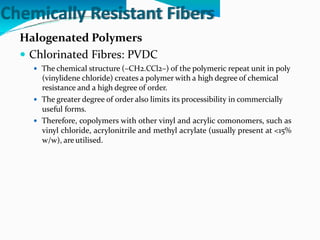
Halogenated Polymers
 Chlorinated Fibres: PVDC
 The chemical structure (–CH2.CCl2–) of the polymeric repeat unit in poly
(vinylidene chloride) creates a polymer with a high degree of chemical
resistance and a high degree of order.
 The greater degree of order also limits its processibility in commercially
useful forms.
 Therefore, copolymers with other vinyl and acrylic comonomers, such as
vinyl chloride, acrylonitrile and methyl acrylate (usually present at <15%
w/w), are utilised.
Chemically Resistant Fibers
Halogenated Polymers
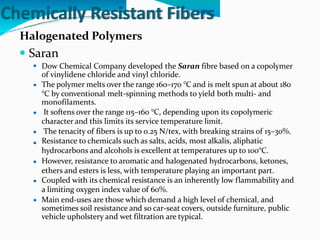
 Saran
Dow Chemical Company developed the Saran fibre based on a copolymer
of vinylidene chloride and vinyl chloride.
The polymer melts over the range 160–170 °C and is melt spun at about 180
°C by conventional melt-spinning methods to yield both multi- and
monofilaments.
It softens over the range 115–160 °C, depending upon its copolymeric
character and this limits its service temperature limit.
The tenacity of fibers is up to 0.25 N/tex, with breaking strains of 15–30%.
Resistance to chemicals such as salts, acids, most alkalis, aliphatic
hydrocarbons and alcohols is excellent at temperatures up to 100°C.
However, resistance to aromatic and halogenated hydrocarbons, ketones,
ethers and esters is less, with temperature playing an important part.
Coupled with its chemical resistance is an inherently low flammability and
a limiting oxygen index value of 60%.
Main end-uses are those which demand a high level of chemical, and
sometimes soil resistance and so car-seat covers, outside furniture, public
vehicle upholstery and wet filtration are typical.








Chemically Resistant Fibers
Halogenated Polymers
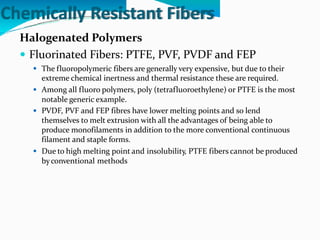
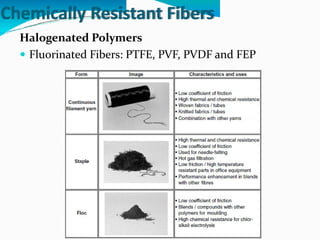
 Fluorinated Fibers: PTFE, PVF, PVDF and FEP
The fluoropolymeric fibers are generally very expensive, but due to their
extreme chemical inertness and thermal resistance these are required.
Among all fluoro polymers, poly (tetrafluoroethylene) or PTFE is the most
notable generic example.
PVDF, PVF and FEP fibres have lower melting points and so lend
themselves to melt extrusion with all the advantages of being able to
produce monofilaments in addition to the more conventional continuous
filament and staple forms.
Due to high melting point and insolubility, PTFE fibers cannot be produced
byconventional methods




Chemically Resistant Fibers
Halogenated Polymers
 Fluorinated Fibers: PTFE,
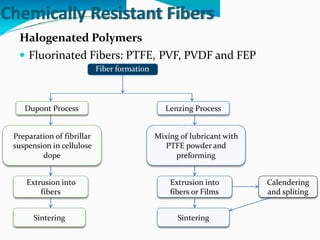
Fiber formation
PVF, PVDF and FEP
Dupont Process Lenzing Process
Preparation of fibrillar
suspension in cellulose
dope
Mixing of lubricant with
PTFE powder and
preforming
Extrusion into
fibers
Extrusion into
fibers or Films
Calendering
and spliting
Sintering Sintering
Chemically Resistant Fibers
Halogenated Polymers
 Fluorinated Fibers: PTFE, PVF, PVDF and FEP
Chemically Resistant Fibers
Halogenated Polymers
 Fluorinated Fibers: PTFE, PVF, PVDF and FEP
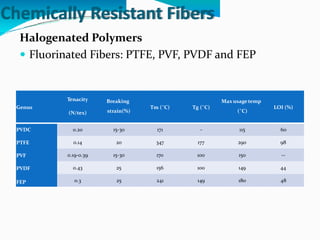
Genus Tm (˚C) Tg (˚C) LOI (%)
Tenacity Breaking Max usagetemp
(N/tex) strain(%) (˚C)
PVDC
PTFE
PVF
PVDF
FEP
0.20 15-30 171 - 115 60
0.14 20 347 177 290 98
0.19-0.39 15-30 170 100 150 --
0.43 25 156 100 149 44
0.3 25 241 149 180 48
Chemically Resistant Fibers
Halogenated Polymers
 Fluorinated Fibers: PTFE, PVF, PVDF and FEP
 All PTFE fibres and yarns show excellent thermal properties in terms of
shrinkage, and maximum service exposure temperatures result from their
wholly fluorinated (–CF2.CF2–) and extremely ordered polymer chains
 C-F is very inert and highly polar which ensure strong intermolecular
forces.
 Resistance to the combined effects of temperature and chemical action is a
combination of the inherent stability and inert nature of the polymer
chain, coupled with the efficiency of intermolecular forces and chain order.
Chemically Resistant Fibers
Chemically Resistant Fibers based on aromatic ring
containing polymers
 The presence of aromatic groups within the polymeric chains bonded
together by relatively inert groups is another category resulting in good
chemical resistance.
 Someexamples are: Poly (etheretherketones) (PEEK), poly (phenylene
oxide) (PPO) and poly (phenylene sulphide) (PPS).
Chemically Resistant Fibers
Chemically Resistant Fibers based on aromatic ring
containing polymers
 PEEK
 Chemically, PEEK has a polymer repeat unit of one ketone and two ether
groups. This provides a linear, fully aromatic, highly stable structure
containing only carbon, hydrogen and oxygen atoms
Chemically Resistant Fibers
Chemically Resistant Fibers based
ring containing polymers
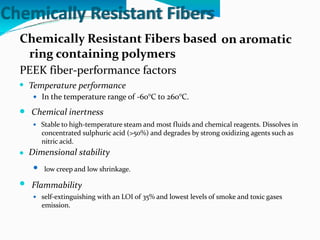
PEEK fiber-performance factors
on aromatic
 Temperature performance
 In the temperature range of -60°C to 260°C.
Chemical inertness
 Stable to high-temperature steam and most fluids and chemical reagents. Dissolves in
concentrated sulphuric acid (>50%) and degrades by strong oxidizing agents such as
nitric acid.
Dimensional stability


 low creep and low shrinkage.
 Flammability
 self-extinguishing with an LOI of 35% and lowest levels of smoke and toxic gases
emission.
Chemically Resistant Fibers
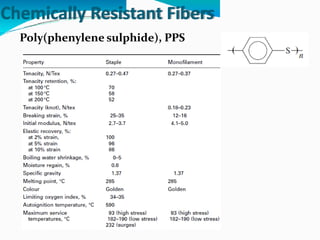
Poly(phenylene sulphide), PPS
Chemically Resistant Fibers
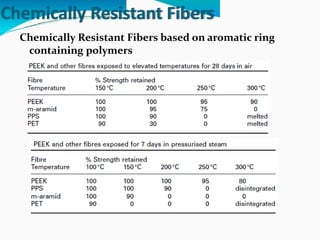
Chemically Resistant Fibers based on aromatic ring
containing polymers
Chemically Resistant Fibers
Chemically Resistant Fibers based on aromatic
ring containing polymers
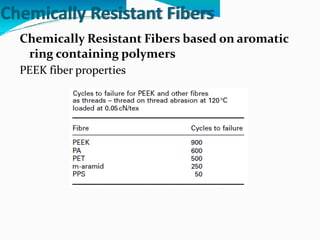
PEEK fiber properties
Chemically Resistant
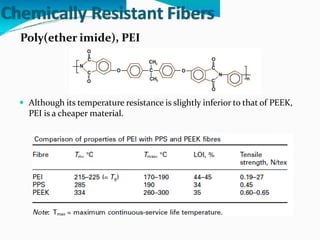
Poly(ether imide), PEI
Fibers
 Although its temperature resistance is slightly inferior to that of PEEK,
PEI is a cheaper material.

6- Chemically Resistant Fibers. pdf

  • 2.
    Chemically Resistant Fibers Introduction Chemically Resistant Fibers are used in environments where resistance to hostile chemical is required. Chemical inertness is the key requirement of these fibers. Because chemical reactions have rates that increase with temperature, the main application areas will be those where the combined effects of heat and reactive chemical agencies operate, such as in wet and dry filtration. Longer term durability to less corrosive environments is demanded in the geotextile and geomembrane sectors, where ambient conditions prevail.   
  • 3.
    Chemically Resistant Fibers Introduction The chemical resistance is obtained by one or more of following characteristics:  Strong chemical bonds  Absence of aliphatic chain replaceable hydrogen atoms ( PE and PP not stable to oxidizing agents at T > 50 °C  Absence of reactive side groups  Backbone free of hydrolysable groups  These polymers are based on chemically stable structures formed by:  Halogenated polymers  Polymers containing aromatic structures
  • 4.
    Chemically Resistant Fibers Theseare used in certain applications where chemical resistance at high temperature is a  Hot gas and liquid filtration fabrics  Braiding materials in chemical plants  Gaskets  Protective textiles  Conveyer belts  High performance sewing threads  Wet and dry filtration  Geotextile and geomembrane sectors requirement such as:  Protective clothing requiring specific chemical resistance
  • 5.
    Chemically Resistant Fibers HalogenatedPolymers  Chlorinated Fibres: PVDC  The chemical structure (–CH2.CCl2–) of the polymeric repeat unit in poly (vinylidene chloride) creates a polymer with a high degree of chemical resistance and a high degree of order.  The greater degree of order also limits its processibility in commercially useful forms.  Therefore, copolymers with other vinyl and acrylic comonomers, such as vinyl chloride, acrylonitrile and methyl acrylate (usually present at <15% w/w), are utilised.
  • 6.
    Chemically Resistant Fibers HalogenatedPolymers  Saran Dow Chemical Company developed the Saran fibre based on a copolymer of vinylidene chloride and vinyl chloride. The polymer melts over the range 160–170 °C and is melt spun at about 180 °C by conventional melt-spinning methods to yield both multi- and monofilaments. It softens over the range 115–160 °C, depending upon its copolymeric character and this limits its service temperature limit. The tenacity of fibers is up to 0.25 N/tex, with breaking strains of 15–30%. Resistance to chemicals such as salts, acids, most alkalis, aliphatic hydrocarbons and alcohols is excellent at temperatures up to 100°C. However, resistance to aromatic and halogenated hydrocarbons, ketones, ethers and esters is less, with temperature playing an important part. Coupled with its chemical resistance is an inherently low flammability and a limiting oxygen index value of 60%. Main end-uses are those which demand a high level of chemical, and sometimes soil resistance and so car-seat covers, outside furniture, public vehicle upholstery and wet filtration are typical.        
  • 7.
    Chemically Resistant Fibers HalogenatedPolymers  Fluorinated Fibers: PTFE, PVF, PVDF and FEP The fluoropolymeric fibers are generally very expensive, but due to their extreme chemical inertness and thermal resistance these are required. Among all fluoro polymers, poly (tetrafluoroethylene) or PTFE is the most notable generic example. PVDF, PVF and FEP fibres have lower melting points and so lend themselves to melt extrusion with all the advantages of being able to produce monofilaments in addition to the more conventional continuous filament and staple forms. Due to high melting point and insolubility, PTFE fibers cannot be produced byconventional methods    
  • 8.
    Chemically Resistant Fibers HalogenatedPolymers  Fluorinated Fibers: PTFE, Fiber formation PVF, PVDF and FEP Dupont Process Lenzing Process Preparation of fibrillar suspension in cellulose dope Mixing of lubricant with PTFE powder and preforming Extrusion into fibers Extrusion into fibers or Films Calendering and spliting Sintering Sintering
  • 9.
    Chemically Resistant Fibers HalogenatedPolymers  Fluorinated Fibers: PTFE, PVF, PVDF and FEP
  • 10.
    Chemically Resistant Fibers HalogenatedPolymers  Fluorinated Fibers: PTFE, PVF, PVDF and FEP Genus Tm (˚C) Tg (˚C) LOI (%) Tenacity Breaking Max usagetemp (N/tex) strain(%) (˚C) PVDC PTFE PVF PVDF FEP 0.20 15-30 171 - 115 60 0.14 20 347 177 290 98 0.19-0.39 15-30 170 100 150 -- 0.43 25 156 100 149 44 0.3 25 241 149 180 48
  • 11.
    Chemically Resistant Fibers HalogenatedPolymers  Fluorinated Fibers: PTFE, PVF, PVDF and FEP  All PTFE fibres and yarns show excellent thermal properties in terms of shrinkage, and maximum service exposure temperatures result from their wholly fluorinated (–CF2.CF2–) and extremely ordered polymer chains  C-F is very inert and highly polar which ensure strong intermolecular forces.  Resistance to the combined effects of temperature and chemical action is a combination of the inherent stability and inert nature of the polymer chain, coupled with the efficiency of intermolecular forces and chain order.
  • 12.
    Chemically Resistant Fibers ChemicallyResistant Fibers based on aromatic ring containing polymers  The presence of aromatic groups within the polymeric chains bonded together by relatively inert groups is another category resulting in good chemical resistance.  Someexamples are: Poly (etheretherketones) (PEEK), poly (phenylene oxide) (PPO) and poly (phenylene sulphide) (PPS).
  • 13.
    Chemically Resistant Fibers ChemicallyResistant Fibers based on aromatic ring containing polymers  PEEK  Chemically, PEEK has a polymer repeat unit of one ketone and two ether groups. This provides a linear, fully aromatic, highly stable structure containing only carbon, hydrogen and oxygen atoms
  • 14.
    Chemically Resistant Fibers ChemicallyResistant Fibers based ring containing polymers PEEK fiber-performance factors on aromatic  Temperature performance  In the temperature range of -60°C to 260°C. Chemical inertness  Stable to high-temperature steam and most fluids and chemical reagents. Dissolves in concentrated sulphuric acid (>50%) and degrades by strong oxidizing agents such as nitric acid. Dimensional stability    low creep and low shrinkage.  Flammability  self-extinguishing with an LOI of 35% and lowest levels of smoke and toxic gases emission.
  • 15.
  • 16.
    Chemically Resistant Fibers ChemicallyResistant Fibers based on aromatic ring containing polymers
  • 17.
    Chemically Resistant Fibers ChemicallyResistant Fibers based on aromatic ring containing polymers PEEK fiber properties
  • 18.
    Chemically Resistant Poly(ether imide),PEI Fibers  Although its temperature resistance is slightly inferior to that of PEEK, PEI is a cheaper material.