Presented by:
Dr.Amira Al Raidan
Director for Health education & awareness programs
Head of mental health department
Sultanate Of Oman
Ministry Of Health
Primary Health Care
The scope of this presentation,,,
 Discuss the concept of high-alert medications.
 Identify the many drug classes considered to be high-alert
status.
 Demonstrated case-scenarios.
 Describe various strategies for safeguarding (monitoring),
the use of high-alert medications.
 High-alert medications:
Are drugs that bear a heightened risk of causing
significant patient harm when used in error.
 Errors may not be more common with these than
with other medications, but the consequences of
errors may be devastating.
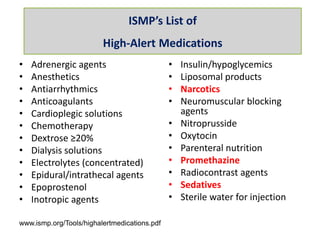
• Adrenergic agents
• Anesthetics
• Antiarrhythmics
• Anticoagulants
• Cardioplegic solutions
• Chemotherapy
• Dextrose ≥20%
• Dialysis solutions
• Electrolytes (concentrated)
• Epidural/intrathecal agents
• Epoprostenol
• Inotropic agents
• Insulin/hypoglycemics
• Liposomal products
• Narcotics
• Neuromuscular blocking
agents
• Nitroprusside
• Oxytocin
• Parenteral nutrition
• Promethazine
• Radiocontrast agents
• Sedatives
• Sterile water for injection
www.ismp.org/Tools/highalertmedications.pdf
ISMP’s List of
High-Alert Medications
1- Insulin.
2- Opiate and Narcotics.
3- Injectable Potassium chloride or phosphate.
4- Injectable Anticoagulant.
5- Sodium chloride solution above 0.9%.
The top five high-alert medications
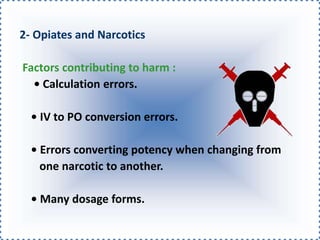
2- Opiates and Narcotics
Factors contributing to harm :
• Calculation errors.
• IV to PO conversion errors.
• Errors converting potency when changing from
one narcotic to another.
• Many dosage forms.
- Parenteral narcotics stored in nursing areas as
floor stock.
- Confusion between hydromorphone and morphine.
- Patient-controlled analgesia (PCA) errors
regarding concentration and rate.
• Adverse effets:
- Respiratory depression
- Confusion
- Lethargy
Cont..
Case scenario-1
A 27 years old Omani gentleman, married with two
kids, working as heavy driver at private sector.
Frequently visiting different health centers with
similar complaint of multiple joint pain, generalized
weakness, blurred vision and poor sleep + appetite.
Each time he comes to A&E, he is screaming he is in
pain & rolling on the floor.
Case scenario-2
A 33 years old Omani gentleman, single, studying at
college. Brought unconscious, forearm multiple cut
wounds. Unstable vitals. As attendant stated patient
was unsell… looks in pain but refuse to talk….stay at
his room. 3 days back patient behaved strangely as
being aggressive, paranoid, awake all the night &
refuse to eat.
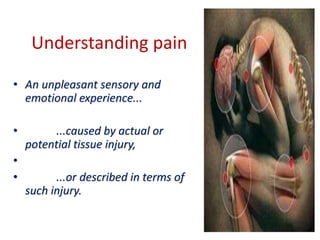
Understanding pain
• An unpleasant sensory and
emotional experience...
• ...caused by actual or
potential tissue injury,
•
• ...or described in terms of
such injury.
To improve:-
• Comfort.
• Function.
• Safety.
• Prevention of expected side effects of opioids use.
Goals of pain management
• General assessment
• Management / Intervention
• Reassessment
Principles of pain management
• Cause of pain.
• The location of pain.
• The characteristic of pain.
• The severity and intensity of pain.
• Duration of pain.
• The impact of quality of life.
• Medication-current and previous analgesics.
• Any relieving factors.
Considerations in pain treatment
Healthcare Professionals Barriers:
1. Fail to routinely assess and document pain.
2. Lack of knowledge and skills.
3. Lack of effective treatment protocols.
4. Fears from side effects of opioids & addiction
Barriers to Effective Pain Management
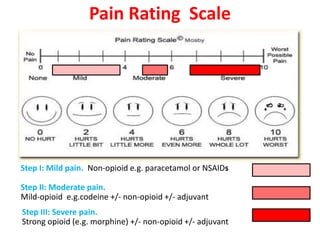
Pain Rating Scale
Step I: Mild pain. Non-opioid e.g. paracetamol or NSAIDs
Step II: Moderate pain.
Mild-opioid e.g.codeine +/- non-opioid +/- adjuvant
Step III: Severe pain.
Strong opioid (e.g. morphine) +/- non-opioid +/- adjuvant
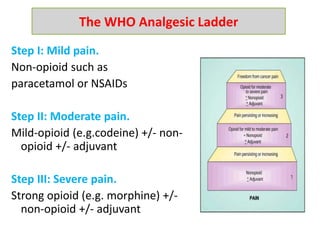
Step I: Mild pain.
Non-opioid such as
paracetamol or NSAIDs
Step II: Moderate pain.
Mild-opioid (e.g.codeine) +/- non-
opioid +/- adjuvant
Step III: Severe pain.
Strong opioid (e.g. morphine) +/-
non-opioid +/- adjuvant
The WHO Analgesic Ladder
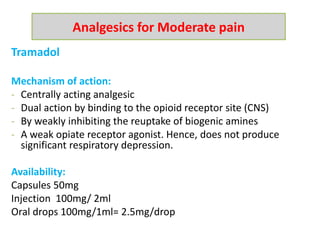
Tramadol
Mechanism of action:
- Centrally acting analgesic
- Dual action by binding to the opioid receptor site (CNS)
- By weakly inhibiting the reuptake of biogenic amines
- A weak opiate receptor agonist. Hence, does not produce
significant respiratory depression.
Availability:
Capsules 50mg
Injection 100mg/ 2ml
Oral drops 100mg/1ml= 2.5mg/drop
Analgesics for Moderate pain
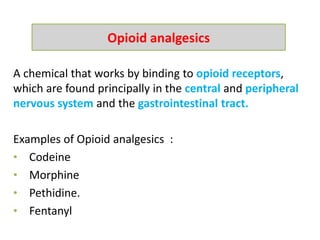
A chemical that works by binding to opioid receptors,
which are found principally in the central and peripheral
nervous system and the gastrointestinal tract.
Examples of Opioid analgesics :
• Codeine
• Morphine
• Pethidine.
• Fentanyl
Opioid analgesics
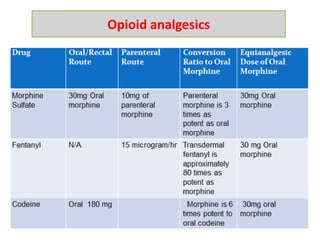
Opioid analgesics
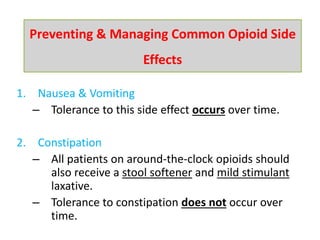
1. Nausea & Vomiting
– Tolerance to this side effect occurs over time.
2. Constipation
– All patients on around-the-clock opioids should
also receive a stool softener and mild stimulant
laxative.
– Tolerance to constipation does not occur over
time.
Preventing & Managing Common Opioid Side
Effects
3. Pruritus
 May be treated with antihistamine
(e.g.chlorphinramine).
 Tolerance occurs over time.
4. Sedation & Respiratory Depression
 Consider giving a lower opioid dose more frequently
to decrease peak serum concentrations.
 Tolerance to this side effect occurs over time.
 Naloxone (toxicity management)
Preventing & Managing Common Opioid Side
Effects
• Antidote – naloxone
• MOA: Pure opioid antagonist competes & displaces
narcotics at opioid receptor sites
• I.V. (preferred), I.M., intratracheal, SubQ: 0.4-2 mg
every 2-3 minutes as needed
• Lower doses in opiate dependence
• Elimination half-life of naloxone is only 60 to 90
minutes
• Repeated administration/infusion may be necessary
• S/E: BP changes; arrhythmias; seizures; withdrawal
Opiates
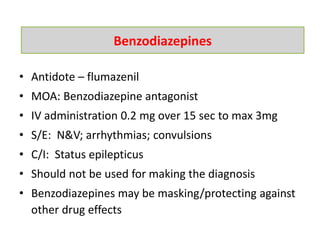
• Antidote – flumazenil
• MOA: Benzodiazepine antagonist
• IV administration 0.2 mg over 15 sec to max 3mg
• S/E: N&V; arrhythmias; convulsions
• C/I: Status epilepticus
• Should not be used for making the diagnosis
• Benzodiazepines may be masking/protecting against
other drug effects
Benzodiazepines
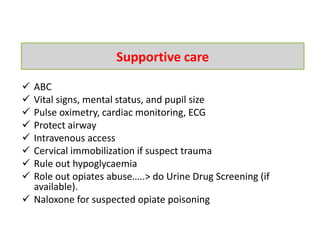
 ABC
 Vital signs, mental status, and pupil size
 Pulse oximetry, cardiac monitoring, ECG
 Protect airway
 Intravenous access
 Cervical immobilization if suspect trauma
 Rule out hypoglycaemia
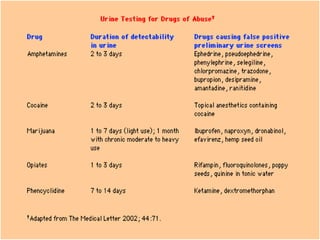
 Role out opiates abuse…..> do Urine Drug Screening (if
available).
 Naloxone for suspected opiate poisoning
Supportive care
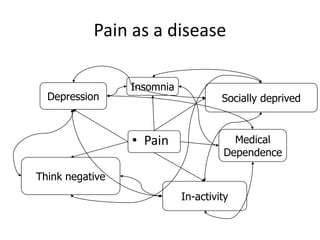
Pain as a disease
• Pain
Depression
Think negative
In-activity
Medical
Dependence
Insomnia
Socially deprived
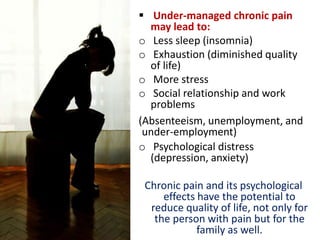
 Under-managed chronic pain
may lead to:
o Less sleep (insomnia)
o Exhaustion (diminished quality
of life)
o More stress
o Social relationship and work
problems
(Absenteeism, unemployment, and
under-employment)
o Psychological distress
(depression, anxiety)
Chronic pain and its psychological
effects have the potential to
reduce quality of life, not only for
the person with pain but for the
family as well.
• So ,,,
• it is important to be able to intervene in
this cycle to improve pain management
and psychological welfare.
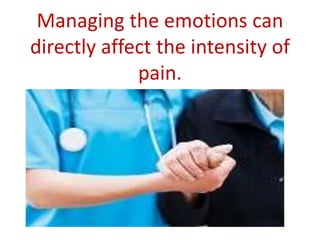
Managing the emotions can
directly affect the intensity of
pain.
Framework for Safeguarding
High-Alert Medication Use
• Reduce or eliminate the possibility of errors.
• Make errors visible.
• Minimize the consequences of errors.
Primary Principles
• Simplify:
– Reduce steps and number of options.
• Externalize or centralize error-prone processes,
i.e: I.V preparations…. For example:
 Use commercially prepared premixed products
- Premixed magnesium sulfate, heparin, etc.
 Centralize preparation of IV solutions
- Prepare pediatric IV medications in pharmacy
• Differentiate items:
– Appearance, location
– Touch, color, smell, etc.
Key Concepts in Safeguarding High-Alert
Medications
• Standardize:
– Communication and dosing methods.
• Redundancy (System of independent checks ):
– Is the Probability that two individuals will make the same error
is small; therefore, having one person check the work of
another is essential.
– Check systems, back-ups (Match high-alert drug orders to the
patient’s diagnosis, the drug’s indication, and vital patient
information)
For example:
Calculations for pediatric patients, select high-alert
medications, etc., performed independently by at least two
individuals, with identical conclusions.
Key Concepts in Safeguarding
High-Alert Medications (continued)
• Reminders.
• Improve access to information (i.e computerized
drug information resources (handheld).
• Constraints that limit access or use in risky situations
(Reduce access to dangerous items by careful
selection of medications and quantities in storage).
• Protocols, checklists, visual and audible alarms.
• Patient monitoring.
Key Concepts in Safeguarding
High-Alert Medications (continued)
Summary,,,
• Develop policies regarding the use of high-alert drugs.
• Assess and implement storage requirements of high-
alert drugs.
• Develop and institute standardized order sets.
• Ensure the process of evaluating potential formulary
additions identifies high-alert medications.
Implement a Safety Checklist for High-Alert
Drugs
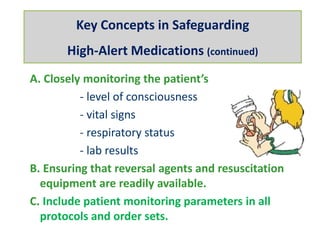
A. Closely monitoring the patient’s
- level of consciousness
- vital signs
- respiratory status
- lab results
B. Ensuring that reversal agents and resuscitation
equipment are readily available.
C. Include patient monitoring parameters in all
protocols and order sets.
Key Concepts in Safeguarding
High-Alert Medications (continued)
 Institute for Safe Medication Practices. ISMP’s list of high-
alert medications. ISMP Medication Safety Alert! March 27,
2008;13(6).
 Institute for Safe Medication Practices. Survey on high-
alert medications. Differences between nursing and
pharmacy perspectives revealed. ISMP Medication Safety
Alert! October 16, 2003;8(21).
• http://www.ismp.org/newsletters/acutecare/articl
es/20070517.asp
References
 High Alert Medication
 High Alert Medication

High Alert Medication

  • 1.
    Presented by: Dr.Amira AlRaidan Director for Health education & awareness programs Head of mental health department Sultanate Of Oman Ministry Of Health Primary Health Care
  • 2.
    The scope ofthis presentation,,,  Discuss the concept of high-alert medications.  Identify the many drug classes considered to be high-alert status.  Demonstrated case-scenarios.  Describe various strategies for safeguarding (monitoring), the use of high-alert medications.
  • 4.
     High-alert medications: Aredrugs that bear a heightened risk of causing significant patient harm when used in error.  Errors may not be more common with these than with other medications, but the consequences of errors may be devastating.
  • 5.
    • Adrenergic agents •Anesthetics • Antiarrhythmics • Anticoagulants • Cardioplegic solutions • Chemotherapy • Dextrose ≥20% • Dialysis solutions • Electrolytes (concentrated) • Epidural/intrathecal agents • Epoprostenol • Inotropic agents • Insulin/hypoglycemics • Liposomal products • Narcotics • Neuromuscular blocking agents • Nitroprusside • Oxytocin • Parenteral nutrition • Promethazine • Radiocontrast agents • Sedatives • Sterile water for injection www.ismp.org/Tools/highalertmedications.pdf ISMP’s List of High-Alert Medications
  • 6.
    1- Insulin. 2- Opiateand Narcotics. 3- Injectable Potassium chloride or phosphate. 4- Injectable Anticoagulant. 5- Sodium chloride solution above 0.9%. The top five high-alert medications
  • 7.
    2- Opiates andNarcotics Factors contributing to harm : • Calculation errors. • IV to PO conversion errors. • Errors converting potency when changing from one narcotic to another. • Many dosage forms.
  • 8.
    - Parenteral narcoticsstored in nursing areas as floor stock. - Confusion between hydromorphone and morphine. - Patient-controlled analgesia (PCA) errors regarding concentration and rate. • Adverse effets: - Respiratory depression - Confusion - Lethargy Cont..
  • 9.
    Case scenario-1 A 27years old Omani gentleman, married with two kids, working as heavy driver at private sector. Frequently visiting different health centers with similar complaint of multiple joint pain, generalized weakness, blurred vision and poor sleep + appetite. Each time he comes to A&E, he is screaming he is in pain & rolling on the floor.
  • 10.
    Case scenario-2 A 33years old Omani gentleman, single, studying at college. Brought unconscious, forearm multiple cut wounds. Unstable vitals. As attendant stated patient was unsell… looks in pain but refuse to talk….stay at his room. 3 days back patient behaved strangely as being aggressive, paranoid, awake all the night & refuse to eat.
  • 11.
    Understanding pain • Anunpleasant sensory and emotional experience... • ...caused by actual or potential tissue injury, • • ...or described in terms of such injury.
  • 12.
    To improve:- • Comfort. •Function. • Safety. • Prevention of expected side effects of opioids use. Goals of pain management
  • 13.
    • General assessment •Management / Intervention • Reassessment Principles of pain management
  • 14.
    • Cause ofpain. • The location of pain. • The characteristic of pain. • The severity and intensity of pain. • Duration of pain. • The impact of quality of life. • Medication-current and previous analgesics. • Any relieving factors. Considerations in pain treatment
  • 15.
    Healthcare Professionals Barriers: 1.Fail to routinely assess and document pain. 2. Lack of knowledge and skills. 3. Lack of effective treatment protocols. 4. Fears from side effects of opioids & addiction Barriers to Effective Pain Management
  • 16.
    Pain Rating Scale StepI: Mild pain. Non-opioid e.g. paracetamol or NSAIDs Step II: Moderate pain. Mild-opioid e.g.codeine +/- non-opioid +/- adjuvant Step III: Severe pain. Strong opioid (e.g. morphine) +/- non-opioid +/- adjuvant
  • 17.
    Step I: Mildpain. Non-opioid such as paracetamol or NSAIDs Step II: Moderate pain. Mild-opioid (e.g.codeine) +/- non- opioid +/- adjuvant Step III: Severe pain. Strong opioid (e.g. morphine) +/- non-opioid +/- adjuvant The WHO Analgesic Ladder
  • 18.
    Tramadol Mechanism of action: -Centrally acting analgesic - Dual action by binding to the opioid receptor site (CNS) - By weakly inhibiting the reuptake of biogenic amines - A weak opiate receptor agonist. Hence, does not produce significant respiratory depression. Availability: Capsules 50mg Injection 100mg/ 2ml Oral drops 100mg/1ml= 2.5mg/drop Analgesics for Moderate pain
  • 19.
    A chemical thatworks by binding to opioid receptors, which are found principally in the central and peripheral nervous system and the gastrointestinal tract. Examples of Opioid analgesics : • Codeine • Morphine • Pethidine. • Fentanyl Opioid analgesics
  • 20.
  • 21.
    1. Nausea &Vomiting – Tolerance to this side effect occurs over time. 2. Constipation – All patients on around-the-clock opioids should also receive a stool softener and mild stimulant laxative. – Tolerance to constipation does not occur over time. Preventing & Managing Common Opioid Side Effects
  • 22.
    3. Pruritus  Maybe treated with antihistamine (e.g.chlorphinramine).  Tolerance occurs over time. 4. Sedation & Respiratory Depression  Consider giving a lower opioid dose more frequently to decrease peak serum concentrations.  Tolerance to this side effect occurs over time.  Naloxone (toxicity management) Preventing & Managing Common Opioid Side Effects
  • 23.
    • Antidote –naloxone • MOA: Pure opioid antagonist competes & displaces narcotics at opioid receptor sites • I.V. (preferred), I.M., intratracheal, SubQ: 0.4-2 mg every 2-3 minutes as needed • Lower doses in opiate dependence • Elimination half-life of naloxone is only 60 to 90 minutes • Repeated administration/infusion may be necessary • S/E: BP changes; arrhythmias; seizures; withdrawal Opiates
  • 24.
    • Antidote –flumazenil • MOA: Benzodiazepine antagonist • IV administration 0.2 mg over 15 sec to max 3mg • S/E: N&V; arrhythmias; convulsions • C/I: Status epilepticus • Should not be used for making the diagnosis • Benzodiazepines may be masking/protecting against other drug effects Benzodiazepines
  • 25.
     ABC  Vitalsigns, mental status, and pupil size  Pulse oximetry, cardiac monitoring, ECG  Protect airway  Intravenous access  Cervical immobilization if suspect trauma  Rule out hypoglycaemia  Role out opiates abuse…..> do Urine Drug Screening (if available).  Naloxone for suspected opiate poisoning Supportive care
  • 27.
    Pain as adisease • Pain Depression Think negative In-activity Medical Dependence Insomnia Socially deprived
  • 28.
     Under-managed chronicpain may lead to: o Less sleep (insomnia) o Exhaustion (diminished quality of life) o More stress o Social relationship and work problems (Absenteeism, unemployment, and under-employment) o Psychological distress (depression, anxiety) Chronic pain and its psychological effects have the potential to reduce quality of life, not only for the person with pain but for the family as well.
  • 29.
    • So ,,, •it is important to be able to intervene in this cycle to improve pain management and psychological welfare.
  • 30.
    Managing the emotionscan directly affect the intensity of pain.
  • 31.
  • 32.
    • Reduce oreliminate the possibility of errors. • Make errors visible. • Minimize the consequences of errors. Primary Principles
  • 33.
    • Simplify: – Reducesteps and number of options. • Externalize or centralize error-prone processes, i.e: I.V preparations…. For example:  Use commercially prepared premixed products - Premixed magnesium sulfate, heparin, etc.  Centralize preparation of IV solutions - Prepare pediatric IV medications in pharmacy • Differentiate items: – Appearance, location – Touch, color, smell, etc. Key Concepts in Safeguarding High-Alert Medications
  • 34.
    • Standardize: – Communicationand dosing methods. • Redundancy (System of independent checks ): – Is the Probability that two individuals will make the same error is small; therefore, having one person check the work of another is essential. – Check systems, back-ups (Match high-alert drug orders to the patient’s diagnosis, the drug’s indication, and vital patient information) For example: Calculations for pediatric patients, select high-alert medications, etc., performed independently by at least two individuals, with identical conclusions. Key Concepts in Safeguarding High-Alert Medications (continued)
  • 35.
    • Reminders. • Improveaccess to information (i.e computerized drug information resources (handheld). • Constraints that limit access or use in risky situations (Reduce access to dangerous items by careful selection of medications and quantities in storage). • Protocols, checklists, visual and audible alarms. • Patient monitoring. Key Concepts in Safeguarding High-Alert Medications (continued)
  • 36.
  • 37.
    • Develop policiesregarding the use of high-alert drugs. • Assess and implement storage requirements of high- alert drugs. • Develop and institute standardized order sets. • Ensure the process of evaluating potential formulary additions identifies high-alert medications. Implement a Safety Checklist for High-Alert Drugs
  • 38.
    A. Closely monitoringthe patient’s - level of consciousness - vital signs - respiratory status - lab results B. Ensuring that reversal agents and resuscitation equipment are readily available. C. Include patient monitoring parameters in all protocols and order sets. Key Concepts in Safeguarding High-Alert Medications (continued)
  • 39.
     Institute forSafe Medication Practices. ISMP’s list of high- alert medications. ISMP Medication Safety Alert! March 27, 2008;13(6).  Institute for Safe Medication Practices. Survey on high- alert medications. Differences between nursing and pharmacy perspectives revealed. ISMP Medication Safety Alert! October 16, 2003;8(21). • http://www.ismp.org/newsletters/acutecare/articl es/20070517.asp References