CASE PRESENTATION
Fadhila Al-Busaidi
CASE 1
 30yrs female presented with burning during passing urine
.
 No frequency , urgency , hesitancy or nocturnal.
 No change in urine color.
 No fever, no abdominal pain,
 No nausea or vomiting .
 No vaginal discharge or itching
 Not in any medications.
 Menstrual history : amenorrhea as she is lactating
6months child .
 Not on contraception
 FH of renal stone in her brother.
EXAMINATION
 Vitals : afebrile , hr 80/min , BP125/77mmhg
 Abdomen : soft, no tenderness .
 Urine dipstick : RBC ++++, leukocyte +
CASE2
 21yrs male presented with 3months h/o passing blood
in the beginning of urination , large amount , no clots
 Associated with burning sensation .
 Associated with poor appetite , weight loss (10kg in
1yr)
 H/o fever at night , not documented ,
 No night sweat
 No frequency , urgency , hesitancy or nocturnal.
 Denied abdominal pain or vomiting.
 Denied urethral discharge.
 No sexaul contact .
 Smoker since 1yr , (dafdof).
 Not alcoholic , not drug abuser .
 No recent surgery or procedure .
 Father and sister has renal colic .
 No f/h of bowel malignancy .
Examination:
 Afebrile , BP 130/75mmhg .
 BMI 18.1
 Abdomen : no tenderness , no organomegally .
 PR and genital examination not done ,
 Dipstick showed RBC ++++, nitrate negative
OUTLINES
Definition
Causes
Investigations
Imaging
Follow up
DEFINITION
According to the AUA, the presence of
three or more red blood cells on a
single, properly collected,
noncontaminated urinalysis without
evidence of infection is considered
clinically significant microscopic
hematuria.
AUA,2012
COMMON ETIOLOGIES
 Unknown 43 to 68 %
 Urinary tract infection 4 to 22 %
 Benign prostatic hyperplasia 10 to 13 %
 Urinary calculi 4 to 5 %
 Bladder cancer 2 to 4 %
 Renal cystic disease 2 to 3 %
 Renal disease 2 to 3 %
 Kidney cancer < 1 %
 Prostate cancer < 1%
COMMON RISK FACTORS FOR URINARY TRACT
MALIGNANCY
Age older than 35 years
Analgesic abuse
Exposure to chemicals or dyes
(benzenes or aromatic amines)
Male sex
Past or current smoking
History of any of the following:
 Chronic indwelling foreign body.
 Chronic urinary tract infection.
 Exposure to known carcinogenic agents or
alkylating chemotherapeutic agents .
 Gross hematuria .
 Irritative voiding symptoms.
 Pelvic irradiation .
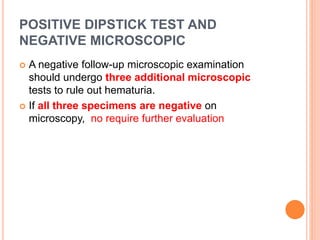
POSITIVE DIPSTICK TEST AND
NEGATIVE MICROSCOPIC
 A negative follow-up microscopic examination
should undergo three additional microscopic
tests to rule out hematuria.
 If all three specimens are negative on
microscopy, no require further evaluation
HEMATURIA WITH URINARY TRACT
INFECTIONS
 If a microscopic hematuria in the presence of pyuria
or bacteriuria, do urine culture.
 Culture-directed antibiotics should be administered.
 A microscopic urinalysis should be repeated in
six weeks to assess for resolution of the
hematuria.
INITIAL INVESTIGATIONS
 Measurement of blood pressure.
 Exclude UTI and/or other transient cause.
 Plasma creatinine and estimated glomerular
filtration rate (eGFR).
 Measure proteinuria: PCR or ACR on a
random sample.
Nice guidelines.
 At the initial evaluation, an estimate of renal function
should be obtained (may include calculated eGFR,
creatinine, and BUN)
AUA,2012
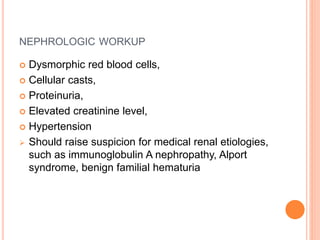
NEPHROLOGIC WORKUP
 Dysmorphic red blood cells,
 Cellular casts,
 Proteinuria,
 Elevated creatinine level,
 Hypertension
 Should raise suspicion for medical renal etiologies,
such as immunoglobulin A nephropathy, Alport
syndrome, benign familial hematuria
IMAGING
 Renal ultrasonography is less sensitive (50%
sensitive and 95% specific) in detecting urothelial
lesions, small renal masses, and urinary calculi.
 Magnetic resonance urography is used less often
because of its relatively high cost, lack of
availability, and the absence of standardized
protocols. Additionally, it is poor at detecting stone
disease, which is a common etiology of microscopic
hematuria.
 Urine cytology and other bladder tumor markers are
not recommended for the initial evaluation of
microscopic hematuria
CYSTOSCOPY
 In patients younger than age 35 years, cystoscopy
may be performed at the physician’s discretion.
Option (Evidence Strength Grade C)
 A cystoscopy should be performed on all patients
who present with risk factors for urinary tract
malignancies (e.g., irritative voiding symptoms,
current or past tobacco use, chemical exposures)
regardless of age.
AUA,2012
HOME MASSAGE
 Further evaluation is recommended for individuals with
three or more red blood cells per high-power field.
 Concurrent nephrologic and urologic referral is indicated
in the presence of hypertension, elevated creatinine
level, and dysmorphic red blood cells, cellular casts, or
proteinuria on urinalysis.
 CT urography is the preferred method for radiologic
imaging in the evaluation of microscopic hematuria.
 Urine cytology and other bladder tumor markers are not
recommended for the initial evaluation of microscopic
hematuria
CASE 1
Was treated with augmentin for 5days
, her symptoms improved
--
 Urine c/s showed E coli,
no RBC
CASE 2
 Urine MCU showed few RBC.
 urine culture : negative .
 ESR AND CBC within normal.
CT abdomen : with contrast and without contrast
normal.
 ???????? Diagnosis
Thank you
REFERENCES
 www.aafp.org.hematuria,2013
 2012 American Urological Association(AUA)

Case Presentation

  • 1.
  • 2.
    CASE 1  30yrsfemale presented with burning during passing urine .  No frequency , urgency , hesitancy or nocturnal.  No change in urine color.  No fever, no abdominal pain,  No nausea or vomiting .  No vaginal discharge or itching  Not in any medications.  Menstrual history : amenorrhea as she is lactating 6months child .  Not on contraception  FH of renal stone in her brother.
  • 3.
    EXAMINATION  Vitals :afebrile , hr 80/min , BP125/77mmhg  Abdomen : soft, no tenderness .  Urine dipstick : RBC ++++, leukocyte +
  • 4.
    CASE2  21yrs malepresented with 3months h/o passing blood in the beginning of urination , large amount , no clots  Associated with burning sensation .  Associated with poor appetite , weight loss (10kg in 1yr)  H/o fever at night , not documented ,  No night sweat  No frequency , urgency , hesitancy or nocturnal.  Denied abdominal pain or vomiting.  Denied urethral discharge.
  • 5.
     No sexaulcontact .  Smoker since 1yr , (dafdof).  Not alcoholic , not drug abuser .  No recent surgery or procedure .  Father and sister has renal colic .  No f/h of bowel malignancy . Examination:  Afebrile , BP 130/75mmhg .  BMI 18.1  Abdomen : no tenderness , no organomegally .  PR and genital examination not done ,
  • 6.
     Dipstick showedRBC ++++, nitrate negative
  • 7.
  • 8.
    DEFINITION According to theAUA, the presence of three or more red blood cells on a single, properly collected, noncontaminated urinalysis without evidence of infection is considered clinically significant microscopic hematuria. AUA,2012
  • 9.
    COMMON ETIOLOGIES  Unknown43 to 68 %  Urinary tract infection 4 to 22 %  Benign prostatic hyperplasia 10 to 13 %  Urinary calculi 4 to 5 %  Bladder cancer 2 to 4 %  Renal cystic disease 2 to 3 %  Renal disease 2 to 3 %  Kidney cancer < 1 %  Prostate cancer < 1%
  • 10.
    COMMON RISK FACTORSFOR URINARY TRACT MALIGNANCY Age older than 35 years Analgesic abuse Exposure to chemicals or dyes (benzenes or aromatic amines) Male sex Past or current smoking
  • 11.
    History of anyof the following:  Chronic indwelling foreign body.  Chronic urinary tract infection.  Exposure to known carcinogenic agents or alkylating chemotherapeutic agents .  Gross hematuria .  Irritative voiding symptoms.  Pelvic irradiation .
  • 12.
    POSITIVE DIPSTICK TESTAND NEGATIVE MICROSCOPIC  A negative follow-up microscopic examination should undergo three additional microscopic tests to rule out hematuria.  If all three specimens are negative on microscopy, no require further evaluation
  • 13.
    HEMATURIA WITH URINARYTRACT INFECTIONS  If a microscopic hematuria in the presence of pyuria or bacteriuria, do urine culture.  Culture-directed antibiotics should be administered.  A microscopic urinalysis should be repeated in six weeks to assess for resolution of the hematuria.
  • 14.
    INITIAL INVESTIGATIONS  Measurementof blood pressure.  Exclude UTI and/or other transient cause.  Plasma creatinine and estimated glomerular filtration rate (eGFR).  Measure proteinuria: PCR or ACR on a random sample. Nice guidelines.
  • 15.
     At theinitial evaluation, an estimate of renal function should be obtained (may include calculated eGFR, creatinine, and BUN) AUA,2012
  • 18.
    NEPHROLOGIC WORKUP  Dysmorphicred blood cells,  Cellular casts,  Proteinuria,  Elevated creatinine level,  Hypertension  Should raise suspicion for medical renal etiologies, such as immunoglobulin A nephropathy, Alport syndrome, benign familial hematuria
  • 20.
    IMAGING  Renal ultrasonographyis less sensitive (50% sensitive and 95% specific) in detecting urothelial lesions, small renal masses, and urinary calculi.  Magnetic resonance urography is used less often because of its relatively high cost, lack of availability, and the absence of standardized protocols. Additionally, it is poor at detecting stone disease, which is a common etiology of microscopic hematuria.
  • 21.
     Urine cytologyand other bladder tumor markers are not recommended for the initial evaluation of microscopic hematuria
  • 22.
    CYSTOSCOPY  In patientsyounger than age 35 years, cystoscopy may be performed at the physician’s discretion. Option (Evidence Strength Grade C)  A cystoscopy should be performed on all patients who present with risk factors for urinary tract malignancies (e.g., irritative voiding symptoms, current or past tobacco use, chemical exposures) regardless of age. AUA,2012
  • 23.
    HOME MASSAGE  Furtherevaluation is recommended for individuals with three or more red blood cells per high-power field.  Concurrent nephrologic and urologic referral is indicated in the presence of hypertension, elevated creatinine level, and dysmorphic red blood cells, cellular casts, or proteinuria on urinalysis.  CT urography is the preferred method for radiologic imaging in the evaluation of microscopic hematuria.  Urine cytology and other bladder tumor markers are not recommended for the initial evaluation of microscopic hematuria
  • 24.
    CASE 1 Was treatedwith augmentin for 5days , her symptoms improved --  Urine c/s showed E coli, no RBC
  • 25.
    CASE 2  UrineMCU showed few RBC.  urine culture : negative .  ESR AND CBC within normal. CT abdomen : with contrast and without contrast normal.  ???????? Diagnosis
  • 26.
  • 27.
    REFERENCES  www.aafp.org.hematuria,2013  2012American Urological Association(AUA)