Hidden
Curriculum
Where is
the
Hidden
Curriculu
m?
Hidden Curriculum
• Many education units adopt curriculum
innovations; some success others fail,
Hidden curriculum
Objectives
• Defining what is Hidden
Curriculum.
• Defining Contributing factors.
• Defining where It is conducted.
• Defining who conducts it.
• How to recognize Hidden
Curriculum.
• How to teach it.
Defining Hidden Curriculum
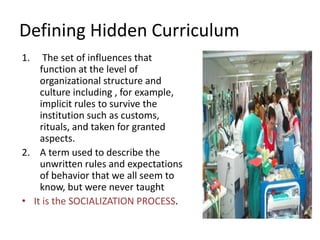
1. The set of influences that
function at the level of
organizational structure and
culture including , for example,
implicit rules to survive the
institution such as customs,
rituals, and taken for granted
aspects.
2. A term used to describe the
unwritten rules and expectations
of behavior that we all seem to
know, but were never taught
• It is the SOCIALIZATION PROCESS.
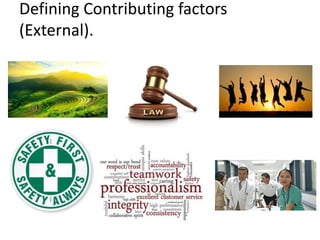
Defining Contributing factors
(External).
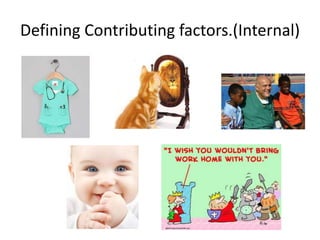
Defining Contributing factors.(Internal)
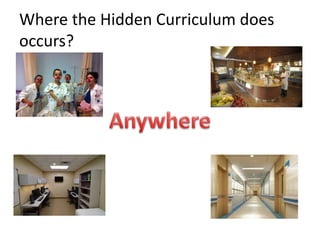
Where the Hidden Curriculum does
occurs?
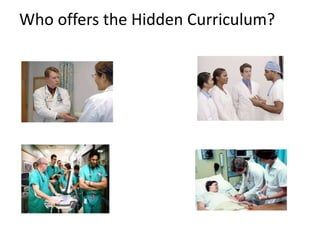
Who offers the Hidden Curriculum?
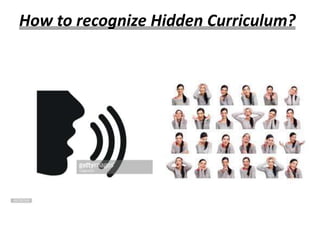
How to recognize Hidden Curriculum?
Positive Influences or Messages Negative Influences or Messages
• Expressing satisfaction with patient
encounters.
• Professional and friendly interaction
with staff including clerical workers.
• Integration of your practice and
home life, including work-life balance
and effective time management,
• Showing enthusiasm about your
teaching assignments.
• Role modeling the “big picture” of
medicine.
• Demonstrating quality.
• Appreciate that there may be more
than one right answer (medicine is
complex).
• Complaints about workload, the cost
of malpractice, number of patients.
• Disparaging remarks about health
team members, other learners or
residents.
• Failing to take time for family or self.
• Ignoring patient concerns.
• Skipping rotation evaluations.
• Over or under-glorifying board
examinations in-training.
• Being rude to patients or talking
negatively about patients.
How to avoid Hidden Curriculum?
1. Being older and more mature.
2. Having had a previous career or life project.
3. Being a woman.
4. Having nonmedical commitments.
5. Having strong patient-centered modeling.
6. Having a family medicine, primary care, or
generalist orientation.
Hidden Curriculum
Hidden Curriculum
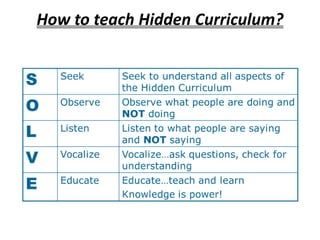
How to teach Hidden Curriculum?
Hidden Curriculum
• Many education units adopt curriculum
innovations; some success others fail,
Hidden Curriculum
Hidden Curriculum
• Hidden Curriculum: is A term used to describe
the unwritten rules and expectations of
behavior that we all seem to know, but were
never taught.
• It is influences by multiple external and
internal contributing factors.
• It is taught anywhere across the healthcare
system.
Hidden Curriculum
• It is taught by all healthcare staff
independently.
• It can be recognized by simple words and/or
body language.
• It can be avoided with certain factors.
• It could be teached by SOLVED strategy.
Hidden cuirriculum

Hidden cuirriculum

  • 1.
  • 2.
    Hidden Curriculum • Manyeducation units adopt curriculum innovations; some success others fail,
  • 3.
    Hidden curriculum Objectives • Definingwhat is Hidden Curriculum. • Defining Contributing factors. • Defining where It is conducted. • Defining who conducts it. • How to recognize Hidden Curriculum. • How to teach it.
  • 4.
    Defining Hidden Curriculum 1.The set of influences that function at the level of organizational structure and culture including , for example, implicit rules to survive the institution such as customs, rituals, and taken for granted aspects. 2. A term used to describe the unwritten rules and expectations of behavior that we all seem to know, but were never taught • It is the SOCIALIZATION PROCESS.
  • 5.
  • 6.
  • 7.
    Where the HiddenCurriculum does occurs?
  • 8.
    Who offers theHidden Curriculum?
  • 9.
    How to recognizeHidden Curriculum?
  • 10.
    How to recognizeHidden Curriculum? Positive Influences or Messages Negative Influences or Messages • Expressing satisfaction with patient encounters. • Professional and friendly interaction with staff including clerical workers. • Integration of your practice and home life, including work-life balance and effective time management, • Showing enthusiasm about your teaching assignments. • Role modeling the “big picture” of medicine. • Demonstrating quality. • Appreciate that there may be more than one right answer (medicine is complex). • Complaints about workload, the cost of malpractice, number of patients. • Disparaging remarks about health team members, other learners or residents. • Failing to take time for family or self. • Ignoring patient concerns. • Skipping rotation evaluations. • Over or under-glorifying board examinations in-training. • Being rude to patients or talking negatively about patients.
  • 11.
    How to avoidHidden Curriculum? 1. Being older and more mature. 2. Having had a previous career or life project. 3. Being a woman. 4. Having nonmedical commitments. 5. Having strong patient-centered modeling. 6. Having a family medicine, primary care, or generalist orientation.
  • 12.
  • 13.
  • 14.
    How to teachHidden Curriculum?
  • 15.
    Hidden Curriculum • Manyeducation units adopt curriculum innovations; some success others fail,
  • 16.
  • 17.
    Hidden Curriculum • HiddenCurriculum: is A term used to describe the unwritten rules and expectations of behavior that we all seem to know, but were never taught. • It is influences by multiple external and internal contributing factors. • It is taught anywhere across the healthcare system.
  • 18.
    Hidden Curriculum • Itis taught by all healthcare staff independently. • It can be recognized by simple words and/or body language. • It can be avoided with certain factors. • It could be teached by SOLVED strategy.

Editor's Notes

  • #5 The “hidden curriculum” refers to medical education as more than simple transmission of knowledge and skills; it is also a socialization process. It is an Altitude. Wittingly or unwittingly, norms and values transmitted to future physicians often undermine the formal messages of the declared curriculum.
  • #6 1.2. enviroment and safety لغريب أن هناك في بعض الناس شيئاً غامضاً يؤهلهم لأن يكونوا أصدقاء بسرعة، والبعض الآخر نرفضه دون سبب ظاهر يتضح لاحقاً ، وقليلاً ما تخطئ حواسنا فيه. ‫#‏مملكة_الفراشة‬ ‫#‏واسيني_الأعرج‬ 3.4. values and beliefs 5.6. friends and colleagues
  • #7 Dreams Inner image Perception of life pressure
  • #8 It is considered “sticky knowledge,” more memorable than the explicit formal curriculum. Every word spoken, every action performed or omitted, every joke, every silence, and every irritation imparts values we might never have intended to impart.
  • #9 . This cascade might explain why changes to the formal curriculum do not always get intended results. Many reforms result in no real change, as day-to-day experiences are more influential than curriculum content.
  • #10 1.Power of language 30%. 2. Body language 70%.
  • #12 females got higher emotional intelligence. 5. The effect of role model to prevent moral decay. 6.Boards role.