High Efficiency Video Coding
Coding Tools and Specification
Mathias Wien
Institut für Nachrichtentechnik
RWTH Aachen University
ICME2013
Mathias Wien (RWTH) HEVC tutorial ICME2013 1 / 165
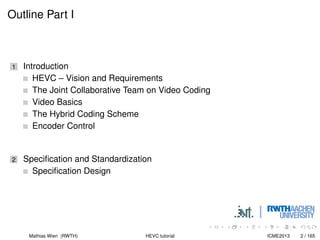
Outline Part I
1 Introduction
HEVC – Vision and Requirements
The Joint Collaborative Team on Video Coding
Video Basics
The Hybrid Coding Scheme
Encoder Control
2 Specification and Standardization
Specification Design
Mathias Wien (RWTH) HEVC tutorial ICME2013 2 / 165
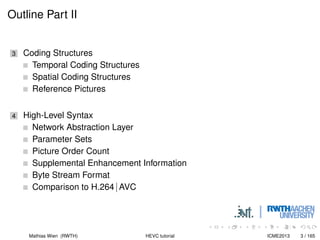
Outline Part II
3 Coding Structures
Temporal Coding Structures
Spatial Coding Structures
Reference Pictures
4 High-Level Syntax
Network Abstraction Layer
Parameter Sets
Picture Order Count
Supplemental Enhancement Information
Byte Stream Format
Comparison to H.264|AVC
Mathias Wien (RWTH) HEVC tutorial ICME2013 3 / 165
Outline Part III
5 Inter Prediction
Motion Compensated Prediction
6 Intra Prediction
Reference Pixels for Intra Prediction
Intra Prediction Modes
Predictive Coding of Intra Prediction Modes
Mathias Wien (RWTH) HEVC tutorial ICME2013 4 / 165
Outline Part IV
7 Residual Coding
Core Transforms
Alternative 4×4 Transform
Quantization
Coded Representation of Transform Blocks
Special Modes
8 Loop Filtering
Deblocking Filter
Sample Adaptive Offset
9 Entropy Coding
Variable Length Codes
CABAC
Mathias Wien (RWTH) HEVC tutorial ICME2013 5 / 165
Outline Part V
10 Profiles, Tiers, and Levels
Main Profiles
Tiers and Levels
11 Compression Performance
12 Extensions to HEVC
Mathias Wien (RWTH) HEVC tutorial ICME2013 6 / 165
Part I
Introduction, Specification
Mathias Wien (RWTH) HEVC tutorial ICME2013 7 / 165
Outline
1 Introduction
HEVC – Vision and Requirements
The Joint Collaborative Team on Video Coding
Video Basics
The Hybrid Coding Scheme
Encoder Control
2 Specification and Standardization
Specification Design
Mathias Wien (RWTH) HEVC tutorial ICME2013 8 / 165
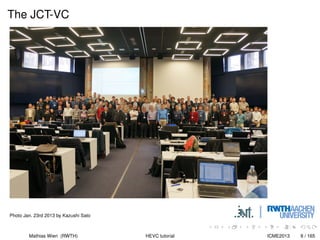
The JCT-VC
Photo Jan. 23rd 2013 by Kazushi Sato
Mathias Wien (RWTH) HEVC tutorial ICME2013 9 / 165
Motivation for a New Video Coding Standard
Increasing Video Resolution
High Definition (HD), Ultra High Definition (UHD), 4K×2K, 8K×4K
Mobile services in HD
Stereo video, multi-view video
Recording and Display Devices
HD and UHD resolutions available
Reaching consumer market
Transport
Video data rate grows faster than feasible network capabilities
Mathias Wien (RWTH) HEVC tutorial ICME2013 10 / 165
HEVC Vision and Requirements
Compression Performance
Substantially better compression ratio than H.264|AVC High Profile
Shall not be worse than existing standards at any operating point
Formats
Large range of picture formats
Various color spaces and sampling
Large range of frame rates
Higher bit depth support
Progressive scan
Mathias Wien (RWTH) HEVC tutorial ICME2013 11 / 165
HEVC Vision and Requirements
Complexity
Low complexity operating point
Lower complexity than H.264|AVC at better compression performance
High performance operating point
Higher complexity than H.264|AVC with substantial better compression
performance
Access
Low delay, random access, trick modes
Error resilience, video buffer, system layer interface
Possible support for scalability and multi-view
Mathias Wien (RWTH) HEVC tutorial ICME2013 12 / 165
Development of HEVC – Time Line
Timeline
July 2005: Start of KTA in ITU-T SQ16/Q6 VCEG
July 2008: Start of HVC activity in ISO/IEC JCT1 SC29/WG11 MPEG
April 2009: Call for Evidence on HVC (MPEG doc N10553)
January 2010: Formation of the Joint Collaborative Team on Video
Coding (JCT-VC) → Joint Call for Proposals (CfP)
April 2010: 1st meeting of the JCT-VC, Evaluation of the CfP
Name: High Efficiency Video Coding (HEVC)
July 2010: Test Model under Consideration (TMuC)
October 2010: 1st HEVC Working Draft (WD-1) and Test Model (HM-1)
. . . new WD and HM every three month . . .
January 2013: 10th HEVC Working Draft and Test Model (HM-10)
Final Draft International Standard / Consent
Mathias Wien (RWTH) HEVC tutorial ICME2013 13 / 165
Joint Collaborative Team on Video Coding – JCT-VC
Previous collaborations between MPEG and ITU-T
H.262|MPEG-2 Video
H.264|AVC in the Joint Video Team (last meeting Nov. 2009 in Geneva)
New collaboration between MPEG and VCEG
Joint Collaborative Team on Video Coding (JCT-VC)
Agreement on Terms of Reference Jan. 2010, N11112, VCEG-AM90 [5]
Joint Call for Proposals issues Jan. 2010, N11113, VCEG-AM91 [6]
1st meeting in Dresden, April 2010
Chairs
Gary J. Sullivan (Microsoft)
Jens-Rainer Ohm (RWTH Aachen University)
Resources
Mathias Wien (RWTH) HEVC tutorial ICME2013 14 / 165
JCT-VC Method of Working
Meetings
Decisions by consensus of the group
Meeting report with all group decisions of meeting
Ad-hoc Group (AhGs)
Organize discussion on defined topic between meetings
Exist for only one meeting cycle (can be reinstalled)
AhG chair / co-chairs: responsible for synchronization, reporting
Core Experiments (CEs)
Defined from meeting to meeting
Single tools: Precise definition, well-defined test and evaluation
Verification and cross-check of reported results
Coordinator(s): responsible for conduction, reporting
Mathias Wien (RWTH) HEVC tutorial ICME2013 15 / 165
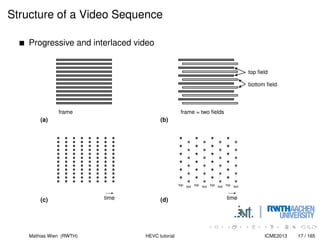
Structure of a Video Sequence
Definitions
Picture: single array or set of multiple (three) arrays of samples
(pixels = picture elements). Has lines of pixels
Field picture: even and odd lines of the full resolution taken at successive
time instances → interlaced video
Top field: even lines
Bottom field: odd lines
Frame:
Pair of top and bottom field pictures for interlaced video
Full resolution picture in progressive scan
Mathias Wien (RWTH) HEVC tutorial ICME2013 16 / 165
Structure of a Video Sequence
Progressive and interlaced video
(a)
frame
(b)
top field
bottom field
frame = two fields
(c) time (d)
top bot top bot top bot top bot
time
Mathias Wien (RWTH) HEVC tutorial ICME2013 17 / 165
Representation of Color
Color representation: YCbCr
Luminance (Y): gray-level picture, weighted sum of the RGB components
Chrominance (Cb, Cr): delta of Luminance to single color components
Normalization according to transfer characteristics of capture/display
Luma and chroma components (Y, Cb, Cr)
Sub-sampling of chroma
luma
chroma
(a) YCbCr 4:2:0 (b) YCbCr 4:2:2
further reading: [7]
Mathias Wien (RWTH) HEVC tutorial ICME2013 18 / 165
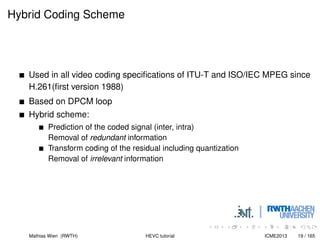
Hybrid Coding Scheme
Used in all video coding specifications of ITU-T and ISO/IEC MPEG since
H.261(first version 1988)
Based on DPCM loop
Hybrid scheme:
Prediction of the coded signal (inter, intra)
Removal of redundant information
Transform coding of the residual including quantization
Removal of irrelevant information
Mathias Wien (RWTH) HEVC tutorial ICME2013 19 / 165
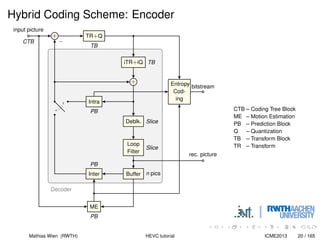
Hybrid Coding Scheme: Encoder
Decoder
CTB
input picture
+
−
TR+Q
TB
iTR+iQ TB
+
Intra
PB
Entropy
Cod-
ing
bitstream
Deblk. Slice
Loop
Filter
Slice
rec. picture
Inter
PB
Buffer n pics
ME
PB
CTB – Coding Tree Block
ME – Motion Estimation
PB – Prediction Block
Q – Quantization
TB – Transform Block
TR – Transform
Mathias Wien (RWTH) HEVC tutorial ICME2013 20 / 165
Encoder Control
Mode decision, determination of coding parameters subject to application
constraints
Picture type
Partitioning and sub-partitioning
Inter / intra prediction mode
Motion vectors, intra prediction directions
Loop filter parameters
Decisions based on distortion metric
Mathias Wien (RWTH) HEVC tutorial ICME2013 21 / 165
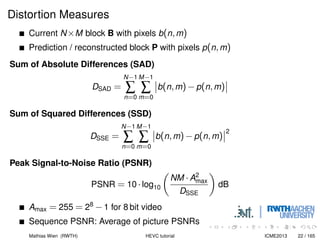
Distortion Measures
Current N×M block B with pixels b(n,m)
Prediction / reconstructed block P with pixels p(n,m)
Sum of Absolute Differences (SAD)
DSAD =
N−1
∑
n=0
M−1
∑
m=0
b(n,m)−p(n,m)
Sum of Squared Differences (SSD)
DSSE =
N−1
∑
n=0
M−1
∑
m=0
b(n,m)−p(n,m)
2
Peak Signal-to-Noise Ratio (PSNR)
PSNR = 10 ·log10

NM ·A2
max
DSSE

dB
Amax = 255 = 28
−1 for 8 bit video
Sequence PSNR: Average of picture PSNRs
Mathias Wien (RWTH) HEVC tutorial ICME2013 22 / 165
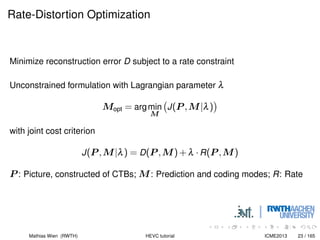
Rate-Distortion Optimization
Minimize reconstruction error D subject to a rate constraint
Unconstrained formulation with Lagrangian parameter λ
Mopt = argmin
M
J(P ,M|λ)

with joint cost criterion
J(P ,M|λ) = D(P ,M)+λ ·R(P ,M)
P : Picture, constructed of CTBs; M: Prediction and coding modes; R: Rate
Mathias Wien (RWTH) HEVC tutorial ICME2013 23 / 165
Bjøntegaard Delta Measurement
0 250 500 750 1000125015001750
35
36
37
38
39
40
41
42
43
44
Rate [kbps]
PSNR
Y
[dB]
0 250 500 750 1000125015001750
35
36
37
38
39
40
41
42
43
44
Rate [kbps]
PSNR
Y
[dB]
(a) BD-PSNR (b) BD-rate
Comparison of two rate-distortion curves with four rate points
Interpolation of curves (using log-rate)
Polynomial VCEG-M33 [9], or pice-wise cubic JCTVC-F270 [10]
Rate delta (BD-rate, %) or PSNR delta (BD-PSNR, dB) by integration
over intermediate area
Mathias Wien (RWTH) HEVC tutorial ICME2013 24 / 165
Outline
1 Introduction
HEVC – Vision and Requirements
The Joint Collaborative Team on Video Coding
Video Basics
The Hybrid Coding Scheme
Encoder Control
2 Specification and Standardization
Specification Design
Mathias Wien (RWTH) HEVC tutorial ICME2013 25 / 165
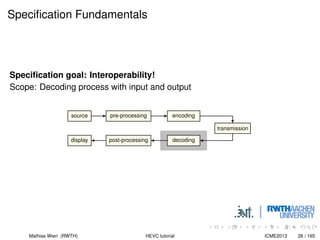
Specification Fundamentals
Specification goal: Interoperability!
Scope: Decoding process with input and output
source pre-processing encoding
transmission
decoding
post-processing
display
Mathias Wien (RWTH) HEVC tutorial ICME2013 26 / 165
Specification Elements: Syntax and Semantics
Syntax
Hierarchical structure
Sequence, picture, CTB, sub-block, coefficient level
Syntax tables, conditional order of syntax elements
Conforming bitstream: subset of possible combinations of syntax
structures
Semantics
’Meaning’ of values of syntax elements
Constraints and dependencies between syntax elements
Mathias Wien (RWTH) HEVC tutorial ICME2013 27 / 165
Specification Elements: Decoding Process
Input
Coded video sequence (in the bitstream)
Decoding Process
Derive reconstructed video from input bitstream
Complete and exact specification of processes
→ Includes all normative operations
Does not include handling of unspecified states, occurrence of
unspecified syntax element values
Output
Reconstructed video
Mathias Wien (RWTH) HEVC tutorial ICME2013 28 / 165
Specification Elements: Parsing Process
Entropy coding of syntax elements
Applicable entropy coding method from syntax table
Specification of context dependency (if applicable)
Context-based Adaptive Binary Arithmetic Coding (CABAC)
Specification of arithmetic decoding process
Context initialization
Context update and renormalization
Mathias Wien (RWTH) HEVC tutorial ICME2013 29 / 165
Specification Principles: Bit-Exact Specification
Exact specification of decoding result
Unambiguous decoding result
Eases conformance testing
Approach
No floating-point decoding process operations specified
Normative operations in integer arithmetic (interpolation, filtering)
Specifically: integer transforms
→ avoid drift between different implementations
Mathias Wien (RWTH) HEVC tutorial ICME2013 30 / 165
Specification Principles: Independent Parsing
Parsing independent from decoding
Parsing must be possible in the case of transmission losses
No dependency of occurrence of syntax elements based on properties of
decoded pictures
Independent slice parsing
Slices of a picture must be independent
→ separately decodable in case of slice losses
Enables parallel processing of slices
Further: no parsing dependencies in parameter sets
(e. g. on certain profile) → extensibility
SzBu12 [11]
Mathias Wien (RWTH) HEVC tutorial ICME2013 31 / 165
Specification Principles: Parallelization
Respond to prevalence of multi-thread / multi-core processing
Picture level
Parallel parsing and decoding
Parallel decoding of slices
Tiles: Parallel decoding of local regions of the picture
Wavefront parallel processing: Parallelization on a row basis
Block level
Inter prediction: fetching from reference pictures
Intra prediction: in parallel to inter prediction if constraint intra prediction
used
Loop filtering operations
Mathias Wien (RWTH) HEVC tutorial ICME2013 32 / 165
Specification Principles: Dynamic Range
Memory consumption
Storage size of decoded pictures, parameters and intermediate values
Bandwidth for memory access
Processing operation
Required register sizes
Bit depth of arithmetic operations
Inverse transform and quantization
Very high dynamic range possible (including 32×32 transform)
Restrictions required, by either
Normative restrictions on encoder
Sufficient head-room in decoder specification
Intermediate truncation (used in HEVC)
JCTVC-G1044, JCTVC-H0541 [12, 13]
Mathias Wien (RWTH) HEVC tutorial ICME2013 33 / 165
Specification Principles: Loss Robustness
Decoder reaction on corrupted bitstream unspecified (could “catch fire. . . )
Approach
Hierarchical organization of information (sequence, picture, block level)
→ Network Abstraction Layer (NAL), Video Coding Layer (VCL)
Inclusion of hooks for resynchronization
In-band / out-of-band transmission of parameter sets
Independent parsing (see above)
Mathias Wien (RWTH) HEVC tutorial ICME2013 34 / 165
Specification Principles: Timing
Concept of time
Not needed for specification of decoding process
Relation of pictures in decoding process identified by order
Needed for correct play-out, buffer control
Specification
Decoding process includes no dependency on time
Hypothetical reference decoder
Timing information for input / output buffer management
Requirements on decoding capabilities (for conformance)
Mathias Wien (RWTH) HEVC tutorial ICME2013 35 / 165
Conformance
Conformance determined by the Hypothetical Reference Decoder (HRD)
Conformance scopes
Decoder conformance
Decoded pictures exactly match output of reference decoding process
Bitstream conformance
Bitstream buffer (Coded Picture Buffer, CPB) never overfilled or
unintendedly emptied
Decoded Picture Buffer (DPB) always contains all required reference
pictures as needed, and all decoded pictures needed for output
Mathias Wien (RWTH) HEVC tutorial ICME2013 36 / 165
Part II
HEVC Structure, High Level Syntax
Mathias Wien (RWTH) HEVC tutorial ICME2013 37 / 165
Outline
3 Coding Structures
Temporal Coding Structures
Spatial Coding Structures
Reference Pictures
4 High-Level Syntax
Network Abstraction Layer
Parameter Sets
Picture Order Count
Supplemental Enhancement Information
Byte Stream Format
Comparison to H.264|AVC
Mathias Wien (RWTH) HEVC tutorial ICME2013 38 / 165
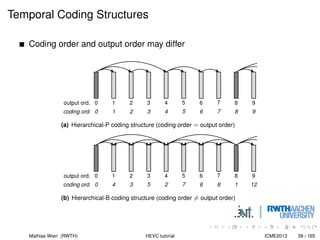
Temporal Coding Structures
Coding order and output order may differ
0 8
1 2 3 4 5 6 7 9 10 12
output ord.
coding ord. 0 1 2 3 4 5 6 7 8 9
(a) Hierarchical-P coding structure (coding order = output order)
0 8
1 2 3 4 5 6 7 9 10 12
output ord.
coding ord. 0 1
2
3
4 5 6
7 8 12
(b) Hierarchical-B coding structure (coding order 6= output order)
Mathias Wien (RWTH) HEVC tutorial ICME2013 39 / 165
Temporal Coding Structures
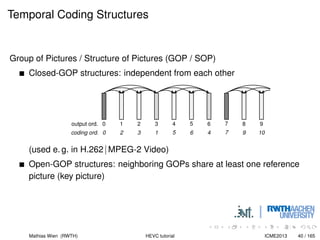
Group of Pictures / Structure of Pictures (GOP / SOP)
Closed-GOP structures: independent from each other
0 7
3 6 10
1 2 4 5 8 9
output ord.
coding ord. 0 2 3 1 5 6 4 7 9 10
(used e. g. in H.262|MPEG-2 Video)
Open-GOP structures: neighboring GOPs share at least one reference
picture (key picture)
Mathias Wien (RWTH) HEVC tutorial ICME2013 40 / 165
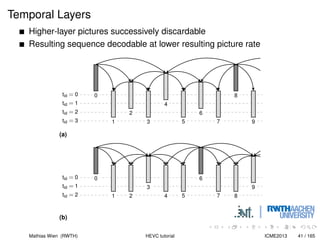
Temporal Layers
Higher-layer pictures successively discardable
Resulting sequence decodable at lower resulting picture rate
tid = 3
tid = 2
tid = 1
tid = 0 0 8
4 12
2 6 10
1 3 5 7 9 11
(a)
tid = 2
tid = 1
tid = 0 0 6 12
3 9
1 2 4 5 7 8 10 11
(b)
Mathias Wien (RWTH) HEVC tutorial ICME2013 41 / 165
Picture Types: Random Access Points
Decoding of sequence may start here
Intra-only prediction allowed
→ “Intra random access point” (IRAP)
Instantaneous Decoder Refresh (IDR)
Start of a new coded video sequence
Reset of decoding process
DPB emptied
Only reference to pictures following IDR in coding order
No reference ’across’ IDR picture
Mathias Wien (RWTH) HEVC tutorial ICME2013 42 / 165
Picture Types: Random Access Point (CRA)
Clean Random Access (CRA)
Decoding process not reset if within coded video sequence
DPB left intact if within coded video sequence
Pictures after CRA in coding and output order without reference to
pictures before CRA
If used as starting point
Conformingly decodable pictures following CRA in output order
Pictures after CRA in coding order but before CRA in output order with
reference to previous pictures: to be discarded.
Mathias Wien (RWTH) HEVC tutorial ICME2013 43 / 165
Picture Types: Random Access Point (BLA)
Broken Link Access (BLA)
Useful for bitstream splicing (example to follow)
Not for original use in coded video sequence
Renaming of CRA after splicing operation
Indicates removal of pictures containing broken / unavailable references
Mathias Wien (RWTH) HEVC tutorial ICME2013 44 / 165
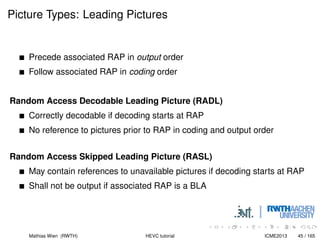
Picture Types: Leading Pictures
Precede associated RAP in output order
Follow associated RAP in coding order
Random Access Decodable Leading Picture (RADL)
Correctly decodable if decoding starts at RAP
No reference to pictures prior to RAP in coding and output order
Random Access Skipped Leading Picture (RASL)
May contain references to unavailable pictures if decoding starts at RAP
Shall not be output if associated RAP is a BLA
Mathias Wien (RWTH) HEVC tutorial ICME2013 45 / 165
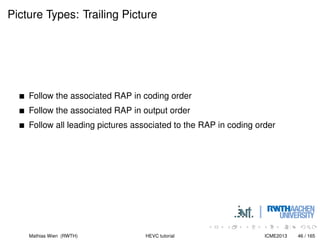
Picture Types: Trailing Picture
Follow the associated RAP in coding order
Follow the associated RAP in output order
Follow all leading pictures associated to the RAP in coding order
Mathias Wien (RWTH) HEVC tutorial ICME2013 46 / 165
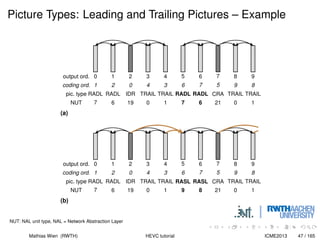
Picture Types: Leading and Trailing Pictures – Example
2 7
0 1 3 4 5 6 8 9
output ord.
coding ord. 0
1 2 3
4 5
6 7 9 8
pic. type RADL RADL IDR TRAIL TRAIL RADL RADL CRA TRAIL TRAIL
NUT 7 6 19 0 1 7 6 21 0 1
(a)
2 7
0 1 3 4 5 6 8 9 10
output ord.
coding ord. 0
1 2 3
4 5
6 7 8
9
pic. type RADL RADL IDR TRAIL TRAIL RASL RASL CRA TRAIL TRAIL
NUT 7 6 19 0 1 9 8 21 0 1
(b)
NUT: NAL unit type, NAL = Network Abstraction Layer
Mathias Wien (RWTH) HEVC tutorial ICME2013 47 / 165
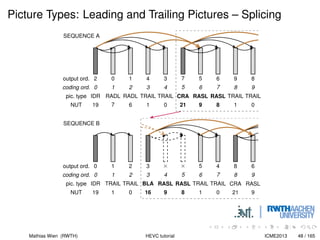
Picture Types: Leading and Trailing Pictures – Splicing
SEQUENCE A
2 0 1 4 3 7 5 6 9 8 12 10 11 1
output ord.
coding ord. 0 1 2 3 4 5 6 7 8 9
pic. type IDR RADL RADL TRAIL TRAIL CRA RASL RASL TRAIL TRAIL
NUT 19 7 6 1 0 21 9 8 1 0
SEQUENCE B
0 1 2 3 × × 5 4 8 6 7 10 9
output ord.
coding ord. 0 1 2 3 4 5 6 7 8 9
pic. type IDR TRAIL TRAIL BLA RASL RASL TRAIL TRAIL CRA RASL
NUT 19 1 0 16 9 8 1 0 21 9
Mathias Wien (RWTH) HEVC tutorial ICME2013 48 / 165
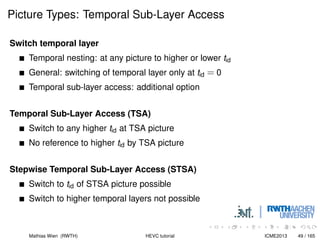
Picture Types: Temporal Sub-Layer Access
Switch temporal layer
Temporal nesting: at any picture to higher or lower tid
General: switching of temporal layer only at tid = 0
Temporal sub-layer access: additional option
Temporal Sub-Layer Access (TSA)
Switch to any higher tid at TSA picture
No reference to higher tid by TSA picture
Stepwise Temporal Sub-Layer Access (STSA)
Switch to tid of STSA picture possible
Switch to higher temporal layers not possible
Mathias Wien (RWTH) HEVC tutorial ICME2013 49 / 165
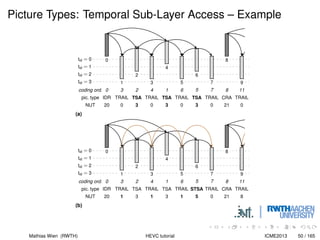
Picture Types: Temporal Sub-Layer Access – Example
tid = 3
tid = 2
tid = 1
tid = 0 0 8
4 12
2 6 10
1 3 5 7 9 11
coding ord. 0 3 2 4 1 6 5 7 8 11
pic. type IDR TRAIL TSA TRAIL TSA TRAIL TSA TRAIL CRA TRAIL
NUT 20 0 3 0 3 0 3 0 21 0
(a)
tid = 3
tid = 2
tid = 1
tid = 0 0 8
4 12
2 6 10
1 3 5 7 9 11
coding ord. 0 3 2 4 1 6 5 7 8 11
pic. type IDR TRAIL TSA TRAIL TSA TRAIL STSA TRAIL CRA TRAIL
NUT 20 1 3 1 3 1 5 0 21 8
(b)
Mathias Wien (RWTH) HEVC tutorial ICME2013 50 / 165
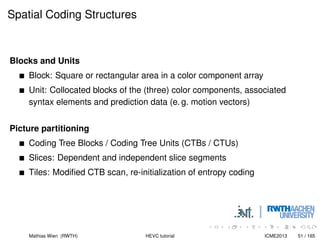
Spatial Coding Structures
Blocks and Units
Block: Square or rectangular area in a color component array
Unit: Collocated blocks of the (three) color components, associated
syntax elements and prediction data (e. g. motion vectors)
Picture partitioning
Coding Tree Blocks / Coding Tree Units (CTBs / CTUs)
Slices: Dependent and independent slice segments
Tiles: Modified CTB scan, re-initialization of entropy coding
Mathias Wien (RWTH) HEVC tutorial ICME2013 51 / 165
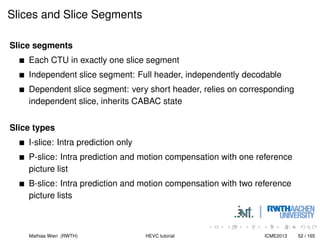
Slices and Slice Segments
Slice segments
Each CTU in exactly one slice segment
Independent slice segment: Full header, independently decodable
Dependent slice segment: very short header, relies on corresponding
independent slice, inherits CABAC state
Slice types
I-slice: Intra prediction only
P-slice: Intra prediction and motion compensation with one reference
picture list
B-slice: Intra prediction and motion compensation with two reference
picture lists
Mathias Wien (RWTH) HEVC tutorial ICME2013 52 / 165
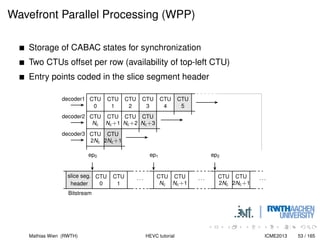
Wavefront Parallel Processing (WPP)
Storage of CABAC states for synchronization
Two CTUs offset per row (availability of top-left CTU)
Entry points coded in the slice segment header
CTU CTU CTU CTU CTU CTU
0 1 2 3 4 5
CTU CTU CTU CTU
Nc Nc+1 Nc+2 Nc+3
CTU CTU
2Nc 2Nc+1
decoder1
decoder2
decoder3
slice seg.
header
CTU CTU CTU CTU CTU CTU
0 1 Nc Nc+1 2Nc 2Nc+1
··· ··· ···
ep0 ep1 ep2
Bitstream
Mathias Wien (RWTH) HEVC tutorial ICME2013 53 / 165
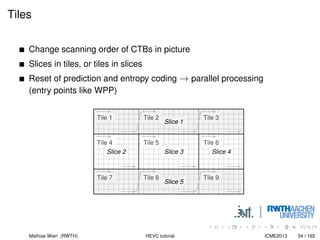
Tiles
Change scanning order of CTBs in picture
Slices in tiles, or tiles in slices
Reset of prediction and entropy coding → parallel processing
(entry points like WPP)
Slice 1
Slice 2 Slice 3 Slice 4
Slice 5
Tile 1 Tile 2 Tile 3
Tile 4 Tile 5 Tile 6
Tile 7 Tile 8 Tile 9
Mathias Wien (RWTH) HEVC tutorial ICME2013 54 / 165
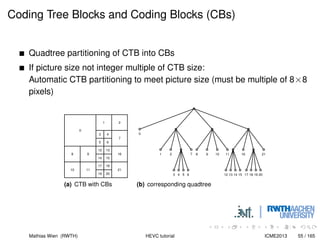
Coding Tree Blocks and Coding Blocks (CBs)
Quadtree partitioning of CTB into CBs
If picture size not integer multiple of CTB size:
Automatic CTB partitioning to meet picture size (must be multiple of 8×8
pixels)
0
1 2
3 4
5 6
7
8 9
10 11
12 13
14 15
16
17 18
19 20
21
0
1 2
3 4 5 6
7 8 9 10 11
12 13 14 15
16
17 18 19 20
21
(a) CTB with CBs (b) corresponding quadtree
Mathias Wien (RWTH) HEVC tutorial ICME2013 55 / 165
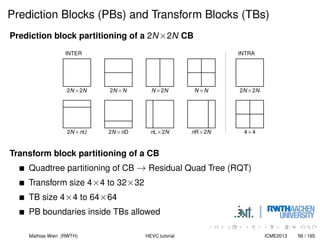
Prediction Blocks (PBs) and Transform Blocks (TBs)
Prediction block partitioning of a 2N×2N CB
INTER
2N×2N 2N×N N×2N N×N
2N×nU 2N×nD nL×2N nR×2N
INTRA
2N×2N
4×4
Transform block partitioning of a CB
Quadtree partitioning of CB → Residual Quad Tree (RQT)
Transform size 4×4 to 32×32
TB size 4×4 to 64×64
PB boundaries inside TBs allowed
Mathias Wien (RWTH) HEVC tutorial ICME2013 56 / 165
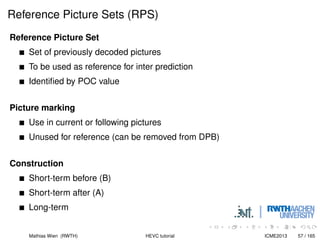
Reference Picture Sets (RPS)
Reference Picture Set
Set of previously decoded pictures
To be used as reference for inter prediction
Identified by POC value
Picture marking
Use in current or following pictures
Unused for reference (can be removed from DPB)
Construction
Short-term before (B)
Short-term after (A)
Long-term
Mathias Wien (RWTH) HEVC tutorial ICME2013 57 / 165
Reference Picture Sets
Short-term and long-term reference pictures
Signaling
Short-term reference picture sets
Pictures in the proximity of the current picture
List of usable short-term RPSs in Sequence Parameter Set (SPS)
Alternative: explicit signaling in slice segment header
Slice indicates which predefined RPS to apply
Long-term reference picture set
Signaled in SPS
Alternative: explicit signaling in slice segment header
further reading: [14]
Mathias Wien (RWTH) HEVC tutorial ICME2013 58 / 165
Short-Term RPS – Example
POC
RPS
8
B0 *
B1
B2
B3
0 8
4
2 6
1 3 5 7
-1
-2
-3
-4
-5
-6
-7
-8
9
B0 A0
*
B1
10
B0 A1
A0
*
B1
3
B0 A2
A1
A0
*
4
B1 A1
A0
B0 *
5
B2 A0
B0
B1 *
6
B1 A1
B0 A0
*
7
B2 A0
B1 B0 *
0 8
4
2 6
1 3 5 7
-1
-2
-3
-4
-5
-6
-7
-8
RPS of random access configuration from the JCT-VC
common testing conditions JCTVC-K1100 [15]
Mathias Wien (RWTH) HEVC tutorial ICME2013 59 / 165
Short-Term RPS – Example
POC
RPS
0 8
B0 *
B1
B2
B3
0 8
4
2 6
1 3 5 7
-1
-2
-3
-4
-5
-6
-7
-8
1 9
B0 A0
*
B1
2 10
B0 A1
A0
*
B1
3
B0 A2
A1
A0
*
4
B1 A1
A0
B0 *
5
B2 A0
B0
B1 *
6
B1 A1
B0 A0
*
7
B2 A0
B1 B0 *
0 8
4
2 6
1 3 5 7
-1
-2
-3
-4
-5
-6
-7
-8
RPS of random access configuration from the JCT-VC
common testing conditions JCTVC-K1100 [15]
Mathias Wien (RWTH) HEVC tutorial ICME2013 59 / 165
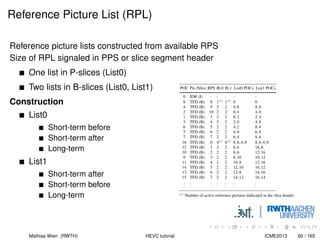
Reference Picture List (RPL)
Reference picture lists constructed from available RPS
Size of RPL signaled in PPS or slice segment header
One list in P-slices (List0)
Two lists in B-slices (List0, List1)
Construction
List0
Short-term before
Short-term after
Long-term
List1
Short-term after
Short-term before
Long-term
Mathias Wien (RWTH) HEVC tutorial ICME2013 60 / 165
Outline
3 Coding Structures
Temporal Coding Structures
Spatial Coding Structures
Reference Pictures
4 High-Level Syntax
Network Abstraction Layer
Parameter Sets
Picture Order Count
Supplemental Enhancement Information
Byte Stream Format
Comparison to H.264|AVC
Mathias Wien (RWTH) HEVC tutorial ICME2013 61 / 165
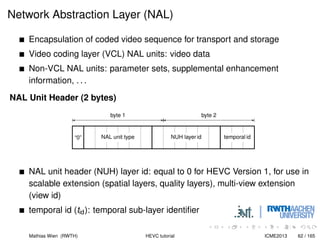
Network Abstraction Layer (NAL)
Encapsulation of coded video sequence for transport and storage
Video coding layer (VCL) NAL units: video data
Non-VCL NAL units: parameter sets, supplemental enhancement
information, . . .
NAL Unit Header (2 bytes)
“0” NAL unit type NUH layer id temporal id
byte 1 byte 2
NAL unit header (NUH) layer id: equal to 0 for HEVC Version 1, for use in
scalable extension (spatial layers, quality layers), multi-view extension
(view id)
temporal id (tid): temporal sub-layer identifier
Mathias Wien (RWTH) HEVC tutorial ICME2013 62 / 165
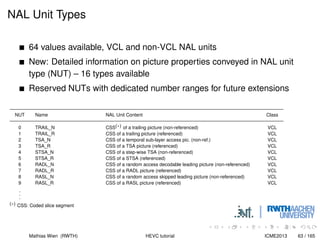
NAL Unit Types
64 values available, VCL and non-VCL NAL units
New: Detailed information on picture properties conveyed in NAL unit
type (NUT) – 16 types available
Reserved NUTs with dedicated number ranges for future extensions
NUT Name NAL Unit Content Class
0 TRAIL_N CSS(∗) of a trailing picture (non-referenced) VCL
1 TRAIL_R CSS of a trailing picture (referenced) VCL
2 TSA_N CSS of a temporal sub-layer access pic. (non-ref.) VCL
3 TSA_R CSS of a TSA picture (referenced) VCL
4 STSA_N CSS of a step-wise TSA (non-referenced) VCL
5 STSA_R CSS of a STSA (referenced) VCL
6 RADL_N CSS of a random access decodable leading picture (non-referenced) VCL
7 RADL_R CSS of a RADL picture (referenced) VCL
8 RASL_N CSS of a random access skipped leading picture (non-referenced) VCL
9 RASL_R CSS of a RASL picture (referenced) VCL
.
.
.
(∗) CSS: Coded slice segment
Mathias Wien (RWTH) HEVC tutorial ICME2013 63 / 165
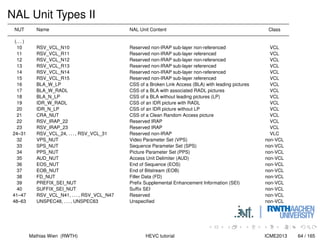
NAL Unit Types II
NUT Name NAL Unit Content Class
(. . . )
10 RSV_VCL_N10 Reserved non-IRAP sub-layer non-referenced VCL
11 RSV_VCL_R11 Reserved non-IRAP sub-layer referenced VCL
12 RSV_VCL_N12 Reserved non-IRAP sub-layer non-referenced VCL
13 RSV_VCL_R13 Reserved non-IRAP sub-layer referenced VCL
14 RSV_VCL_N14 Reserved non-IRAP sub-layer non-referenced VCL
15 RSV_VCL_R15 Reserved non-IRAP sub-layer referenced VCL
16 BLA_W_LP CSS of a Broken Link Access (BLA) with leading pictures VCL
17 BLA_W_RADL CSS of a BLA with associated RADL pictures VCL
18 BLA_N_LP CSS of a BLA without leading pictures (LP) VCL
19 IDR_W_RADL CSS of an IDR picture with RADL VCL
20 IDR_N_LP CSS of an IDR picture without LP VCL
21 CRA_NUT CSS of a Clean Random Access picture VCL
22 RSV_IRAP_22 Reserved IRAP VCL
23 RSV_IRAP_23 Reserved IRAP VCL
24–31 RSV_VCL_24, . . . , RSV_VCL_31 Reserved non-IRAP VLC
32 VPS_NUT Video Parameter Set (VPS) non-VCL
33 SPS_NUT Sequence Parameter Set (SPS) non-VCL
34 PPS_NUT Picture Parameter Set (PPS) non-VCL
35 AUD_NUT Access Unit Delimiter (AUD) non-VCL
36 EOS_NUT End of Sequence (EOS) non-VCL
37 EOB_NUT End of Bitstream (EOB) non-VCL
38 FD_NUT Filler Data (FD) non-VCL
39 PREFIX_SEI_NUT Prefix Supplemental Enhancement Information (SEI) non-VCL
40 SUFFIX_SEI_NUT Suffix SEI non-VCL
41–47 RSV_VCL_N41, . . . , RSV_VCL_N47 Reserved non-VCL
48–63 UNSPEC48, . . . , UNSPEC63 Unspecified non-VCL
Mathias Wien (RWTH) HEVC tutorial ICME2013 64 / 165
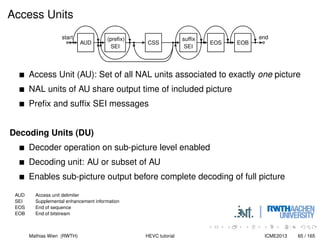
Access Units
start
AUD
(prefix)
SEI
CSS
suffix
SEI
EOS EOB
end
Access Unit (AU): Set of all NAL units associated to exactly one picture
NAL units of AU share output time of included picture
Prefix and suffix SEI messages
Decoding Units (DU)
Decoder operation on sub-picture level enabled
Decoding unit: AU or subset of AU
Enables sub-picture output before complete decoding of full picture
AUD Access unit delimiter
SEI Supplemental enhancement information
EOS End of sequence
EOB End of bitstream
Mathias Wien (RWTH) HEVC tutorial ICME2013 65 / 165
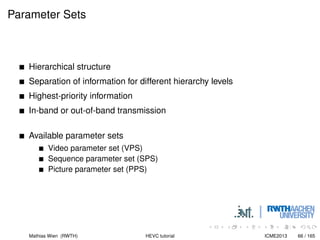
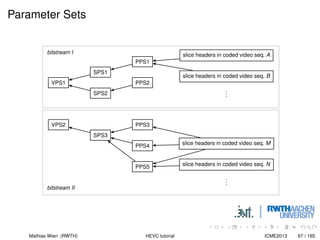
Parameter Sets
Hierarchical structure
Separation of information for different hierarchy levels
Highest-priority information
In-band or out-of-band transmission
Available parameter sets
Video parameter set (VPS)
Sequence parameter set (SPS)
Picture parameter set (PPS)
Mathias Wien (RWTH) HEVC tutorial ICME2013 66 / 165
Parameter Sets
VPS1
VPS2
SPS1
SPS2
SPS3
PPS1
PPS2
PPS3
PPS4
PPS5
slice headers in coded video seq. A
slice headers in coded video seq. B
slice headers in coded video seq. M
slice headers in coded video seq. N
.
.
.
.
.
.
bitstream I
bitstream II
Mathias Wien (RWTH) HEVC tutorial ICME2013 67 / 165
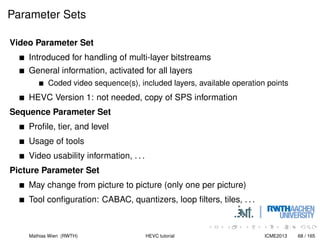
Parameter Sets
Video Parameter Set
Introduced for handling of multi-layer bitstreams
General information, activated for all layers
Coded video sequence(s), included layers, available operation points
HEVC Version 1: not needed, copy of SPS information
Sequence Parameter Set
Profile, tier, and level
Usage of tools
Video usability information, . . .
Picture Parameter Set
May change from picture to picture (only one per picture)
Tool configuration: CABAC, quantizers, loop filters, tiles, . . .
Mathias Wien (RWTH) HEVC tutorial ICME2013 68 / 165
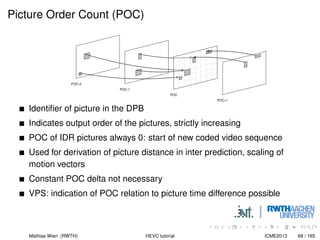
Picture Order Count (POC)
POC-2
POC-1
POC
POC+1
Identifier of picture in the DPB
Indicates output order of the pictures, strictly increasing
POC of IDR pictures always 0: start of new coded video sequence
Used for derivation of picture distance in inter prediction, scaling of
motion vectors
Constant POC delta not necessary
VPS: indication of POC relation to picture time difference possible
Mathias Wien (RWTH) HEVC tutorial ICME2013 69 / 165
Supplemental Enhancement Information (SEI)
Supplemental information not needed for the decoding process
Prefix SEI: Cannot occur after the NAL units of the coded picture
Suffix SEI: Cannot occur before the NAL units of the coded pictures
SEI Message types
Prefix: Buffering period, Picture timing, Pan-scan rectangle, Filler payload, User
data ITU-T T-35, User data unregistered, Recovery point, Scene information,
Picture snapshot, Progressive refinement start/end, Film grain characteristics,
Post filter hint, Tone mapping information, Frame packing arrangement, Display
orientation, Structure of pictures, Active parameter sets, Decoding unit
information, Temporal sub-layer zero index, Scalable nesting, Region refresh
information
Suffix: Filler payload, User data ITU-T T-35, User data unregistered,
Progressive refinement end, Post filter hint, Decoded picture hash
Mathias Wien (RWTH) HEVC tutorial ICME2013 70 / 165
Byte Stream Format
start code prefix = 0x00 0x00 0x01 = 0000 0000 0000 0000 0000 0001
Specified in HEVC Annex B
Byte stream representation of the NAL unit stream, using start codes for
identification of NAL units / resynchronization
Can be used as transport format for the coded video sequence
Not required to be used if suitable transport of NAL units by other means
available
Mathias Wien (RWTH) HEVC tutorial ICME2013 71 / 165
Comparison to H.264|AVC
H.264|AVC picture types and temporal structures
Discrimination of only IRD / non-IDR pictures
Coded slice data partitions A, B, C
SI, SP pictures for stream switching
Concept of tid in scalable extension, Annex G SVC
H.264|AVC Picture partitioning
16×16 macroblocks, prediction partitioning subset of HEVC
4×4 and 8×8 transform blocks (+ two-stage transform for intra 16×16
blocks)
I, P, B slices
Arbitrary slice ordering
No tiles, no slice segments, no WPP
Mathias Wien (RWTH) HEVC tutorial ICME2013 72 / 165
Comparison to H.264|AVC
H.264|AVC reference pictures
Short-term and long-term reference pictures
Unused reference pictures
Implicit decoded picture marking (sliding window), ’FIFO’ operation
Explicit memory management control operations (MMCO)
H.264|AVC Interlaced video support
Picture adaptive frame-field coding (PAFF)
Re-arrangement of macroblocks for macroblock adaptive frame-field
coding (MBAFF)
HEVC: No interlaced video support on tool level!
Mathias Wien (RWTH) HEVC tutorial ICME2013 73 / 165
Comparison to H.264|AVC
H.264|AVC NAL units
One-byte H.264|AVC NAL unit header (extension with layer ids for SVC)
Much less VCL NAL unit types
SEI messages
No suffix NAL units
Parameter sets
No VPS (Scalability information SEI message for SVC)
Picture order count
Concept of frame number indication for H.264|AVC reference pictures
Mathias Wien (RWTH) HEVC tutorial ICME2013 74 / 165
Part III
Inter Prediction, Intra Prediction
Mathias Wien (RWTH) HEVC tutorial ICME2013 75 / 165
Outline
5 Inter Prediction
Motion Compensated Prediction
6 Intra Prediction
Reference Pixels for Intra Prediction
Intra Prediction Modes
Predictive Coding of Intra Prediction Modes
Mathias Wien (RWTH) HEVC tutorial ICME2013 76 / 165
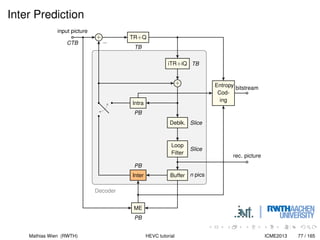
Inter Prediction
Decoder
CTB
input picture
+
−
TR+Q
TB
iTR+iQ TB
+
Intra
PB
Entropy
Cod-
ing
bitstream
Deblk. Slice
Loop
Filter
Slice
rec. picture
Inter
PB
Buffer n pics
ME
PB
Mathias Wien (RWTH) HEVC tutorial ICME2013 77 / 165
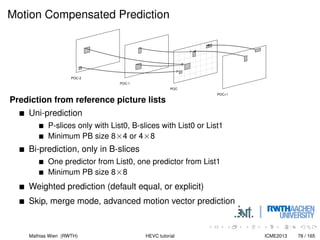
Motion Compensated Prediction
POC-2
POC-1
POC
POC+1
Prediction from reference picture lists
Uni-prediction
P-slices only with List0, B-slices with List0 or List1
Minimum PB size 8×4 or 4×8
Bi-prediction, only in B-slices
One predictor from List0, one predictor from List1
Minimum PB size 8×8
Weighted prediction (default equal, or explicit)
Skip, merge mode, advanced motion vector prediction
Mathias Wien (RWTH) HEVC tutorial ICME2013 78 / 165
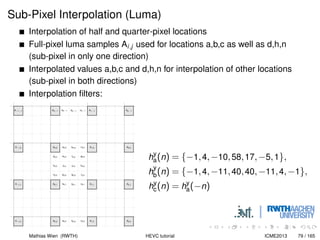
Sub-Pixel Interpolation (Luma)
Interpolation of half and quarter-pixel locations
Full-pixel luma samples Ai,j used for locations a,b,c as well as d,h,n
(sub-pixel in only one direction)
Interpolated values a,b,c and d,h,n for interpolation of other locations
(sub-pixel in both directions)
Interpolation filters:
hy
a(n) = {−1,4,−10,58,17,−5,1},
h
y
b(n) = {−1,4,−11,40,40,−11,4,−1},
hy
c(n) = hy
a(−n)
Mathias Wien (RWTH) HEVC tutorial ICME2013 79 / 165
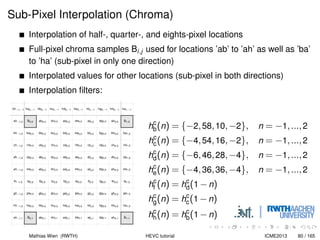
Sub-Pixel Interpolation (Chroma)
Interpolation of half-, quarter-, and eights-pixel locations
Full-pixel chroma samples Bi,j used for locations ’ab’ to ’ah’ as well as ’ba’
to ’ha’ (sub-pixel in only one direction)
Interpolated values for other locations (sub-pixel in both directions)
Interpolation filters:
hc
b(n) = {−2,58,10,−2}, n = −1,...,2
hc
c(n) = {−4,54,16,−2}, n = −1,...,2
hc
d(n) = {−6,46,28,−4}, n = −1,...,2
hc
e(n) = {−4,36,36,−4}, n = −1,...,2
hc
f (n) = hc
d(1 −n)
hc
g(n) = hc
c(1 −n)
hc
h(n) = hc
b(1 −n)
Mathias Wien (RWTH) HEVC tutorial ICME2013 80 / 165
Sub-Pixel Interpolation Filter Derivation
p−3 p−2 p−1 p0 p1 p2 p3 p4
pδ
δ
DCT-based interpolation filter
Interpolation filter derived from inverse DCT at shifted pixel location pδ
Forward and inverse DCT in one filter operation
Additional weighted window functions for reduction of ripple in filter
frequency response
Derivation scheme applicable for arbitrary sub-pixel locations
e. g. JCTVC-D344 [16], JCTVC-F247 [17]
Mathias Wien (RWTH) HEVC tutorial ICME2013 81 / 165
Motion Data Storage Reduction
·
·
·
·
·
·
· ·
· ·
·
·
·
·
·
·
· ·
·
·
·
· ·
×
× ×
×
×
×
CTB boundaries
CB boundaries
PB boundaries
16×16 block grid
Intra coded
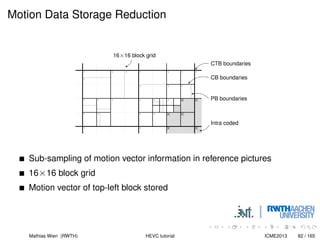
Sub-sampling of motion vector information in reference pictures
16×16 block grid
Motion vector of top-left block stored
Mathias Wien (RWTH) HEVC tutorial ICME2013 82 / 165
Merging Motion Vectors
Merge candidate list
List with up to five different motion merge candidates (list length indicated
in the slice segment header)
Unavailable candidates are ignored
List filled to specified length → Improved loss robustness:
Available list length independent of derivation process
Additional combination of reference picture list 0 and 1 candidates for
B-slices
Merge mode granularity
PU grid size configured in the PPS
PUs below grid size share merge candidate list
Adjustable computational complexity
Mathias Wien (RWTH) HEVC tutorial ICME2013 83 / 165
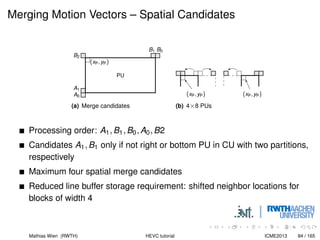
Merging Motion Vectors – Spatial Candidates
A0
A1
B0
B1
B2
(xP,yP)
PU
(xP,yP) (xP,yP)
(a) Merge candidates (b) 4×8 PUs
Processing order: A1,B1,B0,A0,B2
Candidates A1,B1 only if not right or bottom PU in CU with two partitions,
respectively
Maximum four spatial merge candidates
Reduced line buffer storage requirement: shifted neighbor locations for
blocks of width 4
Mathias Wien (RWTH) HEVC tutorial ICME2013 84 / 165
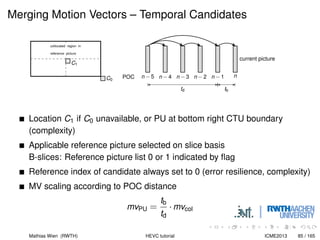
Merging Motion Vectors – Temporal Candidates
collocated region in
reference picture
C0
C1
n −5 n −4 n −3 n −2 n −1 n
current picture
POC
td tb
Location C1 if C0 unavailable, or PU at bottom right CTU boundary
(complexity)
Applicable reference picture selected on slice basis
B-slices: Reference picture list 0 or 1 indicated by flag
Reference index of candidate always set to 0 (error resilience, complexity)
MV scaling according to POC distance
mvPU =
tb
td
·mvcol
Mathias Wien (RWTH) HEVC tutorial ICME2013 85 / 165
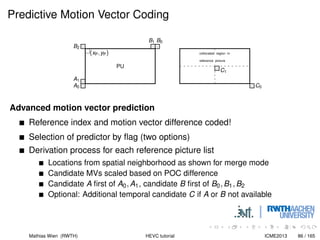
Predictive Motion Vector Coding
A0
A1
B0
B1
B2
(xP,yP)
PU
collocated region in
reference picture
C0
C1
Advanced motion vector prediction
Reference index and motion vector difference coded!
Selection of predictor by flag (two options)
Derivation process for each reference picture list
Locations from spatial neighborhood as shown for merge mode
Candidate MVs scaled based on POC difference
Candidate A first of A0,A1, candidate B first of B0,B1,B2
Optional: Additional temporal candidate C if A or B not available
Mathias Wien (RWTH) HEVC tutorial ICME2013 86 / 165
Comparison to H.264|AVC
H.264|AVC motion vector representation
One motion vector predictor (median)
Temporal and spatial direct mode
H.264|AVC sub-pixel interpolation filtering
Two-stage interpolation for quarter-pixel locations: 6-tap and bi-linear
Bi-linear H.264|AVC chroma sub-pixel interpolation
Precision issue with interpolation filter for half-pixel locations
Mathias Wien (RWTH) HEVC tutorial ICME2013 87 / 165
Outline
5 Inter Prediction
Motion Compensated Prediction
6 Intra Prediction
Reference Pixels for Intra Prediction
Intra Prediction Modes
Predictive Coding of Intra Prediction Modes
Mathias Wien (RWTH) HEVC tutorial ICME2013 88 / 165
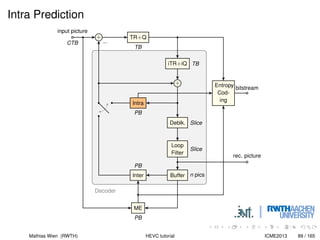
Intra Prediction
Decoder
CTB
input picture
+
−
TR+Q
TB
iTR+iQ TB
+
Intra
PB
Entropy
Cod-
ing
bitstream
Deblk. Slice
Loop
Filter
Slice
rec. picture
Inter
PB
Buffer n pics
ME
PB
Mathias Wien (RWTH) HEVC tutorial ICME2013 89 / 165
Reference Pixels for Intra Prediction
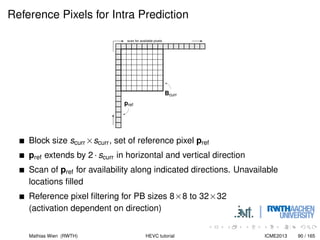
Bcurr
pref
scan for available pixels
Block size scurr×scurr, set of reference pixel pref
pref extends by 2 ·scurr in horizontal and vertical direction
Scan of pref for availability along indicated directions. Unavailable
locations filled
Reference pixel filtering for PB sizes 8×8 to 32×32
(activation dependent on direction)
Mathias Wien (RWTH) HEVC tutorial ICME2013 90 / 165
Intra Prediction Modes
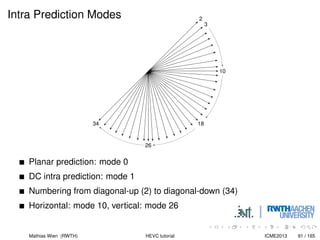
18
10
3
2
34
26
Planar prediction: mode 0
DC intra prediction: mode 1
Numbering from diagonal-up (2) to diagonal-down (34)
Horizontal: mode 10, vertical: mode 26
Mathias Wien (RWTH) HEVC tutorial ICME2013 91 / 165
Intra Prediction Modes
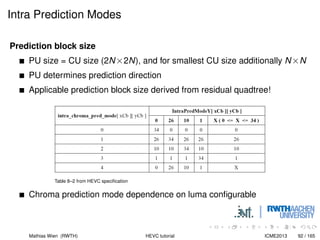
Prediction block size
PU size = CU size (2N×2N), and for smallest CU size additionally N×N
PU determines prediction direction
Applicable prediction block size derived from residual quadtree!
Table 8–2 from HEVC specification
Chroma prediction mode dependence on luma configurable
Mathias Wien (RWTH) HEVC tutorial ICME2013 92 / 165
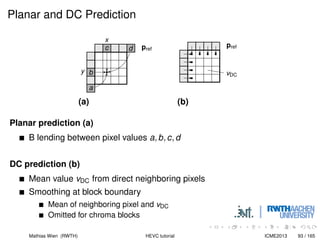
Planar and DC Prediction
y
x
a
b
c d pref
pref
vDC
(a) (b)
Planar prediction (a)
B lending between pixel values a,b,c,d
DC prediction (b)
Mean value vDC from direct neighboring pixels
Smoothing at block boundary
Mean of neighboring pixel and vDC
Omitted for chroma blocks
Mathias Wien (RWTH) HEVC tutorial ICME2013 93 / 165
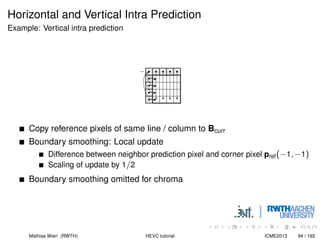
Horizontal and Vertical Intra Prediction
Example: Vertical intra prediction
−
Copy reference pixels of same line / column to Bcurr
Boundary smoothing: Local update
Difference between neighbor prediction pixel and corner pixel pref(−1,−1)
Scaling of update by 1/2
Boundary smoothing omitted for chroma
Mathias Wien (RWTH) HEVC tutorial ICME2013 94 / 165
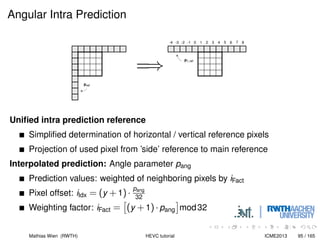
Angular Intra Prediction
-4 -3 -2 -1 0 1 2 3 4 5 6 7 8
=⇒
pref
p1,ref
Unified intra prediction reference
Simplified determination of horizontal / vertical reference pixels
Projection of used pixel from ’side’ reference to main reference
Interpolated prediction: Angle parameter pang
Prediction values: weighted of neighboring pixels by iFact
Pixel offset: iIdx = (y +1)·
pang
32
Weighting factor: iFact =

(y +1)·pang

mod32
Mathias Wien (RWTH) HEVC tutorial ICME2013 95 / 165
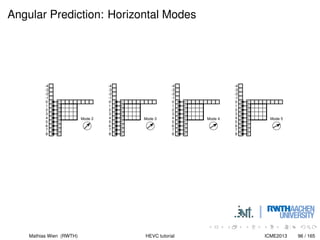
Angular Prediction: Horizontal Modes
-4
-3
-2
-1
0
1
2
3
4
5
6
7
8
Mode 2
-4
-3
-2
-1
0
1
2
3
4
5
6
7
8
Mode 3
-4
-3
-2
-1
0
1
2
3
4
5
6
7
8
Mode 4
-4
-3
-2
-1
0
1
2
3
4
5
6
7
8
Mode 5
Mathias Wien (RWTH) HEVC tutorial ICME2013 96 / 165
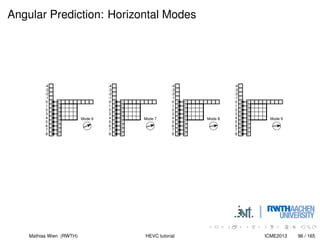
Angular Prediction: Horizontal Modes
-4
-3
-2
-1
0
1
2
3
4
5
6
7
8
Mode 6
-4
-3
-2
-1
0
1
2
3
4
5
6
7
8
Mode 7
-4
-3
-2
-1
0
1
2
3
4
5
6
7
8
Mode 8
-4
-3
-2
-1
0
1
2
3
4
5
6
7
8
Mode 9
Mathias Wien (RWTH) HEVC tutorial ICME2013 96 / 165
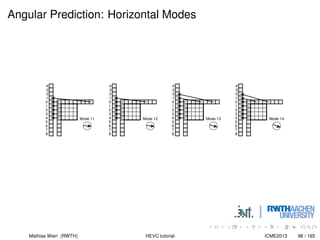
Angular Prediction: Horizontal Modes
-4
-3
-2
-1
0
1
2
3
4
5
6
7
8
Mode 11
-4
-3
-2
-1
0
1
2
3
4
5
6
7
8
Mode 12
-4
-3
-2
-1
0
1
2
3
4
5
6
7
8
Mode 13
-4
-3
-2
-1
0
1
2
3
4
5
6
7
8
Mode 14
Mathias Wien (RWTH) HEVC tutorial ICME2013 96 / 165
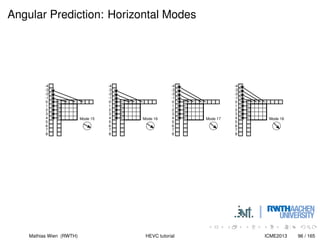
Angular Prediction: Horizontal Modes
-4
-3
-2
-1
0
1
2
3
4
5
6
7
8
Mode 15
-4
-3
-2
-1
0
1
2
3
4
5
6
7
8
Mode 16
-4
-3
-2
-1
0
1
2
3
4
5
6
7
8
Mode 17
-4
-3
-2
-1
0
1
2
3
4
5
6
7
8
Mode 18
Mathias Wien (RWTH) HEVC tutorial ICME2013 96 / 165
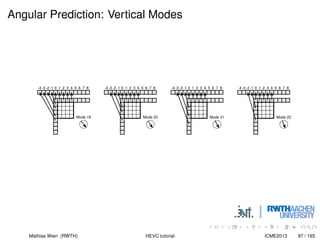
Angular Prediction: Vertical Modes
-4 -3 -2 -1 0 1 2 3 4 5 6 7 8
Mode 19
-4 -3 -2 -1 0 1 2 3 4 5 6 7 8
Mode 20
-4 -3 -2 -1 0 1 2 3 4 5 6 7 8
Mode 21
-4 -3 -2 -1 0 1 2 3 4 5 6 7 8
Mode 22
Mathias Wien (RWTH) HEVC tutorial ICME2013 97 / 165
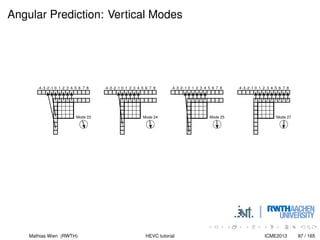
Angular Prediction: Vertical Modes
-4 -3 -2 -1 0 1 2 3 4 5 6 7 8
Mode 23
-4 -3 -2 -1 0 1 2 3 4 5 6 7 8
Mode 24
-4 -3 -2 -1 0 1 2 3 4 5 6 7 8
Mode 25
-4 -3 -2 -1 0 1 2 3 4 5 6 7 8
Mode 27
Mathias Wien (RWTH) HEVC tutorial ICME2013 97 / 165
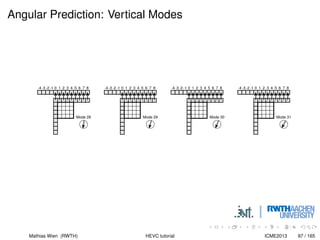
Angular Prediction: Vertical Modes
-4 -3 -2 -1 0 1 2 3 4 5 6 7 8
Mode 28
-4 -3 -2 -1 0 1 2 3 4 5 6 7 8
Mode 29
-4 -3 -2 -1 0 1 2 3 4 5 6 7 8
Mode 30
-4 -3 -2 -1 0 1 2 3 4 5 6 7 8
Mode 31
Mathias Wien (RWTH) HEVC tutorial ICME2013 97 / 165
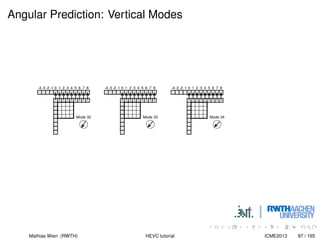
Angular Prediction: Vertical Modes
-4 -3 -2 -1 0 1 2 3 4 5 6 7 8
Mode 32
-4 -3 -2 -1 0 1 2 3 4 5 6 7 8
Mode 33
-4 -3 -2 -1 0 1 2 3 4 5 6 7 8
Mode 34
Mathias Wien (RWTH) HEVC tutorial ICME2013 97 / 165
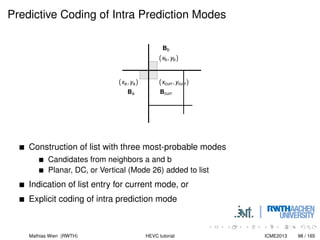
Predictive Coding of Intra Prediction Modes
Bcurr
Ba
Bb
(xcurr,ycurr)
(xa,ya)
(xb,yb)
Construction of list with three most-probable modes
Candidates from neighbors a and b
Planar, DC, or Vertical (Mode 26) added to list
Indication of list entry for current mode, or
Explicit coding of intra prediction mode
Mathias Wien (RWTH) HEVC tutorial ICME2013 98 / 165
Comparison to H.264|AVC
H.264|AVC intra prediction modes
Nine directional prediction modes
DC and planar prediction
4×4 and 8×8 intra prediction blocks (8×8 in High profiles)
16×16 prediction block with less prediction modes
Intra prediction reference
Vertical reference pixels restricted to block size
Predictor low-pass filtering for 8×8 blocks
Mathias Wien (RWTH) HEVC tutorial ICME2013 99 / 165
Part IV
Residual Coding, Loop Filters, Entropy
Coding
Mathias Wien (RWTH) HEVC tutorial ICME2013 100 / 165
Outline
7 Residual Coding
Core Transforms
Alternative 4×4 Transform
Quantization
Coded Representation of Transform Blocks
Special Modes
8 Loop Filtering
Deblocking Filter
Sample Adaptive Offset
9 Entropy Coding
Variable Length Codes
CABAC
Mathias Wien (RWTH) HEVC tutorial ICME2013 101 / 165
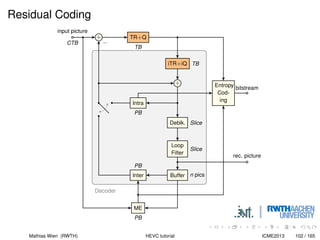
Residual Coding
Decoder
CTB
input picture
+
−
TR+Q
TB
iTR+iQ TB
+
Intra
PB
Entropy
Cod-
ing
bitstream
Deblk. Slice
Loop
Filter
Slice
rec. picture
Inter
PB
Buffer n pics
ME
PB
Mathias Wien (RWTH) HEVC tutorial ICME2013 102 / 165
Core Transforms
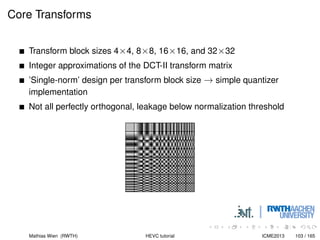
Transform block sizes 4×4, 8×8, 16×16, and 32×32
Integer approximations of the DCT-II transform matrix
’Single-norm’ design per transform block size → simple quantizer
implementation
Not all perfectly orthogonal, leakage below normalization threshold
Mathias Wien (RWTH) HEVC tutorial ICME2013 103 / 165
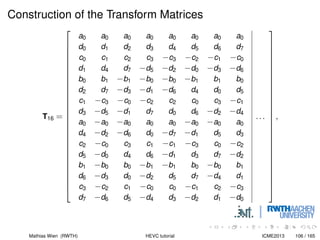
Construction of the Transform Matrices
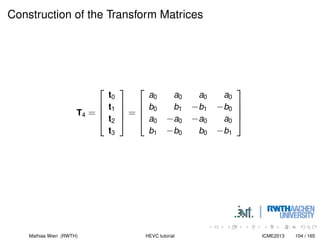
T4 =




t0
t1
t2
t3



 =




a0 a0 a0 a0
b0 b1 −b1 −b0
a0 −a0 −a0 a0
b1 −b0 b0 −b1




Mathias Wien (RWTH) HEVC tutorial ICME2013 104 / 165
Construction of the Transform Matrices
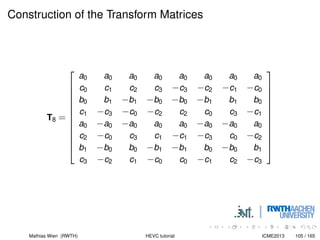
T8 =












a0 a0 a0 a0 a0 a0 a0 a0
c0 c1 c2 c3 −c3 −c2 −c1 −c0
b0 b1 −b1 −b0 −b0 −b1 b1 b0
c1 −c3 −c0 −c2 c2 c0 c3 −c1
a0 −a0 −a0 a0 a0 −a0 −a0 a0
c2 −c0 c3 c1 −c1 −c3 c0 −c2
b1 −b0 b0 −b1 −b1 b0 −b0 b1
c3 −c2 c1 −c0 c0 −c1 c2 −c3












Mathias Wien (RWTH) HEVC tutorial ICME2013 105 / 165
Construction of the Transform Matrices
T16 =





























a0 a0 a0 a0 a0 a0 a0 a0
d0 d1 d2 d3 d4 d5 d6 d7
c0 c1 c2 c3 −c3 −c2 −c1 −c0
d1 d4 d7 −d5 −d2 −d0 −d3 −d6
b0 b1 −b1 −b0 −b0 −b1 b1 b0
d2 d7 −d3 −d1 −d6 d4 d0 d5
c1 −c3 −c0 −c2 c2 c0 c3 −c1
d3 −d5 −d1 d7 d0 d6 −d2 −d4
a0 −a0 −a0 a0 a0 −a0 −a0 a0
d4 −d2 −d6 d0 −d7 −d1 d5 d3
c2 −c0 c3 c1 −c1 −c3 c0 −c2
d5 −d0 d4 d6 −d1 d3 d7 −d2
b1 −b0 b0 −b1 −b1 b0 −b0 b1
d6 −d3 d0 −d2 d5 d7 −d4 d1
c3 −c2 c1 −c0 c0 −c1 c2 −c3
d7 −d6 d5 −d4 d3 −d2 d1 −d0
...





























,
Mathias Wien (RWTH) HEVC tutorial ICME2013 106 / 165
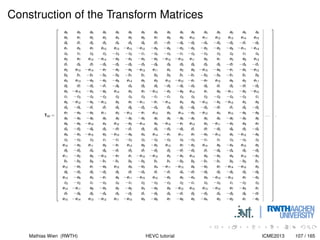
Construction of the Transform Matrices
T32 =






























































a0 a0 a0 a0 a0 a0 a0 a0 a0 a0 a0 a0 a0 a0 a0 a0
e0 e1 e2 e3 e4 e5 e6 e7 e8 e9 e10 e11 e12 e13 e14 e15
d0 d1 d2 d3 d4 d5 d6 d7 −d7 −d6 −d5 −d4 −d3 −d2 −d1 −d0
e1 e4 e7 e10 e13 −e15 −e12 −e9 −e6 −e3 −e0 −e2 −e5 −e8 −e11 −e14
c0 c1 c2 c3 −c3 −c2 −c1 −c0 −c0 −c1 −c2 −c3 c3 c2 c1 c0
e2 e7 e12 −e14 −e9 −e4 −e0 −e5 −e10 −e15 e11 e6 e1 e3 e8 e13
d1 d4 d7 −d5 −d2 −d0 −d3 −d6 d6 d3 d0 d2 d5 −d7 −d4 −d1
e3 e10 −e14 −e7 −e0 −e6 −e13 e11 e4 e2 e9 −e15 −e8 −e1 −e5 −e12
b0 b1 −b1 −b0 −b0 −b1 b1 b0 b0 b1 −b1 −b0 −b0 −b1 b1 b0
e4 e13 −e9 −e0 −e8 e14 e5 e3 e12 −e10 −e1 −e7 e15 e6 e2 e11
d2 d7 −d3 −d1 −d6 d4 d0 d5 −d5 −d0 −d4 d6 d1 d3 −d7 −d2
e5 −e15 −e4 −e6 e14 e3 e7 −e13 −e2 −e8 e12 e1 e9 −e11 −e0 −e10
c1 −c3 −c0 −c2 c2 c0 c3 −c1 −c1 c3 c0 c2 −c2 −c0 −c3 c1
e6 −e12 −e0 −e13 e5 e7 −e11 −e1 −e14 e4 e8 −e10 −e2 −e15 e3 e9
d3 −d5 −d1 d7 d0 d6 −d2 −d4 d4 d2 −d6 −d0 −d7 d1 d5 −d3
e7 −e9 −e5 e11 e3 −e13 −e1 e15 e0 e14 −e2 −e12 e4 e10 −e6 −e8
a0 −a0 −a0 a0 a0 −a0 −a0 a0 a0 −a0 −a0 a0 a0 −a0 −a0 a0
e8 −e6 −e10 e4 e12 −e2 −e14 e0 −e15 −e1 e13 e3 −e11 −e5 e9 e7
d4 −d2 −d6 d0 −d7 −d1 d5 d3 −d3 −d5 d1 d7 −d0 d6 d2 −d4
e9 −e3 −e15 e2 −e10 −e8 e4 e14 −e1 e11 e7 −e5 −e13 e0 −e12 −e6
c2 −c0 c3 c1 −c1 −c3 c0 −c2 −c2 c0 −c3 −c1 c1 c3 −c0 c2
e10 −e0 e11 e9 −e1 e12 e8 −e2 e13 e7 −e3 e14 e6 −e4 e15 e5
d5 −d0 d4 d6 −d1 d3 d7 −d2 d2 −d7 −d3 d1 −d6 −d4 d0 −d5
e11 −e2 e6 −e15 −e7 e1 −e10 −e12 e3 −e5 e14 e8 −e0 e9 e13 −e4
b1 −b0 b0 −b1 −b1 b0 −b0 b1 b1 −b0 b0 −b1 −b1 b0 −b0 b1
e12 −e5 e1 −e8 e15 e9 −e2 e4 −e11 −e13 e6 −e0 e7 −e14 −e10 e3
d6 −d3 d0 −d2 d5 d7 −d4 d1 −d1 d4 −d7 −d5 d2 −d0 d3 −d6
e13 −e8 e3 −e1 e6 −e11 −e15 e10 −e5 e0 −e4 e9 −e14 −e12 e7 −e2
c3 −c2 c1 −c0 c0 −c1 c2 −c3 −c3 c2 −c1 c0 −c0 c1 −c2 c3
e14 −e11 e8 −e5 e2 −e0 e3 −e6 e9 −e12 e15 e13 −e10 e7 −e4 e1
d7 −d6 d5 −d4 d3 −d2 d1 −d0 d0 −d1 d2 −d3 d4 −d5 d6 −d7
e15 −e14 e13 −e12 e11 −e10 e9 −e8 e7 −e6 e5 −e4 e3 −e2 e1 −e0
...






























































.
Mathias Wien (RWTH) HEVC tutorial ICME2013 107 / 165
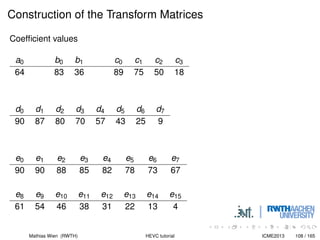
Construction of the Transform Matrices
Coefficient values
a0 b0 b1 c0 c1 c2 c3
64 83 36 89 75 50 18
d0 d1 d2 d3 d4 d5 d6 d7
90 87 80 70 57 43 25 9
e0 e1 e2 e3 e4 e5 e6 e7
90 90 88 85 82 78 73 67
e8 e9 e10 e11 e12 e13 e14 e15
61 54 46 38 31 22 13 4
Mathias Wien (RWTH) HEVC tutorial ICME2013 108 / 165
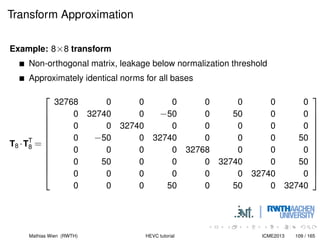
Transform Approximation
Example: 8×8 transform
Non-orthogonal matrix, leakage below normalization threshold
Approximately identical norms for all bases
T8 ·TT
8 =












32768 0 0 0 0 0 0 0
0 32740 0 −50 0 50 0 0
0 0 32740 0 0 0 0 0
0 −50 0 32740 0 0 0 50
0 0 0 0 32768 0 0 0
0 50 0 0 0 32740 0 50
0 0 0 0 0 0 32740 0
0 0 0 50 0 50 0 32740












Mathias Wien (RWTH) HEVC tutorial ICME2013 109 / 165
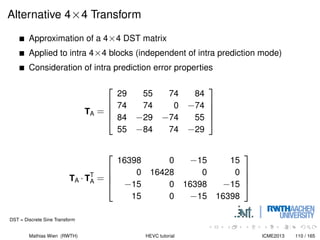
Alternative 4×4 Transform
Approximation of a 4×4 DST matrix
Applied to intra 4×4 blocks (independent of intra prediction mode)
Consideration of intra prediction error properties
TA =




29 55 74 84
74 74 0 −74
84 −29 −74 55
55 −84 74 −29




TA ·TT
A =




16398 0 −15 15
0 16428 0 0
−15 0 16398 −15
15 0 −15 16398




DST = Discrete Sine Transform
Mathias Wien (RWTH) HEVC tutorial ICME2013 110 / 165
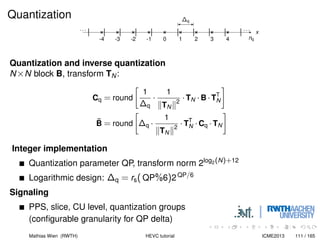
Quantization
... ...
nq
x
-4 -3 -2 -1 1 2 3 4
0
∆q
Quantization and inverse quantization
N×N block B, transform TN:
Cq = round

1
∆q
·
1
kTN k2
·TN ·B ·TT
N

B̃ = round

∆q ·
1
kTN k2
·TT
N ·Cq ·TN

Integer implementation
Quantization parameter QP, transform norm 2log2(N)+12
Logarithmic design: ∆q = rs( QP%6)2QP/6
Signaling
PPS, slice, CU level, quantization groups
(configurable granularity for QP delta)
Mathias Wien (RWTH) HEVC tutorial ICME2013 111 / 165
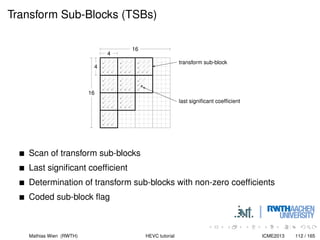
Transform Sub-Blocks (TSBs)
last significant coefficient
16
16
4
4
transform sub-block
Scan of transform sub-blocks
Last significant coefficient
Determination of transform sub-blocks with non-zero coefficients
Coded sub-block flag
Mathias Wien (RWTH) HEVC tutorial ICME2013 112 / 165
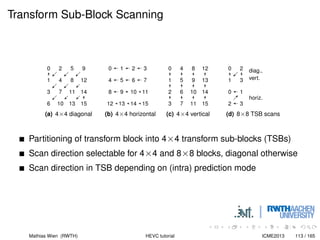
Transform Sub-Block Scanning
0
1
2
3
4
5
6
7
8
9
10
11
12
13
14
15
0 1 2 3
4 5 6 7
8 9 10 11
12 13 14 15
0
1
2
3
4
5
6
7
8
9
10
11
12
13
14
15
0
1
2
3
0
2
1
3
diag.,
vert.
horiz.
(a) 4×4 diagonal (b) 4×4 horizontal (c) 4×4 vertical (d) 8×8 TSB scans
Partitioning of transform block into 4×4 transform sub-blocks (TSBs)
Scan direction selectable for 4×4 and 8×8 blocks, diagonal otherwise
Scan direction in TSB depending on (intra) prediction mode
Mathias Wien (RWTH) HEVC tutorial ICME2013 113 / 165
Coded Representation of Transform Blocks
Coded transform coefficient information in five scan passes
Significance map
Level larger than 1
Level larger than 2
Coefficient sign
Remaining absolute level
Level larger than 1 and 2 scans terminate early if too many significant
coefficients
SoJoNgJiKaClHeDu12 [19]
Mathias Wien (RWTH) HEVC tutorial ICME2013 114 / 165
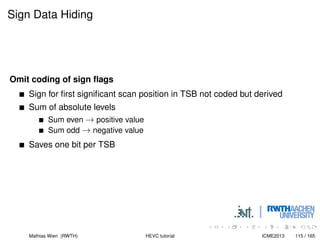
Sign Data Hiding
Omit coding of sign flags
Sign for first significant scan position in TSB not coded but derived
Sum of absolute levels
Sum even → positive value
Sum odd → negative value
Saves one bit per TSB
Mathias Wien (RWTH) HEVC tutorial ICME2013 115 / 165
Special Modes
Transform Skip, applicable to 4×4 TUs
Omit transform step
Inverse quantization operation
Additional bit shift to compensate missing transform
PCM mode
Direct encoding of pixel levels
Lossless representation of a CU
Configurable bit depth (SPS)
Maximum PCM block size 32×32
Mathias Wien (RWTH) HEVC tutorial ICME2013 116 / 165
Outline
7 Residual Coding
Core Transforms
Alternative 4×4 Transform
Quantization
Coded Representation of Transform Blocks
Special Modes
8 Loop Filtering
Deblocking Filter
Sample Adaptive Offset
9 Entropy Coding
Variable Length Codes
CABAC
Mathias Wien (RWTH) HEVC tutorial ICME2013 117 / 165
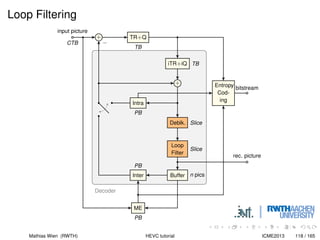
Loop Filtering
Decoder
CTB
input picture
+
−
TR+Q
TB
iTR+iQ TB
+
Intra
PB
Entropy
Cod-
ing
bitstream
Deblk. Slice
Loop
Filter
Slice
rec. picture
Inter
PB
Buffer n pics
ME
PB
Mathias Wien (RWTH) HEVC tutorial ICME2013 118 / 165
Deblocking Filter
Design considerations
Reduction of visible blocking artifacts from block-wise processing
Computational complexity
Parallel processing
H.264|AVC deblocking filter in comparison:
Operation on 4×4 block boundary grid
Operation on macroblock basis (no parallel processing)
Higher computational complexity
[20]
Mathias Wien (RWTH) HEVC tutorial ICME2013 119 / 165
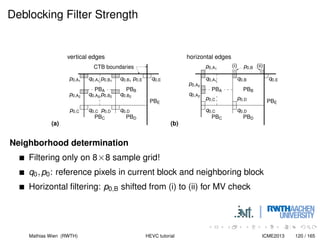
Deblocking Filter Strength
vertical edges horizontal edges
(a)
CTB boundaries
PBA PBB
PBC PBD
PBE
q0,A1
p0,A1
q0,A2
p0,A2
q0,B1
p0,B1
q0,B2
p0,B2
q0,E
p0,E
q0,C
p0,C q0,D
p0,D
(b)
PBA PBB
PBC PBD
PBE
q0,A1
p0,A1
q0,A2
p0,A2
q0,B
p0,B
(i) (ii)
q0,E
q0,C q0,D
p0,C p0,D
Neighborhood determination
Filtering only on 8×8 sample grid!
q0,p0: reference pixels in current block and neighboring block
Horizontal filtering: p0,B shifted from (i) to (ii) for MV check
Mathias Wien (RWTH) HEVC tutorial ICME2013 120 / 165
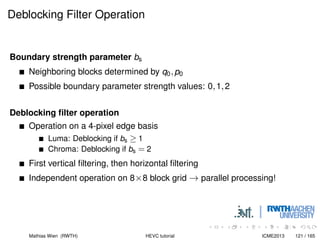
Deblocking Filter Operation
Boundary strength parameter bs
Neighboring blocks determined by q0,p0
Possible boundary parameter strength values: 0,1,2
Deblocking filter operation
Operation on a 4-pixel edge basis
Luma: Deblocking if bs ≥ 1
Chroma: Deblocking if bs = 2
First vertical filtering, then horizontal filtering
Independent operation on 8×8 block grid → parallel processing!
Mathias Wien (RWTH) HEVC tutorial ICME2013 121 / 165
Deblocking Filter Operation
q0,0
q0,3
p0,0
p0,3
q1,0
q1,3
p1,0
p1,3
q2,0
q2,3
p2,0
p2,3
q3,0
q3,3
p3,0
p3,3
Bq
Bp
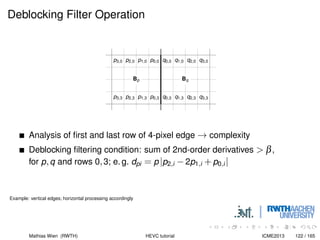
Analysis of first and last row of 4-pixel edge → complexity
Deblocking filtering condition: sum of 2nd-order derivatives  β,
for p,q and rows 0,3; e. g. dpi = p |p2,i −2p1,i +p0,i |
Example: vertical edges; horizontal processing accordingly
Mathias Wien (RWTH) HEVC tutorial ICME2013 122 / 165
Deblocking Filter Operation
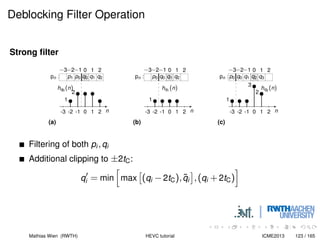
Strong filter
-3 -2 -1 0 1 2 n
1
2
hq0
(n)
p1 p0 q0 q1 q2
pn :
−3−2−1 0 1 2
-3 -2 -1 0 1 2 n
1
hq1
(n)
p0 q0 q1 q2
pn :
−3−2−1 0 1 2
-3 -2 -1 0 1 2 n
1
3
2
hq2
(n)
p0 q0 q1 q2 q3
pn :
−3−2−1 0 1 2
(a) (b) (c)
Filtering of both pi ,qi
Additional clipping to ±2tC:
q0
i = min
h
max

(qi −2tC),q̃i

,(qi +2tC)
i
Mathias Wien (RWTH) HEVC tutorial ICME2013 123 / 165
Deblocking Filter Operation
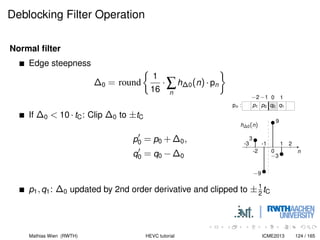
Normal filter
Edge steepness
∆0 = round

1
16
·∑
n
h∆0(n)·pn

If ∆0  10 ·tC: Clip ∆0 to ±tC
p0
0 = p0 +∆0,
q0
0 = q0 −∆0
n
-3 -1 1 2
-2 0
3
−9
9
−3
h∆0(n)
p1 p0 q0 q1
pn :
−2 −1 0 1
p1,q1: ∆0 updated by 2nd order derivative and clipped to ±1
2
tC
Mathias Wien (RWTH) HEVC tutorial ICME2013 124 / 165
Sample Adaptive Offset (SAO)
New filter type in ITU-T / MPEG video coding specifications
Local processing of pixels
Depending on local neighborhood, or
Depending on pixel value (amplitude)
Operation independent of processed pixels → parallel processing
Local filter parameter adaptation
[21]
Mathias Wien (RWTH) HEVC tutorial ICME2013 125 / 165
SAO: Edge Offset
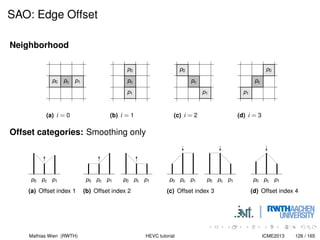
Neighborhood
pc
p0 p1 pc
p1
p0
pc
p1
p0
pc
p1
p0
(a) i = 0 (b) i = 1 (c) i = 2 (d) i = 3
Offset categories: Smoothing only
p0 pc p1 p0 pc p1 p0 pc p1 p0 pc p1 p0 pc p1 p0 pc p1
(a) Offset index 1 (b) Offset index 2 (c) Offset index 3 (d) Offset index 4
Mathias Wien (RWTH) HEVC tutorial ICME2013 126 / 165
SAO: Band Offset
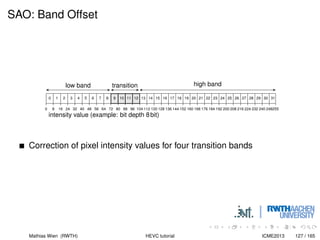
low band transition high band
0 8 16 24 32 40 48 56 64 72 80 88 96 104 112 120 128 136 144 152 160 168 176 184 192 200 208 216 224 232 240 248
0 1 2 3 4 5 6 7 8 9 10 11 12 13 14 15 16 17 18 19 20 21 22 23 24 25 26 27 28 29 30 31
255
intensity value (example: bit depth 8bit)
Correction of pixel intensity values for four transition bands
Mathias Wien (RWTH) HEVC tutorial ICME2013 127 / 165
Sample Adaptive Offset Signaling
Activation of SAO in SPS
SAO signaling on CTU basis
SAO merge (inherit SAO parameters from top or left neighbor)
SAO type: Edge or band offset
SAO offsets
Mathias Wien (RWTH) HEVC tutorial ICME2013 128 / 165
Outline
7 Residual Coding
Core Transforms
Alternative 4×4 Transform
Quantization
Coded Representation of Transform Blocks
Special Modes
8 Loop Filtering
Deblocking Filter
Sample Adaptive Offset
9 Entropy Coding
Variable Length Codes
CABAC
Mathias Wien (RWTH) HEVC tutorial ICME2013 129 / 165
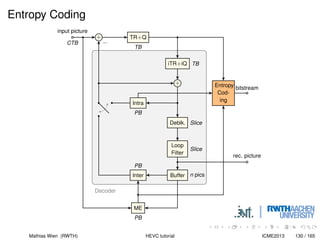
Entropy Coding
Decoder
CTB
input picture
+
−
TR+Q
TB
iTR+iQ TB
+
Intra
PB
Entropy
Cod-
ing
bitstream
Deblk. Slice
Loop
Filter
Slice
rec. picture
Inter
PB
Buffer n pics
ME
PB
Mathias Wien (RWTH) HEVC tutorial ICME2013 130 / 165
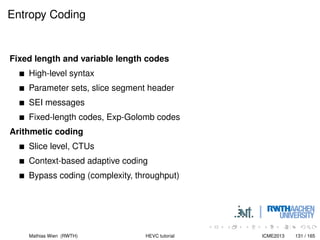
Entropy Coding
Fixed length and variable length codes
High-level syntax
Parameter sets, slice segment header
SEI messages
Fixed-length codes, Exp-Golomb codes
Arithmetic coding
Slice level, CTUs
Context-based adaptive coding
Bypass coding (complexity, throughput)
Mathias Wien (RWTH) HEVC tutorial ICME2013 131 / 165
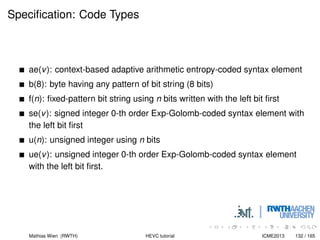
Specification: Code Types
ae(v): context-based adaptive arithmetic entropy-coded syntax element
b(8): byte having any pattern of bit string (8 bits)
f(n): fixed-pattern bit string using n bits written with the left bit first
se(v): signed integer 0-th order Exp-Golomb-coded syntax element with
the left bit first
u(n): unsigned integer using n bits
ue(v): unsigned integer 0-th order Exp-Golomb-coded syntax element
with the left bit first.
Mathias Wien (RWTH) HEVC tutorial ICME2013 132 / 165
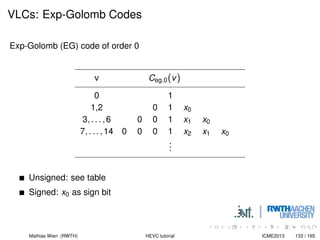
VLCs: Exp-Golomb Codes
Exp-Golomb (EG) code of order 0
v Ceg,0(v)
0 1
1,2 0 1 x0
3,...,6 0 0 1 x1 x0
7,...,14 0 0 0 1 x2 x1 x0
.
.
.
Unsigned: see table
Signed: x0 as sign bit
Mathias Wien (RWTH) HEVC tutorial ICME2013 133 / 165
CABAC
Context-based Adaptive Binary Arithmetic Coding
Binary Arithmetic Coder
syntax element
Binarizer
Context
Modeler
Adaptive
Engine
Bypass
Engine
bitstream
bin string
binary value
bin value coded bits
context update
MaScWi03 [22]
Mathias Wien (RWTH) HEVC tutorial ICME2013 134 / 165
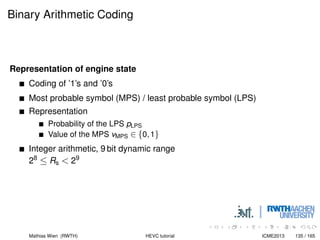
Binary Arithmetic Coding
Representation of engine state
Coding of ’1’s and ’0’s
Most probable symbol (MPS) / least probable symbol (LPS)
Representation
Probability of the LPS pLPS
Value of the MPS vMPS ∈ {0,1}
Integer arithmetic, 9 bit dynamic range
28
≤ Rs  29
Mathias Wien (RWTH) HEVC tutorial ICME2013 135 / 165
CABAC State Transition
0 5 10 15 20 25 30 35 40 45 50 55 60
0.1
0.2
0.3
0.4
0.5
p̃LPSi
ipLPS
state ipLPS
state ipLPS
+1
LPS
MPS
State transitions ipLPS
= 0...62
State ipLPS
= 63 for termination
Highest value p̃LPSi = 0.5 for ipLPS
= 0
Change of vMPS if coding LPS and ipLPS
= 0
MaScWi03 [22]
Mathias Wien (RWTH) HEVC tutorial ICME2013 136 / 165
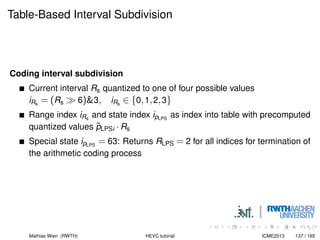
Table-Based Interval Subdivision
Coding interval subdivision
Current interval Rs quantized to one of four possible values
iRs
= (Rs  6)3, iRs
∈ {0,1,2,3}
Range index iRs
and state index ipLPS
as index into table with precomputed
quantized values p̃LPSi ·Rs
Special state ipLPS
= 63: Returns RLPS = 2 for all indices for termination of
the arithmetic coding process
Mathias Wien (RWTH) HEVC tutorial ICME2013 137 / 165
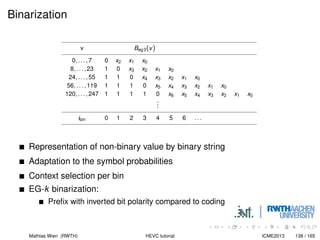
Binarization
v Beg3(v)
0,...,7 0 x2 x1 x0
8,...,23 1 0 x3 x2 x1 x0
24,...,55 1 1 0 x4 x3 x2 x1 x0
56,...,119 1 1 1 0 x5 x4 x3 x2 x1 x0
120,...,247 1 1 1 1 0 x6 x5 x4 x3 x2 x1 x0
.
.
.
ibin 0 1 2 3 4 5 6 ...
Representation of non-binary value by binary string
Adaptation to the symbol probabilities
Context selection per bin
EG-k binarization:
Prefix with inverted bit polarity compared to coding
Mathias Wien (RWTH) HEVC tutorial ICME2013 138 / 165
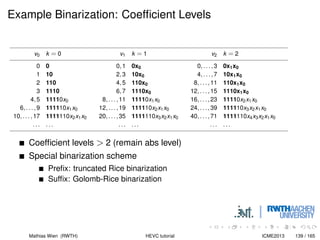
Example Binarization: Coefficient Levels
v0 k = 0 v1 k = 1 v2 k = 2
0 0 0,1 0x0 0,...,3 0x1x0
1 10 2,3 10x0 4,...,7 10x1x0
2 110 4,5 110x0 8,...,11 110x1x0
3 1110 6,7 1110x0 12,...,15 1110x1x0
4,5 11110x0 8,...,11 11110x1x0 16,...,23 11110x2x1x0
6,...,9 111110x1x0 12,...,19 111110x2x1x0 24,...,39 111110x3x2x1x0
10,...,17 1111110x2x1x0 20,...,35 1111110x3x2x1x0 40,...,71 1111110x4x3x2x1x0
... ... ... ... ... ...
Coefficient levels  2 (remain abs level)
Special binarization scheme
Prefix: truncated Rice binarization
Suffix: Golomb-Rice binarization
Mathias Wien (RWTH) HEVC tutorial ICME2013 139 / 165
Context Initialization
Contexts initialized
Beginning of slice
Beginning of tile
Three available sets of initialization values
I-slices
Two sets for P- and B-slices selectable by slice segment header flag
Mathias Wien (RWTH) HEVC tutorial ICME2013 140 / 165
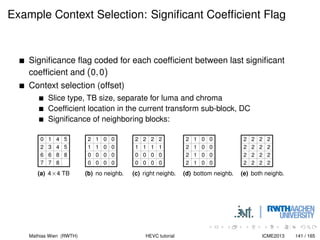
Example Context Selection: Significant Coefficient Flag
Significance flag coded for each coefficient between last significant
coefficient and (0,0)
Context selection (offset)
Slice type, TB size, separate for luma and chroma
Coefficient location in the current transform sub-block, DC
Significance of neighboring blocks:
0 1 4 5
2 3 4 5
6 6 8 8
7 7 8
2 1 0 0
1 1 0 0
0 0 0 0
0 0 0 0
2 2 2 2
1 1 1 1
0 0 0 0
0 0 0 0
2 1 0 0
2 1 0 0
2 1 0 0
2 1 0 0
2 2 2 2
2 2 2 2
2 2 2 2
2 2 2 2
(a) 4×4 TB (b) no neighb. (c) right neighb. (d) bottom neighb. (e) both neighb.
Mathias Wien (RWTH) HEVC tutorial ICME2013 141 / 165
CABAC Throughput
Reduced number of bins using context adaptation: Less computational
complexity for bypass coded bins (range adaptation by bit shift)
Grouping of bypass bins
Grouping of bins with same context
Minimized context dependencies
Avoidance of parsing dependencies
SzBu12 [11]
Mathias Wien (RWTH) HEVC tutorial ICME2013 142 / 165
Comparison to H.264|AVC
Reduced total number of coded bins (worst case, 1.5×)
Reduced number of context coded bins (8×)
Reduced number of contexts, storage size: 153 for HEVC, 459 (289 w/o
interlaced) for H.264|AVC. 8 bit initialization values in HEVC, 16 bit in
H.264|AVC
Coefficient memory consumption: 4×4 transform sub-blocks
Cleaner structure
Grouping of bypass bins, bins with same context
Reduced parsing dependencies (without significant performance impact)
SzBu12 [11]
Mathias Wien (RWTH) HEVC tutorial ICME2013 143 / 165
Part V
Profiles/Tiers/Levels, Extensions,
Performance
Mathias Wien (RWTH) HEVC tutorial ICME2013 144 / 165
Outline
10 Profiles, Tiers, and Levels
Main Profiles
Tiers and Levels
11 Compression Performance
12 Extensions to HEVC
Mathias Wien (RWTH) HEVC tutorial ICME2013 145 / 165
Profiles, Tiers, and Levels
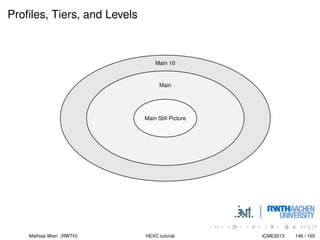
Main Still Picture
Main
Main 10
Mathias Wien (RWTH) HEVC tutorial ICME2013 146 / 165
Profiles
Main Profile
YCbCr 4:2:0 8 bit video only
CTB block sizes 16×16, 32×32, and 64×64
Either tiles or wavefront parallel processing
Minimum tile size 256×64 pixels
Maximum number of bits in the bitstream that are CABAC coded is
5*raw/3
Main 10 Profile
Additional support of bit depths of 9 and 10 bit
Main Still Picture Profile
Like Main, but only one picture in the bitstream
No timing constraints for the decoder
Mathias Wien (RWTH) HEVC tutorial ICME2013 147 / 165
Tiers and Levels
Profiles
Defined tool (sub) set of specification
Tools determined from application space
Tiers and levels
Levels: Restrictions on parameters which determine decoding and
buffering capabilities (13 levels defined)
Tiers: Grouping of level limits for different application spaces (currently:
Main Tier for consumer, High Tier for professional applications)
Decoder capable of decoding Profile@Tier/Level must be able to decode
all lower levels of same and lower tier
Mathias Wien (RWTH) HEVC tutorial ICME2013 148 / 165
Outline
10 Profiles, Tiers, and Levels
Main Profiles
Tiers and Levels
11 Compression Performance
12 Extensions to HEVC
Mathias Wien (RWTH) HEVC tutorial ICME2013 149 / 165
HEVC Compression Performance
Significantly improved compression performance
Comparison of H.264|AVC and HEVC
Subjective and objective quality assessment: OhSuHeTaWi12 [3]
Complexity analysis: BoBrSuFl12 [4]
Facts
Reportedly about 49% bitrate savings for HEVC compared to H.264|AVC
for entertainment application scenario [3]
HEVC real-time encoder and decoder implementations reported and
demonstrated at the JCT-VC meetings, e. g. JCTVC-L0098 [23],
JCTVC-L0379 [24]
Mathias Wien (RWTH) HEVC tutorial ICME2013 150 / 165
Subjective Assessment Results
Entertainment applications
Figure from OhSuHeTaWi12 [3]
Mathias Wien (RWTH) HEVC tutorial ICME2013 151 / 165
Subjective Assessment Results
Entertainment applications
Figure from OhSuHeTaWi12 [3]
Mathias Wien (RWTH) HEVC tutorial ICME2013 152 / 165
Subjective Assessment Results
Entertainment applications
Figure from OhSuHeTaWi12 [3]
Mathias Wien (RWTH) HEVC tutorial ICME2013 153 / 165
Subjective Assessment Results
Entertainment applications
Figure from OhSuHeTaWi12 [3]
Mathias Wien (RWTH) HEVC tutorial ICME2013 154 / 165
Outline
10 Profiles, Tiers, and Levels
Main Profiles
Tiers and Levels
11 Compression Performance
12 Extensions to HEVC
Mathias Wien (RWTH) HEVC tutorial ICME2013 155 / 165
Extensions in Development
Range extensions
Extended color formats (4 : 2 : 2, 4 : 4 : 4)
Extended bit depth
Scalable extensions
Simple, multiloop approach
No modifications on tool-level
Supports spatial, SNR scalability
Temporal scalability already supported in Main profiles
Multi-view / 3D extensions (→ tutorial by Karsten!)
Stereo / multi-view coding
Multi-view + depth
Mathias Wien (RWTH) HEVC tutorial ICME2013 156 / 165
Outline
13 Resources
14 Acronyms
15 References
Mathias Wien (RWTH) HEVC tutorial ICME2013 157 / 165
HEVC Resources
JCT-VC Mailing List
http://mailman.rwth-aachen.de/mailman/listinfo/jct-vc
JCT-VC Document Repository
http://phenix.it-sudparis.eu/jct/index.php
http://ftp3.itu.int/av-arch/jctvc-site/
JCT-VC HM Software Repository
SVN:
https://hevc.hhi.fraunhofer.de/svn/svn_HEVCSoftware
Trac:
https://hevc.hhi.fraunhofer.de/trac/hevc
Mathias Wien (RWTH) HEVC tutorial ICME2013 158 / 165
Outline
13 Resources
14 Acronyms
15 References
Mathias Wien (RWTH) HEVC tutorial ICME2013 159 / 165
Acronyms
AHG – Ad-hoc group
AMVP – Advanced motion vector prediction
AU – Access unit
BDSNR – Bøntegaard Delta PSNR
BD-rate – Bøntegaard Delta rate
BLA – Broken link access
CABAC – Context adaptive binary arithmetic coding
CPB – Coded picture buffer
CB – Coding block
CRA – Clean random access
CTB – Coding tree block
CTU – Coding tree unit
CU – Coding unit
CE – Core experiment
DCT – Discrete cosine transform
DST – Discrete sine transform
DPB – Decoded picture buffer
DU – Decoding unit
GOP – Group of pictures
HRD – Hypothetical reference decoder
Mathias Wien (RWTH) HEVC tutorial ICME2013 160 / 165
Acronyms II
HVS – Human visual system
IDR – Instantaneous decoder refresh
MPM – Most probable mode
Merge – Merge Mode (MV prediction)
NAL – Network abstraction layer
NUT – NAL unit type
QP – Quantization parameter
PB – Prediction block
POC – Picture order count
PPS – Picture parameter set
PU – Prediction unit
RADL – Random access decodable leading picture
RASL – Random access skipped leading picture
RBSP – Raw byte sequence payload
RPL – Reference picture list
RPS – Reference picture set
RQT – Residual quad-tree
SAD – Sum of absolute differences
SAO – Sample adaptive offset
SAR – Sample aspect ratio
Mathias Wien (RWTH) HEVC tutorial ICME2013 161 / 165
Acronyms III
SEI – Supplemental enhancement information
SODB – String of data bits
SOP – Structure of pictures
SPS – Sequence parameter set
SSD – Sum of squared differences
STSA – Stepwise temporal sub-layer access
TB – Transform block
TSA – Temporal sub-layer access
TSB – Transform sub-block
TU – Transform unit
VCL – Video coding layer
VLC – Variable length code
VPS – Video parameter set
VUI – Video usability information
WPP – Wavefront parallel processing
Mathias Wien (RWTH) HEVC tutorial ICME2013 162 / 165
Outline
13 Resources
14 Acronyms
15 References
Mathias Wien (RWTH) HEVC tutorial ICME2013 163 / 165
References I
[1] High efficiency video coding. ITU-T Recommendation H.265 and ISO/IEC 23008-2 (HEVC). Apr. 2013.
[2] Gary J. Sullivan et al. “Overview of the High Efficiency Video Coding (HEVC) Standard”. In: IEEE Transactions on Circuits and
Systems for Video Technology 22.12 (Dec. 2012), pp. 1649–1668. DOI: 10.1109/TCSVT.2012.2221191.
[3] Jens-Rainer Ohm et al. “Comparison of the Coding Efficiency of Video Coding Standards—Including High Efficiency Video Coding
(HEVC)”. In: IEEE Transactions on Circuits and Systems for Video Technology 22.12 (Dec. 2012), pp. 1669–1684. DOI:
10.1109/TCSVT.2012.2221192.
[4] Frank Bossen et al. “HEVC Complexity and Implementation Analysis”. In: IEEE Transactions on Circuits and Systems for Video
Technology 22.12 (Dec. 2012), pp. 1685–1696. DOI: 10.1109/TCSVT.2012.2221255.
[5] VCEG and MPEG. Terms of Reference of the Joint Collaborative Team on Video Coding Standard Development. Doc. VCEG-AM90.
Kyoto, JP: ITU-T SG16/Q6 VCEG, Jan. 2010.
[6] VCEG and MPEG. Joint Call for Proposals on Video Compression Technology. Doc. VCEG-AM91. Kyoto, JP: ITU-T SG16/Q6 VCEG,
Jan. 2010.
[7] Charles Poynton. Digital Video and HD: Algorithms and Interfaces. Waltham, MA, USA: Morgan Kaufman Publishers, 2012.
[8] Video codec for audiovisual services at p ×64kbit/s. ITU-T Recommendation H.261. 1993. URL:
http://www.itu.int/rec/T-REC-H.261/en.
[9] Gisle Bjontegaard. Calculation of average PSNR differences between RD curves. Doc. VCEG-M33. Austin, TX, USA: ITU-T SG16/Q6
VCEG, Apr. 2001.
[10] Jing Wang, Xiang Yu, and Dake He. On BD-rate calculation. Doc. JCTVC-F270. Torino, IT, 6th meeting: Joint Collaborative Team on
Video Coding (JCT-VC) of ITU-T VCEG and ISO/IEC MPEG, July 2011.
[11] Vivienne Sze and Madhukar Budagavi. “High Throughput CABAC Entropy Coding in HEVC”. In: IEEE Transactions on Circuits and
Systems for Video Technology 22.12 (Dec. 2012), pp. 1778–1791. DOI: 10.1109/TCSVT.2012.2221526.
[12] Madhukar Budagavi and Louis Kreofsky. BoG report on Quantization. Doc. JCTVC-G1044. Geneva, CH, 7th meeting: Joint
Collaborative Team on Video Coding (JCT-VC) of ITU-T VCEG and ISO/IEC MPEG, Nov. 2011.
Mathias Wien (RWTH) HEVC tutorial ICME2013 164 / 165
References II
[13] Louis Kerofsky and Andrew Segall. Non CE4: Limiting dynamic range when using a quantization weighting matrix. Doc. JCTVC-H0541.
San Jose, CA, USA, 8th meeting: Joint Collaborative Team on Video Coding (JCT-VC) of ITU-T VCEG and ISO/IEC MPEG, Jan. 2012.
[14] Rickard Sjöberg et al. “Overview of HEVC high-level syntax and reference picture management”. In: IEEE Transactions on Circuits and
Systems for Video Technology 22.12 (Dec. 2012), pp. 1858–1870. DOI: 10.1109/TCSVT.2012.2223052.
[15] Frank Bossen. Common test conditions and software reference configurations. Doc. JCTVC-K1100. Shanghai, CN, 11th meeting: Joint
Collaborative Team on Video Coding (JCT-VC) of ITU-T VCEG and ISO/IEC MPEG, Oct. 2012.
[16] Elena Alshina et al. CE3: Experimental results of DCTIF by Samsung. Doc. JCTVC-D344. Daegu, KR, 4th meeting: Joint Collaborative
Team on Video Coding (JCT-VC) of ITU-T VCEG and ISO/IEC MPEG, Jan. 2011.
[17] Elena Alshina and Alexander Alshin. CE3: DCT derived interpolation filter test by Samsung. Doc. JCTVC-F247. Torino, IT, 6th meeting:
Joint Collaborative Team on Video Coding (JCT-VC) of ITU-T VCEG and ISO/IEC MPEG, July 2011.
[18] Jani Lainema et al. “Intra Coding of the HEVC Standard”. In: IEEE Transactions on Circuits and Systems for Video Technology 22.12
(Dec. 2012), pp. 1792–1801. DOI: 10.1109/TCSVT.2012.2221525.
[19] Joel Sole et al. “Transform Coefficient Coding in HEVC”. In: IEEE Transactions on Circuits and Systems for Video Technology 22.12
(Dec. 2012), pp. 1765–1777. DOI: 10.1109/TCSVT.2012.2223055.
[20] Andrey Norkin et al. “HEVC Deblocking Filter”. In: IEEE Transactions on Circuits and Systems for Video Technology 22.12 (Dec. 2012),
pp. 1746–1754. DOI: 10.1109/TCSVT.2012.2223053.
[21] Chih-Ming Fu et al. “Sample Adaptive Offset in the HEVC Standard”. In: IEEE Transactions on Circuits and Systems for Video
Technology 22.12 (Dec. 2012), pp. 1755–1764. DOI: 10.1109/TCSVT.2012.2221529.
[22] Detlev Marpe, Heiko Schwarz, and Thomas Wiegand. “Context-Based Adaptive Binary Arithmetic Coding in the H.264/AVC Video
Compression Standard”. In: IEEE Transactions on Circuits and Systems for Video Technology 13.7 (July 2003), pp. 620–637.
[23] Thiow K. Tan, Yoshinori Suzuki, and Frank Bossen. On software complexity: decoding 4K60p content on a laptop. Doc. JCTVC-L0098.
Geneva, CH, 12th meeting: Joint Collaborative Team on Video Coding (JCT-VC) of ITU-T VCEG and ISO/IEC MPEG, Jan. 2013.
[24] A. Minezawa et al. HEVC Real-time Hardware Encoder for HDTV signal. Doc. JCTVC-L0379. Geneva, CH, 12th meeting: Joint
Collaborative Team on Video Coding (JCT-VC) of ITU-T VCEG and ISO/IEC MPEG, Jan. 2013.
Mathias Wien (RWTH) HEVC tutorial ICME2013 165 / 165

Tutorial High Efficiency Video Coding Coding - Tools and Specification.pdf

  • 1.
    High Efficiency VideoCoding Coding Tools and Specification Mathias Wien Institut für Nachrichtentechnik RWTH Aachen University ICME2013 Mathias Wien (RWTH) HEVC tutorial ICME2013 1 / 165
  • 2.
    Outline Part I 1Introduction HEVC – Vision and Requirements The Joint Collaborative Team on Video Coding Video Basics The Hybrid Coding Scheme Encoder Control 2 Specification and Standardization Specification Design Mathias Wien (RWTH) HEVC tutorial ICME2013 2 / 165
  • 3.
    Outline Part II 3Coding Structures Temporal Coding Structures Spatial Coding Structures Reference Pictures 4 High-Level Syntax Network Abstraction Layer Parameter Sets Picture Order Count Supplemental Enhancement Information Byte Stream Format Comparison to H.264|AVC Mathias Wien (RWTH) HEVC tutorial ICME2013 3 / 165
  • 4.
    Outline Part III 5Inter Prediction Motion Compensated Prediction 6 Intra Prediction Reference Pixels for Intra Prediction Intra Prediction Modes Predictive Coding of Intra Prediction Modes Mathias Wien (RWTH) HEVC tutorial ICME2013 4 / 165
  • 5.
    Outline Part IV 7Residual Coding Core Transforms Alternative 4×4 Transform Quantization Coded Representation of Transform Blocks Special Modes 8 Loop Filtering Deblocking Filter Sample Adaptive Offset 9 Entropy Coding Variable Length Codes CABAC Mathias Wien (RWTH) HEVC tutorial ICME2013 5 / 165
  • 6.
    Outline Part V 10Profiles, Tiers, and Levels Main Profiles Tiers and Levels 11 Compression Performance 12 Extensions to HEVC Mathias Wien (RWTH) HEVC tutorial ICME2013 6 / 165
  • 7.
    Part I Introduction, Specification MathiasWien (RWTH) HEVC tutorial ICME2013 7 / 165
  • 8.
    Outline 1 Introduction HEVC –Vision and Requirements The Joint Collaborative Team on Video Coding Video Basics The Hybrid Coding Scheme Encoder Control 2 Specification and Standardization Specification Design Mathias Wien (RWTH) HEVC tutorial ICME2013 8 / 165
  • 9.
    The JCT-VC Photo Jan.23rd 2013 by Kazushi Sato Mathias Wien (RWTH) HEVC tutorial ICME2013 9 / 165
  • 10.
    Motivation for aNew Video Coding Standard Increasing Video Resolution High Definition (HD), Ultra High Definition (UHD), 4K×2K, 8K×4K Mobile services in HD Stereo video, multi-view video Recording and Display Devices HD and UHD resolutions available Reaching consumer market Transport Video data rate grows faster than feasible network capabilities Mathias Wien (RWTH) HEVC tutorial ICME2013 10 / 165
  • 11.
    HEVC Vision andRequirements Compression Performance Substantially better compression ratio than H.264|AVC High Profile Shall not be worse than existing standards at any operating point Formats Large range of picture formats Various color spaces and sampling Large range of frame rates Higher bit depth support Progressive scan Mathias Wien (RWTH) HEVC tutorial ICME2013 11 / 165
  • 12.
    HEVC Vision andRequirements Complexity Low complexity operating point Lower complexity than H.264|AVC at better compression performance High performance operating point Higher complexity than H.264|AVC with substantial better compression performance Access Low delay, random access, trick modes Error resilience, video buffer, system layer interface Possible support for scalability and multi-view Mathias Wien (RWTH) HEVC tutorial ICME2013 12 / 165
  • 13.
    Development of HEVC– Time Line Timeline July 2005: Start of KTA in ITU-T SQ16/Q6 VCEG July 2008: Start of HVC activity in ISO/IEC JCT1 SC29/WG11 MPEG April 2009: Call for Evidence on HVC (MPEG doc N10553) January 2010: Formation of the Joint Collaborative Team on Video Coding (JCT-VC) → Joint Call for Proposals (CfP) April 2010: 1st meeting of the JCT-VC, Evaluation of the CfP Name: High Efficiency Video Coding (HEVC) July 2010: Test Model under Consideration (TMuC) October 2010: 1st HEVC Working Draft (WD-1) and Test Model (HM-1) . . . new WD and HM every three month . . . January 2013: 10th HEVC Working Draft and Test Model (HM-10) Final Draft International Standard / Consent Mathias Wien (RWTH) HEVC tutorial ICME2013 13 / 165
  • 14.
    Joint Collaborative Teamon Video Coding – JCT-VC Previous collaborations between MPEG and ITU-T H.262|MPEG-2 Video H.264|AVC in the Joint Video Team (last meeting Nov. 2009 in Geneva) New collaboration between MPEG and VCEG Joint Collaborative Team on Video Coding (JCT-VC) Agreement on Terms of Reference Jan. 2010, N11112, VCEG-AM90 [5] Joint Call for Proposals issues Jan. 2010, N11113, VCEG-AM91 [6] 1st meeting in Dresden, April 2010 Chairs Gary J. Sullivan (Microsoft) Jens-Rainer Ohm (RWTH Aachen University) Resources Mathias Wien (RWTH) HEVC tutorial ICME2013 14 / 165
  • 15.
    JCT-VC Method ofWorking Meetings Decisions by consensus of the group Meeting report with all group decisions of meeting Ad-hoc Group (AhGs) Organize discussion on defined topic between meetings Exist for only one meeting cycle (can be reinstalled) AhG chair / co-chairs: responsible for synchronization, reporting Core Experiments (CEs) Defined from meeting to meeting Single tools: Precise definition, well-defined test and evaluation Verification and cross-check of reported results Coordinator(s): responsible for conduction, reporting Mathias Wien (RWTH) HEVC tutorial ICME2013 15 / 165
  • 16.
    Structure of aVideo Sequence Definitions Picture: single array or set of multiple (three) arrays of samples (pixels = picture elements). Has lines of pixels Field picture: even and odd lines of the full resolution taken at successive time instances → interlaced video Top field: even lines Bottom field: odd lines Frame: Pair of top and bottom field pictures for interlaced video Full resolution picture in progressive scan Mathias Wien (RWTH) HEVC tutorial ICME2013 16 / 165
  • 17.
    Structure of aVideo Sequence Progressive and interlaced video (a) frame (b) top field bottom field frame = two fields (c) time (d) top bot top bot top bot top bot time Mathias Wien (RWTH) HEVC tutorial ICME2013 17 / 165
  • 18.
    Representation of Color Colorrepresentation: YCbCr Luminance (Y): gray-level picture, weighted sum of the RGB components Chrominance (Cb, Cr): delta of Luminance to single color components Normalization according to transfer characteristics of capture/display Luma and chroma components (Y, Cb, Cr) Sub-sampling of chroma luma chroma (a) YCbCr 4:2:0 (b) YCbCr 4:2:2 further reading: [7] Mathias Wien (RWTH) HEVC tutorial ICME2013 18 / 165
  • 19.
    Hybrid Coding Scheme Usedin all video coding specifications of ITU-T and ISO/IEC MPEG since H.261(first version 1988) Based on DPCM loop Hybrid scheme: Prediction of the coded signal (inter, intra) Removal of redundant information Transform coding of the residual including quantization Removal of irrelevant information Mathias Wien (RWTH) HEVC tutorial ICME2013 19 / 165
  • 20.
    Hybrid Coding Scheme:Encoder Decoder CTB input picture + − TR+Q TB iTR+iQ TB + Intra PB Entropy Cod- ing bitstream Deblk. Slice Loop Filter Slice rec. picture Inter PB Buffer n pics ME PB CTB – Coding Tree Block ME – Motion Estimation PB – Prediction Block Q – Quantization TB – Transform Block TR – Transform Mathias Wien (RWTH) HEVC tutorial ICME2013 20 / 165
  • 21.
    Encoder Control Mode decision,determination of coding parameters subject to application constraints Picture type Partitioning and sub-partitioning Inter / intra prediction mode Motion vectors, intra prediction directions Loop filter parameters Decisions based on distortion metric Mathias Wien (RWTH) HEVC tutorial ICME2013 21 / 165
  • 22.
    Distortion Measures Current N×Mblock B with pixels b(n,m) Prediction / reconstructed block P with pixels p(n,m) Sum of Absolute Differences (SAD) DSAD = N−1 ∑ n=0 M−1 ∑ m=0 b(n,m)−p(n,m) Sum of Squared Differences (SSD) DSSE = N−1 ∑ n=0 M−1 ∑ m=0 b(n,m)−p(n,m) 2 Peak Signal-to-Noise Ratio (PSNR) PSNR = 10 ·log10 NM ·A2 max DSSE dB Amax = 255 = 28 −1 for 8 bit video Sequence PSNR: Average of picture PSNRs Mathias Wien (RWTH) HEVC tutorial ICME2013 22 / 165
  • 23.
    Rate-Distortion Optimization Minimize reconstructionerror D subject to a rate constraint Unconstrained formulation with Lagrangian parameter λ Mopt = argmin M J(P ,M|λ) with joint cost criterion J(P ,M|λ) = D(P ,M)+λ ·R(P ,M) P : Picture, constructed of CTBs; M: Prediction and coding modes; R: Rate Mathias Wien (RWTH) HEVC tutorial ICME2013 23 / 165
  • 24.
    Bjøntegaard Delta Measurement 0250 500 750 1000125015001750 35 36 37 38 39 40 41 42 43 44 Rate [kbps] PSNR Y [dB] 0 250 500 750 1000125015001750 35 36 37 38 39 40 41 42 43 44 Rate [kbps] PSNR Y [dB] (a) BD-PSNR (b) BD-rate Comparison of two rate-distortion curves with four rate points Interpolation of curves (using log-rate) Polynomial VCEG-M33 [9], or pice-wise cubic JCTVC-F270 [10] Rate delta (BD-rate, %) or PSNR delta (BD-PSNR, dB) by integration over intermediate area Mathias Wien (RWTH) HEVC tutorial ICME2013 24 / 165
  • 25.
    Outline 1 Introduction HEVC –Vision and Requirements The Joint Collaborative Team on Video Coding Video Basics The Hybrid Coding Scheme Encoder Control 2 Specification and Standardization Specification Design Mathias Wien (RWTH) HEVC tutorial ICME2013 25 / 165
  • 26.
    Specification Fundamentals Specification goal:Interoperability! Scope: Decoding process with input and output source pre-processing encoding transmission decoding post-processing display Mathias Wien (RWTH) HEVC tutorial ICME2013 26 / 165
  • 27.
    Specification Elements: Syntaxand Semantics Syntax Hierarchical structure Sequence, picture, CTB, sub-block, coefficient level Syntax tables, conditional order of syntax elements Conforming bitstream: subset of possible combinations of syntax structures Semantics ’Meaning’ of values of syntax elements Constraints and dependencies between syntax elements Mathias Wien (RWTH) HEVC tutorial ICME2013 27 / 165
  • 28.
    Specification Elements: DecodingProcess Input Coded video sequence (in the bitstream) Decoding Process Derive reconstructed video from input bitstream Complete and exact specification of processes → Includes all normative operations Does not include handling of unspecified states, occurrence of unspecified syntax element values Output Reconstructed video Mathias Wien (RWTH) HEVC tutorial ICME2013 28 / 165
  • 29.
    Specification Elements: ParsingProcess Entropy coding of syntax elements Applicable entropy coding method from syntax table Specification of context dependency (if applicable) Context-based Adaptive Binary Arithmetic Coding (CABAC) Specification of arithmetic decoding process Context initialization Context update and renormalization Mathias Wien (RWTH) HEVC tutorial ICME2013 29 / 165
  • 30.
    Specification Principles: Bit-ExactSpecification Exact specification of decoding result Unambiguous decoding result Eases conformance testing Approach No floating-point decoding process operations specified Normative operations in integer arithmetic (interpolation, filtering) Specifically: integer transforms → avoid drift between different implementations Mathias Wien (RWTH) HEVC tutorial ICME2013 30 / 165
  • 31.
    Specification Principles: IndependentParsing Parsing independent from decoding Parsing must be possible in the case of transmission losses No dependency of occurrence of syntax elements based on properties of decoded pictures Independent slice parsing Slices of a picture must be independent → separately decodable in case of slice losses Enables parallel processing of slices Further: no parsing dependencies in parameter sets (e. g. on certain profile) → extensibility SzBu12 [11] Mathias Wien (RWTH) HEVC tutorial ICME2013 31 / 165
  • 32.
    Specification Principles: Parallelization Respondto prevalence of multi-thread / multi-core processing Picture level Parallel parsing and decoding Parallel decoding of slices Tiles: Parallel decoding of local regions of the picture Wavefront parallel processing: Parallelization on a row basis Block level Inter prediction: fetching from reference pictures Intra prediction: in parallel to inter prediction if constraint intra prediction used Loop filtering operations Mathias Wien (RWTH) HEVC tutorial ICME2013 32 / 165
  • 33.
    Specification Principles: DynamicRange Memory consumption Storage size of decoded pictures, parameters and intermediate values Bandwidth for memory access Processing operation Required register sizes Bit depth of arithmetic operations Inverse transform and quantization Very high dynamic range possible (including 32×32 transform) Restrictions required, by either Normative restrictions on encoder Sufficient head-room in decoder specification Intermediate truncation (used in HEVC) JCTVC-G1044, JCTVC-H0541 [12, 13] Mathias Wien (RWTH) HEVC tutorial ICME2013 33 / 165
  • 34.
    Specification Principles: LossRobustness Decoder reaction on corrupted bitstream unspecified (could “catch fire. . . ) Approach Hierarchical organization of information (sequence, picture, block level) → Network Abstraction Layer (NAL), Video Coding Layer (VCL) Inclusion of hooks for resynchronization In-band / out-of-band transmission of parameter sets Independent parsing (see above) Mathias Wien (RWTH) HEVC tutorial ICME2013 34 / 165
  • 35.
    Specification Principles: Timing Conceptof time Not needed for specification of decoding process Relation of pictures in decoding process identified by order Needed for correct play-out, buffer control Specification Decoding process includes no dependency on time Hypothetical reference decoder Timing information for input / output buffer management Requirements on decoding capabilities (for conformance) Mathias Wien (RWTH) HEVC tutorial ICME2013 35 / 165
  • 36.
    Conformance Conformance determined bythe Hypothetical Reference Decoder (HRD) Conformance scopes Decoder conformance Decoded pictures exactly match output of reference decoding process Bitstream conformance Bitstream buffer (Coded Picture Buffer, CPB) never overfilled or unintendedly emptied Decoded Picture Buffer (DPB) always contains all required reference pictures as needed, and all decoded pictures needed for output Mathias Wien (RWTH) HEVC tutorial ICME2013 36 / 165
  • 37.
    Part II HEVC Structure,High Level Syntax Mathias Wien (RWTH) HEVC tutorial ICME2013 37 / 165
  • 38.
    Outline 3 Coding Structures TemporalCoding Structures Spatial Coding Structures Reference Pictures 4 High-Level Syntax Network Abstraction Layer Parameter Sets Picture Order Count Supplemental Enhancement Information Byte Stream Format Comparison to H.264|AVC Mathias Wien (RWTH) HEVC tutorial ICME2013 38 / 165
  • 39.
    Temporal Coding Structures Codingorder and output order may differ 0 8 1 2 3 4 5 6 7 9 10 12 output ord. coding ord. 0 1 2 3 4 5 6 7 8 9 (a) Hierarchical-P coding structure (coding order = output order) 0 8 1 2 3 4 5 6 7 9 10 12 output ord. coding ord. 0 1 2 3 4 5 6 7 8 12 (b) Hierarchical-B coding structure (coding order 6= output order) Mathias Wien (RWTH) HEVC tutorial ICME2013 39 / 165
  • 40.
    Temporal Coding Structures Groupof Pictures / Structure of Pictures (GOP / SOP) Closed-GOP structures: independent from each other 0 7 3 6 10 1 2 4 5 8 9 output ord. coding ord. 0 2 3 1 5 6 4 7 9 10 (used e. g. in H.262|MPEG-2 Video) Open-GOP structures: neighboring GOPs share at least one reference picture (key picture) Mathias Wien (RWTH) HEVC tutorial ICME2013 40 / 165
  • 41.
    Temporal Layers Higher-layer picturessuccessively discardable Resulting sequence decodable at lower resulting picture rate tid = 3 tid = 2 tid = 1 tid = 0 0 8 4 12 2 6 10 1 3 5 7 9 11 (a) tid = 2 tid = 1 tid = 0 0 6 12 3 9 1 2 4 5 7 8 10 11 (b) Mathias Wien (RWTH) HEVC tutorial ICME2013 41 / 165
  • 42.
    Picture Types: RandomAccess Points Decoding of sequence may start here Intra-only prediction allowed → “Intra random access point” (IRAP) Instantaneous Decoder Refresh (IDR) Start of a new coded video sequence Reset of decoding process DPB emptied Only reference to pictures following IDR in coding order No reference ’across’ IDR picture Mathias Wien (RWTH) HEVC tutorial ICME2013 42 / 165
  • 43.
    Picture Types: RandomAccess Point (CRA) Clean Random Access (CRA) Decoding process not reset if within coded video sequence DPB left intact if within coded video sequence Pictures after CRA in coding and output order without reference to pictures before CRA If used as starting point Conformingly decodable pictures following CRA in output order Pictures after CRA in coding order but before CRA in output order with reference to previous pictures: to be discarded. Mathias Wien (RWTH) HEVC tutorial ICME2013 43 / 165
  • 44.
    Picture Types: RandomAccess Point (BLA) Broken Link Access (BLA) Useful for bitstream splicing (example to follow) Not for original use in coded video sequence Renaming of CRA after splicing operation Indicates removal of pictures containing broken / unavailable references Mathias Wien (RWTH) HEVC tutorial ICME2013 44 / 165
  • 45.
    Picture Types: LeadingPictures Precede associated RAP in output order Follow associated RAP in coding order Random Access Decodable Leading Picture (RADL) Correctly decodable if decoding starts at RAP No reference to pictures prior to RAP in coding and output order Random Access Skipped Leading Picture (RASL) May contain references to unavailable pictures if decoding starts at RAP Shall not be output if associated RAP is a BLA Mathias Wien (RWTH) HEVC tutorial ICME2013 45 / 165
  • 46.
    Picture Types: TrailingPicture Follow the associated RAP in coding order Follow the associated RAP in output order Follow all leading pictures associated to the RAP in coding order Mathias Wien (RWTH) HEVC tutorial ICME2013 46 / 165
  • 47.
    Picture Types: Leadingand Trailing Pictures – Example 2 7 0 1 3 4 5 6 8 9 output ord. coding ord. 0 1 2 3 4 5 6 7 9 8 pic. type RADL RADL IDR TRAIL TRAIL RADL RADL CRA TRAIL TRAIL NUT 7 6 19 0 1 7 6 21 0 1 (a) 2 7 0 1 3 4 5 6 8 9 10 output ord. coding ord. 0 1 2 3 4 5 6 7 8 9 pic. type RADL RADL IDR TRAIL TRAIL RASL RASL CRA TRAIL TRAIL NUT 7 6 19 0 1 9 8 21 0 1 (b) NUT: NAL unit type, NAL = Network Abstraction Layer Mathias Wien (RWTH) HEVC tutorial ICME2013 47 / 165
  • 48.
    Picture Types: Leadingand Trailing Pictures – Splicing SEQUENCE A 2 0 1 4 3 7 5 6 9 8 12 10 11 1 output ord. coding ord. 0 1 2 3 4 5 6 7 8 9 pic. type IDR RADL RADL TRAIL TRAIL CRA RASL RASL TRAIL TRAIL NUT 19 7 6 1 0 21 9 8 1 0 SEQUENCE B 0 1 2 3 × × 5 4 8 6 7 10 9 output ord. coding ord. 0 1 2 3 4 5 6 7 8 9 pic. type IDR TRAIL TRAIL BLA RASL RASL TRAIL TRAIL CRA RASL NUT 19 1 0 16 9 8 1 0 21 9 Mathias Wien (RWTH) HEVC tutorial ICME2013 48 / 165
  • 49.
    Picture Types: TemporalSub-Layer Access Switch temporal layer Temporal nesting: at any picture to higher or lower tid General: switching of temporal layer only at tid = 0 Temporal sub-layer access: additional option Temporal Sub-Layer Access (TSA) Switch to any higher tid at TSA picture No reference to higher tid by TSA picture Stepwise Temporal Sub-Layer Access (STSA) Switch to tid of STSA picture possible Switch to higher temporal layers not possible Mathias Wien (RWTH) HEVC tutorial ICME2013 49 / 165
  • 50.
    Picture Types: TemporalSub-Layer Access – Example tid = 3 tid = 2 tid = 1 tid = 0 0 8 4 12 2 6 10 1 3 5 7 9 11 coding ord. 0 3 2 4 1 6 5 7 8 11 pic. type IDR TRAIL TSA TRAIL TSA TRAIL TSA TRAIL CRA TRAIL NUT 20 0 3 0 3 0 3 0 21 0 (a) tid = 3 tid = 2 tid = 1 tid = 0 0 8 4 12 2 6 10 1 3 5 7 9 11 coding ord. 0 3 2 4 1 6 5 7 8 11 pic. type IDR TRAIL TSA TRAIL TSA TRAIL STSA TRAIL CRA TRAIL NUT 20 1 3 1 3 1 5 0 21 8 (b) Mathias Wien (RWTH) HEVC tutorial ICME2013 50 / 165
  • 51.
    Spatial Coding Structures Blocksand Units Block: Square or rectangular area in a color component array Unit: Collocated blocks of the (three) color components, associated syntax elements and prediction data (e. g. motion vectors) Picture partitioning Coding Tree Blocks / Coding Tree Units (CTBs / CTUs) Slices: Dependent and independent slice segments Tiles: Modified CTB scan, re-initialization of entropy coding Mathias Wien (RWTH) HEVC tutorial ICME2013 51 / 165
  • 52.
    Slices and SliceSegments Slice segments Each CTU in exactly one slice segment Independent slice segment: Full header, independently decodable Dependent slice segment: very short header, relies on corresponding independent slice, inherits CABAC state Slice types I-slice: Intra prediction only P-slice: Intra prediction and motion compensation with one reference picture list B-slice: Intra prediction and motion compensation with two reference picture lists Mathias Wien (RWTH) HEVC tutorial ICME2013 52 / 165
  • 53.
    Wavefront Parallel Processing(WPP) Storage of CABAC states for synchronization Two CTUs offset per row (availability of top-left CTU) Entry points coded in the slice segment header CTU CTU CTU CTU CTU CTU 0 1 2 3 4 5 CTU CTU CTU CTU Nc Nc+1 Nc+2 Nc+3 CTU CTU 2Nc 2Nc+1 decoder1 decoder2 decoder3 slice seg. header CTU CTU CTU CTU CTU CTU 0 1 Nc Nc+1 2Nc 2Nc+1 ··· ··· ··· ep0 ep1 ep2 Bitstream Mathias Wien (RWTH) HEVC tutorial ICME2013 53 / 165
  • 54.
    Tiles Change scanning orderof CTBs in picture Slices in tiles, or tiles in slices Reset of prediction and entropy coding → parallel processing (entry points like WPP) Slice 1 Slice 2 Slice 3 Slice 4 Slice 5 Tile 1 Tile 2 Tile 3 Tile 4 Tile 5 Tile 6 Tile 7 Tile 8 Tile 9 Mathias Wien (RWTH) HEVC tutorial ICME2013 54 / 165
  • 55.
    Coding Tree Blocksand Coding Blocks (CBs) Quadtree partitioning of CTB into CBs If picture size not integer multiple of CTB size: Automatic CTB partitioning to meet picture size (must be multiple of 8×8 pixels) 0 1 2 3 4 5 6 7 8 9 10 11 12 13 14 15 16 17 18 19 20 21 0 1 2 3 4 5 6 7 8 9 10 11 12 13 14 15 16 17 18 19 20 21 (a) CTB with CBs (b) corresponding quadtree Mathias Wien (RWTH) HEVC tutorial ICME2013 55 / 165
  • 56.
    Prediction Blocks (PBs)and Transform Blocks (TBs) Prediction block partitioning of a 2N×2N CB INTER 2N×2N 2N×N N×2N N×N 2N×nU 2N×nD nL×2N nR×2N INTRA 2N×2N 4×4 Transform block partitioning of a CB Quadtree partitioning of CB → Residual Quad Tree (RQT) Transform size 4×4 to 32×32 TB size 4×4 to 64×64 PB boundaries inside TBs allowed Mathias Wien (RWTH) HEVC tutorial ICME2013 56 / 165
  • 57.
    Reference Picture Sets(RPS) Reference Picture Set Set of previously decoded pictures To be used as reference for inter prediction Identified by POC value Picture marking Use in current or following pictures Unused for reference (can be removed from DPB) Construction Short-term before (B) Short-term after (A) Long-term Mathias Wien (RWTH) HEVC tutorial ICME2013 57 / 165
  • 58.
    Reference Picture Sets Short-termand long-term reference pictures Signaling Short-term reference picture sets Pictures in the proximity of the current picture List of usable short-term RPSs in Sequence Parameter Set (SPS) Alternative: explicit signaling in slice segment header Slice indicates which predefined RPS to apply Long-term reference picture set Signaled in SPS Alternative: explicit signaling in slice segment header further reading: [14] Mathias Wien (RWTH) HEVC tutorial ICME2013 58 / 165
  • 59.
    Short-Term RPS –Example POC RPS 8 B0 * B1 B2 B3 0 8 4 2 6 1 3 5 7 -1 -2 -3 -4 -5 -6 -7 -8 9 B0 A0 * B1 10 B0 A1 A0 * B1 3 B0 A2 A1 A0 * 4 B1 A1 A0 B0 * 5 B2 A0 B0 B1 * 6 B1 A1 B0 A0 * 7 B2 A0 B1 B0 * 0 8 4 2 6 1 3 5 7 -1 -2 -3 -4 -5 -6 -7 -8 RPS of random access configuration from the JCT-VC common testing conditions JCTVC-K1100 [15] Mathias Wien (RWTH) HEVC tutorial ICME2013 59 / 165
  • 60.
    Short-Term RPS –Example POC RPS 0 8 B0 * B1 B2 B3 0 8 4 2 6 1 3 5 7 -1 -2 -3 -4 -5 -6 -7 -8 1 9 B0 A0 * B1 2 10 B0 A1 A0 * B1 3 B0 A2 A1 A0 * 4 B1 A1 A0 B0 * 5 B2 A0 B0 B1 * 6 B1 A1 B0 A0 * 7 B2 A0 B1 B0 * 0 8 4 2 6 1 3 5 7 -1 -2 -3 -4 -5 -6 -7 -8 RPS of random access configuration from the JCT-VC common testing conditions JCTVC-K1100 [15] Mathias Wien (RWTH) HEVC tutorial ICME2013 59 / 165
  • 61.
    Reference Picture List(RPL) Reference picture lists constructed from available RPS Size of RPL signaled in PPS or slice segment header One list in P-slices (List0) Two lists in B-slices (List0, List1) Construction List0 Short-term before Short-term after Long-term List1 Short-term after Short-term before Long-term Mathias Wien (RWTH) HEVC tutorial ICME2013 60 / 165
  • 62.
    Outline 3 Coding Structures TemporalCoding Structures Spatial Coding Structures Reference Pictures 4 High-Level Syntax Network Abstraction Layer Parameter Sets Picture Order Count Supplemental Enhancement Information Byte Stream Format Comparison to H.264|AVC Mathias Wien (RWTH) HEVC tutorial ICME2013 61 / 165
  • 63.
    Network Abstraction Layer(NAL) Encapsulation of coded video sequence for transport and storage Video coding layer (VCL) NAL units: video data Non-VCL NAL units: parameter sets, supplemental enhancement information, . . . NAL Unit Header (2 bytes) “0” NAL unit type NUH layer id temporal id byte 1 byte 2 NAL unit header (NUH) layer id: equal to 0 for HEVC Version 1, for use in scalable extension (spatial layers, quality layers), multi-view extension (view id) temporal id (tid): temporal sub-layer identifier Mathias Wien (RWTH) HEVC tutorial ICME2013 62 / 165
  • 64.
    NAL Unit Types 64values available, VCL and non-VCL NAL units New: Detailed information on picture properties conveyed in NAL unit type (NUT) – 16 types available Reserved NUTs with dedicated number ranges for future extensions NUT Name NAL Unit Content Class 0 TRAIL_N CSS(∗) of a trailing picture (non-referenced) VCL 1 TRAIL_R CSS of a trailing picture (referenced) VCL 2 TSA_N CSS of a temporal sub-layer access pic. (non-ref.) VCL 3 TSA_R CSS of a TSA picture (referenced) VCL 4 STSA_N CSS of a step-wise TSA (non-referenced) VCL 5 STSA_R CSS of a STSA (referenced) VCL 6 RADL_N CSS of a random access decodable leading picture (non-referenced) VCL 7 RADL_R CSS of a RADL picture (referenced) VCL 8 RASL_N CSS of a random access skipped leading picture (non-referenced) VCL 9 RASL_R CSS of a RASL picture (referenced) VCL . . . (∗) CSS: Coded slice segment Mathias Wien (RWTH) HEVC tutorial ICME2013 63 / 165
  • 65.
    NAL Unit TypesII NUT Name NAL Unit Content Class (. . . ) 10 RSV_VCL_N10 Reserved non-IRAP sub-layer non-referenced VCL 11 RSV_VCL_R11 Reserved non-IRAP sub-layer referenced VCL 12 RSV_VCL_N12 Reserved non-IRAP sub-layer non-referenced VCL 13 RSV_VCL_R13 Reserved non-IRAP sub-layer referenced VCL 14 RSV_VCL_N14 Reserved non-IRAP sub-layer non-referenced VCL 15 RSV_VCL_R15 Reserved non-IRAP sub-layer referenced VCL 16 BLA_W_LP CSS of a Broken Link Access (BLA) with leading pictures VCL 17 BLA_W_RADL CSS of a BLA with associated RADL pictures VCL 18 BLA_N_LP CSS of a BLA without leading pictures (LP) VCL 19 IDR_W_RADL CSS of an IDR picture with RADL VCL 20 IDR_N_LP CSS of an IDR picture without LP VCL 21 CRA_NUT CSS of a Clean Random Access picture VCL 22 RSV_IRAP_22 Reserved IRAP VCL 23 RSV_IRAP_23 Reserved IRAP VCL 24–31 RSV_VCL_24, . . . , RSV_VCL_31 Reserved non-IRAP VLC 32 VPS_NUT Video Parameter Set (VPS) non-VCL 33 SPS_NUT Sequence Parameter Set (SPS) non-VCL 34 PPS_NUT Picture Parameter Set (PPS) non-VCL 35 AUD_NUT Access Unit Delimiter (AUD) non-VCL 36 EOS_NUT End of Sequence (EOS) non-VCL 37 EOB_NUT End of Bitstream (EOB) non-VCL 38 FD_NUT Filler Data (FD) non-VCL 39 PREFIX_SEI_NUT Prefix Supplemental Enhancement Information (SEI) non-VCL 40 SUFFIX_SEI_NUT Suffix SEI non-VCL 41–47 RSV_VCL_N41, . . . , RSV_VCL_N47 Reserved non-VCL 48–63 UNSPEC48, . . . , UNSPEC63 Unspecified non-VCL Mathias Wien (RWTH) HEVC tutorial ICME2013 64 / 165
  • 66.
    Access Units start AUD (prefix) SEI CSS suffix SEI EOS EOB end AccessUnit (AU): Set of all NAL units associated to exactly one picture NAL units of AU share output time of included picture Prefix and suffix SEI messages Decoding Units (DU) Decoder operation on sub-picture level enabled Decoding unit: AU or subset of AU Enables sub-picture output before complete decoding of full picture AUD Access unit delimiter SEI Supplemental enhancement information EOS End of sequence EOB End of bitstream Mathias Wien (RWTH) HEVC tutorial ICME2013 65 / 165
  • 67.
    Parameter Sets Hierarchical structure Separationof information for different hierarchy levels Highest-priority information In-band or out-of-band transmission Available parameter sets Video parameter set (VPS) Sequence parameter set (SPS) Picture parameter set (PPS) Mathias Wien (RWTH) HEVC tutorial ICME2013 66 / 165
  • 68.
    Parameter Sets VPS1 VPS2 SPS1 SPS2 SPS3 PPS1 PPS2 PPS3 PPS4 PPS5 slice headersin coded video seq. A slice headers in coded video seq. B slice headers in coded video seq. M slice headers in coded video seq. N . . . . . . bitstream I bitstream II Mathias Wien (RWTH) HEVC tutorial ICME2013 67 / 165
  • 69.
    Parameter Sets Video ParameterSet Introduced for handling of multi-layer bitstreams General information, activated for all layers Coded video sequence(s), included layers, available operation points HEVC Version 1: not needed, copy of SPS information Sequence Parameter Set Profile, tier, and level Usage of tools Video usability information, . . . Picture Parameter Set May change from picture to picture (only one per picture) Tool configuration: CABAC, quantizers, loop filters, tiles, . . . Mathias Wien (RWTH) HEVC tutorial ICME2013 68 / 165
  • 70.
    Picture Order Count(POC) POC-2 POC-1 POC POC+1 Identifier of picture in the DPB Indicates output order of the pictures, strictly increasing POC of IDR pictures always 0: start of new coded video sequence Used for derivation of picture distance in inter prediction, scaling of motion vectors Constant POC delta not necessary VPS: indication of POC relation to picture time difference possible Mathias Wien (RWTH) HEVC tutorial ICME2013 69 / 165
  • 71.
    Supplemental Enhancement Information(SEI) Supplemental information not needed for the decoding process Prefix SEI: Cannot occur after the NAL units of the coded picture Suffix SEI: Cannot occur before the NAL units of the coded pictures SEI Message types Prefix: Buffering period, Picture timing, Pan-scan rectangle, Filler payload, User data ITU-T T-35, User data unregistered, Recovery point, Scene information, Picture snapshot, Progressive refinement start/end, Film grain characteristics, Post filter hint, Tone mapping information, Frame packing arrangement, Display orientation, Structure of pictures, Active parameter sets, Decoding unit information, Temporal sub-layer zero index, Scalable nesting, Region refresh information Suffix: Filler payload, User data ITU-T T-35, User data unregistered, Progressive refinement end, Post filter hint, Decoded picture hash Mathias Wien (RWTH) HEVC tutorial ICME2013 70 / 165
  • 72.
    Byte Stream Format startcode prefix = 0x00 0x00 0x01 = 0000 0000 0000 0000 0000 0001 Specified in HEVC Annex B Byte stream representation of the NAL unit stream, using start codes for identification of NAL units / resynchronization Can be used as transport format for the coded video sequence Not required to be used if suitable transport of NAL units by other means available Mathias Wien (RWTH) HEVC tutorial ICME2013 71 / 165
  • 73.
    Comparison to H.264|AVC H.264|AVCpicture types and temporal structures Discrimination of only IRD / non-IDR pictures Coded slice data partitions A, B, C SI, SP pictures for stream switching Concept of tid in scalable extension, Annex G SVC H.264|AVC Picture partitioning 16×16 macroblocks, prediction partitioning subset of HEVC 4×4 and 8×8 transform blocks (+ two-stage transform for intra 16×16 blocks) I, P, B slices Arbitrary slice ordering No tiles, no slice segments, no WPP Mathias Wien (RWTH) HEVC tutorial ICME2013 72 / 165
  • 74.
    Comparison to H.264|AVC H.264|AVCreference pictures Short-term and long-term reference pictures Unused reference pictures Implicit decoded picture marking (sliding window), ’FIFO’ operation Explicit memory management control operations (MMCO) H.264|AVC Interlaced video support Picture adaptive frame-field coding (PAFF) Re-arrangement of macroblocks for macroblock adaptive frame-field coding (MBAFF) HEVC: No interlaced video support on tool level! Mathias Wien (RWTH) HEVC tutorial ICME2013 73 / 165
  • 75.
    Comparison to H.264|AVC H.264|AVCNAL units One-byte H.264|AVC NAL unit header (extension with layer ids for SVC) Much less VCL NAL unit types SEI messages No suffix NAL units Parameter sets No VPS (Scalability information SEI message for SVC) Picture order count Concept of frame number indication for H.264|AVC reference pictures Mathias Wien (RWTH) HEVC tutorial ICME2013 74 / 165
  • 76.
    Part III Inter Prediction,Intra Prediction Mathias Wien (RWTH) HEVC tutorial ICME2013 75 / 165
  • 77.
    Outline 5 Inter Prediction MotionCompensated Prediction 6 Intra Prediction Reference Pixels for Intra Prediction Intra Prediction Modes Predictive Coding of Intra Prediction Modes Mathias Wien (RWTH) HEVC tutorial ICME2013 76 / 165
  • 78.
    Inter Prediction Decoder CTB input picture + − TR+Q TB iTR+iQTB + Intra PB Entropy Cod- ing bitstream Deblk. Slice Loop Filter Slice rec. picture Inter PB Buffer n pics ME PB Mathias Wien (RWTH) HEVC tutorial ICME2013 77 / 165
  • 79.
    Motion Compensated Prediction POC-2 POC-1 POC POC+1 Predictionfrom reference picture lists Uni-prediction P-slices only with List0, B-slices with List0 or List1 Minimum PB size 8×4 or 4×8 Bi-prediction, only in B-slices One predictor from List0, one predictor from List1 Minimum PB size 8×8 Weighted prediction (default equal, or explicit) Skip, merge mode, advanced motion vector prediction Mathias Wien (RWTH) HEVC tutorial ICME2013 78 / 165
  • 80.
    Sub-Pixel Interpolation (Luma) Interpolationof half and quarter-pixel locations Full-pixel luma samples Ai,j used for locations a,b,c as well as d,h,n (sub-pixel in only one direction) Interpolated values a,b,c and d,h,n for interpolation of other locations (sub-pixel in both directions) Interpolation filters: hy a(n) = {−1,4,−10,58,17,−5,1}, h y b(n) = {−1,4,−11,40,40,−11,4,−1}, hy c(n) = hy a(−n) Mathias Wien (RWTH) HEVC tutorial ICME2013 79 / 165
  • 81.
    Sub-Pixel Interpolation (Chroma) Interpolationof half-, quarter-, and eights-pixel locations Full-pixel chroma samples Bi,j used for locations ’ab’ to ’ah’ as well as ’ba’ to ’ha’ (sub-pixel in only one direction) Interpolated values for other locations (sub-pixel in both directions) Interpolation filters: hc b(n) = {−2,58,10,−2}, n = −1,...,2 hc c(n) = {−4,54,16,−2}, n = −1,...,2 hc d(n) = {−6,46,28,−4}, n = −1,...,2 hc e(n) = {−4,36,36,−4}, n = −1,...,2 hc f (n) = hc d(1 −n) hc g(n) = hc c(1 −n) hc h(n) = hc b(1 −n) Mathias Wien (RWTH) HEVC tutorial ICME2013 80 / 165
  • 82.
    Sub-Pixel Interpolation FilterDerivation p−3 p−2 p−1 p0 p1 p2 p3 p4 pδ δ DCT-based interpolation filter Interpolation filter derived from inverse DCT at shifted pixel location pδ Forward and inverse DCT in one filter operation Additional weighted window functions for reduction of ripple in filter frequency response Derivation scheme applicable for arbitrary sub-pixel locations e. g. JCTVC-D344 [16], JCTVC-F247 [17] Mathias Wien (RWTH) HEVC tutorial ICME2013 81 / 165
  • 83.
    Motion Data StorageReduction · · · · · · · · · · · · · · · · · · · · · · · × × × × × × CTB boundaries CB boundaries PB boundaries 16×16 block grid Intra coded Sub-sampling of motion vector information in reference pictures 16×16 block grid Motion vector of top-left block stored Mathias Wien (RWTH) HEVC tutorial ICME2013 82 / 165
  • 84.
    Merging Motion Vectors Mergecandidate list List with up to five different motion merge candidates (list length indicated in the slice segment header) Unavailable candidates are ignored List filled to specified length → Improved loss robustness: Available list length independent of derivation process Additional combination of reference picture list 0 and 1 candidates for B-slices Merge mode granularity PU grid size configured in the PPS PUs below grid size share merge candidate list Adjustable computational complexity Mathias Wien (RWTH) HEVC tutorial ICME2013 83 / 165
  • 85.
    Merging Motion Vectors– Spatial Candidates A0 A1 B0 B1 B2 (xP,yP) PU (xP,yP) (xP,yP) (a) Merge candidates (b) 4×8 PUs Processing order: A1,B1,B0,A0,B2 Candidates A1,B1 only if not right or bottom PU in CU with two partitions, respectively Maximum four spatial merge candidates Reduced line buffer storage requirement: shifted neighbor locations for blocks of width 4 Mathias Wien (RWTH) HEVC tutorial ICME2013 84 / 165
  • 86.
    Merging Motion Vectors– Temporal Candidates collocated region in reference picture C0 C1 n −5 n −4 n −3 n −2 n −1 n current picture POC td tb Location C1 if C0 unavailable, or PU at bottom right CTU boundary (complexity) Applicable reference picture selected on slice basis B-slices: Reference picture list 0 or 1 indicated by flag Reference index of candidate always set to 0 (error resilience, complexity) MV scaling according to POC distance mvPU = tb td ·mvcol Mathias Wien (RWTH) HEVC tutorial ICME2013 85 / 165
  • 87.
    Predictive Motion VectorCoding A0 A1 B0 B1 B2 (xP,yP) PU collocated region in reference picture C0 C1 Advanced motion vector prediction Reference index and motion vector difference coded! Selection of predictor by flag (two options) Derivation process for each reference picture list Locations from spatial neighborhood as shown for merge mode Candidate MVs scaled based on POC difference Candidate A first of A0,A1, candidate B first of B0,B1,B2 Optional: Additional temporal candidate C if A or B not available Mathias Wien (RWTH) HEVC tutorial ICME2013 86 / 165
  • 88.
    Comparison to H.264|AVC H.264|AVCmotion vector representation One motion vector predictor (median) Temporal and spatial direct mode H.264|AVC sub-pixel interpolation filtering Two-stage interpolation for quarter-pixel locations: 6-tap and bi-linear Bi-linear H.264|AVC chroma sub-pixel interpolation Precision issue with interpolation filter for half-pixel locations Mathias Wien (RWTH) HEVC tutorial ICME2013 87 / 165
  • 89.
    Outline 5 Inter Prediction MotionCompensated Prediction 6 Intra Prediction Reference Pixels for Intra Prediction Intra Prediction Modes Predictive Coding of Intra Prediction Modes Mathias Wien (RWTH) HEVC tutorial ICME2013 88 / 165
  • 90.
    Intra Prediction Decoder CTB input picture + − TR+Q TB iTR+iQTB + Intra PB Entropy Cod- ing bitstream Deblk. Slice Loop Filter Slice rec. picture Inter PB Buffer n pics ME PB Mathias Wien (RWTH) HEVC tutorial ICME2013 89 / 165
  • 91.
    Reference Pixels forIntra Prediction Bcurr pref scan for available pixels Block size scurr×scurr, set of reference pixel pref pref extends by 2 ·scurr in horizontal and vertical direction Scan of pref for availability along indicated directions. Unavailable locations filled Reference pixel filtering for PB sizes 8×8 to 32×32 (activation dependent on direction) Mathias Wien (RWTH) HEVC tutorial ICME2013 90 / 165
  • 92.
    Intra Prediction Modes 18 10 3 2 34 26 Planarprediction: mode 0 DC intra prediction: mode 1 Numbering from diagonal-up (2) to diagonal-down (34) Horizontal: mode 10, vertical: mode 26 Mathias Wien (RWTH) HEVC tutorial ICME2013 91 / 165
  • 93.
    Intra Prediction Modes Predictionblock size PU size = CU size (2N×2N), and for smallest CU size additionally N×N PU determines prediction direction Applicable prediction block size derived from residual quadtree! Table 8–2 from HEVC specification Chroma prediction mode dependence on luma configurable Mathias Wien (RWTH) HEVC tutorial ICME2013 92 / 165
  • 94.
    Planar and DCPrediction y x a b c d pref pref vDC (a) (b) Planar prediction (a) B lending between pixel values a,b,c,d DC prediction (b) Mean value vDC from direct neighboring pixels Smoothing at block boundary Mean of neighboring pixel and vDC Omitted for chroma blocks Mathias Wien (RWTH) HEVC tutorial ICME2013 93 / 165
  • 95.
    Horizontal and VerticalIntra Prediction Example: Vertical intra prediction − Copy reference pixels of same line / column to Bcurr Boundary smoothing: Local update Difference between neighbor prediction pixel and corner pixel pref(−1,−1) Scaling of update by 1/2 Boundary smoothing omitted for chroma Mathias Wien (RWTH) HEVC tutorial ICME2013 94 / 165
  • 96.
    Angular Intra Prediction -4-3 -2 -1 0 1 2 3 4 5 6 7 8 =⇒ pref p1,ref Unified intra prediction reference Simplified determination of horizontal / vertical reference pixels Projection of used pixel from ’side’ reference to main reference Interpolated prediction: Angle parameter pang Prediction values: weighted of neighboring pixels by iFact Pixel offset: iIdx = (y +1)· pang 32 Weighting factor: iFact = (y +1)·pang mod32 Mathias Wien (RWTH) HEVC tutorial ICME2013 95 / 165
  • 97.
    Angular Prediction: HorizontalModes -4 -3 -2 -1 0 1 2 3 4 5 6 7 8 Mode 2 -4 -3 -2 -1 0 1 2 3 4 5 6 7 8 Mode 3 -4 -3 -2 -1 0 1 2 3 4 5 6 7 8 Mode 4 -4 -3 -2 -1 0 1 2 3 4 5 6 7 8 Mode 5 Mathias Wien (RWTH) HEVC tutorial ICME2013 96 / 165
  • 98.
    Angular Prediction: HorizontalModes -4 -3 -2 -1 0 1 2 3 4 5 6 7 8 Mode 6 -4 -3 -2 -1 0 1 2 3 4 5 6 7 8 Mode 7 -4 -3 -2 -1 0 1 2 3 4 5 6 7 8 Mode 8 -4 -3 -2 -1 0 1 2 3 4 5 6 7 8 Mode 9 Mathias Wien (RWTH) HEVC tutorial ICME2013 96 / 165
  • 99.
    Angular Prediction: HorizontalModes -4 -3 -2 -1 0 1 2 3 4 5 6 7 8 Mode 11 -4 -3 -2 -1 0 1 2 3 4 5 6 7 8 Mode 12 -4 -3 -2 -1 0 1 2 3 4 5 6 7 8 Mode 13 -4 -3 -2 -1 0 1 2 3 4 5 6 7 8 Mode 14 Mathias Wien (RWTH) HEVC tutorial ICME2013 96 / 165
  • 100.
    Angular Prediction: HorizontalModes -4 -3 -2 -1 0 1 2 3 4 5 6 7 8 Mode 15 -4 -3 -2 -1 0 1 2 3 4 5 6 7 8 Mode 16 -4 -3 -2 -1 0 1 2 3 4 5 6 7 8 Mode 17 -4 -3 -2 -1 0 1 2 3 4 5 6 7 8 Mode 18 Mathias Wien (RWTH) HEVC tutorial ICME2013 96 / 165
  • 101.
    Angular Prediction: VerticalModes -4 -3 -2 -1 0 1 2 3 4 5 6 7 8 Mode 19 -4 -3 -2 -1 0 1 2 3 4 5 6 7 8 Mode 20 -4 -3 -2 -1 0 1 2 3 4 5 6 7 8 Mode 21 -4 -3 -2 -1 0 1 2 3 4 5 6 7 8 Mode 22 Mathias Wien (RWTH) HEVC tutorial ICME2013 97 / 165
  • 102.
    Angular Prediction: VerticalModes -4 -3 -2 -1 0 1 2 3 4 5 6 7 8 Mode 23 -4 -3 -2 -1 0 1 2 3 4 5 6 7 8 Mode 24 -4 -3 -2 -1 0 1 2 3 4 5 6 7 8 Mode 25 -4 -3 -2 -1 0 1 2 3 4 5 6 7 8 Mode 27 Mathias Wien (RWTH) HEVC tutorial ICME2013 97 / 165
  • 103.
    Angular Prediction: VerticalModes -4 -3 -2 -1 0 1 2 3 4 5 6 7 8 Mode 28 -4 -3 -2 -1 0 1 2 3 4 5 6 7 8 Mode 29 -4 -3 -2 -1 0 1 2 3 4 5 6 7 8 Mode 30 -4 -3 -2 -1 0 1 2 3 4 5 6 7 8 Mode 31 Mathias Wien (RWTH) HEVC tutorial ICME2013 97 / 165
  • 104.
    Angular Prediction: VerticalModes -4 -3 -2 -1 0 1 2 3 4 5 6 7 8 Mode 32 -4 -3 -2 -1 0 1 2 3 4 5 6 7 8 Mode 33 -4 -3 -2 -1 0 1 2 3 4 5 6 7 8 Mode 34 Mathias Wien (RWTH) HEVC tutorial ICME2013 97 / 165
  • 105.
    Predictive Coding ofIntra Prediction Modes Bcurr Ba Bb (xcurr,ycurr) (xa,ya) (xb,yb) Construction of list with three most-probable modes Candidates from neighbors a and b Planar, DC, or Vertical (Mode 26) added to list Indication of list entry for current mode, or Explicit coding of intra prediction mode Mathias Wien (RWTH) HEVC tutorial ICME2013 98 / 165
  • 106.
    Comparison to H.264|AVC H.264|AVCintra prediction modes Nine directional prediction modes DC and planar prediction 4×4 and 8×8 intra prediction blocks (8×8 in High profiles) 16×16 prediction block with less prediction modes Intra prediction reference Vertical reference pixels restricted to block size Predictor low-pass filtering for 8×8 blocks Mathias Wien (RWTH) HEVC tutorial ICME2013 99 / 165
  • 107.
    Part IV Residual Coding,Loop Filters, Entropy Coding Mathias Wien (RWTH) HEVC tutorial ICME2013 100 / 165
  • 108.
    Outline 7 Residual Coding CoreTransforms Alternative 4×4 Transform Quantization Coded Representation of Transform Blocks Special Modes 8 Loop Filtering Deblocking Filter Sample Adaptive Offset 9 Entropy Coding Variable Length Codes CABAC Mathias Wien (RWTH) HEVC tutorial ICME2013 101 / 165
  • 109.
    Residual Coding Decoder CTB input picture + − TR+Q TB iTR+iQTB + Intra PB Entropy Cod- ing bitstream Deblk. Slice Loop Filter Slice rec. picture Inter PB Buffer n pics ME PB Mathias Wien (RWTH) HEVC tutorial ICME2013 102 / 165
  • 110.
    Core Transforms Transform blocksizes 4×4, 8×8, 16×16, and 32×32 Integer approximations of the DCT-II transform matrix ’Single-norm’ design per transform block size → simple quantizer implementation Not all perfectly orthogonal, leakage below normalization threshold Mathias Wien (RWTH) HEVC tutorial ICME2013 103 / 165
  • 111.
    Construction of theTransform Matrices T4 =     t0 t1 t2 t3     =     a0 a0 a0 a0 b0 b1 −b1 −b0 a0 −a0 −a0 a0 b1 −b0 b0 −b1     Mathias Wien (RWTH) HEVC tutorial ICME2013 104 / 165
  • 112.
    Construction of theTransform Matrices T8 =             a0 a0 a0 a0 a0 a0 a0 a0 c0 c1 c2 c3 −c3 −c2 −c1 −c0 b0 b1 −b1 −b0 −b0 −b1 b1 b0 c1 −c3 −c0 −c2 c2 c0 c3 −c1 a0 −a0 −a0 a0 a0 −a0 −a0 a0 c2 −c0 c3 c1 −c1 −c3 c0 −c2 b1 −b0 b0 −b1 −b1 b0 −b0 b1 c3 −c2 c1 −c0 c0 −c1 c2 −c3             Mathias Wien (RWTH) HEVC tutorial ICME2013 105 / 165
  • 113.
    Construction of theTransform Matrices T16 =                              a0 a0 a0 a0 a0 a0 a0 a0 d0 d1 d2 d3 d4 d5 d6 d7 c0 c1 c2 c3 −c3 −c2 −c1 −c0 d1 d4 d7 −d5 −d2 −d0 −d3 −d6 b0 b1 −b1 −b0 −b0 −b1 b1 b0 d2 d7 −d3 −d1 −d6 d4 d0 d5 c1 −c3 −c0 −c2 c2 c0 c3 −c1 d3 −d5 −d1 d7 d0 d6 −d2 −d4 a0 −a0 −a0 a0 a0 −a0 −a0 a0 d4 −d2 −d6 d0 −d7 −d1 d5 d3 c2 −c0 c3 c1 −c1 −c3 c0 −c2 d5 −d0 d4 d6 −d1 d3 d7 −d2 b1 −b0 b0 −b1 −b1 b0 −b0 b1 d6 −d3 d0 −d2 d5 d7 −d4 d1 c3 −c2 c1 −c0 c0 −c1 c2 −c3 d7 −d6 d5 −d4 d3 −d2 d1 −d0 ...                              , Mathias Wien (RWTH) HEVC tutorial ICME2013 106 / 165
  • 114.
    Construction of theTransform Matrices T32 =                                                               a0 a0 a0 a0 a0 a0 a0 a0 a0 a0 a0 a0 a0 a0 a0 a0 e0 e1 e2 e3 e4 e5 e6 e7 e8 e9 e10 e11 e12 e13 e14 e15 d0 d1 d2 d3 d4 d5 d6 d7 −d7 −d6 −d5 −d4 −d3 −d2 −d1 −d0 e1 e4 e7 e10 e13 −e15 −e12 −e9 −e6 −e3 −e0 −e2 −e5 −e8 −e11 −e14 c0 c1 c2 c3 −c3 −c2 −c1 −c0 −c0 −c1 −c2 −c3 c3 c2 c1 c0 e2 e7 e12 −e14 −e9 −e4 −e0 −e5 −e10 −e15 e11 e6 e1 e3 e8 e13 d1 d4 d7 −d5 −d2 −d0 −d3 −d6 d6 d3 d0 d2 d5 −d7 −d4 −d1 e3 e10 −e14 −e7 −e0 −e6 −e13 e11 e4 e2 e9 −e15 −e8 −e1 −e5 −e12 b0 b1 −b1 −b0 −b0 −b1 b1 b0 b0 b1 −b1 −b0 −b0 −b1 b1 b0 e4 e13 −e9 −e0 −e8 e14 e5 e3 e12 −e10 −e1 −e7 e15 e6 e2 e11 d2 d7 −d3 −d1 −d6 d4 d0 d5 −d5 −d0 −d4 d6 d1 d3 −d7 −d2 e5 −e15 −e4 −e6 e14 e3 e7 −e13 −e2 −e8 e12 e1 e9 −e11 −e0 −e10 c1 −c3 −c0 −c2 c2 c0 c3 −c1 −c1 c3 c0 c2 −c2 −c0 −c3 c1 e6 −e12 −e0 −e13 e5 e7 −e11 −e1 −e14 e4 e8 −e10 −e2 −e15 e3 e9 d3 −d5 −d1 d7 d0 d6 −d2 −d4 d4 d2 −d6 −d0 −d7 d1 d5 −d3 e7 −e9 −e5 e11 e3 −e13 −e1 e15 e0 e14 −e2 −e12 e4 e10 −e6 −e8 a0 −a0 −a0 a0 a0 −a0 −a0 a0 a0 −a0 −a0 a0 a0 −a0 −a0 a0 e8 −e6 −e10 e4 e12 −e2 −e14 e0 −e15 −e1 e13 e3 −e11 −e5 e9 e7 d4 −d2 −d6 d0 −d7 −d1 d5 d3 −d3 −d5 d1 d7 −d0 d6 d2 −d4 e9 −e3 −e15 e2 −e10 −e8 e4 e14 −e1 e11 e7 −e5 −e13 e0 −e12 −e6 c2 −c0 c3 c1 −c1 −c3 c0 −c2 −c2 c0 −c3 −c1 c1 c3 −c0 c2 e10 −e0 e11 e9 −e1 e12 e8 −e2 e13 e7 −e3 e14 e6 −e4 e15 e5 d5 −d0 d4 d6 −d1 d3 d7 −d2 d2 −d7 −d3 d1 −d6 −d4 d0 −d5 e11 −e2 e6 −e15 −e7 e1 −e10 −e12 e3 −e5 e14 e8 −e0 e9 e13 −e4 b1 −b0 b0 −b1 −b1 b0 −b0 b1 b1 −b0 b0 −b1 −b1 b0 −b0 b1 e12 −e5 e1 −e8 e15 e9 −e2 e4 −e11 −e13 e6 −e0 e7 −e14 −e10 e3 d6 −d3 d0 −d2 d5 d7 −d4 d1 −d1 d4 −d7 −d5 d2 −d0 d3 −d6 e13 −e8 e3 −e1 e6 −e11 −e15 e10 −e5 e0 −e4 e9 −e14 −e12 e7 −e2 c3 −c2 c1 −c0 c0 −c1 c2 −c3 −c3 c2 −c1 c0 −c0 c1 −c2 c3 e14 −e11 e8 −e5 e2 −e0 e3 −e6 e9 −e12 e15 e13 −e10 e7 −e4 e1 d7 −d6 d5 −d4 d3 −d2 d1 −d0 d0 −d1 d2 −d3 d4 −d5 d6 −d7 e15 −e14 e13 −e12 e11 −e10 e9 −e8 e7 −e6 e5 −e4 e3 −e2 e1 −e0 ...                                                               . Mathias Wien (RWTH) HEVC tutorial ICME2013 107 / 165
  • 115.
    Construction of theTransform Matrices Coefficient values a0 b0 b1 c0 c1 c2 c3 64 83 36 89 75 50 18 d0 d1 d2 d3 d4 d5 d6 d7 90 87 80 70 57 43 25 9 e0 e1 e2 e3 e4 e5 e6 e7 90 90 88 85 82 78 73 67 e8 e9 e10 e11 e12 e13 e14 e15 61 54 46 38 31 22 13 4 Mathias Wien (RWTH) HEVC tutorial ICME2013 108 / 165
  • 116.
    Transform Approximation Example: 8×8transform Non-orthogonal matrix, leakage below normalization threshold Approximately identical norms for all bases T8 ·TT 8 =             32768 0 0 0 0 0 0 0 0 32740 0 −50 0 50 0 0 0 0 32740 0 0 0 0 0 0 −50 0 32740 0 0 0 50 0 0 0 0 32768 0 0 0 0 50 0 0 0 32740 0 50 0 0 0 0 0 0 32740 0 0 0 0 50 0 50 0 32740             Mathias Wien (RWTH) HEVC tutorial ICME2013 109 / 165
  • 117.
    Alternative 4×4 Transform Approximationof a 4×4 DST matrix Applied to intra 4×4 blocks (independent of intra prediction mode) Consideration of intra prediction error properties TA =     29 55 74 84 74 74 0 −74 84 −29 −74 55 55 −84 74 −29     TA ·TT A =     16398 0 −15 15 0 16428 0 0 −15 0 16398 −15 15 0 −15 16398     DST = Discrete Sine Transform Mathias Wien (RWTH) HEVC tutorial ICME2013 110 / 165
  • 118.
    Quantization ... ... nq x -4 -3-2 -1 1 2 3 4 0 ∆q Quantization and inverse quantization N×N block B, transform TN: Cq = round 1 ∆q · 1 kTN k2 ·TN ·B ·TT N B̃ = round ∆q · 1 kTN k2 ·TT N ·Cq ·TN Integer implementation Quantization parameter QP, transform norm 2log2(N)+12 Logarithmic design: ∆q = rs( QP%6)2QP/6 Signaling PPS, slice, CU level, quantization groups (configurable granularity for QP delta) Mathias Wien (RWTH) HEVC tutorial ICME2013 111 / 165
  • 119.
    Transform Sub-Blocks (TSBs) lastsignificant coefficient 16 16 4 4 transform sub-block Scan of transform sub-blocks Last significant coefficient Determination of transform sub-blocks with non-zero coefficients Coded sub-block flag Mathias Wien (RWTH) HEVC tutorial ICME2013 112 / 165
  • 120.
    Transform Sub-Block Scanning 0 1 2 3 4 5 6 7 8 9 10 11 12 13 14 15 01 2 3 4 5 6 7 8 9 10 11 12 13 14 15 0 1 2 3 4 5 6 7 8 9 10 11 12 13 14 15 0 1 2 3 0 2 1 3 diag., vert. horiz. (a) 4×4 diagonal (b) 4×4 horizontal (c) 4×4 vertical (d) 8×8 TSB scans Partitioning of transform block into 4×4 transform sub-blocks (TSBs) Scan direction selectable for 4×4 and 8×8 blocks, diagonal otherwise Scan direction in TSB depending on (intra) prediction mode Mathias Wien (RWTH) HEVC tutorial ICME2013 113 / 165
  • 121.
    Coded Representation ofTransform Blocks Coded transform coefficient information in five scan passes Significance map Level larger than 1 Level larger than 2 Coefficient sign Remaining absolute level Level larger than 1 and 2 scans terminate early if too many significant coefficients SoJoNgJiKaClHeDu12 [19] Mathias Wien (RWTH) HEVC tutorial ICME2013 114 / 165
  • 122.
    Sign Data Hiding Omitcoding of sign flags Sign for first significant scan position in TSB not coded but derived Sum of absolute levels Sum even → positive value Sum odd → negative value Saves one bit per TSB Mathias Wien (RWTH) HEVC tutorial ICME2013 115 / 165
  • 123.
    Special Modes Transform Skip,applicable to 4×4 TUs Omit transform step Inverse quantization operation Additional bit shift to compensate missing transform PCM mode Direct encoding of pixel levels Lossless representation of a CU Configurable bit depth (SPS) Maximum PCM block size 32×32 Mathias Wien (RWTH) HEVC tutorial ICME2013 116 / 165
  • 124.
    Outline 7 Residual Coding CoreTransforms Alternative 4×4 Transform Quantization Coded Representation of Transform Blocks Special Modes 8 Loop Filtering Deblocking Filter Sample Adaptive Offset 9 Entropy Coding Variable Length Codes CABAC Mathias Wien (RWTH) HEVC tutorial ICME2013 117 / 165
  • 125.
    Loop Filtering Decoder CTB input picture + − TR+Q TB iTR+iQTB + Intra PB Entropy Cod- ing bitstream Deblk. Slice Loop Filter Slice rec. picture Inter PB Buffer n pics ME PB Mathias Wien (RWTH) HEVC tutorial ICME2013 118 / 165
  • 126.
    Deblocking Filter Design considerations Reductionof visible blocking artifacts from block-wise processing Computational complexity Parallel processing H.264|AVC deblocking filter in comparison: Operation on 4×4 block boundary grid Operation on macroblock basis (no parallel processing) Higher computational complexity [20] Mathias Wien (RWTH) HEVC tutorial ICME2013 119 / 165
  • 127.
    Deblocking Filter Strength verticaledges horizontal edges (a) CTB boundaries PBA PBB PBC PBD PBE q0,A1 p0,A1 q0,A2 p0,A2 q0,B1 p0,B1 q0,B2 p0,B2 q0,E p0,E q0,C p0,C q0,D p0,D (b) PBA PBB PBC PBD PBE q0,A1 p0,A1 q0,A2 p0,A2 q0,B p0,B (i) (ii) q0,E q0,C q0,D p0,C p0,D Neighborhood determination Filtering only on 8×8 sample grid! q0,p0: reference pixels in current block and neighboring block Horizontal filtering: p0,B shifted from (i) to (ii) for MV check Mathias Wien (RWTH) HEVC tutorial ICME2013 120 / 165
  • 128.
    Deblocking Filter Operation Boundarystrength parameter bs Neighboring blocks determined by q0,p0 Possible boundary parameter strength values: 0,1,2 Deblocking filter operation Operation on a 4-pixel edge basis Luma: Deblocking if bs ≥ 1 Chroma: Deblocking if bs = 2 First vertical filtering, then horizontal filtering Independent operation on 8×8 block grid → parallel processing! Mathias Wien (RWTH) HEVC tutorial ICME2013 121 / 165
  • 129.
    Deblocking Filter Operation q0,0 q0,3 p0,0 p0,3 q1,0 q1,3 p1,0 p1,3 q2,0 q2,3 p2,0 p2,3 q3,0 q3,3 p3,0 p3,3 Bq Bp Analysisof first and last row of 4-pixel edge → complexity Deblocking filtering condition: sum of 2nd-order derivatives β, for p,q and rows 0,3; e. g. dpi = p |p2,i −2p1,i +p0,i | Example: vertical edges; horizontal processing accordingly Mathias Wien (RWTH) HEVC tutorial ICME2013 122 / 165
  • 130.
    Deblocking Filter Operation Strongfilter -3 -2 -1 0 1 2 n 1 2 hq0 (n) p1 p0 q0 q1 q2 pn : −3−2−1 0 1 2 -3 -2 -1 0 1 2 n 1 hq1 (n) p0 q0 q1 q2 pn : −3−2−1 0 1 2 -3 -2 -1 0 1 2 n 1 3 2 hq2 (n) p0 q0 q1 q2 q3 pn : −3−2−1 0 1 2 (a) (b) (c) Filtering of both pi ,qi Additional clipping to ±2tC: q0 i = min h max (qi −2tC),q̃i ,(qi +2tC) i Mathias Wien (RWTH) HEVC tutorial ICME2013 123 / 165
  • 131.
    Deblocking Filter Operation Normalfilter Edge steepness ∆0 = round 1 16 ·∑ n h∆0(n)·pn If ∆0 10 ·tC: Clip ∆0 to ±tC p0 0 = p0 +∆0, q0 0 = q0 −∆0 n -3 -1 1 2 -2 0 3 −9 9 −3 h∆0(n) p1 p0 q0 q1 pn : −2 −1 0 1 p1,q1: ∆0 updated by 2nd order derivative and clipped to ±1 2 tC Mathias Wien (RWTH) HEVC tutorial ICME2013 124 / 165
  • 132.
    Sample Adaptive Offset(SAO) New filter type in ITU-T / MPEG video coding specifications Local processing of pixels Depending on local neighborhood, or Depending on pixel value (amplitude) Operation independent of processed pixels → parallel processing Local filter parameter adaptation [21] Mathias Wien (RWTH) HEVC tutorial ICME2013 125 / 165
  • 133.
    SAO: Edge Offset Neighborhood pc p0p1 pc p1 p0 pc p1 p0 pc p1 p0 (a) i = 0 (b) i = 1 (c) i = 2 (d) i = 3 Offset categories: Smoothing only p0 pc p1 p0 pc p1 p0 pc p1 p0 pc p1 p0 pc p1 p0 pc p1 (a) Offset index 1 (b) Offset index 2 (c) Offset index 3 (d) Offset index 4 Mathias Wien (RWTH) HEVC tutorial ICME2013 126 / 165
  • 134.
    SAO: Band Offset lowband transition high band 0 8 16 24 32 40 48 56 64 72 80 88 96 104 112 120 128 136 144 152 160 168 176 184 192 200 208 216 224 232 240 248 0 1 2 3 4 5 6 7 8 9 10 11 12 13 14 15 16 17 18 19 20 21 22 23 24 25 26 27 28 29 30 31 255 intensity value (example: bit depth 8bit) Correction of pixel intensity values for four transition bands Mathias Wien (RWTH) HEVC tutorial ICME2013 127 / 165
  • 135.
    Sample Adaptive OffsetSignaling Activation of SAO in SPS SAO signaling on CTU basis SAO merge (inherit SAO parameters from top or left neighbor) SAO type: Edge or band offset SAO offsets Mathias Wien (RWTH) HEVC tutorial ICME2013 128 / 165
  • 136.
    Outline 7 Residual Coding CoreTransforms Alternative 4×4 Transform Quantization Coded Representation of Transform Blocks Special Modes 8 Loop Filtering Deblocking Filter Sample Adaptive Offset 9 Entropy Coding Variable Length Codes CABAC Mathias Wien (RWTH) HEVC tutorial ICME2013 129 / 165
  • 137.
    Entropy Coding Decoder CTB input picture + − TR+Q TB iTR+iQTB + Intra PB Entropy Cod- ing bitstream Deblk. Slice Loop Filter Slice rec. picture Inter PB Buffer n pics ME PB Mathias Wien (RWTH) HEVC tutorial ICME2013 130 / 165
  • 138.
    Entropy Coding Fixed lengthand variable length codes High-level syntax Parameter sets, slice segment header SEI messages Fixed-length codes, Exp-Golomb codes Arithmetic coding Slice level, CTUs Context-based adaptive coding Bypass coding (complexity, throughput) Mathias Wien (RWTH) HEVC tutorial ICME2013 131 / 165
  • 139.
    Specification: Code Types ae(v):context-based adaptive arithmetic entropy-coded syntax element b(8): byte having any pattern of bit string (8 bits) f(n): fixed-pattern bit string using n bits written with the left bit first se(v): signed integer 0-th order Exp-Golomb-coded syntax element with the left bit first u(n): unsigned integer using n bits ue(v): unsigned integer 0-th order Exp-Golomb-coded syntax element with the left bit first. Mathias Wien (RWTH) HEVC tutorial ICME2013 132 / 165
  • 140.
    VLCs: Exp-Golomb Codes Exp-Golomb(EG) code of order 0 v Ceg,0(v) 0 1 1,2 0 1 x0 3,...,6 0 0 1 x1 x0 7,...,14 0 0 0 1 x2 x1 x0 . . . Unsigned: see table Signed: x0 as sign bit Mathias Wien (RWTH) HEVC tutorial ICME2013 133 / 165
  • 141.
    CABAC Context-based Adaptive BinaryArithmetic Coding Binary Arithmetic Coder syntax element Binarizer Context Modeler Adaptive Engine Bypass Engine bitstream bin string binary value bin value coded bits bin value coded bits context update MaScWi03 [22] Mathias Wien (RWTH) HEVC tutorial ICME2013 134 / 165
  • 142.
    Binary Arithmetic Coding Representationof engine state Coding of ’1’s and ’0’s Most probable symbol (MPS) / least probable symbol (LPS) Representation Probability of the LPS pLPS Value of the MPS vMPS ∈ {0,1} Integer arithmetic, 9 bit dynamic range 28 ≤ Rs 29 Mathias Wien (RWTH) HEVC tutorial ICME2013 135 / 165
  • 143.
    CABAC State Transition 05 10 15 20 25 30 35 40 45 50 55 60 0.1 0.2 0.3 0.4 0.5 p̃LPSi ipLPS state ipLPS state ipLPS +1 LPS MPS State transitions ipLPS = 0...62 State ipLPS = 63 for termination Highest value p̃LPSi = 0.5 for ipLPS = 0 Change of vMPS if coding LPS and ipLPS = 0 MaScWi03 [22] Mathias Wien (RWTH) HEVC tutorial ICME2013 136 / 165
  • 144.
    Table-Based Interval Subdivision Codinginterval subdivision Current interval Rs quantized to one of four possible values iRs = (Rs 6)3, iRs ∈ {0,1,2,3} Range index iRs and state index ipLPS as index into table with precomputed quantized values p̃LPSi ·Rs Special state ipLPS = 63: Returns RLPS = 2 for all indices for termination of the arithmetic coding process Mathias Wien (RWTH) HEVC tutorial ICME2013 137 / 165
  • 145.
    Binarization v Beg3(v) 0,...,7 0x2 x1 x0 8,...,23 1 0 x3 x2 x1 x0 24,...,55 1 1 0 x4 x3 x2 x1 x0 56,...,119 1 1 1 0 x5 x4 x3 x2 x1 x0 120,...,247 1 1 1 1 0 x6 x5 x4 x3 x2 x1 x0 . . . ibin 0 1 2 3 4 5 6 ... Representation of non-binary value by binary string Adaptation to the symbol probabilities Context selection per bin EG-k binarization: Prefix with inverted bit polarity compared to coding Mathias Wien (RWTH) HEVC tutorial ICME2013 138 / 165
  • 146.
    Example Binarization: CoefficientLevels v0 k = 0 v1 k = 1 v2 k = 2 0 0 0,1 0x0 0,...,3 0x1x0 1 10 2,3 10x0 4,...,7 10x1x0 2 110 4,5 110x0 8,...,11 110x1x0 3 1110 6,7 1110x0 12,...,15 1110x1x0 4,5 11110x0 8,...,11 11110x1x0 16,...,23 11110x2x1x0 6,...,9 111110x1x0 12,...,19 111110x2x1x0 24,...,39 111110x3x2x1x0 10,...,17 1111110x2x1x0 20,...,35 1111110x3x2x1x0 40,...,71 1111110x4x3x2x1x0 ... ... ... ... ... ... Coefficient levels 2 (remain abs level) Special binarization scheme Prefix: truncated Rice binarization Suffix: Golomb-Rice binarization Mathias Wien (RWTH) HEVC tutorial ICME2013 139 / 165
  • 147.
    Context Initialization Contexts initialized Beginningof slice Beginning of tile Three available sets of initialization values I-slices Two sets for P- and B-slices selectable by slice segment header flag Mathias Wien (RWTH) HEVC tutorial ICME2013 140 / 165
  • 148.
    Example Context Selection:Significant Coefficient Flag Significance flag coded for each coefficient between last significant coefficient and (0,0) Context selection (offset) Slice type, TB size, separate for luma and chroma Coefficient location in the current transform sub-block, DC Significance of neighboring blocks: 0 1 4 5 2 3 4 5 6 6 8 8 7 7 8 2 1 0 0 1 1 0 0 0 0 0 0 0 0 0 0 2 2 2 2 1 1 1 1 0 0 0 0 0 0 0 0 2 1 0 0 2 1 0 0 2 1 0 0 2 1 0 0 2 2 2 2 2 2 2 2 2 2 2 2 2 2 2 2 (a) 4×4 TB (b) no neighb. (c) right neighb. (d) bottom neighb. (e) both neighb. Mathias Wien (RWTH) HEVC tutorial ICME2013 141 / 165
  • 149.
    CABAC Throughput Reduced numberof bins using context adaptation: Less computational complexity for bypass coded bins (range adaptation by bit shift) Grouping of bypass bins Grouping of bins with same context Minimized context dependencies Avoidance of parsing dependencies SzBu12 [11] Mathias Wien (RWTH) HEVC tutorial ICME2013 142 / 165
  • 150.
    Comparison to H.264|AVC Reducedtotal number of coded bins (worst case, 1.5×) Reduced number of context coded bins (8×) Reduced number of contexts, storage size: 153 for HEVC, 459 (289 w/o interlaced) for H.264|AVC. 8 bit initialization values in HEVC, 16 bit in H.264|AVC Coefficient memory consumption: 4×4 transform sub-blocks Cleaner structure Grouping of bypass bins, bins with same context Reduced parsing dependencies (without significant performance impact) SzBu12 [11] Mathias Wien (RWTH) HEVC tutorial ICME2013 143 / 165
  • 151.
    Part V Profiles/Tiers/Levels, Extensions, Performance MathiasWien (RWTH) HEVC tutorial ICME2013 144 / 165
  • 152.
    Outline 10 Profiles, Tiers,and Levels Main Profiles Tiers and Levels 11 Compression Performance 12 Extensions to HEVC Mathias Wien (RWTH) HEVC tutorial ICME2013 145 / 165
  • 153.
    Profiles, Tiers, andLevels Main Still Picture Main Main 10 Mathias Wien (RWTH) HEVC tutorial ICME2013 146 / 165
  • 154.
    Profiles Main Profile YCbCr 4:2:08 bit video only CTB block sizes 16×16, 32×32, and 64×64 Either tiles or wavefront parallel processing Minimum tile size 256×64 pixels Maximum number of bits in the bitstream that are CABAC coded is 5*raw/3 Main 10 Profile Additional support of bit depths of 9 and 10 bit Main Still Picture Profile Like Main, but only one picture in the bitstream No timing constraints for the decoder Mathias Wien (RWTH) HEVC tutorial ICME2013 147 / 165
  • 155.
    Tiers and Levels Profiles Definedtool (sub) set of specification Tools determined from application space Tiers and levels Levels: Restrictions on parameters which determine decoding and buffering capabilities (13 levels defined) Tiers: Grouping of level limits for different application spaces (currently: Main Tier for consumer, High Tier for professional applications) Decoder capable of decoding Profile@Tier/Level must be able to decode all lower levels of same and lower tier Mathias Wien (RWTH) HEVC tutorial ICME2013 148 / 165
  • 156.
    Outline 10 Profiles, Tiers,and Levels Main Profiles Tiers and Levels 11 Compression Performance 12 Extensions to HEVC Mathias Wien (RWTH) HEVC tutorial ICME2013 149 / 165
  • 157.
    HEVC Compression Performance Significantlyimproved compression performance Comparison of H.264|AVC and HEVC Subjective and objective quality assessment: OhSuHeTaWi12 [3] Complexity analysis: BoBrSuFl12 [4] Facts Reportedly about 49% bitrate savings for HEVC compared to H.264|AVC for entertainment application scenario [3] HEVC real-time encoder and decoder implementations reported and demonstrated at the JCT-VC meetings, e. g. JCTVC-L0098 [23], JCTVC-L0379 [24] Mathias Wien (RWTH) HEVC tutorial ICME2013 150 / 165
  • 158.
    Subjective Assessment Results Entertainmentapplications Figure from OhSuHeTaWi12 [3] Mathias Wien (RWTH) HEVC tutorial ICME2013 151 / 165
  • 159.
    Subjective Assessment Results Entertainmentapplications Figure from OhSuHeTaWi12 [3] Mathias Wien (RWTH) HEVC tutorial ICME2013 152 / 165
  • 160.
    Subjective Assessment Results Entertainmentapplications Figure from OhSuHeTaWi12 [3] Mathias Wien (RWTH) HEVC tutorial ICME2013 153 / 165
  • 161.
    Subjective Assessment Results Entertainmentapplications Figure from OhSuHeTaWi12 [3] Mathias Wien (RWTH) HEVC tutorial ICME2013 154 / 165
  • 162.
    Outline 10 Profiles, Tiers,and Levels Main Profiles Tiers and Levels 11 Compression Performance 12 Extensions to HEVC Mathias Wien (RWTH) HEVC tutorial ICME2013 155 / 165
  • 163.
    Extensions in Development Rangeextensions Extended color formats (4 : 2 : 2, 4 : 4 : 4) Extended bit depth Scalable extensions Simple, multiloop approach No modifications on tool-level Supports spatial, SNR scalability Temporal scalability already supported in Main profiles Multi-view / 3D extensions (→ tutorial by Karsten!) Stereo / multi-view coding Multi-view + depth Mathias Wien (RWTH) HEVC tutorial ICME2013 156 / 165
  • 164.
    Outline 13 Resources 14 Acronyms 15References Mathias Wien (RWTH) HEVC tutorial ICME2013 157 / 165
  • 165.
    HEVC Resources JCT-VC MailingList http://mailman.rwth-aachen.de/mailman/listinfo/jct-vc JCT-VC Document Repository http://phenix.it-sudparis.eu/jct/index.php http://ftp3.itu.int/av-arch/jctvc-site/ JCT-VC HM Software Repository SVN: https://hevc.hhi.fraunhofer.de/svn/svn_HEVCSoftware Trac: https://hevc.hhi.fraunhofer.de/trac/hevc Mathias Wien (RWTH) HEVC tutorial ICME2013 158 / 165
  • 166.
    Outline 13 Resources 14 Acronyms 15References Mathias Wien (RWTH) HEVC tutorial ICME2013 159 / 165
  • 167.
    Acronyms AHG – Ad-hocgroup AMVP – Advanced motion vector prediction AU – Access unit BDSNR – Bøntegaard Delta PSNR BD-rate – Bøntegaard Delta rate BLA – Broken link access CABAC – Context adaptive binary arithmetic coding CPB – Coded picture buffer CB – Coding block CRA – Clean random access CTB – Coding tree block CTU – Coding tree unit CU – Coding unit CE – Core experiment DCT – Discrete cosine transform DST – Discrete sine transform DPB – Decoded picture buffer DU – Decoding unit GOP – Group of pictures HRD – Hypothetical reference decoder Mathias Wien (RWTH) HEVC tutorial ICME2013 160 / 165
  • 168.
    Acronyms II HVS –Human visual system IDR – Instantaneous decoder refresh MPM – Most probable mode Merge – Merge Mode (MV prediction) NAL – Network abstraction layer NUT – NAL unit type QP – Quantization parameter PB – Prediction block POC – Picture order count PPS – Picture parameter set PU – Prediction unit RADL – Random access decodable leading picture RASL – Random access skipped leading picture RBSP – Raw byte sequence payload RPL – Reference picture list RPS – Reference picture set RQT – Residual quad-tree SAD – Sum of absolute differences SAO – Sample adaptive offset SAR – Sample aspect ratio Mathias Wien (RWTH) HEVC tutorial ICME2013 161 / 165
  • 169.
    Acronyms III SEI –Supplemental enhancement information SODB – String of data bits SOP – Structure of pictures SPS – Sequence parameter set SSD – Sum of squared differences STSA – Stepwise temporal sub-layer access TB – Transform block TSA – Temporal sub-layer access TSB – Transform sub-block TU – Transform unit VCL – Video coding layer VLC – Variable length code VPS – Video parameter set VUI – Video usability information WPP – Wavefront parallel processing Mathias Wien (RWTH) HEVC tutorial ICME2013 162 / 165
  • 170.
    Outline 13 Resources 14 Acronyms 15References Mathias Wien (RWTH) HEVC tutorial ICME2013 163 / 165
  • 171.
    References I [1] Highefficiency video coding. ITU-T Recommendation H.265 and ISO/IEC 23008-2 (HEVC). Apr. 2013. [2] Gary J. Sullivan et al. “Overview of the High Efficiency Video Coding (HEVC) Standard”. In: IEEE Transactions on Circuits and Systems for Video Technology 22.12 (Dec. 2012), pp. 1649–1668. DOI: 10.1109/TCSVT.2012.2221191. [3] Jens-Rainer Ohm et al. “Comparison of the Coding Efficiency of Video Coding Standards—Including High Efficiency Video Coding (HEVC)”. In: IEEE Transactions on Circuits and Systems for Video Technology 22.12 (Dec. 2012), pp. 1669–1684. DOI: 10.1109/TCSVT.2012.2221192. [4] Frank Bossen et al. “HEVC Complexity and Implementation Analysis”. In: IEEE Transactions on Circuits and Systems for Video Technology 22.12 (Dec. 2012), pp. 1685–1696. DOI: 10.1109/TCSVT.2012.2221255. [5] VCEG and MPEG. Terms of Reference of the Joint Collaborative Team on Video Coding Standard Development. Doc. VCEG-AM90. Kyoto, JP: ITU-T SG16/Q6 VCEG, Jan. 2010. [6] VCEG and MPEG. Joint Call for Proposals on Video Compression Technology. Doc. VCEG-AM91. Kyoto, JP: ITU-T SG16/Q6 VCEG, Jan. 2010. [7] Charles Poynton. Digital Video and HD: Algorithms and Interfaces. Waltham, MA, USA: Morgan Kaufman Publishers, 2012. [8] Video codec for audiovisual services at p ×64kbit/s. ITU-T Recommendation H.261. 1993. URL: http://www.itu.int/rec/T-REC-H.261/en. [9] Gisle Bjontegaard. Calculation of average PSNR differences between RD curves. Doc. VCEG-M33. Austin, TX, USA: ITU-T SG16/Q6 VCEG, Apr. 2001. [10] Jing Wang, Xiang Yu, and Dake He. On BD-rate calculation. Doc. JCTVC-F270. Torino, IT, 6th meeting: Joint Collaborative Team on Video Coding (JCT-VC) of ITU-T VCEG and ISO/IEC MPEG, July 2011. [11] Vivienne Sze and Madhukar Budagavi. “High Throughput CABAC Entropy Coding in HEVC”. In: IEEE Transactions on Circuits and Systems for Video Technology 22.12 (Dec. 2012), pp. 1778–1791. DOI: 10.1109/TCSVT.2012.2221526. [12] Madhukar Budagavi and Louis Kreofsky. BoG report on Quantization. Doc. JCTVC-G1044. Geneva, CH, 7th meeting: Joint Collaborative Team on Video Coding (JCT-VC) of ITU-T VCEG and ISO/IEC MPEG, Nov. 2011. Mathias Wien (RWTH) HEVC tutorial ICME2013 164 / 165
  • 172.
    References II [13] LouisKerofsky and Andrew Segall. Non CE4: Limiting dynamic range when using a quantization weighting matrix. Doc. JCTVC-H0541. San Jose, CA, USA, 8th meeting: Joint Collaborative Team on Video Coding (JCT-VC) of ITU-T VCEG and ISO/IEC MPEG, Jan. 2012. [14] Rickard Sjöberg et al. “Overview of HEVC high-level syntax and reference picture management”. In: IEEE Transactions on Circuits and Systems for Video Technology 22.12 (Dec. 2012), pp. 1858–1870. DOI: 10.1109/TCSVT.2012.2223052. [15] Frank Bossen. Common test conditions and software reference configurations. Doc. JCTVC-K1100. Shanghai, CN, 11th meeting: Joint Collaborative Team on Video Coding (JCT-VC) of ITU-T VCEG and ISO/IEC MPEG, Oct. 2012. [16] Elena Alshina et al. CE3: Experimental results of DCTIF by Samsung. Doc. JCTVC-D344. Daegu, KR, 4th meeting: Joint Collaborative Team on Video Coding (JCT-VC) of ITU-T VCEG and ISO/IEC MPEG, Jan. 2011. [17] Elena Alshina and Alexander Alshin. CE3: DCT derived interpolation filter test by Samsung. Doc. JCTVC-F247. Torino, IT, 6th meeting: Joint Collaborative Team on Video Coding (JCT-VC) of ITU-T VCEG and ISO/IEC MPEG, July 2011. [18] Jani Lainema et al. “Intra Coding of the HEVC Standard”. In: IEEE Transactions on Circuits and Systems for Video Technology 22.12 (Dec. 2012), pp. 1792–1801. DOI: 10.1109/TCSVT.2012.2221525. [19] Joel Sole et al. “Transform Coefficient Coding in HEVC”. In: IEEE Transactions on Circuits and Systems for Video Technology 22.12 (Dec. 2012), pp. 1765–1777. DOI: 10.1109/TCSVT.2012.2223055. [20] Andrey Norkin et al. “HEVC Deblocking Filter”. In: IEEE Transactions on Circuits and Systems for Video Technology 22.12 (Dec. 2012), pp. 1746–1754. DOI: 10.1109/TCSVT.2012.2223053. [21] Chih-Ming Fu et al. “Sample Adaptive Offset in the HEVC Standard”. In: IEEE Transactions on Circuits and Systems for Video Technology 22.12 (Dec. 2012), pp. 1755–1764. DOI: 10.1109/TCSVT.2012.2221529. [22] Detlev Marpe, Heiko Schwarz, and Thomas Wiegand. “Context-Based Adaptive Binary Arithmetic Coding in the H.264/AVC Video Compression Standard”. In: IEEE Transactions on Circuits and Systems for Video Technology 13.7 (July 2003), pp. 620–637. [23] Thiow K. Tan, Yoshinori Suzuki, and Frank Bossen. On software complexity: decoding 4K60p content on a laptop. Doc. JCTVC-L0098. Geneva, CH, 12th meeting: Joint Collaborative Team on Video Coding (JCT-VC) of ITU-T VCEG and ISO/IEC MPEG, Jan. 2013. [24] A. Minezawa et al. HEVC Real-time Hardware Encoder for HDTV signal. Doc. JCTVC-L0379. Geneva, CH, 12th meeting: Joint Collaborative Team on Video Coding (JCT-VC) of ITU-T VCEG and ISO/IEC MPEG, Jan. 2013. Mathias Wien (RWTH) HEVC tutorial ICME2013 165 / 165