www.pei.de
Hepatitis E
Diagnostics and Standardization
1st ECDC Hepatitis E Virus Expert Group Meeting
Stockholm, 9th-10th December, 2015
Sally A. Baylis, Division of Virology,
Paul-Ehrlich-Institut, Langen, Germany
Virology Division
ļ‚§ 1972 Federal Agency for Sera and Vaccines
ļ‚§ 2009 Federal Institute for Vaccines and Biomedicines
ļ‚§ Marketing authorization of human and veterinary medicines
ļ‚§ Approval of clinical trials
ļ‚§ Inspections
ļ‚§ Pharmacovigilance
ļ‚§ Official batch release testing for blood products, vaccines etc.
ļ‚§ Testing laboratory for in vitro diagnostics devices (IVDs)
ļ‚§ Research related to the above
ļ‚§ 2005 WHO Collaborating Centre for Quality Assurance
…… of Blood Products and In Vitro Diagnostics
ļ‚§ 2013 WHO Collaborating Centre for Vaccines
Paul-Ehrlich-Institut
Virology Division
ļ‚§ Good diagnostics – critical
ļ‚§ Correct diagnosis of hepatitis E
ļ‚§ Prevalence/incidence of hepatitis E cases
ļ‚§ Seroprevalence as a reflection of population exposure
ļ‚§ Implementation of any screening programmes
ļ‚§ Issues
ļ‚§ Lack of awareness of HEV in differential diagnosis of acute
hepatitis/liver abnormalities
ļ‚§ Hampered by assays lacking sensitivity, specificity, standardization
Diagnostics for Hepatitis E – Getting it Right
Virology Division
ļ‚§ Clinical presentation - acute hepatitis
ļ‚§ Jaundice, anorexia, hepatomegaly, abdominal pain/tenderness,
nausea/vomiting, fever etc.
ļ‚§ Biochemical markers
ļ‚§ ↑ Alanine/aspartate aminotransferase, bilirubin, alkaline phosphatase
ļ‚§ Confirmation of HEV infection
ļ‚§ Detect virus or components
ļ‚§ Particles (EM – stool)
ļ‚§ RNA (blood, stool)
ļ‚§ Ag (blood, stool)
ļ‚§ Detect anti-HEV
ļ‚§ IgM
ļ‚§ IgG
ļ‚§ IgA (?)
Diagnosis of Hepatitis E
Kamar et al., 2012 Lancet
Virology Division
ļ‚§ Current infection - acute
ļ‚§ HEV RNA
ļ‚§ HEV RNA + anti-HEV IgM
ļ‚§ HEV RNA + anti-HEV IgG
ļ‚§ HEV RNA + anti-HEV IgM + anti-HEV IgG
ļ‚§ Anti-HEV IgM + IgG (rising)
ļ‚§ Current infection - chronic (immunocompromised)
ļ‚§ HEV RNA (± anti-HEV) > 3 months
ļ‚§ VL testing – monitoring therapy
ļ‚§ Past infection
ļ‚§ Anti-HEV IgG
Diagnosis of Hepatitis E – Laboratory Testing
Virology Division
ļ‚§ WHO IS ā€œGold Standardā€ of biological reference materials
ļ‚§ International Unit (IU) - uniform reporting system
ļ‚§ Basis for calibration of assays, references materials
ļ‚§ Allows comparison of different assays
WHO Standardization - Traceability
International Standard
2Āŗ Reference Materials
Calibration Standards
Working Reagents
Diagnostic Assays
EQA Materials
Virology Division
ļ‚§ Detection of HEV RNA ā€œgold standardā€ - active viraemia
ļ‚§ PEI proposed the development of a WHO International
Standards for HEV RNA for NAT assays in 2009
ļ‚§ Endorsed by Expert Committee on Biological Standardization
ļ‚§ Initial study Q4, 2009 - Q1, 2010
ļ‚§ HEV NAT assay performance - blinded panel of samples
ļ‚§ Zoonotic strains of HEV gt 3a, 3b, 3f and gt 4c
ļ‚§ Blood donor materials (Japan, Germany)
ļ‚§ Determine a strain to develop into a WHO IS
ļ‚§ 20 laboratories, 10 different countries
ļ‚§ In-house assays, with one exception
Standardizing HEV RNA Assays - Background
Virology Division
HEV Strains Investigated in 1st Study
Genotype Virus strain HEV RNA
(copies/ml)
Anti-HEV
IgM/IgG
ALT (IU/L)
3a HRC-HE104 1.6 x 10⁷ -/- 36
3b JRC-HE3 2.5 x 10⁷ +/- 398
3f RKI 1.3 x 10⁶ -/- Negative
4c HRC-HE15 1.0 x 10⁶ -/- 505
Analysis based upon partial
ORF2 sequence
Virology Division
Nominal concentration
(log10 copies/ml) 6.2 5.2 4.2 3.2 2.2 1.2
Lab no. 1 + + + +/- - -
2 a + + + + + -
2 b + + + + +/- -
3 + + + + + -
4 + + + + - +/-
5 + + + + + -
6 + + + + - -
7 + + + + - -
8 + + + - + -
9 + + + + - -
10 + + + - +/- -
11 a + + - - - -
11 b + + +/- - - -
12 + + + + + +
13† + + + + - -
14 + + + + + +
15 a + + + + - -
15 b + + + + - -
16 + + + + - -
17 + + + + - -
18 a + + + - - -
18 b + + + + - -
19 - - - - - -
20 + + + - +/- -
Total number of tests 24 24 24 24 24 24
Percentage positive 96 96 92/88 75/67 38/25 13/8
Example - Qualitative Analysis of HRC-HE104 (Genotype 3a)
Virology Division
Nominal concentration
(log10 copies/ml) 5.0 4.0 3.0 2.0 1.0
Lab no. 1 + + +/- - -
2 a + + - - -
2 b + + - - -
3 + + + + -
4 +/- + +/- - -
5 + + - - -
6 + + + +/- -
7 + + +/- - -
8 + - + - -
9 + + + + -
10 + + - - +
11 a + + - - -
11 b + + - - -
12 + + + + -
13 + + + +/- +/-
14 + + + + +
15 a - - - - -
15 b + + - - -
16 + + + + -
17 + + + + -
18 a + + - - -
18 b + + - - -
19 - - - - -
20 + - - - -
Total number of tests 24 24 24 24 24
Percentage positive 92/88 83 50/38 33/25 4/0
Example - Qualitative Analysis of HRC-HE15 (Genotype 4c)
Virology Division
Example - Analysis of Titres and CT Values - HRC-HE104
Baylis et al.,
J Clin Micro, 2011
Virology Division
ļ‚§ Detection of HEV antigen is not as sensitive as NAT
ļ‚§ New assays offer greatly improved sensitivity
ļ‚§ Zhao et al., J Viral Hepatol, 11, 957-963
ļ‚§ Wen et al., J Clin Microbiol, 53, 782-788
Detection of HEV Antigen
Genotype
HEV RNA
(copies/ml)
Antigen
HEV RNA
(copies/ml)
Antigen
3a 1.6 x 10⁶ pos. 1.6 x 10⁵ neg.
3b 2.5 x 10⁶ pos. 2.5 x 10⁵ neg.
3f 1.3 x 10⁵ neg. 1.3 x 10⁴ neg.
4c 1.0 x 10⁵ pos. 1.0 x 10⁴ pos.
Wantai Assay
Virology Division
ļ‚§ Issues of sensitivity (independent of strain)
ļ‚§ ~100- to 1000-fold difference - majority of assays
ļ‚§ Issues of specificity
ļ‚§ One false positive result, genotyping by the lab in question detected
gt 1 (not included in the panel)
ļ‚§ Wide range of copy numbers reported
ļ‚§ Real-time PCRs out-performed conventional (nested) PCR
ļ‚§ Demonstrates need for assay standardization
ļ‚§ Further details:
ļ‚§ Baylis et al., J Clin Microbiol, 2011 49:1234-9
1st Collaborative Study – Conclusions
Virology Division
ļ‚§ The following strains were lyophilized in September 2010
ļ‚§ HRC-HE104 (genotype 3a) – WHO International Standard
ļ‚§ JRC-HE3 (genotype 3b) – Japanese National Standard
ļ‚§ Drs Okada & Mizusawa, National Institute for Infectious Diseases
ļ‚§ Collaborative study – Q1, 2011
ļ‚§ Blinded replicate samples; 4 assay runs
ļ‚§ Data returned by 23 laboratories (10 countries); all in -
house assays
ļ‚§ 21 qualitative data sets (end point dilution analysis)
ļ‚§ 14 quantitative data sets (reporting in copies/ml)
Development of the WHO IS for HEV RNA
Virology Division
Potencies and Relative Potencies of Participants Results
Potency relative to candidate IS
= difference in estimated log10 units/ml + assigned
value of candidate IS (5.39 log10 IU/ml)
quant. assays (white - copies/ml)
qual. assays (blue - NAT-detectable units/ml)
Potencies
Virology Division
ļ‚§ 1st WHO IS for HEV RNA established in October 2011
ļ‚§ Japanese NIID – simultaneously established a national standard
ļ‚§ 250,000 International Units/ml
ļ‚§ The IS is available from the PEI (code # 6329/10)
ļ‚§ Restriction 5 vials per lab per year
ļ‚§ The standard has been distributed since March 2012
ļ‚§ Uses
ļ‚§ Preparation of secondary standards
ļ‚§ Define analytical sensitivities
ļ‚§ Compare assay performance, EQA reporting, define TT dose etc.
ļ‚§ Further details - http://www.pei.de
ļ‚§ Baylis et al., Emerg Infect Dis, 2013;19:729-35
Establishment of the 1st WHO IS for HEV RNA
Virology Division
ļ‚§ WHO ECBS endorsed panel proposal in October 2011
ļ‚§ All four genotypes & important sub-genotypes
ļ‚§ Strains from plasma (n=8)
ļ‚§ Strains from stool (n=3) diluted in pooled plasma
ļ‚§ Lyophilized
ļ‚§ Collaborative study, Q4, 2014- Q1/2, 2015
ļ‚§ 24 laboratories, 14 different countries
ļ‚§ Evaluate samples concurrently with the WHO IS
ļ‚§ Range of qual./quant. assays (in-house; commercial)
ļ‚§ Simultaneously calibrating a secondary standard (HEV 3f)
ļ‚§ Council of Europe/EU Commission
ļ‚§ Implementation of HEV NAT screening for S/D plasma in EU
International Reference Panel – HEV Genotypes
Virology Division
ļ‚§ Introduction of HEV NAT for S/D plasma – Ph. Eur.
ļ‚§ Development of a Biological Reference Preparation
(BRP)
ļ‚§ EDQM, Council of Europe and the EU Commission
ļ‚§ Dr Eriko Terao
ļ‚§ Candidate BRP for HEV RNA
ļ‚§ Genotype 3f HEV strain - German plasma donor
ļ‚§ 6000 vials lyophilized
ļ‚§ Calibration in IU/ml against the WHO IS in genotype panel study
ļ‚§ Report reviewed by the EDQM BSP steering committee
Biological Standardisation Programme project
(BSP127)
Virology Division
ļ‚§ Adlhoch et al., Vox Sang. 2009
ļ‚§ A regular plasma donor was diagnosed with acute
hepatitis and elevated levels of ALT
ļ‚§ Negative for HAV, HBV, HCV, EBV, CMV and adenovirus
ļ‚§ Tested for anti-HEV - IgM positive
ļ‚§ Robert Koch-Institut was notified and a look-back study
was performed
ļ‚§ A genotype 3f virus was identified - donor worked in a
slaughter house
HEV Infection in a German Plasma Donor
Virology Division
HEV Infection in a German Plasma Donor Contd.
Adlhoch et al., Vox Sang 2009
ELISA
MP Biomedicals/Genelabs
ELISA
Mikrogen
Immunoblot
Mikrogen
ELISA
Euroimmun
ELISA
Wantai
IgM IgG IgM IgG IgM IgG IgM IgG IgM IgG
+ + - +/- +/- +/- + +/- + -
Virology Division
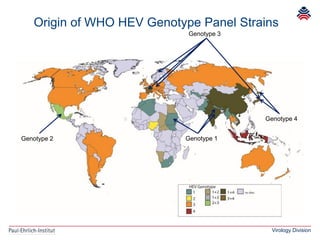
Genotype 2
Genotype 3
Genotype 4
Genotype 1
Origin of WHO HEV Genotype Panel Strains
Virology Division
HQ389543 3 England
AF060668 3a USA
AB089824 3a Japan
WHO IS AB630970 3a Japan
AB074918 3a Japan
AB074920 3a Japan
AB291962 3b Japan
AB246676 3b Japan
8570/13 AB630971 3b Japan
JQ034516 3c Germany
8571/13 JN995569 3c Sweden
JQ034514 3c Germany
FJ705359 3c Germany boar
8574/13s 3 France
JQ013792 3 France rabbit
GU937805 3 China rabbit
FJ906896 3 China rabbit
FJ906895 3 China rabbit
8572/13 JN995564 3e Germany
JQ953665 3e France pig
8573/13 JN995573 3f Sweden
BRP FJ956757 3f Germany
EU495148 3f France
AB369687 3f Japan
AB291961 3f Japan
FJ610232 4d China pig
AY594199 4g China pig
AB108537 4g China
8576/13 4g Japan
AB091395 4c Japan
AB097812 4c Japan
AB074915 4c Japan
8575/13 4c Japan
AB291959 4c Japan
AB161717 4c Japan
M74506 2a Mexico
8577/13s 2a Mexico
AY204877 1e Chad
8569/13 1e Sudan
AY230202 1d Morocco
L25595 1b China
M80581 1b Pakistan
L08816 1b China
D11092 1b China
X99441 1a India
AF051830 1a Nepal
M73218 1a Myanmar
AF185822 1a Pakistan
8567/13 1a India
FJ457024 1a India
8568/13s 1a India
AY535004 avian
94
100
100
100
42
89
100
61
60
99
89
88
65
77
40
99
88
71
36
53
20
93
69
92
99
99
88
61
84
81
40
60
97
94
73
50
85
48
79
35
68
48
92
90
69
84
86
49
0.02
Genotype 3
Genotype 4
Genotype 2
Genotype 1
3a
3b
3c
3
3e
3f
4g
4c
2a
1e
1a
Analysis based upon
partial RdRp
sequence
Virology Division
HEV in European Plasma Donors
Selection of strains from blood donors to reflect
clnically important genotypes
Nucleotide Substitution per 100 residues
0
29.1
510152025
D_N001113105171
D_N001113082834
P_N001213900311
P_N001212901361
P_N001213900152
P_N001213900726
D_N001112090844
NL_Donor_12
P_N001214900744
P_N001213906705
P_N001213910627
P_N001213908973
P_N001213907985
P_N001213908062
P_N001112085481
NL_Donor_15
P_N001212912417
P_N001213901721
P_N001213907677
P_N001213901631
P_N001211907235
NL_Patient_04
P_N001214903106
P_N001212902562
D_N000113083892
D_N001113129349
D_N001113129308
P_N001213903457
P_N001214903706
P_N001213905608
D_N000111204385
NL_Donor_05
FJ705359_3i
P_N001213906628
P_N001213905961
P_N001211903682
P_N001214901309
P_N001210910016
NL_Patient_03
P_N001213908064
P_N001213906323
P_N001212908053
P_N001213907300
Germany_6
Sweden_2
P_N001214900585
D_N001113091139
P_N001213980747
D_N001113905084
P_N001211907392
NL_Patient_07
D_N001811030409
NL_Donor_04
P_N001214902034
P_N001214902688
D_N000313078482
P_AMC_21172902
NL_Patient_05
D_N000311136809
P_N001212910164
French_Donor_12
P_N001212907511
P_N001213905916
P_N001212910296
P_N001211910745
P_N001210988310
D_N001112240056
D_N000311181536
NL_Donor_10
Sweden_8
Sweden_11
D_N000312028013
NL_Donor_11
P_N001214903354
D_N000313050878
Germany_20
P_N001213906287
P_N001213909683
D_N001211117594
NL_Donor_07
P_AMC_2011
P_N001212910998
P_N001212911077
P_N001212910704
P_N001211915955
NL_Patient_06
P_N001213907293
Germany_7
D_N000313051864
P_LUMC_13043210
P_N001212902862
P_N001212904706
D_N000112080777
NL_Donor_16
P_N001212904901
P_N001214903597
D_N000113154350
D_N000313100849
D_N001111236578
NL_Donor_09
D_N000311079197
NL_Donor_03
D_N001111001934
NL_Donor_02
French_Donor_4
French_Donor_15
French_Donor_5
FJ600536_3c
D_N001811283203
NL_Donor_08
Sweden_5
French_Donor_8
French_Donor_17
AF516178_3A
AF466662_3A
Sweden_16
Sweden_19
AB115544_3B
AF296165_3D
French_Donor_10
P_N001214902194
P_N001213909588
P_N001213905698
P_N001213907674
AB248521_3e
AB094250_3E
AB248520_3e
Germany_3
AF503512_3E
AF455784_3G
AF336296_3F
French_Donor_2
French_Donor_22
French_Donor_14
P_N001213906748
French_Donor_3
P_N001212909755
French_Donor_6
French_Donor_13
French_Donor_16
P_N001213908730
P_N001213900814
D_9575_Spaans
French_Donor_11
P_N001212913572
French_Donor_1
P_N001211904913
NL_Patient_01
French_Donor_19
French_Donor_7
D_N001111062446
NL_Donor_01
D_N000312096110
French_Donor_9
P_N001212911317
P_N001212903842
D_N000312101329
NL_Donor_14
P_N001214901379
P_N001212905169
NL_Patient_02
French_Donor_23
P_N001212907243
French_Donor_20
Czech_23
Sweden_15
Sweden_12
P_N001213909941
Germany_18
Genotype 1
Genotype 4
Genotype 2
England&Wales
GT3, group 2
England&Wales
GT3, group 1
3c
3e
3f
Courtesy of S. Ijaz
Virology Division
log10IU/ml
1.5
2.0
2.5
3.0
3.5
4.0
4.5
5.0
5.5
6.0
6.5
#8567/13#8568/13s#8569/13#8570/13#8571/13#8572/13#8573/13#8574/13s#8575/13#8576/13#8577/13#8577/13s
C
andidate
BR
P
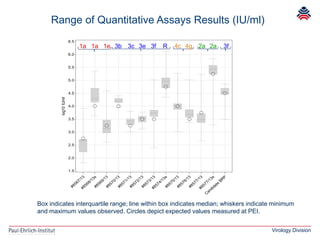
Range of Quantitative Assays Results (IU/ml)
Box indicates interquartile range; line within box indicates median; whiskers indicate minimum
and maximum values observed. Circles depict expected values measured at PEI.
1a 1a 1e 3b 3c 3e 3f R 4c 4g 2a 2a 3f
Virology Division
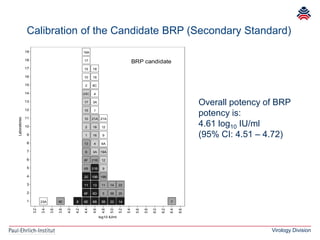
Calibration of the Candidate BRP (Secondary Standard)
23A 6E 8 6E
6F
11
20
6B
6F
8
13
1
2
10
15
17
23C
2
10
15
17
19A
6B
6D
13
19B
21B
21B
3A
4
16
18
21A
1
3A
4
6C
16
18
3B
5
11
19B
9
12
19A
6A
9
12
21A
22
3B
14
14
20
22
7
BRP candidate
Laboratories
1
2
3
4
5
6
7
8
9
10
11
12
13
14
15
16
17
18
19
log10 IU/ml
3.2
3.4
3.6
3.8
4.0
4.2
4.4
4.6
4.8
5.0
5.2
5.4
5.6
5.8
6.0
6.2
6.4
6.6
Overall potency of BRP
potency is:
4.61 log10 IU/ml
(95% CI: 4.51 – 4.72)
Virology Division
ļ‚§ Established by the WHO ECBS in October 2015
ļ‚§ Genotypes generally well detected
ļ‚§ Inevitable genetic changes – other studies; some sub-
genotypes (3) not always so consistently detected
ļ‚§ No unitage assigned to the panel members (WHO policy)
ļ‚§ Details of potencies (+ range) will be reported in IFU
ļ‚§ Wide range (especially gt 1, gt 2)
ļ‚§ Panel will be ready for distribution early 2016
ļ‚§ BRP being reviewed the CoE BSP steering committee
International Reference Panel – HEV Genotypes
Virology Division
ļ‚§ Jothikumar et al., A broadly reactive one-step real-time RT-PCR
assay for rapid and sensitive detection of hepatitis E virus. J Virol
Meth 131, 65-71
ļ‚§ Targets a conserved region in ORF2/ORF3
ļ‚§ Probe is very short, Tm ~10°C lower than normal
ļ‚§ Database - small number of HEV strains with polymorphisms
Widely Used HEV Real-Time PCR – Issues
Virology Division
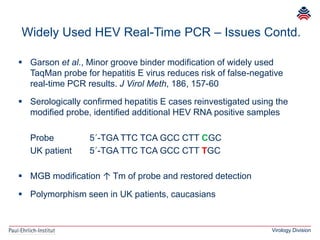
ļ‚§ Garson et al., Minor groove binder modification of widely used
TaqMan probe for hepatitis E virus reduces risk of false-negative
real-time PCR results. J Virol Meth, 186, 157-60
ļ‚§ Serologically confirmed hepatitis E cases reinvestigated using the
modified probe, identified additional HEV RNA positive samples
Probe 5Ā“-TGA TTC TCA GCC CTT CGC
UK patient 5Ā“-TGA TTC TCA GCC CTT TGC
ļ‚§ MGB modification ↑ Tm of probe and restored detection
ļ‚§ Polymorphism seen in UK patients, caucasians
Widely Used HEV Real-Time PCR – Issues Contd.
Virology Division
ļ‚§ Analysis of plasma donors by the PEI in collaboration with
Octapharma has identified a further polymorphism
Probe 5Ā“-TGA TTC TCA GCC CTT CGC
UK patient 5Ā“-TGA TTC TCA GCC CTT TGC
Swedish donor 5Ā“-TGA TTC CCA GCC CTT CGC
Widely Used HEV Real-Time PCR – Issues Contd.
WHO IS
HEV RNA positive
plasma donor
NTC
Virology Division
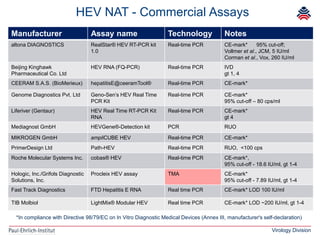
HEV NAT - Commercial Assays
Manufacturer Assay name Technology Notes
altona DIAGNOSTICS RealStarĀ® HEV RT-PCR kit
1.0
Real-time PCR CE-mark* 95% cut-off;
Vollmer et al., JCM, 5 IU/ml
Corman et al., Vox, 260 IU/ml
Beijing Kinghawk
Pharmaceutical Co. Ltd
HEV RNA (FQ-PCR) Real-time PCR IVD
gt 1, 4
CEERAM S.A.S. (BioMerieux) hepatitisE@ceeramToolĀ® Real-time PCR CE-mark*
Genome Diagnostics Pvt. Ltd Geno-Sen’s HEV Real Time
PCR Kit
Real-time PCR CE-mark*
95% cut-off – 80 cps/ml
Liferiver (Gentaur) HEV Real Time RT-PCR Kit
RNA
Real-time PCR CE-mark*
gt 4
Mediagnost GmbH HEVGeneĀ®-Detection kit PCR RUO
MIKROGEN GmbH ampliCUBE HEV Real-time PCR CE-mark*
PrimerDesign Ltd Path-HEV Real-time PCR RUO, <100 cps
Roche Molecular Systems Inc. cobasĀ® HEV Real-time PCR CE-mark*,
95% cut-off - 18.6 IU/ml, gt 1-4
Hologic, Inc./Grifols Diagnostic
Solutions, Inc.
Procleix HEV assay TMA CE-mark*
95% cut-off - 7.89 IU/ml, gt 1-4
Fast Track Diagnostics FTD Hepatitis E RNA Real time PCR CE-mark* LOD 100 IU/ml
TIB Molbiol LightMixĀ® Modular HEV Real time PCR CE-mark* LOD ~200 IU/ml, gt 1-4
*In compliance with Directive 98/79/EC on In Vitro Diagnostic Medical Devices (Annex III, manufacturer's self-declaration)
Virology Division
ļ‚§ Hologic/Grifols – Panther
ļ‚§ Roche - cobasĀ® 6800/8800
Automated Platforms
Virology Division
ļ‚§ Antigens
ļ‚§ Peptides
ļ‚§ Recombinant proteins – greater sensitivity
ļ‚§ Mainly ORF2 capsid protein (occasionally ORF3); different gts
ļ‚§ Assay format
ļ‚§ EIAs – plates, blots, rapid (POC) tests
ļ‚§ IgM, IgG, total Ig
ļ‚§ In-house and commercially available assays
ļ‚§ Assay performance
ļ‚§ Issues of sensitivity, specificity (cross-reactivity e.g. CMV, EBV etc.)
ļ‚§ Often poor concordance between assay results
ļ‚§ Lot-to-lot variability
ļ‚§ Differences in duration of persistence of abs to various epitopes
Detection of Anti-HEV
Virology Division
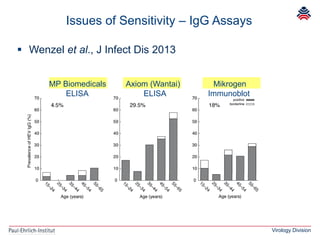
ļ‚§ Seroprevalence (IgG) of HEV significantly underestimated
ļ‚§ Bendall et al., J Med Virol 2010
ļ‚§ Wantai vs. MP Biomedicals
ļ‚§ 16.2% vs. 3.6%, blood donors UK
ļ‚§ Wenzel et al., J Infect Dis 2013
ļ‚§ Wantai vs. MP Biomedicals
ļ‚§ Healthcare workers Germany 29.5% vs. 4.5%
ļ‚§ Revised assay formats suggests better concordance
ļ‚§ Avellon et al., J Med Virol 2015
Issues of Sensitivity – IgG Assays
Virology Division
ļ‚§ Wenzel et al., J Infect Dis 2013
MP Biomedicals Axiom (Wantai) Mikrogen
ELISA ELISA Immunoblot
Issues of Sensitivity – IgG Assays
Virology Division
ļ‚§ Sensitivity/specificity issues
ļ‚§ False reactivity (e.g. EBV, CMV)
ļ‚§ Drobeniuc et al., Clin Inf Dis 2010
ļ‚§ Certain tests perform better at low concentrations of IgM
ļ‚§ Avellon et al., 2015
IgM Assays - Issues
Assay Sensitivity Specificity
I (Sar-55 Ag/Purcell) 98% 78%
II (Antigens aa 452-617 ORF2 gt1) 98% 93%
III (International Immunodiagnostics) 82% 91%
IV (MP Biomedicals) 72% 93%
V (Diagnostic Systems) 98% 95%
VI (Mikrogen) 92% 96%
Virology Division
ļ‚§ A WHO International Reference Reagent (95/584) for anti-
HEV established in 1997
ļ‚§ Ferguson et al. Biologicals 30:43-8.
ļ‚§ Lyophilized, serum pool - 5 separate bleeds over a 45 day
period (4-5 months after onset of illness) from a US patient
who developed acute hepatitis after visiting India
ļ‚§ No confirmation of HEV genotype (Saleem Kamili, pers. comm.)
ļ‚§ Not established as an IS because the number of
participants in the collaborative study was too limited (n=7)
ļ‚§ Anti-HEV IgG; IgM positive (Mikrogen recomWell, Eurimmun,
Wantai, MP Biomedicals)
Serology - Standardization
Virology Division
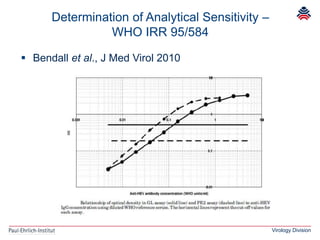
ļ‚§ Bendall et al., J Med Virol 2010
Determination of Analytical Sensitivity –
WHO IRR 95/584
Virology Division
ļ‚§ 48th report of the ECBS (WHO Technical Report
Series 889)
ā€œThe Committee was aware that assays for anti-hepatitis E
were at an early stage of development and recognized that
full assessment of new antibody assays requires panels of
sera. Nevertheless, it felt that the availability of a common
reference material would help evaluate inter-laboratory
variation and would aid developments in the serology of
hepatitis E virus. The Committee therefore established the
preparation coded 95/584, as an interim Reference Reagent
for Anti-hepatitis E Serum, Human, and assigned a value of
50 units per ampoule.ā€
Anti-HEV IRR
Virology Division
ļ‚§ WHO ECBS endorsed a proposal in Oct. 2015 to develop an
international reference panel for anti-HEV
ļ‚§ Acute and convalescent samples
ļ‚§ IgM (± IgG), IgG
ļ‚§ Samples confirmed by PCR (confirmation of gt)
ļ‚§ Wide geographic area
ļ‚§ Large volume samples
ļ‚§ Lyophilized (shipment)
ļ‚§ Evaluation in an international collaborative study
Development of an Anti-HEV Reference Panel
Virology Division
ļ‚§ PEI
ļ‚§ Johannes Blümel
ļ‚§ Kay-Martin Hanschmann
ļ‚§ Roswitha Kleiber
ļ‚§ Sigrid Nick
ļ‚§ Micha Nübling (PEI/WHO)
ļ‚§ Gudrun Winskowsky
ļ‚§ Japan
ļ‚§ Keiji Matsubayashi (JRCS)
ļ‚§ Saeko Mizusawa (NIID)
ļ‚§ EDQM
ļ‚§ Eriko Terao
ļ‚§ WHO
ļ‚§ Collaborative Study Participants
Acknowledgements
ļ‚§ Germany
ļ‚§ Thoma GƤrtner (Octapharma)
ļ‚§ Cornelia Adlhoch (RKI, ECDC)
ļ‚§ Marco Kaiser (RKI)
ļ‚§ Victor Corman (Bonn)
ļ‚§ Jürgen Wenzel (Regensburg)
ļ‚§ UK
ļ‚§ Harry Dalton
ļ‚§ France
ļ‚§ Anne-Marie Roque-Afonso
ļ‚§ India
ļ‚§ Rakesh Aggarwal (SGPIMS)
ļ‚§ Nirupma Trehanpati (ILBS)
ļ‚§ USA
ļ‚§ Saleem Kamili (CDC)

Hepatitis E - Diagnostics and Standardization

  • 1.
    www.pei.de Hepatitis E Diagnostics andStandardization 1st ECDC Hepatitis E Virus Expert Group Meeting Stockholm, 9th-10th December, 2015 Sally A. Baylis, Division of Virology, Paul-Ehrlich-Institut, Langen, Germany
  • 2.
    Virology Division ļ‚§ 1972Federal Agency for Sera and Vaccines ļ‚§ 2009 Federal Institute for Vaccines and Biomedicines ļ‚§ Marketing authorization of human and veterinary medicines ļ‚§ Approval of clinical trials ļ‚§ Inspections ļ‚§ Pharmacovigilance ļ‚§ Official batch release testing for blood products, vaccines etc. ļ‚§ Testing laboratory for in vitro diagnostics devices (IVDs) ļ‚§ Research related to the above ļ‚§ 2005 WHO Collaborating Centre for Quality Assurance …… of Blood Products and In Vitro Diagnostics ļ‚§ 2013 WHO Collaborating Centre for Vaccines Paul-Ehrlich-Institut
  • 3.
    Virology Division ļ‚§ Gooddiagnostics – critical ļ‚§ Correct diagnosis of hepatitis E ļ‚§ Prevalence/incidence of hepatitis E cases ļ‚§ Seroprevalence as a reflection of population exposure ļ‚§ Implementation of any screening programmes ļ‚§ Issues ļ‚§ Lack of awareness of HEV in differential diagnosis of acute hepatitis/liver abnormalities ļ‚§ Hampered by assays lacking sensitivity, specificity, standardization Diagnostics for Hepatitis E – Getting it Right
  • 4.
    Virology Division ļ‚§ Clinicalpresentation - acute hepatitis ļ‚§ Jaundice, anorexia, hepatomegaly, abdominal pain/tenderness, nausea/vomiting, fever etc. ļ‚§ Biochemical markers ļ‚§ ↑ Alanine/aspartate aminotransferase, bilirubin, alkaline phosphatase ļ‚§ Confirmation of HEV infection ļ‚§ Detect virus or components ļ‚§ Particles (EM – stool) ļ‚§ RNA (blood, stool) ļ‚§ Ag (blood, stool) ļ‚§ Detect anti-HEV ļ‚§ IgM ļ‚§ IgG ļ‚§ IgA (?) Diagnosis of Hepatitis E Kamar et al., 2012 Lancet
  • 5.
    Virology Division ļ‚§ Currentinfection - acute ļ‚§ HEV RNA ļ‚§ HEV RNA + anti-HEV IgM ļ‚§ HEV RNA + anti-HEV IgG ļ‚§ HEV RNA + anti-HEV IgM + anti-HEV IgG ļ‚§ Anti-HEV IgM + IgG (rising) ļ‚§ Current infection - chronic (immunocompromised) ļ‚§ HEV RNA (± anti-HEV) > 3 months ļ‚§ VL testing – monitoring therapy ļ‚§ Past infection ļ‚§ Anti-HEV IgG Diagnosis of Hepatitis E – Laboratory Testing
  • 6.
    Virology Division ļ‚§ WHOIS ā€œGold Standardā€ of biological reference materials ļ‚§ International Unit (IU) - uniform reporting system ļ‚§ Basis for calibration of assays, references materials ļ‚§ Allows comparison of different assays WHO Standardization - Traceability International Standard 2Āŗ Reference Materials Calibration Standards Working Reagents Diagnostic Assays EQA Materials
  • 7.
    Virology Division ļ‚§ Detectionof HEV RNA ā€œgold standardā€ - active viraemia ļ‚§ PEI proposed the development of a WHO International Standards for HEV RNA for NAT assays in 2009 ļ‚§ Endorsed by Expert Committee on Biological Standardization ļ‚§ Initial study Q4, 2009 - Q1, 2010 ļ‚§ HEV NAT assay performance - blinded panel of samples ļ‚§ Zoonotic strains of HEV gt 3a, 3b, 3f and gt 4c ļ‚§ Blood donor materials (Japan, Germany) ļ‚§ Determine a strain to develop into a WHO IS ļ‚§ 20 laboratories, 10 different countries ļ‚§ In-house assays, with one exception Standardizing HEV RNA Assays - Background
  • 8.
    Virology Division HEV StrainsInvestigated in 1st Study Genotype Virus strain HEV RNA (copies/ml) Anti-HEV IgM/IgG ALT (IU/L) 3a HRC-HE104 1.6 x 10⁷ -/- 36 3b JRC-HE3 2.5 x 10⁷ +/- 398 3f RKI 1.3 x 10⁶ -/- Negative 4c HRC-HE15 1.0 x 10⁶ -/- 505 Analysis based upon partial ORF2 sequence
  • 9.
    Virology Division Nominal concentration (log10copies/ml) 6.2 5.2 4.2 3.2 2.2 1.2 Lab no. 1 + + + +/- - - 2 a + + + + + - 2 b + + + + +/- - 3 + + + + + - 4 + + + + - +/- 5 + + + + + - 6 + + + + - - 7 + + + + - - 8 + + + - + - 9 + + + + - - 10 + + + - +/- - 11 a + + - - - - 11 b + + +/- - - - 12 + + + + + + 13† + + + + - - 14 + + + + + + 15 a + + + + - - 15 b + + + + - - 16 + + + + - - 17 + + + + - - 18 a + + + - - - 18 b + + + + - - 19 - - - - - - 20 + + + - +/- - Total number of tests 24 24 24 24 24 24 Percentage positive 96 96 92/88 75/67 38/25 13/8 Example - Qualitative Analysis of HRC-HE104 (Genotype 3a)
  • 10.
    Virology Division Nominal concentration (log10copies/ml) 5.0 4.0 3.0 2.0 1.0 Lab no. 1 + + +/- - - 2 a + + - - - 2 b + + - - - 3 + + + + - 4 +/- + +/- - - 5 + + - - - 6 + + + +/- - 7 + + +/- - - 8 + - + - - 9 + + + + - 10 + + - - + 11 a + + - - - 11 b + + - - - 12 + + + + - 13 + + + +/- +/- 14 + + + + + 15 a - - - - - 15 b + + - - - 16 + + + + - 17 + + + + - 18 a + + - - - 18 b + + - - - 19 - - - - - 20 + - - - - Total number of tests 24 24 24 24 24 Percentage positive 92/88 83 50/38 33/25 4/0 Example - Qualitative Analysis of HRC-HE15 (Genotype 4c)
  • 11.
    Virology Division Example -Analysis of Titres and CT Values - HRC-HE104 Baylis et al., J Clin Micro, 2011
  • 12.
    Virology Division ļ‚§ Detectionof HEV antigen is not as sensitive as NAT ļ‚§ New assays offer greatly improved sensitivity ļ‚§ Zhao et al., J Viral Hepatol, 11, 957-963 ļ‚§ Wen et al., J Clin Microbiol, 53, 782-788 Detection of HEV Antigen Genotype HEV RNA (copies/ml) Antigen HEV RNA (copies/ml) Antigen 3a 1.6 x 10⁶ pos. 1.6 x 10⁵ neg. 3b 2.5 x 10⁶ pos. 2.5 x 10⁵ neg. 3f 1.3 x 10⁵ neg. 1.3 x 10⁴ neg. 4c 1.0 x 10⁵ pos. 1.0 x 10⁴ pos. Wantai Assay
  • 13.
    Virology Division ļ‚§ Issuesof sensitivity (independent of strain) ļ‚§ ~100- to 1000-fold difference - majority of assays ļ‚§ Issues of specificity ļ‚§ One false positive result, genotyping by the lab in question detected gt 1 (not included in the panel) ļ‚§ Wide range of copy numbers reported ļ‚§ Real-time PCRs out-performed conventional (nested) PCR ļ‚§ Demonstrates need for assay standardization ļ‚§ Further details: ļ‚§ Baylis et al., J Clin Microbiol, 2011 49:1234-9 1st Collaborative Study – Conclusions
  • 14.
    Virology Division ļ‚§ Thefollowing strains were lyophilized in September 2010 ļ‚§ HRC-HE104 (genotype 3a) – WHO International Standard ļ‚§ JRC-HE3 (genotype 3b) – Japanese National Standard ļ‚§ Drs Okada & Mizusawa, National Institute for Infectious Diseases ļ‚§ Collaborative study – Q1, 2011 ļ‚§ Blinded replicate samples; 4 assay runs ļ‚§ Data returned by 23 laboratories (10 countries); all in - house assays ļ‚§ 21 qualitative data sets (end point dilution analysis) ļ‚§ 14 quantitative data sets (reporting in copies/ml) Development of the WHO IS for HEV RNA
  • 15.
    Virology Division Potencies andRelative Potencies of Participants Results Potency relative to candidate IS = difference in estimated log10 units/ml + assigned value of candidate IS (5.39 log10 IU/ml) quant. assays (white - copies/ml) qual. assays (blue - NAT-detectable units/ml) Potencies
  • 16.
    Virology Division ļ‚§ 1stWHO IS for HEV RNA established in October 2011 ļ‚§ Japanese NIID – simultaneously established a national standard ļ‚§ 250,000 International Units/ml ļ‚§ The IS is available from the PEI (code # 6329/10) ļ‚§ Restriction 5 vials per lab per year ļ‚§ The standard has been distributed since March 2012 ļ‚§ Uses ļ‚§ Preparation of secondary standards ļ‚§ Define analytical sensitivities ļ‚§ Compare assay performance, EQA reporting, define TT dose etc. ļ‚§ Further details - http://www.pei.de ļ‚§ Baylis et al., Emerg Infect Dis, 2013;19:729-35 Establishment of the 1st WHO IS for HEV RNA
  • 17.
    Virology Division ļ‚§ WHOECBS endorsed panel proposal in October 2011 ļ‚§ All four genotypes & important sub-genotypes ļ‚§ Strains from plasma (n=8) ļ‚§ Strains from stool (n=3) diluted in pooled plasma ļ‚§ Lyophilized ļ‚§ Collaborative study, Q4, 2014- Q1/2, 2015 ļ‚§ 24 laboratories, 14 different countries ļ‚§ Evaluate samples concurrently with the WHO IS ļ‚§ Range of qual./quant. assays (in-house; commercial) ļ‚§ Simultaneously calibrating a secondary standard (HEV 3f) ļ‚§ Council of Europe/EU Commission ļ‚§ Implementation of HEV NAT screening for S/D plasma in EU International Reference Panel – HEV Genotypes
  • 18.
    Virology Division ļ‚§ Introductionof HEV NAT for S/D plasma – Ph. Eur. ļ‚§ Development of a Biological Reference Preparation (BRP) ļ‚§ EDQM, Council of Europe and the EU Commission ļ‚§ Dr Eriko Terao ļ‚§ Candidate BRP for HEV RNA ļ‚§ Genotype 3f HEV strain - German plasma donor ļ‚§ 6000 vials lyophilized ļ‚§ Calibration in IU/ml against the WHO IS in genotype panel study ļ‚§ Report reviewed by the EDQM BSP steering committee Biological Standardisation Programme project (BSP127)
  • 19.
    Virology Division ļ‚§ Adlhochet al., Vox Sang. 2009 ļ‚§ A regular plasma donor was diagnosed with acute hepatitis and elevated levels of ALT ļ‚§ Negative for HAV, HBV, HCV, EBV, CMV and adenovirus ļ‚§ Tested for anti-HEV - IgM positive ļ‚§ Robert Koch-Institut was notified and a look-back study was performed ļ‚§ A genotype 3f virus was identified - donor worked in a slaughter house HEV Infection in a German Plasma Donor
  • 20.
    Virology Division HEV Infectionin a German Plasma Donor Contd. Adlhoch et al., Vox Sang 2009 ELISA MP Biomedicals/Genelabs ELISA Mikrogen Immunoblot Mikrogen ELISA Euroimmun ELISA Wantai IgM IgG IgM IgG IgM IgG IgM IgG IgM IgG + + - +/- +/- +/- + +/- + -
  • 21.
    Virology Division Genotype 2 Genotype3 Genotype 4 Genotype 1 Origin of WHO HEV Genotype Panel Strains
  • 22.
    Virology Division HQ389543 3England AF060668 3a USA AB089824 3a Japan WHO IS AB630970 3a Japan AB074918 3a Japan AB074920 3a Japan AB291962 3b Japan AB246676 3b Japan 8570/13 AB630971 3b Japan JQ034516 3c Germany 8571/13 JN995569 3c Sweden JQ034514 3c Germany FJ705359 3c Germany boar 8574/13s 3 France JQ013792 3 France rabbit GU937805 3 China rabbit FJ906896 3 China rabbit FJ906895 3 China rabbit 8572/13 JN995564 3e Germany JQ953665 3e France pig 8573/13 JN995573 3f Sweden BRP FJ956757 3f Germany EU495148 3f France AB369687 3f Japan AB291961 3f Japan FJ610232 4d China pig AY594199 4g China pig AB108537 4g China 8576/13 4g Japan AB091395 4c Japan AB097812 4c Japan AB074915 4c Japan 8575/13 4c Japan AB291959 4c Japan AB161717 4c Japan M74506 2a Mexico 8577/13s 2a Mexico AY204877 1e Chad 8569/13 1e Sudan AY230202 1d Morocco L25595 1b China M80581 1b Pakistan L08816 1b China D11092 1b China X99441 1a India AF051830 1a Nepal M73218 1a Myanmar AF185822 1a Pakistan 8567/13 1a India FJ457024 1a India 8568/13s 1a India AY535004 avian 94 100 100 100 42 89 100 61 60 99 89 88 65 77 40 99 88 71 36 53 20 93 69 92 99 99 88 61 84 81 40 60 97 94 73 50 85 48 79 35 68 48 92 90 69 84 86 49 0.02 Genotype 3 Genotype 4 Genotype 2 Genotype 1 3a 3b 3c 3 3e 3f 4g 4c 2a 1e 1a Analysis based upon partial RdRp sequence
  • 23.
    Virology Division HEV inEuropean Plasma Donors Selection of strains from blood donors to reflect clnically important genotypes Nucleotide Substitution per 100 residues 0 29.1 510152025 D_N001113105171 D_N001113082834 P_N001213900311 P_N001212901361 P_N001213900152 P_N001213900726 D_N001112090844 NL_Donor_12 P_N001214900744 P_N001213906705 P_N001213910627 P_N001213908973 P_N001213907985 P_N001213908062 P_N001112085481 NL_Donor_15 P_N001212912417 P_N001213901721 P_N001213907677 P_N001213901631 P_N001211907235 NL_Patient_04 P_N001214903106 P_N001212902562 D_N000113083892 D_N001113129349 D_N001113129308 P_N001213903457 P_N001214903706 P_N001213905608 D_N000111204385 NL_Donor_05 FJ705359_3i P_N001213906628 P_N001213905961 P_N001211903682 P_N001214901309 P_N001210910016 NL_Patient_03 P_N001213908064 P_N001213906323 P_N001212908053 P_N001213907300 Germany_6 Sweden_2 P_N001214900585 D_N001113091139 P_N001213980747 D_N001113905084 P_N001211907392 NL_Patient_07 D_N001811030409 NL_Donor_04 P_N001214902034 P_N001214902688 D_N000313078482 P_AMC_21172902 NL_Patient_05 D_N000311136809 P_N001212910164 French_Donor_12 P_N001212907511 P_N001213905916 P_N001212910296 P_N001211910745 P_N001210988310 D_N001112240056 D_N000311181536 NL_Donor_10 Sweden_8 Sweden_11 D_N000312028013 NL_Donor_11 P_N001214903354 D_N000313050878 Germany_20 P_N001213906287 P_N001213909683 D_N001211117594 NL_Donor_07 P_AMC_2011 P_N001212910998 P_N001212911077 P_N001212910704 P_N001211915955 NL_Patient_06 P_N001213907293 Germany_7 D_N000313051864 P_LUMC_13043210 P_N001212902862 P_N001212904706 D_N000112080777 NL_Donor_16 P_N001212904901 P_N001214903597 D_N000113154350 D_N000313100849 D_N001111236578 NL_Donor_09 D_N000311079197 NL_Donor_03 D_N001111001934 NL_Donor_02 French_Donor_4 French_Donor_15 French_Donor_5 FJ600536_3c D_N001811283203 NL_Donor_08 Sweden_5 French_Donor_8 French_Donor_17 AF516178_3A AF466662_3A Sweden_16 Sweden_19 AB115544_3B AF296165_3D French_Donor_10 P_N001214902194 P_N001213909588 P_N001213905698 P_N001213907674 AB248521_3e AB094250_3E AB248520_3e Germany_3 AF503512_3E AF455784_3G AF336296_3F French_Donor_2 French_Donor_22 French_Donor_14 P_N001213906748 French_Donor_3 P_N001212909755 French_Donor_6 French_Donor_13 French_Donor_16 P_N001213908730 P_N001213900814 D_9575_Spaans French_Donor_11 P_N001212913572 French_Donor_1 P_N001211904913 NL_Patient_01 French_Donor_19 French_Donor_7 D_N001111062446 NL_Donor_01 D_N000312096110 French_Donor_9 P_N001212911317 P_N001212903842 D_N000312101329 NL_Donor_14 P_N001214901379 P_N001212905169 NL_Patient_02 French_Donor_23 P_N001212907243 French_Donor_20 Czech_23 Sweden_15 Sweden_12 P_N001213909941 Germany_18 Genotype 1 Genotype 4 Genotype 2 England&Wales GT3, group 2 England&Wales GT3, group 1 3c 3e 3f Courtesy of S. Ijaz
  • 24.
    Virology Division log10IU/ml 1.5 2.0 2.5 3.0 3.5 4.0 4.5 5.0 5.5 6.0 6.5 #8567/13#8568/13s#8569/13#8570/13#8571/13#8572/13#8573/13#8574/13s#8575/13#8576/13#8577/13#8577/13s C andidate BR P Range ofQuantitative Assays Results (IU/ml) Box indicates interquartile range; line within box indicates median; whiskers indicate minimum and maximum values observed. Circles depict expected values measured at PEI. 1a 1a 1e 3b 3c 3e 3f R 4c 4g 2a 2a 3f
  • 25.
    Virology Division Calibration ofthe Candidate BRP (Secondary Standard) 23A 6E 8 6E 6F 11 20 6B 6F 8 13 1 2 10 15 17 23C 2 10 15 17 19A 6B 6D 13 19B 21B 21B 3A 4 16 18 21A 1 3A 4 6C 16 18 3B 5 11 19B 9 12 19A 6A 9 12 21A 22 3B 14 14 20 22 7 BRP candidate Laboratories 1 2 3 4 5 6 7 8 9 10 11 12 13 14 15 16 17 18 19 log10 IU/ml 3.2 3.4 3.6 3.8 4.0 4.2 4.4 4.6 4.8 5.0 5.2 5.4 5.6 5.8 6.0 6.2 6.4 6.6 Overall potency of BRP potency is: 4.61 log10 IU/ml (95% CI: 4.51 – 4.72)
  • 26.
    Virology Division ļ‚§ Establishedby the WHO ECBS in October 2015 ļ‚§ Genotypes generally well detected ļ‚§ Inevitable genetic changes – other studies; some sub- genotypes (3) not always so consistently detected ļ‚§ No unitage assigned to the panel members (WHO policy) ļ‚§ Details of potencies (+ range) will be reported in IFU ļ‚§ Wide range (especially gt 1, gt 2) ļ‚§ Panel will be ready for distribution early 2016 ļ‚§ BRP being reviewed the CoE BSP steering committee International Reference Panel – HEV Genotypes
  • 27.
    Virology Division ļ‚§ Jothikumaret al., A broadly reactive one-step real-time RT-PCR assay for rapid and sensitive detection of hepatitis E virus. J Virol Meth 131, 65-71 ļ‚§ Targets a conserved region in ORF2/ORF3 ļ‚§ Probe is very short, Tm ~10°C lower than normal ļ‚§ Database - small number of HEV strains with polymorphisms Widely Used HEV Real-Time PCR – Issues
  • 28.
    Virology Division ļ‚§ Garsonet al., Minor groove binder modification of widely used TaqMan probe for hepatitis E virus reduces risk of false-negative real-time PCR results. J Virol Meth, 186, 157-60 ļ‚§ Serologically confirmed hepatitis E cases reinvestigated using the modified probe, identified additional HEV RNA positive samples Probe 5Ā“-TGA TTC TCA GCC CTT CGC UK patient 5Ā“-TGA TTC TCA GCC CTT TGC ļ‚§ MGB modification ↑ Tm of probe and restored detection ļ‚§ Polymorphism seen in UK patients, caucasians Widely Used HEV Real-Time PCR – Issues Contd.
  • 29.
    Virology Division ļ‚§ Analysisof plasma donors by the PEI in collaboration with Octapharma has identified a further polymorphism Probe 5Ā“-TGA TTC TCA GCC CTT CGC UK patient 5Ā“-TGA TTC TCA GCC CTT TGC Swedish donor 5Ā“-TGA TTC CCA GCC CTT CGC Widely Used HEV Real-Time PCR – Issues Contd. WHO IS HEV RNA positive plasma donor NTC
  • 30.
    Virology Division HEV NAT- Commercial Assays Manufacturer Assay name Technology Notes altona DIAGNOSTICS RealStarĀ® HEV RT-PCR kit 1.0 Real-time PCR CE-mark* 95% cut-off; Vollmer et al., JCM, 5 IU/ml Corman et al., Vox, 260 IU/ml Beijing Kinghawk Pharmaceutical Co. Ltd HEV RNA (FQ-PCR) Real-time PCR IVD gt 1, 4 CEERAM S.A.S. (BioMerieux) hepatitisE@ceeramToolĀ® Real-time PCR CE-mark* Genome Diagnostics Pvt. Ltd Geno-Sen’s HEV Real Time PCR Kit Real-time PCR CE-mark* 95% cut-off – 80 cps/ml Liferiver (Gentaur) HEV Real Time RT-PCR Kit RNA Real-time PCR CE-mark* gt 4 Mediagnost GmbH HEVGeneĀ®-Detection kit PCR RUO MIKROGEN GmbH ampliCUBE HEV Real-time PCR CE-mark* PrimerDesign Ltd Path-HEV Real-time PCR RUO, <100 cps Roche Molecular Systems Inc. cobasĀ® HEV Real-time PCR CE-mark*, 95% cut-off - 18.6 IU/ml, gt 1-4 Hologic, Inc./Grifols Diagnostic Solutions, Inc. Procleix HEV assay TMA CE-mark* 95% cut-off - 7.89 IU/ml, gt 1-4 Fast Track Diagnostics FTD Hepatitis E RNA Real time PCR CE-mark* LOD 100 IU/ml TIB Molbiol LightMixĀ® Modular HEV Real time PCR CE-mark* LOD ~200 IU/ml, gt 1-4 *In compliance with Directive 98/79/EC on In Vitro Diagnostic Medical Devices (Annex III, manufacturer's self-declaration)
  • 31.
    Virology Division ļ‚§ Hologic/Grifols– Panther ļ‚§ Roche - cobasĀ® 6800/8800 Automated Platforms
  • 32.
    Virology Division ļ‚§ Antigens ļ‚§Peptides ļ‚§ Recombinant proteins – greater sensitivity ļ‚§ Mainly ORF2 capsid protein (occasionally ORF3); different gts ļ‚§ Assay format ļ‚§ EIAs – plates, blots, rapid (POC) tests ļ‚§ IgM, IgG, total Ig ļ‚§ In-house and commercially available assays ļ‚§ Assay performance ļ‚§ Issues of sensitivity, specificity (cross-reactivity e.g. CMV, EBV etc.) ļ‚§ Often poor concordance between assay results ļ‚§ Lot-to-lot variability ļ‚§ Differences in duration of persistence of abs to various epitopes Detection of Anti-HEV
  • 33.
    Virology Division ļ‚§ Seroprevalence(IgG) of HEV significantly underestimated ļ‚§ Bendall et al., J Med Virol 2010 ļ‚§ Wantai vs. MP Biomedicals ļ‚§ 16.2% vs. 3.6%, blood donors UK ļ‚§ Wenzel et al., J Infect Dis 2013 ļ‚§ Wantai vs. MP Biomedicals ļ‚§ Healthcare workers Germany 29.5% vs. 4.5% ļ‚§ Revised assay formats suggests better concordance ļ‚§ Avellon et al., J Med Virol 2015 Issues of Sensitivity – IgG Assays
  • 34.
    Virology Division ļ‚§ Wenzelet al., J Infect Dis 2013 MP Biomedicals Axiom (Wantai) Mikrogen ELISA ELISA Immunoblot Issues of Sensitivity – IgG Assays
  • 35.
    Virology Division ļ‚§ Sensitivity/specificityissues ļ‚§ False reactivity (e.g. EBV, CMV) ļ‚§ Drobeniuc et al., Clin Inf Dis 2010 ļ‚§ Certain tests perform better at low concentrations of IgM ļ‚§ Avellon et al., 2015 IgM Assays - Issues Assay Sensitivity Specificity I (Sar-55 Ag/Purcell) 98% 78% II (Antigens aa 452-617 ORF2 gt1) 98% 93% III (International Immunodiagnostics) 82% 91% IV (MP Biomedicals) 72% 93% V (Diagnostic Systems) 98% 95% VI (Mikrogen) 92% 96%
  • 36.
    Virology Division ļ‚§ AWHO International Reference Reagent (95/584) for anti- HEV established in 1997 ļ‚§ Ferguson et al. Biologicals 30:43-8. ļ‚§ Lyophilized, serum pool - 5 separate bleeds over a 45 day period (4-5 months after onset of illness) from a US patient who developed acute hepatitis after visiting India ļ‚§ No confirmation of HEV genotype (Saleem Kamili, pers. comm.) ļ‚§ Not established as an IS because the number of participants in the collaborative study was too limited (n=7) ļ‚§ Anti-HEV IgG; IgM positive (Mikrogen recomWell, Eurimmun, Wantai, MP Biomedicals) Serology - Standardization
  • 37.
    Virology Division ļ‚§ Bendallet al., J Med Virol 2010 Determination of Analytical Sensitivity – WHO IRR 95/584
  • 38.
    Virology Division ļ‚§ 48threport of the ECBS (WHO Technical Report Series 889) ā€œThe Committee was aware that assays for anti-hepatitis E were at an early stage of development and recognized that full assessment of new antibody assays requires panels of sera. Nevertheless, it felt that the availability of a common reference material would help evaluate inter-laboratory variation and would aid developments in the serology of hepatitis E virus. The Committee therefore established the preparation coded 95/584, as an interim Reference Reagent for Anti-hepatitis E Serum, Human, and assigned a value of 50 units per ampoule.ā€ Anti-HEV IRR
  • 39.
    Virology Division ļ‚§ WHOECBS endorsed a proposal in Oct. 2015 to develop an international reference panel for anti-HEV ļ‚§ Acute and convalescent samples ļ‚§ IgM (± IgG), IgG ļ‚§ Samples confirmed by PCR (confirmation of gt) ļ‚§ Wide geographic area ļ‚§ Large volume samples ļ‚§ Lyophilized (shipment) ļ‚§ Evaluation in an international collaborative study Development of an Anti-HEV Reference Panel
  • 40.
    Virology Division ļ‚§ PEI ļ‚§Johannes Blümel ļ‚§ Kay-Martin Hanschmann ļ‚§ Roswitha Kleiber ļ‚§ Sigrid Nick ļ‚§ Micha Nübling (PEI/WHO) ļ‚§ Gudrun Winskowsky ļ‚§ Japan ļ‚§ Keiji Matsubayashi (JRCS) ļ‚§ Saeko Mizusawa (NIID) ļ‚§ EDQM ļ‚§ Eriko Terao ļ‚§ WHO ļ‚§ Collaborative Study Participants Acknowledgements ļ‚§ Germany ļ‚§ Thoma GƤrtner (Octapharma) ļ‚§ Cornelia Adlhoch (RKI, ECDC) ļ‚§ Marco Kaiser (RKI) ļ‚§ Victor Corman (Bonn) ļ‚§ Jürgen Wenzel (Regensburg) ļ‚§ UK ļ‚§ Harry Dalton ļ‚§ France ļ‚§ Anne-Marie Roque-Afonso ļ‚§ India ļ‚§ Rakesh Aggarwal (SGPIMS) ļ‚§ Nirupma Trehanpati (ILBS) ļ‚§ USA ļ‚§ Saleem Kamili (CDC)