3rd ECDC HEV expert group meeting
Cornelia Adlhoch
ECDC, Stockholm, 28-29 November 2018
WELCOME and INTRODUCTION
• Tour de table – Newcomers
• Meeting logistics
• Declaration of interests
• ECDC activities
• UI-441
• Rat HEV
• Meeting objectives and expected outcomes
2
TOUR DE TABLE
3
Terms of reference and
Declaration of interest
4
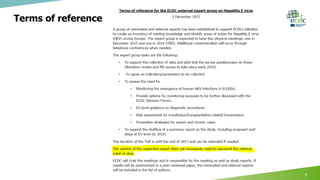
Terms of reference
5
ECDC’s latest and future activities on HEV
6
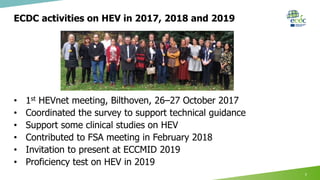
ECDC activities on HEV in 2017, 2018 and 2019
7
• 1st HEVnet meeting, Bilthoven, 26–27 October 2017
• Coordinated the survey to support technical guidance
• Support some clinical studies on HEV
• Contributed to FSA meeting in February 2018
• Invitation to present at ECCMID 2019
• Proficiency test on HEV in 2019
EPHESUS: Evaluation of EU/EEA surveillance of 7 priority Food-
and Waterborne Diseases (FWD):
Recommendations for ECDC and/or European Commission
…
Consider making hepatitis E notifiable at EU level
8
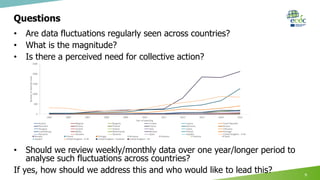
Questions
• Are data fluctuations regularly seen across countries?
• What is the magnitude?
• Is there a perceived need for collective action?
• Should we review weekly/monthly data over one year/longer period to
analyse such fluctuations across countries?
If yes, how should we address this and who would like to lead this? 9
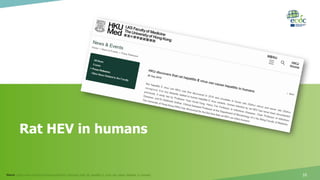
Rat HEV in humans
10Source: https://www.med.hku.hk/news/press/HKU_discovers_that_rat_hepatitis_E_virus_can_cause_hepatitis_in_humans
Media alerts – 1st case
11
Sources: https://www.scmp.com/news/hong-kong/health-environment/article/2166090/worlds-first-case-rat-hepatitis-e-infecting-human
https://www.nytimes.com/2018/09/28/science/hepatitis-e-rats-hong-kong.html
https://www.dailymail.co.uk/health/article-6218439/Worlds-human-case-rat-disease-56-year-old-man-Hong-Kong.html
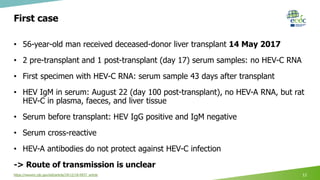
First case
https://wwwnc.cdc.gov/eid/article/24/12/18-0937_article 12
• 56-year-old man received deceased-donor liver transplant 14 May 2017
• 2 pre-transplant and 1 post-transplant (day 17) serum samples: no HEV-C RNA
• First specimen with HEV-C RNA: serum sample 43 days after transplant
• HEV IgM in serum: August 22 (day 100 post-transplant), no HEV-A RNA, but rat
HEV-C in plasma, faeces, and liver tissue
• Serum before transplant: HEV IgG positive and IgM negative
• Serum cross-reactive
• HEV-A antibodies do not protect against HEV-C infection
-> Route of transmission is unclear
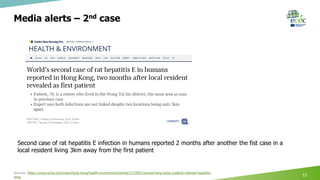
Media alerts – 2nd case
Sources: https://www.scmp.com/news/hong-kong/health-environment/article/2173951/second-hong-kong-resident-infected-hepatitis-
virus
13
Second case of rat hepatitis E infection in humans reported 2 months after another the fist case in a
local resident living 3km away from the first patient
Second case
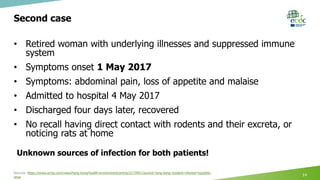
• Retired woman with underlying illnesses and suppressed immune
system
• Symptoms onset 1 May 2017
• Symptoms: abdominal pain, loss of appetite and malaise
• Admitted to hospital 4 May 2017
• Discharged four days later, recovered
• No recall having direct contact with rodents and their excreta, or
noticing rats at home
Sources: https://www.scmp.com/news/hong-kong/health-environment/article/2173951/second-hong-kong-resident-infected-hepatitis-
virus
14
Unknown sources of infection for both patients!
Some thoughts and questions
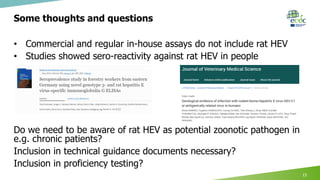
• Commercial and regular in-house assays do not include rat HEV
• Studies showed sero-reactivity against rat HEV in people
Do we need to be aware of rat HEV as potential zoonotic pathogen in
e.g. chronic patients?
Inclusion in technical guidance documents necessary?
Inclusion in proficiency testing?
15
Meeting objectives and expected outcomes
16
Outcomes of previous meetings
17
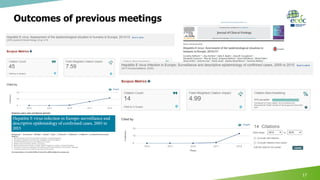
Webstatistics – ECDC HEV report
Publication: https://ecdc.europa.eu/en/publications-data/hepatitis-e-eueea-2005-2015
Page views (July 2017-November 2018): 568
Top 5 user countries: Sweden, UK, Italy, Spain and Switzerland
Top 5 user sources: Google, direct (URL), Twitter, EFSA and Bing
PDF: (https://ecdc.europa.eu/sites/portal/files/documents/HEV_Surveillance-report-2005-2015.pdf)
Downloads (July 2017-November 2018): 847
Top 5 countries: Italy, UK, Germany, Netherlands and Spain
Top user sources: Direct (URL), Google, Bing and The Lancet
News item: https://ecdc.europa.eu/en/news-events/ecdc-report-10-fold-increase-hepatitis-e-cases-eueea-
between-2005-and-2015
Page views (July 2017-November 2018): 509
Top 5 countries: Italy, Sweden, Spain, UK and Netherlands
Top user sources: Google, direct (URL), EFSA and ESCAIDE
18
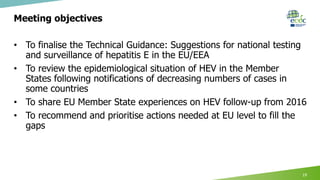
Meeting objectives
• To finalise the Technical Guidance: Suggestions for national testing
and surveillance of hepatitis E in the EU/EEA
• To review the epidemiological situation of HEV in the Member
States following notifications of decreasing numbers of cases in
some countries
• To share EU Member State experiences on HEV follow-up from 2016
• To recommend and prioritise actions needed at EU level to fill the
gaps
19
Expected outcome(s) of the meeting
20
• Finalisation of the technical guidance document
• Decision on related publication
• Update of assessment with new data? TBD
• Analysis of weekly/monthly surveillance data? TBD
• Statement/recommendation related to rat HEV? TBD
Data synthesis of the technical guidance document
1. A draft document was developed using available information, and shared with
the ECDC HEV expert group in October 2018 for review and comments before
the meeting in November 2018. Received comments were included for
discussion and final agreement.
2. A final meeting with the ECDC HEV expert group was conducted in
November 2018 to agree on the final version of the document. Where
no consensus was reached, concerns of the participants were added
to the respective chapter in the document.
3. The final document was shared with all members of ECDC’s HEV expert group
and ECDC staff for final minor revisions and approval.
21
Please feel free to
ask, discuss, question, suggest,…
Any immediate questions?
22
Proficiency testing 2019
Which viruses should be included and focused on?
Genotypes 1-4
Subtypes 3 – which ones
Rat HEV?
Other species? (Rabbit, camel, bat,…)
Detection capability, sequence lengths and quality?
23

ECDC_intro_hev_meeting_nov2018

  • 1.
    3rd ECDC HEVexpert group meeting Cornelia Adlhoch ECDC, Stockholm, 28-29 November 2018
  • 2.
    WELCOME and INTRODUCTION •Tour de table – Newcomers • Meeting logistics • Declaration of interests • ECDC activities • UI-441 • Rat HEV • Meeting objectives and expected outcomes 2
  • 3.
  • 4.
    Terms of referenceand Declaration of interest 4
  • 5.
  • 6.
    ECDC’s latest andfuture activities on HEV 6
  • 7.
    ECDC activities onHEV in 2017, 2018 and 2019 7 • 1st HEVnet meeting, Bilthoven, 26–27 October 2017 • Coordinated the survey to support technical guidance • Support some clinical studies on HEV • Contributed to FSA meeting in February 2018 • Invitation to present at ECCMID 2019 • Proficiency test on HEV in 2019
  • 8.
    EPHESUS: Evaluation ofEU/EEA surveillance of 7 priority Food- and Waterborne Diseases (FWD): Recommendations for ECDC and/or European Commission … Consider making hepatitis E notifiable at EU level 8
  • 9.
    Questions • Are datafluctuations regularly seen across countries? • What is the magnitude? • Is there a perceived need for collective action? • Should we review weekly/monthly data over one year/longer period to analyse such fluctuations across countries? If yes, how should we address this and who would like to lead this? 9
  • 10.
    Rat HEV inhumans 10Source: https://www.med.hku.hk/news/press/HKU_discovers_that_rat_hepatitis_E_virus_can_cause_hepatitis_in_humans
  • 11.
    Media alerts –1st case 11 Sources: https://www.scmp.com/news/hong-kong/health-environment/article/2166090/worlds-first-case-rat-hepatitis-e-infecting-human https://www.nytimes.com/2018/09/28/science/hepatitis-e-rats-hong-kong.html https://www.dailymail.co.uk/health/article-6218439/Worlds-human-case-rat-disease-56-year-old-man-Hong-Kong.html
  • 12.
    First case https://wwwnc.cdc.gov/eid/article/24/12/18-0937_article 12 •56-year-old man received deceased-donor liver transplant 14 May 2017 • 2 pre-transplant and 1 post-transplant (day 17) serum samples: no HEV-C RNA • First specimen with HEV-C RNA: serum sample 43 days after transplant • HEV IgM in serum: August 22 (day 100 post-transplant), no HEV-A RNA, but rat HEV-C in plasma, faeces, and liver tissue • Serum before transplant: HEV IgG positive and IgM negative • Serum cross-reactive • HEV-A antibodies do not protect against HEV-C infection -> Route of transmission is unclear
  • 13.
    Media alerts –2nd case Sources: https://www.scmp.com/news/hong-kong/health-environment/article/2173951/second-hong-kong-resident-infected-hepatitis- virus 13 Second case of rat hepatitis E infection in humans reported 2 months after another the fist case in a local resident living 3km away from the first patient
  • 14.
    Second case • Retiredwoman with underlying illnesses and suppressed immune system • Symptoms onset 1 May 2017 • Symptoms: abdominal pain, loss of appetite and malaise • Admitted to hospital 4 May 2017 • Discharged four days later, recovered • No recall having direct contact with rodents and their excreta, or noticing rats at home Sources: https://www.scmp.com/news/hong-kong/health-environment/article/2173951/second-hong-kong-resident-infected-hepatitis- virus 14 Unknown sources of infection for both patients!
  • 15.
    Some thoughts andquestions • Commercial and regular in-house assays do not include rat HEV • Studies showed sero-reactivity against rat HEV in people Do we need to be aware of rat HEV as potential zoonotic pathogen in e.g. chronic patients? Inclusion in technical guidance documents necessary? Inclusion in proficiency testing? 15
  • 16.
    Meeting objectives andexpected outcomes 16
  • 17.
  • 18.
    Webstatistics – ECDCHEV report Publication: https://ecdc.europa.eu/en/publications-data/hepatitis-e-eueea-2005-2015 Page views (July 2017-November 2018): 568 Top 5 user countries: Sweden, UK, Italy, Spain and Switzerland Top 5 user sources: Google, direct (URL), Twitter, EFSA and Bing PDF: (https://ecdc.europa.eu/sites/portal/files/documents/HEV_Surveillance-report-2005-2015.pdf) Downloads (July 2017-November 2018): 847 Top 5 countries: Italy, UK, Germany, Netherlands and Spain Top user sources: Direct (URL), Google, Bing and The Lancet News item: https://ecdc.europa.eu/en/news-events/ecdc-report-10-fold-increase-hepatitis-e-cases-eueea- between-2005-and-2015 Page views (July 2017-November 2018): 509 Top 5 countries: Italy, Sweden, Spain, UK and Netherlands Top user sources: Google, direct (URL), EFSA and ESCAIDE 18
  • 19.
    Meeting objectives • Tofinalise the Technical Guidance: Suggestions for national testing and surveillance of hepatitis E in the EU/EEA • To review the epidemiological situation of HEV in the Member States following notifications of decreasing numbers of cases in some countries • To share EU Member State experiences on HEV follow-up from 2016 • To recommend and prioritise actions needed at EU level to fill the gaps 19
  • 20.
    Expected outcome(s) ofthe meeting 20 • Finalisation of the technical guidance document • Decision on related publication • Update of assessment with new data? TBD • Analysis of weekly/monthly surveillance data? TBD • Statement/recommendation related to rat HEV? TBD
  • 21.
    Data synthesis ofthe technical guidance document 1. A draft document was developed using available information, and shared with the ECDC HEV expert group in October 2018 for review and comments before the meeting in November 2018. Received comments were included for discussion and final agreement. 2. A final meeting with the ECDC HEV expert group was conducted in November 2018 to agree on the final version of the document. Where no consensus was reached, concerns of the participants were added to the respective chapter in the document. 3. The final document was shared with all members of ECDC’s HEV expert group and ECDC staff for final minor revisions and approval. 21
  • 22.
    Please feel freeto ask, discuss, question, suggest,… Any immediate questions? 22
  • 23.
    Proficiency testing 2019 Whichviruses should be included and focused on? Genotypes 1-4 Subtypes 3 – which ones Rat HEV? Other species? (Rabbit, camel, bat,…) Detection capability, sequence lengths and quality? 23