Hepatitis E
and what we know about the situation in
Denmark
Steen Ethelberg
Statens Serum Institut
Senior Researcher, Head of unit
set@ssi.dk
This short presentation…
• Limited amount of data ~15 pub papers
I’ll go through:
• Surveillance
• Data on number of cases
• Animal and environmental studies
• Serological population studies.
HEV in DK
• Hepatitis E virus infections have so far not
been high on the agenda in Denmark
• Not notifiable
• …. But will be from next year!
• Only lab diagnosing is at the SSI
• Awareness probably limited among clinicians.
HEV diagnostic in Denmark
• Diagnosed in Denmark since 2000
• From 2000 to 2009 the samples were sent to
Smidttskytsinstituttet in Sweden
• Published case series (1993-2007):
Since 2010 diagnosed at SSI
Median age 43 years; Male gender 50.1%
Data: Hanne Thang Vestergaard, Vir Dept, SSI
Test/
patient
2010 2011 2012 2013 2014* Total
Patients
tested
302 293 340 475 162 1572
Samples
tested
327 426 473 635 234 2095
1st IgM
pos
9 21 13 21 9 73
1st IgG
pos
29 40 39 57 24 189
Pos IgM,
IgG and
PCR
4 13 7 6 2 32
Animal and environmental studies
 Breum SØ, Hjulsager CK, de Deus N, Segalés J, Larsen LE.
Hepatitis E virus is highly prevalent in the Danish pig
population.
Vet Microbiol. 2010
 Krog JS, Breum SØ, Jensen TH, Larsen LE.
Hepatitis E virus variant in farmed mink, Denmark.
Emerg Infect Dis. 2013
 Krog JS, Larsen LE, Schultz AC:
Enteric porcine viruses in farmed shellfish in Denmark.
Int J Food Microbiol. 2014
 Krog JS et al
Leaching of viruses naturally occurring in pig slurry to
field drains and their correlations with other
microorganisms. Submitted
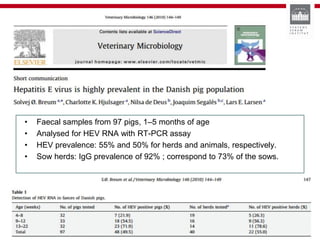
• Faecal samples from 97 pigs, 1–5 months of age
• Analysed for HEV RNA with RT-PCR assay
• HEV prevalence: 55% and 50% for herds and animals, respectively.
• Sow herds: IgG prevalence of 92% ; correspond to 73% of the sows.
Seroprevalence studies
1. Christensen PB, Engle RE, Jacobsen SE, Krarup HB, Georgsen J, Purcell RH.
High prevalence of hepatitis E antibodies among Danish
prisoners and drug users. J Med Virol. 2002
2. Christensen PB, Engle RE, Hjort C, Homburg KM, Vach W, Georgsen J,
Purcell RH.
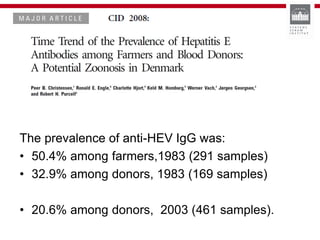
Time trend of the prevalence of hepatitis E antibodies
among farmers and blood donors: a potential zoonosis in
Denmark.
Clin Infect Dis. 2008
3. Holm DK, Moessner BK, Engle RE, Zaaijer HL, Georgsen J, Purcell RH,
Christensen PB.
Declining prevalence of hepatitis E antibodies among
Danish blood donors. Transfusion. 2015
The prevalence of anti-HEV IgG was:
• 50.4% among farmers,1983 (291 samples)
• 32.9% among donors, 1983 (169 samples)
• 20.6% among donors, 2003 (461 samples).
Method:
• NIH in-house ELISA; recombinant ORF2 protein
• Sensitivity of 96%, specificity of 98%, good test at the time.
Correlated with increasing age in all groups
Questionnaire, corr. with: Male sex, children, HAV, horses...
In conclusion
• Increasing awareness
– Notifiable from 2016
– Case definition to come
– More clinical labs to offer analysis
• Presently very few known cases
• Repeated seroprevalence studies:
– 1983: 33%; 2003: 21%; 2013: 11%
• Not indication of rise in cases/exposure.
THANKS!

Hepatitis E in Denmark

  • 1.
    Hepatitis E and whatwe know about the situation in Denmark Steen Ethelberg Statens Serum Institut Senior Researcher, Head of unit set@ssi.dk
  • 2.
    This short presentation… •Limited amount of data ~15 pub papers I’ll go through: • Surveillance • Data on number of cases • Animal and environmental studies • Serological population studies.
  • 3.
    HEV in DK •Hepatitis E virus infections have so far not been high on the agenda in Denmark • Not notifiable • …. But will be from next year! • Only lab diagnosing is at the SSI • Awareness probably limited among clinicians.
  • 4.
    HEV diagnostic inDenmark • Diagnosed in Denmark since 2000 • From 2000 to 2009 the samples were sent to Smidttskytsinstituttet in Sweden • Published case series (1993-2007):
  • 5.
    Since 2010 diagnosedat SSI Median age 43 years; Male gender 50.1% Data: Hanne Thang Vestergaard, Vir Dept, SSI Test/ patient 2010 2011 2012 2013 2014* Total Patients tested 302 293 340 475 162 1572 Samples tested 327 426 473 635 234 2095 1st IgM pos 9 21 13 21 9 73 1st IgG pos 29 40 39 57 24 189 Pos IgM, IgG and PCR 4 13 7 6 2 32
  • 6.
    Animal and environmentalstudies  Breum SØ, Hjulsager CK, de Deus N, Segalés J, Larsen LE. Hepatitis E virus is highly prevalent in the Danish pig population. Vet Microbiol. 2010  Krog JS, Breum SØ, Jensen TH, Larsen LE. Hepatitis E virus variant in farmed mink, Denmark. Emerg Infect Dis. 2013  Krog JS, Larsen LE, Schultz AC: Enteric porcine viruses in farmed shellfish in Denmark. Int J Food Microbiol. 2014  Krog JS et al Leaching of viruses naturally occurring in pig slurry to field drains and their correlations with other microorganisms. Submitted
  • 7.
    • Faecal samplesfrom 97 pigs, 1–5 months of age • Analysed for HEV RNA with RT-PCR assay • HEV prevalence: 55% and 50% for herds and animals, respectively. • Sow herds: IgG prevalence of 92% ; correspond to 73% of the sows.
  • 8.
    Seroprevalence studies 1. ChristensenPB, Engle RE, Jacobsen SE, Krarup HB, Georgsen J, Purcell RH. High prevalence of hepatitis E antibodies among Danish prisoners and drug users. J Med Virol. 2002 2. Christensen PB, Engle RE, Hjort C, Homburg KM, Vach W, Georgsen J, Purcell RH. Time trend of the prevalence of hepatitis E antibodies among farmers and blood donors: a potential zoonosis in Denmark. Clin Infect Dis. 2008 3. Holm DK, Moessner BK, Engle RE, Zaaijer HL, Georgsen J, Purcell RH, Christensen PB. Declining prevalence of hepatitis E antibodies among Danish blood donors. Transfusion. 2015
  • 9.
    The prevalence ofanti-HEV IgG was: • 50.4% among farmers,1983 (291 samples) • 32.9% among donors, 1983 (169 samples) • 20.6% among donors, 2003 (461 samples).
  • 10.
    Method: • NIH in-houseELISA; recombinant ORF2 protein • Sensitivity of 96%, specificity of 98%, good test at the time. Correlated with increasing age in all groups Questionnaire, corr. with: Male sex, children, HAV, horses...
  • 13.
    In conclusion • Increasingawareness – Notifiable from 2016 – Case definition to come – More clinical labs to offer analysis • Presently very few known cases • Repeated seroprevalence studies: – 1983: 33%; 2003: 21%; 2013: 11% • Not indication of rise in cases/exposure.
  • 14.