Case Study
Alana Saldana
Patient
O A 16 year old Cambodian boy with fever,
abdominal pain, nausea, vomiting,
headache, and a sore throat for several
days.
Clinical History
O The family came to the United States
about 2 months before the onset of the
present illness. The patient never had a
similar episode in the past. He had no
history of malarial infection and no history
of anemia or blood transfusion. He is not
taking any medication.
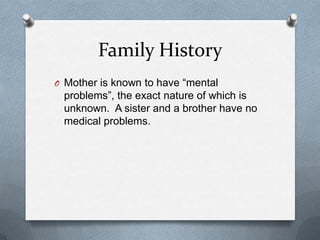
Family History
O Mother is known to have “mental
problems”, the exact nature of which is
unknown. A sister and a brother have no
medical problems.
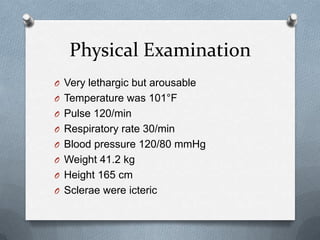
Physical Examination
O Very lethargic but arousable
O Temperature was 101°F
O Pulse 120/min
O Respiratory rate 30/min
O Blood pressure 120/80 mmHg
O Weight 41.2 kg
O Height 165 cm
O Sclerae were icteric
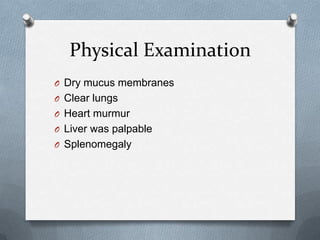
Physical Examination
O Dry mucus membranes
O Clear lungs
O Heart murmur
O Liver was palpable
O Splenomegaly
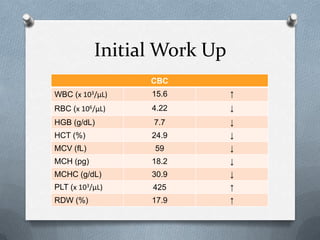
Initial Work Up
CBC
WBC (x 103/µL) 15.6 ↑
RBC (x 106/µL) 4.22 ↓
HGB (g/dL) 7.7 ↓
HCT (%) 24.9 ↓
MCV (fL) 59 ↓
MCH (pg) 18.2 ↓
MCHC (g/dL) 30.9 ↓
PLT (x 103/µL) 425 ↑
RDW (%) 17.9 ↑
Initial Work Up
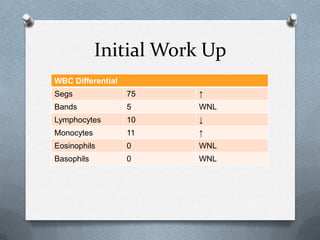
WBC Differential
Segs 75 ↑
Bands 5 WNL
Lymphocytes 10 ↓
Monocytes 11 ↑
Eosinophils 0 WNL
Basophils 0 WNL
Initial Work Up
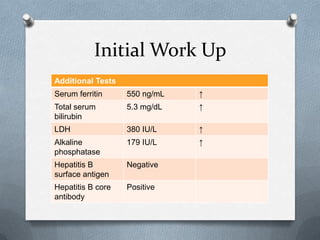
Additional Tests
Serum ferritin 550 ng/mL ↑
Total serum
bilirubin
5.3 mg/dL ↑
LDH 380 IU/L ↑
Alkaline
phosphatase
179 IU/L ↑
Hepatitis B
surface antigen
Negative
Hepatitis B core
antibody
Positive
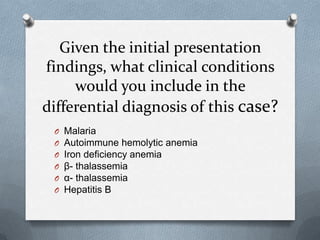
Given the initial presentation
findings, what clinical conditions
would you include in the
differential diagnosis of this case?
O Malaria
O Autoimmune hemolytic anemia
O Iron deficiency anemia
O β- thalassemia
O α- thalassemia
O Hepatitis B
What additional work-up will help
you arrive at a final diagnosis?
O Examination of thin and thick blood
smears for malaria
O Direct and indirect antiglobulin (Coombs)
tests
O Hemoglobin electrophoresis
O Brilliant cresyl blue test to detect the
presence of hemoglobin H inclusions
O Molecular diagnostic studies using DNA
O Stool culture
Results of Additional Work-Up
O Blood smears were negative for malaria
O Direct and indirect antiglobulin (Coombs) test
were negative
O Rules out autoimmune hemolytic disorder
O Hemoglobin electrophoresis showed presence
of hemoglobin A (81.7%), hemoglobin H
(15%), hemoglobin A2 (1.3%), and
hemoglobin F (2%)
O Molecular diagnostic studies using DNA
showed that his α genotype was (--/-α), which
is consistent with Hb H disease
Results of Additional Work-Up
O Examination of stool culture was positive
for Yersinia enterocolitica
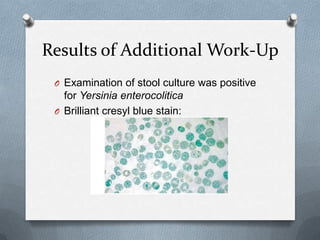
O Brilliant cresyl blue stain:
Final Diagnosis
O This patient has Hb H disease (--/-α) with
Yersinia enterocolitis and hepatitis B
Outline the course of
management for this patient
and/or the condition
O The course of management for Hb H
disease would be possible splenectomy,
supportive therapy, and blood
transfusions.
O This patient gradually improved with
symptomatic and supportive therapy.
O He received a blood transfusion with two
units of blood which subsided his fever
and raised his hemoglobin.
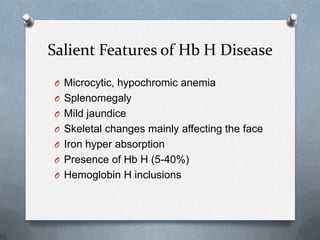
Salient Features of Hb H Disease
O Microcytic, hypochromic anemia
O Splenomegaly
O Mild jaundice
O Skeletal changes mainly affecting the face
O Iron hyper absorption
O Presence of Hb H (5-40%)
O Hemoglobin H inclusions
References
O Ciesla, Betty (2007). Hematology in
Practice. Philadelphia: F.A. Davis
Company
O Harmening, Denis M. (1997 & 2009).
Clinical Hematology and
Fundamentals of Hemostasis.
Philadelphia: F.A. Davis Company
O Turgeon, Mary Louise (1993). Clinical
Hematology. Boston: Little, Brown,
and Company

Hemoglobin H Disease

  • 1.
  • 2.
    Patient O A 16year old Cambodian boy with fever, abdominal pain, nausea, vomiting, headache, and a sore throat for several days.
  • 3.
    Clinical History O Thefamily came to the United States about 2 months before the onset of the present illness. The patient never had a similar episode in the past. He had no history of malarial infection and no history of anemia or blood transfusion. He is not taking any medication.
  • 4.
    Family History O Motheris known to have “mental problems”, the exact nature of which is unknown. A sister and a brother have no medical problems.
  • 5.
    Physical Examination O Verylethargic but arousable O Temperature was 101°F O Pulse 120/min O Respiratory rate 30/min O Blood pressure 120/80 mmHg O Weight 41.2 kg O Height 165 cm O Sclerae were icteric
  • 6.
    Physical Examination O Drymucus membranes O Clear lungs O Heart murmur O Liver was palpable O Splenomegaly
  • 7.
    Initial Work Up CBC WBC(x 103/µL) 15.6 ↑ RBC (x 106/µL) 4.22 ↓ HGB (g/dL) 7.7 ↓ HCT (%) 24.9 ↓ MCV (fL) 59 ↓ MCH (pg) 18.2 ↓ MCHC (g/dL) 30.9 ↓ PLT (x 103/µL) 425 ↑ RDW (%) 17.9 ↑
  • 8.
    Initial Work Up WBCDifferential Segs 75 ↑ Bands 5 WNL Lymphocytes 10 ↓ Monocytes 11 ↑ Eosinophils 0 WNL Basophils 0 WNL
  • 9.
    Initial Work Up AdditionalTests Serum ferritin 550 ng/mL ↑ Total serum bilirubin 5.3 mg/dL ↑ LDH 380 IU/L ↑ Alkaline phosphatase 179 IU/L ↑ Hepatitis B surface antigen Negative Hepatitis B core antibody Positive
  • 11.
    Given the initialpresentation findings, what clinical conditions would you include in the differential diagnosis of this case? O Malaria O Autoimmune hemolytic anemia O Iron deficiency anemia O β- thalassemia O α- thalassemia O Hepatitis B
  • 12.
    What additional work-upwill help you arrive at a final diagnosis? O Examination of thin and thick blood smears for malaria O Direct and indirect antiglobulin (Coombs) tests O Hemoglobin electrophoresis O Brilliant cresyl blue test to detect the presence of hemoglobin H inclusions O Molecular diagnostic studies using DNA O Stool culture
  • 13.
    Results of AdditionalWork-Up O Blood smears were negative for malaria O Direct and indirect antiglobulin (Coombs) test were negative O Rules out autoimmune hemolytic disorder O Hemoglobin electrophoresis showed presence of hemoglobin A (81.7%), hemoglobin H (15%), hemoglobin A2 (1.3%), and hemoglobin F (2%) O Molecular diagnostic studies using DNA showed that his α genotype was (--/-α), which is consistent with Hb H disease
  • 14.
    Results of AdditionalWork-Up O Examination of stool culture was positive for Yersinia enterocolitica O Brilliant cresyl blue stain:
  • 15.
    Final Diagnosis O Thispatient has Hb H disease (--/-α) with Yersinia enterocolitis and hepatitis B
  • 16.
    Outline the courseof management for this patient and/or the condition O The course of management for Hb H disease would be possible splenectomy, supportive therapy, and blood transfusions. O This patient gradually improved with symptomatic and supportive therapy. O He received a blood transfusion with two units of blood which subsided his fever and raised his hemoglobin.
  • 17.
    Salient Features ofHb H Disease O Microcytic, hypochromic anemia O Splenomegaly O Mild jaundice O Skeletal changes mainly affecting the face O Iron hyper absorption O Presence of Hb H (5-40%) O Hemoglobin H inclusions
  • 18.
    References O Ciesla, Betty(2007). Hematology in Practice. Philadelphia: F.A. Davis Company O Harmening, Denis M. (1997 & 2009). Clinical Hematology and Fundamentals of Hemostasis. Philadelphia: F.A. Davis Company O Turgeon, Mary Louise (1993). Clinical Hematology. Boston: Little, Brown, and Company