© 2023, IRJET | Impact Factor value: 8.226 | ISO 9001:2008 Certified Journal | Page 37
Helmet and License Plate Detection using Machine Learning
Mr. Meeravali Shaik1, V Uday Kiran2, K Vineeth3, CH Sudheer4
1 Assistant Professor, Dept. Of Computer Science and Engineering, SNIST, Hyderbad, 501301, India
2,3,4B.Tech Scholars , Dept. Of Computer Science and Engineering, SNIST, Hyderbad, 501301, India
---------------------------------------------------------------------***---------------------------------------------------------------------
Abstract - Over the years, the number of motorcycle
accidents has been rising quickly in many nations. More
than 37 million individuals in India ride two wheels. To
ensure road safety, a mechanism for the automatic
identification of helmet use must be developed. As a
result, a unique object detection model that can recognise
motorcycle riders is developed utilising a machine
learning-based approach. When a rider without a helmet
is spotted, the licence plate is retrieved, and an optical
character recognition system is used to identify the
licence plate number.Using a webcam or a CCTV as input,
this application can be used in real-time.
Key Words: Automatic License Plate Recognition (ALPR),
Deep Neural Network (DNN), Helmet Detection, Machine
Learning, Mean Average Precision (mAP), Optical
Character Recognition (OCR), You Only Look Once
(YOLO).
1. INTRODUCTION
Helmets are the primary piece of safety gear for
motorcycle riders. The motorcycle rider is protected from
accidents by the helmet. Although wearing a helmet is
required in many nations, some motorcycle riders choose
not to wear one or wear one inappropriately. Numerous
studies in traffic analysis have been conducted in recent
years, including those on vehicle detection and
categorization and helmet detection. Computer vision
technologies, such as background and foreground image
detection to segment the moving objects in a scene and
image descriptors to extract features, were used to
develop intelligent traffic systems. To classify the items,
computational intelligence technologies such as machine
learning algorithms are also used.
Machine learning (ML) is the area of artificial intelligence
where a trained model uses inputs from the training
phase to operate autonomously. In order to generate
predictions or choices, machine learning algorithms
create a mathematical model using sample data, referred
to as "training data," and are also utilised in object
identification applications. Therefore, a Helmet detection
model can be put into use by training with a certain
dataset. This helmet detection model makes it simple to
identify riders without helmets. The rider's licence plate
is clipped out and saved as an image based on the
recognised classes.An optical character recognition (OCR)
model is given this image, recognises the text, and
outputs the licence plate number as machine-encoded
text. Additionally, a Webcam can be used to implement it.
The goal of this study is to create a system that uses CCTV
cameras to enforce helmet use. The created system tries to
alter risky behaviours, hence lowering accident frequency
and severity.
2. RELATED WORK
The issue of helmet detection has been addressed in a
number of ways during the past few years. In, the authors
employ a background subtraction technique to identify
and distinguish between moving vehicles. Additionally,
they classified human heads with helmets and without
helmets using Support Vector Machines (SVM). In, Silva et
al. suggested a hybrid descriptor model based on
geometric shape and texture data to automatically identify
motorcycle riders without helmets. They combined the
Hough transform with SVM to find the motorcyclist's head.
They also add a multi-layer perception model for the
classification of distinct items to their work from [10].
A circular arc detection technique based on the Hough
transform is used by Wen et al. They used it on the
surveillance system to detect helmets. The flaw in this
research is that they rely solely on geometric cues to
determine whether a safety helmet is present in the set.
Finding helmets requires more than just geometrical
traits.suggests a computer vision system with the goal of
partially detecting and segmenting motorcycles. Utilizing a
helmet detecting device, the presence of a helmet confirms
the presence of a motorcycle. The edges are computed on
the potential helmet region in order to identify the
existence of the helmet. It employs the Canny edge
detector.
A system to detect moving objects using a k-NN classifier
placed over a motorcycle rider's head to categorise a
helmet was proposed by Waranusat et al. These models
had a cap on the degree of precision that could be attained
and were based on statistical data from photographs.
The accuracy of categorization has continued to increase
with the development of neural networks and deep
learning models. A convolutional neural network (CNN)
based approach for object classification and detection was
introduced by Alex et al. Despite using CNN, they have
poor accuracy in detecting helmets due to restrictions on
helmet colour and the presence of several riders on a
single biker.
International Research Journal of Engineering and Technology (IRJET) e-ISSN: 2395-0056
Volume: 10 Issue: 06 | Jun 2023 www.irjet.net p-ISSN: 2395-0072
International Research Journal of Engineering and Technology (IRJET) e-ISSN: 2395-0056
Volume: 10 Issue: 06 | Jun 2023 www.irjet.net p-ISSN: 2395-0072
© 2023, IRJET | Impact Factor value: 8.226 | ISO 9001:2008 Certified Journal | Page 38
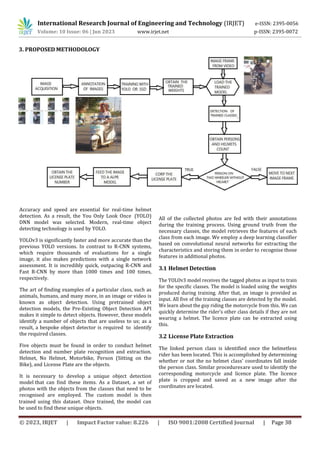
3. PROPOSED METHODOLOGY
Accuracy and speed are essential for real-time helmet
detection. As a result, the You Only Look Once (YOLO)
DNN model was selected. Modern, real-time object
detecting technology is used by YOLO.
YOLOv3 is significantly faster and more accurate than the
previous YOLO versions. In contrast to R-CNN systems,
which require thousands of evaluations for a single
image, it also makes predictions with a single network
assessment. It is incredibly quick, outpacing R-CNN and
Fast R-CNN by more than 1000 times and 100 times,
respectively.
The art of finding examples of a particular class, such as
animals, humans, and many more, in an image or video is
known as object detection. Using pretrained object
detection models, the Pre-Existing Object Detection API
makes it simple to detect objects. However, these models
identify a number of objects that are useless to us; as a
result, a bespoke object detector is required to identify
the required classes.
Five objects must be found in order to conduct helmet
detection and number plate recognition and extraction.
Helmet, No Helmet, Motorbike, Person (Sitting on the
Bike), and License Plate are the objects.
It is necessary to develop a unique object detection
model that can find these items. As a Dataset, a set of
photos with the objects from the classes that need to be
recognised are employed. The custom model is then
All of the collected photos are fed with their annotations
during the training process. Using ground truth from the
necessary classes, the model retrieves the features of each
class from each image. We employ a deep learning classifier
based on convolutional neural networks for extracting the
characteristics and storing them in order to recognise those
features in additional photos.
3.1 Helmet Detection
The YOLOv3 model receives the tagged photos as input to train
for the specific classes. The model is loaded using the weights
produced during training. After that, an image is provided as
input. All five of the training classes are detected by the model.
We learn about the guy riding the motorcycle from this. We can
quickly determine the rider's other class details if they are not
wearing a helmet. The licence plate can be extracted using
this.
3.2 License Plate Extraction
The linked person class is identified once the helmetless
rider has been located. This is accomplished by determining
whether or not the no helmet class' coordinates fall inside
the person class. Similar proceduresare used to identify the
corresponding motorcycle and licence plate. The licence
plate is cropped and saved as a new image after the
coordinates are located.
trained using this dataset. Once trained, the model can
be used to find these unique objects.
International Research Journal of Engineering and Technology (IRJET) e-ISSN: 2395-0056
Volume: 10 Issue: 06 | Jun 2023 www.irjet.net p-ISSN: 2395-0072
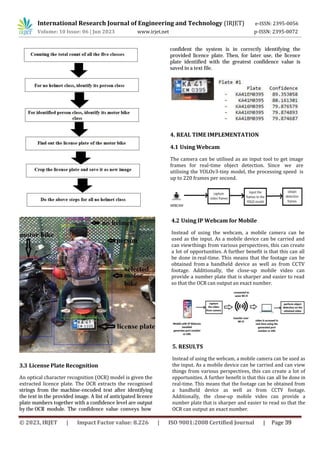
3.3 License Plate Recognition
An optical character recognition (OCR) model is given the
extracted licence plate. The OCR extracts the recognised
strings from the machine-encoded text after identifying
the text in the provided image. A list of anticipated licence
plate numbers together with a confidence level are output
by the OCR module. The confidence value conveys how
confident the system is in correctly identifying the
provided licence plate. Then, for later use, the licence
plate identified with the greatest confidence value is
saved in a text file.
4. REAL TIME IMPLEMENTATION
4.1 Using Webcam
The camera can be utilised as an input tool to get image
frames for real-time object detection. Since we are
utilising the YOLOv3-tiny model, the processing speed is
up to 220 frames per second.
4.2 Using IP Webcam for Mobile
Instead of using the webcam, a mobile camera can be
used as the input. As a mobile device can be carried and
can viewthings from various perspectives, this can create
a lot of opportunities. A further benefit is that this can all
be done in real-time. This means that the footage can be
obtained from a handheld device as well as from CCTV
footage. Additionally, the close-up mobile video can
provide a number plate that is sharper and easier to read
so that the OCR can output an exact number.
5. RESULTS
Instead of using the webcam, a mobile camera can be used as
the input. As a mobile device can be carried and can view
things from various perspectives, this can create a lot of
opportunities. A further benefit is that this can all be done in
real-time. This means that the footage can be obtained from
a handheld device as well as from CCTV footage.
Additionally, the close-up mobile video can provide a
number plate that is sharper and easier to read so that the
OCR can output an exact number.
© 2023, IRJET | Impact Factor value: 8.226 | ISO 9001:2008 Certified Journal | Page 39
International Research Journal of Engineering and Technology (IRJET) e-ISSN: 2395-0056
Volume: 10 Issue: 06 | Jun 2023 www.irjet.net p-ISSN: 2395-0072
The graphic below displays a few samples of the input
image and the item detector
From the output of the object detector, the code retrieves the
licenceplate. The code used to retrieve licence plates only pulls
information from motorbikes whose riders are not wearing
helmets and discards the information from motorbikes
whose riders are wearing helmets.
With an accuracy of upto 85%, the OCR model can find
and identify any licence plates that are visible in an image.
In the accompanying figure, a recognized licence plate is
displayed as an example.
6. CONCLUSION
According to the data shown above, it is clear that YOLO
object detection is ideally suited for real-time processing
and was successful in accurately classifying and localizing
all object classes. The suggested end-to-end model was
successfully constructed and has all the necessary
components to be automated and deployed for
monitoring. A variety of strategies are used to extract the
licence plates, some of which are created to handle the
majority of situations while taking into account various
scenarios like numerous riders operating without
helmets. All of the software and libraries utilized in our
project are open source, making them very adaptable and
affordable. The initiative was primarily created to address
the issue of ineffective traffic management. So, in
conclusion, we can claim that if implemented by any
traffic management departments, it will facilitate and
speed up their work.
REFERENCES
[1] Viola and Jones, “Robust Real-time Object
Detection”,IJCV 2001.
[2] Navneet Dalal and Bill Triggs, “Histogram of
orientedgradients for human detection”.
[3] Ross, Jeff, Trevor and Jitendra “Rich feature Hierarchy
for Accurate object Detection”.
© 2023, IRJET | Impact Factor value: 8.226 | ISO 9001:2008 Certified Journal | Page 40
International Research Journal of Engineering and Technology (IRJET) e-ISSN: 2395-0056
Volume: 10 Issue: 06 | Jun 2023 www.irjet.net p-ISSN: 2395-0072
[4] Shaoqing Ren, Kaiming He, Ross Girshick, Jian Sun,
“FastR-CNN” (Submitted on 4 Jun 2015 (v1), last revised 6
Jan 2016 (this version, v3)).
[5] Joseph Redmon, Ali Farhadi, “YOLO9000: Better,
Faster,Stronger”, University of Washington, Allen Institute
Of AI.
[6] Joseph Redmon, Ali Farhadi, “YOLOv3: An
Incremental Improvement”, University of Washington,
Allen Institute ofAI.
[6] Wei Liu, Dragomir Anguelov, Dumitru Erhan,
Christian Szegedy, Scott Reed, Cheng – Yang Fu, Alexander
C. Berg, “SSD: Single Shot MultiBox Detector”.
[7] A. Adam, E. Rivlin, I. Shimshoni, and D. Reinitz,
“Robust real-time unusual event detection using multiple
fixed- location monitors,” IEEE Transactions on Pattern
Analysis and Machine Intelligence, vol. 30, no. 3, pp. 555–
560, March2008.
[8] AlexeyAB,
https://github.com/AlexeyAB/darknet#requirements.
[9] C.-Y. Wen, S.-H. Chiu, J.-J. Liaw, and C.-P. Lu,
“The safety helmet detection for atm’s surveillance
system via the modified hough transform,” in IEEE
37th Annual International Carnahan Conference on
Security Technology., 2003, pp. 364–369.
[10] C.-C. Chiu, M.-Y. Ku, and H.-T. Chen,
“Motorcycle detection and tracking system with occlusion
segmentation,” in WIAMIS ’07, USA, 2007
[11] A. Hirota, N. H. Tiep, L. Van Khanh, and N.
Oka, Classifying Helmeted and Non-helmeted Motorcyclists.
Cham: Springer International Publishing, 2017, pp. 81–86.
© 2023, IRJET | Impact Factor value: 8.226 | ISO 9001:2008 Certified Journal | Page 41

Helmet and License Plate Detection using Machine Learning

  • 1.
    © 2023, IRJET| Impact Factor value: 8.226 | ISO 9001:2008 Certified Journal | Page 37 Helmet and License Plate Detection using Machine Learning Mr. Meeravali Shaik1, V Uday Kiran2, K Vineeth3, CH Sudheer4 1 Assistant Professor, Dept. Of Computer Science and Engineering, SNIST, Hyderbad, 501301, India 2,3,4B.Tech Scholars , Dept. Of Computer Science and Engineering, SNIST, Hyderbad, 501301, India ---------------------------------------------------------------------***--------------------------------------------------------------------- Abstract - Over the years, the number of motorcycle accidents has been rising quickly in many nations. More than 37 million individuals in India ride two wheels. To ensure road safety, a mechanism for the automatic identification of helmet use must be developed. As a result, a unique object detection model that can recognise motorcycle riders is developed utilising a machine learning-based approach. When a rider without a helmet is spotted, the licence plate is retrieved, and an optical character recognition system is used to identify the licence plate number.Using a webcam or a CCTV as input, this application can be used in real-time. Key Words: Automatic License Plate Recognition (ALPR), Deep Neural Network (DNN), Helmet Detection, Machine Learning, Mean Average Precision (mAP), Optical Character Recognition (OCR), You Only Look Once (YOLO). 1. INTRODUCTION Helmets are the primary piece of safety gear for motorcycle riders. The motorcycle rider is protected from accidents by the helmet. Although wearing a helmet is required in many nations, some motorcycle riders choose not to wear one or wear one inappropriately. Numerous studies in traffic analysis have been conducted in recent years, including those on vehicle detection and categorization and helmet detection. Computer vision technologies, such as background and foreground image detection to segment the moving objects in a scene and image descriptors to extract features, were used to develop intelligent traffic systems. To classify the items, computational intelligence technologies such as machine learning algorithms are also used. Machine learning (ML) is the area of artificial intelligence where a trained model uses inputs from the training phase to operate autonomously. In order to generate predictions or choices, machine learning algorithms create a mathematical model using sample data, referred to as "training data," and are also utilised in object identification applications. Therefore, a Helmet detection model can be put into use by training with a certain dataset. This helmet detection model makes it simple to identify riders without helmets. The rider's licence plate is clipped out and saved as an image based on the recognised classes.An optical character recognition (OCR) model is given this image, recognises the text, and outputs the licence plate number as machine-encoded text. Additionally, a Webcam can be used to implement it. The goal of this study is to create a system that uses CCTV cameras to enforce helmet use. The created system tries to alter risky behaviours, hence lowering accident frequency and severity. 2. RELATED WORK The issue of helmet detection has been addressed in a number of ways during the past few years. In, the authors employ a background subtraction technique to identify and distinguish between moving vehicles. Additionally, they classified human heads with helmets and without helmets using Support Vector Machines (SVM). In, Silva et al. suggested a hybrid descriptor model based on geometric shape and texture data to automatically identify motorcycle riders without helmets. They combined the Hough transform with SVM to find the motorcyclist's head. They also add a multi-layer perception model for the classification of distinct items to their work from [10]. A circular arc detection technique based on the Hough transform is used by Wen et al. They used it on the surveillance system to detect helmets. The flaw in this research is that they rely solely on geometric cues to determine whether a safety helmet is present in the set. Finding helmets requires more than just geometrical traits.suggests a computer vision system with the goal of partially detecting and segmenting motorcycles. Utilizing a helmet detecting device, the presence of a helmet confirms the presence of a motorcycle. The edges are computed on the potential helmet region in order to identify the existence of the helmet. It employs the Canny edge detector. A system to detect moving objects using a k-NN classifier placed over a motorcycle rider's head to categorise a helmet was proposed by Waranusat et al. These models had a cap on the degree of precision that could be attained and were based on statistical data from photographs. The accuracy of categorization has continued to increase with the development of neural networks and deep learning models. A convolutional neural network (CNN) based approach for object classification and detection was introduced by Alex et al. Despite using CNN, they have poor accuracy in detecting helmets due to restrictions on helmet colour and the presence of several riders on a single biker. International Research Journal of Engineering and Technology (IRJET) e-ISSN: 2395-0056 Volume: 10 Issue: 06 | Jun 2023 www.irjet.net p-ISSN: 2395-0072
  • 2.
    International Research Journalof Engineering and Technology (IRJET) e-ISSN: 2395-0056 Volume: 10 Issue: 06 | Jun 2023 www.irjet.net p-ISSN: 2395-0072 © 2023, IRJET | Impact Factor value: 8.226 | ISO 9001:2008 Certified Journal | Page 38 3. PROPOSED METHODOLOGY Accuracy and speed are essential for real-time helmet detection. As a result, the You Only Look Once (YOLO) DNN model was selected. Modern, real-time object detecting technology is used by YOLO. YOLOv3 is significantly faster and more accurate than the previous YOLO versions. In contrast to R-CNN systems, which require thousands of evaluations for a single image, it also makes predictions with a single network assessment. It is incredibly quick, outpacing R-CNN and Fast R-CNN by more than 1000 times and 100 times, respectively. The art of finding examples of a particular class, such as animals, humans, and many more, in an image or video is known as object detection. Using pretrained object detection models, the Pre-Existing Object Detection API makes it simple to detect objects. However, these models identify a number of objects that are useless to us; as a result, a bespoke object detector is required to identify the required classes. Five objects must be found in order to conduct helmet detection and number plate recognition and extraction. Helmet, No Helmet, Motorbike, Person (Sitting on the Bike), and License Plate are the objects. It is necessary to develop a unique object detection model that can find these items. As a Dataset, a set of photos with the objects from the classes that need to be recognised are employed. The custom model is then All of the collected photos are fed with their annotations during the training process. Using ground truth from the necessary classes, the model retrieves the features of each class from each image. We employ a deep learning classifier based on convolutional neural networks for extracting the characteristics and storing them in order to recognise those features in additional photos. 3.1 Helmet Detection The YOLOv3 model receives the tagged photos as input to train for the specific classes. The model is loaded using the weights produced during training. After that, an image is provided as input. All five of the training classes are detected by the model. We learn about the guy riding the motorcycle from this. We can quickly determine the rider's other class details if they are not wearing a helmet. The licence plate can be extracted using this. 3.2 License Plate Extraction The linked person class is identified once the helmetless rider has been located. This is accomplished by determining whether or not the no helmet class' coordinates fall inside the person class. Similar proceduresare used to identify the corresponding motorcycle and licence plate. The licence plate is cropped and saved as a new image after the coordinates are located. trained using this dataset. Once trained, the model can be used to find these unique objects.
  • 3.
    International Research Journalof Engineering and Technology (IRJET) e-ISSN: 2395-0056 Volume: 10 Issue: 06 | Jun 2023 www.irjet.net p-ISSN: 2395-0072 3.3 License Plate Recognition An optical character recognition (OCR) model is given the extracted licence plate. The OCR extracts the recognised strings from the machine-encoded text after identifying the text in the provided image. A list of anticipated licence plate numbers together with a confidence level are output by the OCR module. The confidence value conveys how confident the system is in correctly identifying the provided licence plate. Then, for later use, the licence plate identified with the greatest confidence value is saved in a text file. 4. REAL TIME IMPLEMENTATION 4.1 Using Webcam The camera can be utilised as an input tool to get image frames for real-time object detection. Since we are utilising the YOLOv3-tiny model, the processing speed is up to 220 frames per second. 4.2 Using IP Webcam for Mobile Instead of using the webcam, a mobile camera can be used as the input. As a mobile device can be carried and can viewthings from various perspectives, this can create a lot of opportunities. A further benefit is that this can all be done in real-time. This means that the footage can be obtained from a handheld device as well as from CCTV footage. Additionally, the close-up mobile video can provide a number plate that is sharper and easier to read so that the OCR can output an exact number. 5. RESULTS Instead of using the webcam, a mobile camera can be used as the input. As a mobile device can be carried and can view things from various perspectives, this can create a lot of opportunities. A further benefit is that this can all be done in real-time. This means that the footage can be obtained from a handheld device as well as from CCTV footage. Additionally, the close-up mobile video can provide a number plate that is sharper and easier to read so that the OCR can output an exact number. © 2023, IRJET | Impact Factor value: 8.226 | ISO 9001:2008 Certified Journal | Page 39
  • 4.
    International Research Journalof Engineering and Technology (IRJET) e-ISSN: 2395-0056 Volume: 10 Issue: 06 | Jun 2023 www.irjet.net p-ISSN: 2395-0072 The graphic below displays a few samples of the input image and the item detector From the output of the object detector, the code retrieves the licenceplate. The code used to retrieve licence plates only pulls information from motorbikes whose riders are not wearing helmets and discards the information from motorbikes whose riders are wearing helmets. With an accuracy of upto 85%, the OCR model can find and identify any licence plates that are visible in an image. In the accompanying figure, a recognized licence plate is displayed as an example. 6. CONCLUSION According to the data shown above, it is clear that YOLO object detection is ideally suited for real-time processing and was successful in accurately classifying and localizing all object classes. The suggested end-to-end model was successfully constructed and has all the necessary components to be automated and deployed for monitoring. A variety of strategies are used to extract the licence plates, some of which are created to handle the majority of situations while taking into account various scenarios like numerous riders operating without helmets. All of the software and libraries utilized in our project are open source, making them very adaptable and affordable. The initiative was primarily created to address the issue of ineffective traffic management. So, in conclusion, we can claim that if implemented by any traffic management departments, it will facilitate and speed up their work. REFERENCES [1] Viola and Jones, “Robust Real-time Object Detection”,IJCV 2001. [2] Navneet Dalal and Bill Triggs, “Histogram of orientedgradients for human detection”. [3] Ross, Jeff, Trevor and Jitendra “Rich feature Hierarchy for Accurate object Detection”. © 2023, IRJET | Impact Factor value: 8.226 | ISO 9001:2008 Certified Journal | Page 40
  • 5.
    International Research Journalof Engineering and Technology (IRJET) e-ISSN: 2395-0056 Volume: 10 Issue: 06 | Jun 2023 www.irjet.net p-ISSN: 2395-0072 [4] Shaoqing Ren, Kaiming He, Ross Girshick, Jian Sun, “FastR-CNN” (Submitted on 4 Jun 2015 (v1), last revised 6 Jan 2016 (this version, v3)). [5] Joseph Redmon, Ali Farhadi, “YOLO9000: Better, Faster,Stronger”, University of Washington, Allen Institute Of AI. [6] Joseph Redmon, Ali Farhadi, “YOLOv3: An Incremental Improvement”, University of Washington, Allen Institute ofAI. [6] Wei Liu, Dragomir Anguelov, Dumitru Erhan, Christian Szegedy, Scott Reed, Cheng – Yang Fu, Alexander C. Berg, “SSD: Single Shot MultiBox Detector”. [7] A. Adam, E. Rivlin, I. Shimshoni, and D. Reinitz, “Robust real-time unusual event detection using multiple fixed- location monitors,” IEEE Transactions on Pattern Analysis and Machine Intelligence, vol. 30, no. 3, pp. 555– 560, March2008. [8] AlexeyAB, https://github.com/AlexeyAB/darknet#requirements. [9] C.-Y. Wen, S.-H. Chiu, J.-J. Liaw, and C.-P. Lu, “The safety helmet detection for atm’s surveillance system via the modified hough transform,” in IEEE 37th Annual International Carnahan Conference on Security Technology., 2003, pp. 364–369. [10] C.-C. Chiu, M.-Y. Ku, and H.-T. Chen, “Motorcycle detection and tracking system with occlusion segmentation,” in WIAMIS ’07, USA, 2007 [11] A. Hirota, N. H. Tiep, L. Van Khanh, and N. Oka, Classifying Helmeted and Non-helmeted Motorcyclists. Cham: Springer International Publishing, 2017, pp. 81–86. © 2023, IRJET | Impact Factor value: 8.226 | ISO 9001:2008 Certified Journal | Page 41