International Research Journal of Engineering and Technology (IRJET) e-ISSN: 2395-0056
Volume: 07 Issue: 02 | Feb 2020 www.irjet.net p-ISSN: 2395-0072
© 2020, IRJET | Impact Factor value: 7.34 | ISO 9001:2008 Certified Journal | Page 3091
HELMET VIOLATION DETECTION USING DEEP LEARNING
Sri Uthra V1, Sariga Devi V2, Vaishali K S3, Padma Priya S4
1,2,3Student, Dept. of Information Technology, K.L.N. College of Engineering, Tamil Nadu, India
4Mrs. Padma Priya S, Dept. of Information Technology, K.L.N. College of Engineering, Tamil Nadu, India
---------------------------------------------------------------------***---------------------------------------------------------------------
Abstract - Two-wheeler is the most popular modes of
transport. Also, it is proved that one of every five bike riders
who died on roads were not wearing helmet. This paper
proposed a method for motorcycle detection and
classification, helmet detection and license plate recognition
to detect and identify the motorcyclists without helmet and
report it to concerned authorities. Support Vector Machine
(SVM) is used for vehicle classification. For helmet detection,
CNN algorithms are applied to extract the image attributes,
and the SVM classifier is used to classify the objects. For
License plate Recognition, Optical Character Recognition
(OCR) algorithm is used. The Simple Message Service (SMS)
is sent to the helmet rule violators. The results are stored in
the Database for further actions.
Key Words: Helmet detection, Classifiers, Character
recognition
1. INTRODUCTION
Head injuries are the leading cause of death and
major trauma for two- and three-wheel motor vehicle
users. Travel on a motorcycle carries and a much higher
risk of injury or death than driving a car. In 2016, the risk
of and fatal crash was 28 times greater than that of
automobiles. About 75% of accidents involve motorcycle
and passenger vehicle, while the rest 25% of accidents
were motorcycle accidents. Correct helmet use can lead to
a 42% reduction in the risk of fatal injuries and 69%
reduction in the risk of head injuries [1].
In India, the highest rate of deaths due to the
motorcycle rider without a helmet is reported in Tamil
Nadu. The number of accidents recorded in Tamil Nadu is
24 percent. Tamil Nadu is followed by Uttar Pradesh
where the death toll of such riders was 4,406 (12.25
percent). Maharashtra holds third place with 4,369 deaths
and Madhya Pradesh with 3,183 deaths. Meghalaya and
Mizoram were the only two states where no motorcycle
user without a helmet died.
The Global status on road safety highlights that
the number of annual road traffic fatal count has reached
1.35 million in the year 2018 [2]. On analyzing the statistics
provided by the ministry, India Today Data Intelligence
Unit (DIU) has found that of all the road accidents that
took place in 2017, motorcycle accidents were the worst.
In 2017, more than 48,746 two-wheeler users died in road
accidents. Out of that 73.8 percent of them were not
wearing a helmet. This means that every hour, for two-
wheeler users who died in and road accident did not wear
a helmet[3].
Though there are severe fines and laws imposed
for helmet violations, most of the motorcyclists do not
wear the helmet properly. This may lead to fatal accidents
of the motorcyclists, passengers and even pedestrians.
According to the report issued by Bangalore Traffic Police,
within 24 hours an amount of Rs.20, 55,200 were collected
as fine from 1,274 cases [4]. An increase in the motorcycle
count there is an increase in the violation of the rules.
There is the least possibility of imposing fine on each
motorcyclist violating the traffic rules due to the shortage
of manpower and technology implemented. The fatal
percentage for motorcycle riders not wearing a helmet
was the highest in Jharkhand - 52.33 percent. This means
out of every two road accidents a two-wheeler rider did
not wear a helmet.
The objective of this system is to reduce the
number of helmet violation cases. The proposed system
does continuous surveillance on the roads for motorcyclist
with no helmet especially in main roads were the use of
helmets are mandatory and generate fine amount without
any manpower. The fine amount generated will be sent as
Simple Message Service (SMS) to the mobile number
associated with the insurance of the vehicle. The
motorcyclist violating the helmet laws are monitored
using a database. Repeated violations are reported to the
concerned authority. These data can be further used for
enforcement of traffic laws. This system is useful for
countries with the highest population and highest fatal
rates. The proposed system provides a solution for the
reduction in the fatal rates and road accidents with the
increase in the number of motorcyclist wearing a helmet.
This system is based on the study of Image
Processing and Deep Learning. Image processing is done
for the detection of a motorcyclist without a helmet,
classification on motorcyclists with helmet and with no
helmet and for license plate recognition. The vehicle is
classified as two- and three-wheelers, both the bicycles
and the motorcycles falls into the category of two-
wheelers. The motorcycle and bicycle are differentiated
with the help of their features. The helmet and no helmet
classification are done by considering the head of the rider
as the Region of Interest which may be circular. The
helmet and the human head may appear as a circle. The
Support Vector Machine (SVM) is used as a classifier for
identifying the motorcyclists and the helmet.
International Research Journal of Engineering and Technology (IRJET) e-ISSN: 2395-0056
Volume: 07 Issue: 02 | Feb 2020 www.irjet.net p-ISSN: 2395-0072
© 2020, IRJET | Impact Factor value: 7.34 | ISO 9001:2008 Certified Journal | Page 3092
The license plate recognition is done using Optical
Character Recognition (OCR). It consists of three stages:
license plate localization, character segmentation, and
character recognition. In the first phase the license plate of
the motorcycle violating the helmet rule is located, the
characters on the license plate are segmented by finding
the contours in the image and the recognition of
characters in the number plate is done with the use of the
OCR. The system is trained to recognize the characters in
the license plate of the vehicles with the help of horizontal
and vertical projection.
2. RELATED WORK
The existing work that solves the problem by
image processing solutions use technologies like HOG,
LBP, WT [5][6][7] . The system proposed by isolates the bikes
from images and by approximation crops the most
probable area where helmet might be present and then
feeds it to the feature extraction and matching system.
Chiverton[5] proposed the use of circular arc to
identify helmet in a video feed, it has very low accuracy.
On the other hand, given the number of vehicles on the
speed at a given instant, the computation that required is
very heavy and consumes lots of resources. These
methods will deter-mine any circular object around the
bike rider as helmet.
In [6] two phases were used for helmet detection.
In the first phase, moving objects were determined where
cross line was specified. It is then checked whether it is a
motorbike or not. In the second phase, a region of interest
was used to improve efficiency. A SVM classifier was used
to classify moving object into two classes. Three
classification families were used viz. geometric, periodic,
and tree based. Videos were captured at 25 fps and image
size was of 1280x720 [8].
Talks about a system very similar to the one
proposed in this paper which identifies bike riders
without helmet and captures the number plate of all the
offenders on a COCO database. It classifies motor bike and
helmet using YOLO and the technology used for license
place recognition is Open ALPR. Both of these technologies
charge monthly fees and hence are not economically
feasible.
A detection method for circular arcs was
proposed by Wen et al. [9] based on the modified circular
Hough transform (CHT) [10].The edges of the image are
calculated using defined threshold value. The circle Hough
transforms is subsequently applied. Circular regions such
as a helmet are searched by the transform. In automated
teller machines (ATM), this method was used for
surveillance systems. To identify a helmet in the image
with use of geometric resources is the main limitation of
this study. For locating the helmet, Geometric
characteristics are not sufficient; the helmet can be
confused with a human head, as their shapes are similar.
Chiu et al. [11] proposed a vehicle counting system
based on computational vision. The objective is to detect
and track motorcycles that are partially occluded by
another vehicle. Motorcycle is detected using Helmet
detection system. The system assumes that the helmet
region has a shape of a circle. The edges of the image are
calculated over its possible region where the motorcycle is
located to detect the helmet. The numbers of edge points
that resemble a circle are subsequently counted. If this
number is greater or equal to a predefined value during
the calibration of the system, the region will correspond to
a helmet. A motorcycle is assumed to exist in the same
location if helmet is detected by the system. Some
parameters such as helmet radius, camera angle and
height are required to be given as input by the system
operator at the calibration stage. If any condition, such as
camera height or the road on which the system is in
operation, changes, all parameters should be altered.
Waranusast et al. [12] proposed most recent study
of the detection of helmet use. Moving objects from videos
is extracted using the AGMM algorithm. The system
classifies extracted objects as motorcycles or other
objects. Three features are employed for this purpose: the
area of the rectangle that contains the image, the ratio
between the width and the height of the rectangle and the
standard deviation of the H band in the hue-saturation-
value (HSV) colour space around a rectangle at the Centre
of the object. The next step uses k-nearest neighbours
(KNN) classifier with the calculated features. The counting
of passengers, which is performed by the number of heads
that appear on the image, is the primary advantage of this
study. The final step performs classification using
geometric information of the head region and colour
information. KNN classifier reapplied these features to
classify the images of motorcyclists with helmets and
without helmets. Hit rate of 95 % is obtained at the
motorcycle detection stage. The passenger counting stage
obtained a total of 83.82 % hits. In the helmet detection
stage, the hit rate was 89 %. The images of the head region
were manually cut in the latter stage. A flaw of the system
was the images were perpendicularly captured by the
camera, that is, the images show the side view of
motorcycles, as the vehicle registration plate is difficult to
capture in that position. More than one person on the
motorcycle is identified in the images using this method.
Another angle images had been taken from other side, one
of the persons on the motorcycle would most likely be
superimposed on another image, which would generate an
occlusion.
International Research Journal of Engineering and Technology (IRJET) e-ISSN: 2395-0056
Volume: 07 Issue: 02 | Feb 2020 www.irjet.net p-ISSN: 2395-0072
© 2020, IRJET | Impact Factor value: 7.34 | ISO 9001:2008 Certified Journal | Page 3093
Chart -1: Flowchart of Proposed System.
2. MODULE DESCRIPTION
2.1 Vehicle Classification
There are different types of vehicles available in the
society. The image from the database is trained and tested
using Support Vector Machine (SVM) classifier. The
system focuses on two-wheelers. The motorcycle and
bicycle are classified based on their unique features. The
input image is fed into the system. The RGB image is
converted to grayscale for better classification by reducing
the complexity of the image using Histogram of Gradient
(HOG). The next step is background subtraction for the
extraction of the vehicles from the image. This is done for
the elimination of the other unwanted information.
Feature extraction is done to differentiate motorcycle
objects from the other vehicular objects using Wavelet
Transform (WT); features like aspect ratio and standard
deviation of hue from all the vehicles are extracted. The
aspect ratio gives the ratio between the length and the
width of the bounded rectangle that bounds the vehicle
object. The standard deviation of hue is used to find a
variation in hue around the center of vehicular object. It is
assumed that motorcycle has more variation than other
vehicles.
Table -1: Various Vehicle Classifier Comparisons
DESCRIPTOR A% K P R F1 ROC
HOG[1] 97 0.95 0.98 0.97 0.975 0.975
WT[2] 97.5 0.95 0.961 0.99 0.975 0.975
[1]+[2] 99.5 0.99 99.5 0.99 0.995 0.99
Fig-1: Output for Vehicle Classification
2.2 Helmet vs. Non-Helmet Classifier
This classifier was built similar to the Vehicle
Classification. Once an object from the image is classified
as a motorcycle, to locate the head of the motorcycle rider
for checking whether the rider is wearing a helmet, the top
25% of the motorcycle blobs is considered as the Region of
Interest (RoI). The RoI size is tested with images to check
whether the head region is fully in the RoI. The RoI helps
in reduction of computational cost and unwanted
searching of features in the image. RoI segmentation
minimizes the processing time of the system. The image is
converted to grayscale from RGB after the RoI. If this
classifier classifies the RoI as no helmet, then the original
image of the motorcyclist is cropped for the number plate
of the motorcycle. The cropped image is forwarded for
number plate detection; otherwise, the image is discarded.
The classifier is used to train the system for helmet and no
helmet classification. Two methods are used for the
classification of helmet vs. non-helmet. First, the system
looks for facial features. Second, the human head and the
helmet differs in shape, this is used for the classification.
Training of this system helps in better distinguishing of
the riders without helmet. The training of the module for
helmet vs. non-helmet is done by SVM classifier.
Table -1: Various Vehicle Classifier Comparisons
Descriptor SVM RBFN MLP Naive
Bayes
KNN
WT[1] 0.870 0.851 0.858 0.843 0.819
HOG[2] 0.878 0.843 0.913 0.870 0.847
LBP[3] 0.811 0.737 0.702 0.609 0.556
[1]+[2] 0.870 0.823 0.882 0.847 0.847
[1]+[3] 0.870 0.851 0.854 0.847 0.835
[2]+[3] 0.878 0.772 0.831 0.756 0.811
[1]+[2]+[3] 0.870 0.886 0.878 0.843 0.854
International Research Journal of Engineering and Technology (IRJET) e-ISSN: 2395-0056
Volume: 07 Issue: 02 | Feb 2020 www.irjet.net p-ISSN: 2395-0072
© 2020, IRJET | Impact Factor value: 7.34 | ISO 9001:2008 Certified Journal | Page 3094
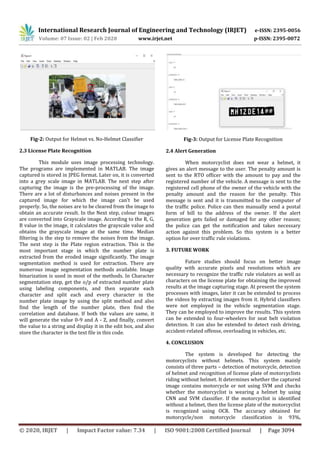
Fig-2: Output for Helmet vs. No-Helmet Classifier
2.3 License Plate Recognition
This module uses image processing technology.
The programs are implemented in MATLAB. The image
captured is stored in JPEG format. Later on, it is converted
into a grey scale image in MATLAB. The next step after
capturing the image is the pre-processing of the image.
There are a lot of disturbances and noises present in the
captured image for which the image can’t be used
properly. So, the noises are to be cleared from the image to
obtain an accurate result. In the Next step, colour images
are converted into Grayscale image. According to the R, G,
B value in the image, it calculates the grayscale value and
obtains the grayscale image at the same time. Median
filtering is the step to remove the noises from the image.
The next step is the Plate region extraction. This is the
most important stage in which the number plate is
extracted from the eroded image significantly. The image
segmentation method is used for extraction. There are
numerous image segmentation methods available. Image
binarization is used in most of the methods. In Character
segmentation step, get the o/p of extracted number plate
using labeling components, and then separate each
character and split each and every character in the
number plate image by using the split method and also
find the length of the number plate, then find the
correlation and database. If both the values are same, it
will generate the value 0-9 and A - Z, and finally, convert
the value to a string and display it in the edit box, and also
store the character in the text file in this code.
Fig-3: Output for License Plate Recognition
2.4 Alert Generation
When motorcyclist does not wear a helmet, it
gives an alert message to the user. The penalty amount is
sent to the RTO officer with the amount to pay and the
registered number of the vehicle. A message is sent to the
registered cell phone of the owner of the vehicle with the
penalty amount and the reason for the penalty. This
message is sent and it is transmitted to the computer of
the traffic police. Police can then manually send a postal
form of bill to the address of the owner. If the alert
generation gets failed or damaged for any other reason;
the police can get the notification and takes necessary
action against this problem. So this system is a better
option for over traffic rule violations.
3. FUTURE WORK
Future studies should focus on better image
quality with accurate pixels and resolutions which are
necessary to recognize the traffic rule violators as well as
characters on the license plate for obtaining the improved
results at the image capturing stage. At present the system
processes with images, later it can be extended to process
the videos by extracting images from it. Hybrid classifiers
were not employed in the vehicle segmentation stage.
They can be employed to improve the results. This system
can be extended to four-wheelers for seat belt violation
detection. It can also be extended to detect rash driving,
accident-related offense, overloading in vehicles, etc.
4. CONCLUSION
The system is developed for detecting the
motorcyclists without helmets. This system mainly
consists of three parts – detection of motorcycle, detection
of helmet and recognition of license plate of motorcyclists
riding without helmet. It determines whether the captured
image contains motorcycle or not using SVM and checks
whether the motorcyclist is wearing a helmet by using
CNN and SVM classifier. If the motorcyclist is identified
without a helmet, then the license plate of the motorcyclist
is recognized using OCR. The accuracy obtained for
motorcycle/non motorcycle classification is 93%,
International Research Journal of Engineering and Technology (IRJET) e-ISSN: 2395-0056
Volume: 07 Issue: 02 | Feb 2020 www.irjet.net p-ISSN: 2395-0072
© 2020, IRJET | Impact Factor value: 7.34 | ISO 9001:2008 Certified Journal | Page 3095
helmet/no-helmet classification is 85% and license plate
recognition is 83% resulting in an average accuracy of
around 81%. The accuracy can be improved by increasing
the training data set and image quality.
REFERENCES
[1] Cochrane report on “Helmets are shown to reduce
motorcyclist head injury and death”, Authors: Liu BC, Ivers
R, Norton R, Boufous S, Blows S, Lo SK (2008)
https://www.cochrane.org/CD004333/INJ_helmets-are-
shown-to-reduce-motorcyclist-head-injury-and-death
[2] Global Status Report on Road Safety (2018)
https://knoema.com/WHOGSRS2019Jan/global-status-
report-on-road-safety-2018
[3] India Today’s Data Intelligent Unit Report on “4 people
die every hour in India because they do not wear a helmet”
https://www.indiatoday.in/dui/story/two-wheeler-
death-road-accidents-helmets-states-india-1602794-
2019-09-24
[4] The New Indian Express report on “Traffic violation:
Cops collects Rs 20 lakh from 55 in just 24 hours”
https://www.newindianexpress.com/cities/bengaluru/20
19/sep/13/traffic-violation-cops-collect-rs-20-lakh-from-
55-in-just-24-hours-2032987.html
[5] Chiverton J (2012) Helmet presence classification with
motorcycle detection and tracking. Intell Transp Syst
6(3):259–269
[6] ‘Automatic detection of motorcyclists without helmet’
by Romuere Silva, Kelson Aires, Thiago Santos, Kalyf
Abdala, Rodrigo Veras, André Soares, Departamento de
Computação, 2013 Latin America Cmputiong Conference.
[7] ‘Detection of motorcyclist without helmet using video
convolution neural network’ by C. Vishnu,Dinesh Singh,C.
Krishna Mohan,Sohan Babu; 2017 International Joint
conference on Neural Networks(IJCNN).
[8] An Automatic Detection of Helmeted and Non-
Helmeted Motorcyclist with License Plate Extraction using
Convolutional Neural Network’ by Jimit Mistry, Aashish K.
Misraa, Meenu Agarwal, Ayushi Vyas, Vishal M.
Chudasama, Kishor P. Upla, Sardar Vallabhbhai National
Institute of Technology (SVNIT),
[9] Wen C-Y, Chiu S-H, Liaw J-J, Chuan-Pin L (2003) The
safety helmet detection for atm’s surveillance system via
the modified hough transform. In: IEEE 37th Annual
international carnahan conference on security technology,
pp 364–369
[10] Duda RO, Hart PE (1972) Use of the hough
transformation to detect lines and curves in pictures.
Commun Assoc Comput Mach 15(1):11–15
[11] Chiu C-C, Min-Yu K, Chen H-T (2007) Motorcycle
detection and tracking system with occlusion
segmentation. In: Eighth International workshop on image
analysis for multimedia interactive services. USA
[12] Waranusast R, Bundon N, Timtong V, Tangnoi C,
Pattanathaburt P (2013) Machine vision techniques for
motorcycle safety helmet detection. In: 2013 28th
International conference of image and vision computing
New Zealand (IVCNZ), pp 35–40

IRJET - Helmet Violation Detection using Deep Learning

  • 1.
    International Research Journalof Engineering and Technology (IRJET) e-ISSN: 2395-0056 Volume: 07 Issue: 02 | Feb 2020 www.irjet.net p-ISSN: 2395-0072 © 2020, IRJET | Impact Factor value: 7.34 | ISO 9001:2008 Certified Journal | Page 3091 HELMET VIOLATION DETECTION USING DEEP LEARNING Sri Uthra V1, Sariga Devi V2, Vaishali K S3, Padma Priya S4 1,2,3Student, Dept. of Information Technology, K.L.N. College of Engineering, Tamil Nadu, India 4Mrs. Padma Priya S, Dept. of Information Technology, K.L.N. College of Engineering, Tamil Nadu, India ---------------------------------------------------------------------***--------------------------------------------------------------------- Abstract - Two-wheeler is the most popular modes of transport. Also, it is proved that one of every five bike riders who died on roads were not wearing helmet. This paper proposed a method for motorcycle detection and classification, helmet detection and license plate recognition to detect and identify the motorcyclists without helmet and report it to concerned authorities. Support Vector Machine (SVM) is used for vehicle classification. For helmet detection, CNN algorithms are applied to extract the image attributes, and the SVM classifier is used to classify the objects. For License plate Recognition, Optical Character Recognition (OCR) algorithm is used. The Simple Message Service (SMS) is sent to the helmet rule violators. The results are stored in the Database for further actions. Key Words: Helmet detection, Classifiers, Character recognition 1. INTRODUCTION Head injuries are the leading cause of death and major trauma for two- and three-wheel motor vehicle users. Travel on a motorcycle carries and a much higher risk of injury or death than driving a car. In 2016, the risk of and fatal crash was 28 times greater than that of automobiles. About 75% of accidents involve motorcycle and passenger vehicle, while the rest 25% of accidents were motorcycle accidents. Correct helmet use can lead to a 42% reduction in the risk of fatal injuries and 69% reduction in the risk of head injuries [1]. In India, the highest rate of deaths due to the motorcycle rider without a helmet is reported in Tamil Nadu. The number of accidents recorded in Tamil Nadu is 24 percent. Tamil Nadu is followed by Uttar Pradesh where the death toll of such riders was 4,406 (12.25 percent). Maharashtra holds third place with 4,369 deaths and Madhya Pradesh with 3,183 deaths. Meghalaya and Mizoram were the only two states where no motorcycle user without a helmet died. The Global status on road safety highlights that the number of annual road traffic fatal count has reached 1.35 million in the year 2018 [2]. On analyzing the statistics provided by the ministry, India Today Data Intelligence Unit (DIU) has found that of all the road accidents that took place in 2017, motorcycle accidents were the worst. In 2017, more than 48,746 two-wheeler users died in road accidents. Out of that 73.8 percent of them were not wearing a helmet. This means that every hour, for two- wheeler users who died in and road accident did not wear a helmet[3]. Though there are severe fines and laws imposed for helmet violations, most of the motorcyclists do not wear the helmet properly. This may lead to fatal accidents of the motorcyclists, passengers and even pedestrians. According to the report issued by Bangalore Traffic Police, within 24 hours an amount of Rs.20, 55,200 were collected as fine from 1,274 cases [4]. An increase in the motorcycle count there is an increase in the violation of the rules. There is the least possibility of imposing fine on each motorcyclist violating the traffic rules due to the shortage of manpower and technology implemented. The fatal percentage for motorcycle riders not wearing a helmet was the highest in Jharkhand - 52.33 percent. This means out of every two road accidents a two-wheeler rider did not wear a helmet. The objective of this system is to reduce the number of helmet violation cases. The proposed system does continuous surveillance on the roads for motorcyclist with no helmet especially in main roads were the use of helmets are mandatory and generate fine amount without any manpower. The fine amount generated will be sent as Simple Message Service (SMS) to the mobile number associated with the insurance of the vehicle. The motorcyclist violating the helmet laws are monitored using a database. Repeated violations are reported to the concerned authority. These data can be further used for enforcement of traffic laws. This system is useful for countries with the highest population and highest fatal rates. The proposed system provides a solution for the reduction in the fatal rates and road accidents with the increase in the number of motorcyclist wearing a helmet. This system is based on the study of Image Processing and Deep Learning. Image processing is done for the detection of a motorcyclist without a helmet, classification on motorcyclists with helmet and with no helmet and for license plate recognition. The vehicle is classified as two- and three-wheelers, both the bicycles and the motorcycles falls into the category of two- wheelers. The motorcycle and bicycle are differentiated with the help of their features. The helmet and no helmet classification are done by considering the head of the rider as the Region of Interest which may be circular. The helmet and the human head may appear as a circle. The Support Vector Machine (SVM) is used as a classifier for identifying the motorcyclists and the helmet.
  • 2.
    International Research Journalof Engineering and Technology (IRJET) e-ISSN: 2395-0056 Volume: 07 Issue: 02 | Feb 2020 www.irjet.net p-ISSN: 2395-0072 © 2020, IRJET | Impact Factor value: 7.34 | ISO 9001:2008 Certified Journal | Page 3092 The license plate recognition is done using Optical Character Recognition (OCR). It consists of three stages: license plate localization, character segmentation, and character recognition. In the first phase the license plate of the motorcycle violating the helmet rule is located, the characters on the license plate are segmented by finding the contours in the image and the recognition of characters in the number plate is done with the use of the OCR. The system is trained to recognize the characters in the license plate of the vehicles with the help of horizontal and vertical projection. 2. RELATED WORK The existing work that solves the problem by image processing solutions use technologies like HOG, LBP, WT [5][6][7] . The system proposed by isolates the bikes from images and by approximation crops the most probable area where helmet might be present and then feeds it to the feature extraction and matching system. Chiverton[5] proposed the use of circular arc to identify helmet in a video feed, it has very low accuracy. On the other hand, given the number of vehicles on the speed at a given instant, the computation that required is very heavy and consumes lots of resources. These methods will deter-mine any circular object around the bike rider as helmet. In [6] two phases were used for helmet detection. In the first phase, moving objects were determined where cross line was specified. It is then checked whether it is a motorbike or not. In the second phase, a region of interest was used to improve efficiency. A SVM classifier was used to classify moving object into two classes. Three classification families were used viz. geometric, periodic, and tree based. Videos were captured at 25 fps and image size was of 1280x720 [8]. Talks about a system very similar to the one proposed in this paper which identifies bike riders without helmet and captures the number plate of all the offenders on a COCO database. It classifies motor bike and helmet using YOLO and the technology used for license place recognition is Open ALPR. Both of these technologies charge monthly fees and hence are not economically feasible. A detection method for circular arcs was proposed by Wen et al. [9] based on the modified circular Hough transform (CHT) [10].The edges of the image are calculated using defined threshold value. The circle Hough transforms is subsequently applied. Circular regions such as a helmet are searched by the transform. In automated teller machines (ATM), this method was used for surveillance systems. To identify a helmet in the image with use of geometric resources is the main limitation of this study. For locating the helmet, Geometric characteristics are not sufficient; the helmet can be confused with a human head, as their shapes are similar. Chiu et al. [11] proposed a vehicle counting system based on computational vision. The objective is to detect and track motorcycles that are partially occluded by another vehicle. Motorcycle is detected using Helmet detection system. The system assumes that the helmet region has a shape of a circle. The edges of the image are calculated over its possible region where the motorcycle is located to detect the helmet. The numbers of edge points that resemble a circle are subsequently counted. If this number is greater or equal to a predefined value during the calibration of the system, the region will correspond to a helmet. A motorcycle is assumed to exist in the same location if helmet is detected by the system. Some parameters such as helmet radius, camera angle and height are required to be given as input by the system operator at the calibration stage. If any condition, such as camera height or the road on which the system is in operation, changes, all parameters should be altered. Waranusast et al. [12] proposed most recent study of the detection of helmet use. Moving objects from videos is extracted using the AGMM algorithm. The system classifies extracted objects as motorcycles or other objects. Three features are employed for this purpose: the area of the rectangle that contains the image, the ratio between the width and the height of the rectangle and the standard deviation of the H band in the hue-saturation- value (HSV) colour space around a rectangle at the Centre of the object. The next step uses k-nearest neighbours (KNN) classifier with the calculated features. The counting of passengers, which is performed by the number of heads that appear on the image, is the primary advantage of this study. The final step performs classification using geometric information of the head region and colour information. KNN classifier reapplied these features to classify the images of motorcyclists with helmets and without helmets. Hit rate of 95 % is obtained at the motorcycle detection stage. The passenger counting stage obtained a total of 83.82 % hits. In the helmet detection stage, the hit rate was 89 %. The images of the head region were manually cut in the latter stage. A flaw of the system was the images were perpendicularly captured by the camera, that is, the images show the side view of motorcycles, as the vehicle registration plate is difficult to capture in that position. More than one person on the motorcycle is identified in the images using this method. Another angle images had been taken from other side, one of the persons on the motorcycle would most likely be superimposed on another image, which would generate an occlusion.
  • 3.
    International Research Journalof Engineering and Technology (IRJET) e-ISSN: 2395-0056 Volume: 07 Issue: 02 | Feb 2020 www.irjet.net p-ISSN: 2395-0072 © 2020, IRJET | Impact Factor value: 7.34 | ISO 9001:2008 Certified Journal | Page 3093 Chart -1: Flowchart of Proposed System. 2. MODULE DESCRIPTION 2.1 Vehicle Classification There are different types of vehicles available in the society. The image from the database is trained and tested using Support Vector Machine (SVM) classifier. The system focuses on two-wheelers. The motorcycle and bicycle are classified based on their unique features. The input image is fed into the system. The RGB image is converted to grayscale for better classification by reducing the complexity of the image using Histogram of Gradient (HOG). The next step is background subtraction for the extraction of the vehicles from the image. This is done for the elimination of the other unwanted information. Feature extraction is done to differentiate motorcycle objects from the other vehicular objects using Wavelet Transform (WT); features like aspect ratio and standard deviation of hue from all the vehicles are extracted. The aspect ratio gives the ratio between the length and the width of the bounded rectangle that bounds the vehicle object. The standard deviation of hue is used to find a variation in hue around the center of vehicular object. It is assumed that motorcycle has more variation than other vehicles. Table -1: Various Vehicle Classifier Comparisons DESCRIPTOR A% K P R F1 ROC HOG[1] 97 0.95 0.98 0.97 0.975 0.975 WT[2] 97.5 0.95 0.961 0.99 0.975 0.975 [1]+[2] 99.5 0.99 99.5 0.99 0.995 0.99 Fig-1: Output for Vehicle Classification 2.2 Helmet vs. Non-Helmet Classifier This classifier was built similar to the Vehicle Classification. Once an object from the image is classified as a motorcycle, to locate the head of the motorcycle rider for checking whether the rider is wearing a helmet, the top 25% of the motorcycle blobs is considered as the Region of Interest (RoI). The RoI size is tested with images to check whether the head region is fully in the RoI. The RoI helps in reduction of computational cost and unwanted searching of features in the image. RoI segmentation minimizes the processing time of the system. The image is converted to grayscale from RGB after the RoI. If this classifier classifies the RoI as no helmet, then the original image of the motorcyclist is cropped for the number plate of the motorcycle. The cropped image is forwarded for number plate detection; otherwise, the image is discarded. The classifier is used to train the system for helmet and no helmet classification. Two methods are used for the classification of helmet vs. non-helmet. First, the system looks for facial features. Second, the human head and the helmet differs in shape, this is used for the classification. Training of this system helps in better distinguishing of the riders without helmet. The training of the module for helmet vs. non-helmet is done by SVM classifier. Table -1: Various Vehicle Classifier Comparisons Descriptor SVM RBFN MLP Naive Bayes KNN WT[1] 0.870 0.851 0.858 0.843 0.819 HOG[2] 0.878 0.843 0.913 0.870 0.847 LBP[3] 0.811 0.737 0.702 0.609 0.556 [1]+[2] 0.870 0.823 0.882 0.847 0.847 [1]+[3] 0.870 0.851 0.854 0.847 0.835 [2]+[3] 0.878 0.772 0.831 0.756 0.811 [1]+[2]+[3] 0.870 0.886 0.878 0.843 0.854
  • 4.
    International Research Journalof Engineering and Technology (IRJET) e-ISSN: 2395-0056 Volume: 07 Issue: 02 | Feb 2020 www.irjet.net p-ISSN: 2395-0072 © 2020, IRJET | Impact Factor value: 7.34 | ISO 9001:2008 Certified Journal | Page 3094 Fig-2: Output for Helmet vs. No-Helmet Classifier 2.3 License Plate Recognition This module uses image processing technology. The programs are implemented in MATLAB. The image captured is stored in JPEG format. Later on, it is converted into a grey scale image in MATLAB. The next step after capturing the image is the pre-processing of the image. There are a lot of disturbances and noises present in the captured image for which the image can’t be used properly. So, the noises are to be cleared from the image to obtain an accurate result. In the Next step, colour images are converted into Grayscale image. According to the R, G, B value in the image, it calculates the grayscale value and obtains the grayscale image at the same time. Median filtering is the step to remove the noises from the image. The next step is the Plate region extraction. This is the most important stage in which the number plate is extracted from the eroded image significantly. The image segmentation method is used for extraction. There are numerous image segmentation methods available. Image binarization is used in most of the methods. In Character segmentation step, get the o/p of extracted number plate using labeling components, and then separate each character and split each and every character in the number plate image by using the split method and also find the length of the number plate, then find the correlation and database. If both the values are same, it will generate the value 0-9 and A - Z, and finally, convert the value to a string and display it in the edit box, and also store the character in the text file in this code. Fig-3: Output for License Plate Recognition 2.4 Alert Generation When motorcyclist does not wear a helmet, it gives an alert message to the user. The penalty amount is sent to the RTO officer with the amount to pay and the registered number of the vehicle. A message is sent to the registered cell phone of the owner of the vehicle with the penalty amount and the reason for the penalty. This message is sent and it is transmitted to the computer of the traffic police. Police can then manually send a postal form of bill to the address of the owner. If the alert generation gets failed or damaged for any other reason; the police can get the notification and takes necessary action against this problem. So this system is a better option for over traffic rule violations. 3. FUTURE WORK Future studies should focus on better image quality with accurate pixels and resolutions which are necessary to recognize the traffic rule violators as well as characters on the license plate for obtaining the improved results at the image capturing stage. At present the system processes with images, later it can be extended to process the videos by extracting images from it. Hybrid classifiers were not employed in the vehicle segmentation stage. They can be employed to improve the results. This system can be extended to four-wheelers for seat belt violation detection. It can also be extended to detect rash driving, accident-related offense, overloading in vehicles, etc. 4. CONCLUSION The system is developed for detecting the motorcyclists without helmets. This system mainly consists of three parts – detection of motorcycle, detection of helmet and recognition of license plate of motorcyclists riding without helmet. It determines whether the captured image contains motorcycle or not using SVM and checks whether the motorcyclist is wearing a helmet by using CNN and SVM classifier. If the motorcyclist is identified without a helmet, then the license plate of the motorcyclist is recognized using OCR. The accuracy obtained for motorcycle/non motorcycle classification is 93%,
  • 5.
    International Research Journalof Engineering and Technology (IRJET) e-ISSN: 2395-0056 Volume: 07 Issue: 02 | Feb 2020 www.irjet.net p-ISSN: 2395-0072 © 2020, IRJET | Impact Factor value: 7.34 | ISO 9001:2008 Certified Journal | Page 3095 helmet/no-helmet classification is 85% and license plate recognition is 83% resulting in an average accuracy of around 81%. The accuracy can be improved by increasing the training data set and image quality. REFERENCES [1] Cochrane report on “Helmets are shown to reduce motorcyclist head injury and death”, Authors: Liu BC, Ivers R, Norton R, Boufous S, Blows S, Lo SK (2008) https://www.cochrane.org/CD004333/INJ_helmets-are- shown-to-reduce-motorcyclist-head-injury-and-death [2] Global Status Report on Road Safety (2018) https://knoema.com/WHOGSRS2019Jan/global-status- report-on-road-safety-2018 [3] India Today’s Data Intelligent Unit Report on “4 people die every hour in India because they do not wear a helmet” https://www.indiatoday.in/dui/story/two-wheeler- death-road-accidents-helmets-states-india-1602794- 2019-09-24 [4] The New Indian Express report on “Traffic violation: Cops collects Rs 20 lakh from 55 in just 24 hours” https://www.newindianexpress.com/cities/bengaluru/20 19/sep/13/traffic-violation-cops-collect-rs-20-lakh-from- 55-in-just-24-hours-2032987.html [5] Chiverton J (2012) Helmet presence classification with motorcycle detection and tracking. Intell Transp Syst 6(3):259–269 [6] ‘Automatic detection of motorcyclists without helmet’ by Romuere Silva, Kelson Aires, Thiago Santos, Kalyf Abdala, Rodrigo Veras, André Soares, Departamento de Computação, 2013 Latin America Cmputiong Conference. [7] ‘Detection of motorcyclist without helmet using video convolution neural network’ by C. Vishnu,Dinesh Singh,C. Krishna Mohan,Sohan Babu; 2017 International Joint conference on Neural Networks(IJCNN). [8] An Automatic Detection of Helmeted and Non- Helmeted Motorcyclist with License Plate Extraction using Convolutional Neural Network’ by Jimit Mistry, Aashish K. Misraa, Meenu Agarwal, Ayushi Vyas, Vishal M. Chudasama, Kishor P. Upla, Sardar Vallabhbhai National Institute of Technology (SVNIT), [9] Wen C-Y, Chiu S-H, Liaw J-J, Chuan-Pin L (2003) The safety helmet detection for atm’s surveillance system via the modified hough transform. In: IEEE 37th Annual international carnahan conference on security technology, pp 364–369 [10] Duda RO, Hart PE (1972) Use of the hough transformation to detect lines and curves in pictures. Commun Assoc Comput Mach 15(1):11–15 [11] Chiu C-C, Min-Yu K, Chen H-T (2007) Motorcycle detection and tracking system with occlusion segmentation. In: Eighth International workshop on image analysis for multimedia interactive services. USA [12] Waranusast R, Bundon N, Timtong V, Tangnoi C, Pattanathaburt P (2013) Machine vision techniques for motorcycle safety helmet detection. In: 2013 28th International conference of image and vision computing New Zealand (IVCNZ), pp 35–40