Embedding Information Literacy in
Teaching and Learning at the University of
the Western Cape (UWC)
1. Resources
2. Changing programmes of IL
3. Learning Outcomes
4. Your role as Librarian in embedding IL in
teaching and learning
5. Additional load?
6. Collaboration?
Guidelines
For
Embedding information literacy
in Teaching and Learning at UWC
information literacy: a learning literacy
IL framework: 6 frames drafted by ACRL
(Association of College and Research Libraries)
2014 http://www.ala.org/acrl/ invite
understanding of what it means to use information
to think, read and write in a discipline (context)
Lloyd (2010): information literacy is a situated
socio-cultural practice
Literacies are social and
situated
•Reading: comprehension, analysis,
evaluation
•Thinking: visualising, synthesis, problem
solving
•Writing: articulation, shaping argument,
structure
Digital applications: searching, reading,
interacting, visualising, recording, writing
– multimodal communication
…IL as Socio-material
 As textual practices are transformed by emerging
technologies and the Web 2.0 ecology, these
practices are reinterpreted by new understandings
of literacy.
 Bhatt and de Roock’s study (2013) on the socio-
materiality of digital literacy events and Bhatt’s
doctoral thesis, (2014) A socio-material account of
assignment writing in Further Education
classrooms
 The literacy practices that occur during research
and writing therefore also includes interaction with
material objects.
 Research is undertaken alongside a host of
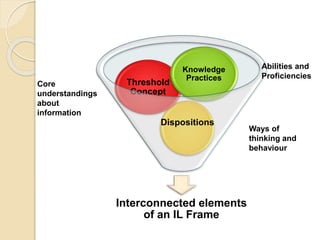
Interconnected elements
of an IL Frame
Threshold
Concept
Knowledge
Practices
Dispositions
Core
understandings
about
information
Abilities and
Proficiencies
Ways of
thinking and
behaviour
THE SIX FRAMES OF THE
INFORMATION LITERACY
FRAMEWORK
1. Scholarship is a
Conversation
 no single, easy answer in scholarly
research
 discursive practice where ideas are
formulated, debated and weighed
against each other
 competing ideas give rise to fresh
insights and new discoveries –
contesting and reframing perspectives
within a field
 students given opportunities to
become conversant with the discipline
 Knowledge is contested and uncertain
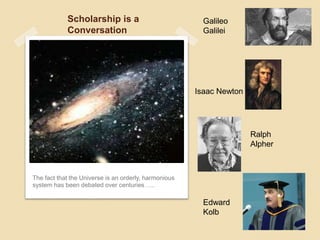
Scholarship is a
Conversation
The fact that the Universe is an orderly, harmonious
system has been debated over centuries ….
Galileo
Galilei
Isaac Newton
Ralph
Alpher
Edward
Kolb
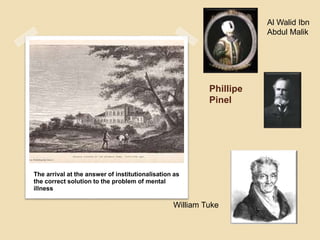
Phillipe
Pinel
The arrival at the answer of institutionalisation as
the correct solution to the problem of mental
illness
Al Walid Ibn
Abdul Malik
William Tuke
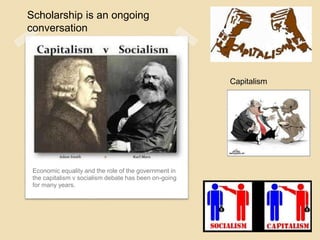
Economic equality and the role of the government in
the capitalism v socialism debate has been on-going
for many years.
Scholarship is an ongoing
conversation
Capitalism
2. Research as Inquiry
 Open-ended exploration and engagement with
information
 Iterative process – student has to rethink, rework,
explore, test concepts of their discipline
 Students need to be taught how to identify
unresolved issues and frame questions
 Students will uncover more complex questions as
they deepen their knowledge within a field
 Process includes various research methodologies
and different lines of inquiry
 Data collection and management requires students
to communicate with role players and practitioners in
the community, where they will learn how issues
affect these individuals.
Example of an assignment
 Is the “passion” gap (removal of the top
four incisor teeth) that is so prevalent on
the Cape Flats, a cultural phenomenon,
fashion statement or a result of poor
dental hygiene? Discuss your position
and give possible strategies to combat it.
 It involves doing interviews, with open –
ended questions, surveys and
observations.
 (They will get a better picture of cultural
beliefs, personal perspectives and can
follow up on questions and have
Example of an assignment
 Ask students to conduct original research based on
qualitative interviews, a form of research where
people are permitted to answer questions for
themselves and in their own terms.
 The interview-based assessment that is set
requires students to interview someone who was or
who had been involved in crime or the criminal
justice system.
 Students will be taught to learn new ways of
investigating an issue
 They will value the possibility of discovering social
worlds about which they knew little
 May also use the opportunity to explore their own
social milieu.
3. Authority of texts is
Contextual and Constructed
 Authority may be seen as the degree
of trust that is assigned to the source
of information
 Depends on the origin, information
need and context within which
information will be used
Markers of Authority ….
 external indicators such as peer
reviewed articles and credentials of
the author
 origin, context and suitability for the
information need of the moment
 Authority is contextual in that the
information need may help determine
the level of authority required.
Authority as Contextual
 Check currency rate of eg. UK and RSA
 Quick currency convertor check – no need
to test the authority of the source
 But a dissertation on the Economics of
Inflation – study of currency – investigate
the credibility of the source
Authority as
Contextual…
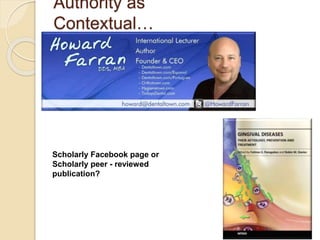
Scholarly Facebook page or
Scholarly peer - reviewed
publication?
Authority is Constructed…
 The “authority” of different information
sources tends to be determined by
disciplinary communities
 Acknowledges that certain voices are
elevated through established rules and
systems – social construction of
knowledge
 All sources are not created equal,
authoritative voices exist in specific
categories of knowledge and
 Whereas the novice learner may rely on
superficial indicators of authority, the
expert recognises schools of thought or
paradigms within the discipline
4. INFORMATION CREATION AS A PROCESS
 Scholarly communication is evolving and
knowledge is shared in different ways
 Each source of information has constraints
and capabilities. These characteristics as
well as the particular information need will
determine how the product is used
 The novice learner should understand the
importance of the creation process of each
information source. This will enable them to
make informed choices when matching the
source with the information need
 The expert researcher is able to recognise
that information sources are valued
differently in different contexts – academia
or workplace
Format of Information How is it Created? How can I locate
information in this
format?
Newspapers
(online + print)
Interviews, reports,
investigations, research
Online via newspaper
websites.
Reading newspapers
Books Research, interviews Print copies( libraries,
bookshops)
Podcasts Audio recording Podcasting sites online
Journal Article Reading , research,
thought, debate, drafts,
formal peer review. May
have been shaped form a
conference presentation
Online or in print
Blog Online Blog websites
5. Searching as Exploration
 Search strategy is not straight-forward
and sequential
 Involves inquiry, discovery and
serendipity
 Discovery of one source can lead to
other sources or avenues of inquiry
 Basic and advanced search strategies,
interview techniques
 Should be able to match information
need and search strategy with
appropriate search tool
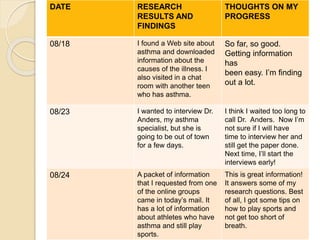
DATE RESEARCH
RESULTS AND
FINDINGS
THOUGHTS ON MY
PROGRESS
08/18 I found a Web site about
asthma and downloaded
information about the
causes of the illness. I
also visited in a chat
room with another teen
who has asthma.
So far, so good.
Getting information
has
been easy. I’m finding
out a lot.
08/23 I wanted to interview Dr.
Anders, my asthma
specialist, but she is
going to be out of town
for a few days.
I think I waited too long to
call Dr. Anders. Now I’m
not sure if I will have
time to interview her and
still get the paper done.
Next time, I’ll start the
interviews early!
08/24 A packet of information
that I requested from one
of the online groups
came in today’s mail. It
has a lot of information
about athletes who have
asthma and still play
sports.
This is great information!
It answers some of my
research questions. Best
of all, I got some tips on
how to play sports and
not get too short of
breath.
6. Information has Value
 “Information possesses several dimensions
of value – as a commodity, as a means of
education, as a means of influence, and as a
means of negotiating and understanding the
world” (ACRL,2014)
 Students should understand their obligation
to cite and acknowledge the ideas of others
 Understand the differences between
copyright, open access and public domain
 Commerce acts as a barrier – students
should understand how their research
strategy may be affected by toll access.
Acknowledge the ideas of
others…
Roles
 Library to work closely with relevant role-
players
 Teaching staff: application of 6 frames
in their coursework
 Framework offers a problem-based
learning pedagogy with several sample
assignments
 Library to support lecturers by working
with Teaching and Learning Specialists -
designing learning outcomes and
learning activities and assessments
Our story so far…
 Faculty Librarians have been trained to understand
and apply the new IL Frames
 Library drafted Guidelines for the Embedding of IL
in Teaching and Learning at UWC
 Shared Guidelines and held presentations on the 6
IL Frames with all Faculties at Teaching and
Learning Committee meetings, Board meetings
and seminars
 Positive feedback from Faculties - Invited to offer
workshops/consultations at departmental level to
discuss and design how IL may be embedded via
learning activities and assessments
Contact details
Shehaamah Mohamed
Senior Librarian: Information
Literacy
University of the Western Cape
shmohamed@uwc.ac.za
021-9592922
HELIG Webinar on ACRL Framework for Information Literacy

HELIG Webinar on ACRL Framework for Information Literacy

  • 1.
    Embedding Information Literacyin Teaching and Learning at the University of the Western Cape (UWC)
  • 2.
    1. Resources 2. Changingprogrammes of IL 3. Learning Outcomes 4. Your role as Librarian in embedding IL in teaching and learning 5. Additional load? 6. Collaboration?
  • 3.
    Guidelines For Embedding information literacy inTeaching and Learning at UWC information literacy: a learning literacy IL framework: 6 frames drafted by ACRL (Association of College and Research Libraries) 2014 http://www.ala.org/acrl/ invite understanding of what it means to use information to think, read and write in a discipline (context) Lloyd (2010): information literacy is a situated socio-cultural practice
  • 4.
    Literacies are socialand situated •Reading: comprehension, analysis, evaluation •Thinking: visualising, synthesis, problem solving •Writing: articulation, shaping argument, structure Digital applications: searching, reading, interacting, visualising, recording, writing – multimodal communication
  • 5.
    …IL as Socio-material As textual practices are transformed by emerging technologies and the Web 2.0 ecology, these practices are reinterpreted by new understandings of literacy.  Bhatt and de Roock’s study (2013) on the socio- materiality of digital literacy events and Bhatt’s doctoral thesis, (2014) A socio-material account of assignment writing in Further Education classrooms  The literacy practices that occur during research and writing therefore also includes interaction with material objects.  Research is undertaken alongside a host of
  • 6.
    Interconnected elements of anIL Frame Threshold Concept Knowledge Practices Dispositions Core understandings about information Abilities and Proficiencies Ways of thinking and behaviour
  • 7.
    THE SIX FRAMESOF THE INFORMATION LITERACY FRAMEWORK
  • 8.
    1. Scholarship isa Conversation  no single, easy answer in scholarly research  discursive practice where ideas are formulated, debated and weighed against each other  competing ideas give rise to fresh insights and new discoveries – contesting and reframing perspectives within a field  students given opportunities to become conversant with the discipline  Knowledge is contested and uncertain
  • 10.
    Scholarship is a Conversation Thefact that the Universe is an orderly, harmonious system has been debated over centuries …. Galileo Galilei Isaac Newton Ralph Alpher Edward Kolb
  • 11.
    Phillipe Pinel The arrival atthe answer of institutionalisation as the correct solution to the problem of mental illness Al Walid Ibn Abdul Malik William Tuke
  • 12.
    Economic equality andthe role of the government in the capitalism v socialism debate has been on-going for many years. Scholarship is an ongoing conversation Capitalism
  • 16.
    2. Research asInquiry  Open-ended exploration and engagement with information  Iterative process – student has to rethink, rework, explore, test concepts of their discipline  Students need to be taught how to identify unresolved issues and frame questions  Students will uncover more complex questions as they deepen their knowledge within a field  Process includes various research methodologies and different lines of inquiry  Data collection and management requires students to communicate with role players and practitioners in the community, where they will learn how issues affect these individuals.
  • 17.
    Example of anassignment  Is the “passion” gap (removal of the top four incisor teeth) that is so prevalent on the Cape Flats, a cultural phenomenon, fashion statement or a result of poor dental hygiene? Discuss your position and give possible strategies to combat it.  It involves doing interviews, with open – ended questions, surveys and observations.  (They will get a better picture of cultural beliefs, personal perspectives and can follow up on questions and have
  • 18.
    Example of anassignment  Ask students to conduct original research based on qualitative interviews, a form of research where people are permitted to answer questions for themselves and in their own terms.  The interview-based assessment that is set requires students to interview someone who was or who had been involved in crime or the criminal justice system.  Students will be taught to learn new ways of investigating an issue  They will value the possibility of discovering social worlds about which they knew little  May also use the opportunity to explore their own social milieu.
  • 19.
    3. Authority oftexts is Contextual and Constructed  Authority may be seen as the degree of trust that is assigned to the source of information  Depends on the origin, information need and context within which information will be used
  • 20.
    Markers of Authority….  external indicators such as peer reviewed articles and credentials of the author  origin, context and suitability for the information need of the moment  Authority is contextual in that the information need may help determine the level of authority required.
  • 21.
    Authority as Contextual Check currency rate of eg. UK and RSA  Quick currency convertor check – no need to test the authority of the source  But a dissertation on the Economics of Inflation – study of currency – investigate the credibility of the source
  • 22.
    Authority as Contextual… Scholarly Facebookpage or Scholarly peer - reviewed publication?
  • 23.
    Authority is Constructed… The “authority” of different information sources tends to be determined by disciplinary communities  Acknowledges that certain voices are elevated through established rules and systems – social construction of knowledge  All sources are not created equal, authoritative voices exist in specific categories of knowledge and  Whereas the novice learner may rely on superficial indicators of authority, the expert recognises schools of thought or paradigms within the discipline
  • 25.
  • 26.
     Scholarly communicationis evolving and knowledge is shared in different ways  Each source of information has constraints and capabilities. These characteristics as well as the particular information need will determine how the product is used  The novice learner should understand the importance of the creation process of each information source. This will enable them to make informed choices when matching the source with the information need  The expert researcher is able to recognise that information sources are valued differently in different contexts – academia or workplace
  • 27.
    Format of InformationHow is it Created? How can I locate information in this format? Newspapers (online + print) Interviews, reports, investigations, research Online via newspaper websites. Reading newspapers Books Research, interviews Print copies( libraries, bookshops) Podcasts Audio recording Podcasting sites online Journal Article Reading , research, thought, debate, drafts, formal peer review. May have been shaped form a conference presentation Online or in print Blog Online Blog websites
  • 28.
    5. Searching asExploration  Search strategy is not straight-forward and sequential  Involves inquiry, discovery and serendipity  Discovery of one source can lead to other sources or avenues of inquiry  Basic and advanced search strategies, interview techniques  Should be able to match information need and search strategy with appropriate search tool
  • 29.
    DATE RESEARCH RESULTS AND FINDINGS THOUGHTSON MY PROGRESS 08/18 I found a Web site about asthma and downloaded information about the causes of the illness. I also visited in a chat room with another teen who has asthma. So far, so good. Getting information has been easy. I’m finding out a lot. 08/23 I wanted to interview Dr. Anders, my asthma specialist, but she is going to be out of town for a few days. I think I waited too long to call Dr. Anders. Now I’m not sure if I will have time to interview her and still get the paper done. Next time, I’ll start the interviews early! 08/24 A packet of information that I requested from one of the online groups came in today’s mail. It has a lot of information about athletes who have asthma and still play sports. This is great information! It answers some of my research questions. Best of all, I got some tips on how to play sports and not get too short of breath.
  • 30.
    6. Information hasValue  “Information possesses several dimensions of value – as a commodity, as a means of education, as a means of influence, and as a means of negotiating and understanding the world” (ACRL,2014)  Students should understand their obligation to cite and acknowledge the ideas of others  Understand the differences between copyright, open access and public domain  Commerce acts as a barrier – students should understand how their research strategy may be affected by toll access.
  • 31.
  • 32.
    Roles  Library towork closely with relevant role- players  Teaching staff: application of 6 frames in their coursework  Framework offers a problem-based learning pedagogy with several sample assignments  Library to support lecturers by working with Teaching and Learning Specialists - designing learning outcomes and learning activities and assessments
  • 33.
    Our story sofar…  Faculty Librarians have been trained to understand and apply the new IL Frames  Library drafted Guidelines for the Embedding of IL in Teaching and Learning at UWC  Shared Guidelines and held presentations on the 6 IL Frames with all Faculties at Teaching and Learning Committee meetings, Board meetings and seminars  Positive feedback from Faculties - Invited to offer workshops/consultations at departmental level to discuss and design how IL may be embedded via learning activities and assessments
  • 34.
    Contact details Shehaamah Mohamed SeniorLibrarian: Information Literacy University of the Western Cape shmohamed@uwc.ac.za 021-9592922