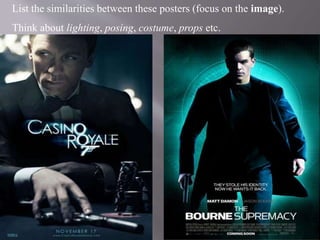
List the similarities between these posters (focus on the image).
Think about lighting, posing, costume, props etc.
The genre tropes that exist within the action
genre, give us some clues to a dominant
representation of masculinity.
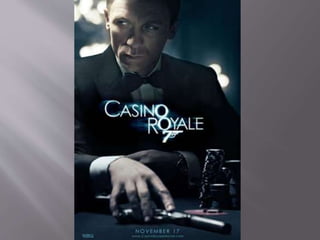
How have genre codes been used in the Casino
Royale poster to construct a notion of
masculinity?
Gun – a symbol of power, but also (arguably) a
phallic symbol, which specifies male power
and dominance (what has been termed as the
anthropomorphised phallus).
Composition – The man is centre of the frame,
almost filling the picture. This emphasises his
importance, but also highlights his bulk and
muscular form. He physically dominates the
frame.
Lighting – the man is half-hidden in shadow,
connoting that he is mysterious and secretive.
The darkness symbolises a ruthless and violent
side of his personality, but the light reminds
the audience that this violence is justifiable, as
he is fighting the good of others.
Halo of light – the subject is surrounded by light.
These arguably resemble angels’ wings, which
again symbolises that he is a force for good. It
also connotes that he has powers that are
‘above’ the average person. Or it could
resemble a spotlight, positioning the man as a
celebrity or ‘star’. Either interpretation puts
him in a position of power.
Smart clothing– unmistakably masculine, but
also middle/upper class. The dominant male
is also a member of the dominant social group.
Poker chips – a signifier of wealth (and, again,
power), but also suggests that this man is
intelligent and skilled. The fact that he is a
risk-taker enhances the notion that men are
adventurous and playful, but that a successful
man will always win.
Facial expression – the hero has a serious, intent
look on their face. They are active, looking as if
they are on an important mission. This gives
them a superiority (in that everyone else’s
needs seem unimportant, by comparison) and
also enhances a perception of men as
dangerous and potentially violent.
Representations of men in the action genre
appear to reinforce patriarchy. Men are
constructed as dominant and successful.
Audiences are positioned to forgive any
negative traits of masculinity (e.g. men as
forceful and destructive), as these traits are
usually necessary for the man to achieve justice
in these films.
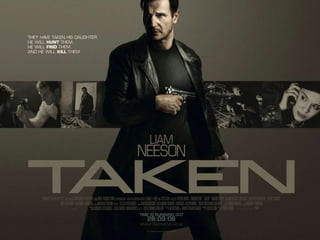
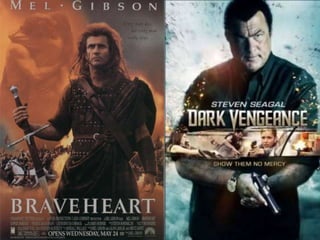
Importantly, men are active in these posters (it
is obvious that they are ‘on a mission’). To
quote John Berger: “men act”, which is a
contrast to the passive representation we often
see of women, who “appear” as objects of
beauty for the male gaze.
Representations, where men are positioned as
Bond is here, are repeated so often, that they
become ‘common sense’ and seem almost
natural.
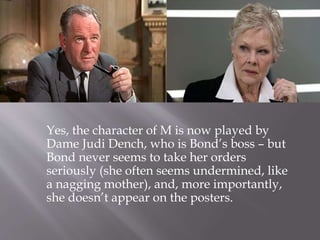
Yes, the character of M is now played by
Dame Judi Dench, who is Bond’s boss – but
Bond never seems to take her orders
seriously (she often seems undermined, like
a nagging mother), and, more importantly,
she doesn’t appear on the posters.
1. How does Bond embody the concept of
hegemonic masculinity? (What is so good
about being a man?)
2. Using your own examples, what evidence
do we have to suggest that hegemonic
masculinity is supported by mass-media?
3. Using your own examples, what evidence
do we have to suggest that hegemonic
masculinity is being subverted in the mass-
media?

Hegemony in the Action Poster

  • 1.
    List the similaritiesbetween these posters (focus on the image). Think about lighting, posing, costume, props etc.
  • 2.
    The genre tropesthat exist within the action genre, give us some clues to a dominant representation of masculinity.
  • 6.
    How have genrecodes been used in the Casino Royale poster to construct a notion of masculinity?
  • 8.
    Gun – asymbol of power, but also (arguably) a phallic symbol, which specifies male power and dominance (what has been termed as the anthropomorphised phallus).
  • 9.
    Composition – Theman is centre of the frame, almost filling the picture. This emphasises his importance, but also highlights his bulk and muscular form. He physically dominates the frame.
  • 10.
    Lighting – theman is half-hidden in shadow, connoting that he is mysterious and secretive. The darkness symbolises a ruthless and violent side of his personality, but the light reminds the audience that this violence is justifiable, as he is fighting the good of others.
  • 11.
    Halo of light– the subject is surrounded by light. These arguably resemble angels’ wings, which again symbolises that he is a force for good. It also connotes that he has powers that are ‘above’ the average person. Or it could resemble a spotlight, positioning the man as a celebrity or ‘star’. Either interpretation puts him in a position of power.
  • 12.
    Smart clothing– unmistakablymasculine, but also middle/upper class. The dominant male is also a member of the dominant social group.
  • 13.
    Poker chips –a signifier of wealth (and, again, power), but also suggests that this man is intelligent and skilled. The fact that he is a risk-taker enhances the notion that men are adventurous and playful, but that a successful man will always win.
  • 14.
    Facial expression –the hero has a serious, intent look on their face. They are active, looking as if they are on an important mission. This gives them a superiority (in that everyone else’s needs seem unimportant, by comparison) and also enhances a perception of men as dangerous and potentially violent.
  • 15.
    Representations of menin the action genre appear to reinforce patriarchy. Men are constructed as dominant and successful. Audiences are positioned to forgive any negative traits of masculinity (e.g. men as forceful and destructive), as these traits are usually necessary for the man to achieve justice in these films.
  • 16.
    Importantly, men areactive in these posters (it is obvious that they are ‘on a mission’). To quote John Berger: “men act”, which is a contrast to the passive representation we often see of women, who “appear” as objects of beauty for the male gaze.
  • 17.
    Representations, where menare positioned as Bond is here, are repeated so often, that they become ‘common sense’ and seem almost natural.
  • 18.
    Yes, the characterof M is now played by Dame Judi Dench, who is Bond’s boss – but Bond never seems to take her orders seriously (she often seems undermined, like a nagging mother), and, more importantly, she doesn’t appear on the posters.
  • 19.
    1. How doesBond embody the concept of hegemonic masculinity? (What is so good about being a man?) 2. Using your own examples, what evidence do we have to suggest that hegemonic masculinity is supported by mass-media? 3. Using your own examples, what evidence do we have to suggest that hegemonic masculinity is being subverted in the mass- media?

Editor's Notes

  • #2 Look for: Weapon in right hand / both white males of similar age group / both have face half-hidden in shadow / both have a serious, determined expression, eyes fixed on something just off camera / both smartly dressed / both have short hair / both images are dark / both characters have an aura or light surrounding them.
  • #4 Note the similarities. Explain why poster-designers use such codes.