Climate Risk
 Michel Rochette, MBA,FSA
 2007 SOA Annual Meeting
Enterprise Risk Advisory, LLC
Topics
• Physical Evidence of climate changes: risk
  drivers of environmental risk
• Observed and projected physical impacts
• Government and industry efforts to face climate
  change
• Risks due to climate change
• Proposed Disclosures:
  – Investor Network on Climate Risk
  – Carbon Disclosure Project
  – SEC Proposed Requirements
Physical Evidence of Climate
    Changes: Risk Drivers
"Periodically, major forces dramatically reshape
  the business world – globalization and the
  information technology –. Climate change in
  its complexity and potential impact may rival
  both of them.“
Michael Porter, Harvard
Physical Evidence of Climate
       Changes: Risk Drivers
• Primary drivers: Gazes produced naturally
  and by mankind create the green house
  effect, trapping heat from the sun.
• From year 1000 to 1860, concentration of
  Co2 has been about 300 PPM.
• Since 1860, concentration has increased
  36% to 382 PPM.(2000)
Physical Evidence of Climate
         Changes: Risk Drivers
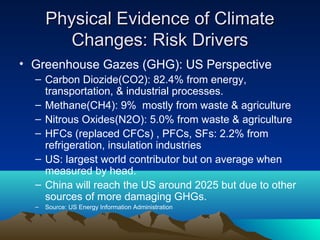
• Greenhouse Gazes (GHG): US Perspective
  – Carbon Diozide(CO2): 82.4% from energy,
    transportation, & industrial processes.
  – Methane(CH4): 9% mostly from waste & agriculture
  – Nitrous Oxides(N2O): 5.0% from waste & agriculture
  – HFCs (replaced CFCs) , PFCs, SFs: 2.2% from
    refrigeration, insulation industries
  – US: largest world contributor but on average when
    measured by head.
  – China will reach the US around 2025 but due to other
    sources of more damaging GHGs.
  –   Source: US Energy Information Administration
Physical Evidence of Climate
    Changes: Risk Drivers
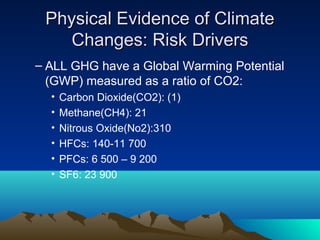
– ALL GHG have a Global Warming Potential
  (GWP) measured as a ratio of CO2:
  •   Carbon Dioxide(CO2): (1)
  •   Methane(CH4): 21
  •   Nitrous Oxide(No2):310
  •   HFCs: 140-11 700
  •   PFCs: 6 500 – 9 200
  •   SF6: 23 900
Physical Evidence of Climate
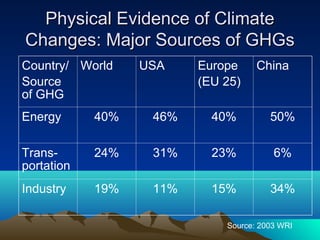
Changes: Major Sources of GHGs
Country/ World    USA    Europe     China
Source                   (EU 25)
of GHG
Energy      40%    46%     40%         50%

Trans-      24%    31%     23%          6%
portation
Industry    19%    11%     15%         34%

                             Source: 2003 WRI
Observed Physical Impacts:
   Global Temperature
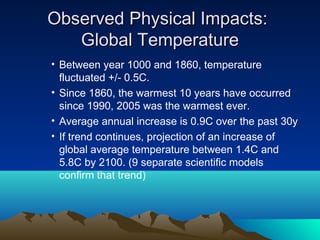
• Between year 1000 and 1860, temperature
  fluctuated +/- 0.5C.
• Since 1860, the warmest 10 years have occurred
  since 1990, 2005 was the warmest ever.
• Average annual increase is 0.9C over the past 30y
• If trend continues, projection of an increase of
  global average temperature between 1.4C and
  5.8C by 2100. (9 separate scientific models
  confirm that trend)
Observed Physical Impacts:
   Global Temperature
• Increase could accelerate if other phenomenon
  interact:
   – Higher temperature →More intense Fires → Burn trees
     which store GHG
   – More deforestation → reduction in natural GHG
     sequestration by forests.
   – Higher temperature → thawing frozen soils → Release of
     GHGs as it may contain close to 30% of carbon stored in
     soils
   – Combined with other natural phenomenon like volcanoes
Observed Physical Impacts:
    Rising Sea Levels
• Higher global temperature is causing sea levels to
  rise from:
   – Melting of polar caps and glaciers. (30% of total annual
     increase), especially Greenland.
   – Expansion of the volume of the water itself because the
     sea water temperature is increasing due to the higher
     external temperature; thus, higher water temperature
     causes water to expand. (70% of total annual increase)
• From 1870 to 2004: global increase of 200 mm.
• Currently: sea rising more rapidly at 2.6-2.7 mm +/-
  0.7 mm per year globally.
Observed Physical Impacts:
    Rising Sea Levels
• By 2100, best estimates are for sea levels to rise
  by about 0.3 m. (1 foot)
• At that rate, sea increase would be 6 m over the
  next 500 years.
• Consequences:
   – More than 4m, every coastal city inundated.
   – US northeast vulnerable due to low land and high
     population density. NY more vulnerable than CA.
   – Coastal erosion: Florida at risk.
   – Combined with wind → more storm surges → more
     flooding → more physical damage → more deaths and
     health issues.
Observed Physical Impacts:
Hurricanes/Typhoons/Windstorms
  • Higher temperature is causing more intense hurricanes due
    to the warming of the oceans.
  • Combined with higher sea levels, more sea surges are
    expected.
  • Out of the ten strongest hurricanes ever recorder in the North
    Atlantic, 3 occurred in 2005.
  • Property exposures at risk: Florida at 79% and NY at 61%.
  • 15 property insurers insolvent after Andrew in FL in 1992.
  • EX: Katrina:
      – Property losses: 40.6 billion $
      – Deaths over 1 200.
  • National Flood program will continue to exacerbate the
    potential impacts by "encouraging" people to live near the
    coast.
Observed Physical Impacts:
   Droughts and Fires
• Droughts observed in the American West: drier
  weather, earlier snow melt, higher summer temp.
  → more frequent and longer wildfires.
• Since 1980, surface burned by wildfires doubled
  compared to 1920-1980 period.
• Ex: 1991 Oakland/Berkeley Hills fire
   – 2 billion $ in damage
   – 25 lives lost, 150 people injured.
• California is the most at risk: 22 out of last 38.
Observed Physical Impacts:
 Precipitation and Flooding
• Higher global temperatures → more water vapor in
  the atmosphere → more precipitation → more
  flooding → more damage.
• More physical damage in the US but more lives
  lost in less developed countries:
   – 50 billion $ of damage in the US in 1990s.
   – Increase of more extreme precipitations in some areas:
     US western regions and Eastern regions.
Observed Physical Impacts:
          Other
• Warmer temperature →heat waves
   – Extremely hot days are also three times as common now
     as they were 127 years ago.
   – Consequences:
       • 52 000 died in 2003 in Europe.
       • During the peak, 2000 dying per day in France.
• Warmer temperature → spread of diseases
   –   more mosquitoes carry malaria and Lyme
   –   More pollen in the atmosphere
   –   More air pollution → respiratory illnesses
   –   More southern diseases moving north.
• Ocean acidification → ocean chemistry → food
  chain → food for population
Government and Industry Efforts to
     Face Climate Change


  UK Stern Review stated in 2006:
 – Cost of doing nothing: Risk losing at least 5%
   of GDP every year for ever.
 – Cost of action: around 1% of GDP.
Government and Industry Efforts to
     Face Climate Change
• 1992 United Nations Climate Convention:
  sharing of information on GHGs, setting up
  national policies and best practices. 191 nations.
• 1997 Kyoto Protocol:
  – Legally binding reductions varying by countries.
  – Most countries have committed to 8% reductions of
    emissions from 1990 levels over 2008-2012.
  – Different approaches to hedge:
     • Clean development endorsement in developing nations: CER
     • Joint implementation: ERU
     • Emissions trading: EU ETS
Government and Industry Efforts to
     Face Climate Change
• 2007 G8 Summit endorsed the idea of cuts in GHG of
  50% by 2050.
• Asia-Pacific Climate Partnership.
• US initiative with 15 countries: 85% of emitters of GHG
  including China and India.
• Europe adopted in 2007 a target of 20% reduction by
  2020 from 1990 levels.
• UK on track to reduce by 15-18% by 2010.
• EU Emission Trading System (ETS) began operation in
  January 2005.
   – Cap and Trade System.
   – Being discussed at the US Congress right now.
• Previous success: Remember acid rain.
Government and Industry Efforts to
     Face Climate Change
• US Supreme Court in April 2007 that EPA has
  authority to regulate GHG emissions from cars
  and trucks. Considered a pollutant.
• California adopted climate change legislation to
  reduce GHG to 1990 levels by 2020,
  implementing caps starting in 2012 and
  mandatory reporting.
• Nine North East and Mid Atlantic states have
  signed the Regional Greenhouse Gas initiative.
  (RGGI):
  – Goal to reduce by 10% GHG to 1990 level by 2018.
  – 1st regional Cap and Trade by 01-2009.
Government and Industry Efforts to
     Face Climate Change
• US Climate Action Partnership: group of
  business leaders:
  – Implement cap and trade
  – Development of policies to encourage zero emitting
    technologies
• NAIC: Climate Change Task Force
• AIA and Ins. Inf. Institute have published
  analysis papers on climate changes.
• UK Climate Change Working Party where some
  actuaries are involved. Read Sept 07 Issue of
  UK The Actuary.
Climate-Induced Risk
"Regulatory policy will set the rules of the
  game that will affect how the burden will
  fall.. It is time to know how you will
  respond. At a minimum, all companies
  should know their carbon footprint, where
  their emissions are coming from and in
  what amounts.“
Andrew Hoffman, University of Michigan
Co Author of Climate Change: What’s your business strategy?
Climate-Induced Risk
• Regulatory/Compliance risk:
  – Fines for non compliance to new regulations on GHG
    including new upcoming mandatory national and
    regional GHG reductions as outlined.
  – European operations more at risk.
  – Miscalculation and lack of certification of carbon
    footprint coupled with lack of disclosure.
  – Less risk for US companies but:
     • Affected if they have international operations in countries
       covered by Kyoto even if US didn’t sign.
     • In the US, must keep track of CA and North East States.
     • Proposed SEC disclosures.
Climate-Induced Risk
• Investment and Shareholders’ Risk:
  – For ins. Cos: States have the prudent person rule as it
    relates to investments.
  – For pension plans: fiduciary responsibility.
  – Ex. 7 Billion $ pipeline in the McKenzie Valley could
    be at risk if permafrost melts.
  – Investor Network on Climate Risk:
     • New risk policy model on climate risk.
     • Seek to asses and obtain information on how companies are
       managing climate related risks.
     • Corporate Governance Score Card on Climate Risk.
Climate-Induced Risk
• Litigation risk:
   – When making investments, cos could be accused of
     not taking environmental issues into account.
   – Lawsuits by states for non compliance, especially for
     high emitters of GHGs.
   – Lawsuits by shareholders for lack of planning by
     Board of directors if companies suffer from climate
     changes.
   – Class actions suits could come when people will be
     more affected: Ex. Katrina. The Maldives
   – Big potential impact on D/O type insurance coverage.
Climate-Induced Risk
• Physical risk:
   – Impact on property damage of clients of insurance
     companies as well on insurers’ own properties.
   – Impact business and supply chains: interruptions.
   – Necessitate more extreme modeling of events even
     for life insurers as indirect impacts of physical
     changes will affect both lives and health: Ex. heath
     waves and lack of preparedness by governments.
Climate-Induced Risk
• Reputation and business risk:
  – Risk related to lack of climate risk preparedness/
    corporate resilience/perceived inaction.
  – One short-term approach is to commit to be a carbon-
    neutral company.
  – Proactive:
     • Energy field:
         – BP
         – American Electric Power to build the 1st gasification power
           plant.
         – ConocoPhillips funding alternative fuels research.
Climate-Induced Risk
• Reputation and business risk:
  – Proactive:
     • Banking:
        – HSBC has a set up a carbon offsetting program: electricity
          consumed in London offset by projects in New Zealand with
          wind power.
        – Citigroup and BOA have committed 50 billion $ and 20 billion $
          of future investments be made in sustainable business activities
          over the next 10 years.
     • Insurance:
        – Swiss Re doing research and committing to being carbon
          neutral in operations by 2013.
        – AIG has become the 1st US company to adopt a corporate
          climate change policy.
        – Fireman Funds new “green coverage” for green buildings.
Proposed Disclosures
• Global Reporting Initiative:
  – Principles and standards linking
    environmental, social and economic
    performance.
  – GOAL: Sustainability reporting which allows
    investors to assess the capacity of companies
    to create value in a resource-constrained
    world, including their impact on the climate.
Proposed Disclosures
• Carbon Disclosure Project:
  – Now at CDP5: sent to 2 400 companies.
  – Survey by CERES undertaken for institutional
    investors – 280 - in order to understand the risks and
    opportunities of companies impacted by climate
    change.
  – Investors are now elaborating climate related ratios:
    Low Revenues/Co2 would indicate high climate.
  – See www.cdproject.net: AXA, Aetna, Aegon, Allstate,
    Aviva.
Proposed Disclosures
– SEC:
  • Being pressured to issue guidelines on disclosure
    covering carbon disclosures and potential impact
    of climate changes on companies: scenarios.
  • Item 101 of Regulation S-K on the discharge of
    materials into the environment
  • Item 303 of Regulation S-k on disclosure around
    future trends likely to affect profitability.
  • 96% of electric utilities provide disclosure on
    climate risk while only 15% of property-casualty
    insurers do so.
Final thoughts
• According to AXA in its 2005 SEC filing:

  "20% of the World GDP is affected by climate
   change while for insurance companies, climate
   change is more important than interest or FX
   risks. “
“ The insurance industry will face new challenges
   in the coming years in increases in future claims,
   which will become harder to assess based on
   past events. "
Thanks


To Ellen Bull, librarian at the Society of
Actuaries for her continued support and
help in preparing this presentation.
Contact
Michel Rochette, MBA, FSA
• Enterprise Risk Advisory
• 954-607-6969
• Michel.rochette@enterprise-risk-
  advisory.com

Environmental Risk

  • 1.
    Climate Risk MichelRochette, MBA,FSA 2007 SOA Annual Meeting Enterprise Risk Advisory, LLC
  • 2.
    Topics • Physical Evidenceof climate changes: risk drivers of environmental risk • Observed and projected physical impacts • Government and industry efforts to face climate change • Risks due to climate change • Proposed Disclosures: – Investor Network on Climate Risk – Carbon Disclosure Project – SEC Proposed Requirements
  • 3.
    Physical Evidence ofClimate Changes: Risk Drivers "Periodically, major forces dramatically reshape the business world – globalization and the information technology –. Climate change in its complexity and potential impact may rival both of them.“ Michael Porter, Harvard
  • 4.
    Physical Evidence ofClimate Changes: Risk Drivers • Primary drivers: Gazes produced naturally and by mankind create the green house effect, trapping heat from the sun. • From year 1000 to 1860, concentration of Co2 has been about 300 PPM. • Since 1860, concentration has increased 36% to 382 PPM.(2000)
  • 5.
    Physical Evidence ofClimate Changes: Risk Drivers • Greenhouse Gazes (GHG): US Perspective – Carbon Diozide(CO2): 82.4% from energy, transportation, & industrial processes. – Methane(CH4): 9% mostly from waste & agriculture – Nitrous Oxides(N2O): 5.0% from waste & agriculture – HFCs (replaced CFCs) , PFCs, SFs: 2.2% from refrigeration, insulation industries – US: largest world contributor but on average when measured by head. – China will reach the US around 2025 but due to other sources of more damaging GHGs. – Source: US Energy Information Administration
  • 6.
    Physical Evidence ofClimate Changes: Risk Drivers – ALL GHG have a Global Warming Potential (GWP) measured as a ratio of CO2: • Carbon Dioxide(CO2): (1) • Methane(CH4): 21 • Nitrous Oxide(No2):310 • HFCs: 140-11 700 • PFCs: 6 500 – 9 200 • SF6: 23 900
  • 7.
    Physical Evidence ofClimate Changes: Major Sources of GHGs Country/ World USA Europe China Source (EU 25) of GHG Energy 40% 46% 40% 50% Trans- 24% 31% 23% 6% portation Industry 19% 11% 15% 34% Source: 2003 WRI
  • 8.
    Observed Physical Impacts: Global Temperature • Between year 1000 and 1860, temperature fluctuated +/- 0.5C. • Since 1860, the warmest 10 years have occurred since 1990, 2005 was the warmest ever. • Average annual increase is 0.9C over the past 30y • If trend continues, projection of an increase of global average temperature between 1.4C and 5.8C by 2100. (9 separate scientific models confirm that trend)
  • 9.
    Observed Physical Impacts: Global Temperature • Increase could accelerate if other phenomenon interact: – Higher temperature →More intense Fires → Burn trees which store GHG – More deforestation → reduction in natural GHG sequestration by forests. – Higher temperature → thawing frozen soils → Release of GHGs as it may contain close to 30% of carbon stored in soils – Combined with other natural phenomenon like volcanoes
  • 10.
    Observed Physical Impacts: Rising Sea Levels • Higher global temperature is causing sea levels to rise from: – Melting of polar caps and glaciers. (30% of total annual increase), especially Greenland. – Expansion of the volume of the water itself because the sea water temperature is increasing due to the higher external temperature; thus, higher water temperature causes water to expand. (70% of total annual increase) • From 1870 to 2004: global increase of 200 mm. • Currently: sea rising more rapidly at 2.6-2.7 mm +/- 0.7 mm per year globally.
  • 11.
    Observed Physical Impacts: Rising Sea Levels • By 2100, best estimates are for sea levels to rise by about 0.3 m. (1 foot) • At that rate, sea increase would be 6 m over the next 500 years. • Consequences: – More than 4m, every coastal city inundated. – US northeast vulnerable due to low land and high population density. NY more vulnerable than CA. – Coastal erosion: Florida at risk. – Combined with wind → more storm surges → more flooding → more physical damage → more deaths and health issues.
  • 12.
    Observed Physical Impacts: Hurricanes/Typhoons/Windstorms • Higher temperature is causing more intense hurricanes due to the warming of the oceans. • Combined with higher sea levels, more sea surges are expected. • Out of the ten strongest hurricanes ever recorder in the North Atlantic, 3 occurred in 2005. • Property exposures at risk: Florida at 79% and NY at 61%. • 15 property insurers insolvent after Andrew in FL in 1992. • EX: Katrina: – Property losses: 40.6 billion $ – Deaths over 1 200. • National Flood program will continue to exacerbate the potential impacts by "encouraging" people to live near the coast.
  • 13.
    Observed Physical Impacts: Droughts and Fires • Droughts observed in the American West: drier weather, earlier snow melt, higher summer temp. → more frequent and longer wildfires. • Since 1980, surface burned by wildfires doubled compared to 1920-1980 period. • Ex: 1991 Oakland/Berkeley Hills fire – 2 billion $ in damage – 25 lives lost, 150 people injured. • California is the most at risk: 22 out of last 38.
  • 14.
    Observed Physical Impacts: Precipitation and Flooding • Higher global temperatures → more water vapor in the atmosphere → more precipitation → more flooding → more damage. • More physical damage in the US but more lives lost in less developed countries: – 50 billion $ of damage in the US in 1990s. – Increase of more extreme precipitations in some areas: US western regions and Eastern regions.
  • 15.
    Observed Physical Impacts: Other • Warmer temperature →heat waves – Extremely hot days are also three times as common now as they were 127 years ago. – Consequences: • 52 000 died in 2003 in Europe. • During the peak, 2000 dying per day in France. • Warmer temperature → spread of diseases – more mosquitoes carry malaria and Lyme – More pollen in the atmosphere – More air pollution → respiratory illnesses – More southern diseases moving north. • Ocean acidification → ocean chemistry → food chain → food for population
  • 16.
    Government and IndustryEfforts to Face Climate Change UK Stern Review stated in 2006: – Cost of doing nothing: Risk losing at least 5% of GDP every year for ever. – Cost of action: around 1% of GDP.
  • 17.
    Government and IndustryEfforts to Face Climate Change • 1992 United Nations Climate Convention: sharing of information on GHGs, setting up national policies and best practices. 191 nations. • 1997 Kyoto Protocol: – Legally binding reductions varying by countries. – Most countries have committed to 8% reductions of emissions from 1990 levels over 2008-2012. – Different approaches to hedge: • Clean development endorsement in developing nations: CER • Joint implementation: ERU • Emissions trading: EU ETS
  • 18.
    Government and IndustryEfforts to Face Climate Change • 2007 G8 Summit endorsed the idea of cuts in GHG of 50% by 2050. • Asia-Pacific Climate Partnership. • US initiative with 15 countries: 85% of emitters of GHG including China and India. • Europe adopted in 2007 a target of 20% reduction by 2020 from 1990 levels. • UK on track to reduce by 15-18% by 2010. • EU Emission Trading System (ETS) began operation in January 2005. – Cap and Trade System. – Being discussed at the US Congress right now. • Previous success: Remember acid rain.
  • 19.
    Government and IndustryEfforts to Face Climate Change • US Supreme Court in April 2007 that EPA has authority to regulate GHG emissions from cars and trucks. Considered a pollutant. • California adopted climate change legislation to reduce GHG to 1990 levels by 2020, implementing caps starting in 2012 and mandatory reporting. • Nine North East and Mid Atlantic states have signed the Regional Greenhouse Gas initiative. (RGGI): – Goal to reduce by 10% GHG to 1990 level by 2018. – 1st regional Cap and Trade by 01-2009.
  • 20.
    Government and IndustryEfforts to Face Climate Change • US Climate Action Partnership: group of business leaders: – Implement cap and trade – Development of policies to encourage zero emitting technologies • NAIC: Climate Change Task Force • AIA and Ins. Inf. Institute have published analysis papers on climate changes. • UK Climate Change Working Party where some actuaries are involved. Read Sept 07 Issue of UK The Actuary.
  • 21.
    Climate-Induced Risk "Regulatory policywill set the rules of the game that will affect how the burden will fall.. It is time to know how you will respond. At a minimum, all companies should know their carbon footprint, where their emissions are coming from and in what amounts.“ Andrew Hoffman, University of Michigan Co Author of Climate Change: What’s your business strategy?
  • 22.
    Climate-Induced Risk • Regulatory/Compliancerisk: – Fines for non compliance to new regulations on GHG including new upcoming mandatory national and regional GHG reductions as outlined. – European operations more at risk. – Miscalculation and lack of certification of carbon footprint coupled with lack of disclosure. – Less risk for US companies but: • Affected if they have international operations in countries covered by Kyoto even if US didn’t sign. • In the US, must keep track of CA and North East States. • Proposed SEC disclosures.
  • 23.
    Climate-Induced Risk • Investmentand Shareholders’ Risk: – For ins. Cos: States have the prudent person rule as it relates to investments. – For pension plans: fiduciary responsibility. – Ex. 7 Billion $ pipeline in the McKenzie Valley could be at risk if permafrost melts. – Investor Network on Climate Risk: • New risk policy model on climate risk. • Seek to asses and obtain information on how companies are managing climate related risks. • Corporate Governance Score Card on Climate Risk.
  • 24.
    Climate-Induced Risk • Litigationrisk: – When making investments, cos could be accused of not taking environmental issues into account. – Lawsuits by states for non compliance, especially for high emitters of GHGs. – Lawsuits by shareholders for lack of planning by Board of directors if companies suffer from climate changes. – Class actions suits could come when people will be more affected: Ex. Katrina. The Maldives – Big potential impact on D/O type insurance coverage.
  • 25.
    Climate-Induced Risk • Physicalrisk: – Impact on property damage of clients of insurance companies as well on insurers’ own properties. – Impact business and supply chains: interruptions. – Necessitate more extreme modeling of events even for life insurers as indirect impacts of physical changes will affect both lives and health: Ex. heath waves and lack of preparedness by governments.
  • 26.
    Climate-Induced Risk • Reputationand business risk: – Risk related to lack of climate risk preparedness/ corporate resilience/perceived inaction. – One short-term approach is to commit to be a carbon- neutral company. – Proactive: • Energy field: – BP – American Electric Power to build the 1st gasification power plant. – ConocoPhillips funding alternative fuels research.
  • 27.
    Climate-Induced Risk • Reputationand business risk: – Proactive: • Banking: – HSBC has a set up a carbon offsetting program: electricity consumed in London offset by projects in New Zealand with wind power. – Citigroup and BOA have committed 50 billion $ and 20 billion $ of future investments be made in sustainable business activities over the next 10 years. • Insurance: – Swiss Re doing research and committing to being carbon neutral in operations by 2013. – AIG has become the 1st US company to adopt a corporate climate change policy. – Fireman Funds new “green coverage” for green buildings.
  • 28.
    Proposed Disclosures • GlobalReporting Initiative: – Principles and standards linking environmental, social and economic performance. – GOAL: Sustainability reporting which allows investors to assess the capacity of companies to create value in a resource-constrained world, including their impact on the climate.
  • 29.
    Proposed Disclosures • CarbonDisclosure Project: – Now at CDP5: sent to 2 400 companies. – Survey by CERES undertaken for institutional investors – 280 - in order to understand the risks and opportunities of companies impacted by climate change. – Investors are now elaborating climate related ratios: Low Revenues/Co2 would indicate high climate. – See www.cdproject.net: AXA, Aetna, Aegon, Allstate, Aviva.
  • 30.
    Proposed Disclosures – SEC: • Being pressured to issue guidelines on disclosure covering carbon disclosures and potential impact of climate changes on companies: scenarios. • Item 101 of Regulation S-K on the discharge of materials into the environment • Item 303 of Regulation S-k on disclosure around future trends likely to affect profitability. • 96% of electric utilities provide disclosure on climate risk while only 15% of property-casualty insurers do so.
  • 31.
    Final thoughts • Accordingto AXA in its 2005 SEC filing: "20% of the World GDP is affected by climate change while for insurance companies, climate change is more important than interest or FX risks. “ “ The insurance industry will face new challenges in the coming years in increases in future claims, which will become harder to assess based on past events. "
  • 32.
    Thanks To Ellen Bull,librarian at the Society of Actuaries for her continued support and help in preparing this presentation.
  • 33.
    Contact Michel Rochette, MBA,FSA • Enterprise Risk Advisory • 954-607-6969 • Michel.rochette@enterprise-risk- advisory.com