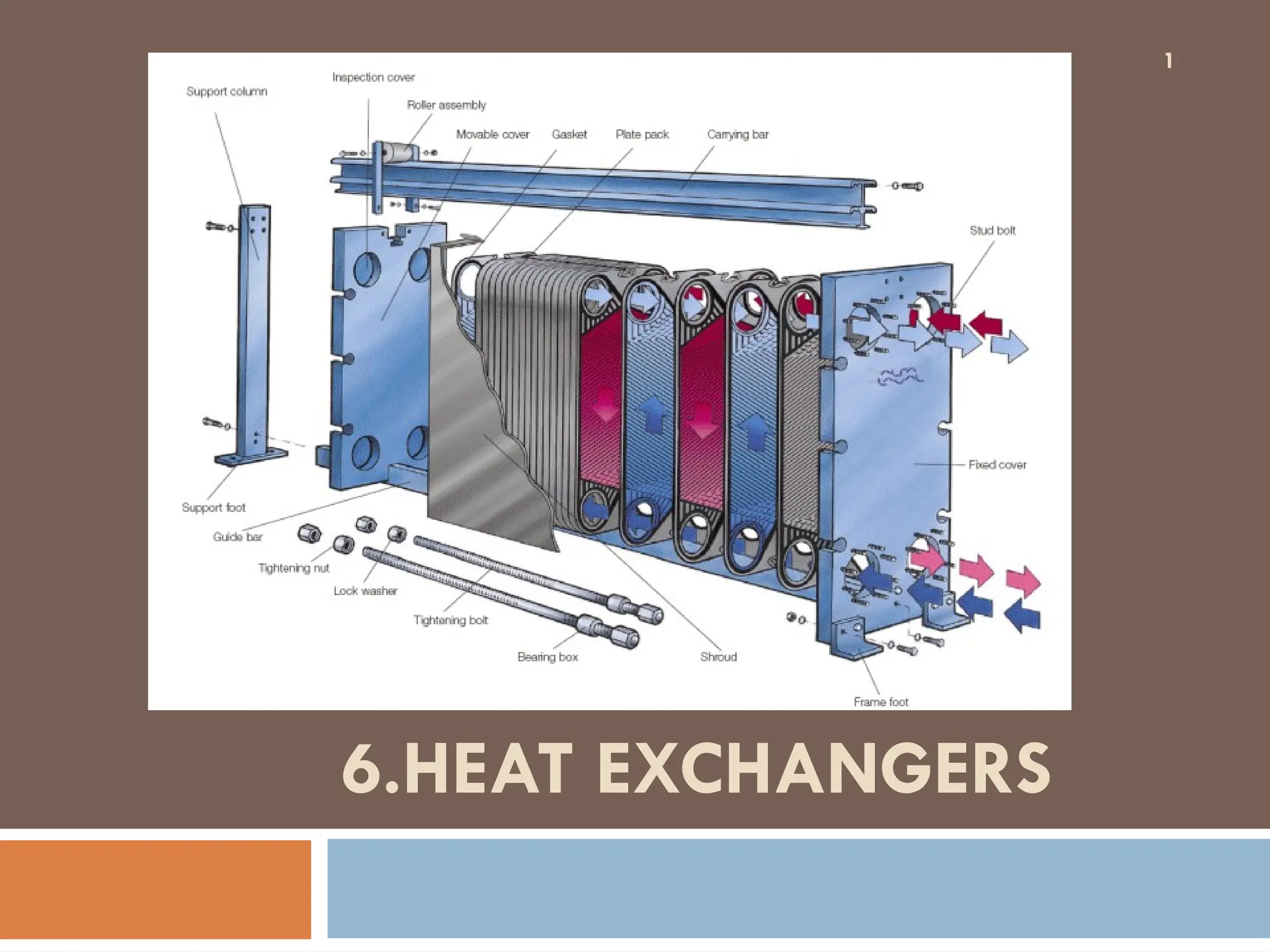
6.HEAT EXCHANGERS
1
6.1 INTRODUCTION
 A heat exchanger can be defined as any device
that transfers heat from one fluid to another that
are at different temperatures.
 Some of the specific applications of heat
exchangers are
 in space heating and air-conditioning,
 power production,
 waste heat recovery, and
 chemical processing.
2
6.2 HEAT EXCHANGER TYPES
Heat exchangers may be classified according to:
 Flow arrangement,
 Parallel flow,
 Counter flow,
 Cross flow.
 Construction type
 Tubular,
 Plate,
 Extended,
Regenerative.
3
6.2 HEAT EXCHANGER TYPES…
 Number of fluid passes,
 Two pass,
 Three pass, …
 Compactness
 Gas to liquid,
 Liquid to liquid,
 Phase change.
 Transfer processes
 Direct,
Indirect.
4
6.2 HEAT EXCHANGER TYPES…
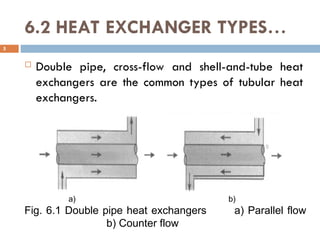
 Double pipe, cross-flow and shell-and-tube heat
exchangers are the common types of tubular heat
exchangers.
a) b)
Fig. 6.1 Double pipe heat exchangers a) Parallel flow
b) Counter flow
5
6.2 HEAT EXCHANGER TYPES…
6
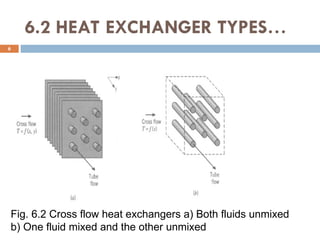
Fig. 6.2 Cross flow heat exchangers a) Both fluids unmixed
b) One fluid mixed and the other unmixed
6.2 HEAT EXCHANGER TYPES…
7
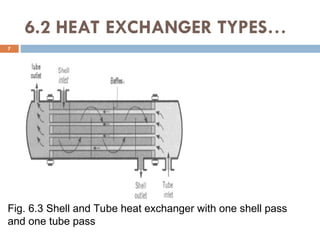
Fig. 6.3 Shell and Tube heat exchanger with one shell pass
and one tube pass
6.2 HEAT EXCHANGER TYPES…
8
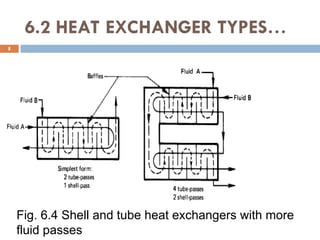
Fig. 6.4 Shell and tube heat exchangers with more
fluid passes
6.2 HEAT EXCHANGER TYPES…
9
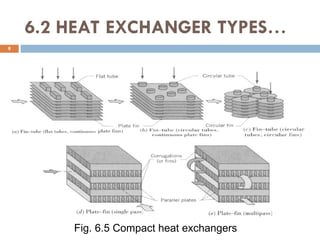
Fig. 6.5 Compact heat exchangers
6.3 HEAT EXCHANGER ANALYSIS
10
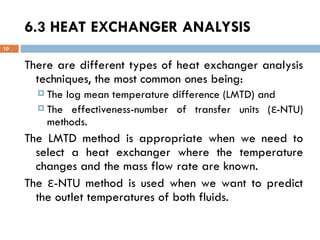
There are different types of heat exchanger analysis
techniques, the most common ones being:
 The log mean temperature difference (LMTD) and
 The effectiveness-number of transfer units ( -NTU)
ε
methods.
The LMTD method is appropriate when we need to
select a heat exchanger where the temperature
changes and the mass flow rate are known.
The -NTU method is used when we want to predict
ε
the outlet temperatures of both fluids.
6.4 LOG MEAN TEMPERATURE
DIFFERENCE METHOD
11
Parallel flow heat exchangers
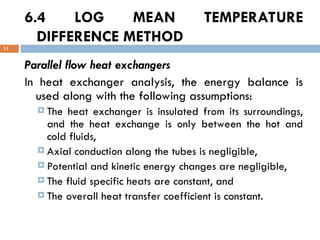
In heat exchanger analysis, the energy balance is
used along with the following assumptions:
 The heat exchanger is insulated from its surroundings,
and the heat exchange is only between the hot and
cold fluids,
 Axial conduction along the tubes is negligible,
 Potential and kinetic energy changes are negligible,
 The fluid specific heats are constant, and
 The overall heat transfer coefficient is constant.
6.4 LOG MEAN TEMPERATURE
DIFFERENCE METHOD…
12
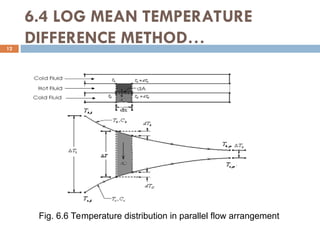
Fig. 6.6 Temperature distribution in parallel flow arrangement
6.4 LOG MEAN TEMPERATURE
DIFFERENCE METHOD…
13
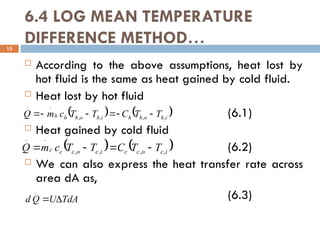
 According to the above assumptions, heat lost by
hot fluid is the same as heat gained by cold fluid.
 Heat lost by hot fluid
(6.1)
 Heat gained by cold fluid
(6.2)
 We can also express the heat transfer rate across
area dA as,
(6.3)
   
i
h
o
h
h
i
h
o
h
h
h T
T
C
T
T
c
m
Q ,
,
,
,
.
.






   
i
c
o
c
c
i
c
o
c
c
c T
T
C
T
T
c
m
Q ,
,
,
,
.
.




TdA
U
Q
d 

.
6.4 LOG MEAN TEMPERATURE
DIFFERENCE METHOD…
14
 T=Th-Tc is the local temperature difference
between the hot and cold fluids.
 To integrate equation (6.3), let’s make use of the
following relation
  c
h dT
dT
T
d 


  














c
h
c
h C
C
Q
d
C
Q
d
C
Q
d
T
d
1
1
.
.
.
  












c
h C
C
TdA
U
T
d
1
1
  dA
C
C
U
T
T
d
c
h












 1
1
6.4 LOG MEAN TEMPERATURE
DIFFERENCE METHOD…
15
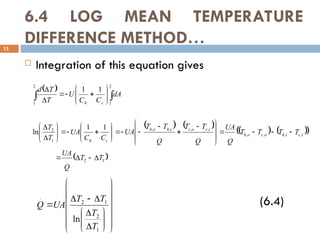
 Integration of this equation gives
(6.4)
 

 












2
1
2
1
1
1
dA
C
C
U
T
T
d
c
h
       
 
 
1
2
.
,
,
,
,
.
.
,
,
.
,
,
1
2 1
1
ln
T
T
Q
UA
T
T
T
T
Q
UA
Q
T
T
Q
T
T
UA
C
C
UA
T
T
i
c
i
h
o
c
o
h
i
c
o
c
i
h
o
h
c
h

















 






















































1
2
1
2
.
ln
T
T
T
T
UA
Q
6.4 LOG MEAN TEMPERATURE
DIFFERENCE METHOD…
16
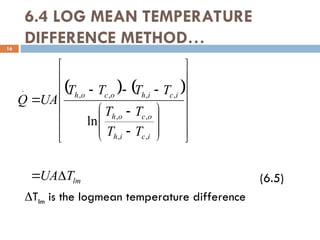
(6.5)
Tlm is the logmean temperature difference
   
lm
i
c
i
h
o
c
o
h
i
c
i
h
o
c
o
h
T
UA
T
T
T
T
T
T
T
T
UA
Q






























,
,
,
,
,
,
,
,
.
ln
6.4 LOG MEAN TEMPERATURE
DIFFERENCE METHOD…
17
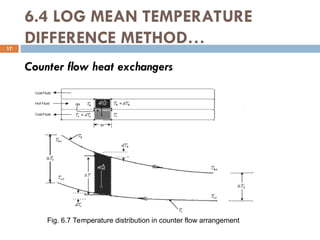
Counter flow heat exchangers
Fig. 6.7 Temperature distribution in counter flow arrangement
6.4 LOG MEAN TEMPERATURE
DIFFERENCE METHOD…
18
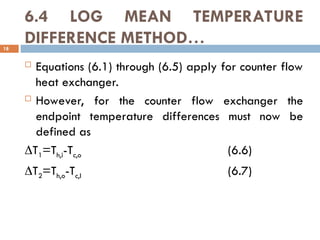
 Equations (6.1) through (6.5) apply for counter flow
heat exchanger.
 However, for the counter flow exchanger the
endpoint temperature differences must now be
defined as
T1=Th,i-Tc,o (6.6)
T2=Th,o-Tc,I (6.7)
6.4 LOG MEAN TEMPERATURE
DIFFERENCE METHOD…
19
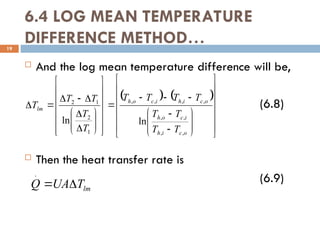
 And the log mean temperature difference will be,
(6.8)
 Then the heat transfer rate is
(6.9)
   

























































o
c
i
h
i
c
o
h
o
c
i
h
i
c
o
h
lm
T
T
T
T
T
T
T
T
T
T
T
T
T
,
,
,
,
,
,
,
,
1
2
1
2
ln
ln
lm
T
UA
Q 

.
6.4 LOG MEAN TEMPERATURE
DIFFERENCE METHOD…
20
Multi-pass and cross flow heat exchangers
 The log mean temperature difference method
developed earlier is limited to parallel and counter
flow heat exchangers.
 Similar relations can also be developed for cross flow
and multi-pass shell-and-tube heat exchangers but the
resulting relations are so complicated because of the
complex flow conditions.
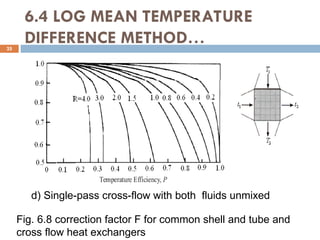
 The easiest way is to relate the log mean temperature
difference of such heat exchangers with that of counter
flow heat exchanger using some correction factor F.
6.4 LOG MEAN TEMPERATURE
DIFFERENCE METHOD…
21
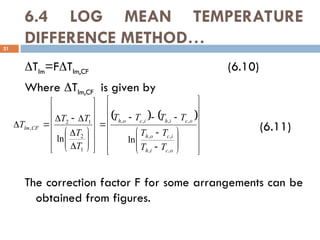
Tlm=FTlm,CF (6.10)
Where Tlm,CF is given by
(6.11)
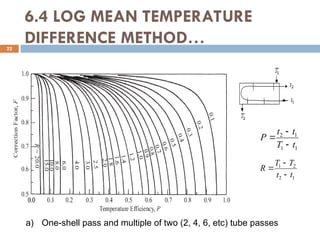
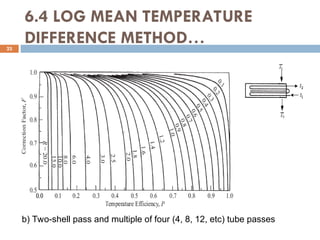
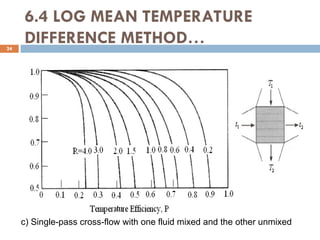
The correction factor F for some arrangements can be
obtained from figures.
   

























































o
c
i
h
i
c
o
h
o
c
i
h
i
c
o
h
CF
lm
T
T
T
T
T
T
T
T
T
T
T
T
T
,
,
,
,
,
,
,
,
1
2
1
2
,
ln
ln
6.4 LOG MEAN TEMPERATURE
DIFFERENCE METHOD…
22
a) One-shell pass and multiple of two (2, 4, 6, etc) tube passes
1
1
1
2
t
T
t
t
P



1
2
2
1
t
t
T
T
R



6.4 LOG MEAN TEMPERATURE
DIFFERENCE METHOD…
23
b) Two-shell pass and multiple of four (4, 8, 12, etc) tube passes
6.4 LOG MEAN TEMPERATURE
DIFFERENCE METHOD…
24
c) Single-pass cross-flow with one fluid mixed and the other unmixed
6.4 LOG MEAN TEMPERATURE
DIFFERENCE METHOD…
25
Fig. 6.8 correction factor F for common shell and tube and
cross flow heat exchangers
d) Single-pass cross-flow with both fluids unmixed
6.4 LOG MEAN TEMPERATURE
DIFFERENCE METHOD…
26
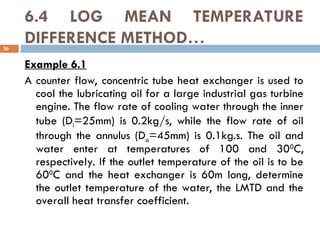
Example 6.1
A counter flow, concentric tube heat exchanger is used to
cool the lubricating oil for a large industrial gas turbine
engine. The flow rate of cooling water through the inner
tube (Di=25mm) is 0.2kg/s, while the flow rate of oil
through the annulus (Do=45mm) is 0.1kg.s. The oil and
water enter at temperatures of 100 and 300
C,
respectively. If the outlet temperature of the oil is to be
600
C and the heat exchanger is 60m long, determine
the outlet temperature of the water, the LMTD and the
overall heat transfer coefficient.
6.4 LOG MEAN TEMPERATURE
DIFFERENCE METHOD…
27
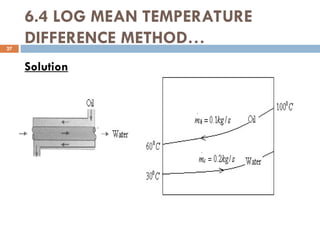
Solution
6.4 LOG MEAN TEMPERATURE
DIFFERENCE METHOD…
28
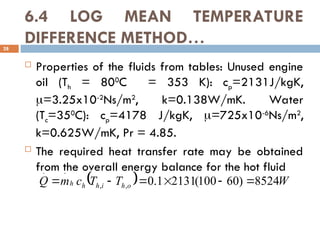
 Properties of the fluids from tables: Unused engine
oil (Th = 800
C = 353 K): cp=2131J/kgK,
=3.25x10⁻²
Ns/m2
, k=0.138W/mK. Water
(Tc=350
C): cp=4178 J/kgK, =725x10-6
Ns/m2
,
k=0.625W/mK, Pr = 4.85.
 The required heat transfer rate may be obtained
from the overall energy balance for the hot fluid
  W
T
T
c
m
Q o
h
i
h
h
h 8524
)
60
100
(
2131
1
.
0
,
,
.
.






6.4 LOG MEAN TEMPERATURE
DIFFERENCE METHOD…
29
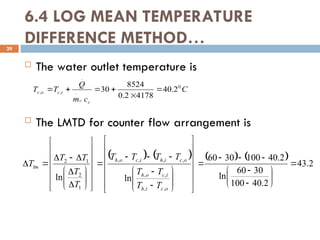
 The water outlet temperature is
 The LMTD for counter flow arrangement is
C
c
m
Q
T
T
c
c
i
c
o
c
0
.
.
,
, 2
.
40
4178
2
.
0
8524
30 





        2
.
43
2
.
40
100
30
60
ln
2
.
40
100
30
60
ln
ln
,
,
,
,
,
,
,
,
1
2
1
2






































































o
c
i
h
i
c
o
h
o
c
i
h
i
c
o
h
lm
T
T
T
T
T
T
T
T
T
T
T
T
T
6.4 LOG MEAN TEMPERATURE
DIFFERENCE METHOD…
30
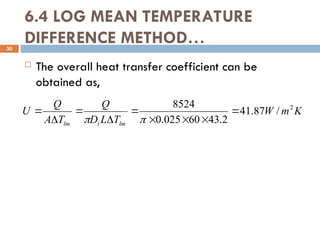
 The overall heat transfer coefficient can be
obtained as,
K
m
W
T
L
D
Q
T
A
Q
U
lm
i
lm
2
.
.
/
87
.
41
2
.
43
60
025
.
0
8524











6.5 THE EFFECTIVENESS-NUMBER OF
TRANSFER UNITS (-NTU) METHOD
 The parameter P in the LMTD correction factor method
requires three temperatures for its computation.
 The inlet temperature of both the hot and cold streams
is usually a given, but when the cold-side outlet
temperature is not known, a trial-and-error method is
required to evaluate P.
 The trial-and-error procedure may be avoided in the
-
ε NTU method, and because of its suitability for
computer-aided design, the -
ε NTU method is gaining
more popularity.
31
6.5 THE EFFECTIVENESS-NUMBER OF
TRANSFER UNITS (e-NTU) METHOD…
Kays and London (1984) have shown that the heat
exchanger transfer equations may be written in
dimensionless form, which results in three
dimensionless groups:
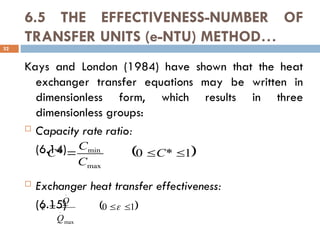
 Capacity rate ratio:
(6.14)
 Exchanger heat transfer effectiveness:
(6.15)
32
 
1
*
0
*
max
min


 C
C
C
C
 
1
0
max
.
.


 

Q
Q
6.5 THE EFFECTIVENESS-NUMBER OF
TRANSFER UNITS (e-NTU) METHOD…
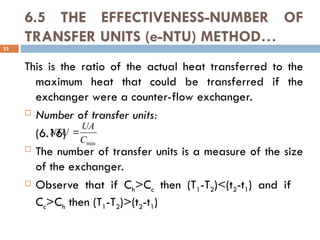
This is the ratio of the actual heat transferred to the
maximum heat that could be transferred if the
exchanger were a counter-flow exchanger.
 Number of transfer units:
(6.16)
 The number of transfer units is a measure of the size
of the exchanger.
 Observe that if Ch>Cc then (T1-T2)<(t2-t1) and if
Cc>Ch then (T1-T2)>(t2-t1)
33
min
C
UA
NTU 
6.5 THE EFFECTIVENESS-NUMBER OF
TRANSFER UNITS (e-NTU) METHOD…
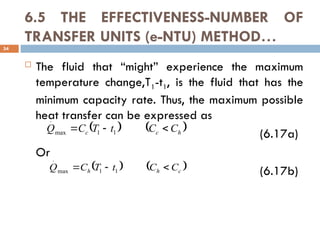
 The fluid that “might” experience the maximum
temperature change,T1-t1, is the fluid that has the
minimum capacity rate. Thus, the maximum possible
heat transfer can be expressed as
(6.17a)
Or
(6.17b)
34
   
h
c
c C
C
t
T
C
Q 

 1
1
max
.
   
c
h
h C
C
t
T
C
Q 

 1
1
max
.
6.5 THE EFFECTIVENESS-NUMBER OF
TRANSFER UNITS (e-NTU) METHOD…
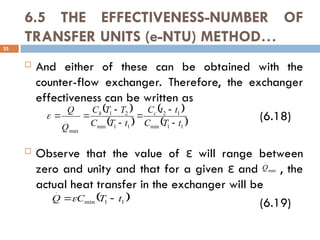
 And either of these can be obtained with the
counter-flow exchanger. Therefore, the exchanger
effectiveness can be written as
(6.18)
 Observe that the value of will range between
ε
zero and unity and that for a given and , the
ε
actual heat transfer in the exchanger will be
(6.19)
35
 
 
 
 
1
1
min
1
2
1
1
min
2
1
max
.
.
t
T
C
t
t
C
t
T
C
T
T
C
Q
Q c
h








 
1
1
min
.
t
T
C
Q 

max
.
Q
6.5 THE EFFECTIVENESS-NUMBER OF
TRANSFER UNITS (e-NTU) METHOD…
36
6.5 THE EFFECTIVENESS-NUMBER OF
TRANSFER UNITS (e-NTU) METHOD…
Example 6.2
Hot oil (Cp=2200J/kgK) is to be cooled by water
(Cp=4180J/kgK) in a 1-shell-pass and 6-tube-pass heat
exchanger. The tubes are thin walled and are made of copper
with an internal diameter of 1.8cm. The length of each tube
pass in the heat exchanger is 3m, and the overall heat transfer
coefficient is 340W/m2
K. Water flows through the tubes at a
rate of 0.1kg/s, and the oil through shell at a rate of 0.2kg/s.
The water and oil enter at temperatures 180
C and 1600
C,
respectively. Determine the rate of heat transfer and the outlet
temperatures of the water and the oil.
37
6.5 THE EFFECTIVENESS-NUMBER OF
TRANSFER UNITS (e-NTU) METHOD…
Solution
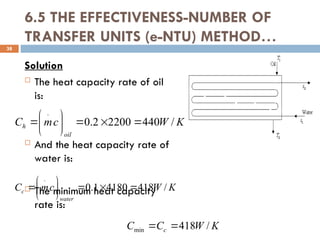
 The heat capacity rate of oil
is:
 And the heat capacity rate of
water is:
 The minimum heat capacity
rate is:
38
K
W
c
m
C
oil
h /
440
2200
2
.
0
.










K
W
c
m
C
water
c /
418
4180
1
.
0
.










K
W
C
C c /
418
min 

6.5 THE EFFECTIVENESS-NUMBER OF
TRANSFER UNITS (e-NTU) METHOD…
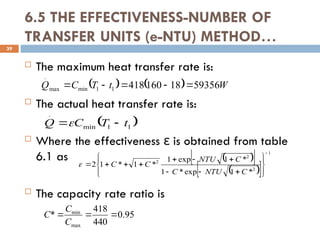
 The maximum heat transfer rate is:
 The actual heat transfer rate is:
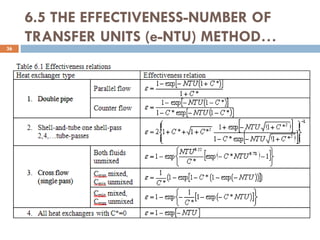
 Where the effectiveness is obtained from table
ε
6.1 as
 The capacity rate ratio is
39
    W
t
T
C
Q 59356
18
160
418
1
1
min
max
.





 
1
1
min
.
t
T
C
Q 

 
 
 
 
1
2
2
2
*
1
exp
*
1
*
1
exp
1
*
1
*
1
2





















C
NTU
C
C
NTU
C
C

95
.
0
440
418
*
max
min



C
C
C
6.5 THE EFFECTIVENESS-NUMBER OF
TRANSFER UNITS (e-NTU) METHOD…
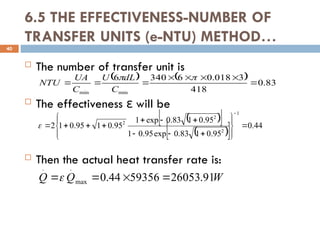
 The number of transfer unit is
 The effectiveness will be
ε
 Then the actual heat transfer rate is:
40
    83
.
0
418
3
018
.
0
6
340
6
min
min










C
dL
U
C
UA
NTU
 
 
 
  44
.
0
95
.
0
1
83
.
0
exp
95
.
0
1
95
.
0
1
83
.
0
exp
1
95
.
0
1
95
.
0
1
2
1
2
2
2























W
Q
Q 91
.
26053
59356
44
.
0
max
.
.




6.5 THE EFFECTIVENESS-NUMBER OF
TRANSFER UNITS (e-NTU) METHOD…
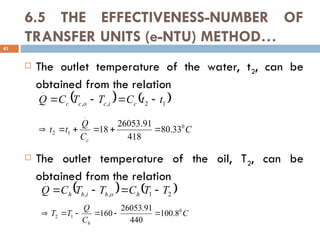
 The outlet temperature of the water, t2, can be
obtained from the relation
 The outlet temperature of the oil, T2, can be
obtained from the relation
41
   
1
2
,
,
.
t
t
C
T
T
C
Q c
i
c
o
c
c 



C
C
Q
t
t
c
0
.
1
2 33
.
80
418
91
.
26053
18 





   
2
1
,
,
.
T
T
C
T
T
C
Q h
o
h
i
h
h 



C
C
Q
T
T
h
0
.
1
2 8
.
100
440
91
.
26053
160 





6.5 THE EFFECTIVENESS-NUMBER OF
TRANSFER UNITS (e-NTU) METHOD…
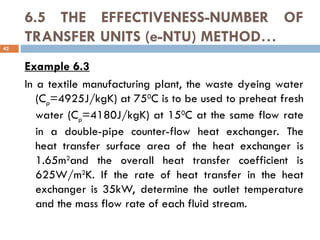
Example 6.3
In a textile manufacturing plant, the waste dyeing water
(Cp=4925J/kgK) at 750
C is to be used to preheat fresh
water (Cp=4180J/kgK) at 150
C at the same flow rate
in a double-pipe counter-flow heat exchanger. The
heat transfer surface area of the heat exchanger is
1.65m2
and the overall heat transfer coefficient is
625W/m2
K. If the rate of heat transfer in the heat
exchanger is 35kW, determine the outlet temperature
and the mass flow rate of each fluid stream.
42
6.5 THE EFFECTIVENESS-NUMBER OF
TRANSFER UNITS (e-NTU) METHOD…
43
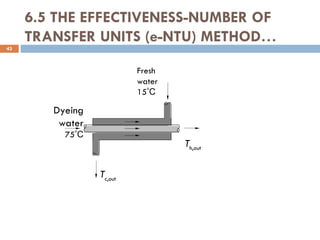
Fresh
water
15C
Dyeing
water
75C
Tc,out
Th,out
6.5 THE EFFECTIVENESS-NUMBER OF
TRANSFER UNITS (e-NTU) METHOD…
Solution
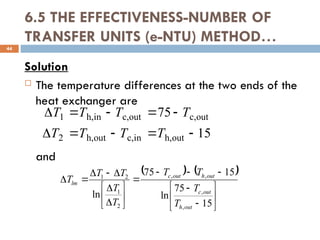
 The temperature differences at the two ends of the
heat exchanger are
and
44
15
75
out
h,
in
c,
out
h,
2
out
c,
out
c,
in
h,
1










T
T
T
T
T
T
T
T
   

























15
75
ln
15
75
ln
,
,
,
,
2
1
2
1
out
h
out
c
out
h
out
c
lm
T
T
T
T
T
T
T
T
T
6.5 THE EFFECTIVENESS-NUMBER OF
TRANSFER UNITS (e-NTU) METHOD…
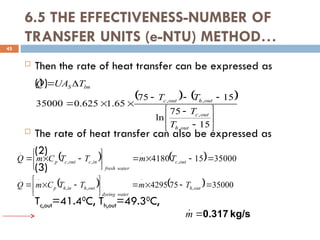
 Then the rate of heat transfer can be expressed as
(1)
 The rate of heat transfer can also be expressed as
(2)
(3)
Tc,out=41.40
C, Th,out=49.30
C,
45
   
















15
75
ln
15
75
65
.
1
625
.
0
35000
,
,
,
,
.
out
h
out
c
out
h
out
c
lm
S
T
T
T
T
T
UA
Q
    35000
15
4180 ,
.
,
,
.
.












 out
c
water
fresh
in
c
out
c
p T
m
T
T
C
m
Q
    35000
75
4295 ,
.
,
,
.
.












 out
h
water
dyeing
out
h
in
h
p T
m
T
T
C
m
Q
kg/s
0.317

m

6.5 THE EFFECTIVENESS-NUMBER OF
TRANSFER UNITS (e-NTU) METHOD…
Example 6.4
A cross-flow air-to-water heat exchanger with an
effectiveness of 0.65 is used to heat water
(Cp=4180J/kgK) with hot air (Cp=1010J/kgK).
Water enters the heat exchanger at 200
C at a rate of
4kg/s, while air enters at 1000
C at a rate of 9kg/s. If
the overall heat transfer coefficient based on the
water side is 260W/m2
K, determine the heat transfer
surface area of the heat exchanger on the water side.
Assume both fluids are unmixed.
46
6.5 THE EFFECTIVENESS-NUMBER OF
TRANSFER UNITS (e-NTU) METHOD…
47
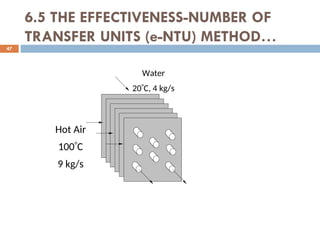
Hot Air
100C
9 kg/s
Water
20C, 4 kg/s
6.5 THE EFFECTIVENESS-NUMBER OF
TRANSFER UNITS (e-NTU) METHOD…
Solution
 The heat capacity rates of the hot and cold fluids
are
Therefore,
and
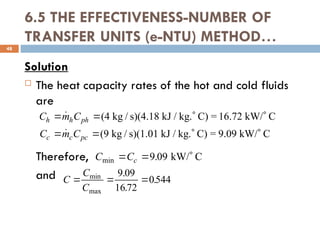
48
C m C
C m C
h h ph
c c pc
   
   


(4 kg / s)(4.18 kJ / kg. C) = 16.72 kW/ C
(9 kg / s)(1.01 kJ / kg. C) = 9.09 kW/ C
C Cc
min .
  
9 09 kW/ C
C
C
C
  
min
max
.
.
.
9 09
16 72
0544
6.5 THE EFFECTIVENESS-NUMBER OF
TRANSFER UNITS (e-NTU) METHOD…
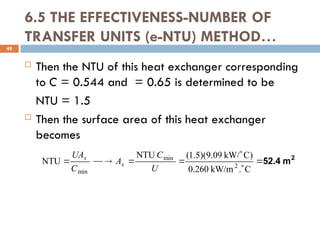
 Then the NTU of this heat exchanger corresponding
to C = 0.544 and = 0.65 is determined to be
NTU = 1.5
 Then the surface area of this heat exchanger
becomes
49
2
m
52.4








C
.
kW/m
260
.
0
)
C
kW/
09
.
9
)(
5
.
1
(
NTU
NTU 2
min
min U
C
A
C
UA
s
s
6.6 FOULING FACTOR
 After a period of operation the heat transfer
surfaces for a heat exchanger may
 become coated with various deposits present in the flow
systems, or
 the surfaces may become corroded as a result of the
interaction between the fluids and the material used for
construction of the heat exchanger.
 In either event, this coating represents an additional
resistance to the heat flow, and thus results in
decreased performance.
50
6.6 FOULING FACTOR…
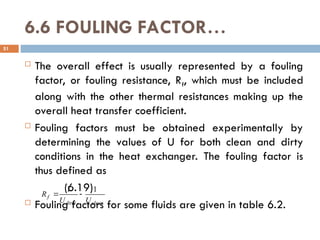
 The overall effect is usually represented by a fouling
factor, or fouling resistance, Rf, which must be included
along with the other thermal resistances making up the
overall heat transfer coefficient.
 Fouling factors must be obtained experimentally by
determining the values of U for both clean and dirty
conditions in the heat exchanger. The fouling factor is
thus defined as
(6.19)
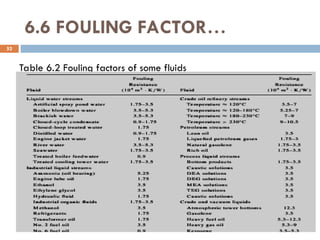
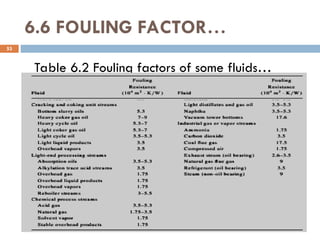
 Fouling factors for some fluids are given in table 6.2.
51
clean
dirty
f
U
U
R
1
1


6.6 FOULING FACTOR…
52
Table 6.2 Fouling factors of some fluids
6.6 FOULING FACTOR…
53
Table 6.2 Fouling factors of some fluids…
6.6 FOULING FACTOR…
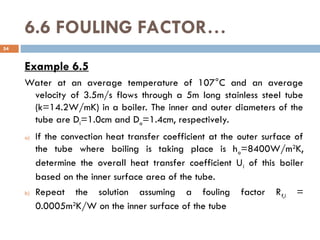
Example 6.5
Water at an average temperature of 107°C and an average
velocity of 3.5m/s flows through a 5m long stainless steel tube
(k=14.2W/mK) in a boiler. The inner and outer diameters of the
tube are Di=1.0cm and Do=1.4cm, respectively.
a) If the convection heat transfer coefficient at the outer surface of
the tube where boiling is taking place is ho=8400W/m2
K,
determine the overall heat transfer coefficient Ui of this boiler
based on the inner surface area of the tube.
b) Repeat the solution assuming a fouling factor Rf,i =
0.0005m2
K/W on the inner surface of the tube
54
6.6 FOULING FACTOR…
Solution
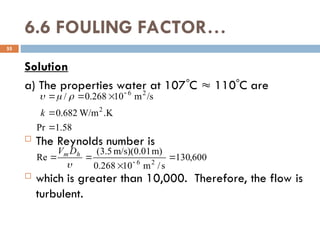
a) The properties water at 107C  110C are
 The Reynolds number is
 which is greater than 10,000. Therefore, the flow is
turbulent.
55
58
.
1
Pr
K
.
W/m
682
.
0
/s
m
10
268
.
0
/
2
2
6




 
k



600
,
130
s
/
m
10
268
.
0
m)
m/s)(0.01
5
.
3
(
Re 2
6



 

h
m D
V
6.6 FOULING FACTOR…
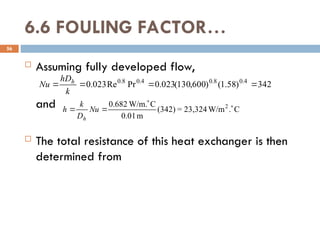
 Assuming fully developed flow,
and
 The total resistance of this heat exchanger is then
determined from
56
342
)
58
.
1
(
)
600
,
130
(
023
.
0
Pr
Re
023
.
0 4
.
0
8
.
0
4
.
0
8
.
0




k
hD
Nu h
C
.
W/m
23,324
=
(342)
m
01
.
0
C
W/m.
682
.
0 2



 Nu
D
k
h
h
6.6 FOULING FACTOR…
57
C/W
00157
.
0
=
]
m)
m)(5
(0.014
C)[
.
W/m
8400
(
1
m)]
C)(5
W/m.
2
.
14
(
2
[
)
1
/
4
.
1
ln(
]
m)
m)(5
(0.01
C)[
.
W/m
324
,
23
(
1
1
2
)
/
ln(
1
2
2

















 o
o
i
o
i
i
o
wall
i
total
A
h
kL
D
D
A
h
R
R
R
R
R
and
C
.
W/m
4055 2








]
m)
m)(5
(0.01
C/W)[
00157
.
0
(
1
1
1

i
i
i
i RA
U
A
U
R
6.6 FOULING FACTOR…
b) The thermal resistance of heat exchanger with a
fouling factor of Rf,i=0.0005m2
.0
C/W is
determined from
58
C/W
00476
.
0
m)]
m)(5
014
.
0
(
[
C)
.
W/m
8400
(
1
m)
C)(5
W/m.
2
.
14
(
2
)
1
/
4
.
1
ln(
m)]
m)(5
01
.
0
(
[
C/W
.
m
0005
.
0
m)]
m)(5
01
.
0
(
[
C)
.
W/m
324
,
23
(
1
1
2
)
/
ln(
1
2
2
2
,



















R
A
h
kL
D
D
A
R
A
h
R
o
o
i
o
i
i
f
i
i
6.6 FOULING FACTOR…
Then,
59
C
.
W/m
1337 2








]
m)
m)(5
(0.01
C/W)[
00476
.
0
(
1
1
1

i
i
i
i RA
U
A
U
R

Heat transfer / Heat exchanger Chapter6.ppt

  • 1.
  • 2.
    6.1 INTRODUCTION  Aheat exchanger can be defined as any device that transfers heat from one fluid to another that are at different temperatures.  Some of the specific applications of heat exchangers are  in space heating and air-conditioning,  power production,  waste heat recovery, and  chemical processing. 2
  • 3.
    6.2 HEAT EXCHANGERTYPES Heat exchangers may be classified according to:  Flow arrangement,  Parallel flow,  Counter flow,  Cross flow.  Construction type  Tubular,  Plate,  Extended, Regenerative. 3
  • 4.
    6.2 HEAT EXCHANGERTYPES…  Number of fluid passes,  Two pass,  Three pass, …  Compactness  Gas to liquid,  Liquid to liquid,  Phase change.  Transfer processes  Direct, Indirect. 4
  • 5.
    6.2 HEAT EXCHANGERTYPES…  Double pipe, cross-flow and shell-and-tube heat exchangers are the common types of tubular heat exchangers. a) b) Fig. 6.1 Double pipe heat exchangers a) Parallel flow b) Counter flow 5
  • 6.
    6.2 HEAT EXCHANGERTYPES… 6 Fig. 6.2 Cross flow heat exchangers a) Both fluids unmixed b) One fluid mixed and the other unmixed
  • 7.
    6.2 HEAT EXCHANGERTYPES… 7 Fig. 6.3 Shell and Tube heat exchanger with one shell pass and one tube pass
  • 8.
    6.2 HEAT EXCHANGERTYPES… 8 Fig. 6.4 Shell and tube heat exchangers with more fluid passes
  • 9.
    6.2 HEAT EXCHANGERTYPES… 9 Fig. 6.5 Compact heat exchangers
  • 10.
    6.3 HEAT EXCHANGERANALYSIS 10 There are different types of heat exchanger analysis techniques, the most common ones being:  The log mean temperature difference (LMTD) and  The effectiveness-number of transfer units ( -NTU) ε methods. The LMTD method is appropriate when we need to select a heat exchanger where the temperature changes and the mass flow rate are known. The -NTU method is used when we want to predict ε the outlet temperatures of both fluids.
  • 11.
    6.4 LOG MEANTEMPERATURE DIFFERENCE METHOD 11 Parallel flow heat exchangers In heat exchanger analysis, the energy balance is used along with the following assumptions:  The heat exchanger is insulated from its surroundings, and the heat exchange is only between the hot and cold fluids,  Axial conduction along the tubes is negligible,  Potential and kinetic energy changes are negligible,  The fluid specific heats are constant, and  The overall heat transfer coefficient is constant.
  • 12.
    6.4 LOG MEANTEMPERATURE DIFFERENCE METHOD… 12 Fig. 6.6 Temperature distribution in parallel flow arrangement
  • 13.
    6.4 LOG MEANTEMPERATURE DIFFERENCE METHOD… 13  According to the above assumptions, heat lost by hot fluid is the same as heat gained by cold fluid.  Heat lost by hot fluid (6.1)  Heat gained by cold fluid (6.2)  We can also express the heat transfer rate across area dA as, (6.3)     i h o h h i h o h h h T T C T T c m Q , , , , . .           i c o c c i c o c c c T T C T T c m Q , , , , . .     TdA U Q d   .
  • 14.
    6.4 LOG MEANTEMPERATURE DIFFERENCE METHOD… 14  T=Th-Tc is the local temperature difference between the hot and cold fluids.  To integrate equation (6.3), let’s make use of the following relation   c h dT dT T d                     c h c h C C Q d C Q d C Q d T d 1 1 . . .                c h C C TdA U T d 1 1   dA C C U T T d c h              1 1
  • 15.
    6.4 LOG MEANTEMPERATURE DIFFERENCE METHOD… 15  Integration of this equation gives (6.4)                  2 1 2 1 1 1 dA C C U T T d c h             1 2 . , , , , . . , , . , , 1 2 1 1 ln T T Q UA T T T T Q UA Q T T Q T T UA C C UA T T i c i h o c o h i c o c i h o h c h                                                                          1 2 1 2 . ln T T T T UA Q
  • 16.
    6.4 LOG MEANTEMPERATURE DIFFERENCE METHOD… 16 (6.5) Tlm is the logmean temperature difference     lm i c i h o c o h i c i h o c o h T UA T T T T T T T T UA Q                               , , , , , , , , . ln
  • 17.
    6.4 LOG MEANTEMPERATURE DIFFERENCE METHOD… 17 Counter flow heat exchangers Fig. 6.7 Temperature distribution in counter flow arrangement
  • 18.
    6.4 LOG MEANTEMPERATURE DIFFERENCE METHOD… 18  Equations (6.1) through (6.5) apply for counter flow heat exchanger.  However, for the counter flow exchanger the endpoint temperature differences must now be defined as T1=Th,i-Tc,o (6.6) T2=Th,o-Tc,I (6.7)
  • 19.
    6.4 LOG MEANTEMPERATURE DIFFERENCE METHOD… 19  And the log mean temperature difference will be, (6.8)  Then the heat transfer rate is (6.9)                                                              o c i h i c o h o c i h i c o h lm T T T T T T T T T T T T T , , , , , , , , 1 2 1 2 ln ln lm T UA Q   .
  • 20.
    6.4 LOG MEANTEMPERATURE DIFFERENCE METHOD… 20 Multi-pass and cross flow heat exchangers  The log mean temperature difference method developed earlier is limited to parallel and counter flow heat exchangers.  Similar relations can also be developed for cross flow and multi-pass shell-and-tube heat exchangers but the resulting relations are so complicated because of the complex flow conditions.  The easiest way is to relate the log mean temperature difference of such heat exchangers with that of counter flow heat exchanger using some correction factor F.
  • 21.
    6.4 LOG MEANTEMPERATURE DIFFERENCE METHOD… 21 Tlm=FTlm,CF (6.10) Where Tlm,CF is given by (6.11) The correction factor F for some arrangements can be obtained from figures.                                                              o c i h i c o h o c i h i c o h CF lm T T T T T T T T T T T T T , , , , , , , , 1 2 1 2 , ln ln
  • 22.
    6.4 LOG MEANTEMPERATURE DIFFERENCE METHOD… 22 a) One-shell pass and multiple of two (2, 4, 6, etc) tube passes 1 1 1 2 t T t t P    1 2 2 1 t t T T R   
  • 23.
    6.4 LOG MEANTEMPERATURE DIFFERENCE METHOD… 23 b) Two-shell pass and multiple of four (4, 8, 12, etc) tube passes
  • 24.
    6.4 LOG MEANTEMPERATURE DIFFERENCE METHOD… 24 c) Single-pass cross-flow with one fluid mixed and the other unmixed
  • 25.
    6.4 LOG MEANTEMPERATURE DIFFERENCE METHOD… 25 Fig. 6.8 correction factor F for common shell and tube and cross flow heat exchangers d) Single-pass cross-flow with both fluids unmixed
  • 26.
    6.4 LOG MEANTEMPERATURE DIFFERENCE METHOD… 26 Example 6.1 A counter flow, concentric tube heat exchanger is used to cool the lubricating oil for a large industrial gas turbine engine. The flow rate of cooling water through the inner tube (Di=25mm) is 0.2kg/s, while the flow rate of oil through the annulus (Do=45mm) is 0.1kg.s. The oil and water enter at temperatures of 100 and 300 C, respectively. If the outlet temperature of the oil is to be 600 C and the heat exchanger is 60m long, determine the outlet temperature of the water, the LMTD and the overall heat transfer coefficient.
  • 27.
    6.4 LOG MEANTEMPERATURE DIFFERENCE METHOD… 27 Solution
  • 28.
    6.4 LOG MEANTEMPERATURE DIFFERENCE METHOD… 28  Properties of the fluids from tables: Unused engine oil (Th = 800 C = 353 K): cp=2131J/kgK, =3.25x10⁻² Ns/m2 , k=0.138W/mK. Water (Tc=350 C): cp=4178 J/kgK, =725x10-6 Ns/m2 , k=0.625W/mK, Pr = 4.85.  The required heat transfer rate may be obtained from the overall energy balance for the hot fluid   W T T c m Q o h i h h h 8524 ) 60 100 ( 2131 1 . 0 , , . .      
  • 29.
    6.4 LOG MEANTEMPERATURE DIFFERENCE METHOD… 29  The water outlet temperature is  The LMTD for counter flow arrangement is C c m Q T T c c i c o c 0 . . , , 2 . 40 4178 2 . 0 8524 30               2 . 43 2 . 40 100 30 60 ln 2 . 40 100 30 60 ln ln , , , , , , , , 1 2 1 2                                                                       o c i h i c o h o c i h i c o h lm T T T T T T T T T T T T T
  • 30.
    6.4 LOG MEANTEMPERATURE DIFFERENCE METHOD… 30  The overall heat transfer coefficient can be obtained as, K m W T L D Q T A Q U lm i lm 2 . . / 87 . 41 2 . 43 60 025 . 0 8524           
  • 31.
    6.5 THE EFFECTIVENESS-NUMBEROF TRANSFER UNITS (-NTU) METHOD  The parameter P in the LMTD correction factor method requires three temperatures for its computation.  The inlet temperature of both the hot and cold streams is usually a given, but when the cold-side outlet temperature is not known, a trial-and-error method is required to evaluate P.  The trial-and-error procedure may be avoided in the - ε NTU method, and because of its suitability for computer-aided design, the - ε NTU method is gaining more popularity. 31
  • 32.
    6.5 THE EFFECTIVENESS-NUMBEROF TRANSFER UNITS (e-NTU) METHOD… Kays and London (1984) have shown that the heat exchanger transfer equations may be written in dimensionless form, which results in three dimensionless groups:  Capacity rate ratio: (6.14)  Exchanger heat transfer effectiveness: (6.15) 32   1 * 0 * max min    C C C C   1 0 max . .      Q Q
  • 33.
    6.5 THE EFFECTIVENESS-NUMBEROF TRANSFER UNITS (e-NTU) METHOD… This is the ratio of the actual heat transferred to the maximum heat that could be transferred if the exchanger were a counter-flow exchanger.  Number of transfer units: (6.16)  The number of transfer units is a measure of the size of the exchanger.  Observe that if Ch>Cc then (T1-T2)<(t2-t1) and if Cc>Ch then (T1-T2)>(t2-t1) 33 min C UA NTU 
  • 34.
    6.5 THE EFFECTIVENESS-NUMBEROF TRANSFER UNITS (e-NTU) METHOD…  The fluid that “might” experience the maximum temperature change,T1-t1, is the fluid that has the minimum capacity rate. Thus, the maximum possible heat transfer can be expressed as (6.17a) Or (6.17b) 34     h c c C C t T C Q    1 1 max .     c h h C C t T C Q    1 1 max .
  • 35.
    6.5 THE EFFECTIVENESS-NUMBEROF TRANSFER UNITS (e-NTU) METHOD…  And either of these can be obtained with the counter-flow exchanger. Therefore, the exchanger effectiveness can be written as (6.18)  Observe that the value of will range between ε zero and unity and that for a given and , the ε actual heat transfer in the exchanger will be (6.19) 35         1 1 min 1 2 1 1 min 2 1 max . . t T C t t C t T C T T C Q Q c h           1 1 min . t T C Q   max . Q
  • 36.
    6.5 THE EFFECTIVENESS-NUMBEROF TRANSFER UNITS (e-NTU) METHOD… 36
  • 37.
    6.5 THE EFFECTIVENESS-NUMBEROF TRANSFER UNITS (e-NTU) METHOD… Example 6.2 Hot oil (Cp=2200J/kgK) is to be cooled by water (Cp=4180J/kgK) in a 1-shell-pass and 6-tube-pass heat exchanger. The tubes are thin walled and are made of copper with an internal diameter of 1.8cm. The length of each tube pass in the heat exchanger is 3m, and the overall heat transfer coefficient is 340W/m2 K. Water flows through the tubes at a rate of 0.1kg/s, and the oil through shell at a rate of 0.2kg/s. The water and oil enter at temperatures 180 C and 1600 C, respectively. Determine the rate of heat transfer and the outlet temperatures of the water and the oil. 37
  • 38.
    6.5 THE EFFECTIVENESS-NUMBEROF TRANSFER UNITS (e-NTU) METHOD… Solution  The heat capacity rate of oil is:  And the heat capacity rate of water is:  The minimum heat capacity rate is: 38 K W c m C oil h / 440 2200 2 . 0 .           K W c m C water c / 418 4180 1 . 0 .           K W C C c / 418 min  
  • 39.
    6.5 THE EFFECTIVENESS-NUMBEROF TRANSFER UNITS (e-NTU) METHOD…  The maximum heat transfer rate is:  The actual heat transfer rate is:  Where the effectiveness is obtained from table ε 6.1 as  The capacity rate ratio is 39     W t T C Q 59356 18 160 418 1 1 min max .        1 1 min . t T C Q           1 2 2 2 * 1 exp * 1 * 1 exp 1 * 1 * 1 2                      C NTU C C NTU C C  95 . 0 440 418 * max min    C C C
  • 40.
    6.5 THE EFFECTIVENESS-NUMBEROF TRANSFER UNITS (e-NTU) METHOD…  The number of transfer unit is  The effectiveness will be ε  Then the actual heat transfer rate is: 40     83 . 0 418 3 018 . 0 6 340 6 min min           C dL U C UA NTU         44 . 0 95 . 0 1 83 . 0 exp 95 . 0 1 95 . 0 1 83 . 0 exp 1 95 . 0 1 95 . 0 1 2 1 2 2 2                        W Q Q 91 . 26053 59356 44 . 0 max . .    
  • 41.
    6.5 THE EFFECTIVENESS-NUMBEROF TRANSFER UNITS (e-NTU) METHOD…  The outlet temperature of the water, t2, can be obtained from the relation  The outlet temperature of the oil, T2, can be obtained from the relation 41     1 2 , , . t t C T T C Q c i c o c c     C C Q t t c 0 . 1 2 33 . 80 418 91 . 26053 18           2 1 , , . T T C T T C Q h o h i h h     C C Q T T h 0 . 1 2 8 . 100 440 91 . 26053 160      
  • 42.
    6.5 THE EFFECTIVENESS-NUMBEROF TRANSFER UNITS (e-NTU) METHOD… Example 6.3 In a textile manufacturing plant, the waste dyeing water (Cp=4925J/kgK) at 750 C is to be used to preheat fresh water (Cp=4180J/kgK) at 150 C at the same flow rate in a double-pipe counter-flow heat exchanger. The heat transfer surface area of the heat exchanger is 1.65m2 and the overall heat transfer coefficient is 625W/m2 K. If the rate of heat transfer in the heat exchanger is 35kW, determine the outlet temperature and the mass flow rate of each fluid stream. 42
  • 43.
    6.5 THE EFFECTIVENESS-NUMBEROF TRANSFER UNITS (e-NTU) METHOD… 43 Fresh water 15C Dyeing water 75C Tc,out Th,out
  • 44.
    6.5 THE EFFECTIVENESS-NUMBEROF TRANSFER UNITS (e-NTU) METHOD… Solution  The temperature differences at the two ends of the heat exchanger are and 44 15 75 out h, in c, out h, 2 out c, out c, in h, 1           T T T T T T T T                              15 75 ln 15 75 ln , , , , 2 1 2 1 out h out c out h out c lm T T T T T T T T T
  • 45.
    6.5 THE EFFECTIVENESS-NUMBEROF TRANSFER UNITS (e-NTU) METHOD…  Then the rate of heat transfer can be expressed as (1)  The rate of heat transfer can also be expressed as (2) (3) Tc,out=41.40 C, Th,out=49.30 C, 45                     15 75 ln 15 75 65 . 1 625 . 0 35000 , , , , . out h out c out h out c lm S T T T T T UA Q     35000 15 4180 , . , , . .              out c water fresh in c out c p T m T T C m Q     35000 75 4295 , . , , . .              out h water dyeing out h in h p T m T T C m Q kg/s 0.317  m 
  • 46.
    6.5 THE EFFECTIVENESS-NUMBEROF TRANSFER UNITS (e-NTU) METHOD… Example 6.4 A cross-flow air-to-water heat exchanger with an effectiveness of 0.65 is used to heat water (Cp=4180J/kgK) with hot air (Cp=1010J/kgK). Water enters the heat exchanger at 200 C at a rate of 4kg/s, while air enters at 1000 C at a rate of 9kg/s. If the overall heat transfer coefficient based on the water side is 260W/m2 K, determine the heat transfer surface area of the heat exchanger on the water side. Assume both fluids are unmixed. 46
  • 47.
    6.5 THE EFFECTIVENESS-NUMBEROF TRANSFER UNITS (e-NTU) METHOD… 47 Hot Air 100C 9 kg/s Water 20C, 4 kg/s
  • 48.
    6.5 THE EFFECTIVENESS-NUMBEROF TRANSFER UNITS (e-NTU) METHOD… Solution  The heat capacity rates of the hot and cold fluids are Therefore, and 48 C m C C m C h h ph c c pc           (4 kg / s)(4.18 kJ / kg. C) = 16.72 kW/ C (9 kg / s)(1.01 kJ / kg. C) = 9.09 kW/ C C Cc min .    9 09 kW/ C C C C    min max . . . 9 09 16 72 0544
  • 49.
    6.5 THE EFFECTIVENESS-NUMBEROF TRANSFER UNITS (e-NTU) METHOD…  Then the NTU of this heat exchanger corresponding to C = 0.544 and = 0.65 is determined to be NTU = 1.5  Then the surface area of this heat exchanger becomes 49 2 m 52.4         C . kW/m 260 . 0 ) C kW/ 09 . 9 )( 5 . 1 ( NTU NTU 2 min min U C A C UA s s
  • 50.
    6.6 FOULING FACTOR After a period of operation the heat transfer surfaces for a heat exchanger may  become coated with various deposits present in the flow systems, or  the surfaces may become corroded as a result of the interaction between the fluids and the material used for construction of the heat exchanger.  In either event, this coating represents an additional resistance to the heat flow, and thus results in decreased performance. 50
  • 51.
    6.6 FOULING FACTOR… The overall effect is usually represented by a fouling factor, or fouling resistance, Rf, which must be included along with the other thermal resistances making up the overall heat transfer coefficient.  Fouling factors must be obtained experimentally by determining the values of U for both clean and dirty conditions in the heat exchanger. The fouling factor is thus defined as (6.19)  Fouling factors for some fluids are given in table 6.2. 51 clean dirty f U U R 1 1  
  • 52.
    6.6 FOULING FACTOR… 52 Table6.2 Fouling factors of some fluids
  • 53.
    6.6 FOULING FACTOR… 53 Table6.2 Fouling factors of some fluids…
  • 54.
    6.6 FOULING FACTOR… Example6.5 Water at an average temperature of 107°C and an average velocity of 3.5m/s flows through a 5m long stainless steel tube (k=14.2W/mK) in a boiler. The inner and outer diameters of the tube are Di=1.0cm and Do=1.4cm, respectively. a) If the convection heat transfer coefficient at the outer surface of the tube where boiling is taking place is ho=8400W/m2 K, determine the overall heat transfer coefficient Ui of this boiler based on the inner surface area of the tube. b) Repeat the solution assuming a fouling factor Rf,i = 0.0005m2 K/W on the inner surface of the tube 54
  • 55.
    6.6 FOULING FACTOR… Solution a)The properties water at 107C  110C are  The Reynolds number is  which is greater than 10,000. Therefore, the flow is turbulent. 55 58 . 1 Pr K . W/m 682 . 0 /s m 10 268 . 0 / 2 2 6       k    600 , 130 s / m 10 268 . 0 m) m/s)(0.01 5 . 3 ( Re 2 6       h m D V
  • 56.
    6.6 FOULING FACTOR… Assuming fully developed flow, and  The total resistance of this heat exchanger is then determined from 56 342 ) 58 . 1 ( ) 600 , 130 ( 023 . 0 Pr Re 023 . 0 4 . 0 8 . 0 4 . 0 8 . 0     k hD Nu h C . W/m 23,324 = (342) m 01 . 0 C W/m. 682 . 0 2     Nu D k h h
  • 57.
    6.6 FOULING FACTOR… 57 C/W 00157 . 0 = ] m) m)(5 (0.014 C)[ . W/m 8400 ( 1 m)] C)(5 W/m. 2 . 14 ( 2 [ ) 1 / 4 . 1 ln( ] m) m)(5 (0.01 C)[ . W/m 324 , 23 ( 1 1 2 ) / ln( 1 2 2                  o o i o i i o wall i total A h kL D D A h R R R R R and C . W/m 4055 2         ] m) m)(5 (0.01 C/W)[ 00157 . 0 ( 1 1 1  i i i i RA U A U R
  • 58.
    6.6 FOULING FACTOR… b)The thermal resistance of heat exchanger with a fouling factor of Rf,i=0.0005m2 .0 C/W is determined from 58 C/W 00476 . 0 m)] m)(5 014 . 0 ( [ C) . W/m 8400 ( 1 m) C)(5 W/m. 2 . 14 ( 2 ) 1 / 4 . 1 ln( m)] m)(5 01 . 0 ( [ C/W . m 0005 . 0 m)] m)(5 01 . 0 ( [ C) . W/m 324 , 23 ( 1 1 2 ) / ln( 1 2 2 2 ,                    R A h kL D D A R A h R o o i o i i f i i
  • 59.
    6.6 FOULING FACTOR… Then, 59 C . W/m 13372         ] m) m)(5 (0.01 C/W)[ 00476 . 0 ( 1 1 1  i i i i RA U A U R