ABHISEK ANAND
 Pressure, a feeling of fullness or a squeezing pain in
  the center of your chest that lasts for more than a few
  minutes
 Pain extending beyond your chest to your shoulder,
  arm, back, or even to your teeth and jaw
 Increasing episodes of chest pain
 Prolonged pain in the upper abdomen
 Shortness of breath
 Sweating
 Impending sense of doom
 Fainting
 Nausea and vomiting
 Age.
 Tobacco.
 Diabetes.
 High blood pressure.
 High blood cholesterol or triglyceride   levels.
 Family history of heart attack.
 Lack of physical activity.
 Obesity.
 Stress.
 Illegal drug use.
 Gender
 High blood pressure
 Alcohol
 Oral contraceptive pill
Abnormal   heart
 rhythms
Heart failure.
Heart rupture.
Valve problems.
 Electrocardiogram   (ECG).
 Blood  tests
 Echocardiography ("echo")
 Cardiovascular magnetic resonance imaging
  (CMR)
 Cardiac stress test
 Auscultation
 Holter monitor
 Electrophysiology study
Sphygmomanometer
Cardiac marker
Coronary catheterization
Fractional flow reserve (FFRmyo)
Intravascular ultrasound (IVUS)
Optical coherence tomography
 (OCT)
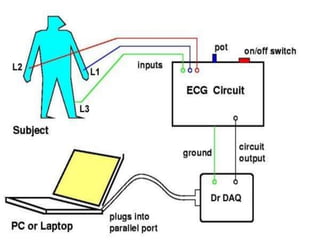
Electrocardiography (ECG or EKG)
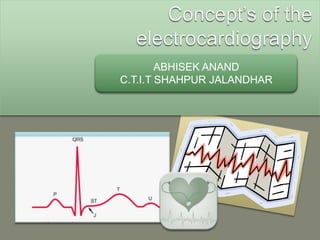
ABHISEK ANAND
C.T.I.T SHAHPUR JALANDHAR
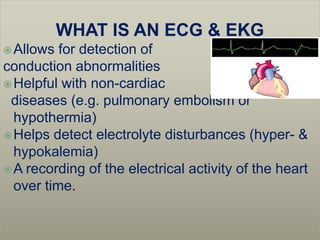
WHAT IS AN ECG & EKG
 Allows  for detection of
conduction abnormalities
 Helpful with non-cardiac
 diseases (e.g. pulmonary embolism or
  hypothermia)
 Helps detect electrolyte disturbances (hyper- &
  hypokalemia)
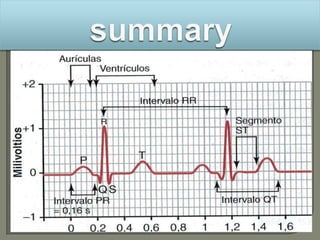
 A recording of the electrical activity of the heart
  over time.
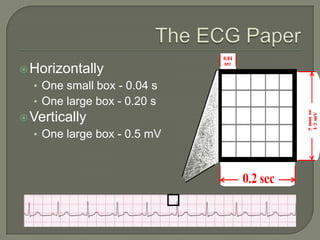
 Horizontally
  • One small box - 0.04 s
  • One large box - 0.20 s
 Vertically
  • One large box - 0.5 mV
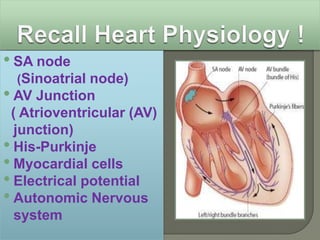
• SA node
  (Sinoatrial node)
• AV Junction
 ( Atrioventricular (AV)
  junction)
• His-Purkinje
• Myocardial cells
• Electrical potential
• Autonomic Nervous
  system
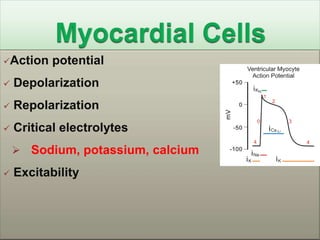
Action    potential
   Depolarization
   Repolarization
   Critical electrolytes
     Sodium, potassium, calcium
   Excitability
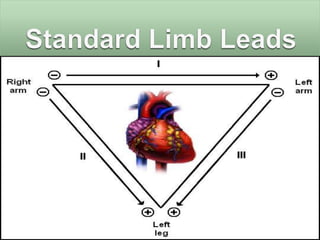
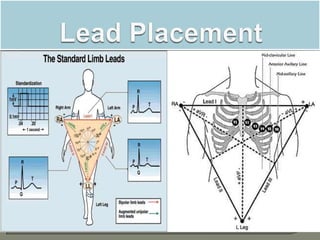
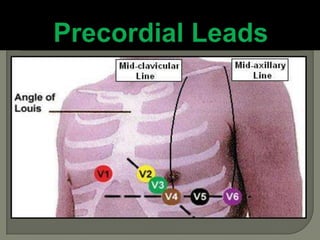
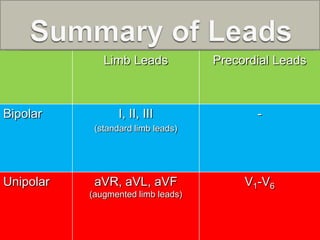
Limb Leads            Precordial Leads


Bipolar           I, II, III               -
            (standard limb leads)


Unipolar    aVR, aVL, aVF                V1-V6
           (augmented limb leads)
A transmembrane electrical gradient
 (potential) is maintained, with the interior of
 the cell negative with respect to outside the
 cell
 (-90mv) and (+30mv) inside and outside the cell
 Caused by unequal distribution of ions
 inside vs. outside cell
 Na+ higher outside than inside cell
 Ca+ much higher “ “ “         “
 K+ higher inside cell than outside
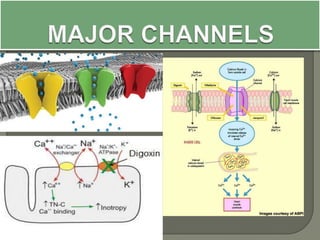
 Maintenanceby ion selective channels,
 active pumps and exchangers
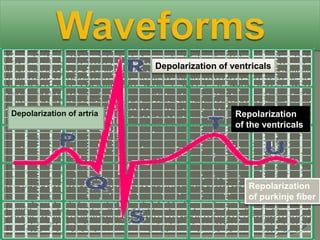
Depolarization of ventricals


Depolarization of artria                      Repolarization
                                              of the ventricals


                                                 Repolarization
                                                 of purkinje fiber
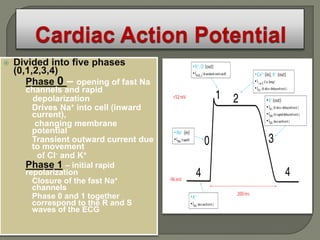
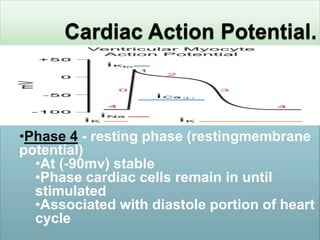
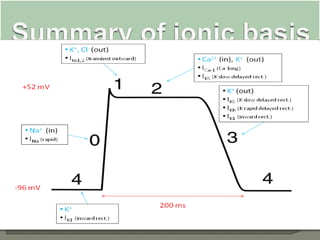
   Divided into five phases
    (0,1,2,3,4)
     • Phase 0 – opening of fast Na
      channels and rapid
    •   depolarization
       Drives Na+ into cell (inward
        current),
         changing membrane
        potential
       Transient outward current due
        to movement
          of Cl- and K+
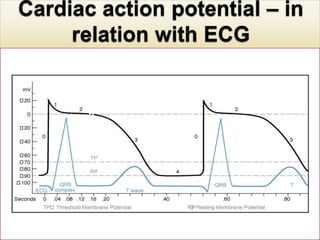
    • Phase 1 – initial rapid
      repolarization
       Closure of the fast Na+
        channels
       Phase 0 and 1 together
        correspond to the R and S
        waves of the ECG
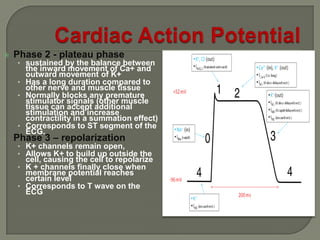
   Phase 2 - plateau phase
    • sustained by the balance between
      the inward movement of Ca+ and
      outward movement of K+
    • Has a long duration compared to
      other nerve and muscle tissue
    • Normally blocks any premature
      stimulator signals (other muscle
      tissue can accept additional
      stimulation and increase
      contractility in a summation effect)
    • Corresponds to ST segment of the
      ECG.
•   Phase 3 – repolarization
    • K+ channels remain open,
    • Allows K+ to build up outside the
      cell, causing the cell to repolarize
    • K + channels finally close when
      membrane potential reaches
      certain level
    • Corresponds to T wave on the
      ECG
•Phase 4 - resting phase (restingmembrane
potential)
  •At (-90mv) stable
  •Phase cardiac cells remain in until
  stimulated
  •Associated with diastole portion of heart
  cycle
R


        T

    S
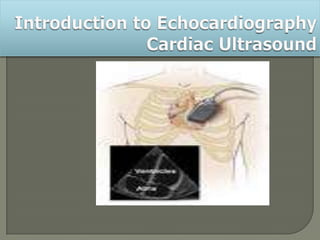
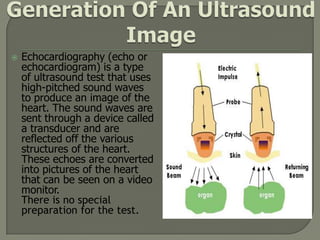
   Echocardiography (echo or
    echocardiogram) is a type
    of ultrasound test that uses
    high-pitched sound waves
    to produce an image of the
    heart. The sound waves are
    sent through a device called
    a transducer and are
    reflected off the various
    structures of the heart.
    These echoes are converted
    into pictures of the heart
    that can be seen on a video
    monitor.
    There is no special
    preparation for the test.
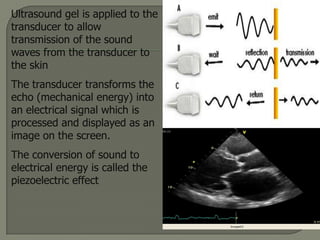
Ultrasound gel is applied to the
transducer to allow
transmission of the sound
waves from the transducer to
the skin
The transducer transforms the
echo (mechanical energy) into
an electrical signal which is
processed and displayed as an
image on the screen.
The conversion of sound to
electrical energy is called the
piezoelectric effect
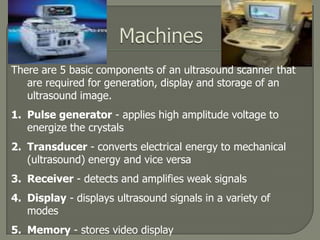
There are 5 basic components of an ultrasound scanner that
   are required for generation, display and storage of an
   ultrasound image.
1. Pulse generator - applies high amplitude voltage to
   energize the crystals
2. Transducer - converts electrical energy to mechanical
   (ultrasound) energy and vice versa
3. Receiver - detects and amplifies weak signals
4. Display - displays ultrasound signals in a variety of
   modes
5. Memory - stores video display
sometimes known as cardiac MRI, is a medical
imaging technology for the non-invasive assessment of
the function and structure of the cardiovascular system.
It is derived from and based on the same basic
principles as magnetic resonance imaging (MRI) but
with optimization for use in the cardiovascular system.
These optimizations are principally in the use of ECG
gating and rapid imaging techniques or sequences. By
combining a variety of such techniques into protocols,
key functional and morphological features of the
cardiovascular system can be assessed.
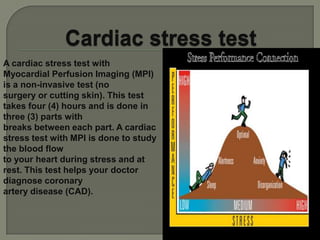
A cardiac stress test with
Myocardial Perfusion Imaging (MPI)
is a non-invasive test (no
surgery or cutting skin). This test
takes four (4) hours and is done in
three (3) parts with
breaks between each part. A cardiac
stress test with MPI is done to study
the blood flow
to your heart during stress and at
rest. This test helps your doctor
diagnose coronary
artery disease (CAD).
   Heart sounds are generated by the beating heart and the
    resultant flow of blood through the cardiac circulation, also
    referred to as the heartbeat. In cardiac auscultation, the nurse
    uses a stethoscope to listen for normal heart sounds and any
    other adventitious sounds or murmurs that may be present.

   In healthy adults, there are two normal heart sounds often
    described as a lub and a dub (or dup), that occur in sequence
    with each heart beat. These are the first heart sound (S1) and
    the second heart sound (S2), produced by the closing of the
    atrioventricular valves (tricuspid and mitral valves ) and the
    semilunar valves (pulmonic and aortic) respectively.
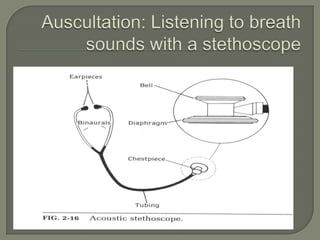
AUSCULTATION OF THE HEART
• be sure to use both sides of the stethoscope to
  examine the heart
• the diaphragm is best for hearing high-pitched sounds,
  including S1, S2 and most heart murmurs
• the bell is bests for hearing low-pitched sounds,
  including S3, S4 and a few murmurs (e.g. mitral
  stenosis)
• use LIGHT TOUCH when using the bell. Pressure
  turns it into a diaphragm
•A biomarker is a substance used as an
indicator of a biologic state. It is a
characteristic that is objectively measured
and evaluated as an indicator of normal
biologic processes, pathogenic processes,
or pharmacologic responses to a
therapeutic intervention.
•Cardiac markers are substances released
from heart muscle when it is damaged as a
result of myocardial infarction.
Heart attacks & detection

Heart attacks & detection

  • 1.
  • 5.
     Pressure, afeeling of fullness or a squeezing pain in the center of your chest that lasts for more than a few minutes  Pain extending beyond your chest to your shoulder, arm, back, or even to your teeth and jaw  Increasing episodes of chest pain  Prolonged pain in the upper abdomen  Shortness of breath  Sweating  Impending sense of doom  Fainting  Nausea and vomiting
  • 6.
     Age.  Tobacco. Diabetes.  High blood pressure.  High blood cholesterol or triglyceride levels.  Family history of heart attack.  Lack of physical activity.  Obesity.  Stress.  Illegal drug use.  Gender  High blood pressure  Alcohol  Oral contraceptive pill
  • 7.
    Abnormal heart rhythms Heart failure. Heart rupture. Valve problems.
  • 8.
     Electrocardiogram (ECG).  Blood tests  Echocardiography ("echo")  Cardiovascular magnetic resonance imaging (CMR)  Cardiac stress test  Auscultation  Holter monitor  Electrophysiology study
  • 9.
    Sphygmomanometer Cardiac marker Coronary catheterization Fractionalflow reserve (FFRmyo) Intravascular ultrasound (IVUS) Optical coherence tomography (OCT) Electrocardiography (ECG or EKG)
  • 10.
  • 11.
    WHAT IS ANECG & EKG  Allows for detection of conduction abnormalities  Helpful with non-cardiac diseases (e.g. pulmonary embolism or hypothermia)  Helps detect electrolyte disturbances (hyper- & hypokalemia)  A recording of the electrical activity of the heart over time.
  • 12.
     Horizontally • One small box - 0.04 s • One large box - 0.20 s  Vertically • One large box - 0.5 mV
  • 13.
    • SA node (Sinoatrial node) • AV Junction ( Atrioventricular (AV) junction) • His-Purkinje • Myocardial cells • Electrical potential • Autonomic Nervous system
  • 14.
    Action potential  Depolarization  Repolarization  Critical electrolytes  Sodium, potassium, calcium  Excitability
  • 20.
    Limb Leads Precordial Leads Bipolar I, II, III - (standard limb leads) Unipolar aVR, aVL, aVF V1-V6 (augmented limb leads)
  • 21.
    A transmembrane electricalgradient (potential) is maintained, with the interior of the cell negative with respect to outside the cell (-90mv) and (+30mv) inside and outside the cell  Caused by unequal distribution of ions inside vs. outside cell Na+ higher outside than inside cell Ca+ much higher “ “ “ “ K+ higher inside cell than outside  Maintenanceby ion selective channels, active pumps and exchangers
  • 22.
    Depolarization of ventricals Depolarizationof artria Repolarization of the ventricals Repolarization of purkinje fiber
  • 23.
    Divided into five phases (0,1,2,3,4) • Phase 0 – opening of fast Na channels and rapid • depolarization  Drives Na+ into cell (inward current), changing membrane potential  Transient outward current due to movement of Cl- and K+ • Phase 1 – initial rapid repolarization  Closure of the fast Na+ channels  Phase 0 and 1 together correspond to the R and S waves of the ECG
  • 24.
    Phase 2 - plateau phase • sustained by the balance between the inward movement of Ca+ and outward movement of K+ • Has a long duration compared to other nerve and muscle tissue • Normally blocks any premature stimulator signals (other muscle tissue can accept additional stimulation and increase contractility in a summation effect) • Corresponds to ST segment of the ECG. • Phase 3 – repolarization • K+ channels remain open, • Allows K+ to build up outside the cell, causing the cell to repolarize • K + channels finally close when membrane potential reaches certain level • Corresponds to T wave on the ECG
  • 25.
    •Phase 4 -resting phase (restingmembrane potential) •At (-90mv) stable •Phase cardiac cells remain in until stimulated •Associated with diastole portion of heart cycle
  • 27.
    R T S
  • 30.
    Echocardiography (echo or echocardiogram) is a type of ultrasound test that uses high-pitched sound waves to produce an image of the heart. The sound waves are sent through a device called a transducer and are reflected off the various structures of the heart. These echoes are converted into pictures of the heart that can be seen on a video monitor. There is no special preparation for the test.
  • 31.
    Ultrasound gel isapplied to the transducer to allow transmission of the sound waves from the transducer to the skin The transducer transforms the echo (mechanical energy) into an electrical signal which is processed and displayed as an image on the screen. The conversion of sound to electrical energy is called the piezoelectric effect
  • 32.
    There are 5basic components of an ultrasound scanner that are required for generation, display and storage of an ultrasound image. 1. Pulse generator - applies high amplitude voltage to energize the crystals 2. Transducer - converts electrical energy to mechanical (ultrasound) energy and vice versa 3. Receiver - detects and amplifies weak signals 4. Display - displays ultrasound signals in a variety of modes 5. Memory - stores video display
  • 33.
    sometimes known ascardiac MRI, is a medical imaging technology for the non-invasive assessment of the function and structure of the cardiovascular system. It is derived from and based on the same basic principles as magnetic resonance imaging (MRI) but with optimization for use in the cardiovascular system. These optimizations are principally in the use of ECG gating and rapid imaging techniques or sequences. By combining a variety of such techniques into protocols, key functional and morphological features of the cardiovascular system can be assessed.
  • 34.
    A cardiac stresstest with Myocardial Perfusion Imaging (MPI) is a non-invasive test (no surgery or cutting skin). This test takes four (4) hours and is done in three (3) parts with breaks between each part. A cardiac stress test with MPI is done to study the blood flow to your heart during stress and at rest. This test helps your doctor diagnose coronary artery disease (CAD).
  • 36.
    Heart sounds are generated by the beating heart and the resultant flow of blood through the cardiac circulation, also referred to as the heartbeat. In cardiac auscultation, the nurse uses a stethoscope to listen for normal heart sounds and any other adventitious sounds or murmurs that may be present.  In healthy adults, there are two normal heart sounds often described as a lub and a dub (or dup), that occur in sequence with each heart beat. These are the first heart sound (S1) and the second heart sound (S2), produced by the closing of the atrioventricular valves (tricuspid and mitral valves ) and the semilunar valves (pulmonic and aortic) respectively.
  • 37.
    AUSCULTATION OF THEHEART • be sure to use both sides of the stethoscope to examine the heart • the diaphragm is best for hearing high-pitched sounds, including S1, S2 and most heart murmurs • the bell is bests for hearing low-pitched sounds, including S3, S4 and a few murmurs (e.g. mitral stenosis) • use LIGHT TOUCH when using the bell. Pressure turns it into a diaphragm
  • 38.
    •A biomarker isa substance used as an indicator of a biologic state. It is a characteristic that is objectively measured and evaluated as an indicator of normal biologic processes, pathogenic processes, or pharmacologic responses to a therapeutic intervention. •Cardiac markers are substances released from heart muscle when it is damaged as a result of myocardial infarction.