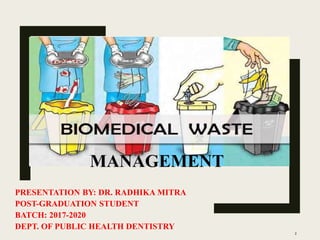
PRESENTATION BY: DR. RADHIKA MITRA
POST-GRADUATION STUDENT
BATCH: 2017-2020
DEPT. OF PUBLIC HEALTH DENTISTRY
MANAGEMENT
1
PRESENTATION BY: DR. RADHIKA MITRA
POST-GRADUATION STUDENT
BATCH: 2017-2020
DEPT. OF PUBLIC HEALTH DENTISTRY
MANAGEMENT
2
CONTENTS
■ Introduction
■ Classification
■ Sources Of Health Care Waste
■ Composition Of Health Care Waste
■ Rationale Of Waste Disposal
■ Health Hazards Of Health Care Waste
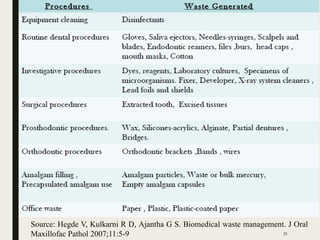
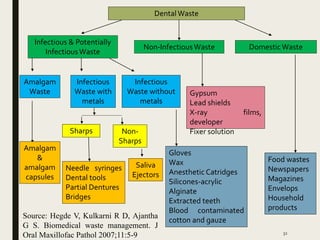
■ Categories Of Waste Generated In Dental setup
3
CONTENTS
■ Amendments
■ Steps In Waste Disposal
■ Treatment And Disposal Technique For Dental Health-
care Waste
■ Method Needed To Be Adapted For Proper Management
Of The Health Care Waste In A Dental Camp/Clinical
Setting
■ Conclusion
■ References
4
INTRODUCTION
■ Hospitals have existed in one form or the other since
time immemorial. But there never has been so much
concern about the waste generated by them. With the
increase in number of hospitals there has been
increase in quantum of waste generated.
■ Discovery of nosocomial infection, rising incidence
of hepatitis B and HIV, increasing land and water
pollution has lead to increase in possibility of many
diseases. Air pollution due to emission of hazardous
gases by incinerator such as furans, dioxins, etc. has
compelled the authorities to think seriously about
hospital wastes.
5
INTRODUCTION
■ Ultimately, Ministry of Environment and Forests,
Government of India passed an act on biomedical
waste (management and handling) rule, 1998 which
came into force on 27th July, 1998.
■ This rule applies to all those who generate, collect,
receive, store, dispose, treat or handle biomedical
waste in any manner.
■ As per this rule any person who generates waste
needs to apply for consent to respective state
pollution control boards for generating and
appropriate management.
6
INTRODUCTION
■ A dental hospital is a complex multidisciplinary
system which consumes lots of items for delivery of
dental care. Since last few years there has been a rapid
mushrooming of dental hospitals to meet the demand
for care which has increased the quantity of dental
health care waste.
■ Though the quantity from each establishment may not
be as much as in the general hospital, the collective
quality and quantity is certainly significant. The advent
and acceptance of disposables has contributed to this
issue and made hospital waste a significant factor in
today’s health care establishment.
7
INTRODUCTION
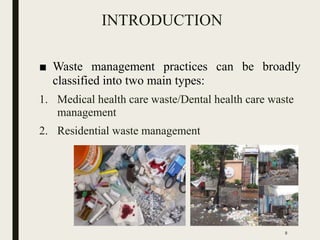
■ Waste management practices can be broadly
classified into two main types:
1. Medical health care waste/Dental health care waste
management
2. Residential waste management
8
Source: Park K. Park’s Textbook of Preventive and Social Medicine. 24th ed. India:
Bhanot Publishers; 2015. 9
CLASSIFICATION
■ WHO classification:
1. INFECTIOUS WASTE – Waste suspected to
contain pathogens e.g.- laboratory cultures; waste
from isolation wards; tissues, materials, or
equipments that have been in contact with infected
patients; excreta
2. PATHOLOGICAL WASTE – Human tissues or fluids
e.g.- body parts; blood and other body fluids.
3. SHARPS – Sharp waste e.g.- needles; infusion sets;
scalpels; knives; blades; broken glass.
10
4. PHARMACEUTICAL WASTE – Waste containing
pharmaceuticals eg- pharmaceuticals that are expired
or no longer needed; items contaminated by or
containing pharmaceuticals.
5. GENOTOXIC WASTE – Waste containing substances
with genotoxic properties e.g.- waste containing
cytostatic drugs; genotoxic chemicals.
6. CHEMICAL WASTE - Waste containing chemical
substances eg – laboratory reagents; film developers;
disinfectants that are no longer needed; solvents.
7. WASTES WITH HIGH CONTENT OF HEAVY
METALS – Batteries; broken thermometers; blood
pressure gauges.
Source: Park K. Park’s Textbook of Preventive and Social Medicine. 24th ed. India:
Bhanot Publishers; 2015. 11
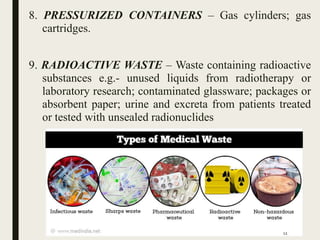
8. PRESSURIZED CONTAINERS – Gas cylinders; gas
cartridges.
9. RADIOACTIVE WASTE – Waste containing radioactive
substances e.g.- unused liquids from radiotherapy or
laboratory research; contaminated glassware; packages or
absorbent paper; urine and excreta from patients treated
or tested with unsealed radionuclides
12
■ Hospital waste classification (Gerig 1993)
I. Biohazardous waste
1. Corpses and parts of human body
2. Waste impregnated with blood
3. Wound dressings and casts of plaster
4. Dialytic waste
5. Waste from isolation wards, laboratories, excreta
6. Radioactive waste
13
Source: Govt. of India (2016). Ministry of Environment, Forest and Climate Change,
Notification published in the Gazatte of India, Bio-Medical Waste Management Rule 2016.
7. Chemical waste from laboratories
8. Disposable materials like IV sets, syringes
9. Waste from stores
10. Sharp objects like glass, cans etc.
II. Non Biohazardous waste
1. Dry household waste e.g.- floor refuse like dust,
paper trash
2. Wet garbage from kitchen and pantry
14
DEFINITION
■ According to Bio-medical waste (Management
and Handling) Rules, 1998 of India, “Bio-
medical waste” means any waste, which is
generated during the diagnosis, treatment or
immunization of human beings or animals or in
research activities pertaining there to or in the
production or testing of biological research.
Source: Park K. Park’s Textbook of Preventive and Social Medicine. 24th ed. India:
Bhanot Publishers; 2015. 15
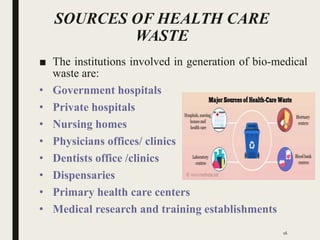
SOURCES OF HEALTH CARE
WASTE
■ The institutions involved in generation of bio-medical
waste are:
• Government hospitals
• Private hospitals
• Nursing homes
• Physicians offices/ clinics
• Dentists office /clinics
• Dispensaries
• Primary health care centers
• Medical research and training establishments
16
• Mortuaries
• Blood banks and collection centers
• Animal houses
• Slaughter houses
• Laboratories
• Research organizations
• Vaccination centers
• Bio- technology institutions/ production units
All these health care establishments generate waste
and are therefore covered under Bio-medical waste
rules.
17
COMPOSITION OF HOSPITAL
WASTE
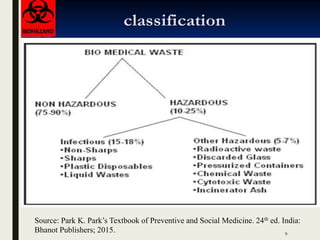
■ The amount of waste generated per bed varies with
the type of hospital, however, on an average, 1-5kg of
waste per bed per day is generated. The type of waste
generated is.
a) Non Hazardous – 85%
b) Hazardous – 15%
Hazardous but not infective 5%
Hazardous but infective 10%
18
Waste generation depends on
numerous factors such as
■ Established waste management methods
■ Type of health care establishments
■ Hospital specializations
■ Proportion of reusable items employed in health
care
■ Proportion of patients treated on a day care basis.
19
■ Developing countries that have not performed their
own surveys of health-care waste, find the following
estimates for an average distribution of health-care
wastes useful for preliminary planning of waste
management:
 80% general health care waste- normal domestic and
urban waste management system.
 15% pathological and infectious waste
 1% sharp waste
 3% chemical and pharmacological waste
 Less than 1% special waste-radioactive or cytotoxic
waste, pressurized containers, or broken thermometers
and used batteries
20
RATIONALE FOR WASTE
DISPOSAL
■ To prevent Nosocomial infection or Hospital
acquired infection
■ To protect Health care providers
■ To prevent risk to general population (when
hospital waste is thrown in open area without
proper treatment, it is hazardous)
■ To protect environment
22
Source: Hiremath SS. Textbook of Public Health Dentistry. 3rd ed. Elsevier
HEALTH HAZARDS OF HEALTH
CARE WASTE
■ Exposure to hazardous health care waste can result in
disease or injury due to one or more of the following
characteristics
o It contains infectious agents
o It contains toxic or hazardous chemical or
pharmaceuticals
o It contains sharps
o It is genotoxic and
o It is radioactive
23
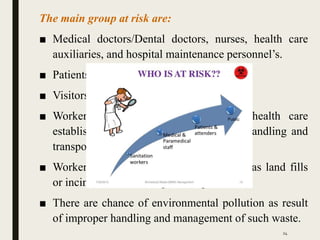
The main group at risk are:
■ Medical doctors/Dental doctors, nurses, health care
auxiliaries, and hospital maintenance personnel’s.
■ Patients in health care establishments
■ Visitors to health care establishments
■ Workers in support service allied to health care
establishments such as laundries, waste handling and
transporting
■ Workers in waste disposal facilities such as land fills
or incinerators including scavengers
■ There are chance of environmental pollution as result
of improper handling and management of such waste.
24
Hazards from infectious waste and sharps
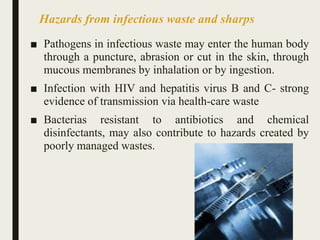
■ Pathogens in infectious waste may enter the human body
through a puncture, abrasion or cut in the skin, through
mucous membranes by inhalation or by ingestion.
■ Infection with HIV and hepatitis virus B and C- strong
evidence of transmission via health-care waste
■ Bacterias resistant to antibiotics and chemical
disinfectants, may also contribute to hazards created by
poorly managed wastes.
25
Hazards from chemical and pharmaceutical waste
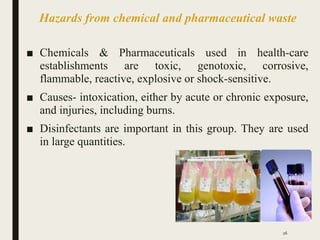
■ Chemicals & Pharmaceuticals used in health-care
establishments are toxic, genotoxic, corrosive,
flammable, reactive, explosive or shock-sensitive.
■ Causes- intoxication, either by acute or chronic exposure,
and injuries, including burns.
■ Disinfectants are important in this group. They are used
in large quantities.
26
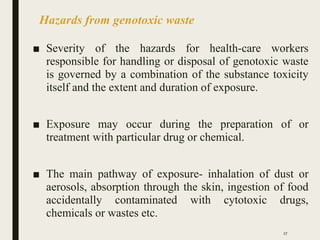
Hazards from genotoxic waste
■ Severity of the hazards for health-care workers
responsible for handling or disposal of genotoxic waste
is governed by a combination of the substance toxicity
itself and the extent and duration of exposure.
■ Exposure may occur during the preparation of or
treatment with particular drug or chemical.
■ The main pathway of exposure- inhalation of dust or
aerosols, absorption through the skin, ingestion of food
accidentally contaminated with cytotoxic drugs,
chemicals or wastes etc.
27
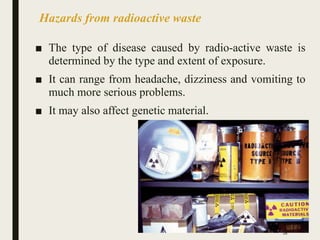
Hazards from radioactive waste
■ The type of disease caused by radio-active waste is
determined by the type and extent of exposure.
■ It can range from headache, dizziness and vomiting to
much more serious problems.
■ It may also affect genetic material.
28
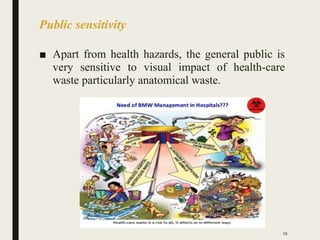
Public sensitivity
■ Apart from health hazards, the general public is
very sensitive to visual impact of health-care
waste particularly anatomical waste.
29
CATEGORIES OF WASTE
GENERATED IN A DENTAL
SET-UP
30
Source: Hegde V, Kulkarni R D, Ajantha G S. Biomedical waste management. J Oral
Maxillofac Pathol 2007;11:5-9 31
Dental Waste
Infectious & Potentially
InfectiousWaste
Non-InfectiousWaste DomesticWaste
Amalgam
Waste
Infectious
Waste with
metals
Infectious
Waste without
metals
Amalgam
&
amalgam
capsules
Sharps Non-
Sharps
Needle syringes
Dental tools
Partial Dentures
Bridges
Saliva
Ejectors
Gloves
Wax
Anesthetic Catridges
Silicones-acrylic
Alginate
Extracted teeth
Blood contaminated
cotton and gauze
Gypsum
Lead shields
X-ray films,
developer
Fixer solution
Food wastes
Newspapers
Magazines
Envelops
Household
products
32
Source: Hegde V, Kulkarni R D, Ajantha
G S. Biomedical waste management. J
Oral Maxillofac Pathol 2007;11:5-9
AMENDMENTS
33
OSHA
■ Healthcare workers are occupationally exposed to a
variety of infectious diseases during the performance
of their duties. Several OSHA standards are directly
applicable to protecting them against transmission of
infectious agents.
■ These include OSHA’s-
 Bloodborne Pathogens Standard,
 Personal Protective Equipment Standard
 Respiratory Protection Standard.
Source: www.osha.gov. Accessed on 05/09/18 34
Center for Disease Control & Prevention
(CDC)
■ The Center for Disease Control and Prevention
(CDC) and American Dental Association
guidelines/recommendations contain important
valuable information.
■ CDC has recommendations for handling infected sharps
it recommends that sharp containers to be located as
close as is practical to the work area. This means that
each operatory should have at least one sharps
container.
■ The CDC indicates that one should pour blood,
suctioned fluids, or other liquid waste carefully into a
drain connected to a sanitary sewer system
35
The Environment (Protection) Act, 1996
■ The Ministry of Environment and Forest, Government of
India issued a notification under the Environment
protection Act in July 1996
■ To provide for the protection and improvement of
environment and prevention of hazards to human beings,
other living creatures, plants and property.
■ It says:-
– Punishable for imprisonment which may extend upto 5
years.
– Fine of 1 lakh or both may be applied
– Appeal against punishment– within 30 days.
Source: Datta P, Mohi GK, Chander J. Biomedical waste management in India:
Critical appraisal. J Lab Physicians 2018;10:6-14. 36
Bio-medical Waste Management In India
■ Bio-Medical waste(Management and Handling)
Rules 1998, prescribed by the Ministry of
Environment and Forests, Government of India,
came into force on 28th July 1998.
■ This rule applies to those who generate, collect,
receive, store, dispose, treat or handle bio-medical
waste in any manner.
■ The Act is now superceded by Bio-Medical Waste
Management Rules, 2016, which came into force
from 28th March, 2016.
Source: Datta P, Mohi GK, Chander J. Biomedical waste management in India:
Critical appraisal. J Lab Physicians 2018;10:6-14. 37
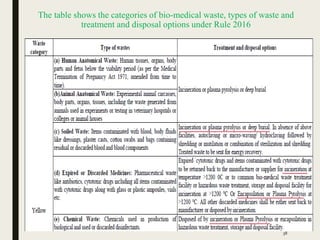
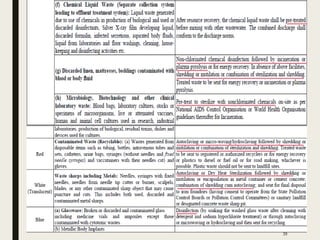
The table shows the categories of bio-medical waste, types of waste and
treatment and disposal options under Rule 2016
38
39
Major Differences Between BMW Rules
1998 & 2011
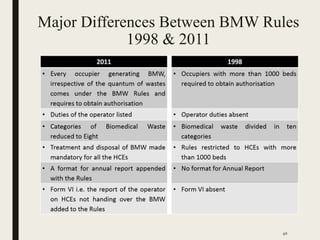
40
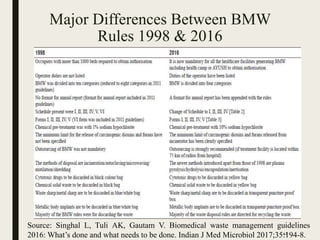
Major Differences Between BMW
Rules 1998 & 2016
41
Source: Singhal L, Tuli AK, Gautam V. Biomedical waste management guidelines
2016: What’s done and what needs to be done. Indian J Med Microbiol 2017;35:194-8.
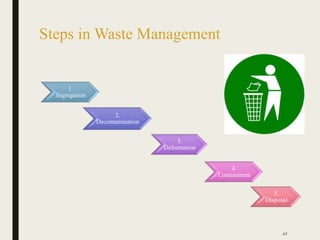
Steps in Waste Management
1.
Segregation
2.
Decontamination
3.
Deformation
4.
Containment
5.
Disposal
42
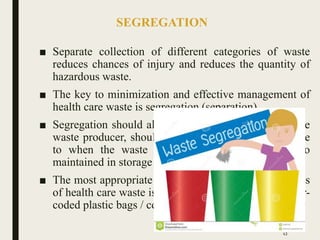
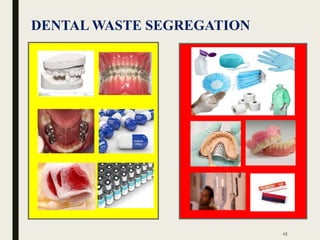
SEGREGATION
■ Separate collection of different categories of waste
reduces chances of injury and reduces the quantity of
hazardous waste.
■ The key to minimization and effective management of
health care waste is segregation (separation)
■ Segregation should always be the responsibility of the
waste producer, should take place as close as possible
to when the waste is generated and should be so
maintained in storage areas and during transport.
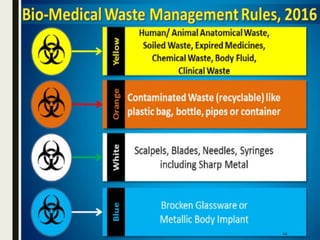
■ The most appropriate way of identifying the categories
of health care waste is by sorting the waste into colour-
coded plastic bags / containers.
43
44
DENTAL WASTE SEGREGATION
45
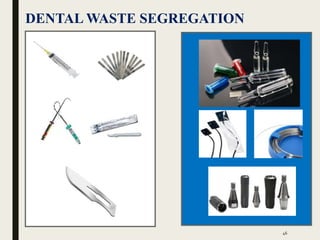
DENTAL WASTE SEGREGATION
46
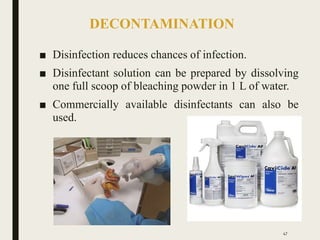
DECONTAMINATION
■ Disinfection reduces chances of infection.
■ Disinfectant solution can be prepared by dissolving
one full scoop of bleaching powder in 1 L of water.
■ Commercially available disinfectants can also be
used.
47
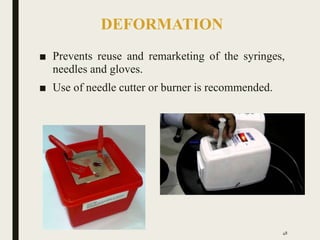
DEFORMATION
■ Prevents reuse and remarketing of the syringes,
needles and gloves.
■ Use of needle cutter or burner is recommended.
48
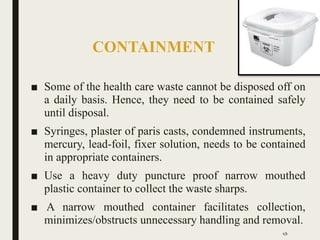
CONTAINMENT
■ Some of the health care waste cannot be disposed off on
a daily basis. Hence, they need to be contained safely
until disposal.
■ Syringes, plaster of paris casts, condemned instruments,
mercury, lead-foil, fixer solution, needs to be contained
in appropriate containers.
■ Use a heavy duty puncture proof narrow mouthed
plastic container to collect the waste sharps.
■ A narrow mouthed container facilitates collection,
minimizes/obstructs unnecessary handling and removal.
49
STORAGE
■ A storage location for health care waste should be
designated inside the health care establishment or
research facility.
■ The waste in bags or containers, should be stored in a
separate area, room or building of a size appropriate to
the quantities of waste produced.
■ Unless a refrigerated storage rooms is available,
storage times for health care waste should not exceed
the following ;
1. Temperate climate : 72 hrs in winter
2. Winter climate : 48 hrs during cold season
3. Warm climate : 24 hrs in hot climate.
50
Recommendations of storage facilities for health
care waste are :
■ The storage area should have an impermeable, hard standing
floor (with good training) it should be easy to clean and
disinfect.
■ There should be a water supply for cleaning purposes.
■ The storage areas should afford easy access for staff in charge
of handling the waste.
■ It should be possible to lock the store to prevent access by
unauthorized persons.
■ Easy access for waste collections vehicles is essential.
■ There should be protection from the sun.
■ The storage area should be inaccessible to animals, insects
and birds.
■ The storage area should not be situated in the proximity of
fresh food stores or food preparation areas.
51
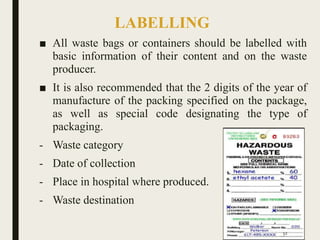
LABELLING
■ All waste bags or containers should be labelled with
basic information of their content and on the waste
producer.
■ It is also recommended that the 2 digits of the year of
manufacture of the packing specified on the package,
as well as special code designating the type of
packaging.
- Waste category
- Date of collection
- Place in hospital where produced.
- Waste destination
52
TRANSPORTATION
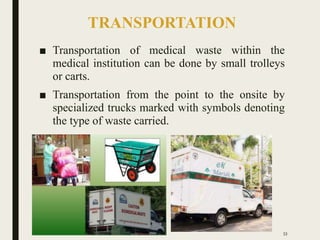
■ Transportation of medical waste within the
medical institution can be done by small trolleys
or carts.
■ Transportation from the point to the onsite by
specialized trucks marked with symbols denoting
the type of waste carried.
53
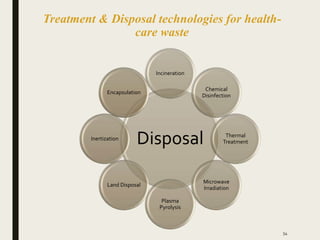
Treatment & Disposal technologies for health-
care waste
Disposal
Incineration
Chemical
Disinfection
Thermal
Treatment
Microwave
Irradiation
Plasma
Pyrolysis
Land Disposal
Inertization
Encapsulation
54
INCINERATION
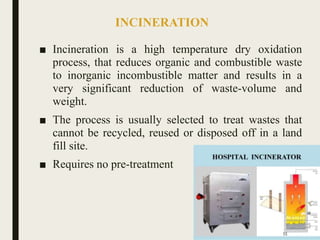
■ Incineration is a high temperature dry oxidation
process, that reduces organic and combustible waste
to inorganic incombustible matter and results in a
very significant reduction of waste-volume and
weight.
■ The process is usually selected to treat wastes that
cannot be recycled, reused or disposed off in a land
fill site.
■ Requires no pre-treatment
55
Characteristics of the waste suitable for incineration
■ Low heating volume – above 2000 kcal/ kg for single
chamber incinerators and above 3500 kcal/kg for
pryolytic double chamber incinerators.
■ Content of combustible matter above 60%
■ Content of noncombustible solids below 5%
■ Content of noncombustible fumes below 20%
■ Moisture content below 30%
56
Waste type not to be incinerated
■ Pressurized gas containers
■ Large amounts of reactive chemical waste
■ Silver salts and photographic or radiographic wastes (x-
ray films)
■ Halogenated plastic and rubber disposables used in the
hospitals.
■ Waste with high mercury or cadmium content such as
broken thermometers & used batteries
■ Sealed ampules or ampules containing heavy metals
57
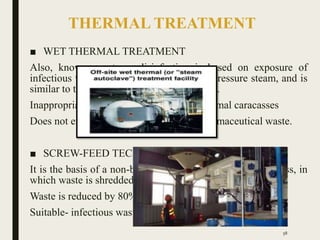
THERMAL TREATMENT
■ WET THERMAL TREATMENT
Also, known as steam disinfection is based on exposure of
infectious waste to high-temperature, highpressure steam, and is
similar to the autoclave sterilization process.
Inappropriate for- anatomical waste and animal caracasses
Does not efficiently treat chemical and pharmaceutical waste.
■ SCREW-FEED TECHNOLOGY
It is the basis of a non-burn, dry thermal disinfection process, in
which waste is shredded and heated in a rotating auger.
Waste is reduced by 80% in volume & 20-35% in weight
Suitable- infectious waste and sharps.
58
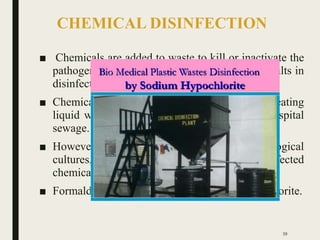
CHEMICAL DISINFECTION
■ Chemicals are added to waste to kill or inactivate the
pathogens it contains, this treatment usually results in
disinfection rather than sterilization.
■ Chemical disinfection is most suitable for treating
liquid waste such as blood, urine, stools, or hospital
sewage.
■ However, solid wastes including microbiological
cultures, sharps, etc may also be disinfected
chemically with certain limitations.
■ Formaldehyde, Glutaraldehyde, Sodium hypochlorite.
59
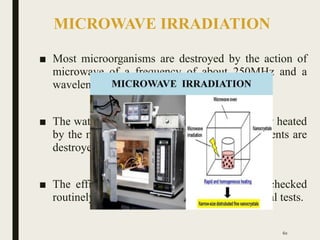
MICROWAVE IRRADIATION
■ Most microorganisms are destroyed by the action of
microwave of a frequency of about 250MHz and a
wavelength of 12.24nm.
■ The water contained within the waste is rapidly heated
by the microwaves and the infectious components are
destroyed by heat conduction.
■ The efficiency of the microwave should be checked
routinely through bacteriological and virological tests.
60
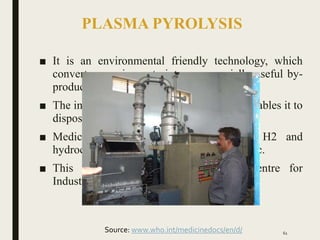
PLASMA PYROLYSIS
■ It is an environmental friendly technology, which
converts organic waste into commercially useful by-
product.
■ The intense heat generated by the plasma enables it to
dispose all types of waste.
■ Medical waste is pyrolyzed into CO, H2 and
hydrocarbons when it comes with plasma-arc.
■ This was developed by Facilitation Centre for
Industrial Plasma Technology, Gujrat.
61
Source: www.who.int/medicinedocs/en/d/
LAND DISPOSAL
■ If a municipality or medical authority genuinely lacks the
means to treat wastes before disposal, the use of a landfill
has to be regarded as an acceptable disposal route.
■ There are two distinct types of waste disposal-Open
dumping &Sanitary landfill.
■ Sanitary landfills are designed to have atleast four
advantages over open dumps:
 Geological isolation of waste from environment
 Appropriate engineering preparation before the site is ready
to accept waste
 Staff present on site to control operations
 Organized deposit and daily coverage of waste.
62
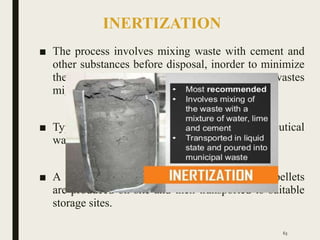
INERTIZATION
■ The process involves mixing waste with cement and
other substances before disposal, inorder to minimize
the risk of toxic substances contained in the wastes
migrating into the surface water or ground water.
■ Typical proportion of mixture: 65% pharmaceutical
waste, 15% lime, 15% cement and 5% water.
■ A homogenous mass is formed and cubes or pellets
are produced on site and then transported to suitable
storage sites.
63
ENCAPSULATION
■ Encapsulation involves immobilizing the
pharmaceuticals in a solid block within a plastic or
steel drum.
■ They are filled to 75% capacity with solid and semi-
solid pharmaceuticals, and the remaining space is
filled with by pouring in a medium such as cement, or
cement/lime mixture, plastic foam or bituminous sand.
■ The sealed drums should be placed at the base of a
landfill and covered with fresh municipal solid wastes.
64
Source: www.who.int/medicinedocs/en/d/
MANAGEMENT OF
DENTAL WASTES
65
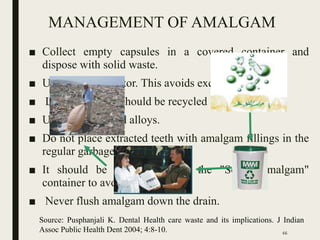
MANAGEMENT OF AMALGAM
■ Collect empty capsules in a covered container and
dispose with solid waste.
■ Use of amalgamator. This avoids excess mercury.
■ Larger particles should be recycled
■ Use precapsulated alloys.
■ Do not place extracted teeth with amalgam fillings in the
regular garbage.
■ It should be disposed of in the "Scrap Amalgam"
container to avoid incineration
■ Never flush amalgam down the drain.
Source: Pusphanjali K. Dental Health care waste and its implications. J Indian
Assoc Public Health Dent 2004; 4:8-10. 66
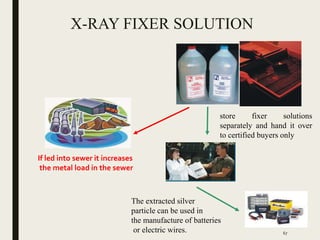
X-RAY FIXER SOLUTION
store fixer solutions
separately and hand it over
to certified buyers only
The extracted silver
particle can be used in
the manufacture of batteries
or electric wires.
If led into sewer it increases
the metal load in the sewer
67
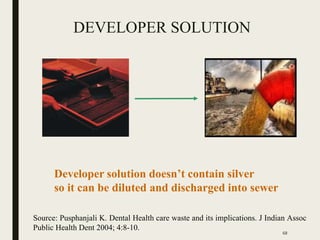
DEVELOPER SOLUTION
Developer solution doesn’t contain silver
so it can be diluted and discharged into sewer
Source: Pusphanjali K. Dental Health care waste and its implications. J Indian Assoc
Public Health Dent 2004; 4:8-10.
68
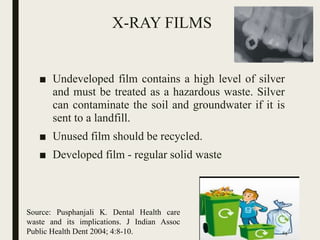
X-RAY FILMS
■ Undeveloped film contains a high level of silver
and must be treated as a hazardous waste. Silver
can contaminate the soil and groundwater if it is
sent to a landfill.
■ Unused film should be recycled.
■ Developed film - regular solid waste
Source: Pusphanjali K. Dental Health care
waste and its implications. J Indian Assoc
Public Health Dent 2004; 4:8-10. 69
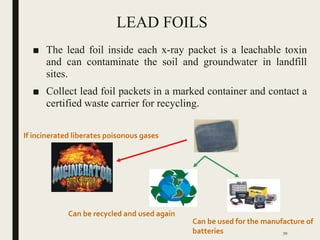
LEAD FOILS
■ The lead foil inside each x-ray packet is a leachable toxin
and can contaminate the soil and groundwater in landfill
sites.
■ Collect lead foil packets in a marked container and contact a
certified waste carrier for recycling.
If incinerated liberates poisonous gases
Can be recycled and used again
Can be used for the manufacture of
batteries 70
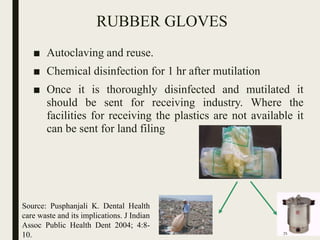
RUBBER GLOVES
■ Autoclaving and reuse.
■ Chemical disinfection for 1 hr after mutilation
■ Once it is thoroughly disinfected and mutilated it
should be sent for receiving industry. Where the
facilities for receiving the plastics are not available it
can be sent for land filing
Source: Pusphanjali K. Dental Health
care waste and its implications. J Indian
Assoc Public Health Dent 2004; 4:8-
10. 71
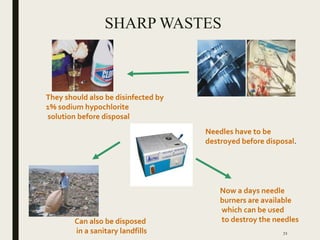
SHARP WASTES
Needles have to be
destroyed before disposal.
They should also be disinfected by
1% sodium hypochlorite
solution before disposal
Can also be disposed
in a sanitary landfills
Now a days needle
burners are available
which can be used
to destroy the needles
72
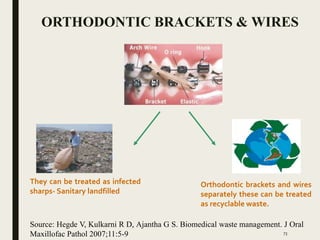
ORTHODONTIC BRACKETS & WIRES
They can be treated as infected
sharps- Sanitary landfilled
Orthodontic brackets and wires
separately these can be treated
as recyclable waste.
Source: Hegde V, Kulkarni R D, Ajantha G S. Biomedical waste management. J Oral
Maxillofac Pathol 2007;11:5-9 73
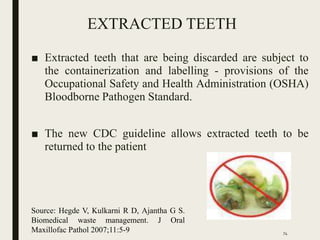
EXTRACTED TEETH
■ Extracted teeth that are being discarded are subject to
the containerization and labelling - provisions of the
Occupational Safety and Health Administration (OSHA)
Bloodborne Pathogen Standard.
■ The new CDC guideline allows extracted teeth to be
returned to the patient
Source: Hegde V, Kulkarni R D, Ajantha G S.
Biomedical waste management. J Oral
Maxillofac Pathol 2007;11:5-9 74
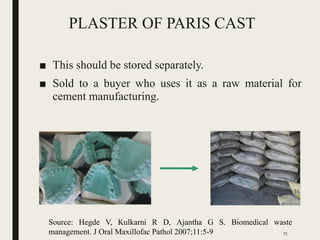
PLASTER OF PARIS CAST
■ This should be stored separately.
■ Sold to a buyer who uses it as a raw material for
cement manufacturing.
Source: Hegde V, Kulkarni R D, Ajantha G S. Biomedical waste
management. J Oral Maxillofac Pathol 2007;11:5-9 75
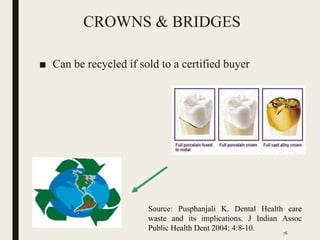
CROWNS & BRIDGES
■ Can be recycled if sold to a certified buyer
Source: Pusphanjali K. Dental Health care
waste and its implications. J Indian Assoc
Public Health Dent 2004; 4:8-10. 76
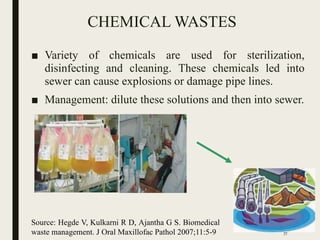
CHEMICAL WASTES
■ Variety of chemicals are used for sterilization,
disinfecting and cleaning. These chemicals led into
sewer can cause explosions or damage pipe lines.
■ Management: dilute these solutions and then into sewer.
Source: Hegde V, Kulkarni R D, Ajantha G S. Biomedical
waste management. J Oral Maxillofac Pathol 2007;11:5-9 77
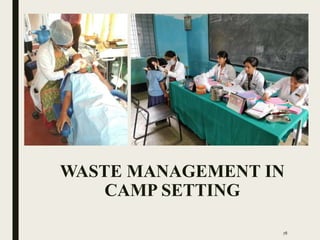
WASTE MANAGEMENT IN
CAMP SETTING
78
■ The procedures about handling of infectious sources
should be based on the universal precautions recommended
by Centers for Disease Control (CDC).
■ The centers should have containers used specifically for
disposal of sharps.
■ Infectious waste from health centre should be separated
from other health care waste.
■ Disposal towels and tissues, materials contaminated with
blood should be disposed off in a trash container lined with
plastic.
■ Liquid, semi liquid and items dripping with blood should
be placed in closable and labeled containers.
79
■ Determine if infectious waste needs to be left at a
location different from where solids waste is left.
■ Landfill the infectious waste or arrange for disposal
through the local health care community.
■ If neither are possible, storage and transportation of
waste from the camp site back to hospital should be
done with utmost care.
■ The waste can finally be disposed according to the
hospital regulations
80
Source: Singh A, Purohit B. Exercising Infection Control in Unorthodox and
Unconventional Field Settings. Advances in Life Science and its
Application.(2013);1(4);71-3
CONCLUSION
■ Proper handling, treatment and disposal of biomedical
wastes are important elements of health care office
infection control programme. Correct procedure will
help protect health care workers, patients and the local
community.
■ If properly designed and applied, waste management
can be a relatively effective and an efficient
compliance-related practice. Safe and effective
management of waste is not only a legal necessity but
also a social responsibility.
■ Lack of concern, motivation, awareness and cost
factor are some of the problems faced in the proper
hospital waste management.
81
■ Clearly there is a need for education as to the hazards
associated with improper waste disposal. An effective
communication strategy is imperative keeping in view
the low awareness level among different category of
staff in the health care establishments regarding
biomedical waste management.
■ Proper collection and segregation of biomedical waste
are important. At the same time, the quantity of waste
generated is equally important.
■ A lesser amount of biomedical waste means a lesser
burden on waste disposal work, cost-saving and a
more efficient waste disposal system. Hence, health
care providers should always try to reduce the waste
generation in day-to-day work in the clinic or at the
hospital.
82
REFERENCES
1. Park K. Park’s Textbook of Preventive and Social
Medicine. 24th ed. India: Bhanot Publishers; 2015. p.
826-29.
2. Hiremath SS. Textbook of Public Health Dentistry.
3rd ed. Elsevier Publishers; 2016. p. 51-3.
3. Datta P, Mohi GK, Chander J. Biomedical waste
management in India: Critical appraisal. J Lab
Physicians 2018;10:6-14.
4. Singhal L, Tuli AK, Gautam V. Biomedical waste
management guidelines 2016: What’s done and what
needs to be done. Indian J Med Microbiol
2017;35:194-8.
83
REFERENCES
5. Govt. of India (2016). Ministry of Environment,
Forest and Climate Change, Notification published in
the Gazatte of India, Bio-Medical Wste Management
Rule 2016.
6. Govan P. Waste management in dental practice. SADJ
2014;69(4):178-81.
7. Amin R, Gul R, Mehrab A. Hospital waste
management; practices in different hospitals of Distt.
Peshawar. Professional Med J 2013;20(6): 988-994.
8. Hegde V, Kulkarni R D, Ajantha G S. Biomedical
waste management. J Oral Maxillofac Pathol
2007;11:5-9
84
REFERENCES
9. Pusphanjali K. Dental Health care waste and its
implications. J Indian Assoc Public Health Dent 2004;
4:8-10.
10. Pruss, A., Giroult, E., and Rushbrook P. et. al; " Safe
Management of Wastes from Health-Care activities",
World Health Organisation, Geneva, 1999.
11. http://www.searo.who.int/linkfiles/publications and
documents HW Amex.9.pdf(accessed on 6/09/18)
12. www.osha.gov. Accessed on 06/09/18
13. Singh A, Purohit B. Exercising Infection Control in
Unorthodox and Unconventional Field Settings. Advances
in Life Science and its Application.(2013);1(4);71-3
85
REFERENCES
14. Manasi S , Umamani KS, Latha N. Biomedical Waste
Management: Issues and Concerns - A Ward Level
Study of Bangalore City. Available at
http://www.isec.ac.in/WP%20312%20-
%20Manasi,%20Umamani%20and%20Latha_Final.pdf
Accessed on 09/09/18
15. Babu BR, Parande AK, Rajalakshmi R, et al.
Management of Biomedical Waste in India and Other
Countries: A Review. J. Int. Environmental Application
& Science. 2009;4(1):65-78
86
87

Biomedical waste management

  • 1.
    PRESENTATION BY: DR.RADHIKA MITRA POST-GRADUATION STUDENT BATCH: 2017-2020 DEPT. OF PUBLIC HEALTH DENTISTRY MANAGEMENT 1
  • 2.
    PRESENTATION BY: DR.RADHIKA MITRA POST-GRADUATION STUDENT BATCH: 2017-2020 DEPT. OF PUBLIC HEALTH DENTISTRY MANAGEMENT 2
  • 3.
    CONTENTS ■ Introduction ■ Classification ■Sources Of Health Care Waste ■ Composition Of Health Care Waste ■ Rationale Of Waste Disposal ■ Health Hazards Of Health Care Waste ■ Categories Of Waste Generated In Dental setup 3
  • 4.
    CONTENTS ■ Amendments ■ StepsIn Waste Disposal ■ Treatment And Disposal Technique For Dental Health- care Waste ■ Method Needed To Be Adapted For Proper Management Of The Health Care Waste In A Dental Camp/Clinical Setting ■ Conclusion ■ References 4
  • 5.
    INTRODUCTION ■ Hospitals haveexisted in one form or the other since time immemorial. But there never has been so much concern about the waste generated by them. With the increase in number of hospitals there has been increase in quantum of waste generated. ■ Discovery of nosocomial infection, rising incidence of hepatitis B and HIV, increasing land and water pollution has lead to increase in possibility of many diseases. Air pollution due to emission of hazardous gases by incinerator such as furans, dioxins, etc. has compelled the authorities to think seriously about hospital wastes. 5
  • 6.
    INTRODUCTION ■ Ultimately, Ministryof Environment and Forests, Government of India passed an act on biomedical waste (management and handling) rule, 1998 which came into force on 27th July, 1998. ■ This rule applies to all those who generate, collect, receive, store, dispose, treat or handle biomedical waste in any manner. ■ As per this rule any person who generates waste needs to apply for consent to respective state pollution control boards for generating and appropriate management. 6
  • 7.
    INTRODUCTION ■ A dentalhospital is a complex multidisciplinary system which consumes lots of items for delivery of dental care. Since last few years there has been a rapid mushrooming of dental hospitals to meet the demand for care which has increased the quantity of dental health care waste. ■ Though the quantity from each establishment may not be as much as in the general hospital, the collective quality and quantity is certainly significant. The advent and acceptance of disposables has contributed to this issue and made hospital waste a significant factor in today’s health care establishment. 7
  • 8.
    INTRODUCTION ■ Waste managementpractices can be broadly classified into two main types: 1. Medical health care waste/Dental health care waste management 2. Residential waste management 8
  • 9.
    Source: Park K.Park’s Textbook of Preventive and Social Medicine. 24th ed. India: Bhanot Publishers; 2015. 9
  • 10.
    CLASSIFICATION ■ WHO classification: 1.INFECTIOUS WASTE – Waste suspected to contain pathogens e.g.- laboratory cultures; waste from isolation wards; tissues, materials, or equipments that have been in contact with infected patients; excreta 2. PATHOLOGICAL WASTE – Human tissues or fluids e.g.- body parts; blood and other body fluids. 3. SHARPS – Sharp waste e.g.- needles; infusion sets; scalpels; knives; blades; broken glass. 10
  • 11.
    4. PHARMACEUTICAL WASTE– Waste containing pharmaceuticals eg- pharmaceuticals that are expired or no longer needed; items contaminated by or containing pharmaceuticals. 5. GENOTOXIC WASTE – Waste containing substances with genotoxic properties e.g.- waste containing cytostatic drugs; genotoxic chemicals. 6. CHEMICAL WASTE - Waste containing chemical substances eg – laboratory reagents; film developers; disinfectants that are no longer needed; solvents. 7. WASTES WITH HIGH CONTENT OF HEAVY METALS – Batteries; broken thermometers; blood pressure gauges. Source: Park K. Park’s Textbook of Preventive and Social Medicine. 24th ed. India: Bhanot Publishers; 2015. 11
  • 12.
    8. PRESSURIZED CONTAINERS– Gas cylinders; gas cartridges. 9. RADIOACTIVE WASTE – Waste containing radioactive substances e.g.- unused liquids from radiotherapy or laboratory research; contaminated glassware; packages or absorbent paper; urine and excreta from patients treated or tested with unsealed radionuclides 12
  • 13.
    ■ Hospital wasteclassification (Gerig 1993) I. Biohazardous waste 1. Corpses and parts of human body 2. Waste impregnated with blood 3. Wound dressings and casts of plaster 4. Dialytic waste 5. Waste from isolation wards, laboratories, excreta 6. Radioactive waste 13 Source: Govt. of India (2016). Ministry of Environment, Forest and Climate Change, Notification published in the Gazatte of India, Bio-Medical Waste Management Rule 2016.
  • 14.
    7. Chemical wastefrom laboratories 8. Disposable materials like IV sets, syringes 9. Waste from stores 10. Sharp objects like glass, cans etc. II. Non Biohazardous waste 1. Dry household waste e.g.- floor refuse like dust, paper trash 2. Wet garbage from kitchen and pantry 14
  • 15.
    DEFINITION ■ According toBio-medical waste (Management and Handling) Rules, 1998 of India, “Bio- medical waste” means any waste, which is generated during the diagnosis, treatment or immunization of human beings or animals or in research activities pertaining there to or in the production or testing of biological research. Source: Park K. Park’s Textbook of Preventive and Social Medicine. 24th ed. India: Bhanot Publishers; 2015. 15
  • 16.
    SOURCES OF HEALTHCARE WASTE ■ The institutions involved in generation of bio-medical waste are: • Government hospitals • Private hospitals • Nursing homes • Physicians offices/ clinics • Dentists office /clinics • Dispensaries • Primary health care centers • Medical research and training establishments 16
  • 17.
    • Mortuaries • Bloodbanks and collection centers • Animal houses • Slaughter houses • Laboratories • Research organizations • Vaccination centers • Bio- technology institutions/ production units All these health care establishments generate waste and are therefore covered under Bio-medical waste rules. 17
  • 18.
    COMPOSITION OF HOSPITAL WASTE ■The amount of waste generated per bed varies with the type of hospital, however, on an average, 1-5kg of waste per bed per day is generated. The type of waste generated is. a) Non Hazardous – 85% b) Hazardous – 15% Hazardous but not infective 5% Hazardous but infective 10% 18
  • 19.
    Waste generation dependson numerous factors such as ■ Established waste management methods ■ Type of health care establishments ■ Hospital specializations ■ Proportion of reusable items employed in health care ■ Proportion of patients treated on a day care basis. 19
  • 20.
    ■ Developing countriesthat have not performed their own surveys of health-care waste, find the following estimates for an average distribution of health-care wastes useful for preliminary planning of waste management:  80% general health care waste- normal domestic and urban waste management system.  15% pathological and infectious waste  1% sharp waste  3% chemical and pharmacological waste  Less than 1% special waste-radioactive or cytotoxic waste, pressurized containers, or broken thermometers and used batteries 20
  • 21.
    RATIONALE FOR WASTE DISPOSAL ■To prevent Nosocomial infection or Hospital acquired infection ■ To protect Health care providers ■ To prevent risk to general population (when hospital waste is thrown in open area without proper treatment, it is hazardous) ■ To protect environment 22 Source: Hiremath SS. Textbook of Public Health Dentistry. 3rd ed. Elsevier
  • 22.
    HEALTH HAZARDS OFHEALTH CARE WASTE ■ Exposure to hazardous health care waste can result in disease or injury due to one or more of the following characteristics o It contains infectious agents o It contains toxic or hazardous chemical or pharmaceuticals o It contains sharps o It is genotoxic and o It is radioactive 23
  • 23.
    The main groupat risk are: ■ Medical doctors/Dental doctors, nurses, health care auxiliaries, and hospital maintenance personnel’s. ■ Patients in health care establishments ■ Visitors to health care establishments ■ Workers in support service allied to health care establishments such as laundries, waste handling and transporting ■ Workers in waste disposal facilities such as land fills or incinerators including scavengers ■ There are chance of environmental pollution as result of improper handling and management of such waste. 24
  • 24.
    Hazards from infectiouswaste and sharps ■ Pathogens in infectious waste may enter the human body through a puncture, abrasion or cut in the skin, through mucous membranes by inhalation or by ingestion. ■ Infection with HIV and hepatitis virus B and C- strong evidence of transmission via health-care waste ■ Bacterias resistant to antibiotics and chemical disinfectants, may also contribute to hazards created by poorly managed wastes. 25
  • 25.
    Hazards from chemicaland pharmaceutical waste ■ Chemicals & Pharmaceuticals used in health-care establishments are toxic, genotoxic, corrosive, flammable, reactive, explosive or shock-sensitive. ■ Causes- intoxication, either by acute or chronic exposure, and injuries, including burns. ■ Disinfectants are important in this group. They are used in large quantities. 26
  • 26.
    Hazards from genotoxicwaste ■ Severity of the hazards for health-care workers responsible for handling or disposal of genotoxic waste is governed by a combination of the substance toxicity itself and the extent and duration of exposure. ■ Exposure may occur during the preparation of or treatment with particular drug or chemical. ■ The main pathway of exposure- inhalation of dust or aerosols, absorption through the skin, ingestion of food accidentally contaminated with cytotoxic drugs, chemicals or wastes etc. 27
  • 27.
    Hazards from radioactivewaste ■ The type of disease caused by radio-active waste is determined by the type and extent of exposure. ■ It can range from headache, dizziness and vomiting to much more serious problems. ■ It may also affect genetic material. 28
  • 28.
    Public sensitivity ■ Apartfrom health hazards, the general public is very sensitive to visual impact of health-care waste particularly anatomical waste. 29
  • 29.
    CATEGORIES OF WASTE GENERATEDIN A DENTAL SET-UP 30
  • 30.
    Source: Hegde V,Kulkarni R D, Ajantha G S. Biomedical waste management. J Oral Maxillofac Pathol 2007;11:5-9 31
  • 31.
    Dental Waste Infectious &Potentially InfectiousWaste Non-InfectiousWaste DomesticWaste Amalgam Waste Infectious Waste with metals Infectious Waste without metals Amalgam & amalgam capsules Sharps Non- Sharps Needle syringes Dental tools Partial Dentures Bridges Saliva Ejectors Gloves Wax Anesthetic Catridges Silicones-acrylic Alginate Extracted teeth Blood contaminated cotton and gauze Gypsum Lead shields X-ray films, developer Fixer solution Food wastes Newspapers Magazines Envelops Household products 32 Source: Hegde V, Kulkarni R D, Ajantha G S. Biomedical waste management. J Oral Maxillofac Pathol 2007;11:5-9
  • 32.
  • 33.
    OSHA ■ Healthcare workersare occupationally exposed to a variety of infectious diseases during the performance of their duties. Several OSHA standards are directly applicable to protecting them against transmission of infectious agents. ■ These include OSHA’s-  Bloodborne Pathogens Standard,  Personal Protective Equipment Standard  Respiratory Protection Standard. Source: www.osha.gov. Accessed on 05/09/18 34
  • 34.
    Center for DiseaseControl & Prevention (CDC) ■ The Center for Disease Control and Prevention (CDC) and American Dental Association guidelines/recommendations contain important valuable information. ■ CDC has recommendations for handling infected sharps it recommends that sharp containers to be located as close as is practical to the work area. This means that each operatory should have at least one sharps container. ■ The CDC indicates that one should pour blood, suctioned fluids, or other liquid waste carefully into a drain connected to a sanitary sewer system 35
  • 35.
    The Environment (Protection)Act, 1996 ■ The Ministry of Environment and Forest, Government of India issued a notification under the Environment protection Act in July 1996 ■ To provide for the protection and improvement of environment and prevention of hazards to human beings, other living creatures, plants and property. ■ It says:- – Punishable for imprisonment which may extend upto 5 years. – Fine of 1 lakh or both may be applied – Appeal against punishment– within 30 days. Source: Datta P, Mohi GK, Chander J. Biomedical waste management in India: Critical appraisal. J Lab Physicians 2018;10:6-14. 36
  • 36.
    Bio-medical Waste ManagementIn India ■ Bio-Medical waste(Management and Handling) Rules 1998, prescribed by the Ministry of Environment and Forests, Government of India, came into force on 28th July 1998. ■ This rule applies to those who generate, collect, receive, store, dispose, treat or handle bio-medical waste in any manner. ■ The Act is now superceded by Bio-Medical Waste Management Rules, 2016, which came into force from 28th March, 2016. Source: Datta P, Mohi GK, Chander J. Biomedical waste management in India: Critical appraisal. J Lab Physicians 2018;10:6-14. 37
  • 37.
    The table showsthe categories of bio-medical waste, types of waste and treatment and disposal options under Rule 2016 38
  • 38.
  • 39.
    Major Differences BetweenBMW Rules 1998 & 2011 40
  • 40.
    Major Differences BetweenBMW Rules 1998 & 2016 41 Source: Singhal L, Tuli AK, Gautam V. Biomedical waste management guidelines 2016: What’s done and what needs to be done. Indian J Med Microbiol 2017;35:194-8.
  • 41.
    Steps in WasteManagement 1. Segregation 2. Decontamination 3. Deformation 4. Containment 5. Disposal 42
  • 42.
    SEGREGATION ■ Separate collectionof different categories of waste reduces chances of injury and reduces the quantity of hazardous waste. ■ The key to minimization and effective management of health care waste is segregation (separation) ■ Segregation should always be the responsibility of the waste producer, should take place as close as possible to when the waste is generated and should be so maintained in storage areas and during transport. ■ The most appropriate way of identifying the categories of health care waste is by sorting the waste into colour- coded plastic bags / containers. 43
  • 43.
  • 44.
  • 45.
  • 46.
    DECONTAMINATION ■ Disinfection reduceschances of infection. ■ Disinfectant solution can be prepared by dissolving one full scoop of bleaching powder in 1 L of water. ■ Commercially available disinfectants can also be used. 47
  • 47.
    DEFORMATION ■ Prevents reuseand remarketing of the syringes, needles and gloves. ■ Use of needle cutter or burner is recommended. 48
  • 48.
    CONTAINMENT ■ Some ofthe health care waste cannot be disposed off on a daily basis. Hence, they need to be contained safely until disposal. ■ Syringes, plaster of paris casts, condemned instruments, mercury, lead-foil, fixer solution, needs to be contained in appropriate containers. ■ Use a heavy duty puncture proof narrow mouthed plastic container to collect the waste sharps. ■ A narrow mouthed container facilitates collection, minimizes/obstructs unnecessary handling and removal. 49
  • 49.
    STORAGE ■ A storagelocation for health care waste should be designated inside the health care establishment or research facility. ■ The waste in bags or containers, should be stored in a separate area, room or building of a size appropriate to the quantities of waste produced. ■ Unless a refrigerated storage rooms is available, storage times for health care waste should not exceed the following ; 1. Temperate climate : 72 hrs in winter 2. Winter climate : 48 hrs during cold season 3. Warm climate : 24 hrs in hot climate. 50
  • 50.
    Recommendations of storagefacilities for health care waste are : ■ The storage area should have an impermeable, hard standing floor (with good training) it should be easy to clean and disinfect. ■ There should be a water supply for cleaning purposes. ■ The storage areas should afford easy access for staff in charge of handling the waste. ■ It should be possible to lock the store to prevent access by unauthorized persons. ■ Easy access for waste collections vehicles is essential. ■ There should be protection from the sun. ■ The storage area should be inaccessible to animals, insects and birds. ■ The storage area should not be situated in the proximity of fresh food stores or food preparation areas. 51
  • 51.
    LABELLING ■ All wastebags or containers should be labelled with basic information of their content and on the waste producer. ■ It is also recommended that the 2 digits of the year of manufacture of the packing specified on the package, as well as special code designating the type of packaging. - Waste category - Date of collection - Place in hospital where produced. - Waste destination 52
  • 52.
    TRANSPORTATION ■ Transportation ofmedical waste within the medical institution can be done by small trolleys or carts. ■ Transportation from the point to the onsite by specialized trucks marked with symbols denoting the type of waste carried. 53
  • 53.
    Treatment & Disposaltechnologies for health- care waste Disposal Incineration Chemical Disinfection Thermal Treatment Microwave Irradiation Plasma Pyrolysis Land Disposal Inertization Encapsulation 54
  • 54.
    INCINERATION ■ Incineration isa high temperature dry oxidation process, that reduces organic and combustible waste to inorganic incombustible matter and results in a very significant reduction of waste-volume and weight. ■ The process is usually selected to treat wastes that cannot be recycled, reused or disposed off in a land fill site. ■ Requires no pre-treatment 55
  • 55.
    Characteristics of thewaste suitable for incineration ■ Low heating volume – above 2000 kcal/ kg for single chamber incinerators and above 3500 kcal/kg for pryolytic double chamber incinerators. ■ Content of combustible matter above 60% ■ Content of noncombustible solids below 5% ■ Content of noncombustible fumes below 20% ■ Moisture content below 30% 56
  • 56.
    Waste type notto be incinerated ■ Pressurized gas containers ■ Large amounts of reactive chemical waste ■ Silver salts and photographic or radiographic wastes (x- ray films) ■ Halogenated plastic and rubber disposables used in the hospitals. ■ Waste with high mercury or cadmium content such as broken thermometers & used batteries ■ Sealed ampules or ampules containing heavy metals 57
  • 57.
    THERMAL TREATMENT ■ WETTHERMAL TREATMENT Also, known as steam disinfection is based on exposure of infectious waste to high-temperature, highpressure steam, and is similar to the autoclave sterilization process. Inappropriate for- anatomical waste and animal caracasses Does not efficiently treat chemical and pharmaceutical waste. ■ SCREW-FEED TECHNOLOGY It is the basis of a non-burn, dry thermal disinfection process, in which waste is shredded and heated in a rotating auger. Waste is reduced by 80% in volume & 20-35% in weight Suitable- infectious waste and sharps. 58
  • 58.
    CHEMICAL DISINFECTION ■ Chemicalsare added to waste to kill or inactivate the pathogens it contains, this treatment usually results in disinfection rather than sterilization. ■ Chemical disinfection is most suitable for treating liquid waste such as blood, urine, stools, or hospital sewage. ■ However, solid wastes including microbiological cultures, sharps, etc may also be disinfected chemically with certain limitations. ■ Formaldehyde, Glutaraldehyde, Sodium hypochlorite. 59
  • 59.
    MICROWAVE IRRADIATION ■ Mostmicroorganisms are destroyed by the action of microwave of a frequency of about 250MHz and a wavelength of 12.24nm. ■ The water contained within the waste is rapidly heated by the microwaves and the infectious components are destroyed by heat conduction. ■ The efficiency of the microwave should be checked routinely through bacteriological and virological tests. 60
  • 60.
    PLASMA PYROLYSIS ■ Itis an environmental friendly technology, which converts organic waste into commercially useful by- product. ■ The intense heat generated by the plasma enables it to dispose all types of waste. ■ Medical waste is pyrolyzed into CO, H2 and hydrocarbons when it comes with plasma-arc. ■ This was developed by Facilitation Centre for Industrial Plasma Technology, Gujrat. 61 Source: www.who.int/medicinedocs/en/d/
  • 61.
    LAND DISPOSAL ■ Ifa municipality or medical authority genuinely lacks the means to treat wastes before disposal, the use of a landfill has to be regarded as an acceptable disposal route. ■ There are two distinct types of waste disposal-Open dumping &Sanitary landfill. ■ Sanitary landfills are designed to have atleast four advantages over open dumps:  Geological isolation of waste from environment  Appropriate engineering preparation before the site is ready to accept waste  Staff present on site to control operations  Organized deposit and daily coverage of waste. 62
  • 62.
    INERTIZATION ■ The processinvolves mixing waste with cement and other substances before disposal, inorder to minimize the risk of toxic substances contained in the wastes migrating into the surface water or ground water. ■ Typical proportion of mixture: 65% pharmaceutical waste, 15% lime, 15% cement and 5% water. ■ A homogenous mass is formed and cubes or pellets are produced on site and then transported to suitable storage sites. 63
  • 63.
    ENCAPSULATION ■ Encapsulation involvesimmobilizing the pharmaceuticals in a solid block within a plastic or steel drum. ■ They are filled to 75% capacity with solid and semi- solid pharmaceuticals, and the remaining space is filled with by pouring in a medium such as cement, or cement/lime mixture, plastic foam or bituminous sand. ■ The sealed drums should be placed at the base of a landfill and covered with fresh municipal solid wastes. 64 Source: www.who.int/medicinedocs/en/d/
  • 64.
  • 65.
    MANAGEMENT OF AMALGAM ■Collect empty capsules in a covered container and dispose with solid waste. ■ Use of amalgamator. This avoids excess mercury. ■ Larger particles should be recycled ■ Use precapsulated alloys. ■ Do not place extracted teeth with amalgam fillings in the regular garbage. ■ It should be disposed of in the "Scrap Amalgam" container to avoid incineration ■ Never flush amalgam down the drain. Source: Pusphanjali K. Dental Health care waste and its implications. J Indian Assoc Public Health Dent 2004; 4:8-10. 66
  • 66.
    X-RAY FIXER SOLUTION storefixer solutions separately and hand it over to certified buyers only The extracted silver particle can be used in the manufacture of batteries or electric wires. If led into sewer it increases the metal load in the sewer 67
  • 67.
    DEVELOPER SOLUTION Developer solutiondoesn’t contain silver so it can be diluted and discharged into sewer Source: Pusphanjali K. Dental Health care waste and its implications. J Indian Assoc Public Health Dent 2004; 4:8-10. 68
  • 68.
    X-RAY FILMS ■ Undevelopedfilm contains a high level of silver and must be treated as a hazardous waste. Silver can contaminate the soil and groundwater if it is sent to a landfill. ■ Unused film should be recycled. ■ Developed film - regular solid waste Source: Pusphanjali K. Dental Health care waste and its implications. J Indian Assoc Public Health Dent 2004; 4:8-10. 69
  • 69.
    LEAD FOILS ■ Thelead foil inside each x-ray packet is a leachable toxin and can contaminate the soil and groundwater in landfill sites. ■ Collect lead foil packets in a marked container and contact a certified waste carrier for recycling. If incinerated liberates poisonous gases Can be recycled and used again Can be used for the manufacture of batteries 70
  • 70.
    RUBBER GLOVES ■ Autoclavingand reuse. ■ Chemical disinfection for 1 hr after mutilation ■ Once it is thoroughly disinfected and mutilated it should be sent for receiving industry. Where the facilities for receiving the plastics are not available it can be sent for land filing Source: Pusphanjali K. Dental Health care waste and its implications. J Indian Assoc Public Health Dent 2004; 4:8- 10. 71
  • 71.
    SHARP WASTES Needles haveto be destroyed before disposal. They should also be disinfected by 1% sodium hypochlorite solution before disposal Can also be disposed in a sanitary landfills Now a days needle burners are available which can be used to destroy the needles 72
  • 72.
    ORTHODONTIC BRACKETS &WIRES They can be treated as infected sharps- Sanitary landfilled Orthodontic brackets and wires separately these can be treated as recyclable waste. Source: Hegde V, Kulkarni R D, Ajantha G S. Biomedical waste management. J Oral Maxillofac Pathol 2007;11:5-9 73
  • 73.
    EXTRACTED TEETH ■ Extractedteeth that are being discarded are subject to the containerization and labelling - provisions of the Occupational Safety and Health Administration (OSHA) Bloodborne Pathogen Standard. ■ The new CDC guideline allows extracted teeth to be returned to the patient Source: Hegde V, Kulkarni R D, Ajantha G S. Biomedical waste management. J Oral Maxillofac Pathol 2007;11:5-9 74
  • 74.
    PLASTER OF PARISCAST ■ This should be stored separately. ■ Sold to a buyer who uses it as a raw material for cement manufacturing. Source: Hegde V, Kulkarni R D, Ajantha G S. Biomedical waste management. J Oral Maxillofac Pathol 2007;11:5-9 75
  • 75.
    CROWNS & BRIDGES ■Can be recycled if sold to a certified buyer Source: Pusphanjali K. Dental Health care waste and its implications. J Indian Assoc Public Health Dent 2004; 4:8-10. 76
  • 76.
    CHEMICAL WASTES ■ Varietyof chemicals are used for sterilization, disinfecting and cleaning. These chemicals led into sewer can cause explosions or damage pipe lines. ■ Management: dilute these solutions and then into sewer. Source: Hegde V, Kulkarni R D, Ajantha G S. Biomedical waste management. J Oral Maxillofac Pathol 2007;11:5-9 77
  • 77.
  • 78.
    ■ The proceduresabout handling of infectious sources should be based on the universal precautions recommended by Centers for Disease Control (CDC). ■ The centers should have containers used specifically for disposal of sharps. ■ Infectious waste from health centre should be separated from other health care waste. ■ Disposal towels and tissues, materials contaminated with blood should be disposed off in a trash container lined with plastic. ■ Liquid, semi liquid and items dripping with blood should be placed in closable and labeled containers. 79
  • 79.
    ■ Determine ifinfectious waste needs to be left at a location different from where solids waste is left. ■ Landfill the infectious waste or arrange for disposal through the local health care community. ■ If neither are possible, storage and transportation of waste from the camp site back to hospital should be done with utmost care. ■ The waste can finally be disposed according to the hospital regulations 80 Source: Singh A, Purohit B. Exercising Infection Control in Unorthodox and Unconventional Field Settings. Advances in Life Science and its Application.(2013);1(4);71-3
  • 80.
    CONCLUSION ■ Proper handling,treatment and disposal of biomedical wastes are important elements of health care office infection control programme. Correct procedure will help protect health care workers, patients and the local community. ■ If properly designed and applied, waste management can be a relatively effective and an efficient compliance-related practice. Safe and effective management of waste is not only a legal necessity but also a social responsibility. ■ Lack of concern, motivation, awareness and cost factor are some of the problems faced in the proper hospital waste management. 81
  • 81.
    ■ Clearly thereis a need for education as to the hazards associated with improper waste disposal. An effective communication strategy is imperative keeping in view the low awareness level among different category of staff in the health care establishments regarding biomedical waste management. ■ Proper collection and segregation of biomedical waste are important. At the same time, the quantity of waste generated is equally important. ■ A lesser amount of biomedical waste means a lesser burden on waste disposal work, cost-saving and a more efficient waste disposal system. Hence, health care providers should always try to reduce the waste generation in day-to-day work in the clinic or at the hospital. 82
  • 82.
    REFERENCES 1. Park K.Park’s Textbook of Preventive and Social Medicine. 24th ed. India: Bhanot Publishers; 2015. p. 826-29. 2. Hiremath SS. Textbook of Public Health Dentistry. 3rd ed. Elsevier Publishers; 2016. p. 51-3. 3. Datta P, Mohi GK, Chander J. Biomedical waste management in India: Critical appraisal. J Lab Physicians 2018;10:6-14. 4. Singhal L, Tuli AK, Gautam V. Biomedical waste management guidelines 2016: What’s done and what needs to be done. Indian J Med Microbiol 2017;35:194-8. 83
  • 83.
    REFERENCES 5. Govt. ofIndia (2016). Ministry of Environment, Forest and Climate Change, Notification published in the Gazatte of India, Bio-Medical Wste Management Rule 2016. 6. Govan P. Waste management in dental practice. SADJ 2014;69(4):178-81. 7. Amin R, Gul R, Mehrab A. Hospital waste management; practices in different hospitals of Distt. Peshawar. Professional Med J 2013;20(6): 988-994. 8. Hegde V, Kulkarni R D, Ajantha G S. Biomedical waste management. J Oral Maxillofac Pathol 2007;11:5-9 84
  • 84.
    REFERENCES 9. Pusphanjali K.Dental Health care waste and its implications. J Indian Assoc Public Health Dent 2004; 4:8-10. 10. Pruss, A., Giroult, E., and Rushbrook P. et. al; " Safe Management of Wastes from Health-Care activities", World Health Organisation, Geneva, 1999. 11. http://www.searo.who.int/linkfiles/publications and documents HW Amex.9.pdf(accessed on 6/09/18) 12. www.osha.gov. Accessed on 06/09/18 13. Singh A, Purohit B. Exercising Infection Control in Unorthodox and Unconventional Field Settings. Advances in Life Science and its Application.(2013);1(4);71-3 85
  • 85.
    REFERENCES 14. Manasi S, Umamani KS, Latha N. Biomedical Waste Management: Issues and Concerns - A Ward Level Study of Bangalore City. Available at http://www.isec.ac.in/WP%20312%20- %20Manasi,%20Umamani%20and%20Latha_Final.pdf Accessed on 09/09/18 15. Babu BR, Parande AK, Rajalakshmi R, et al. Management of Biomedical Waste in India and Other Countries: A Review. J. Int. Environmental Application & Science. 2009;4(1):65-78 86
  • 86.

Editor's Notes

  • #6 It is ironical that the every hospital that brings relief to the sick can create health hazard due to improper management of waste generated by it. Its implications are on public, health care personnel and environment at large.
  • #7 Failing to do so, he or she will be liable for penalty which amounts to rs. 1lac/ and/or 5 yrs of imprisonment. The rule has been amended on 6th March 2000, 2nd June 2000, 17th September 2003.
  • #8 Appropriate management of health-care waste is thus a crucial component of environmental health protection, and it should become an itegral feature of health-cae services.
  • #12 Genotoxic- derives from drugs used in oncology or radiotherapy.
  • #21 which may be dealt with by the
  • #27 (Often corrosive, reactive chemicals may form highly toxic secondary compounds.) Formaldehyde- potentially carcinogenic, Glutaraldehyde- skin irritation, mucous membrane irritation and multiple pulmonary symptoms such as occupational asthma, allergic rhinitis
  • #35 With Occupational Safety and Health Act of 1970, OSHA was created by the congress to assure safe and healthful working conditions. It is an agency of United States Dept. of Labour. That prescribes safeguards to protect workers against health hazards caused by bloodborne pathogens. That requires the employers to protect their employees from workplace hazards that can cause injury. Ppe- equipment worn to minimise exposure to variety of hazards. For control of those diseases that are caused by breathing air contaminated with dust, gases, aerosols smokes, etc.
  • #36 provided that local sewer discharge requirements are met and that the state has declared this is to be an acceptable method of disposal One must wear appropriate personal protective equipment while performing this task. The new CDC guidelines allows extracted teeth to be returned to the patient.
  • #38 The BMW 1998 rules were modified in the following years – 2000, 2003, and 2011. The draft of BMW rules 2011 remained as draft and did not get notified because of lack of consensus on categorization and standards
  • #46 Now implementing the waste management rules in our practice, pop casts, ortho braces, stainless steel crowns, expired antibiotics, contaminated gauze /linen, vaccines are yellow color coded. Disposable items, impression materials, acrylic, saline bottles, articulating paper are red color coded.
  • #48 Some disinfectants used in dental office- glutaraldehyde, glutaraldehyde with phenol, quaternary ammonium chloride, hydrogen peroxide, formaldehyde, etc.
  • #49 Deformation also known as destruction.
  • #51 Winter climate- average temp. is 10-15 degree C in northwest and 20-25 degree in southeast mainland Summer climate- 20-25 degree C
  • #53 This instructions may be written directly on the bag or container or on preprinted labels, securely attached. Labeling also warns operative staff and the general public of the hazardous nature of the waste. The hazards posed by container contents can be quickly identified in case of accident, enabling emergency services to take appropriate action.
  • #56 Provided that certain waste types are not included in the matter to be incinerated.
  • #58 Reactive chemical waster – corrosive like the acids bases, toxic containing mercury lead. Wil release toxic fumes, gases can cause explosions Mercury and cadmium- releases gases that is nephrotoxic and neurotoxic Dioxin is released from half-burnt chlorine based plastics lyk PVC
  • #59 Not used to process pathological, cytotoxic or radio-active waste.
  • #64 Reducing mobility f toxic compounds
  • #67 Amalgam should be stored under fixer solution or submerged in a soln of bleach and water in an air-tight container. Apply biohazard sticker and can be disposed in sanitary landfills.
  • #70 Exposed films: These are harmless we can treat it as general waste.
  • #71 If incinerated- affects neurological function and development
  • #75 Extracted tooth- They are considered potentially infectious. Problems involves the treatment of the teeth containing amalgam restorations. So amalgam restored teeth can be disinfected before disposal, ideally one should use a sterilizing chemical(e.g. - full strength gluteraldehyde) Exposure should be for 30 min. 2. Excised tissues, items contaminated with blood and body fluids including cotton, dressing, bedding contaminated with blood Can be either incinerated whenever applicable.