Health Services in
Egypt
Dr. Dalia El-ShafeiDr. Dalia El-Shafei
Lecturer, community medicine department,Lecturer, community medicine department,
Zagazig universityZagazig university
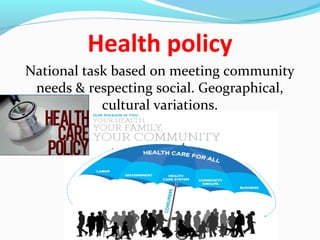
Health policy
National task based on meeting community
needs & respecting social. Geographical,
cultural variations.
Ministry of Health and
Population “MOPH”
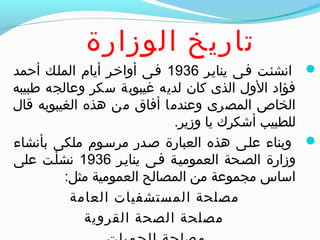
‫الوزارة‬ ‫تاريخ‬
‫ينايير‬ ‫فيى‬ ‫انشئيت‬1936‫أحمد‬ ‫المليك‬ ‫أيام‬ ‫أواخير‬ ‫فيى‬
‫طبيبه‬ ‫وعالجه‬ ‫سكر‬ ‫غيبوبة‬ ‫لديه‬ ‫كان‬ ‫الذى‬ ‫الول‬ ‫فؤاد‬
‫قال‬ ‫الغيبوبه‬ ‫هذه‬ ‫من‬ ‫أفاق‬ ‫وعندما‬ ‫المصرى‬ ‫الخاص‬
.‫وزير‬ ‫يا‬ ‫أشكرك‬ ‫للطبيب‬
‫بأنشاء‬ ‫ملكى‬ ‫مرسيوم‬ ‫صيدر‬ ‫العبارة‬ ‫هذه‬ ‫عليى‬ ‫وبناء‬
‫ينايير‬ ‫فيى‬ ‫العموميية‬ ‫الصيحة‬ ‫وزارة‬1936‫على‬ ‫نشأيت‬
:‫مثل‬ ‫العمومية‬ ‫المصالح‬ ‫من‬ ‫مجموعة‬ ‫اساس‬
‫العامة‬ ‫المستشفيات‬ ‫مصلحة‬
‫القروية‬ ‫الصحة‬ ‫مصلحة‬
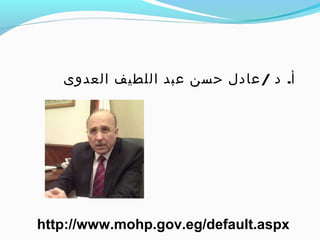
/ .‫العدوى‬ ‫اللطيف‬ ‫عبد‬ ‫حسن‬ ‫عادل‬ ‫د‬ ‫أ‬
http://www.mohp.gov.eg/default.aspx
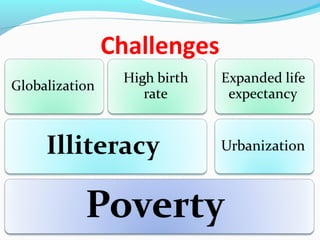
Challenges
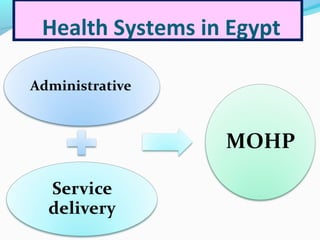
Health Systems in Egypt
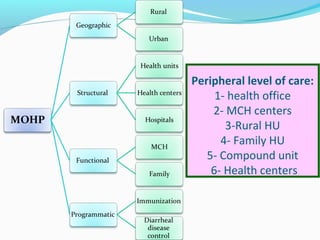
Peripheral level of care:
1- health office
2- MCH centers
3-Rural HU
4- Family HU
5- Compound unit
6- Health centers
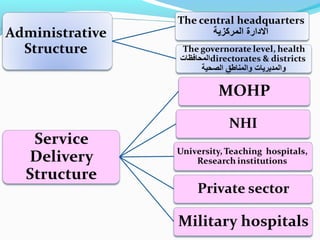
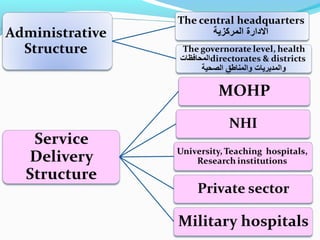
provides promotive, preventive & curative
services through 3 levels “5000 Health
facilities, 80000 beds”:
1ry: manage 80% of community health
problems.” cheap & cost effective”
2ry: in district & general hospitals that deals
with 15% of complicated cases “expensive”
3ry: Specialized hospitals “ophthalmology,
dermatology, fever hospitals” “highly
expensive”.
II) Health insurance organization: “NHI”
Covers governmental employee, students, newly
born & private sector employee “47% in 2003”
It is financed by beneficiaries & taxes.
provides mainly curative services & some
preventive, promotive services as:
1- Recording of health files
2-Screening tests (schools)
3-Micronutrient supplement (infants), growth
monitoring, vaccination and health education.
4-Inpatient and outpatient services are available.
III) University, teaching hospitals. Research
institutions (mainly Curative services).
IV) Private sector (Curative services).
V) Military hospitals serve military &public sectors
(all level of care).
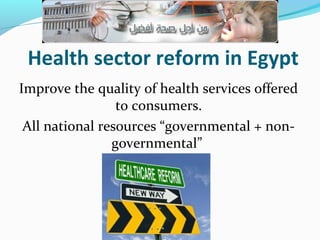
Improve the quality of health services offered
to consumers.
All national resources “governmental + non-
governmental”
Health sector reform in Egypt
objectives :
1- Provision of good quality services.
2- Complete coverage of the whole citizens by NHI.
3- Provision of holistic, comprehensive, integrated basic
benefit package BBP.
4- Up grading PHC to provide family care with increasing
the preventive role.
5- Increasing capacity of health providers through training
and new medical information.
6- Motivation of community participation in health care.
7-Decentralization of decision making. Strengthening
management systems.
8- Developing the domestic pharmaceutical industry .
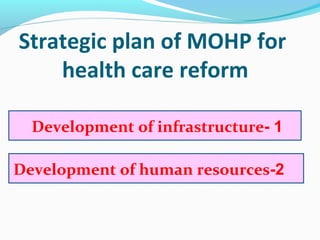
Strategic plan of MOHP for
health care reform
1-Development of infrastructure
2-Development of human resources
1-Development of infrastructure
New services to slum & deprived areas .
 Renovation of the existing units
Developing a separate system for financial needs
 Providing all equipments & materials.
Application of family medicine program
Supporting transportation & communication
network to upgrade the efficiency of referral system.
 Developing health information system from
central to peripheral levels & between public &
private health services.
2-Development of human resources
 Expansion and support of family medicine
program application “medical schools
curriculum, continuous training of physicians,
nurses and technicians”.
 Continuous training in preventive & clinical
medicine through fellowship program.
 Development of managerial capabilities of
physicians.
 Application of quality assurance system
according to fixed standards to evaluate the
performance of health team.
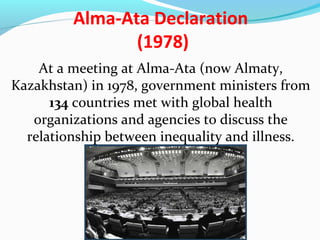
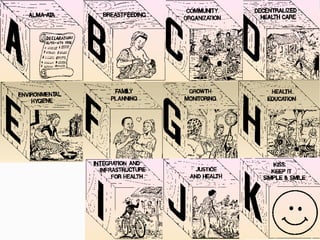
Alma-Ata Declaration
(1978)
At a meeting at Alma-Ata (now Almaty,
Kazakhstan) in 1978, government ministers from
134 countries met with global health
organizations and agencies to discuss the
relationship between inequality and illness.
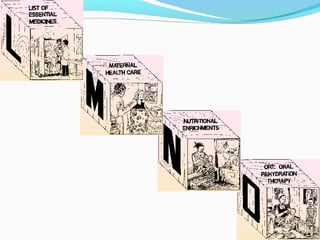
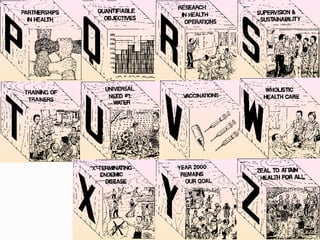
Primary Health Care from A to Z
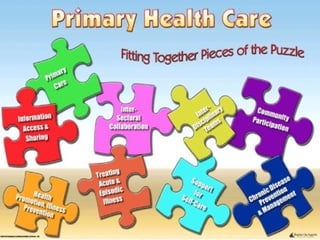
Definition of PHC:
The ESSENTIALESSENTIAL health care given to individuals and
families through their FULL PARTICIPATIONFULL PARTICIPATION and at
AFFORDABLE COST.AFFORDABLE COST.
Based on PRACTICAL, SCIENTIFIC,PRACTICAL, SCIENTIFIC, and SOCIALLYSOCIALLY
ACCEPTEDACCEPTED methods and technology.
The FIRSTFIRST contact between health sector and the
public.
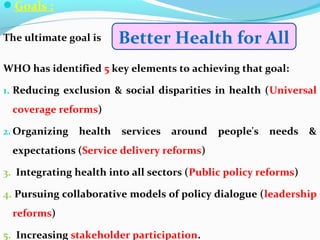
Goals :
The ultimate goal is
WHO has identified 5 key elements to achieving that goal:
1. Reducing exclusion & social disparities in health (Universal
coverage reforms)
2. Organizing health services around people's needs &
expectations (Service delivery reforms)
3. Integrating health into all sectors (Public policy reforms)
4. Pursuing collaborative models of policy dialogue (leadership
reforms)
5. Increasing stakeholder participation.
Better Health for All
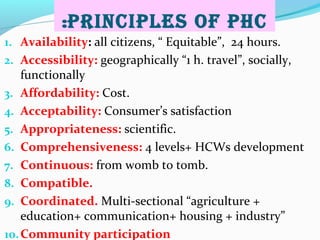
PrinCiPles of PHC:
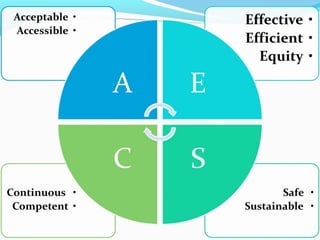
1. Availability: all citizens, “ Equitable”, 24 hours.
2. Accessibility: geographically “1 h. travel”, socially,
functionally
3. Affordability: Cost.
4. Acceptability: Consumer’s satisfaction
5. Appropriateness: scientific.
6. Comprehensiveness: 4 levels+ HCWs development
7. Continuous: from womb to tomb.
8. Compatible.
9. Coordinated. Multi-sectional “agriculture +
education+ communication+ housing + industry”
10.Community participation
PHC Approaches
GOBI-FFF
ELEMENTS
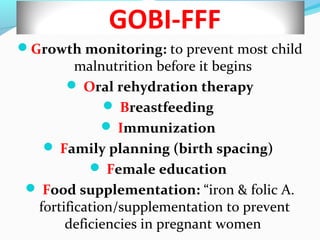
GOBI-FFF
Growth monitoring: to prevent most child
malnutrition before it begins
 Oral rehydration therapy
 Breastfeeding
 Immunization
 Family planning (birth spacing)
 Female education
 Food supplementation: “iron & folic A.
fortification/supplementation to prevent
deficiencies in pregnant women
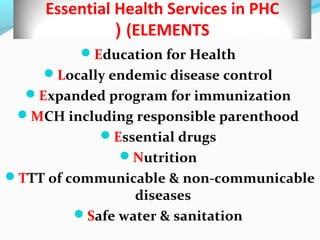
Essential Health Services in PHC
(ELEMENTS(
Education for Health
Locally endemic disease control
Expanded program for immunization
MCH including responsible parenthood
Essential drugs
Nutrition
TTT of communicable & non-communicable
diseases
Safe water & sanitation
PHC in Egypt
1942 through maternal health units &
endemic diseases units
4300 PHC units
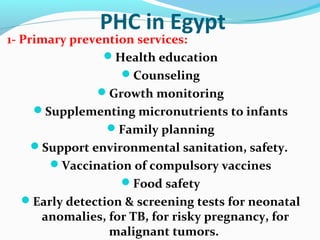
PHC in Egypt
1- Primary prevention services:
Health education
Counseling
Growth monitoring
Supplementing micronutrients to infants
Family planning
Support environmental sanitation, safety.
Vaccination of compulsory vaccines
Food safety
Early detection & screening tests for neonatal
anomalies, for TB, for risky pregnancy, for
malignant tumors.
2- Secondary prevention (Curative services):
TTT of communicable & non communicable
diseases.
 Control of epidemics & endemic diseases. .
First aid & emergency care.
Referral of needy cases to higher care level.
Provision of some drugs.
PHC mainly provides preventive services. Curative
services constitute 20% only! This concept must
be practiced & understood by all health care
providers.
Criteria of effective & successful PHC
Coordination of PHC with different related sectors as
education, social, agricultural, environmental organizations as
they share in people health.
 Community participation in PHC management, in needs
assessment, setting priorities, helping in resources and in
evaluation of activities.
Customer's satisfaction must be the ultimate & remote
objective of PHC providers, through providing quality health
care and by meeting people needs.
Health provider satisfaction by continuous education,
training, motives and promotion.
Continuous monitoring & evaluation of services by collection
& analysis of data, follow up of performance & assess output
indicators.

Health services

  • 1.
    Health Services in Egypt Dr.Dalia El-ShafeiDr. Dalia El-Shafei Lecturer, community medicine department,Lecturer, community medicine department, Zagazig universityZagazig university
  • 2.
    Health policy National taskbased on meeting community needs & respecting social. Geographical, cultural variations.
  • 3.
    Ministry of Healthand Population “MOPH”
  • 4.
    ‫الوزارة‬ ‫تاريخ‬ ‫ينايير‬ ‫فيى‬‫انشئيت‬1936‫أحمد‬ ‫المليك‬ ‫أيام‬ ‫أواخير‬ ‫فيى‬ ‫طبيبه‬ ‫وعالجه‬ ‫سكر‬ ‫غيبوبة‬ ‫لديه‬ ‫كان‬ ‫الذى‬ ‫الول‬ ‫فؤاد‬ ‫قال‬ ‫الغيبوبه‬ ‫هذه‬ ‫من‬ ‫أفاق‬ ‫وعندما‬ ‫المصرى‬ ‫الخاص‬ .‫وزير‬ ‫يا‬ ‫أشكرك‬ ‫للطبيب‬ ‫بأنشاء‬ ‫ملكى‬ ‫مرسيوم‬ ‫صيدر‬ ‫العبارة‬ ‫هذه‬ ‫عليى‬ ‫وبناء‬ ‫ينايير‬ ‫فيى‬ ‫العموميية‬ ‫الصيحة‬ ‫وزارة‬1936‫على‬ ‫نشأيت‬ :‫مثل‬ ‫العمومية‬ ‫المصالح‬ ‫من‬ ‫مجموعة‬ ‫اساس‬ ‫العامة‬ ‫المستشفيات‬ ‫مصلحة‬ ‫القروية‬ ‫الصحة‬ ‫مصلحة‬
  • 5.
    / .‫العدوى‬ ‫اللطيف‬‫عبد‬ ‫حسن‬ ‫عادل‬ ‫د‬ ‫أ‬ http://www.mohp.gov.eg/default.aspx
  • 6.
  • 7.
  • 11.
    Peripheral level ofcare: 1- health office 2- MCH centers 3-Rural HU 4- Family HU 5- Compound unit 6- Health centers
  • 12.
    provides promotive, preventive& curative services through 3 levels “5000 Health facilities, 80000 beds”: 1ry: manage 80% of community health problems.” cheap & cost effective” 2ry: in district & general hospitals that deals with 15% of complicated cases “expensive” 3ry: Specialized hospitals “ophthalmology, dermatology, fever hospitals” “highly expensive”.
  • 13.
    II) Health insuranceorganization: “NHI” Covers governmental employee, students, newly born & private sector employee “47% in 2003” It is financed by beneficiaries & taxes. provides mainly curative services & some preventive, promotive services as: 1- Recording of health files 2-Screening tests (schools) 3-Micronutrient supplement (infants), growth monitoring, vaccination and health education. 4-Inpatient and outpatient services are available.
  • 14.
    III) University, teachinghospitals. Research institutions (mainly Curative services). IV) Private sector (Curative services). V) Military hospitals serve military &public sectors (all level of care).
  • 15.
    Improve the qualityof health services offered to consumers. All national resources “governmental + non- governmental” Health sector reform in Egypt
  • 16.
    objectives : 1- Provisionof good quality services. 2- Complete coverage of the whole citizens by NHI. 3- Provision of holistic, comprehensive, integrated basic benefit package BBP. 4- Up grading PHC to provide family care with increasing the preventive role. 5- Increasing capacity of health providers through training and new medical information. 6- Motivation of community participation in health care. 7-Decentralization of decision making. Strengthening management systems. 8- Developing the domestic pharmaceutical industry .
  • 18.
    Strategic plan ofMOHP for health care reform 1-Development of infrastructure 2-Development of human resources
  • 19.
    1-Development of infrastructure Newservices to slum & deprived areas .  Renovation of the existing units Developing a separate system for financial needs  Providing all equipments & materials. Application of family medicine program Supporting transportation & communication network to upgrade the efficiency of referral system.  Developing health information system from central to peripheral levels & between public & private health services.
  • 20.
    2-Development of humanresources  Expansion and support of family medicine program application “medical schools curriculum, continuous training of physicians, nurses and technicians”.  Continuous training in preventive & clinical medicine through fellowship program.  Development of managerial capabilities of physicians.  Application of quality assurance system according to fixed standards to evaluate the performance of health team.
  • 22.
    Alma-Ata Declaration (1978) At ameeting at Alma-Ata (now Almaty, Kazakhstan) in 1978, government ministers from 134 countries met with global health organizations and agencies to discuss the relationship between inequality and illness.
  • 23.
  • 27.
    Definition of PHC: TheESSENTIALESSENTIAL health care given to individuals and families through their FULL PARTICIPATIONFULL PARTICIPATION and at AFFORDABLE COST.AFFORDABLE COST. Based on PRACTICAL, SCIENTIFIC,PRACTICAL, SCIENTIFIC, and SOCIALLYSOCIALLY ACCEPTEDACCEPTED methods and technology. The FIRSTFIRST contact between health sector and the public.
  • 29.
    Goals : The ultimategoal is WHO has identified 5 key elements to achieving that goal: 1. Reducing exclusion & social disparities in health (Universal coverage reforms) 2. Organizing health services around people's needs & expectations (Service delivery reforms) 3. Integrating health into all sectors (Public policy reforms) 4. Pursuing collaborative models of policy dialogue (leadership reforms) 5. Increasing stakeholder participation. Better Health for All
  • 30.
    PrinCiPles of PHC: 1.Availability: all citizens, “ Equitable”, 24 hours. 2. Accessibility: geographically “1 h. travel”, socially, functionally 3. Affordability: Cost. 4. Acceptability: Consumer’s satisfaction 5. Appropriateness: scientific. 6. Comprehensiveness: 4 levels+ HCWs development 7. Continuous: from womb to tomb. 8. Compatible. 9. Coordinated. Multi-sectional “agriculture + education+ communication+ housing + industry” 10.Community participation
  • 31.
  • 32.
    GOBI-FFF Growth monitoring: toprevent most child malnutrition before it begins  Oral rehydration therapy  Breastfeeding  Immunization  Family planning (birth spacing)  Female education  Food supplementation: “iron & folic A. fortification/supplementation to prevent deficiencies in pregnant women
  • 33.
    Essential Health Servicesin PHC (ELEMENTS( Education for Health Locally endemic disease control Expanded program for immunization MCH including responsible parenthood Essential drugs Nutrition TTT of communicable & non-communicable diseases Safe water & sanitation
  • 34.
    PHC in Egypt 1942through maternal health units & endemic diseases units 4300 PHC units
  • 35.
    PHC in Egypt 1-Primary prevention services: Health education Counseling Growth monitoring Supplementing micronutrients to infants Family planning Support environmental sanitation, safety. Vaccination of compulsory vaccines Food safety Early detection & screening tests for neonatal anomalies, for TB, for risky pregnancy, for malignant tumors.
  • 36.
    2- Secondary prevention(Curative services): TTT of communicable & non communicable diseases.  Control of epidemics & endemic diseases. . First aid & emergency care. Referral of needy cases to higher care level. Provision of some drugs. PHC mainly provides preventive services. Curative services constitute 20% only! This concept must be practiced & understood by all health care providers.
  • 37.
    Criteria of effective& successful PHC Coordination of PHC with different related sectors as education, social, agricultural, environmental organizations as they share in people health.  Community participation in PHC management, in needs assessment, setting priorities, helping in resources and in evaluation of activities. Customer's satisfaction must be the ultimate & remote objective of PHC providers, through providing quality health care and by meeting people needs. Health provider satisfaction by continuous education, training, motives and promotion. Continuous monitoring & evaluation of services by collection & analysis of data, follow up of performance & assess output indicators.