Salale University
College Of Health Science
Department of Nursing
Master of Pediatric and Child Health Nursing Program
Advanced Neonatal Care practicum
Seminar on case presentation
Presented to: Mr. Kumera .B (MSc, Assistant Professor)
Mr. Mathewos .M (MSc, Assistant Professor)
Mr . Dejene .H (MSc, Assistant Professor)
October , 2023
Fiche, Ethiopia
1
11/12/2023
Presentation outline
 Organizing nursing services
 Health care Delivery System
 Hospital development
 Development of Community health service
 Role of NGO's in health service delivery
 Organizing emergency support services
2
11/12/2023
Learning Objectives
At the end of this session, learners will be able to:
» Define organization of nursing and health
management at district, regional and national
levels.
» Describe hospital development, regionalization
types and function of hospitals.
» Discuss community development health services
» Explain the different between private hospitals and
government hospitals.
» Identify the role of NGO health delivery system. 3
11/12/2023
Organizing nursing services
 Nursing service is the part of the total health organization
which aims at satisfying the nursing needs of the
patients/community.
 WHO expert committee defines as the part of the total
health organization which aims to satisfy major objective
of the nursing services is to provide prevention of disease
and promotion of health.
4
11/12/2023
Organizing nursing services…
 Organizing Nursing service: the process and action of
engaging co-workers of nurse to build a workplace
which upholds high standards of care, fairness and
transparency
 Nursing service administration is a complex of
elements in interaction and is organized to achieve
the excellence in nursing care services
5
11/12/2023
Health care delivery system
 Staying healthy is an important part of everyone's life,
since good health determines how productive a
person can be and how much they can participate in
daily activities.
 People with good health are free from disease, and
their bodies function efficiently.
 People need guidance in how to stay healthy.
 Scientists and medical professionals conduct research
and develop guidelines to help people manage their
health.
11/12/2023 6
Health care delivery system…
 Is an organization that provides resources and treatments
that help people when they are sick or injured, and helps
them stay healthy through preventive care.
 Includes all the institutions, organizations, people and
resources that help a particular group of people stay
healthy.
 Health care delivery systems have 4 components:
¤ Services: Health care assistance available
¤ Consumers: People who require health care
¤ Personnel (providers): All the people who provide health care
¤ Payment: Method of paying for the health care
11/12/2023 7
Health care Delivery System…
 The health care setting organization to country
extends from the national to distinct level.
 From the total organization structure, include
the setting of health care system at national,
state district, regional, level.
8
11/12/2023
Health care Delivery System…
 The public health care system in Ethiopia is
structured in three tiered health care delivery.
¤ Primary
¤ Secondary and
¤ Tertiary levels with defined populations to be
served at each level.
Health care Delivery System…
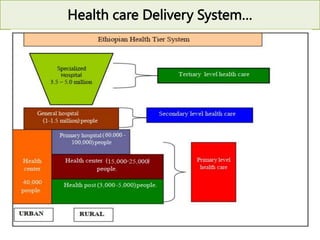
 For rural settings: at the base is the primary health care unit (PHCU).
¤ Health centre with five satellite health posts catering to a population
of 25,000
¤ Primary hospital, serving a population of 60,000 to 100,000
 For urban setting: at the base is a health center, serving 40,000 people.
 Secondary level: general hospital, services to 1 up to 1.5million
 Tertiary level: at the apex and includes specialized hospitals, serves 3.5
to 5 million people
Health care Delivery System…
Health center
◊Provides services to approximately 25,000 people
together with five satellite health posts.
◊HC is staffed with an average of 20 staff.
◊It provides both preventive and curative services.
◊It serves as a referral center for health posts and a
practical training institution for HEWs.
◊HC has an inpatient capacity of 5 beds.
Primary hospital
 Provides inpatient and ambulatory services to an average
population of 100,000.
 In addition to what a HC can provide, a primary hospital
provides emergency surgical services, including C/S and
gives access to blood transfusion service.
 Serves as a referral center for HCs under its catchment
areas, a practical training center for nurses and other
paramedical health professionals.
 Has an inpatient capacity of 25-50 beds.
 staffed by an average number of 53 persons.
General hospital
 Provides inpatient and ambulatory services to an
average of 1,000,000 people.
 Staffed by an average of 234 professionals.
 Serves as a referral center for primary hospitals.
 Serves as a training center for health officers,
nurses and emergency surgeons.
Specialized hospital
 Serves an average of five million people.
 Staffed by an average of 440 professionals.
 staffed by specialists and sub-specialists
 Serves as a referral for general hospitals.
 Provides highly specialized services.
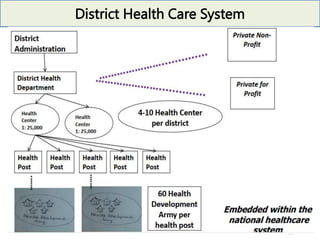
District Health system management
• The district is the most peripheral fully organized
unit of local government and administration.
• It differs greatly from country to country in size
and degree of autonomy, and population may vary
from less than 50 000 to over 300 000.
Characteristics of District
¤ A hub – where national goals and local needs
meet
¤ Large opportunity for inter-sectoral collaboration
¤ Social capital-people know each other
District Health Care System
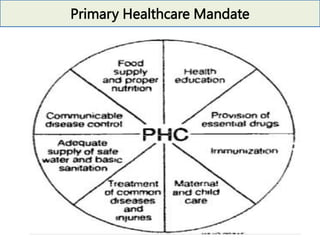
Primary Healthcare Mandate
Functions of district health department
» Planning
» Service delivery
» Leadership
» HR and Incentive management
» Logistics management
» Financial management
» Supervision and monitoring
Functions of district health department…
 Planning:
Community diagnosis, Priority setting
Objectives and targets
Health and healthcare
Action plan
Coordination mechanism
Resources, incentives, logistics
Monitoring and control
Periodic evaluation
Functions of district health department…
 Service delivery:
Environmental, occupational
Location of HCs
Organization of services
Physical design
Drugs and supplies –availing
Community needs –alignment
Affordability
Outreach services
Adequacy and training of staff
r/ship with hospital –referral mechanisms
Learning
Functions of district health department…
 Leadership:
Interpretation of events,
choice of objectives, and strategies,
the organization of activities,
the motivation of people,
the maintenance of cooperative relationships,
the development of skills, and
the enlistment of support and cooperation from
outside
Functions of district health department…
 Incentives:
Recognition – awards
Scholarships
Training opportunities
Housing allowance
Salary increases
Fellowships
Functions of district health department…
 Logistics – drugs and medical equipment :
Trained staff
Selection and quantification process
Purchasing? Who? When? Specification
Receiving and inspection
Storage
Distribution
Stock management –inventory, min/ max stock, stock-out
Wastage rate
Reserve stocks
Re-order levels
Records management
Functions of district health department…
 Financial management:
The degree of authority of the district
Capital and recurrent
Cost of alternative interventions
Lowest cost for the most effective outcome
Expenditure tracking – Under-spending vs. over-
spending
Shifting between budget lines during implementation t
Functions of district health department…
 Supervision and monitoring:
Supportive supervision
Monitoring of performance indicators
Primary Health Care (PHC)
 The health care that is available to all the people at the first
level of health care.
 According to WHO, ‘Primary Health Care is a basic health
care and is a whole of society approach to healthy well-
being, focused on needs and priorities of individuals,
families and communities.’
 Primary Health Care (PHC) is a new approach to health care
which integrates at the community level all the factors
required for improving the health status of the population.
Primary Health Care (PHC)…
 Primary health care is both a philosophy of health care and an
approach to providing health services.
 It addresses the expansive determining factor of health and
ensures whole person care for health demands during the course
of the natural life.
 It is developed with the concept that the people of the country
receive at least the basic minimum health services that are
essential for their good health and care.
 It is the first level of contact of individuals, the family and, the
community with the national health system, bringing healthcare
as close as possible to where people live and work, and
constitutes the first element of a continuing health care process.
History of Primary Health Care
¤ In 1950’s there were vertical health service
strategies, which were expensive & unsuccessful.
¤ 1960’s basic health service with the attention of
rural health service.
¤ 1970’s integration of specialized disease programs.
¤ Before 1978, globally, existing health services were
failing to provide quality health care to the people.
History of Primary Health Care…
¤ Different alternatives and ideas failed to establish a well-
functioning health care system.
¤ As a result;
 Millions of people in the world had unacceptable level of
health despite fundamental right
 Health status of disadvantaged remain low
 Limited health institutions failed to satisfy demand
 Isolated health sector
 Lack of community participation in the care they receive
History of Primary Health Care…
¤ These has led WHO & its partners to re-examine the existing
health policies.
¤ Considering these issues, a joint WHO-UNICEF international
conference was held in 1978 in Alma Ata (USSR), commonly
known as Alma-Ata conference.
¤ The conference included participation from governments of
134 countries and other different agencies.
¤ The conference has jointly called for a revolutionary
approach to the health care
History of Primary Health Care…
¤ The conference declared ‘The existing gross inequality in the
health status of people particularly between developed and
developing countries as well as within countries is politically,
socially and economically unacceptable’.
¤ The points stressed at the conference were:
– Health is basic human right
– Governments are responsible to assure this right
– It is Right & duty of people to participate in their own health care.
– The need for scientifically, socially & economical sound technologies.
¤ Thus, the Alma-Ata conference called for acceptance of WHO goal
of ‘Health for All’ by 2000.
¤ Finally a strategy to attain the “health for all” declaration was
designed & adopted and that strategy was PHC.
¤ In this way, the concept of Primary Health Care came into
existence globally in 1978 from the Alma-Ata Conference
Objectives of Primary Health Care
» To increase the programs and services that affect the
healthy growth and development of children and youth.
» To boost participation of the community with government
and community sectors to improve the health of their
community.
» To develop community satisfaction with the primary
health care system.
» To support and advocate for healthy public policy within
all sectors and levels of government.
» To support and encourage the implementation of
provincial public health policies and direction.
Objectives of Primary Health Care
» To provide reasonable and timely access to primary health care
services.
» To apply the standards of accountability in professional
practice.
» To establish, within available resources, primary health care
teams and networks.
» To support the provision of comprehensive, integrated, and
evidence-based primary health care services.
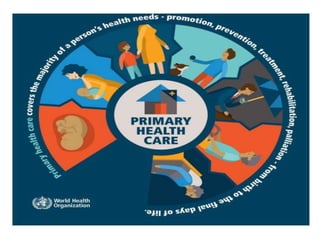
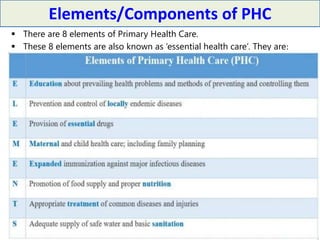
Elements/Components of PHC
 There are 8 elements of Primary Health Care.
 These 8 elements are also known as ‘essential health care’. They are:
Function of Primary Health Care
 Primary Health Care focuses more on quality health service
and cost-effectiveness.
 Primary Health Care focuses on “Health for all”.
 Primary Health Care integrates preventive, promotive, curative,
rehabilitative and palliative health care services.
 Primary Health Care encourages new connection and
community participation.
 It includes services that are readily accessible and available to
the community.
Function of Primary Health Care…
 Can be easily accessible by all as it includes services that
are simple and efficient with respect to cost, techniques
and organization.
 promotes equity and equality.
 Improves safety, performance, and accountability.
 Advocates on health promotion and focuses on
prevention, screening and early intervention of health
disparities.
 Also perceived as an integral part of country’s socio-
economic development.
Hospital
Hospital is an institution which possesses adequate
accommodation and well qualified and experienced
personnel to provide services of;
 curative
 restorative,
 preventive and
 promotive character of the highest quality
possible to all people regardless of race,
color, creed or economic status.
40
11/12/2023
Factors responsible for development of hospital
◊ Advance in medical science
◊ Development of technological and specialization
◊ Development professional nursing
◊ Advance in medical education
◊ Contribution by industrialist
◊ Support by health insurance
◊ Role of government
41
11/12/2023
Hospital development
Data required in planning the hospital
 Geographic data
 Morbidity and mortality status
 Need and demand
 Details of existing facilities
 Financial feasibility
42
11/12/2023
Hospital development…
Basic objectives which are to be meet by the
hospital;
 Quality patient care
 Effective community orientation
 Economic viability
43
11/12/2023
Regionalization
 Is the integrated organization of a health care system,
where in regional structures are responsible for providing
and administrating health services in a specific region.
 Geographic process of formal or informal health care policy that
accentuates one or more of the following: the distribution of
physicians, the distribution of equipment and facilities, and the
control of patient movement within the system
44
11/12/2023
Cont…
 Regionalization refers to the creation of an intermediary
administrative and governance structure.
 Referred to as a regional health authority or board) that
assumes responsibility for organizing and delivering health
care services to a defined population.
 The main goals of regionalization are :
o to improve responsiveness to and accountability for
population health needs, and
o to increase public participation in health care decision-
making
45
11/12/2023
Types of hospitals
According to ownership:-
 Government hospital:- public health hospital
 They are owned, administered and controlled
by the government
 Private hospital:
 Privately owned or controlled by an
individual or group of physicians or citizens or
by private organization
46
11/12/2023
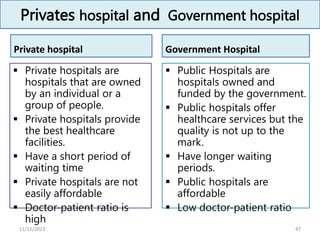
Privates hospital and Government hospital
Private hospital
 Private hospitals are
hospitals that are owned
by an individual or a
group of people.
 Private hospitals provide
the best healthcare
facilities.
 Have a short period of
waiting time
 Private hospitals are not
easily affordable
 Doctor-patient ratio is
high
Government Hospital
 Public Hospitals are
hospitals owned and
funded by the government.
 Public hospitals offer
healthcare services but the
quality is not up to the
mark.
 Have longer waiting
periods.
 Public hospitals are
affordable
 Low doctor-patient ratio
47
11/12/2023
Types of Hospital…
According to Level of Care:
 Primary Care Hospital
 Primary care is the day-to-day health care given by a
health care provider.
 Provides mostly basic health care. Eg. District Hospital
 Secondary health care:
 This level of services are provided in
General hospitals.
 Tertiary level:
 This level deals with highly specialized services provided
at regional or central level hospitals
48
11/12/2023
Types of Hospital Cont…
According to services of Hospitals
 General Hospital
o They provide wide-range of various types of healthcare, but with limited
capacity.
o They care for patients with various-disease conditions for both sexes to all
ages
 Specialized hospital
o They limit their service to a particular condition, orthopedics,
maternity, paediatrics, geriatrics, oncology etc
 Teaching hospital
o College is attached for medical/ nursing/ dental/ pharmacy education.
o Main objective is to provide medical care, teaching and research purpose
 District hospital
o District hospital is a hospital responsible for a district of a defined
geographical area containing a defined population. 49
11/12/2023
Functions of hospitals
 Patient care
 Education services
 Research function
 Public health care
 Training center
50
11/12/2023
Common structure of hospital
 Administrative services
 Informational service
 Therapeutic service
 Diagnostic services
 Support services
51
11/12/2023
Hospital service
 Line service in hospital are the care which
is directly related to patient treatment’
 Emergency services
 Out patient services
 Inpatient services(wards)
 Intensive care unit
 Operation theatre
 NICU
 Labour ward
 Other Services
52
11/12/2023
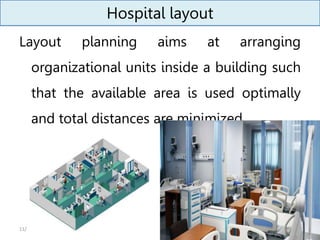
Hospital layout
Layout planning aims at arranging
organizational units inside a building such
that the available area is used optimally
and total distances are minimized.
53
11/12/2023
Hospital layout…
Selection of site
Needs of community
 Easy of accessibility
Range of services offered
 Requirement of the staff and services
54
11/12/2023
Development of Community health service
 A community is a collection of people who share some
important feature of their lives.
 A collection of people who interact with one another
and whose common interests or characteristics form the
basis for a sense of unity or belonging.
 It can be a society of people holding common rights and
privileges (eg, citizens of a town),
 sharing common interests (eg, a community of farmers),
 living under the same laws and regulations (eg, a prison
community).
55
11/12/2023
The role of NGO’s in development
 Providing goods and services
 Assisting the government achieve its
development
 Helping citizens to voice their aspirations,
concerns and alternatives for consideration by
policy makers
 Helping to enhance the accountability and
transparency of government and local
government programs and of officials 56
11/12/2023
Role of NGO…
 Women's issues (women's and child health care, rights, counseling,
literacy issues)
 Maintaining the international health relations
 Conducting and funding the medical and public health research for
improvement of health service
 To maintain the intersectoral coordination in health care delivery
system
 Technical assistance and training for health care delivery
 Advocacy for and with the government programmed of health care
from partners and advisors as well as sponsors
 Can provide valuable resources in promoting health care
 Implementing the mutually agreed programmed of collaboration
57
11/12/2023
Organizing emergency and support services
I. Laboratory services
 It also assists in teaching programmes
for doctors, nurses and laboratory technologists.
 It carries out urgent tests at any part of day or night.
Functional divisions:
 Hematology
 Microbiology
 Clinical chemistry/ biochemistry
 Histopathologye. Urine and stool analysis
58
11/12/2023
II. Planning and organization of laundry services
Location
 It should be in the same building as the hospital,
and
should have separate entrance and exit areas.
Space requirements:
 The requirement for any laundry services has bee
n workedout to be approx. 10-15 sq.ft./bed
59
11/12/2023
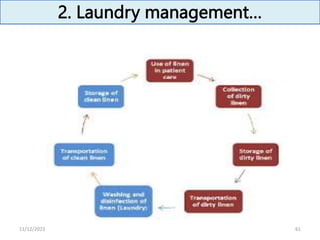
2. Laundry management:
Linen distribution system:
 Topping up
 Clean for dirty exchange
 Exchange trolley system
 Quality control of laundry services
60
11/12/2023
2. Laundry management…
11/12/2023 61
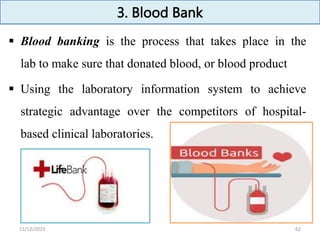
3. Blood Bank
 Blood banking is the process that takes place in the
lab to make sure that donated blood, or blood product
 Using the laboratory information system to achieve
strategic advantage over the competitors of hospital-
based clinical laboratories.
62
11/12/2023
Blood bank…
The term "blood bank" typically refers to a division of a
hospital where the storage of blood product occurs and
where proper testing is performed (to reduce the risk of
transfusion related adverse events). However, it
sometimes refers to a collection center, and some
hospitals also perform collection
11/12/2023 63
4. Bio-medical waste
 Means any solid and/or liquid waste including its container and any
intermediate product, which is generated during the diagnosis, treatment
or immunization of human beings or animals or in research pertaining
thereto or in the production or testing.
Bio-medical waste:
Segregated storage at source in colored plastic bags (according to
the rules) which are inside sturdy covered containers.
For collection, dedicated wheel-barrows are to be used for carrying
the containers directly to the storage area.
For transportation, covered vans are to be used.
for treatment and disposal, the bio-medical waste should be
taken to a common treatment and disposal facility having
incineration facility
64
11/12/2023
References
• Nursing leadership and management lecture notes
• Gillies, Ann Dee (1994). Nursing Management. A
Systems Approach, 3rd. ed. W. B. Saunders Company,
Philadelphia.
• Hermann SJ. (1978). Becoming Assertive, A Guide for
Nurses. New York, NY: D. Van Nostrand, Co. 27
• Kotter, I.P., and L.A. Schlesinger (1979). "Choosing
Strategies for Change", HarvardBusiness Review. Vol 57 (March
- April)
• Lovell, R. (1994). Managing Change in the New Public
Sector. London: Longman in
65
11/12/2023
THANK YOU!!!
11/12/2023 66

LEADERSHIP G1.pptx

  • 1.
    Salale University College OfHealth Science Department of Nursing Master of Pediatric and Child Health Nursing Program Advanced Neonatal Care practicum Seminar on case presentation Presented to: Mr. Kumera .B (MSc, Assistant Professor) Mr. Mathewos .M (MSc, Assistant Professor) Mr . Dejene .H (MSc, Assistant Professor) October , 2023 Fiche, Ethiopia 1 11/12/2023
  • 2.
    Presentation outline  Organizingnursing services  Health care Delivery System  Hospital development  Development of Community health service  Role of NGO's in health service delivery  Organizing emergency support services 2 11/12/2023
  • 3.
    Learning Objectives At theend of this session, learners will be able to: » Define organization of nursing and health management at district, regional and national levels. » Describe hospital development, regionalization types and function of hospitals. » Discuss community development health services » Explain the different between private hospitals and government hospitals. » Identify the role of NGO health delivery system. 3 11/12/2023
  • 4.
    Organizing nursing services Nursing service is the part of the total health organization which aims at satisfying the nursing needs of the patients/community.  WHO expert committee defines as the part of the total health organization which aims to satisfy major objective of the nursing services is to provide prevention of disease and promotion of health. 4 11/12/2023
  • 5.
    Organizing nursing services… Organizing Nursing service: the process and action of engaging co-workers of nurse to build a workplace which upholds high standards of care, fairness and transparency  Nursing service administration is a complex of elements in interaction and is organized to achieve the excellence in nursing care services 5 11/12/2023
  • 6.
    Health care deliverysystem  Staying healthy is an important part of everyone's life, since good health determines how productive a person can be and how much they can participate in daily activities.  People with good health are free from disease, and their bodies function efficiently.  People need guidance in how to stay healthy.  Scientists and medical professionals conduct research and develop guidelines to help people manage their health. 11/12/2023 6
  • 7.
    Health care deliverysystem…  Is an organization that provides resources and treatments that help people when they are sick or injured, and helps them stay healthy through preventive care.  Includes all the institutions, organizations, people and resources that help a particular group of people stay healthy.  Health care delivery systems have 4 components: ¤ Services: Health care assistance available ¤ Consumers: People who require health care ¤ Personnel (providers): All the people who provide health care ¤ Payment: Method of paying for the health care 11/12/2023 7
  • 8.
    Health care DeliverySystem…  The health care setting organization to country extends from the national to distinct level.  From the total organization structure, include the setting of health care system at national, state district, regional, level. 8 11/12/2023
  • 9.
    Health care DeliverySystem…  The public health care system in Ethiopia is structured in three tiered health care delivery. ¤ Primary ¤ Secondary and ¤ Tertiary levels with defined populations to be served at each level.
  • 10.
    Health care DeliverySystem…  For rural settings: at the base is the primary health care unit (PHCU). ¤ Health centre with five satellite health posts catering to a population of 25,000 ¤ Primary hospital, serving a population of 60,000 to 100,000  For urban setting: at the base is a health center, serving 40,000 people.  Secondary level: general hospital, services to 1 up to 1.5million  Tertiary level: at the apex and includes specialized hospitals, serves 3.5 to 5 million people
  • 11.
  • 12.
    Health center ◊Provides servicesto approximately 25,000 people together with five satellite health posts. ◊HC is staffed with an average of 20 staff. ◊It provides both preventive and curative services. ◊It serves as a referral center for health posts and a practical training institution for HEWs. ◊HC has an inpatient capacity of 5 beds.
  • 13.
    Primary hospital  Providesinpatient and ambulatory services to an average population of 100,000.  In addition to what a HC can provide, a primary hospital provides emergency surgical services, including C/S and gives access to blood transfusion service.  Serves as a referral center for HCs under its catchment areas, a practical training center for nurses and other paramedical health professionals.  Has an inpatient capacity of 25-50 beds.  staffed by an average number of 53 persons.
  • 14.
    General hospital  Providesinpatient and ambulatory services to an average of 1,000,000 people.  Staffed by an average of 234 professionals.  Serves as a referral center for primary hospitals.  Serves as a training center for health officers, nurses and emergency surgeons.
  • 15.
    Specialized hospital  Servesan average of five million people.  Staffed by an average of 440 professionals.  staffed by specialists and sub-specialists  Serves as a referral for general hospitals.  Provides highly specialized services.
  • 16.
    District Health systemmanagement • The district is the most peripheral fully organized unit of local government and administration. • It differs greatly from country to country in size and degree of autonomy, and population may vary from less than 50 000 to over 300 000.
  • 17.
    Characteristics of District ¤A hub – where national goals and local needs meet ¤ Large opportunity for inter-sectoral collaboration ¤ Social capital-people know each other
  • 18.
  • 19.
  • 20.
    Functions of districthealth department » Planning » Service delivery » Leadership » HR and Incentive management » Logistics management » Financial management » Supervision and monitoring
  • 21.
    Functions of districthealth department…  Planning: Community diagnosis, Priority setting Objectives and targets Health and healthcare Action plan Coordination mechanism Resources, incentives, logistics Monitoring and control Periodic evaluation
  • 22.
    Functions of districthealth department…  Service delivery: Environmental, occupational Location of HCs Organization of services Physical design Drugs and supplies –availing Community needs –alignment Affordability Outreach services Adequacy and training of staff r/ship with hospital –referral mechanisms Learning
  • 23.
    Functions of districthealth department…  Leadership: Interpretation of events, choice of objectives, and strategies, the organization of activities, the motivation of people, the maintenance of cooperative relationships, the development of skills, and the enlistment of support and cooperation from outside
  • 24.
    Functions of districthealth department…  Incentives: Recognition – awards Scholarships Training opportunities Housing allowance Salary increases Fellowships
  • 25.
    Functions of districthealth department…  Logistics – drugs and medical equipment : Trained staff Selection and quantification process Purchasing? Who? When? Specification Receiving and inspection Storage Distribution Stock management –inventory, min/ max stock, stock-out Wastage rate Reserve stocks Re-order levels Records management
  • 26.
    Functions of districthealth department…  Financial management: The degree of authority of the district Capital and recurrent Cost of alternative interventions Lowest cost for the most effective outcome Expenditure tracking – Under-spending vs. over- spending Shifting between budget lines during implementation t
  • 27.
    Functions of districthealth department…  Supervision and monitoring: Supportive supervision Monitoring of performance indicators
  • 28.
    Primary Health Care(PHC)  The health care that is available to all the people at the first level of health care.  According to WHO, ‘Primary Health Care is a basic health care and is a whole of society approach to healthy well- being, focused on needs and priorities of individuals, families and communities.’  Primary Health Care (PHC) is a new approach to health care which integrates at the community level all the factors required for improving the health status of the population.
  • 29.
    Primary Health Care(PHC)…  Primary health care is both a philosophy of health care and an approach to providing health services.  It addresses the expansive determining factor of health and ensures whole person care for health demands during the course of the natural life.  It is developed with the concept that the people of the country receive at least the basic minimum health services that are essential for their good health and care.  It is the first level of contact of individuals, the family and, the community with the national health system, bringing healthcare as close as possible to where people live and work, and constitutes the first element of a continuing health care process.
  • 30.
    History of PrimaryHealth Care ¤ In 1950’s there were vertical health service strategies, which were expensive & unsuccessful. ¤ 1960’s basic health service with the attention of rural health service. ¤ 1970’s integration of specialized disease programs. ¤ Before 1978, globally, existing health services were failing to provide quality health care to the people.
  • 31.
    History of PrimaryHealth Care… ¤ Different alternatives and ideas failed to establish a well- functioning health care system. ¤ As a result;  Millions of people in the world had unacceptable level of health despite fundamental right  Health status of disadvantaged remain low  Limited health institutions failed to satisfy demand  Isolated health sector  Lack of community participation in the care they receive
  • 32.
    History of PrimaryHealth Care… ¤ These has led WHO & its partners to re-examine the existing health policies. ¤ Considering these issues, a joint WHO-UNICEF international conference was held in 1978 in Alma Ata (USSR), commonly known as Alma-Ata conference. ¤ The conference included participation from governments of 134 countries and other different agencies. ¤ The conference has jointly called for a revolutionary approach to the health care
  • 33.
    History of PrimaryHealth Care… ¤ The conference declared ‘The existing gross inequality in the health status of people particularly between developed and developing countries as well as within countries is politically, socially and economically unacceptable’. ¤ The points stressed at the conference were: – Health is basic human right – Governments are responsible to assure this right – It is Right & duty of people to participate in their own health care. – The need for scientifically, socially & economical sound technologies. ¤ Thus, the Alma-Ata conference called for acceptance of WHO goal of ‘Health for All’ by 2000. ¤ Finally a strategy to attain the “health for all” declaration was designed & adopted and that strategy was PHC. ¤ In this way, the concept of Primary Health Care came into existence globally in 1978 from the Alma-Ata Conference
  • 34.
    Objectives of PrimaryHealth Care » To increase the programs and services that affect the healthy growth and development of children and youth. » To boost participation of the community with government and community sectors to improve the health of their community. » To develop community satisfaction with the primary health care system. » To support and advocate for healthy public policy within all sectors and levels of government. » To support and encourage the implementation of provincial public health policies and direction.
  • 35.
    Objectives of PrimaryHealth Care » To provide reasonable and timely access to primary health care services. » To apply the standards of accountability in professional practice. » To establish, within available resources, primary health care teams and networks. » To support the provision of comprehensive, integrated, and evidence-based primary health care services.
  • 36.
    Elements/Components of PHC There are 8 elements of Primary Health Care.  These 8 elements are also known as ‘essential health care’. They are:
  • 37.
    Function of PrimaryHealth Care  Primary Health Care focuses more on quality health service and cost-effectiveness.  Primary Health Care focuses on “Health for all”.  Primary Health Care integrates preventive, promotive, curative, rehabilitative and palliative health care services.  Primary Health Care encourages new connection and community participation.  It includes services that are readily accessible and available to the community.
  • 38.
    Function of PrimaryHealth Care…  Can be easily accessible by all as it includes services that are simple and efficient with respect to cost, techniques and organization.  promotes equity and equality.  Improves safety, performance, and accountability.  Advocates on health promotion and focuses on prevention, screening and early intervention of health disparities.  Also perceived as an integral part of country’s socio- economic development.
  • 40.
    Hospital Hospital is aninstitution which possesses adequate accommodation and well qualified and experienced personnel to provide services of;  curative  restorative,  preventive and  promotive character of the highest quality possible to all people regardless of race, color, creed or economic status. 40 11/12/2023
  • 41.
    Factors responsible fordevelopment of hospital ◊ Advance in medical science ◊ Development of technological and specialization ◊ Development professional nursing ◊ Advance in medical education ◊ Contribution by industrialist ◊ Support by health insurance ◊ Role of government 41 11/12/2023
  • 42.
    Hospital development Data requiredin planning the hospital  Geographic data  Morbidity and mortality status  Need and demand  Details of existing facilities  Financial feasibility 42 11/12/2023
  • 43.
    Hospital development… Basic objectiveswhich are to be meet by the hospital;  Quality patient care  Effective community orientation  Economic viability 43 11/12/2023
  • 44.
    Regionalization  Is theintegrated organization of a health care system, where in regional structures are responsible for providing and administrating health services in a specific region.  Geographic process of formal or informal health care policy that accentuates one or more of the following: the distribution of physicians, the distribution of equipment and facilities, and the control of patient movement within the system 44 11/12/2023
  • 45.
    Cont…  Regionalization refersto the creation of an intermediary administrative and governance structure.  Referred to as a regional health authority or board) that assumes responsibility for organizing and delivering health care services to a defined population.  The main goals of regionalization are : o to improve responsiveness to and accountability for population health needs, and o to increase public participation in health care decision- making 45 11/12/2023
  • 46.
    Types of hospitals Accordingto ownership:-  Government hospital:- public health hospital  They are owned, administered and controlled by the government  Private hospital:  Privately owned or controlled by an individual or group of physicians or citizens or by private organization 46 11/12/2023
  • 47.
    Privates hospital andGovernment hospital Private hospital  Private hospitals are hospitals that are owned by an individual or a group of people.  Private hospitals provide the best healthcare facilities.  Have a short period of waiting time  Private hospitals are not easily affordable  Doctor-patient ratio is high Government Hospital  Public Hospitals are hospitals owned and funded by the government.  Public hospitals offer healthcare services but the quality is not up to the mark.  Have longer waiting periods.  Public hospitals are affordable  Low doctor-patient ratio 47 11/12/2023
  • 48.
    Types of Hospital… Accordingto Level of Care:  Primary Care Hospital  Primary care is the day-to-day health care given by a health care provider.  Provides mostly basic health care. Eg. District Hospital  Secondary health care:  This level of services are provided in General hospitals.  Tertiary level:  This level deals with highly specialized services provided at regional or central level hospitals 48 11/12/2023
  • 49.
    Types of HospitalCont… According to services of Hospitals  General Hospital o They provide wide-range of various types of healthcare, but with limited capacity. o They care for patients with various-disease conditions for both sexes to all ages  Specialized hospital o They limit their service to a particular condition, orthopedics, maternity, paediatrics, geriatrics, oncology etc  Teaching hospital o College is attached for medical/ nursing/ dental/ pharmacy education. o Main objective is to provide medical care, teaching and research purpose  District hospital o District hospital is a hospital responsible for a district of a defined geographical area containing a defined population. 49 11/12/2023
  • 50.
    Functions of hospitals Patient care  Education services  Research function  Public health care  Training center 50 11/12/2023
  • 51.
    Common structure ofhospital  Administrative services  Informational service  Therapeutic service  Diagnostic services  Support services 51 11/12/2023
  • 52.
    Hospital service  Lineservice in hospital are the care which is directly related to patient treatment’  Emergency services  Out patient services  Inpatient services(wards)  Intensive care unit  Operation theatre  NICU  Labour ward  Other Services 52 11/12/2023
  • 53.
    Hospital layout Layout planningaims at arranging organizational units inside a building such that the available area is used optimally and total distances are minimized. 53 11/12/2023
  • 54.
    Hospital layout… Selection ofsite Needs of community  Easy of accessibility Range of services offered  Requirement of the staff and services 54 11/12/2023
  • 55.
    Development of Communityhealth service  A community is a collection of people who share some important feature of their lives.  A collection of people who interact with one another and whose common interests or characteristics form the basis for a sense of unity or belonging.  It can be a society of people holding common rights and privileges (eg, citizens of a town),  sharing common interests (eg, a community of farmers),  living under the same laws and regulations (eg, a prison community). 55 11/12/2023
  • 56.
    The role ofNGO’s in development  Providing goods and services  Assisting the government achieve its development  Helping citizens to voice their aspirations, concerns and alternatives for consideration by policy makers  Helping to enhance the accountability and transparency of government and local government programs and of officials 56 11/12/2023
  • 57.
    Role of NGO… Women's issues (women's and child health care, rights, counseling, literacy issues)  Maintaining the international health relations  Conducting and funding the medical and public health research for improvement of health service  To maintain the intersectoral coordination in health care delivery system  Technical assistance and training for health care delivery  Advocacy for and with the government programmed of health care from partners and advisors as well as sponsors  Can provide valuable resources in promoting health care  Implementing the mutually agreed programmed of collaboration 57 11/12/2023
  • 58.
    Organizing emergency andsupport services I. Laboratory services  It also assists in teaching programmes for doctors, nurses and laboratory technologists.  It carries out urgent tests at any part of day or night. Functional divisions:  Hematology  Microbiology  Clinical chemistry/ biochemistry  Histopathologye. Urine and stool analysis 58 11/12/2023
  • 59.
    II. Planning andorganization of laundry services Location  It should be in the same building as the hospital, and should have separate entrance and exit areas. Space requirements:  The requirement for any laundry services has bee n workedout to be approx. 10-15 sq.ft./bed 59 11/12/2023
  • 60.
    2. Laundry management: Linendistribution system:  Topping up  Clean for dirty exchange  Exchange trolley system  Quality control of laundry services 60 11/12/2023
  • 61.
  • 62.
    3. Blood Bank Blood banking is the process that takes place in the lab to make sure that donated blood, or blood product  Using the laboratory information system to achieve strategic advantage over the competitors of hospital- based clinical laboratories. 62 11/12/2023
  • 63.
    Blood bank… The term"blood bank" typically refers to a division of a hospital where the storage of blood product occurs and where proper testing is performed (to reduce the risk of transfusion related adverse events). However, it sometimes refers to a collection center, and some hospitals also perform collection 11/12/2023 63
  • 64.
    4. Bio-medical waste Means any solid and/or liquid waste including its container and any intermediate product, which is generated during the diagnosis, treatment or immunization of human beings or animals or in research pertaining thereto or in the production or testing. Bio-medical waste: Segregated storage at source in colored plastic bags (according to the rules) which are inside sturdy covered containers. For collection, dedicated wheel-barrows are to be used for carrying the containers directly to the storage area. For transportation, covered vans are to be used. for treatment and disposal, the bio-medical waste should be taken to a common treatment and disposal facility having incineration facility 64 11/12/2023
  • 65.
    References • Nursing leadershipand management lecture notes • Gillies, Ann Dee (1994). Nursing Management. A Systems Approach, 3rd. ed. W. B. Saunders Company, Philadelphia. • Hermann SJ. (1978). Becoming Assertive, A Guide for Nurses. New York, NY: D. Van Nostrand, Co. 27 • Kotter, I.P., and L.A. Schlesinger (1979). "Choosing Strategies for Change", HarvardBusiness Review. Vol 57 (March - April) • Lovell, R. (1994). Managing Change in the New Public Sector. London: Longman in 65 11/12/2023
  • 66.