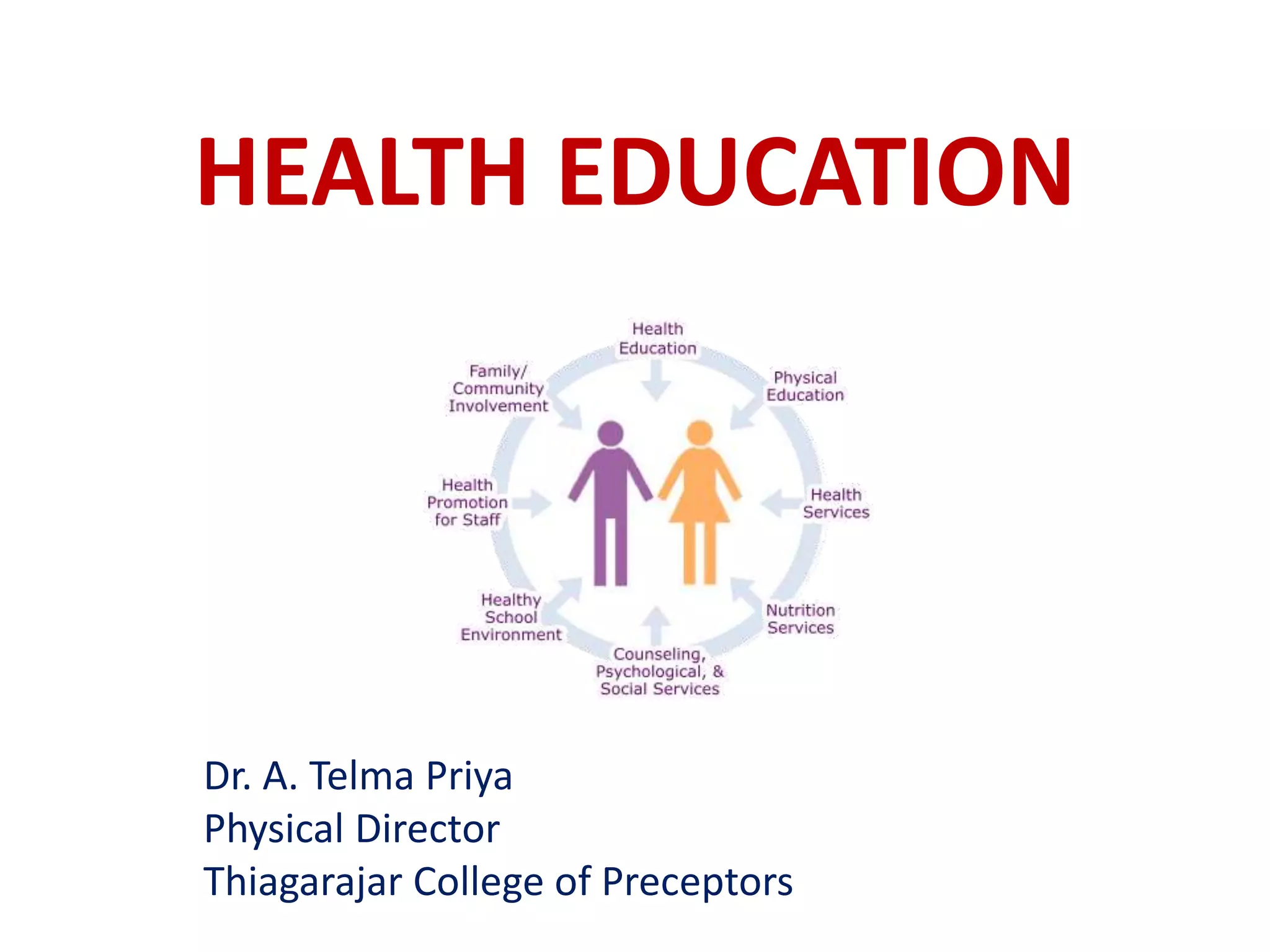
HEALTH EDUCATION
Dr. A. Telma Priya
Physical Director
Thiagarajar College of Preceptors
INTRODUCTION
The practice of instructing people and
communities in the principles of hygiene
and in ways of avoiding disease is a very
ancient one.
An elementary study of the history of
medicine reveals that since time immemorial
it has been considered a necessity to instruct
communities in health matters for their
protection and survival.
DEFINITIONS
• The National Conference on Preventive Medicine
[USA]
Health education is a process which
informs, motivate and helps people to
adopt and maintain healthy practices and
life styles; advocates environmental
changes as needed to facilitate this goal
and conducts professional training and
research to the same end.
WHO Definition
Health Education, like general
education, is concerned with
changes in knowledge, feelings and
behaviour of people. In its most
usual forms, it concentrates on
developing such health practices as
are believed to bring about the best
possible state of well being.
AIMS OF HEALTH EDUCATION
• To inform the general public of the principles of
physical and mental hygiene and methods of
preventing avoidable diseases.
• To create an informed body of opinion and
knowledge. (social workers, teachers)
• To give the public accurate information of medical
discoveries.
• To facilitate the acceptance and proper usage of
medical measures.
METHODS OF APPROACHES IN HEALTH
EDUCATION
1. Legal or Regulatory Approach
2. Administrative or Service Approach
3. Educational Approach
Legal or Regulatory Approach
• Makes use of the law to protect the health of
the public.
• Eg : Epidemic Diseases Act , Pollution
prevention Act
• Limitations :
1. Applicable only at certain times or limited
situations.
2. They may not alter the behaviour of the
individual.
Educational Approach
Components
1. Motivation
2. Communication
3. Decision making
•Results slow , but permanent and enduring.
•Suffient time for an individual to bring about changes
• Learning new facts as well as unlearning wrong
information as well.
CONTENTS OF HEALTH EDUCATION
1. Human Biology
2. Nutrition
3. Hygiene
4. Family Health Care
5. Control of Communicable and Non- Communicable
Diseases
6. Mental health
7. Prevention of Accidents
8. Use of Health Services
Human Biology
• Human biology is an interdisciplinary area of
study that examines humans through the
influences and interplay of many diverse fields
such as genetics, evolution, physiology,
anatomy, epidemiology, anthropology,
ecology, nutrition, population genetics, and
sociocultural influences.
Nutrition
• For prevention of malnutrition
• Taught nutrient value of food stuffs
• Method of preparation , storage
• Help people to choose balanced diet
Vitamins
Hygiene
Personal Environmental
Family Health Care
• Strengthen and improve the health of the
family as a unit rather than as an individual.
• Maternal and child health care, family
planning, immunization, nutrition, etc.
• Health Insurance
Control of Communicable and Non-
Communicable diseases
Provide elementary knowledge
about the nature of the diseases
and methods of preventing them.
Mental Health
• Depression, neurosis, mental anxiety and
emotional disturbances
• Basic knowledge of common psychological
ailments, methods of prevention and
treatment.
Use of Health services
• People should be informed about various
health services and preventive programmes
available to them.
PRINCIPLES OF HEALTH EDUCATION
• INTEREST
• PARTICIPATION
• COMPREHENSION
• MOTIVATION
• REINFORCEMENT
• KNOWN TO UNKNOWN
• LEARNING BY DOING
• SOIL, SEED & SOWER
• COMMUNITY LEADERS
• GOOD HEALTH RELATIONS
Interest
• Topic of interest
• Identify the ”felt needs” of the
people
• Then prepare a programme
Participation
• Educator should encourage people to
participate in health education
programmes
• Group discussions, panel discussions,
etc provide oppurtunities for
people’s participation
• Leads to acceptance
Known to Unknown
• Start with what the people
already know and then give
the new knowledge
• Existing knowledge as people
as the basic step
Reinforcement
• Also called as “booster dose”
• Refers to repetition needed
• When not possible for people
to learn new things in short
time
Good Human Relations
• Health educator should have
good personal qualities
• Should be able to maintain
friendly relations with people
• Should have a kind and
sympathetic attitude
Community leaders
• Leaders can be used to reach
people of the community and
to convince them about the
need for health education.
EDUCATIONAL AIDS USED IN HEALTH
EDUCATION
1. Audio aids
2. Visual aids
3. Combination of Audio-Visual aids
HEALTH EDUCATION FOR THE GENERAL
PUBLIC
• Mass communication literally means communication
that is given to a community where the people
gathered together does not belong to one particular
group.
• Advantages
 large no. of people can be reached
 people of all socio-economic status
irrespective of their caste, creed and religion
• Medias
televisions, radios, posters, news papers, etc
ESSENTIALS OF HEALTH EDUCATON TO THE
PUBLIC
1. Accuracy and Truth
2. Presentation must be simple
3. Health education should be factual
4. Principles of health should be taught
CONCLUSION
In a field such as health, it is natural that
“helping people to help themselves” should
be as important as direct service.
Thank You

HEALTH EDUCATION

  • 1.
    HEALTH EDUCATION Dr. A.Telma Priya Physical Director Thiagarajar College of Preceptors
  • 2.
    INTRODUCTION The practice ofinstructing people and communities in the principles of hygiene and in ways of avoiding disease is a very ancient one. An elementary study of the history of medicine reveals that since time immemorial it has been considered a necessity to instruct communities in health matters for their protection and survival.
  • 3.
    DEFINITIONS • The NationalConference on Preventive Medicine [USA] Health education is a process which informs, motivate and helps people to adopt and maintain healthy practices and life styles; advocates environmental changes as needed to facilitate this goal and conducts professional training and research to the same end.
  • 4.
    WHO Definition Health Education,like general education, is concerned with changes in knowledge, feelings and behaviour of people. In its most usual forms, it concentrates on developing such health practices as are believed to bring about the best possible state of well being.
  • 5.
    AIMS OF HEALTHEDUCATION • To inform the general public of the principles of physical and mental hygiene and methods of preventing avoidable diseases. • To create an informed body of opinion and knowledge. (social workers, teachers) • To give the public accurate information of medical discoveries. • To facilitate the acceptance and proper usage of medical measures.
  • 6.
    METHODS OF APPROACHESIN HEALTH EDUCATION 1. Legal or Regulatory Approach 2. Administrative or Service Approach 3. Educational Approach
  • 7.
    Legal or RegulatoryApproach • Makes use of the law to protect the health of the public. • Eg : Epidemic Diseases Act , Pollution prevention Act • Limitations : 1. Applicable only at certain times or limited situations. 2. They may not alter the behaviour of the individual.
  • 8.
    Educational Approach Components 1. Motivation 2.Communication 3. Decision making •Results slow , but permanent and enduring. •Suffient time for an individual to bring about changes • Learning new facts as well as unlearning wrong information as well.
  • 9.
    CONTENTS OF HEALTHEDUCATION 1. Human Biology 2. Nutrition 3. Hygiene 4. Family Health Care 5. Control of Communicable and Non- Communicable Diseases 6. Mental health 7. Prevention of Accidents 8. Use of Health Services
  • 10.
    Human Biology • Humanbiology is an interdisciplinary area of study that examines humans through the influences and interplay of many diverse fields such as genetics, evolution, physiology, anatomy, epidemiology, anthropology, ecology, nutrition, population genetics, and sociocultural influences.
  • 11.
    Nutrition • For preventionof malnutrition • Taught nutrient value of food stuffs • Method of preparation , storage • Help people to choose balanced diet
  • 12.
  • 14.
  • 15.
    Family Health Care •Strengthen and improve the health of the family as a unit rather than as an individual. • Maternal and child health care, family planning, immunization, nutrition, etc. • Health Insurance
  • 16.
    Control of Communicableand Non- Communicable diseases Provide elementary knowledge about the nature of the diseases and methods of preventing them.
  • 19.
    Mental Health • Depression,neurosis, mental anxiety and emotional disturbances • Basic knowledge of common psychological ailments, methods of prevention and treatment.
  • 20.
    Use of Healthservices • People should be informed about various health services and preventive programmes available to them.
  • 21.
    PRINCIPLES OF HEALTHEDUCATION • INTEREST • PARTICIPATION • COMPREHENSION • MOTIVATION • REINFORCEMENT • KNOWN TO UNKNOWN • LEARNING BY DOING • SOIL, SEED & SOWER • COMMUNITY LEADERS • GOOD HEALTH RELATIONS
  • 22.
    Interest • Topic ofinterest • Identify the ”felt needs” of the people • Then prepare a programme
  • 23.
    Participation • Educator shouldencourage people to participate in health education programmes • Group discussions, panel discussions, etc provide oppurtunities for people’s participation • Leads to acceptance
  • 24.
    Known to Unknown •Start with what the people already know and then give the new knowledge • Existing knowledge as people as the basic step
  • 25.
    Reinforcement • Also calledas “booster dose” • Refers to repetition needed • When not possible for people to learn new things in short time
  • 26.
    Good Human Relations •Health educator should have good personal qualities • Should be able to maintain friendly relations with people • Should have a kind and sympathetic attitude
  • 27.
    Community leaders • Leaderscan be used to reach people of the community and to convince them about the need for health education.
  • 28.
    EDUCATIONAL AIDS USEDIN HEALTH EDUCATION 1. Audio aids 2. Visual aids 3. Combination of Audio-Visual aids
  • 29.
    HEALTH EDUCATION FORTHE GENERAL PUBLIC • Mass communication literally means communication that is given to a community where the people gathered together does not belong to one particular group. • Advantages  large no. of people can be reached  people of all socio-economic status irrespective of their caste, creed and religion • Medias televisions, radios, posters, news papers, etc
  • 30.
    ESSENTIALS OF HEALTHEDUCATON TO THE PUBLIC 1. Accuracy and Truth 2. Presentation must be simple 3. Health education should be factual 4. Principles of health should be taught
  • 31.
    CONCLUSION In a fieldsuch as health, it is natural that “helping people to help themselves” should be as important as direct service. Thank You