• Headache is common complaint in paediatric
population.
• Headache in children is headache of patients as
well as Pediatrician.
• Prevalence :
• < 7 years old : 35-50 %
• < 15 years old : 60-80 %
:: INTRODUCTION ::
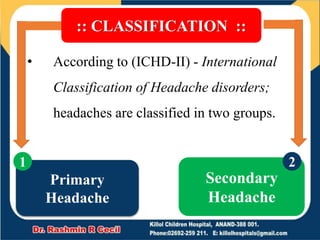
:: CLASSIFICATION ::
Primary
Headache
Secondary
Headache
2
1
• According to (ICHD-II) - International
Classification of Headache disorders;
headaches are classified in two groups.
• [1] Primary headache :
• Headache is considered primary when a
disease or other medical condition does
not cause the headache.
• Primary headaches are benign, chronic
and not life threatening.
• Primary headaches fall into three main
types:
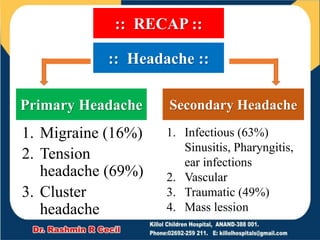
1. Migraine (16%)
2. Tension headache (69%)
3. Cluster headache
• [2] Secondary headache :
• Secondary headaches are due to
underlying medical conditions.
• It may be resulting from life threatening
diseases, early diagnosis is essential
• Most common causes are :
1. Infectious (63%) Sinusitis, Pharyngitis,
ear infections
2. Vascular
3. Traumatic (49%)
4. Mass lession
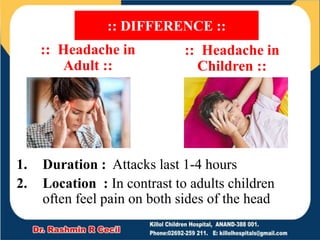
:: Headache in
Adult ::
:: DIFFERENCE ::
:: Headache in
Children ::
1. Duration : Attacks last 1-4 hours
2. Location : In contrast to adults children
often feel pain on both sides of the head
3. Aura (warning signs) infrequent
4. Associated nausea, vomiting, abdominal pain
5. Prodromes and trigger factors common
6. Children may look pale and appear restless or
irritable before and during an attack
7. Other children may become nauseous, lose their
appetite, or feel pain elsewhere in the body
during the headache
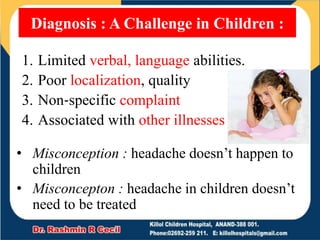
1. Limited verbal, language abilities.
2. Poor localization, quality
3. Non‐specific complaint
4. Associated with other illnesses
Diagnosis : A Challenge in Children :
• Misconception : headache doesn’t happen to
children
• Misconcepton : headache in children doesn’t
need to be treated
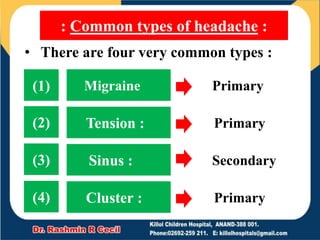
: Common types of headache :
Migraine
Tension :
Sinus :
Cluster :
(1)
(2)
(3)
(4)
• There are four very common types :
Primary
Primary
Secondary
Primary
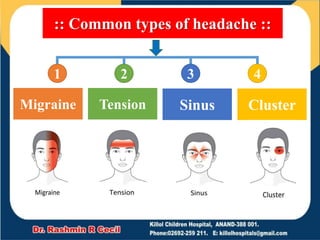
• [1] Migraine :
• Symptoms:
1. Pain in the face or neck,
2. Throbbing in one area,
3. Sensitivity to light and sound,
4. Nausea, distorted vision
• Duration: 4 to 72 hours
• [2] Tension :
• Symptoms :
• Dull pain on either side of the head,
and pressure across the forehead
• Duration: 30 minutes to several hours
• [3] Sinus :
• Symptoms :
• Pain in the face, sinuses, eyes, ears or
forehead. Congestion, itching, runny nose,
fever, swelling in the face.
• Duration : several days to weeks (if treated)
• [4] Cluster :
• Symptoms :
1. severe pain on one side of the head,
2. usually around the eye,
3. accompanied with a drooping eyelid,
4. small pupil, tearing, runny nose or
redness on the same side of the head
• Duration :
• Can last for weeks or several months,
usually followed by a period of
remission that can last for several
months or several years.
1. Acute recurrent : migraines
2. Acute Generalized : Systemic illness (Malaria, Flu,
Dengue)
3. Acute localized : OM, Sinusitis, Trauma
4. Acute Progressive : masses, haemorrhage
5. Chronic Non-progressive : depression, anxiety,
refractory error.
:: Common Clinical Headache Patterns :
:: Migraine in Children ::
• Migraine headaches are common in children,
their frequency increases through
adolescence.
• The mean age of onset : 7.2 yrs for boys and
10.9 yrs for girls, with prevalence rates :
1. 3% for children age 3-7 years
2. 4-11 % for children age 7-11 years (M>>>F)
3. 8-23% for children age 11-15 plus years
(F>M)
:: Clues to identify Migraine attacks ::
1. Sensitivity to light and noise : suspected
when a child :
2. Refuses to watch television or use the
computer
3. When the child stops playing and lie down
in a dark room.
4. Irritable and complaint of abdominal pain
during headache (abdominal migraine)
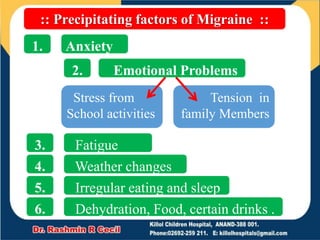
:: Precipitating factors of Migraine ::
Anxiety
Emotional Problems
Fatigue
Weather changes
Irregular eating and sleep
Dehydration, Food, certain drinks .
1.
2.
3.
4.
5.
6.
Stress from
School activities
Tension in
family Members
:: Tension Headache ::
• Tension type headache clearly occur in
children but have not been rigorously
studied. The common causes are :
1. Emotional stress : family, school, friends
2. Eye strain
3. Neck or back strain due to poor posture
4. Depression may also be reason
5. Anxiety
6. Abuse : physical, sexual, verbal
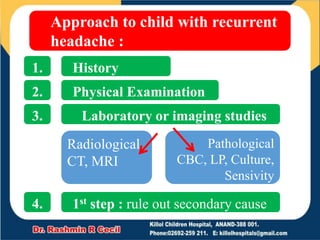
Approach to child with recurrent
headache :
History
Physical Examination
Laboratory or imaging studies
1st step : rule out secondary cause
1.
2.
3.
4.
Radiological
CT, MRI
Pathological
CBC, LP, Culture,
Sensivity
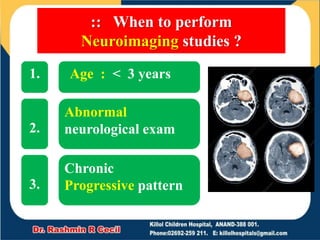
:: When to perform
Neuroimaging studies ?
Age : < 3 years
Abnormal
neurological exam
Chronic
Progressive pattern
1.
2.
3.
:: WARNING SIGNS ::
1. Suspected headache in a child below 3
years
2. Headache that is most severe in the
morning or which awakens one from sleep.
It improves as day progresses.
3. Headache that is relieved by vomiting
4. Hypertension and bradycardia
5. 6th nerve palsy (abducens), papiloedema
(swelling of optic nerve)
6. Mecewen’s sign : (A crack pot sign),
7. Headache Which is persistently
occipital
8. If headache worsens with sneezing,
coughing, valsailva manoeuvre
9. Pulsating tinnitus
10. Confusion
11. Lack of family History of migraine
12. Lack of response to analgesics
13. Focal neurodeficits, localizing signs
:: EVALUATION ::
1. The first step in evaluating a child with
headache is to rule out secondary causes.
2. Detailed history and medical examination
necessary to differentiate primary from
secondary headache.
3. If child's headache become worse or
become more frequent despite treatment
referral to a specialist is required.
EVALUATION . . . . . .
1. After ruling out secondary causes of
headache, detailed work up should be done
regarding nature, pattern, precipitating
factors and associated comorbidities.
2. Specifically different anxiety disorders,
depression, adjustment problems,
somatization etcs should be ruled out.
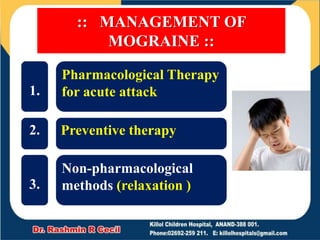
:: MANAGEMENT OF
MOGRAINE ::
Pharmacological Therapy
for acute attack
Preventive therapy
Non-pharmacological
methods (relaxation )
1.
2.
3.
1. Intermittent use of oral analgesic is the
mainstay of treatment; Both Ibuprofen and
acetaminophen have been shown to be safe and
effective
2. Sumatriptan is the only 5HT1 agonist that has
proven effective for the treatment of children
and with migraine with the nasal spray having
the most favorable profile
3. Narcotics should be avoided
4. Nausea and vomiting can be relieved by
antiemetic agents
[1] Pharmacological therapy for accute
attack ::
1. Use of prophylactic agents Propranolol
and Flunazine should be reserved for
children with frequent or disabling
migraine headaches.
2. The Optium duration of prophylactic
therapy is uncertain.
3. Data are limited on the effectiveness of
preventive agents in children
[2] Preventive therapy ::
1. Education
2. Relaxation therapy
3. Stress management
4. Sleep Hygiene
5. Eliminate triggers
6. Regular Exercise
[3] Non-Pharmacological methods :
1. Low dose amirtiptyline (10 mg per day) may be
efficacious
2. Biobehavioural therapies, including relaxation
techniques show the evapentic benefits.
• Increasing use of computers, Laptops, Video
games and other electronic gadgets are triggering
acute headaches among teenagers in India.
Management : Tension type
Headaches ::
1. Migraine (16%)
2. Tension
headache (69%)
3. Cluster
headache
:: RECAP ::
:: Headache ::
Primary Headache Secondary Headache
1. Infectious (63%)
Sinusitis, Pharyngitis,
ear infections
2. Vascular
3. Traumatic (49%)
4. Mass lession
:: Common types of headache ::
Migraine Tension Sinus Cluster
1 2 3 4
Headache in children

Headache in children

  • 2.
    • Headache iscommon complaint in paediatric population. • Headache in children is headache of patients as well as Pediatrician. • Prevalence : • < 7 years old : 35-50 % • < 15 years old : 60-80 % :: INTRODUCTION ::
  • 3.
    :: CLASSIFICATION :: Primary Headache Secondary Headache 2 1 •According to (ICHD-II) - International Classification of Headache disorders; headaches are classified in two groups.
  • 4.
    • [1] Primaryheadache : • Headache is considered primary when a disease or other medical condition does not cause the headache. • Primary headaches are benign, chronic and not life threatening. • Primary headaches fall into three main types: 1. Migraine (16%) 2. Tension headache (69%) 3. Cluster headache
  • 5.
    • [2] Secondaryheadache : • Secondary headaches are due to underlying medical conditions. • It may be resulting from life threatening diseases, early diagnosis is essential • Most common causes are : 1. Infectious (63%) Sinusitis, Pharyngitis, ear infections 2. Vascular 3. Traumatic (49%) 4. Mass lession
  • 6.
    :: Headache in Adult:: :: DIFFERENCE :: :: Headache in Children :: 1. Duration : Attacks last 1-4 hours 2. Location : In contrast to adults children often feel pain on both sides of the head
  • 7.
    3. Aura (warningsigns) infrequent 4. Associated nausea, vomiting, abdominal pain 5. Prodromes and trigger factors common 6. Children may look pale and appear restless or irritable before and during an attack 7. Other children may become nauseous, lose their appetite, or feel pain elsewhere in the body during the headache
  • 8.
    1. Limited verbal,language abilities. 2. Poor localization, quality 3. Non‐specific complaint 4. Associated with other illnesses Diagnosis : A Challenge in Children : • Misconception : headache doesn’t happen to children • Misconcepton : headache in children doesn’t need to be treated
  • 9.
    : Common typesof headache : Migraine Tension : Sinus : Cluster : (1) (2) (3) (4) • There are four very common types : Primary Primary Secondary Primary
  • 10.
    • [1] Migraine: • Symptoms: 1. Pain in the face or neck, 2. Throbbing in one area, 3. Sensitivity to light and sound, 4. Nausea, distorted vision • Duration: 4 to 72 hours
  • 11.
    • [2] Tension: • Symptoms : • Dull pain on either side of the head, and pressure across the forehead • Duration: 30 minutes to several hours • [3] Sinus : • Symptoms : • Pain in the face, sinuses, eyes, ears or forehead. Congestion, itching, runny nose, fever, swelling in the face. • Duration : several days to weeks (if treated)
  • 12.
    • [4] Cluster: • Symptoms : 1. severe pain on one side of the head, 2. usually around the eye, 3. accompanied with a drooping eyelid, 4. small pupil, tearing, runny nose or redness on the same side of the head • Duration : • Can last for weeks or several months, usually followed by a period of remission that can last for several months or several years.
  • 13.
    1. Acute recurrent: migraines 2. Acute Generalized : Systemic illness (Malaria, Flu, Dengue) 3. Acute localized : OM, Sinusitis, Trauma 4. Acute Progressive : masses, haemorrhage 5. Chronic Non-progressive : depression, anxiety, refractory error. :: Common Clinical Headache Patterns :
  • 14.
    :: Migraine inChildren :: • Migraine headaches are common in children, their frequency increases through adolescence. • The mean age of onset : 7.2 yrs for boys and 10.9 yrs for girls, with prevalence rates : 1. 3% for children age 3-7 years 2. 4-11 % for children age 7-11 years (M>>>F) 3. 8-23% for children age 11-15 plus years (F>M)
  • 15.
    :: Clues toidentify Migraine attacks :: 1. Sensitivity to light and noise : suspected when a child : 2. Refuses to watch television or use the computer 3. When the child stops playing and lie down in a dark room. 4. Irritable and complaint of abdominal pain during headache (abdominal migraine)
  • 16.
    :: Precipitating factorsof Migraine :: Anxiety Emotional Problems Fatigue Weather changes Irregular eating and sleep Dehydration, Food, certain drinks . 1. 2. 3. 4. 5. 6. Stress from School activities Tension in family Members
  • 17.
    :: Tension Headache:: • Tension type headache clearly occur in children but have not been rigorously studied. The common causes are : 1. Emotional stress : family, school, friends 2. Eye strain 3. Neck or back strain due to poor posture 4. Depression may also be reason 5. Anxiety 6. Abuse : physical, sexual, verbal
  • 18.
    Approach to childwith recurrent headache : History Physical Examination Laboratory or imaging studies 1st step : rule out secondary cause 1. 2. 3. 4. Radiological CT, MRI Pathological CBC, LP, Culture, Sensivity
  • 19.
    :: When toperform Neuroimaging studies ? Age : < 3 years Abnormal neurological exam Chronic Progressive pattern 1. 2. 3.
  • 20.
    :: WARNING SIGNS:: 1. Suspected headache in a child below 3 years 2. Headache that is most severe in the morning or which awakens one from sleep. It improves as day progresses. 3. Headache that is relieved by vomiting 4. Hypertension and bradycardia 5. 6th nerve palsy (abducens), papiloedema (swelling of optic nerve)
  • 21.
    6. Mecewen’s sign: (A crack pot sign), 7. Headache Which is persistently occipital 8. If headache worsens with sneezing, coughing, valsailva manoeuvre 9. Pulsating tinnitus 10. Confusion 11. Lack of family History of migraine 12. Lack of response to analgesics 13. Focal neurodeficits, localizing signs
  • 22.
    :: EVALUATION :: 1.The first step in evaluating a child with headache is to rule out secondary causes. 2. Detailed history and medical examination necessary to differentiate primary from secondary headache. 3. If child's headache become worse or become more frequent despite treatment referral to a specialist is required.
  • 23.
    EVALUATION . .. . . . 1. After ruling out secondary causes of headache, detailed work up should be done regarding nature, pattern, precipitating factors and associated comorbidities. 2. Specifically different anxiety disorders, depression, adjustment problems, somatization etcs should be ruled out.
  • 24.
    :: MANAGEMENT OF MOGRAINE:: Pharmacological Therapy for acute attack Preventive therapy Non-pharmacological methods (relaxation ) 1. 2. 3.
  • 25.
    1. Intermittent useof oral analgesic is the mainstay of treatment; Both Ibuprofen and acetaminophen have been shown to be safe and effective 2. Sumatriptan is the only 5HT1 agonist that has proven effective for the treatment of children and with migraine with the nasal spray having the most favorable profile 3. Narcotics should be avoided 4. Nausea and vomiting can be relieved by antiemetic agents [1] Pharmacological therapy for accute attack ::
  • 26.
    1. Use ofprophylactic agents Propranolol and Flunazine should be reserved for children with frequent or disabling migraine headaches. 2. The Optium duration of prophylactic therapy is uncertain. 3. Data are limited on the effectiveness of preventive agents in children [2] Preventive therapy ::
  • 27.
    1. Education 2. Relaxationtherapy 3. Stress management 4. Sleep Hygiene 5. Eliminate triggers 6. Regular Exercise [3] Non-Pharmacological methods :
  • 28.
    1. Low doseamirtiptyline (10 mg per day) may be efficacious 2. Biobehavioural therapies, including relaxation techniques show the evapentic benefits. • Increasing use of computers, Laptops, Video games and other electronic gadgets are triggering acute headaches among teenagers in India. Management : Tension type Headaches ::
  • 29.
    1. Migraine (16%) 2.Tension headache (69%) 3. Cluster headache :: RECAP :: :: Headache :: Primary Headache Secondary Headache 1. Infectious (63%) Sinusitis, Pharyngitis, ear infections 2. Vascular 3. Traumatic (49%) 4. Mass lession
  • 30.
    :: Common typesof headache :: Migraine Tension Sinus Cluster 1 2 3 4