Pediatric Headache and Migraine
Current Management and Controversies in the 
Emergency Department
Lawrence Richer MD MSc FRCPC
Associate Professor
CHU Sainte Justine
Oct 29, 2015
Disclosure
• Faculty: Lawrence Richer
• Relationships with commercial interests:
– Grants/Research Support: CIHR Catalyst Grant, WCHRI
– Speakers Bureau/Honoraria: N/A
– Consulting Fees: N/A
– Other: N/A
• All recommendations made without RCT supporting evidence 
in pediatrics is declared and only offered as a consideration
Objectives
• Consider difference diagnosis of headache in 
the Pediatric ED
• Review basic migraine physiology as it relates 
to migraine in the ED
• Review current evidence for the treatment of 
migraine in the ED 
• Consider some controversies, unanswered 
questions, and ‘best practices’
Headache in the ED
• URTI
• Minor head trauma
• Primary headaches
– 54% of all non‐traumatic neuro in ED
• Secondary headaches
– Vascular (stroke, RCVS, hemorrhage)
– Intracranial hypertension (tumour, IIH)
– Orthostatic headache (IC hypotension, POTS)
– Metabolic disorders
Thunderclap Headache
• Reaches 7 or more in < 1 min
• Etiology
– Subarachnoid hemorrhage
– Other vascular
• Reversible cerebral vasoconstriction syndrome (RCVS) –
recurrence over days
• Cerebral artery dissection
• Pituitary apoplexy
• Sinovenous thrombosis
• Posterior reversible encephalopathy syndrome (PRES)
– Other (infectious, vasculitis, high or low ICP
Phases of migraine
ED
Charles A. The Evolution of a Migraine Attack - A Review of Recent Evidence. Headache. 2012 Dec 20.
fatigue; euphoria; 
depression; irritability; 
food cravings; 
constipation; neck 
stiffness; increased 
yawning; and/or 
abnormal sensitivity to 
light, sound, and smell 
Migraine
Generator
Trigeminovascular (neurovascular) unit
Parasympathetic output (pterygopalatine ganglion)
Hypothalamus via SSN 
Cortex via cortical spreading depression (i.e. aura)
Arachnoid membrane
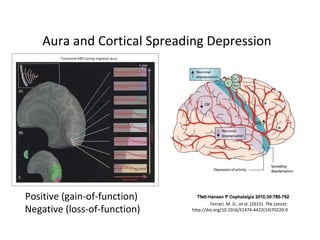
Aura and Cortical Spreading Depression
Positive (gain‐of‐function) 
Negative (loss‐of‐function)
Ferrari, M. D., et al. (2015). The Lancet. 
http://doi.org/10.1016/S1474‐4422(14)70220‐0
CSD may trigger the 
trigeminovascular system
Ferrari, M. D., Klever, R. R., Terwindt, G. M., & Ayata, C. (2015).
Migraine pathophysiology: lessons from mouse models and
human genetics. The Lancet. http://doi.org/10.1016/S1474-
4422(14)70220-0
Brainstem activation as measured with PET in 
spontaneous human migraine without aura attacks 
Tfelt‐Hansen P Cephalalgia 2010;30:780‐792
Genetics
• Familial Hemiplegic Migraine
– Type 1 (CACNA1A) – vg P/Q type Ca++ channel
– Type 2 (ATP1A2) – Na+/K+ ATPase pump
– Type 3 (SCN1A) – vg Na+ channel
– Other ‐ SLC1A3, PRRT2, and SLC4A4 
• Susceptibility genes (clinic and population based)
– Glumatminergic neurotransmission
– Synapse development and plasticity
– Pain sensing
– Metalloproteinases
– Vasculature and metabolism
Ferrari, M. D., Klever, R. R., Terwindt, G. M., & Ayata, C. (2015). Migraine pathophysiology: lessons from 
mouse models and human genetics. The Lancet. http://doi.org/10.1016/S1474‐4422(14)70220‐0
Russo A, Tessitore A, Giordano A, et al.
Cephalalgia. 2012 Oct;32(14):1041–8.
Executive resting-state network connectivity in migraine without aura.
Cognitive symptoms (attention deficit, difficulty finding 
words, transient amnesia, and reduced ability to navigate 
in familiar environments) 
Silberstein SD. Emerging target-based paradigms to prevent and treat migraine. Clin. Pharmacol. Ther. 2013 Jan;93(1):78–85.
WHEN SHOULD I IMAGE?
ACR Appropriateness Criteria for Child 
with Headache 
Primary Headache
• No imaging is indicated for typical 
migraine.
• In ophthalmologic migraine with focal 
neurologic symptoms of unilateral 
ptosis or complete third‐nerve palsy, 
MRI is recommended.
• MRI is also recommended for patients 
with miscellaneous findings such as 
vertigo, basilar artery migraine 
syndrome, persistent confusion 
migraine syndrome, progressive chronic 
headache, or hemiplegic migraine.
• MRI should be performed for patients 
with seizures and postictal headaches.
Secondary Headache
• If neurologic signs or symptoms of increased 
intracranial pressure are present, MRI is 
recommended. If MRI is not available or 
there are problems with sedation, CT should 
be performed.
• CT of the head without intravenous contrast 
is recommended for sudden severe 
headaches (thunderclap headaches).
• If subarachnoid hemorrhage is detected, CT 
or conventional angiography should be 
performed. MRA is also appropriate but is 
generally considered less sensitive in 
detecting small aneurysms.
• If intracranial hemorrhage is present, MRI of 
the brain should be performed if possible. 
Obtaining a concomitant MRA is 
recommended.
Hayes LL, Coley BD, Karmazyn B et al. American College of Radiology. ACR Appropriateness Criteria. Headache—child. 
Reston (VA): ACR [Internet]. 2012[cited 2015 Jun 25]; 8. Available from: https://acsearch.acr.org/docs/69439/Narrative/
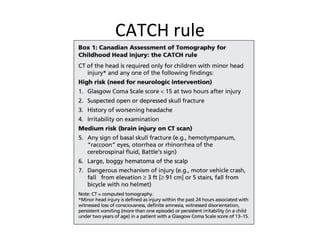
CATCH rule
Appropriateness Rating 
Category
N  Imaged % Important 
Abnormalities
Incidental 
Abnormalities
Usually not appropriate 72 4 6% 0 1
May be appropriate 13 8 61% 1 1
Usually appropriate 10 8 80% 1 3
Imaging Audit
- 95 patient visits sampled
- Diagnosis: headache in 35, migraine in 53, meningeal infection
in 1, neoplasm with hydrocephalus in 1, metabolic disease in 1
and other non-relevant conditions in 4
- 4 patients imaged did not meet any appropriateness criteria,
but each had prior neurosurgery
Hayes LL, Coley BD, Karmazyn B et al. American College of Radiology. ACR Appropriateness Criteria. Headache—child. 
Reston (VA): ACR [Internet]. 2012[cited 2015 Jun 25]; 8. Available from: https://acsearch.acr.org/docs/69439/Narrative/
Brain AttACKs
Predictors
N=1075
18% brought by EMS
Symptoms including headache, focal weakness, etc …
29 (3%) medically important diagnosis
Predictors of Abnormal Imaging
• “First”, “Worst”, thunderclap, or progressive
– Bilateral headache > secondary cause (Masano, 2014)
• *Focal motor findings
• *Unsteady gait / ataxia
• *Altered level of consciousness
• *Signs/symptoms of raised ICP
• *Hypertension (and tachycardia)
• *Young age
Massano D, et al. J Pediatr. 2014;165(2):376‐82.
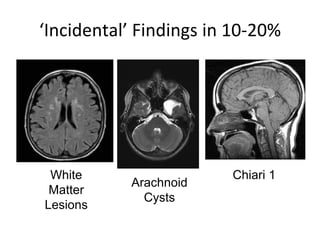
‘Incidental’ Findings in 10‐20%
White
Matter
Lesions
Arachnoid
Cysts
Chiari 1
ORAL, NASAL SPRAY, OR SC 
THERAPY
Network analysis
Placebo
Acetaminophen
IbuprofenZolmitriptan
Almotriptan
Eletriptan
Naratriptan
Rizatriptan
Sumatriptan
Sumatriptan/Naproxen
Approach to abortive therapy
• Start with ibuprofen
– Ensure right dose, right time
– Add metoclopramide 5‐10 mg PO
• Consider other NSAID
• Consider a triptan
– Almotriptan
– Sumatriptan + Naproxen sodium
– Rizatriptan
• Consider infusion 
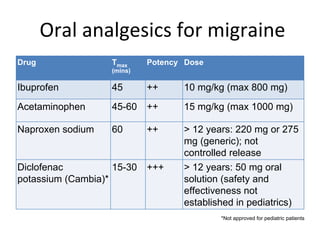
Drug Tmax
(mins)
Potency Dose
Ibuprofen 45 ++ 10 mg/kg (max 800 mg)
Acetaminophen 45-60 ++ 15 mg/kg (max 1000 mg)
Naproxen sodium 60 ++ > 12 years: 220 mg or 275
mg (generic); not
controlled release
Diclofenac
potassium (Cambia)*
15-30 +++ > 12 years: 50 mg oral
solution (safety and
effectiveness not
established in pediatrics)
Oral analgesics for migraine
*Not approved for pediatric patients
Triptans
Drug Approval Dose
Almotriptan Y (Can1) 6.25 mg or 12.5 mg PO
Sumatriptan/naproxe
n
Y (US1) 10 mg/60 mg PO
Rizatriptan Y (US2) 5 mg PO (<40 kg)
10 mg PO (>40 kg)
Sumatriptan Y (US) 25-100 mg PO
5 or 20 mg NS
3 or 6 mg SC
Zolmitriptan Y (US) 2.5 or 5 mg PO/NS
Eletriptan N 20 or 40 mg PO
Naratiptan N 1-2.5 mg PO 112‐17 years
26‐17 years
Novel therapies
• Calcitonin gene‐related peptide (CGRP) receptor antagonist 
– Better than placebo
– Development terminated
• Serotonin 5‐HT1F receptor agonist (Lasmiditan, COL‐144) 
– Better than placebo
• Combined serotonin (5‐HT 1B/1D) receptor agonist and 
neuronal nitric oxide synthase (nNOS) inhibitor 
– Negative phase 2
• Transient receptor potential vanilloid (TRPV1) receptor 
modulators 
– Negative phase 2
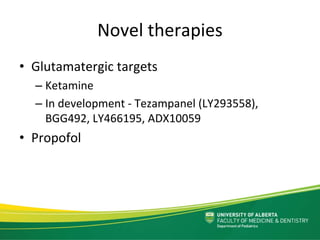
Novel therapies
• Glutamatergic targets 
– Ketamine
– In development ‐ Tezampanel (LY293558), 
BGG492, LY466195, ADX10059
• Propofol 
WHAT NEXT?
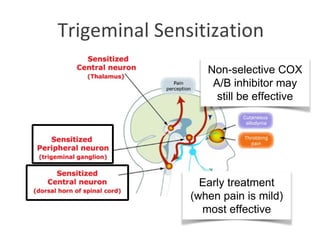
Trigeminal Sensitization
Early treatment
(when pain is mild)
most effective
Non-selective COX
A/B inhibitor may
still be effective
Practice variation in Canada
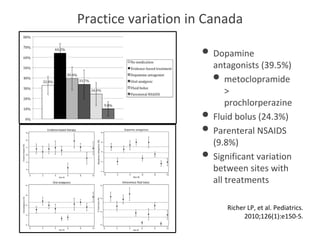
• Dopamine 
antagonists (39.5%)
• metoclopramide 
> 
prochlorperazine
• Fluid bolus (24.3%)
• Parenteral NSAIDS 
(9.8%)
• Significant variation 
between sites with 
all treatments
Richer LP, et al. Pediatrics. 
2010;126(1):e150‐5.
Fluid study
• Headache relief = VAS decrease > 20 mm
• Three (n=3; 6%) returned to the ED in 24 hours
Richer L, et al. Headache. 2014;54(9):1496‐505.
• n=62
• All received 10
ml/kg NS bolus
over 30 mins
• Discharged with
naproxen
sodium for 24
hours
Brousseau DC, Duffy SJ, Anderson AC, Linakis JG. Treatment of pediatric migraine headaches: a randomized, double-blind trial of prochlorperazine versus ketorolac.
Ann Emerg Med. 2004 Feb 1;43(2):256–62.
Prochlorperazine vs. Ketorolac
Agency for Health Research and Quality. Acute Migraine Treatment in Emergency Settings. 2012;
Comparative Effective Review Number 84.
Adult data only
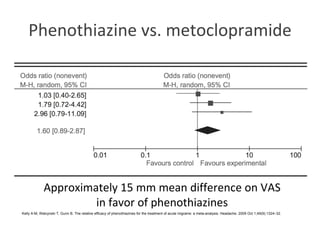
Phenothiazine vs. metoclopramide
Kelly A-M, Walcynski T, Gunn B. The relative efficacy of phenothiazines for the treatment of acute migraine: a meta-analysis. Headache. 2009 Oct 1;49(9):1324–32.
Approximately 15 mm mean difference on VAS 
in favor of phenothiazines
Diphenhydramin
e
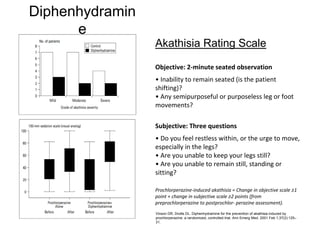
Akathisia Rating Scale
Objective: 2‐minute seated observation
• Inability to remain seated (is the patient 
shifting)?
• Any semipurposeful or purposeless leg or foot 
movements?
Subjective: Three questions
• Do you feel restless within, or the urge to move, 
especially in the legs?
• Are you unable to keep your legs still?
• Are you unable to remain still, standing or 
sitting?
Prochlorperazine‐induced akathisia = Change in objective scale ≥1 
point + change in subjective scale ≥2 points (from 
preprochlorperazine to postprochlor‐ perazine assessment).
Vinson DR, Drotts DL. Diphenhydramine for the prevention of akathisia induced by
prochlorperazine: a randomized, controlled trial. Ann Emerg Med. 2001 Feb 1;37(2):125–
31.
ED visits in pediatric health centers
• 35 pediatric EDs (2009–2012) ‐ 32 124 children with 
migraine
– 5.5% had a return ED visit within 3 days
• Meds ‐ nonopioid analgesics (66%); dopamine antagonists 
(50%) – metoclopramide or prochlorperazine; 
diphenhydramine (33%); ondansetron (21%); Triptans and 
opiate medications (3% each)
• Metoclopramide had a 31% increased odds for an ED 
revisit within 3 days compared with prochlorperazine
– Ondansetron had similar revisit rates to those receiving 
dopamine antagonists.
• Diphenhydramine with dopamine antagonists was 
associated with 27% increased odds of an ED revisit 
Bachur RG, et al. Pediatrics. 2015.
Other dopamine antagonists
• Droperidol
– Butyrophenone
– Mean difference in VAS ~ 40 mm
– Possible risk of QT prolongation
• Chlorpromazine
– Associated with increased risk of hospitalization in 
one retrospective study
Ketorolac
• Survey (n=40)
– 78% always or sometimes use ketorolac among 
Alberta pediatric ED physicians
– 84% of those use it in combination with other 
medications
• Ketorolac + metoclopramide / 
prochlorperazine
– Used in 36% of ED presentations in Canada
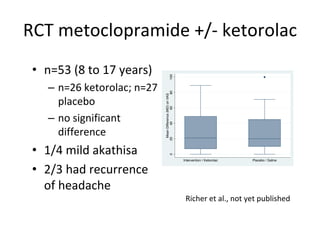
RCT metoclopramide +/‐ ketorolac
• n=53 (8 to 17 years)
– n=26 ketorolac; n=27 
placebo
– no significant 
difference
• 1/4 mild akathisa
• 2/3 had recurrence 
of headache
Richer et al., not yet published
Dihydroergotamine – side effects
• skin reactions (29 percent) and/or local 
reactions (22 percent)
• sedation (20 percent)
• digestive issues (12 percent)
• nausea or vomiting (11 percent)
• chest symptoms (9 percent) 
Best practice – first line therapy?
• Prochlorperazine better than metoclopramide
• Consider droperidol if prochlorperazine not 
available and metoclopramide not sufficiently 
effective
– Probable increased risk of side‐effects
• Consider combination therapy
– Evidence for DHE + neuroleptic/metoclopramide
Propofol
• Rapid onset
– GABAA receptor potentiation
– Na+ channel blocker
– Endocannabinoid system
• Propofol
> dexamethasone 
= SC sumatriptan
• Risk of addiction
• Ongoing pediatric study 
(NCT02485418)
– IV propofol infusion starting 
at 20 mcg/kg/min for 20 
minutes, then 30  then 40
Moshtaghion H, et al. Pain practice 2014; 
published online July 12. DOI: 
10.1111/papr.12230. 
Ketamine
• Analgesic and anesthetic properties
– antagonist of NMDA glutamate receptor 
• Possible treatment of prolonged aura
– Blocks cortical spreading depression
– Ketamine 25 mg IN vs. Midazolam 2 mg IN
– Reduced severity but not duration of aura
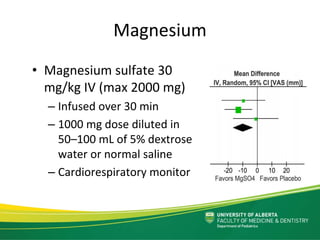
Magnesium
• Magnesium sulfate 30 
mg/kg IV (max 2000 mg)
– Infused over 30 min
– 1000 mg dose diluted in 
50–100 mL of 5% dextrose 
water or normal saline 
– Cardiorespiratory monitor 
Dexamethasone
Colman I, Friedman BW, Brown MD, Innes GD, Grafstein E, Roberts TE, et al. Parenteral dexamethasone for acute severe migraine headache:
meta-analysis of randomised controlled trials for preventing recurrence. BMJ. 2008 Jun 14;336(7657):1359–61.
Best practice ‐ recurrence
• Dexamethasone may reduce headache 
recurrence although no data availalbe in 
children
• Consider dexamethasone 0.5 mg/kg IV (max 
25 mg) single dose prior to discharge 
especially if known to experience recurrence
– Adult studies support IV delivery, but PO 
bioavailability is high as well
When to admit?
• Partial response in ED
• Repeated visits to ED
• Dehydration, intractable vomiting
• Co‐morbidities
– Psychological
– Other medical (e.g. hypertension)
• Further investigation
Dihydroergotamin
e
Side Effects
Chest pain (more common with sumatriptan), nausea
(more common with DHE), drowsiness, flushing, neck
stiffness, vertigo, weakness, and injection site
reactions
• 70% response
• repeated dosing
may be more
effective (IN and
IV)
• 3 and 6 day
protocols
• nausea is a limiting
SE
• sumatriptan SC
may be superior
initially, but DHE
more likely to
sustained pain free
Kabbouche MA, et al. Headache. 2009;49(1):106‐9.
Best practice ‐ admission
• Admission may be associated with better 
outcomes when treating chronic daily 
headache
– Consult other disciplines (e.g. psychiatry)
– Hydration and carbohydrate replacement
• Consider
– Repeated dosing of DHE with neuroleptic / 
metoclopramide
Marmura MJ and Goldberg SW. Current neurology and neuroscience 
reports. 2015;15(4):13.
POST‐TRAUMATIC HEADACHE
ED Treatment of Post‐Traumatic 
HA
• Avoid medication overuse, light activity, 
hydration
• Are there migraine characteristics?
– Use migraine therapy per local protocol
– Case series of sumatriptan or DHE show benefit
• Amitriptyline frequently prescribed symptom 
reducing treatment
Dubrovsky AS, Friedman D, Kocilowicz H. Pediatric post‐traumatic headaches and peripheral nerve 
blocks of the scalp: a case series and patient satisfaction survey. Headache. 2014;54(5):878–87.
Dubrovsky AS, Friedman D, Kocilowicz H. Pediatric post‐traumatic headaches and peripheral nerve 
blocks of the scalp: a case series and patient satisfaction survey. Headache. 2014;54(5):878–87.
• Peripheral nerve block
– 71 % reporting immediate relief 
– Decrease mean intensity of 93% 
– GON + supra‐orbital nerve (SON) in 60%
– GON alone in 27%
– GON + lesser occipital nerve +/‐ SON in 14%
Summary
•Migraine is a complex brain‐based disorder
•Treatment of migraine in the ED is highly variable
•Neuroleptics (e.g. prochlorperazine) and 
combination therapy with DHE are likely most 
effective
Acknowledgements
D. Johnson, S. Ali, B. Rowe, M. Newton, R. 
Rosychuk
PERC
Women and Children’s Health Research Institute 
Innovation Grant and Stollery Children’s Hospital 
Foundation
Canadian Institutes of Health Research (CIHR)

La migraine