Headache
diagnosis and treatment :
now and the future
Paul Rolan MBBS MD FRACP FFPM DCPSA
Professor of Clinical Pharmacology
Senior Consultant, Pain Management Unit, RAH
Headache
• in 99.9% of people with headache there is no sign of tissue
damage
• injuring the brain itself does not cause pain – it causes
altered brain function
• however the membrane and blood vessels of the brain are
very pain sensitive
Headache: causes
• Primary (99%+)
• Tension – type 69
• Migraine 16
• Stabbing 2
• Exertional 1
• Cluster 0.1
• Due to something else
(<1%)
• Systemic infection 63
• Head injury 4
• Vascular / bleeding 1
• Brain tumour 0.1
Headache diagnosis
• almost entirely on the patients story
• tests, scans etc rarely helpful.
Headache: history
• How old were you when the headaches started?
• How often do they come?
• Do they come in relationship to anything else?
• At what time do they come on?
• How do they start?
• Where is the pain?
• How long does it last?
• How bad is it?
• Are there other symptoms?
• Does anything bring it on?
• What helps?
• How long does it last?
Pattern recognition
pick the odd one out
Tension-type Headache
• Frequency chronic
often daily
• Pain mild-moderate
pressure, tightness
• Duration 30 mins - 7 days
• Location both sides
whole head and neck
• Symptoms no light / sound sensitivity
no aura
Typical patient : any
Tension-type headache
• now thought to be due to increased brain sensitivity to
normal sensory inputs
• few effective treatments : we are trialling a non-drug
treatment
Migraine (“half-head”)
• Frequency 1-2/year- 2-3/week
• Pain moderate - severe
pulsating, throbbing
• Duration 4 hrs - 3 days
• Location usually one sided (but side can swap
between attacks)
• Symptoms aura
nausea, vomiting
sensitive to light, sound, smells
Typical migraine patient
• onset often as child / teenager / young adult
• but can start at any age
• 2-3 x more common in women than men
• typical patient : young woman (15% of all young women)
What happens during a migraine?
Migraine cause
• cause unknown but strongly inherited
• a lower threshold to spontaneously produce symptoms as if
the head and brain had been injured
• many effective treatments
Triggers
• foods : spices, wine , chocolate, citrus
• food additives : monosodium glutamate
• sleep : both too much and too little
• stress : mainly offset
• female hormones : fluctuating or falling oestrogen
Migrainous Aura
Migrainous Aura
Migrainous Aura
Medication overuse headache
• headache made WORSE by pain killers
• only occurs in people who already had headache
• mainly due to codeine-containing medicines or stronger
morphine-like drugs
• need to stop responsible medicines : easier said than done
• we are trialling a new treatment for this
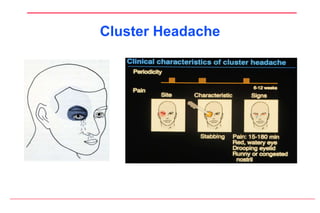
Cluster Headache
• Frequency clusters – every time each year or season;
then free
• Pain excruciating
penetrating, boring
continuous, non-throbbing
• Duration 15mins-3 hrs; same clock time each day
(2am); several episodes / day
• Location ALWAYS the same side
• Symptoms watering eyes
nasal stuffiness, runny nose
red eye, swollen eyelids
sweating
Typical patient : middle aged male smoker
Cluster Headache
Trigeminal Neuralgia
• VERY short (<1 sec) severe
pain
• Knife-like
• Local triggering : eating etc
Typical patient : middle aged / elderly woman
Other headaches
• Paroxysmal hemicrania
• “SUNCT”
– short lasting neuralgiform;conjunctival injection, tearing
• Stabbing headaches
• After head injury / head surgery
• Sexual headaches
• Altitude sickness
Treatment
Explanation, set realistic objectives
Lifestyle change
Treatment of
the attack
Treatment to reduce
attack frequency
Treatment of the attack
1 General pain relievers
2 Migraine-specific treatments
- triptans and ergots
3 Cluster specific treatment
- oxygen
- triptans
General pain relievers : migraine,
tension
aspirin paracetamol ibuprofen codeine tramadol
Fast? ✔✔ ✔ ✔
Safe? ✔✔
OK for
long term?
✖ ✔✔ ✖ ✖✖✖
Not suitable : dextropropoxyphene “Doloxene; Di-Gesic”
morphine, pethidine
Additives : metoclopramide (nausea)
caffeine
Triptans : Imigran, Zomig,
Naramig, Maxalt, Relpax
FOR
• can be very
effective :
migraine, cluster
(NOT tension)
• tablets, wafers,
nasal spray,
injection
• AGAINST
• feel strange, chest
pain
• expensive, small
supply
• overuse makes
headaches more
frequent
• constrict blood
vessels
Ergots : migraine, cluster
FOR
• can be very
effective when
others fail
• nasal spray,
suppository
injection
• AGAINST
• hard to get
• overuse causes
poor circulation
and more
headache
• not for tension
Preventative drugs
• “mixed bag” of drugs used for other conditions found to be
effective in headache usually by chance
• usually for high blood pressure, depression, epilepsy
• all work in somebody ; none works in everybody
• generally reduce frequency but do not change attacks
• key to success : trial and error : persist
• need to start at low dose and increase until effective or not
tolerated
• about 50 % of patients will get 50% or more reduction in
attacks
Main migraine preventers
Effectiveness
Tolerability / safety Good Fair Poor
Good propranolol verapamil
Botox
Fair amitriptyline
topiramate
valproate
pizotifen
ibuprofen
Poor methysergide
Tension preventers
Effectiveness
Tolerability / safety Good Fair Poor
Good
Fair amitriptyline ibuprofen
Poor
Cluster preventers - balance of
effectiveness and safety /
tolerability
Effectiveness
Tolerability / safety Good Fair Poor
Good verapamil
Fair topiramate
Poor methysergide
steroids
lithium
Non drug
Herbal
•feverfew – no
•butterbur – possibly
Manual therapies
•physiotherapy – caution
•acupuncture – no
Electrical occipital nerve stimulation : possibly
Closure of hole in heart - no
In the pipeline
In the pipeline
• “vaccination” for migraine
• new classes of drugs
Our research
• we are trialling a non-drug electrical therapy for tension-
type headache
• we are trialling a completely new drug approach to
medication overuse headache
• we may be trialling new agents for migraine in the near
future
http://www.adelaide.edu.au/painresearch/participate/

Headache.ppt

  • 1.
    Headache diagnosis and treatment: now and the future Paul Rolan MBBS MD FRACP FFPM DCPSA Professor of Clinical Pharmacology Senior Consultant, Pain Management Unit, RAH
  • 2.
    Headache • in 99.9%of people with headache there is no sign of tissue damage • injuring the brain itself does not cause pain – it causes altered brain function • however the membrane and blood vessels of the brain are very pain sensitive
  • 4.
    Headache: causes • Primary(99%+) • Tension – type 69 • Migraine 16 • Stabbing 2 • Exertional 1 • Cluster 0.1 • Due to something else (<1%) • Systemic infection 63 • Head injury 4 • Vascular / bleeding 1 • Brain tumour 0.1
  • 5.
    Headache diagnosis • almostentirely on the patients story • tests, scans etc rarely helpful.
  • 6.
    Headache: history • Howold were you when the headaches started? • How often do they come? • Do they come in relationship to anything else? • At what time do they come on? • How do they start? • Where is the pain? • How long does it last? • How bad is it? • Are there other symptoms? • Does anything bring it on? • What helps? • How long does it last?
  • 7.
  • 8.
    Tension-type Headache • Frequencychronic often daily • Pain mild-moderate pressure, tightness • Duration 30 mins - 7 days • Location both sides whole head and neck • Symptoms no light / sound sensitivity no aura Typical patient : any
  • 9.
  • 10.
    Tension-type headache • nowthought to be due to increased brain sensitivity to normal sensory inputs • few effective treatments : we are trialling a non-drug treatment
  • 11.
    Migraine (“half-head”) • Frequency1-2/year- 2-3/week • Pain moderate - severe pulsating, throbbing • Duration 4 hrs - 3 days • Location usually one sided (but side can swap between attacks) • Symptoms aura nausea, vomiting sensitive to light, sound, smells
  • 12.
    Typical migraine patient •onset often as child / teenager / young adult • but can start at any age • 2-3 x more common in women than men • typical patient : young woman (15% of all young women)
  • 13.
  • 14.
    Migraine cause • causeunknown but strongly inherited • a lower threshold to spontaneously produce symptoms as if the head and brain had been injured • many effective treatments
  • 15.
    Triggers • foods :spices, wine , chocolate, citrus • food additives : monosodium glutamate • sleep : both too much and too little • stress : mainly offset • female hormones : fluctuating or falling oestrogen
  • 16.
  • 17.
  • 18.
  • 19.
    Medication overuse headache •headache made WORSE by pain killers • only occurs in people who already had headache • mainly due to codeine-containing medicines or stronger morphine-like drugs • need to stop responsible medicines : easier said than done • we are trialling a new treatment for this
  • 20.
    Cluster Headache • Frequencyclusters – every time each year or season; then free • Pain excruciating penetrating, boring continuous, non-throbbing • Duration 15mins-3 hrs; same clock time each day (2am); several episodes / day • Location ALWAYS the same side • Symptoms watering eyes nasal stuffiness, runny nose red eye, swollen eyelids sweating Typical patient : middle aged male smoker
  • 21.
  • 22.
    Trigeminal Neuralgia • VERYshort (<1 sec) severe pain • Knife-like • Local triggering : eating etc Typical patient : middle aged / elderly woman
  • 23.
    Other headaches • Paroxysmalhemicrania • “SUNCT” – short lasting neuralgiform;conjunctival injection, tearing • Stabbing headaches • After head injury / head surgery • Sexual headaches • Altitude sickness
  • 24.
    Treatment Explanation, set realisticobjectives Lifestyle change Treatment of the attack Treatment to reduce attack frequency
  • 25.
    Treatment of theattack 1 General pain relievers 2 Migraine-specific treatments - triptans and ergots 3 Cluster specific treatment - oxygen - triptans
  • 26.
    General pain relievers: migraine, tension aspirin paracetamol ibuprofen codeine tramadol Fast? ✔✔ ✔ ✔ Safe? ✔✔ OK for long term? ✖ ✔✔ ✖ ✖✖✖ Not suitable : dextropropoxyphene “Doloxene; Di-Gesic” morphine, pethidine Additives : metoclopramide (nausea) caffeine
  • 27.
    Triptans : Imigran,Zomig, Naramig, Maxalt, Relpax FOR • can be very effective : migraine, cluster (NOT tension) • tablets, wafers, nasal spray, injection • AGAINST • feel strange, chest pain • expensive, small supply • overuse makes headaches more frequent • constrict blood vessels
  • 28.
    Ergots : migraine,cluster FOR • can be very effective when others fail • nasal spray, suppository injection • AGAINST • hard to get • overuse causes poor circulation and more headache • not for tension
  • 29.
    Preventative drugs • “mixedbag” of drugs used for other conditions found to be effective in headache usually by chance • usually for high blood pressure, depression, epilepsy • all work in somebody ; none works in everybody • generally reduce frequency but do not change attacks • key to success : trial and error : persist • need to start at low dose and increase until effective or not tolerated • about 50 % of patients will get 50% or more reduction in attacks
  • 30.
    Main migraine preventers Effectiveness Tolerability/ safety Good Fair Poor Good propranolol verapamil Botox Fair amitriptyline topiramate valproate pizotifen ibuprofen Poor methysergide
  • 31.
    Tension preventers Effectiveness Tolerability /safety Good Fair Poor Good Fair amitriptyline ibuprofen Poor
  • 32.
    Cluster preventers -balance of effectiveness and safety / tolerability Effectiveness Tolerability / safety Good Fair Poor Good verapamil Fair topiramate Poor methysergide steroids lithium
  • 33.
    Non drug Herbal •feverfew –no •butterbur – possibly Manual therapies •physiotherapy – caution •acupuncture – no Electrical occipital nerve stimulation : possibly Closure of hole in heart - no
  • 34.
  • 35.
    In the pipeline •“vaccination” for migraine • new classes of drugs
  • 36.
    Our research • weare trialling a non-drug electrical therapy for tension- type headache • we are trialling a completely new drug approach to medication overuse headache • we may be trialling new agents for migraine in the near future
  • 37.