PARKINSONISM
Dr. Ahmad Shahir Mawardi
MD (UKM), MMED (UKM), CCST Neurology (Mal), Fellowship in Movement Disorders (UK)
Dr. Nor Amelia Mohd Fauzi
MBBChBAO (Ire), BMedSc (Ire), MRCP (UK), CCST Neurology (Mal), Fellowship of the European
Board of Neurology (FEBN), Fellowships in Epilepsy & Movement Disorders (London,UK)
Case 1
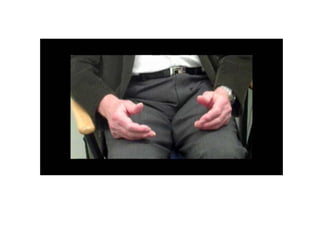
This gentleman complains
of right hand tremor.
Please examine his upper
limbs and proceed
accordingly.
How to examine for rigidity?
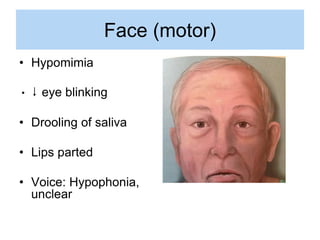
Face (motor)
• Hypomimia
• ↓ eye blinking
• Drooling of saliva
• Lips parted
• Voice: Hypophonia,
unclear
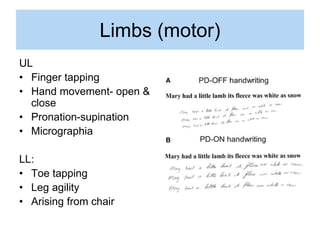
Limbs (motor)
UL
• Finger tapping
• Hand movement- open &
close
• Pronation-supination
• Micrographia
LL:
• Toe tapping
• Leg agility
• Arising from chair
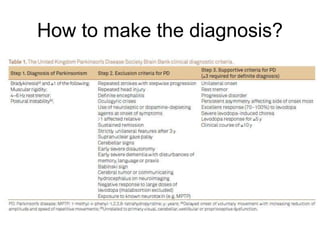
How to make the diagnosis?
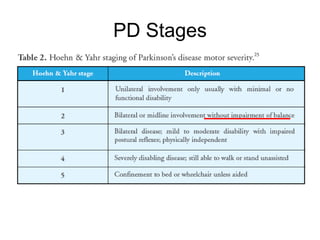
PD Stages
• Can it be so simple?
– Always think about complications of disease
– Treatment options
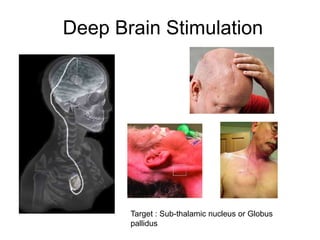
Deep Brain Stimulation
Target : Sub-thalamic nucleus or Globus
pallidus
Complication of Therapy
• Levodopa induced
dyskinesia
• Extra question: Types
of dyskinesia
– peak dose dyskinesia
– end dose dyskinesia
– biphasic dyskinesia
Possible questions
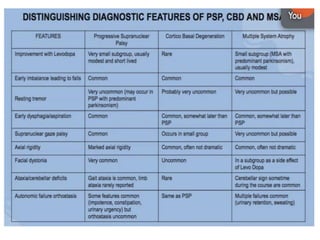
1. What are the causes of Parkinsonism?
2. What are the Parkinson-Plus syndromes?
3. List the non-motor symtoms
4. How would you investigate this patient? Which
investigation of choice to differentiate PD vs Essential
tremor?
5. What is the pharmacological management of
Parkinson’s disease?
6. What non-oral therapies are available for Parkinson’s
disease?
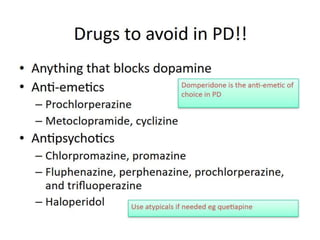
7. Is there any drug that should be avoided in PD patients?
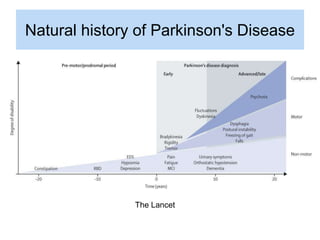
Natural history of Parkinson's Disease
The Lancet
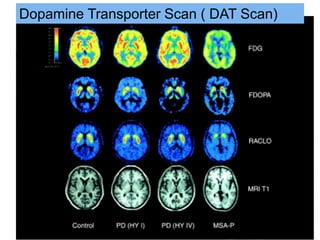
Dopamine Transporter Scan ( DAT Scan)
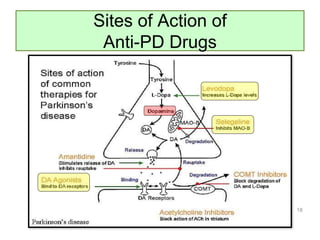
Sites of Action of
Anti-PD Drugs
18
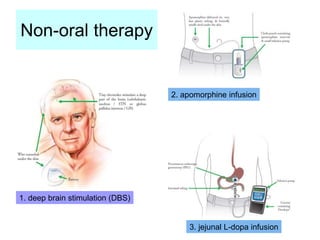
Non-oral therapy
1. deep brain stimulation (DBS)
2. apomorphine infusion
3. jejunal L-dopa infusion
Case 2
This gentleman complains
of limbs stiffness.
Please examine his upper
limbs and proceed
accordingly.
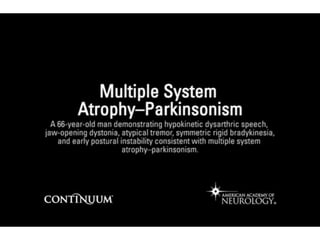
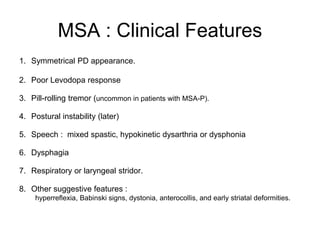
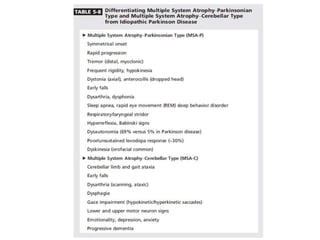
MSA : Clinical Features
1. Symmetrical PD appearance.
2. Poor Levodopa response
3. Pill-rolling tremor (uncommon in patients with MSA-P).
4. Postural instability (later)
5. Speech : mixed spastic, hypokinetic dysarthria or dysphonia
6. Dysphagia
7. Respiratory or laryngeal stridor.
8. Other suggestive features :
hyperreflexia, Babinski signs, dystonia, anterocollis, and early striatal deformities.
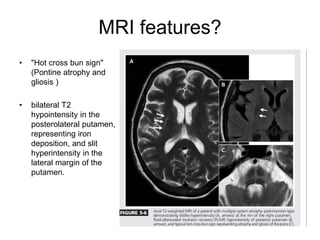
MRI features?
• "Hot cross bun sign"
(Pontine atrophy and
gliosis )
• bilateral T2
hypointensity in the
posterolateral putamen,
representing iron
deposition, and slit
hyperintensity in the
lateral margin of the
putamen.
What other investigations that can
support the diagnosis?
• PET scans : decreased striatal and frontal metabolism.
• DAT (125I-ioflupane) SPECT : asymmetric reduced striatal binding.46
• Autonomic testing :
– tilt-table testing
– 24-hour ambulatory blood pressure and heart rate monitoring
– baroreceptor sensitivity (Sweat testing, gastric emptying study for gastroparesis, and
urodyamics for urinary dysfunction.
Case 3
This gentleman complains
of dysphagia and recurrent
falls.
Look at his face and please
proceed accordingly.
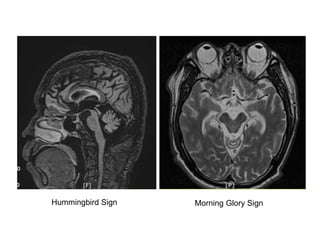
Hummingbird Sign Morning Glory Sign
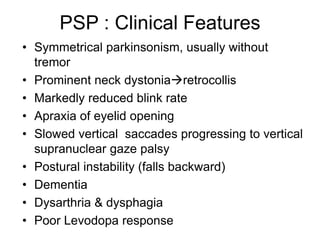
• Symmetrical parkinsonism, usually without
tremor
• Prominent neck dystoniaretrocollis
• Markedly reduced blink rate
• Apraxia of eyelid opening
• Slowed vertical saccades progressing to vertical
supranuclear gaze palsy
• Postural instability (falls backward)
• Dementia
• Dysarthria & dysphagia
• Poor Levodopa response
PSP : Clinical Features
Case 4
This lady complains of
speech disturbance and
unsteady gait.
Look at her face and please
proceed accordingly.
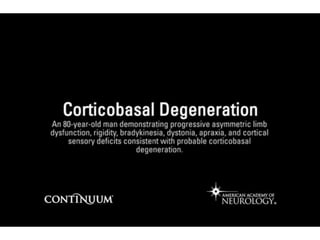
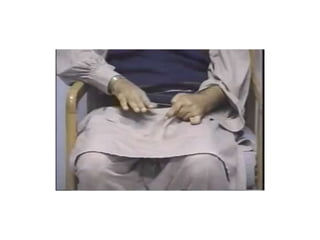
Motor Symptoms:
•Asymmetrical parkinsonism – affecting one
limb
•Progressive dystonia
•The limb often described as “dead”,
“useless”, frequently held postured across
the body
•Myoclonus (distal, stimulus-sensitive)
•Alien-limb phenomena – in 50% patients
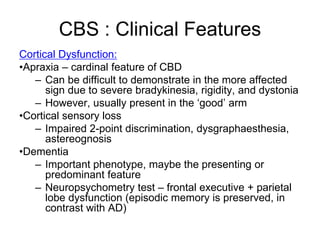
CBS : Clinical Features
Cortical Dysfunction:
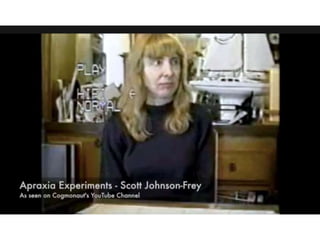
•Apraxia – cardinal feature of CBD
– Can be difficult to demonstrate in the more affected
sign due to severe bradykinesia, rigidity, and dystonia
– However, usually present in the ‘good’ arm
•Cortical sensory loss
– Impaired 2-point discrimination, dysgraphaesthesia,
astereognosis
•Dementia
– Important phenotype, maybe the presenting or
predominant feature
– Neuropsychometry test – frontal executive + parietal
lobe dysfunction (episodic memory is preserved, in
contrast with AD)
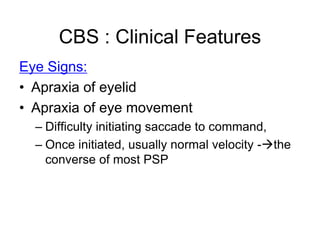
CBS : Clinical Features
Eye Signs:
• Apraxia of eyelid
• Apraxia of eye movement
– Difficulty initiating saccade to command,
– Once initiated, usually normal velocity -the
converse of most PSP
CBS : Clinical Features
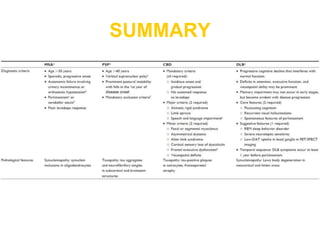
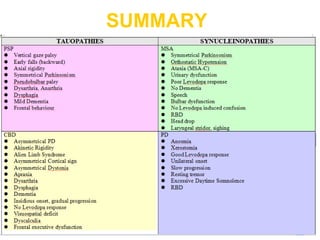
SUMMARY
SUMMARY
Post-Congress Workshop - Parkinsonism.ppt

Post-Congress Workshop - Parkinsonism.ppt

  • 1.
    PARKINSONISM Dr. Ahmad ShahirMawardi MD (UKM), MMED (UKM), CCST Neurology (Mal), Fellowship in Movement Disorders (UK) Dr. Nor Amelia Mohd Fauzi MBBChBAO (Ire), BMedSc (Ire), MRCP (UK), CCST Neurology (Mal), Fellowship of the European Board of Neurology (FEBN), Fellowships in Epilepsy & Movement Disorders (London,UK)
  • 3.
  • 4.
    This gentleman complains ofright hand tremor. Please examine his upper limbs and proceed accordingly.
  • 6.
    How to examinefor rigidity?
  • 7.
    Face (motor) • Hypomimia •↓ eye blinking • Drooling of saliva • Lips parted • Voice: Hypophonia, unclear
  • 8.
    Limbs (motor) UL • Fingertapping • Hand movement- open & close • Pronation-supination • Micrographia LL: • Toe tapping • Leg agility • Arising from chair
  • 10.
    How to makethe diagnosis?
  • 11.
  • 12.
    • Can itbe so simple? – Always think about complications of disease – Treatment options
  • 13.
    Deep Brain Stimulation Target: Sub-thalamic nucleus or Globus pallidus
  • 14.
    Complication of Therapy •Levodopa induced dyskinesia • Extra question: Types of dyskinesia – peak dose dyskinesia – end dose dyskinesia – biphasic dyskinesia
  • 15.
    Possible questions 1. Whatare the causes of Parkinsonism? 2. What are the Parkinson-Plus syndromes? 3. List the non-motor symtoms 4. How would you investigate this patient? Which investigation of choice to differentiate PD vs Essential tremor? 5. What is the pharmacological management of Parkinson’s disease? 6. What non-oral therapies are available for Parkinson’s disease? 7. Is there any drug that should be avoided in PD patients?
  • 16.
    Natural history ofParkinson's Disease The Lancet
  • 17.
  • 18.
    Sites of Actionof Anti-PD Drugs 18
  • 19.
    Non-oral therapy 1. deepbrain stimulation (DBS) 2. apomorphine infusion 3. jejunal L-dopa infusion
  • 21.
  • 22.
    This gentleman complains oflimbs stiffness. Please examine his upper limbs and proceed accordingly.
  • 24.
    MSA : ClinicalFeatures 1. Symmetrical PD appearance. 2. Poor Levodopa response 3. Pill-rolling tremor (uncommon in patients with MSA-P). 4. Postural instability (later) 5. Speech : mixed spastic, hypokinetic dysarthria or dysphonia 6. Dysphagia 7. Respiratory or laryngeal stridor. 8. Other suggestive features : hyperreflexia, Babinski signs, dystonia, anterocollis, and early striatal deformities.
  • 26.
    MRI features? • "Hotcross bun sign" (Pontine atrophy and gliosis ) • bilateral T2 hypointensity in the posterolateral putamen, representing iron deposition, and slit hyperintensity in the lateral margin of the putamen.
  • 27.
    What other investigationsthat can support the diagnosis? • PET scans : decreased striatal and frontal metabolism. • DAT (125I-ioflupane) SPECT : asymmetric reduced striatal binding.46 • Autonomic testing : – tilt-table testing – 24-hour ambulatory blood pressure and heart rate monitoring – baroreceptor sensitivity (Sweat testing, gastric emptying study for gastroparesis, and urodyamics for urinary dysfunction.
  • 28.
  • 29.
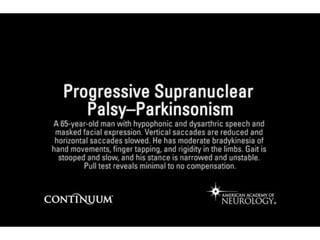
    This gentleman complains ofdysphagia and recurrent falls. Look at his face and please proceed accordingly.
  • 31.
  • 32.
    • Symmetrical parkinsonism,usually without tremor • Prominent neck dystoniaretrocollis • Markedly reduced blink rate • Apraxia of eyelid opening • Slowed vertical saccades progressing to vertical supranuclear gaze palsy • Postural instability (falls backward) • Dementia • Dysarthria & dysphagia • Poor Levodopa response PSP : Clinical Features
  • 33.
  • 34.
    This lady complainsof speech disturbance and unsteady gait. Look at her face and please proceed accordingly.
  • 36.
    Motor Symptoms: •Asymmetrical parkinsonism– affecting one limb •Progressive dystonia •The limb often described as “dead”, “useless”, frequently held postured across the body •Myoclonus (distal, stimulus-sensitive) •Alien-limb phenomena – in 50% patients CBS : Clinical Features
  • 38.
    Cortical Dysfunction: •Apraxia –cardinal feature of CBD – Can be difficult to demonstrate in the more affected sign due to severe bradykinesia, rigidity, and dystonia – However, usually present in the ‘good’ arm •Cortical sensory loss – Impaired 2-point discrimination, dysgraphaesthesia, astereognosis •Dementia – Important phenotype, maybe the presenting or predominant feature – Neuropsychometry test – frontal executive + parietal lobe dysfunction (episodic memory is preserved, in contrast with AD) CBS : Clinical Features
  • 40.
    Eye Signs: • Apraxiaof eyelid • Apraxia of eye movement – Difficulty initiating saccade to command, – Once initiated, usually normal velocity -the converse of most PSP CBS : Clinical Features
  • 42.
  • 43.

Editor's Notes

  • #12 How to check for balance impariment?
  • #33 Asymmetrical parkinsonism – IPD, MSA, DIP, CBD The limb seems to have the mind of their own Without patient wiling, or noticing it, the limb may move about
  • #37 Asymmetrical parkinsonism – IPD, MSA, DIP, CBD The limb seems to have the mind of their own Without patient wiling, or noticing it, the limb may move about
  • #39 Asymmetrical parkinsonism – IPD, MSA, DIP, CBD Without patient wiling, or noticing it, the limb may move about
  • #41 Asymmetrical parkinsonism – IPD, MSA, DIP, CBD Without patient wiling, or noticing it, the limb may move about