Multimodality treatment of head and neck SCC R5  林育靖   / P  洪瑞隆
Outline  Introduction, staging Who needs multimodality treatment Incorporate chemotherapy to definitive local tx Adjuvant  Induction Concurrent  Organ preservation  Laryngeal cancer as an example
Head and neck cancer Heterogeneous disease Oral cavity, oropharynx, larynx, hypopharynx  Mostly SCC Common etiology: smoking and drinking (betel nut for oral ca) Similar biological behavior Today’s topic  Nasopharynx:  WHO class type III: undifferentiate ca (NPC) Nasal and paranasal sinus  Salivary gland
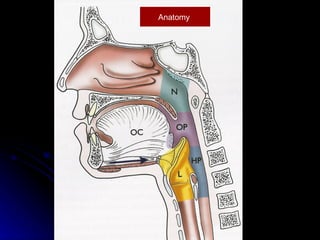
Anatomy
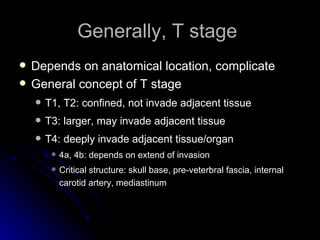
Generally, T stage  Depends on anatomical location, complicate  General concept of T stage T1, T2: confined, not invade adjacent tissue T3: larger, may invade adjacent tissue T4: deeply invade adjacent tissue/organ 4a, 4b: depends on extend of invasion  Critical structure: skull base, pre-veterbral fascia, internal carotid artery, mediastinum
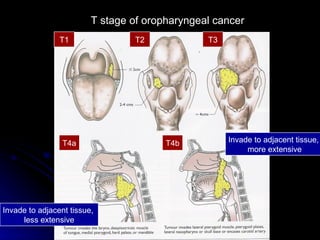
T stage of oropharyngeal cancer T1 T2 T3 T4a T4b Invade to adjacent tissue,  less extensive Invade to adjacent tissue,  more extensive
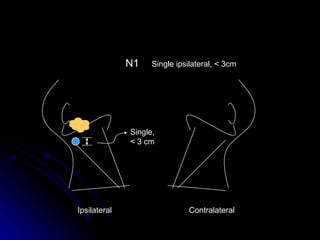
Ipsilateral  Contralateral  N1 Single,< 3 cm Single ipsilateral, < 3cm
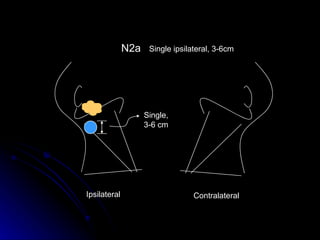
N2a Single ipsilateral, 3-6cm Contralateral  Ipsilateral  Single, 3-6 cm
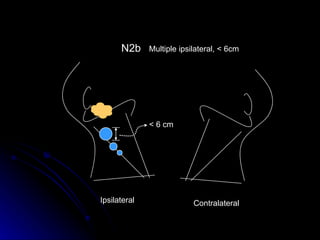
N2b Multiple ipsilateral, < 6cm Ipsilateral  < 6 cm Contralateral
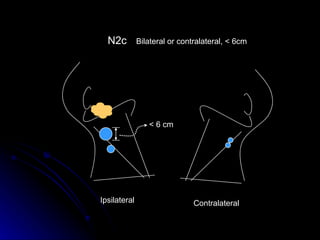
N2c Bilateral or contralateral, < 6cm Ipsilateral  < 6 cm Contralateral
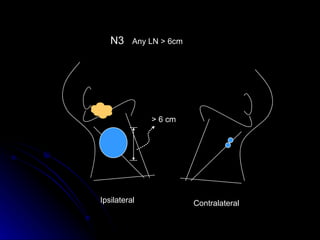
N3 Any LN > 6cm Ipsilateral  > 6 cm Contralateral
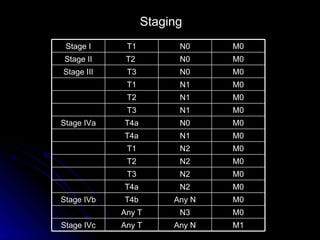
Staging   M0 N3 Any T M1 Any N Any T Stage IVc M0 Any N T4b Stage IVb M0 N2 T4a M0 N2 T3 M0 N2 T2 M0 N2 T1 M0 N1 T4a M0 N0 T4a Stage IVa M0 N1 T3 M0 N1 T2 M0 N1 T1 M0 N0 T3 Stage III M0 N0 T2  Stage II M0 N0 T1 Stage I
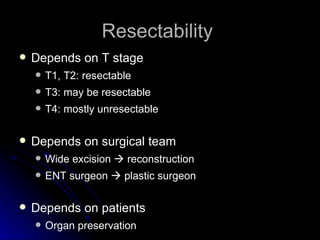
Resectability  Depends on T stage T1, T2: resectable T3: may be resectable T4: mostly unresectable Depends on surgical team Wide excision    reconstruction ENT surgeon    plastic surgeon Depends on patients Organ preservation
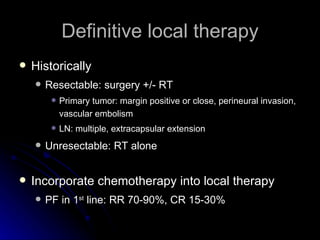
Definitive local therapy Historically  Resectable: surgery +/- RT Primary tumor: margin positive or close, perineural invasion, vascular embolism LN: multiple, extracapsular extension Unresectable: RT alone Incorporate chemotherapy into local therapy PF in 1 st  line: RR 70-90%, CR 15-30%
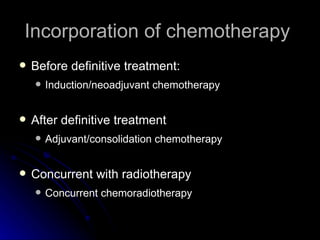
Incorporation of chemotherapy  Before definitive treatment:  Induction/neoadjuvant chemotherapy After definitive treatment Adjuvant/consolidation chemotherapy  Concurrent with radiotherapy Concurrent chemoradiotherapy
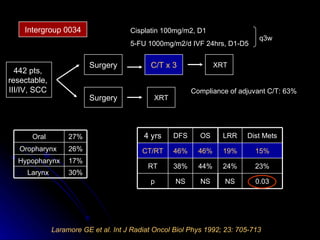
Intergroup 0034 Laramore GE et al. Int J Radiat Oncol Biol Phys 1992; 23: 705-713 442 pts,  resectable,  III/IV, SCC  C/T x 3 Surgery XRT XRT Cisplatin 100mg/m2, D1 5-FU 1000mg/m2/d IVF 24hrs, D1-D5 q3w Compliance of adjuvant C/T: 63% Surgery 30% Larynx  17% Hypopharynx 26% 27% Oropharynx  Oral NS 38% 46% DFS NS 44% 46% OS 0.03 NS p 23% 15% Dist Mets 24% RT 19% CT/RT LRR 4 yrs
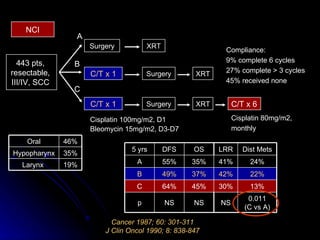
NCI 443 pts,  resectable,  III/IV, SCC  C/T x 1 XRT XRT Surgery C/T x 6 XRT Surgery C/T x 1 Surgery Cisplatin 100mg/m2, D1 Bleomycin 15mg/m2, D3-D7 Cisplatin 80mg/m2,  monthly Compliance: 9% complete 6 cycles 27% complete > 3 cycles 45% received none A B C Cancer 1987; 60: 301-311 J Clin Oncol 1990; 8: 838-847 19% Larynx  35% Hypopharynx 46% Oral NS 45% 37% 35% OS NS 64% 49% 55% DFS 22% 42% B 0.011 (C vs A) NS p 13% 24% Dist Mets 30% C 41% A LRR 5 yrs
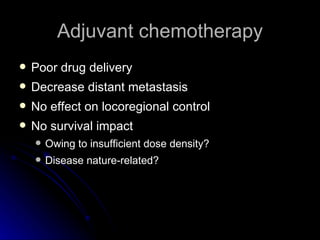
Adjuvant chemotherapy Poor drug delivery  Decrease distant metastasis No effect on locoregional control No survival impact Owing to insufficient dose density? Disease nature-related?
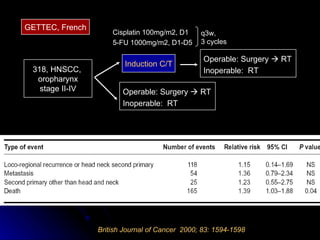
British Journal of Cancer  2000; 83: 1594-1598 GETTEC, French 318, HNSCC,  oropharynx stage II-IV Induction C/T Cisplatin 100mg/m2, D1 5-FU 1000mg/m2, D1-D5 q3w,  3 cycles Operable: Surgery    RT Inoperable:  RT Operable: Surgery    RT Inoperable:  RT
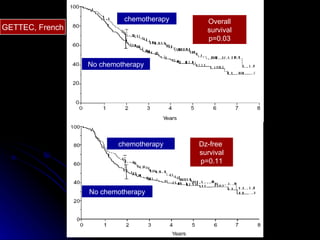
chemotherapy No chemotherapy Overall survival p=0.03 chemotherapy No chemotherapy Dz-free  survival p=0.11 GETTEC, French
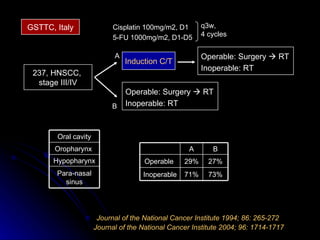
Journal of the National Cancer Institute 1994; 86: 265-272  Journal of the National Cancer Institute 2004; 96: 1714-1717 GSTTC, Italy 237, HNSCC,  stage III/IV Induction C/T Operable: Surgery    RT Inoperable: RT Cisplatin 100mg/m2, D1 5-FU 1000mg/m2, D1-D5 q3w,  4 cycles Operable: Surgery    RT Inoperable: RT A B Oral cavity Para-nasal sinus Hypopharynx Oropharynx  73% 71% Inoperable  29% A 27% Operable  B
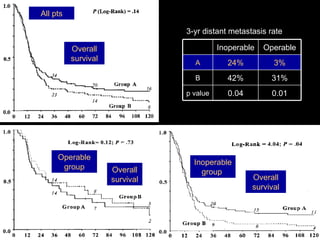
All pts Operable group Inoperable group  Overall survival Overall survival Overall survival 3-yr distant metastasis rate 0.01 31% 3% Operable 0.04 p value 42% B 24% A Inoperable
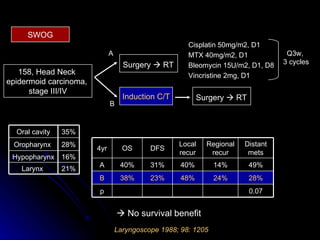
SWOG 158, Head Neck  epidermoid carcinoma,  stage III/IV Induction C/T Surgery    RT Cisplatin 50mg/m2, D1 MTX 40mg/m2, D1 Bleomycin 15U/m2, D1, D8 Vincristine 2mg, D1  Q3w,  3 cycles A B Laryngoscope 1988; 98: 1205 Surgery    RT    No survival benefit 21% 16% 28% 35% Oral cavity Larynx  Hypopharynx Oropharynx  0.07 28% 49% Distant mets 48% 40% Local recur 23% 31% DFS p 38% 40% OS 24% B 14% A Regional recur 4yr
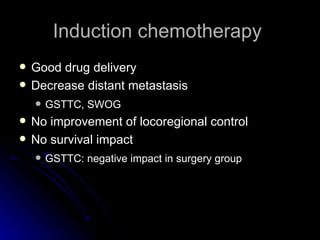
Induction chemotherapy  Good drug delivery Decrease distant metastasis GSTTC, SWOG No improvement of locoregional control No survival impact GSTTC: negative impact in surgery group
Concurrent chemoradiotherapy
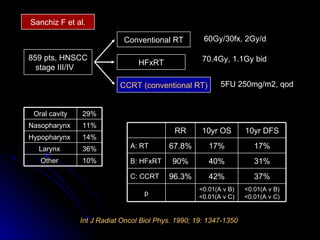
859 pts, HNSCC stage III/IV  HFxRT Conventional RT Sanchiz F et al. Int J Radiat Oncol Biol Phys. 1990; 19: 1347-1350   CCRT (conventional RT) 60Gy/30fx, 2Gy/d 70.4Gy, 1.1Gy bid  5FU 250mg/m2, qod <0.01(A v B) <0.01(A v C) <0.01(A v B) <0.01(A v C) p 96.3% 90% 67.8% RR 37% 31% 17% 10yr DFS 42% C: CCRT 40% B: HFxRT 17% A: RT 10yr OS 36% Larynx  10% Other  14% Hypopharynx  11% Nasopharynx  29% Oral cavity
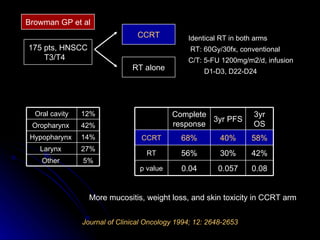
Journal of Clinical Oncology 1994; 12: 2648-2653 175 pts, HNSCC T3/T4  RT alone CCRT Identical RT in both arms  RT: 60Gy/30fx, conventional C/T: 5-FU 1200mg/m2/d, infusion    D1-D3, D22-D24 More mucositis, weight loss, and skin toxicity in CCRT arm Browman GP et al 0.04 56% 68% Complete response 0.08 42% 58% 3yr OS 0.057 p value 30% RT 40% CCRT 3yr PFS 27% Larynx  5% Other  14% Hypopharynx  42% Oropharynx  12% Oral cavity
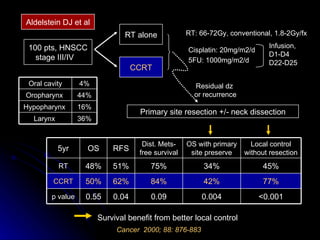
100 pts, HNSCC stage III/IV  RT alone CCRT RT: 66-72Gy, conventional, 1.8-2Gy/fx Aldelstein DJ et al Cancer  2000; 88: 876-883 Cisplatin: 20mg/m2/d 5FU: 1000mg/m2/d Infusion,  D1-D4 D22-D25 Primary site resection +/- neck dissection Residual dz  or recurrence Survival benefit from better local control <0.001 77% 45% Local control without resection 0.004 42% 34% OS with primary site preserve 75% 51% 48% RT 0.55 50% OS 0.09 84% Dist. Mets-free survival 0.04 p value 62% CCRT RFS 5yr 36% Larynx  16% Hypopharynx  44% Oropharynx  4% Oral cavity
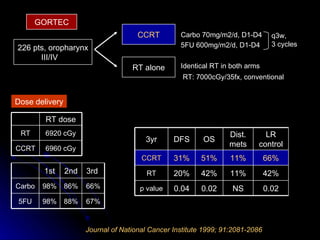
Journal of National Cancer Institute 1999; 91:2081-2086 GORTEC 226 pts, oropharynx III/IV  RT alone CCRT Identical RT in both arms  RT: 7000cGy/35fx, conventional Dose delivery q3w,  3 cycles Carbo 70mg/m2/d, D1-D4 5FU 600mg/m2/d, D1-D4 0.02 42% 66% LR control 0.04 20% 31% DFS NS 11% 11% Dist. mets 0.02 p value 42% RT 51% CCRT OS 3yr 6960 cGy CCRT 6920 cGy RT dose RT 67% 66% 3rd  88% 86% 2nd 1st 98% 5FU 98% Carbo
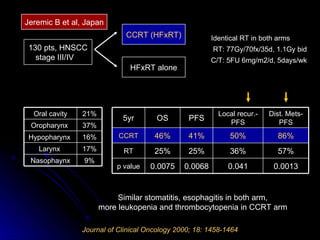
Journal of Clinical Oncology 2000; 18: 1458-1464 130 pts, HNSCC stage III/IV  HFxRT alone CCRT (HFxRT) Identical RT in both arms  RT: 77Gy/70fx/35d, 1.1Gy bid C/T: 5FU 6mg/m2/d, 5days/wk  Similar stomatitis, esophagitis in both arm, more leukopenia and thrombocytopenia in CCRT arm Jeremic B et al, Japan 0.0013 57% 86% Dist. Mets-PFS 0.0075 25% 46% OS 0.041 36% 50% Local recur.-PFS 0.0068 p value 25% RT 41% CCRT PFS 5yr 17% Larynx  9% Nasophaynx 16% Hypopharynx  37% Oropharynx  21% Oral cavity
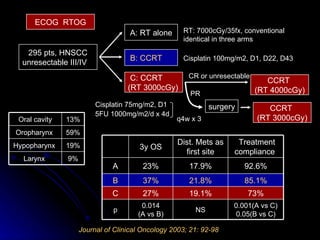
Journal of Clinical Oncology 2003; 21: 92-98 ECOG  RTOG 295 pts, HNSCC unresectable III/IV  A: RT alone B: CCRT surgery Cisplatin 100mg/m2, D1, D22, D43 C: CCRT  (RT 3000cGy) CR or unresectable CCRT  (RT 4000cGy) PR CCRT  (RT 3000cGy) Cisplatin 75mg/m2, D1 5FU 1000mg/m2/d x 4d q4w x 3 RT: 7000cGy/35fx, conventional identical in three arms 9% Larynx  19% Hypopharynx  59% Oropharynx  13% Oral cavity 0.001(A vs C) 0.05(B vs C) 73% 85.1% 92.6% Treatment compliance  NS 0.014 (A vs B) p 27% 37% 23% 3y OS 19.1% 21.8% 17.9% Dist. Mets as first site C B A
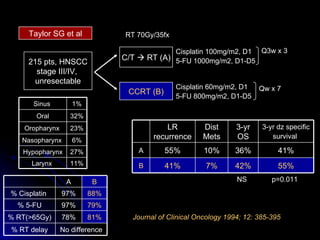
Journal of Clinical Oncology 1994; 12: 385-395 215 pts, HNSCC stage III/IV,  unresectable RT 70Gy/35fx C/T    RT (A) CCRT (B) Cisplatin 100mg/m2, D1 5-FU 1000mg/m2, D1-D5 Q3w x 3 Cisplatin 60mg/m2, D1 5-FU 800mg/m2, D1-D5 Qw x 7 Taylor SG et al NS p=0.011 11% Larynx  27% Hypopharynx 6% Nasopharynx  23% Oropharynx  32% Oral 1% Sinus  55% 41% 3-yr dz specific survival   42% 36% 3-yr OS 7% 10% Dist Mets 41% 55% LR recurrence B A 81% 79% 88% B No difference % RT delay 78% % RT(>65Gy) 97% % 5-FU 97% % Cisplatin  A
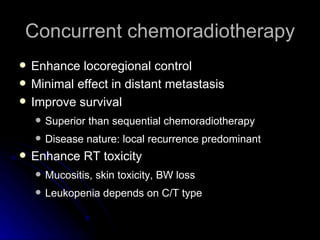
Concurrent chemoradiotherapy Enhance locoregional control Minimal effect in distant metastasis Improve survival Superior than sequential chemoradiotherapy Disease nature: local recurrence predominant  Enhance RT toxicity Mucositis, skin toxicity, BW loss Leukopenia depends on C/T type
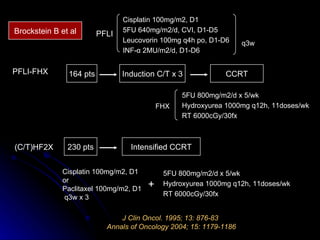
J Clin Oncol. 1995; 13: 876-83   Annals of Oncology 2004; 15: 1179-1186 Brockstein B et al Induction C/T x 3 CCRT Intensified CCRT 164 pts 230 pts Cisplatin 100mg/m2, D1 5FU 640mg/m2/d, CVI, D1-D5 Leucovorin 100mg q4h po, D1-D6 INF- α  2MU/m2/d, D1-D6 q3w PFLI 5FU 800mg/m2/d x 5/wk Hydroxyurea 1000mg q12h, 11doses/wk RT 6000cGy/30fx FHX 5FU 800mg/m2/d x 5/wk Hydroxyurea 1000mg q12h, 11doses/wk RT 6000cGy/30fx Cisplatin 100mg/m2, D1  or Paclitaxel 100mg/m2, D1  q3w x 3 + PFLI-FHX (C/T)HF2X
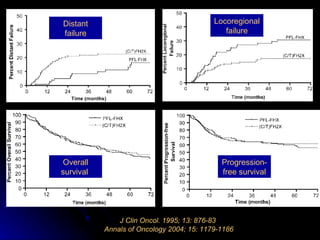
Distant failure Locoregional failure Overall survival  Progression-free survival J Clin Oncol. 1995; 13: 876-83   Annals of Oncology 2004; 15: 1179-1186
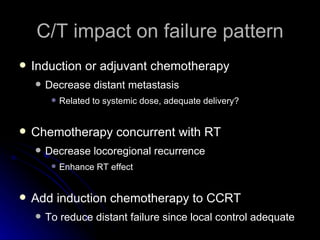
C/T impact on failure pattern Induction or adjuvant chemotherapy Decrease distant metastasis Related to systemic dose, adequate delivery? Chemotherapy concurrent with RT Decrease locoregional recurrence Enhance RT effect Add induction chemotherapy to CCRT To reduce distant failure since local control adequate
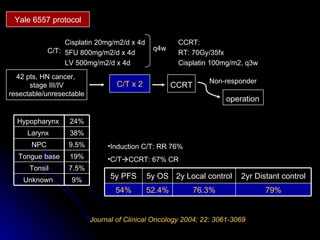
42 pts, HN cancer,  stage III/IV resectable/unresectable C/T x 2 CCRT Non-responder operation Cisplatin 20mg/m2/d x 4d 5FU 800mg/m2/d x 4d LV 500mg/m2/d x 4d q4w C/T: CCRT: RT: 70Gy/35fx Cisplatin 100mg/m2, q3w Yale 6557 protocol Induction C/T: RR 76% C/T  CCRT: 67% CR Journal of Clinical Oncology 2004; 22: 3061-3069 79% 2yr Distant control 76.3% 2y Local control 52.4% 5y OS 54% 5y PFS 9% Unknown  9.5% NPC 7.5% 19% 38% 24% Hypopharynx  Tonsil Tongue base Larynx
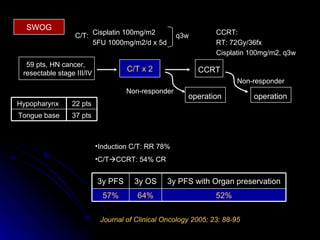
59 pts, HN cancer,   resectable stage III/IV C/T x 2 CCRT Cisplatin 100mg/m2 5FU 1000mg/m2/d x 5d q3w C/T: CCRT: RT: 72Gy/36fx Cisplatin 100mg/m2, q3w SWOG Non-responder Non-responder operation operation Induction C/T: RR 78% C/T  CCRT: 54% CR Journal of Clinical Oncology 2005; 23: 88-95 37 pts 22 pts Hypopharynx  Tongue base 52% 3y PFS with Organ preservation 64% 3y OS 57% 3y PFS
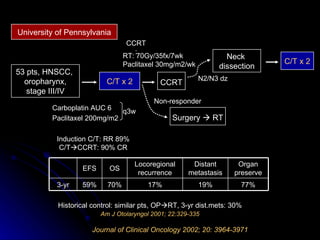
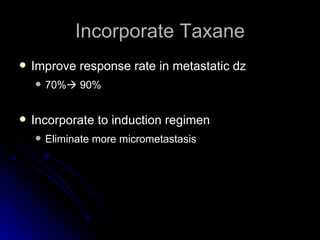
Incorporate Taxane Improve response rate in metastatic dz 70%   90% Incorporate to induction regimen Eliminate more micrometastasis
Journal of Clinical Oncology 2002; 20: 3964-3971 53 pts, HNSCC,  oropharynx, stage III/IV C/T x 2 CCRT Carboplatin AUC 6 Paclitaxel 200mg/m2 q3w Non-responder Surgery    RT C/T x 2 Neck  dissection N2/N3 dz University of Pennsylvania RT: 70Gy/35fx/7wk Paclitaxel 30mg/m2/wk CCRT: Historical control: similar pts, OP  RT, 3-yr dist.mets: 30% Am J Otolaryngol 2001; 22:329-335 Induction C/T: RR 89% C/T  CCRT: 90% CR 77% Organ preserve 19% Distant metastasis 17% Locoregional recurrence 70% OS 59% 3-yr EFS
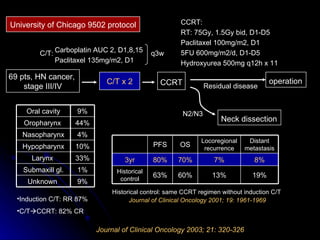
Journal of Clinical Oncology 2003; 21: 320-326 University of Chicago 9502 protocol 69 pts, HN cancer,  stage III/IV C/T x 2 CCRT Carboplatin AUC 2, D1,8,15 Paclitaxel 135mg/m2, D1 q3w C/T: CCRT: RT: 75Gy, 1.5Gy bid, D1-D5 Paclitaxel 100mg/m2, D1 5FU 600mg/m2/d, D1-D5 Hydroxyurea 500mg q12h x 11 N2/N3 Neck dissection Residual disease operation Historical control: same CCRT regimen without induction C/T   Journal of Clinical Oncology 2001; 19: 1961-1969 Induction C/T: RR 87% C/T  CCRT: 82% CR 9% Unknown  4% Nasopharynx 1% Submaxill gl. 33% 10% 44% 9% Oral cavity Larynx  Hypopharynx Oropharynx  19% 13% 60% 63% Historical control 8% Distant metastasis 7% Locoregional recurrence 70% OS 80% 3yr PFS
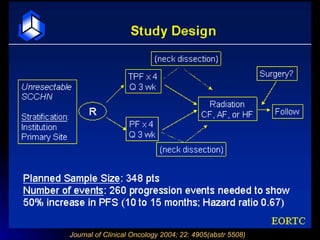
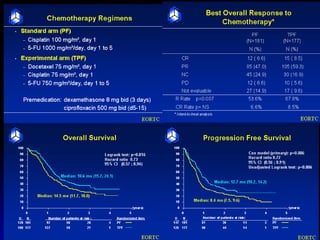
Journal of Clinical Oncology 2004; 22: 4905(abstr 5508)
 
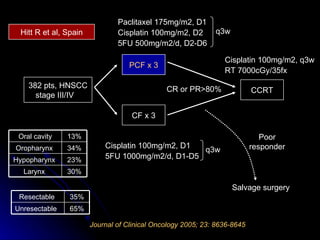
Journal of Clinical Oncology 2005; 23: 8636-8645 382 pts, HNSCC stage III/IV  CF x 3 PCF x 3 Hitt R et al, Spain Paclitaxel 175mg/m2, D1 Cisplatin 100mg/m2, D2 5FU 500mg/m2/d, D2-D6 Cisplatin 100mg/m2, D1 5FU 1000mg/m2/d, D1-D5 q3w q3w CCRT Cisplatin 100mg/m2, q3w RT 7000cGy/35fx CR or PR>80% Poor responder Salvage surgery 30% Larynx  23% Hypopharynx  34% Oropharynx  13% Oral cavity 65% Unresectable  35% Resectable
Hitt R et al, Spain Journal of Clinical Oncology 2005; 23: 8636-8645 0.03 26m 36m Time to tx failure 0.03 37m 43m Median survival Induction  <0.001 14% 33% CR <0.001 16% 53% mucositis p value 36% CF 37% PCF neutropenia Dose density <0.001 81% 91% Cisplatin 99% Paclitaxel <0.001 p value 91% CF 98% PCF 5FU
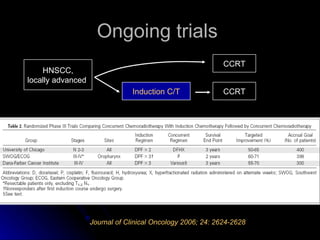
Ongoing trials  HNSCC, locally advanced  Induction C/T CCRT CCRT Journal of Clinical Oncology 2006; 24: 2624-2628
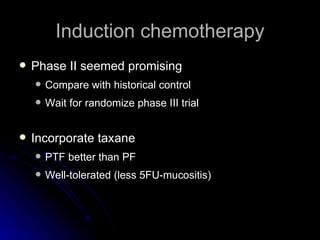
Induction chemotherapy Phase II seemed promising  Compare with historical control  Wait for randomize phase III trial Incorporate taxane PTF better than PF Well-tolerated (less 5FU-mucositis)
Post-op CCRT
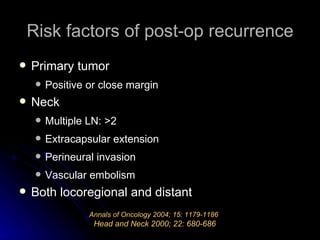
Risk factors of post-op recurrence Primary tumor Positive or close margin Neck Multiple LN: >2 Extracapsular extension Perineural invasion Vascular embolism Both locoregional and distant Annals of Oncology 2004; 15: 1179-1186   Head and Neck 2000; 22: 680-686
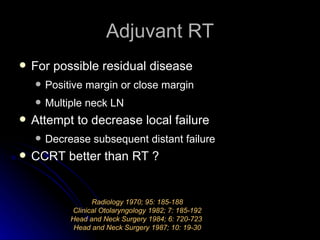
Adjuvant RT For possible residual disease Positive margin or close margin Multiple neck LN Attempt to decrease local failure Decrease subsequent distant failure CCRT better than RT ? Radiology 1970; 95: 185-188 Clinical Otolaryngology 1982; 7: 185-192 Head and Neck Surgery 1984; 6: 720-723  Head and Neck Surgery 1987; 10: 19-30
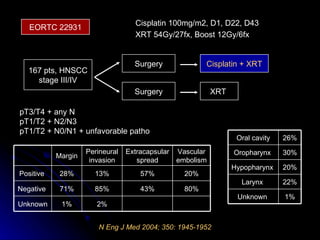
N Eng J Med 2004; 350: 1945-1952 EORTC 22931 167 pts, HNSCC stage III/IV XRT  Cisplatin + XRT Cisplatin 100mg/m2, D1, D22, D43 XRT 54Gy/27fx, Boost 12Gy/6fx Surgery Surgery pT3/T4 + any N pT1/T2 + N2/N3 pT1/T2 + N0/N1 + unfavorable patho 80% 20% Vascular embolism 43% 57% Extracapsular spread 2% 85% 13% Perineural invasion 1% Unknown  71% Negative  28% Positive  Margin 1% Unknown  22% Larynx  20% Hypopharynx  30% Oropharynx  26% Oral cavity
N Eng J Med 2004; 350: 1945-1952 EORTC 22931 0.61 25% 21% Dist Mets 0.007 31% 18% LRR 0.02 40% 53% 5yr OS 0.04 p value 36% RT 47% CCRT 5yr PFS 0.001 21% 41% Acute mucosa reaction - 16% Severe leukopenia 20% 14% Xerostomia  p value 5% RT 10% CCRT Mucosa fibrosis 49% 3rd  66% 2nd 88% 1st C/T on time without delay
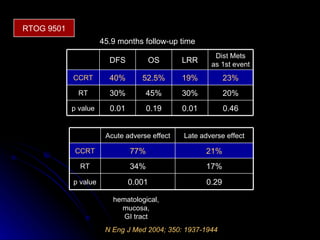
RTOG 9501 416 pts, HNSCC,  high risk of  recurrence XRT  Cisplatin + XRT Cisplatin 100mg/m2, D1, D22, D43 XRT 60Gy/30fx, Boost 6Gy/3fx Surgery Surgery N Eng J Med 2004; 350: 1937-1944 83% LN>2 or extracapsular extension  17% Positive margin  21% Larynx  10% Hypopharynx  42% Oropharynx  27% Oral cavity
N Eng J Med 2004; 350: 1937-1944 45.9 months follow-up time hematological,  mucosa,  GI tract RTOG 9501 0.46 20% 23% Dist Mets as 1st event 0.01 30% 19% LRR 0.19 45% 52.5% OS 0.01 p value 30% RT 40% CCRT DFS 0.001 34% 77% Acute adverse effect 0.29 p value 17% RT 21% CCRT Late adverse effect
Post-op adjuvant CCRT Decrease locoregional recurrence Not affect distant metastasis Though systemic side-effect Insufficient dose delivery? Single agent not enough? Actually improve survival Locoregional recurrence dominant in HNSCC
Organ preservation
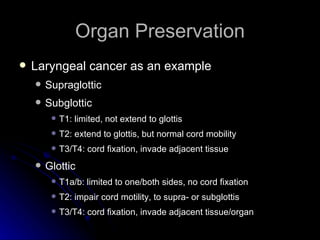
Organ Preservation Laryngeal cancer as an example Supraglottic Subglottic T1: limited, not extend to glottis T2: extend to glottis, but normal cord mobility T3/T4: cord fixation, invade adjacent tissue Glottic T1a/b: limited to one/both sides, no cord fixation T2: impair cord motility, to supra- or subglottis T3/T4: cord fixation, invade adjacent tissue/organ
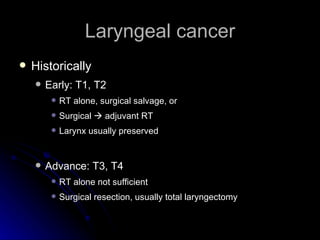
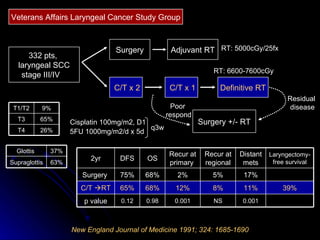
Laryngeal cancer Historically  Early: T1, T2 RT alone, surgical salvage, or Surgical    adjuvant RT Larynx usually preserved Advance: T3, T4 RT alone not sufficient  Surgical resection, usually total laryngectomy
New England Journal of Medicine 1991; 324: 1685-1690 Veterans Affairs Laryngeal Cancer Study Group 332 pts,  laryngeal SCC stage III/IV  Surgery Surgery +/- RT C/T x 2 Cisplatin 100mg/m2, D1 5FU 1000mg/m2/d x 5d q3w RT: 5000cGy/25fx Adjuvant RT Definitive RT RT: 6600-7600cGy C/T x 1 Residual  disease Poor  respond 39% Laryngectomy-free survival 0.001 11% 17% Distant mets NS 8% 5% Recur at regional 0.001 12% 2% Recur at primary  0.98 68% 68% OS 0.12 p value 65% C/T   RT 75% Surgery  DFS 2yr 26% T4 65% T3 9% T1/T2 63% Supraglottis 37% Glottis
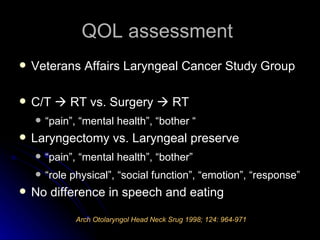
QOL assessment  Veterans Affairs Laryngeal Cancer Study Group C/T    RT vs. Surgery    RT “pain”, “mental health”, “bother “ Laryngectomy vs. Laryngeal preserve “pain”, “mental health”, “bother” “role physical”, “social function”, “emotion”, “response” No difference in speech and eating Arch Otolaryngol Head Neck Srug 1998; 124: 964-971
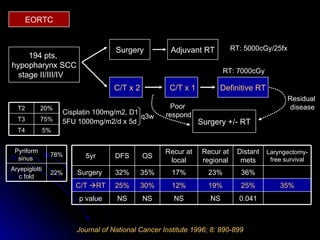
Journal of National Cancer Institute 1996; 8: 890-899 EORTC 194 pts,  hypopharynx SCC stage II/III/IV  Surgery Surgery +/- RT C/T x 2 Cisplatin 100mg/m2, D1 5FU 1000mg/m2/d x 5d q3w RT: 5000cGy/25fx Adjuvant RT Definitive RT RT: 7000cGy C/T x 1 Residual  disease Poor  respond 35% Laryngectomy-free survival 0.041 25% 36% Distant mets NS 19% 23% Recur at regional NS 12% 17% Recur at local NS 30% 35% OS NS p value 25% C/T   RT 32% Surgery  DFS 5yr 5% T4 75% T3 20% T2 22% Aryepiglottic fold 78% Pyriform sinus
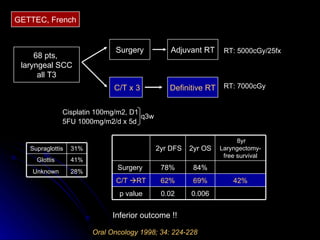
Oral Oncology 1998; 34: 224-228 GETTEC, French 68 pts,  laryngeal SCC all T3 Surgery C/T x 3 Cisplatin 100mg/m2, D1 5FU 1000mg/m2/d x 5d q3w RT: 5000cGy/25fx Adjuvant RT Definitive RT RT: 7000cGy Inferior outcome !! 28% Unknown  41% Glottis  31% Supraglottis 42% 8yr Laryngectomy-free survival 0.006 69% 84% 2yr OS 0.02 p value 62% C/T   RT 78% Surgery  2yr DFS
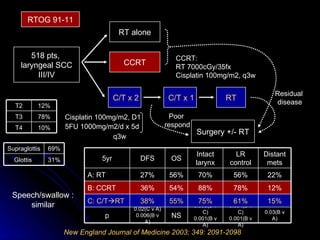
New England Journal of Medicine 2003; 349: 2091-2098 RTOG 91-11 518 pts,  laryngeal SCC III/IV Surgery +/- RT C/T x 2 Cisplatin 100mg/m2, D1 5FU 1000mg/m2/d x 5d q3w CCRT RT CCRT: RT 7000cGy/35fx Cisplatin 100mg/m2, q3w C/T x 1 Residual  disease Poor  respond RT alone Speech/swallow :  similar  0.004(B v C) 0.001(B v A) 61% 78% 56% LR control 0.03(B v A) 15% 12% 22% Distant mets 0.005(B v C) 0.001(B v A) 75% 88% 70% Intact larynx 56% 27% A: RT NS 55% 54% OS 0.02(C v A) 0.006(B v A) p 38% C: C/T  RT 36% B: CCRT DFS 5yr 10% T4 78% T3 12% T2 31% Glottis  69% Supraglottis
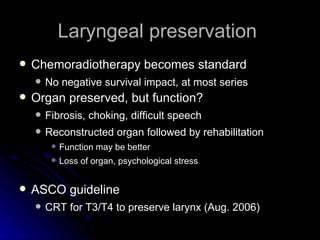
Laryngeal preservation  Chemoradiotherapy becomes standard  No negative survival impact, at most series Organ preserved, but function? Fibrosis, choking, difficult speech Reconstructed organ followed by rehabilitation  Function may be better Loss of organ, psychological stress ASCO guideline CRT for T3/T4 to preserve larynx (Aug. 2006)
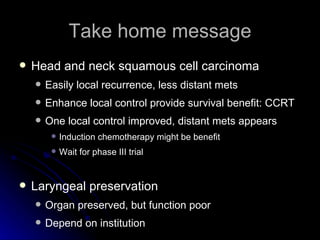
Take home message Head and neck squamous cell carcinoma Easily local recurrence, less distant mets Enhance local control provide survival benefit: CCRT One local control improved, distant mets appears Induction chemotherapy might be benefit Wait for phase III trial Laryngeal preservation Organ preserved, but function poor Depend on institution
 

Head And Neck Squamous Cell Carcinoma

  • 1.
    Multimodality treatment ofhead and neck SCC R5 林育靖 / P 洪瑞隆
  • 2.
    Outline Introduction,staging Who needs multimodality treatment Incorporate chemotherapy to definitive local tx Adjuvant Induction Concurrent Organ preservation Laryngeal cancer as an example
  • 3.
    Head and neckcancer Heterogeneous disease Oral cavity, oropharynx, larynx, hypopharynx Mostly SCC Common etiology: smoking and drinking (betel nut for oral ca) Similar biological behavior Today’s topic Nasopharynx: WHO class type III: undifferentiate ca (NPC) Nasal and paranasal sinus Salivary gland
  • 4.
  • 5.
    Generally, T stage Depends on anatomical location, complicate General concept of T stage T1, T2: confined, not invade adjacent tissue T3: larger, may invade adjacent tissue T4: deeply invade adjacent tissue/organ 4a, 4b: depends on extend of invasion Critical structure: skull base, pre-veterbral fascia, internal carotid artery, mediastinum
  • 6.
    T stage oforopharyngeal cancer T1 T2 T3 T4a T4b Invade to adjacent tissue, less extensive Invade to adjacent tissue, more extensive
  • 7.
    Ipsilateral Contralateral N1 Single,< 3 cm Single ipsilateral, < 3cm
  • 8.
    N2a Single ipsilateral,3-6cm Contralateral Ipsilateral Single, 3-6 cm
  • 9.
    N2b Multiple ipsilateral,< 6cm Ipsilateral < 6 cm Contralateral
  • 10.
    N2c Bilateral orcontralateral, < 6cm Ipsilateral < 6 cm Contralateral
  • 11.
    N3 Any LN> 6cm Ipsilateral > 6 cm Contralateral
  • 12.
    Staging M0 N3 Any T M1 Any N Any T Stage IVc M0 Any N T4b Stage IVb M0 N2 T4a M0 N2 T3 M0 N2 T2 M0 N2 T1 M0 N1 T4a M0 N0 T4a Stage IVa M0 N1 T3 M0 N1 T2 M0 N1 T1 M0 N0 T3 Stage III M0 N0 T2 Stage II M0 N0 T1 Stage I
  • 13.
    Resectability Dependson T stage T1, T2: resectable T3: may be resectable T4: mostly unresectable Depends on surgical team Wide excision  reconstruction ENT surgeon  plastic surgeon Depends on patients Organ preservation
  • 14.
    Definitive local therapyHistorically Resectable: surgery +/- RT Primary tumor: margin positive or close, perineural invasion, vascular embolism LN: multiple, extracapsular extension Unresectable: RT alone Incorporate chemotherapy into local therapy PF in 1 st line: RR 70-90%, CR 15-30%
  • 15.
    Incorporation of chemotherapy Before definitive treatment: Induction/neoadjuvant chemotherapy After definitive treatment Adjuvant/consolidation chemotherapy Concurrent with radiotherapy Concurrent chemoradiotherapy
  • 16.
    Intergroup 0034 LaramoreGE et al. Int J Radiat Oncol Biol Phys 1992; 23: 705-713 442 pts, resectable, III/IV, SCC C/T x 3 Surgery XRT XRT Cisplatin 100mg/m2, D1 5-FU 1000mg/m2/d IVF 24hrs, D1-D5 q3w Compliance of adjuvant C/T: 63% Surgery 30% Larynx 17% Hypopharynx 26% 27% Oropharynx Oral NS 38% 46% DFS NS 44% 46% OS 0.03 NS p 23% 15% Dist Mets 24% RT 19% CT/RT LRR 4 yrs
  • 17.
    NCI 443 pts, resectable, III/IV, SCC C/T x 1 XRT XRT Surgery C/T x 6 XRT Surgery C/T x 1 Surgery Cisplatin 100mg/m2, D1 Bleomycin 15mg/m2, D3-D7 Cisplatin 80mg/m2, monthly Compliance: 9% complete 6 cycles 27% complete > 3 cycles 45% received none A B C Cancer 1987; 60: 301-311 J Clin Oncol 1990; 8: 838-847 19% Larynx 35% Hypopharynx 46% Oral NS 45% 37% 35% OS NS 64% 49% 55% DFS 22% 42% B 0.011 (C vs A) NS p 13% 24% Dist Mets 30% C 41% A LRR 5 yrs
  • 18.
    Adjuvant chemotherapy Poordrug delivery Decrease distant metastasis No effect on locoregional control No survival impact Owing to insufficient dose density? Disease nature-related?
  • 19.
    British Journal ofCancer 2000; 83: 1594-1598 GETTEC, French 318, HNSCC, oropharynx stage II-IV Induction C/T Cisplatin 100mg/m2, D1 5-FU 1000mg/m2, D1-D5 q3w, 3 cycles Operable: Surgery  RT Inoperable: RT Operable: Surgery  RT Inoperable: RT
  • 20.
    chemotherapy No chemotherapyOverall survival p=0.03 chemotherapy No chemotherapy Dz-free survival p=0.11 GETTEC, French
  • 21.
    Journal of theNational Cancer Institute 1994; 86: 265-272 Journal of the National Cancer Institute 2004; 96: 1714-1717 GSTTC, Italy 237, HNSCC, stage III/IV Induction C/T Operable: Surgery  RT Inoperable: RT Cisplatin 100mg/m2, D1 5-FU 1000mg/m2, D1-D5 q3w, 4 cycles Operable: Surgery  RT Inoperable: RT A B Oral cavity Para-nasal sinus Hypopharynx Oropharynx 73% 71% Inoperable 29% A 27% Operable B
  • 22.
    All pts Operablegroup Inoperable group Overall survival Overall survival Overall survival 3-yr distant metastasis rate 0.01 31% 3% Operable 0.04 p value 42% B 24% A Inoperable
  • 23.
    SWOG 158, HeadNeck epidermoid carcinoma, stage III/IV Induction C/T Surgery  RT Cisplatin 50mg/m2, D1 MTX 40mg/m2, D1 Bleomycin 15U/m2, D1, D8 Vincristine 2mg, D1 Q3w, 3 cycles A B Laryngoscope 1988; 98: 1205 Surgery  RT  No survival benefit 21% 16% 28% 35% Oral cavity Larynx Hypopharynx Oropharynx 0.07 28% 49% Distant mets 48% 40% Local recur 23% 31% DFS p 38% 40% OS 24% B 14% A Regional recur 4yr
  • 24.
    Induction chemotherapy Good drug delivery Decrease distant metastasis GSTTC, SWOG No improvement of locoregional control No survival impact GSTTC: negative impact in surgery group
  • 25.
  • 26.
    859 pts, HNSCCstage III/IV HFxRT Conventional RT Sanchiz F et al. Int J Radiat Oncol Biol Phys. 1990; 19: 1347-1350 CCRT (conventional RT) 60Gy/30fx, 2Gy/d 70.4Gy, 1.1Gy bid 5FU 250mg/m2, qod <0.01(A v B) <0.01(A v C) <0.01(A v B) <0.01(A v C) p 96.3% 90% 67.8% RR 37% 31% 17% 10yr DFS 42% C: CCRT 40% B: HFxRT 17% A: RT 10yr OS 36% Larynx 10% Other 14% Hypopharynx 11% Nasopharynx 29% Oral cavity
  • 27.
    Journal of ClinicalOncology 1994; 12: 2648-2653 175 pts, HNSCC T3/T4 RT alone CCRT Identical RT in both arms RT: 60Gy/30fx, conventional C/T: 5-FU 1200mg/m2/d, infusion D1-D3, D22-D24 More mucositis, weight loss, and skin toxicity in CCRT arm Browman GP et al 0.04 56% 68% Complete response 0.08 42% 58% 3yr OS 0.057 p value 30% RT 40% CCRT 3yr PFS 27% Larynx 5% Other 14% Hypopharynx 42% Oropharynx 12% Oral cavity
  • 28.
    100 pts, HNSCCstage III/IV RT alone CCRT RT: 66-72Gy, conventional, 1.8-2Gy/fx Aldelstein DJ et al Cancer 2000; 88: 876-883 Cisplatin: 20mg/m2/d 5FU: 1000mg/m2/d Infusion, D1-D4 D22-D25 Primary site resection +/- neck dissection Residual dz or recurrence Survival benefit from better local control <0.001 77% 45% Local control without resection 0.004 42% 34% OS with primary site preserve 75% 51% 48% RT 0.55 50% OS 0.09 84% Dist. Mets-free survival 0.04 p value 62% CCRT RFS 5yr 36% Larynx 16% Hypopharynx 44% Oropharynx 4% Oral cavity
  • 29.
    Journal of NationalCancer Institute 1999; 91:2081-2086 GORTEC 226 pts, oropharynx III/IV RT alone CCRT Identical RT in both arms RT: 7000cGy/35fx, conventional Dose delivery q3w, 3 cycles Carbo 70mg/m2/d, D1-D4 5FU 600mg/m2/d, D1-D4 0.02 42% 66% LR control 0.04 20% 31% DFS NS 11% 11% Dist. mets 0.02 p value 42% RT 51% CCRT OS 3yr 6960 cGy CCRT 6920 cGy RT dose RT 67% 66% 3rd 88% 86% 2nd 1st 98% 5FU 98% Carbo
  • 30.
    Journal of ClinicalOncology 2000; 18: 1458-1464 130 pts, HNSCC stage III/IV HFxRT alone CCRT (HFxRT) Identical RT in both arms RT: 77Gy/70fx/35d, 1.1Gy bid C/T: 5FU 6mg/m2/d, 5days/wk Similar stomatitis, esophagitis in both arm, more leukopenia and thrombocytopenia in CCRT arm Jeremic B et al, Japan 0.0013 57% 86% Dist. Mets-PFS 0.0075 25% 46% OS 0.041 36% 50% Local recur.-PFS 0.0068 p value 25% RT 41% CCRT PFS 5yr 17% Larynx 9% Nasophaynx 16% Hypopharynx 37% Oropharynx 21% Oral cavity
  • 31.
    Journal of ClinicalOncology 2003; 21: 92-98 ECOG RTOG 295 pts, HNSCC unresectable III/IV A: RT alone B: CCRT surgery Cisplatin 100mg/m2, D1, D22, D43 C: CCRT (RT 3000cGy) CR or unresectable CCRT (RT 4000cGy) PR CCRT (RT 3000cGy) Cisplatin 75mg/m2, D1 5FU 1000mg/m2/d x 4d q4w x 3 RT: 7000cGy/35fx, conventional identical in three arms 9% Larynx 19% Hypopharynx 59% Oropharynx 13% Oral cavity 0.001(A vs C) 0.05(B vs C) 73% 85.1% 92.6% Treatment compliance NS 0.014 (A vs B) p 27% 37% 23% 3y OS 19.1% 21.8% 17.9% Dist. Mets as first site C B A
  • 32.
    Journal of ClinicalOncology 1994; 12: 385-395 215 pts, HNSCC stage III/IV, unresectable RT 70Gy/35fx C/T  RT (A) CCRT (B) Cisplatin 100mg/m2, D1 5-FU 1000mg/m2, D1-D5 Q3w x 3 Cisplatin 60mg/m2, D1 5-FU 800mg/m2, D1-D5 Qw x 7 Taylor SG et al NS p=0.011 11% Larynx 27% Hypopharynx 6% Nasopharynx 23% Oropharynx 32% Oral 1% Sinus 55% 41% 3-yr dz specific survival 42% 36% 3-yr OS 7% 10% Dist Mets 41% 55% LR recurrence B A 81% 79% 88% B No difference % RT delay 78% % RT(>65Gy) 97% % 5-FU 97% % Cisplatin A
  • 33.
    Concurrent chemoradiotherapy Enhancelocoregional control Minimal effect in distant metastasis Improve survival Superior than sequential chemoradiotherapy Disease nature: local recurrence predominant Enhance RT toxicity Mucositis, skin toxicity, BW loss Leukopenia depends on C/T type
  • 34.
    J Clin Oncol.1995; 13: 876-83 Annals of Oncology 2004; 15: 1179-1186 Brockstein B et al Induction C/T x 3 CCRT Intensified CCRT 164 pts 230 pts Cisplatin 100mg/m2, D1 5FU 640mg/m2/d, CVI, D1-D5 Leucovorin 100mg q4h po, D1-D6 INF- α 2MU/m2/d, D1-D6 q3w PFLI 5FU 800mg/m2/d x 5/wk Hydroxyurea 1000mg q12h, 11doses/wk RT 6000cGy/30fx FHX 5FU 800mg/m2/d x 5/wk Hydroxyurea 1000mg q12h, 11doses/wk RT 6000cGy/30fx Cisplatin 100mg/m2, D1 or Paclitaxel 100mg/m2, D1 q3w x 3 + PFLI-FHX (C/T)HF2X
  • 35.
    Distant failure Locoregionalfailure Overall survival Progression-free survival J Clin Oncol. 1995; 13: 876-83 Annals of Oncology 2004; 15: 1179-1186
  • 36.
    C/T impact onfailure pattern Induction or adjuvant chemotherapy Decrease distant metastasis Related to systemic dose, adequate delivery? Chemotherapy concurrent with RT Decrease locoregional recurrence Enhance RT effect Add induction chemotherapy to CCRT To reduce distant failure since local control adequate
  • 37.
    42 pts, HNcancer, stage III/IV resectable/unresectable C/T x 2 CCRT Non-responder operation Cisplatin 20mg/m2/d x 4d 5FU 800mg/m2/d x 4d LV 500mg/m2/d x 4d q4w C/T: CCRT: RT: 70Gy/35fx Cisplatin 100mg/m2, q3w Yale 6557 protocol Induction C/T: RR 76% C/T  CCRT: 67% CR Journal of Clinical Oncology 2004; 22: 3061-3069 79% 2yr Distant control 76.3% 2y Local control 52.4% 5y OS 54% 5y PFS 9% Unknown 9.5% NPC 7.5% 19% 38% 24% Hypopharynx Tonsil Tongue base Larynx
  • 38.
    59 pts, HNcancer, resectable stage III/IV C/T x 2 CCRT Cisplatin 100mg/m2 5FU 1000mg/m2/d x 5d q3w C/T: CCRT: RT: 72Gy/36fx Cisplatin 100mg/m2, q3w SWOG Non-responder Non-responder operation operation Induction C/T: RR 78% C/T  CCRT: 54% CR Journal of Clinical Oncology 2005; 23: 88-95 37 pts 22 pts Hypopharynx Tongue base 52% 3y PFS with Organ preservation 64% 3y OS 57% 3y PFS
  • 39.
    Incorporate Taxane Improveresponse rate in metastatic dz 70%  90% Incorporate to induction regimen Eliminate more micrometastasis
  • 40.
    Journal of ClinicalOncology 2002; 20: 3964-3971 53 pts, HNSCC, oropharynx, stage III/IV C/T x 2 CCRT Carboplatin AUC 6 Paclitaxel 200mg/m2 q3w Non-responder Surgery  RT C/T x 2 Neck dissection N2/N3 dz University of Pennsylvania RT: 70Gy/35fx/7wk Paclitaxel 30mg/m2/wk CCRT: Historical control: similar pts, OP  RT, 3-yr dist.mets: 30% Am J Otolaryngol 2001; 22:329-335 Induction C/T: RR 89% C/T  CCRT: 90% CR 77% Organ preserve 19% Distant metastasis 17% Locoregional recurrence 70% OS 59% 3-yr EFS
  • 41.
    Journal of ClinicalOncology 2003; 21: 320-326 University of Chicago 9502 protocol 69 pts, HN cancer, stage III/IV C/T x 2 CCRT Carboplatin AUC 2, D1,8,15 Paclitaxel 135mg/m2, D1 q3w C/T: CCRT: RT: 75Gy, 1.5Gy bid, D1-D5 Paclitaxel 100mg/m2, D1 5FU 600mg/m2/d, D1-D5 Hydroxyurea 500mg q12h x 11 N2/N3 Neck dissection Residual disease operation Historical control: same CCRT regimen without induction C/T Journal of Clinical Oncology 2001; 19: 1961-1969 Induction C/T: RR 87% C/T  CCRT: 82% CR 9% Unknown 4% Nasopharynx 1% Submaxill gl. 33% 10% 44% 9% Oral cavity Larynx Hypopharynx Oropharynx 19% 13% 60% 63% Historical control 8% Distant metastasis 7% Locoregional recurrence 70% OS 80% 3yr PFS
  • 42.
    Journal of ClinicalOncology 2004; 22: 4905(abstr 5508)
  • 43.
  • 44.
    Journal of ClinicalOncology 2005; 23: 8636-8645 382 pts, HNSCC stage III/IV CF x 3 PCF x 3 Hitt R et al, Spain Paclitaxel 175mg/m2, D1 Cisplatin 100mg/m2, D2 5FU 500mg/m2/d, D2-D6 Cisplatin 100mg/m2, D1 5FU 1000mg/m2/d, D1-D5 q3w q3w CCRT Cisplatin 100mg/m2, q3w RT 7000cGy/35fx CR or PR>80% Poor responder Salvage surgery 30% Larynx 23% Hypopharynx 34% Oropharynx 13% Oral cavity 65% Unresectable 35% Resectable
  • 45.
    Hitt R etal, Spain Journal of Clinical Oncology 2005; 23: 8636-8645 0.03 26m 36m Time to tx failure 0.03 37m 43m Median survival Induction <0.001 14% 33% CR <0.001 16% 53% mucositis p value 36% CF 37% PCF neutropenia Dose density <0.001 81% 91% Cisplatin 99% Paclitaxel <0.001 p value 91% CF 98% PCF 5FU
  • 46.
    Ongoing trials HNSCC, locally advanced Induction C/T CCRT CCRT Journal of Clinical Oncology 2006; 24: 2624-2628
  • 47.
    Induction chemotherapy PhaseII seemed promising Compare with historical control Wait for randomize phase III trial Incorporate taxane PTF better than PF Well-tolerated (less 5FU-mucositis)
  • 48.
  • 49.
    Risk factors ofpost-op recurrence Primary tumor Positive or close margin Neck Multiple LN: >2 Extracapsular extension Perineural invasion Vascular embolism Both locoregional and distant Annals of Oncology 2004; 15: 1179-1186 Head and Neck 2000; 22: 680-686
  • 50.
    Adjuvant RT Forpossible residual disease Positive margin or close margin Multiple neck LN Attempt to decrease local failure Decrease subsequent distant failure CCRT better than RT ? Radiology 1970; 95: 185-188 Clinical Otolaryngology 1982; 7: 185-192 Head and Neck Surgery 1984; 6: 720-723 Head and Neck Surgery 1987; 10: 19-30
  • 51.
    N Eng JMed 2004; 350: 1945-1952 EORTC 22931 167 pts, HNSCC stage III/IV XRT Cisplatin + XRT Cisplatin 100mg/m2, D1, D22, D43 XRT 54Gy/27fx, Boost 12Gy/6fx Surgery Surgery pT3/T4 + any N pT1/T2 + N2/N3 pT1/T2 + N0/N1 + unfavorable patho 80% 20% Vascular embolism 43% 57% Extracapsular spread 2% 85% 13% Perineural invasion 1% Unknown 71% Negative 28% Positive Margin 1% Unknown 22% Larynx 20% Hypopharynx 30% Oropharynx 26% Oral cavity
  • 52.
    N Eng JMed 2004; 350: 1945-1952 EORTC 22931 0.61 25% 21% Dist Mets 0.007 31% 18% LRR 0.02 40% 53% 5yr OS 0.04 p value 36% RT 47% CCRT 5yr PFS 0.001 21% 41% Acute mucosa reaction - 16% Severe leukopenia 20% 14% Xerostomia p value 5% RT 10% CCRT Mucosa fibrosis 49% 3rd 66% 2nd 88% 1st C/T on time without delay
  • 53.
    RTOG 9501 416pts, HNSCC, high risk of recurrence XRT Cisplatin + XRT Cisplatin 100mg/m2, D1, D22, D43 XRT 60Gy/30fx, Boost 6Gy/3fx Surgery Surgery N Eng J Med 2004; 350: 1937-1944 83% LN>2 or extracapsular extension 17% Positive margin 21% Larynx 10% Hypopharynx 42% Oropharynx 27% Oral cavity
  • 54.
    N Eng JMed 2004; 350: 1937-1944 45.9 months follow-up time hematological, mucosa, GI tract RTOG 9501 0.46 20% 23% Dist Mets as 1st event 0.01 30% 19% LRR 0.19 45% 52.5% OS 0.01 p value 30% RT 40% CCRT DFS 0.001 34% 77% Acute adverse effect 0.29 p value 17% RT 21% CCRT Late adverse effect
  • 55.
    Post-op adjuvant CCRTDecrease locoregional recurrence Not affect distant metastasis Though systemic side-effect Insufficient dose delivery? Single agent not enough? Actually improve survival Locoregional recurrence dominant in HNSCC
  • 56.
  • 57.
    Organ Preservation Laryngealcancer as an example Supraglottic Subglottic T1: limited, not extend to glottis T2: extend to glottis, but normal cord mobility T3/T4: cord fixation, invade adjacent tissue Glottic T1a/b: limited to one/both sides, no cord fixation T2: impair cord motility, to supra- or subglottis T3/T4: cord fixation, invade adjacent tissue/organ
  • 58.
    Laryngeal cancer Historically Early: T1, T2 RT alone, surgical salvage, or Surgical  adjuvant RT Larynx usually preserved Advance: T3, T4 RT alone not sufficient Surgical resection, usually total laryngectomy
  • 59.
    New England Journalof Medicine 1991; 324: 1685-1690 Veterans Affairs Laryngeal Cancer Study Group 332 pts, laryngeal SCC stage III/IV Surgery Surgery +/- RT C/T x 2 Cisplatin 100mg/m2, D1 5FU 1000mg/m2/d x 5d q3w RT: 5000cGy/25fx Adjuvant RT Definitive RT RT: 6600-7600cGy C/T x 1 Residual disease Poor respond 39% Laryngectomy-free survival 0.001 11% 17% Distant mets NS 8% 5% Recur at regional 0.001 12% 2% Recur at primary 0.98 68% 68% OS 0.12 p value 65% C/T  RT 75% Surgery DFS 2yr 26% T4 65% T3 9% T1/T2 63% Supraglottis 37% Glottis
  • 60.
    QOL assessment Veterans Affairs Laryngeal Cancer Study Group C/T  RT vs. Surgery  RT “pain”, “mental health”, “bother “ Laryngectomy vs. Laryngeal preserve “pain”, “mental health”, “bother” “role physical”, “social function”, “emotion”, “response” No difference in speech and eating Arch Otolaryngol Head Neck Srug 1998; 124: 964-971
  • 61.
    Journal of NationalCancer Institute 1996; 8: 890-899 EORTC 194 pts, hypopharynx SCC stage II/III/IV Surgery Surgery +/- RT C/T x 2 Cisplatin 100mg/m2, D1 5FU 1000mg/m2/d x 5d q3w RT: 5000cGy/25fx Adjuvant RT Definitive RT RT: 7000cGy C/T x 1 Residual disease Poor respond 35% Laryngectomy-free survival 0.041 25% 36% Distant mets NS 19% 23% Recur at regional NS 12% 17% Recur at local NS 30% 35% OS NS p value 25% C/T  RT 32% Surgery DFS 5yr 5% T4 75% T3 20% T2 22% Aryepiglottic fold 78% Pyriform sinus
  • 62.
    Oral Oncology 1998;34: 224-228 GETTEC, French 68 pts, laryngeal SCC all T3 Surgery C/T x 3 Cisplatin 100mg/m2, D1 5FU 1000mg/m2/d x 5d q3w RT: 5000cGy/25fx Adjuvant RT Definitive RT RT: 7000cGy Inferior outcome !! 28% Unknown 41% Glottis 31% Supraglottis 42% 8yr Laryngectomy-free survival 0.006 69% 84% 2yr OS 0.02 p value 62% C/T  RT 78% Surgery 2yr DFS
  • 63.
    New England Journalof Medicine 2003; 349: 2091-2098 RTOG 91-11 518 pts, laryngeal SCC III/IV Surgery +/- RT C/T x 2 Cisplatin 100mg/m2, D1 5FU 1000mg/m2/d x 5d q3w CCRT RT CCRT: RT 7000cGy/35fx Cisplatin 100mg/m2, q3w C/T x 1 Residual disease Poor respond RT alone Speech/swallow : similar 0.004(B v C) 0.001(B v A) 61% 78% 56% LR control 0.03(B v A) 15% 12% 22% Distant mets 0.005(B v C) 0.001(B v A) 75% 88% 70% Intact larynx 56% 27% A: RT NS 55% 54% OS 0.02(C v A) 0.006(B v A) p 38% C: C/T  RT 36% B: CCRT DFS 5yr 10% T4 78% T3 12% T2 31% Glottis 69% Supraglottis
  • 64.
    Laryngeal preservation Chemoradiotherapy becomes standard No negative survival impact, at most series Organ preserved, but function? Fibrosis, choking, difficult speech Reconstructed organ followed by rehabilitation Function may be better Loss of organ, psychological stress ASCO guideline CRT for T3/T4 to preserve larynx (Aug. 2006)
  • 65.
    Take home messageHead and neck squamous cell carcinoma Easily local recurrence, less distant mets Enhance local control provide survival benefit: CCRT One local control improved, distant mets appears Induction chemotherapy might be benefit Wait for phase III trial Laryngeal preservation Organ preserved, but function poor Depend on institution
  • 66.