Changes between the 7th and 8th editions in
head and neck cancers and it’s clinical
implications
Dr. Vijay.P.Raturi
Dept of Radiation Oncology,
Kokilaben Dhirubhai ambani Hospital
• The TMN 8th edition has been published in December
2016.
• The UICC TNM Project has published the 8th Edition of
the TNM Classification of Malignant Tumours which
came into effect on January 1, 2017.
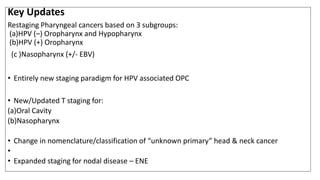
Key Updates
Restaging Pharyngeal cancers based on 3 subgroups:
(a)HPV (–) Oropharynx and Hypopharynx
(b)HPV (+) Oropharynx
(c )Nasopharynx (+/- EBV)
• Entirely new staging paradigm for HPV associated OPC
• New/Updated T staging for:
(a)Oral Cavity
(b)Nasopharynx
• Change in nomenclature/classification of “unknown primary” head & neck cancer
•
• Expanded staging for nodal disease – ENE
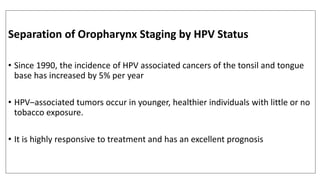
Separation of Oropharynx Staging by HPV Status
• Since 1990, the incidence of HPV associated cancers of the tonsil and tongue
base has increased by 5% per year
• HPV–associated tumors occur in younger, healthier individuals with little or no
tobacco exposure.
• It is highly responsive to treatment and has an excellent prognosis
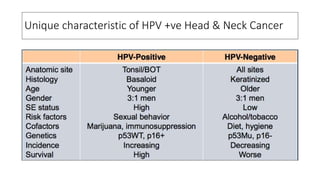
Unique characteristic of HPV +ve Head & Neck Cancer
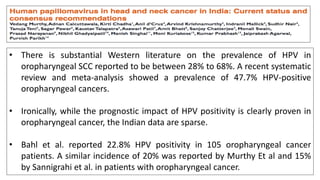
• There is substantial Western literature on the prevalence of HPV in
oropharyngeal SCC reported to be between 28% to 68%. A recent systematic
review and meta-analysis showed a prevalence of 47.7% HPV-positive
oropharyngeal cancers.
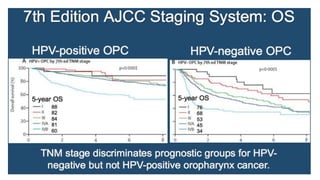
• Ironically, while the prognostic impact of HPV positivity is clearly proven in
oropharyngeal cancer, the Indian data are sparse.
• Bahl et al. reported 22.8% HPV positivity in 105 oropharyngeal cancer
patients. A similar incidence of 20% was reported by Murthy Et al and 15%
by Sannigrahi et al. in patients with oropharyngeal cancer.
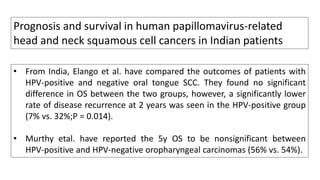
• From India, Elango et al. have compared the outcomes of patients with
HPV-positive and negative oral tongue SCC. They found no significant
difference in OS between the two groups, however, a significantly lower
rate of disease recurrence at 2 years was seen in the HPV-positive group
(7% vs. 32%;P = 0.014).
• Murthy etal. have reported the 5y OS to be nonsignificant between
HPV-positive and HPV-negative oropharyngeal carcinomas (56% vs. 54%).
Prognosis and survival in human papillomavirus-related
head and neck squamous cell cancers in Indian patients
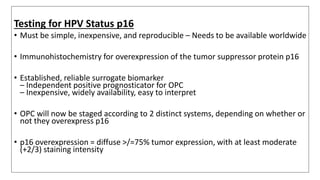
Testing for HPV Status p16
• Must be simple, inexpensive, and reproducible – Needs to be available worldwide
• Immunohistochemistry for overexpression of the tumor suppressor protein p16
• Established, reliable surrogate biomarker
– Independent positive prognosticator for OPC
– Inexpensive, widely availability, easy to interpret
• OPC will now be staged according to 2 distinct systems, depending on whether or
not they overexpress p16
• p16 overexpression = diffuse >/=75% tumor expression, with at least moderate
(+2/3) staining intensity
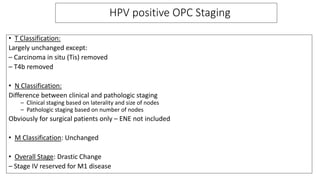
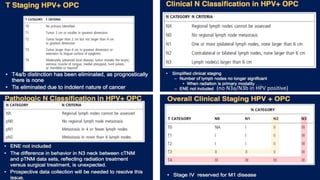
HPV positive OPC Staging
• T Classification:
Largely unchanged except:
– Carcinoma in situ (Tis) removed
– T4b removed
• N Classification:
Difference between clinical and pathologic staging
– Clinical staging based on laterality and size of nodes
– Pathologic staging based on number of nodes
Obviously for surgical patients only – ENE not included
• M Classification: Unchanged
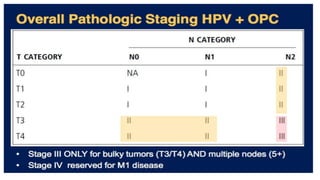
• Overall Stage: Drastic Change
– Stage IV reserved for M1 disease
(no N3a/N3b in HPV positive)
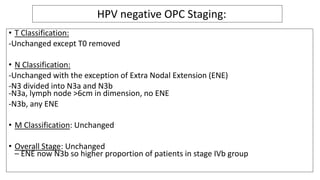
• T Classification:
-Unchanged except T0 removed
• N Classification:
-Unchanged with the exception of Extra Nodal Extension (ENE)
-N3 divided into N3a and N3b
-N3a, lymph node >6cm in dimension, no ENE
-N3b, any ENE
• M Classification: Unchanged
• Overall Stage: Unchanged
– ENE now N3b so higher proportion of patients in stage IVb group
HPV negative OPC Staging:
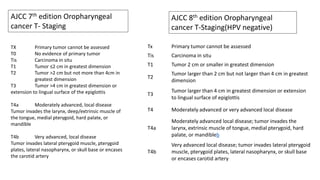
TX Primary tumor cannot be assessed
T0 No evidence of primary tumor
Tis Carcinoma in situ
T1 Tumor ≤2 cm in greatest dimension
T2 Tumor >2 cm but not more than 4cm in
greatest dimension
T3 Tumor >4 cm in greatest dimension or
extension to lingual surface of the epiglottis
T4a Moderately advanced, local disease
Tumor invades the larynx, deep/extrinsic muscle of
the tongue, medial pterygoid, hard palate, or
mandible
T4b Very advanced, local disease
Tumor invades lateral pterygoid muscle, pterygoid
plates, lateral nasopharynx, or skull base or encases
the carotid artery
AJCC 7th edition Oropharyngeal
cancer T- Staging
AJCC 8th edition Oropharyngeal
cancer T-Staging(HPV negative)
Tx Primary tumor cannot be assessed
Tis Carcinoma in situ
T1 Tumor 2 cm or smaller in greatest dimension
T2
Tumor larger than 2 cm but not larger than 4 cm in greatest
dimension
T3
Tumor larger than 4 cm in greatest dimension or extension
to lingual surface of epiglottis
T4 Moderately advanced or very advanced local disease
T4a
Moderately advanced local disease; tumor invades the
larynx, extrinsic muscle of tongue, medial pterygoid, hard
palate, or mandibleb
T4b
Very advanced local disease; tumor invades lateral pterygoid
muscle, pterygoid plates, lateral nasopharynx, or skull base
or encases carotid artery
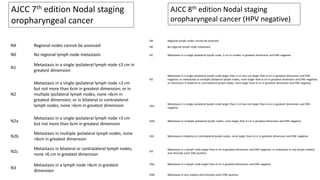
NX Regional nodes cannot be assessed
N0 No regional lymph node metastasis
N1
Metastasis in a single ipsilateral lymph node ≤3 cm in
greatest dimension
N2
Metastasis in a single ipsilateral lymph node >3 cm
but not more than 6cm in greatest dimension; or in
multiple ipsilateral lymph nodes, none >6cm in
greatest dimension; or in bilateral or contralateral
lymph nodes, none >6cm in greatest dimension
N2a
Metastasis in a single ipsilateral lymph node >3 cm
but not more than 6cm in greatest dimension
N2b
Metastasis in multiple ipsilateral lymph nodes, none
>6cm in greatest dimension
N2c
Metastasis in bilateral or contralateral lymph nodes,
none >6 cm in greatest dimension
N3
Metastasis in a lymph node >6cm in greatest
dimension
AJCC 7th edition Nodal staging
oropharyngeal cancer
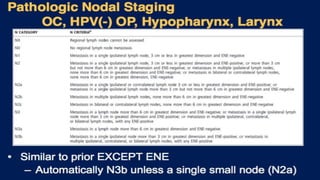
NX Regional lymph nodes cannot be assessed
N0 No regional lymph node metastasis
N1 Metastasis in a single ipsilateral lymph node, 3 cm or smaller in greatest dimension and ENE-negative
N2
Metastasis in a single ipsilateral lymph node larger than 3 cm but not larger than 6 cm in greatest dimension and ENE-
negative; or metastases in multiple ipsilateral lymph nodes, none larger than 6 cm in greatest dimension and ENE-negative;
or metastasis in bilateral or contralateral lymph nodes, none larger than 6 cm in greatest dimension and ENE-negative
N2a
Metastasis in a single ipsilateral lymph node larger than 3 cm but not larger than 6 cm in greatest dimension and ENE-
negative
N2b Metastasis in multiple ipsilateral lymph nodes, none larger than 6 cm in greatest dimension and ENE-negative
N2c Metastasis in bilateral or contralateral lymph nodes, none larger than 6 cm in greatest dimension and ENE-negative
N3
Metastasis in a lymph node larger than 6 cm in greatest dimension and ENE-negative; or metastasis in any lymph node(s)
and clinically overt ENE-positive
N3a Metastasis in a lymph node larger than 6 cm in greatest dimension and ENE-negative
N3b Metastasis in any node(s) and clinically overt ENE-positive
AJCC 8th edition Nodal staging
oropharyngeal cancer (HPV negative)
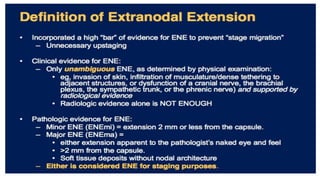
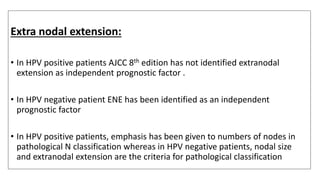
Extra nodal extension:
• In HPV positive patients AJCC 8th edition has not identified extranodal
extension as independent prognostic factor .
• In HPV negative patient ENE has been identified as an independent
prognostic factor
• In HPV positive patients, emphasis has been given to numbers of nodes in
pathological N classification whereas in HPV negative patients, nodal size
and extranodal extension are the criteria for pathological classification
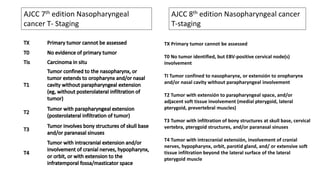
Nasopharynx
• There are 2 changes in nasopharynx T classifications relating to
anatomic markers rather than DOI. The previous T4 criteria
“masticator space” and “infratemporal fossa” were used as synonyms,
but their anatomic descriptions differ, sowing confusion among
clinicians. These terms will now be replaced by a specific description
of soft-tissue involvement to avoid ambiguity.
• In addition, adjacent muscle involvement (including medial pterygoid,
lateral pterygoid, and prevertebral muscles) will now be “down-
staged” to T2 based on a recent analysis showing them to have a
more favorable outcome using current treatment
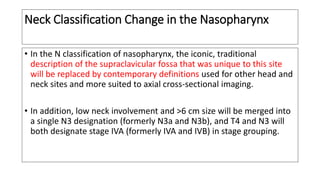
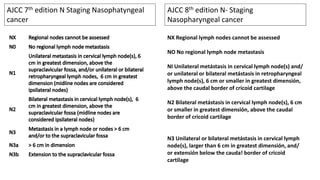
Neck Classification Change in the Nasopharynx
• In the N classification of nasopharynx, the iconic, traditional
description of the supraclavicular fossa that was unique to this site
will be replaced by contemporary definitions used for other head and
neck sites and more suited to axial cross-sectional imaging.
• In addition, low neck involvement and >6 cm size will be merged into
a single N3 designation (formerly N3a and N3b), and T4 and N3 will
both designate stage IVA (formerly IVA and IVB) in stage grouping.
AJCC 7th edition Nasopharyngeal
cancer T- Staging
AJCC 8th edition Nasopharyngeal cancer
T-staging
TX Primary tumor cannot be assessed
T0 No tumor identified, but EBV-positive cervical node(s)
involvement
TI Tumor confined to nasopharynx, or extensión to oropharynx
and/or nasal cavity without parapharyngeal involvement
T2 Tumor with extensión to parapharyngeal space, and/or
adjacent soft tissue involvement (medial pterygoid, lateral
pterygoid, prevertebral muscles)
T3 Tumor with infiltration of bony structures at skull base, cervical
vertebra, pterygoid structures, and/or paranasal sinuses
T4 Tumor with intracranial extensión, involvement of cranial
nerves, hypopharynx, orbit, parotid gland, and/ or extensive soft
tissue infiltration beyond the lateral surface of the lateral
pterygoid muscle
AJCC 7th edition N Staging Nasophatyngeal
cancer
NX Regional lymph nodes cannot be assessed
NO No regional lymph node metastasis
NI Unilateral metástasis in cervical lymph node(s) and/
or unilateral or bilateral metástasis in retropharyngeal
lymph node(s), 6 cm or smaller in greatest dimensión,
above the caudal border of cricoid cartilage
N2 Bilateral metástasis in cervical lymph node(s), 6 cm
or smaller in greatest dimensión, above the caudal
border of cricoid cartilage
N3 Unilateral or bilateral metástasis in cervical lymph
node(s), larger than 6 cm in greatest dimensión, and/
or extensión below the cauda! border of cricoid
cartilage
AJCC 8th edition N- Staging
Nasopharyngeal cancer
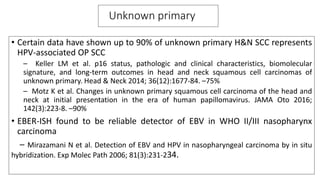
Unknown primary
• Certain data have shown up to 90% of unknown primary H&N SCC represents
HPV-associated OP SCC
– Keller LM et al. p16 status, pathologic and clinical characteristics, biomolecular
signature, and long-term outcomes in head and neck squamous cell carcinomas of
unknown primary. Head & Neck 2014; 36(12):1677-84. –75%
– Motz K et al. Changes in unknown primary squamous cell carcinoma of the head and
neck at initial presentation in the era of human papillomavirus. JAMA Oto 2016;
142(3):223-8. –90%
• EBER-ISH found to be reliable detector of EBV in WHO II/III nasopharynx
carcinoma
– Mirazamani N et al. Detection of EBV and HPV in nasopharyngeal carcinoma by in situ
hybridization. Exp Molec Path 2006; 81(3):231-234.
Unknown Primary
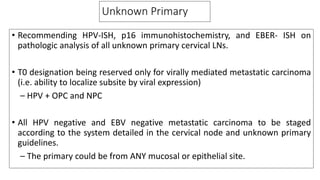
• Recommending HPV-ISH, p16 immunohistochemistry, and EBER- ISH on
pathologic analysis of all unknown primary cervical LNs.
• T0 designation being reserved only for virally mediated metastatic carcinoma
(i.e. ability to localize subsite by viral expression)
– HPV + OPC and NPC
• All HPV negative and EBV negative metastatic carcinoma to be staged
according to the system detailed in the cervical node and unknown primary
guidelines.
– The primary could be from ANY mucosal or epithelial site.
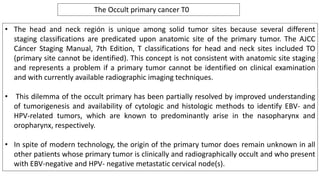
• The head and neck región is unique among solid tumor sites because several different
staging classifications are predicated upon anatomic site of the primary tumor. The AJCC
Cáncer Staging Manual, 7th Edition, T classifications for head and neck sites included TO
(primary site cannot be identified). This concept is not consistent with anatomic site staging
and represents a problem if a primary tumor cannot be identified on clinical examination
and with currently available radiographic imaging techniques.
• This dilemma of the occult primary has been partially resolved by improved understanding
of tumorigenesis and availability of cytologic and histologic methods to identify EBV- and
HPV-related tumors, which are known to predominantly arise in the nasopharynx and
oropharynx, respectively.
• In spite of modern technology, the origin of the primary tumor does remain unknown in all
other patients whose primary tumor is clinically and radiographically occult and who present
with EBV-negative and HPV- negative metastatic cervical node(s).
The Occult primary cancer T0
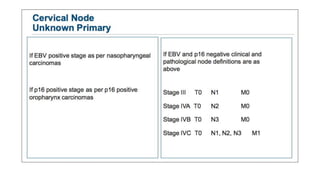
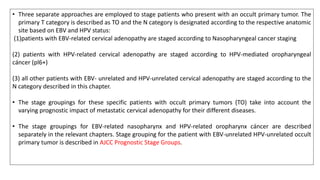
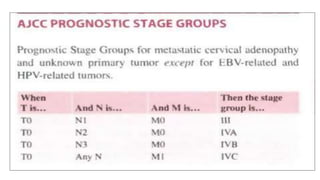
• Three separate approaches are employed to stage patients who present with an occult primary tumor. The
primary T category is described as TO and the N category is designated according to the respective anatomic
site based on EBV and HPV status:
(1)patients with EBV-related cervical adenopathy are staged according to Nasopharyngeal cancer staging
(2) patients with HPV-related cervical adenopathy are staged according to HPV-mediated oropharyngeal
cáncer (pl6+)
(3) all other patients with EBV- unrelated and HPV-unrelated cervical adenopathy are staged according to the
N category described in this chapter.
• The stage groupings for these specific patients with occult primary tumors (TO) take into account the
varying prognostic impact of metastatic cervical adenopathy for their different diseases.
• The stage groupings for EBV-related nasopharynx and HPV-related oropharynx cáncer are described
separately in the relevant chapters. Stage grouping for the patient with EBV-unrelated HPV-unrelated occult
primary tumor is described in AJCC Prognostic Stage Groups.
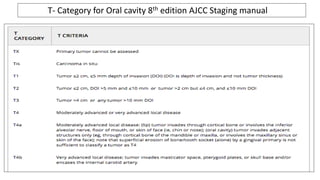
T- Category for Oral cavity 8th edition AJCC Staging manual
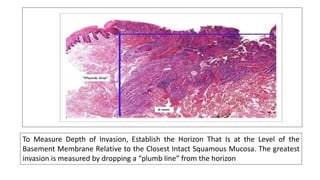
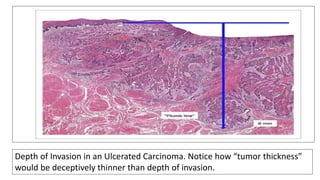
To Measure Depth of Invasion, Establish the Horizon That Is at the Level of the
Basement Membrane Relative to the Closest Intact Squamous Mucosa. The greatest
invasion is measured by dropping a “plumb line” from the horizon
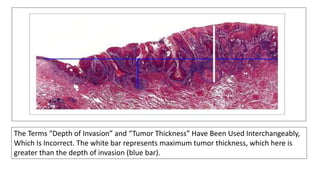
The Terms “Depth of Invasion” and “Tumor Thickness” Have Been Used Interchangeably,
Which Is Incorrect. The white bar represents maximum tumor thickness, which here is
greater than the depth of invasion (blue bar).
Depth of Invasion in an Ulcerated Carcinoma. Notice how “tumor thickness”
would be deceptively thinner than depth of invasion.
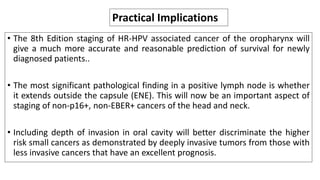
• The 8th Edition staging of HR-HPV associated cancer of the oropharynx will
give a much more accurate and reasonable prediction of survival for newly
diagnosed patients..
• The most significant pathological finding in a positive lymph node is whether
it extends outside the capsule (ENE). This will now be an important aspect of
staging of non-p16+, non-EBER+ cancers of the head and neck.
• Including depth of invasion in oral cavity will better discriminate the higher
risk small cancers as demonstrated by deeply invasive tumors from those with
less invasive cancers that have an excellent prognosis.
Practical Implications
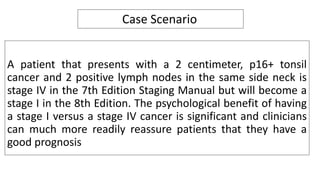
A patient that presents with a 2 centimeter, p16+ tonsil
cancer and 2 positive lymph nodes in the same side neck is
stage IV in the 7th Edition Staging Manual but will become a
stage I in the 8th Edition. The psychological benefit of having
a stage I versus a stage IV cancer is significant and clinicians
can much more readily reassure patients that they have a
good prognosis
Case Scenario

7th to 8th AJCC Head and Neck

  • 1.
    Changes between the7th and 8th editions in head and neck cancers and it’s clinical implications Dr. Vijay.P.Raturi Dept of Radiation Oncology, Kokilaben Dhirubhai ambani Hospital
  • 2.
    • The TMN8th edition has been published in December 2016. • The UICC TNM Project has published the 8th Edition of the TNM Classification of Malignant Tumours which came into effect on January 1, 2017.
  • 5.
    Key Updates Restaging Pharyngealcancers based on 3 subgroups: (a)HPV (–) Oropharynx and Hypopharynx (b)HPV (+) Oropharynx (c )Nasopharynx (+/- EBV) • Entirely new staging paradigm for HPV associated OPC • New/Updated T staging for: (a)Oral Cavity (b)Nasopharynx • Change in nomenclature/classification of “unknown primary” head & neck cancer • • Expanded staging for nodal disease – ENE
  • 6.
    Separation of OropharynxStaging by HPV Status • Since 1990, the incidence of HPV associated cancers of the tonsil and tongue base has increased by 5% per year • HPV–associated tumors occur in younger, healthier individuals with little or no tobacco exposure. • It is highly responsive to treatment and has an excellent prognosis
  • 7.
    Unique characteristic ofHPV +ve Head & Neck Cancer
  • 8.
    • There issubstantial Western literature on the prevalence of HPV in oropharyngeal SCC reported to be between 28% to 68%. A recent systematic review and meta-analysis showed a prevalence of 47.7% HPV-positive oropharyngeal cancers. • Ironically, while the prognostic impact of HPV positivity is clearly proven in oropharyngeal cancer, the Indian data are sparse. • Bahl et al. reported 22.8% HPV positivity in 105 oropharyngeal cancer patients. A similar incidence of 20% was reported by Murthy Et al and 15% by Sannigrahi et al. in patients with oropharyngeal cancer.
  • 9.
    • From India,Elango et al. have compared the outcomes of patients with HPV-positive and negative oral tongue SCC. They found no significant difference in OS between the two groups, however, a significantly lower rate of disease recurrence at 2 years was seen in the HPV-positive group (7% vs. 32%;P = 0.014). • Murthy etal. have reported the 5y OS to be nonsignificant between HPV-positive and HPV-negative oropharyngeal carcinomas (56% vs. 54%). Prognosis and survival in human papillomavirus-related head and neck squamous cell cancers in Indian patients
  • 11.
    Testing for HPVStatus p16 • Must be simple, inexpensive, and reproducible – Needs to be available worldwide • Immunohistochemistry for overexpression of the tumor suppressor protein p16 • Established, reliable surrogate biomarker – Independent positive prognosticator for OPC – Inexpensive, widely availability, easy to interpret • OPC will now be staged according to 2 distinct systems, depending on whether or not they overexpress p16 • p16 overexpression = diffuse >/=75% tumor expression, with at least moderate (+2/3) staining intensity
  • 12.
    HPV positive OPCStaging • T Classification: Largely unchanged except: – Carcinoma in situ (Tis) removed – T4b removed • N Classification: Difference between clinical and pathologic staging – Clinical staging based on laterality and size of nodes – Pathologic staging based on number of nodes Obviously for surgical patients only – ENE not included • M Classification: Unchanged • Overall Stage: Drastic Change – Stage IV reserved for M1 disease
  • 13.
    (no N3a/N3b inHPV positive)
  • 15.
    • T Classification: -Unchangedexcept T0 removed • N Classification: -Unchanged with the exception of Extra Nodal Extension (ENE) -N3 divided into N3a and N3b -N3a, lymph node >6cm in dimension, no ENE -N3b, any ENE • M Classification: Unchanged • Overall Stage: Unchanged – ENE now N3b so higher proportion of patients in stage IVb group HPV negative OPC Staging:
  • 16.
    TX Primary tumorcannot be assessed T0 No evidence of primary tumor Tis Carcinoma in situ T1 Tumor ≤2 cm in greatest dimension T2 Tumor >2 cm but not more than 4cm in greatest dimension T3 Tumor >4 cm in greatest dimension or extension to lingual surface of the epiglottis T4a Moderately advanced, local disease Tumor invades the larynx, deep/extrinsic muscle of the tongue, medial pterygoid, hard palate, or mandible T4b Very advanced, local disease Tumor invades lateral pterygoid muscle, pterygoid plates, lateral nasopharynx, or skull base or encases the carotid artery AJCC 7th edition Oropharyngeal cancer T- Staging AJCC 8th edition Oropharyngeal cancer T-Staging(HPV negative) Tx Primary tumor cannot be assessed Tis Carcinoma in situ T1 Tumor 2 cm or smaller in greatest dimension T2 Tumor larger than 2 cm but not larger than 4 cm in greatest dimension T3 Tumor larger than 4 cm in greatest dimension or extension to lingual surface of epiglottis T4 Moderately advanced or very advanced local disease T4a Moderately advanced local disease; tumor invades the larynx, extrinsic muscle of tongue, medial pterygoid, hard palate, or mandibleb T4b Very advanced local disease; tumor invades lateral pterygoid muscle, pterygoid plates, lateral nasopharynx, or skull base or encases carotid artery
  • 17.
    NX Regional nodescannot be assessed N0 No regional lymph node metastasis N1 Metastasis in a single ipsilateral lymph node ≤3 cm in greatest dimension N2 Metastasis in a single ipsilateral lymph node >3 cm but not more than 6cm in greatest dimension; or in multiple ipsilateral lymph nodes, none >6cm in greatest dimension; or in bilateral or contralateral lymph nodes, none >6cm in greatest dimension N2a Metastasis in a single ipsilateral lymph node >3 cm but not more than 6cm in greatest dimension N2b Metastasis in multiple ipsilateral lymph nodes, none >6cm in greatest dimension N2c Metastasis in bilateral or contralateral lymph nodes, none >6 cm in greatest dimension N3 Metastasis in a lymph node >6cm in greatest dimension AJCC 7th edition Nodal staging oropharyngeal cancer NX Regional lymph nodes cannot be assessed N0 No regional lymph node metastasis N1 Metastasis in a single ipsilateral lymph node, 3 cm or smaller in greatest dimension and ENE-negative N2 Metastasis in a single ipsilateral lymph node larger than 3 cm but not larger than 6 cm in greatest dimension and ENE- negative; or metastases in multiple ipsilateral lymph nodes, none larger than 6 cm in greatest dimension and ENE-negative; or metastasis in bilateral or contralateral lymph nodes, none larger than 6 cm in greatest dimension and ENE-negative N2a Metastasis in a single ipsilateral lymph node larger than 3 cm but not larger than 6 cm in greatest dimension and ENE- negative N2b Metastasis in multiple ipsilateral lymph nodes, none larger than 6 cm in greatest dimension and ENE-negative N2c Metastasis in bilateral or contralateral lymph nodes, none larger than 6 cm in greatest dimension and ENE-negative N3 Metastasis in a lymph node larger than 6 cm in greatest dimension and ENE-negative; or metastasis in any lymph node(s) and clinically overt ENE-positive N3a Metastasis in a lymph node larger than 6 cm in greatest dimension and ENE-negative N3b Metastasis in any node(s) and clinically overt ENE-positive AJCC 8th edition Nodal staging oropharyngeal cancer (HPV negative)
  • 19.
    Extra nodal extension: •In HPV positive patients AJCC 8th edition has not identified extranodal extension as independent prognostic factor . • In HPV negative patient ENE has been identified as an independent prognostic factor • In HPV positive patients, emphasis has been given to numbers of nodes in pathological N classification whereas in HPV negative patients, nodal size and extranodal extension are the criteria for pathological classification
  • 20.
    Nasopharynx • There are2 changes in nasopharynx T classifications relating to anatomic markers rather than DOI. The previous T4 criteria “masticator space” and “infratemporal fossa” were used as synonyms, but their anatomic descriptions differ, sowing confusion among clinicians. These terms will now be replaced by a specific description of soft-tissue involvement to avoid ambiguity. • In addition, adjacent muscle involvement (including medial pterygoid, lateral pterygoid, and prevertebral muscles) will now be “down- staged” to T2 based on a recent analysis showing them to have a more favorable outcome using current treatment
  • 21.
    Neck Classification Changein the Nasopharynx • In the N classification of nasopharynx, the iconic, traditional description of the supraclavicular fossa that was unique to this site will be replaced by contemporary definitions used for other head and neck sites and more suited to axial cross-sectional imaging. • In addition, low neck involvement and >6 cm size will be merged into a single N3 designation (formerly N3a and N3b), and T4 and N3 will both designate stage IVA (formerly IVA and IVB) in stage grouping.
  • 22.
    AJCC 7th editionNasopharyngeal cancer T- Staging AJCC 8th edition Nasopharyngeal cancer T-staging TX Primary tumor cannot be assessed T0 No tumor identified, but EBV-positive cervical node(s) involvement TI Tumor confined to nasopharynx, or extensión to oropharynx and/or nasal cavity without parapharyngeal involvement T2 Tumor with extensión to parapharyngeal space, and/or adjacent soft tissue involvement (medial pterygoid, lateral pterygoid, prevertebral muscles) T3 Tumor with infiltration of bony structures at skull base, cervical vertebra, pterygoid structures, and/or paranasal sinuses T4 Tumor with intracranial extensión, involvement of cranial nerves, hypopharynx, orbit, parotid gland, and/ or extensive soft tissue infiltration beyond the lateral surface of the lateral pterygoid muscle
  • 23.
    AJCC 7th editionN Staging Nasophatyngeal cancer NX Regional lymph nodes cannot be assessed NO No regional lymph node metastasis NI Unilateral metástasis in cervical lymph node(s) and/ or unilateral or bilateral metástasis in retropharyngeal lymph node(s), 6 cm or smaller in greatest dimensión, above the caudal border of cricoid cartilage N2 Bilateral metástasis in cervical lymph node(s), 6 cm or smaller in greatest dimensión, above the caudal border of cricoid cartilage N3 Unilateral or bilateral metástasis in cervical lymph node(s), larger than 6 cm in greatest dimensión, and/ or extensión below the cauda! border of cricoid cartilage AJCC 8th edition N- Staging Nasopharyngeal cancer
  • 24.
    Unknown primary • Certaindata have shown up to 90% of unknown primary H&N SCC represents HPV-associated OP SCC – Keller LM et al. p16 status, pathologic and clinical characteristics, biomolecular signature, and long-term outcomes in head and neck squamous cell carcinomas of unknown primary. Head & Neck 2014; 36(12):1677-84. –75% – Motz K et al. Changes in unknown primary squamous cell carcinoma of the head and neck at initial presentation in the era of human papillomavirus. JAMA Oto 2016; 142(3):223-8. –90% • EBER-ISH found to be reliable detector of EBV in WHO II/III nasopharynx carcinoma – Mirazamani N et al. Detection of EBV and HPV in nasopharyngeal carcinoma by in situ hybridization. Exp Molec Path 2006; 81(3):231-234.
  • 25.
    Unknown Primary • RecommendingHPV-ISH, p16 immunohistochemistry, and EBER- ISH on pathologic analysis of all unknown primary cervical LNs. • T0 designation being reserved only for virally mediated metastatic carcinoma (i.e. ability to localize subsite by viral expression) – HPV + OPC and NPC • All HPV negative and EBV negative metastatic carcinoma to be staged according to the system detailed in the cervical node and unknown primary guidelines. – The primary could be from ANY mucosal or epithelial site.
  • 27.
    • The headand neck región is unique among solid tumor sites because several different staging classifications are predicated upon anatomic site of the primary tumor. The AJCC Cáncer Staging Manual, 7th Edition, T classifications for head and neck sites included TO (primary site cannot be identified). This concept is not consistent with anatomic site staging and represents a problem if a primary tumor cannot be identified on clinical examination and with currently available radiographic imaging techniques. • This dilemma of the occult primary has been partially resolved by improved understanding of tumorigenesis and availability of cytologic and histologic methods to identify EBV- and HPV-related tumors, which are known to predominantly arise in the nasopharynx and oropharynx, respectively. • In spite of modern technology, the origin of the primary tumor does remain unknown in all other patients whose primary tumor is clinically and radiographically occult and who present with EBV-negative and HPV- negative metastatic cervical node(s). The Occult primary cancer T0
  • 28.
    • Three separateapproaches are employed to stage patients who present with an occult primary tumor. The primary T category is described as TO and the N category is designated according to the respective anatomic site based on EBV and HPV status: (1)patients with EBV-related cervical adenopathy are staged according to Nasopharyngeal cancer staging (2) patients with HPV-related cervical adenopathy are staged according to HPV-mediated oropharyngeal cáncer (pl6+) (3) all other patients with EBV- unrelated and HPV-unrelated cervical adenopathy are staged according to the N category described in this chapter. • The stage groupings for these specific patients with occult primary tumors (TO) take into account the varying prognostic impact of metastatic cervical adenopathy for their different diseases. • The stage groupings for EBV-related nasopharynx and HPV-related oropharynx cáncer are described separately in the relevant chapters. Stage grouping for the patient with EBV-unrelated HPV-unrelated occult primary tumor is described in AJCC Prognostic Stage Groups.
  • 30.
    T- Category forOral cavity 8th edition AJCC Staging manual
  • 31.
    To Measure Depthof Invasion, Establish the Horizon That Is at the Level of the Basement Membrane Relative to the Closest Intact Squamous Mucosa. The greatest invasion is measured by dropping a “plumb line” from the horizon
  • 32.
    The Terms “Depthof Invasion” and “Tumor Thickness” Have Been Used Interchangeably, Which Is Incorrect. The white bar represents maximum tumor thickness, which here is greater than the depth of invasion (blue bar).
  • 33.
    Depth of Invasionin an Ulcerated Carcinoma. Notice how “tumor thickness” would be deceptively thinner than depth of invasion.
  • 35.
    • The 8thEdition staging of HR-HPV associated cancer of the oropharynx will give a much more accurate and reasonable prediction of survival for newly diagnosed patients.. • The most significant pathological finding in a positive lymph node is whether it extends outside the capsule (ENE). This will now be an important aspect of staging of non-p16+, non-EBER+ cancers of the head and neck. • Including depth of invasion in oral cavity will better discriminate the higher risk small cancers as demonstrated by deeply invasive tumors from those with less invasive cancers that have an excellent prognosis. Practical Implications
  • 36.
    A patient thatpresents with a 2 centimeter, p16+ tonsil cancer and 2 positive lymph nodes in the same side neck is stage IV in the 7th Edition Staging Manual but will become a stage I in the 8th Edition. The psychological benefit of having a stage I versus a stage IV cancer is significant and clinicians can much more readily reassure patients that they have a good prognosis Case Scenario