Dr. Rajib Bhattacharjee, PGT, IPGME&R, Kolkata
Dr. Subir Pal, PGT, IPGME&R, Kolkata
Dr. Somnath Roy, SR, IPGME&R, Kolkata
Dr. Siddhartha Basu, Professor & HOD, IPGME&R, Kolkata
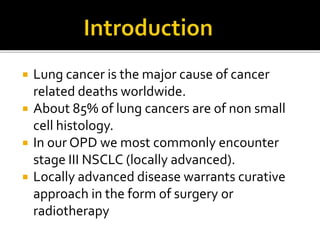
 Lung cancer is the major cause of cancer
related deaths worldwide.
 About 85% of lung cancers are of non small
cell histology.
 In our OPD we most commonly encounter
stage III NSCLC (locally advanced).
 Locally advanced disease warrants curative
approach in the form of surgery or
radiotherapy
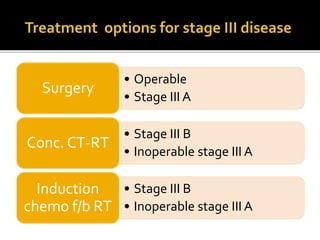
• Operable
• Stage III A
Surgery
• Stage III B
• Inoperable stage III A
Conc. CT-RT
• Stage III B
• Inoperable stage III A
Induction
chemo f/b RT
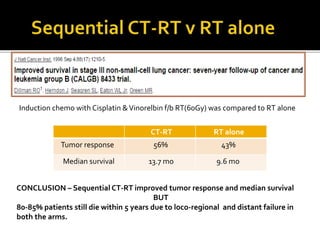
Induction chemo with Cisplatin &Vinorelbin f/b RT(60Gy) was compared to RT alone
CT-RT RT alone
Tumor response 56% 43%
Median survival 13.7 mo 9.6 mo
CONCLUSION – Sequential CT-RT improved tumor response and median survival
BUT
80-85% patients still die within 5 years due to loco-regional and distant failure in
both the arms.
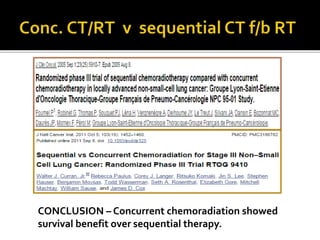
CONCLUSION – Concurrent chemoradiation showed
survival benefit over sequential therapy.
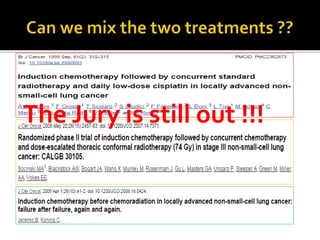
The Jury is still out !!!
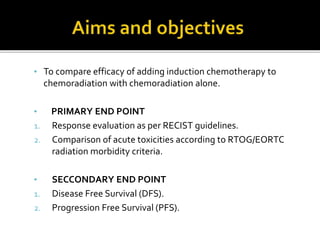
• To compare efficacy of adding induction chemotherapy to
chemoradiation with chemoradiation alone.
• PRIMARY END POINT
1. Response evaluation as per RECIST guidelines.
2. Comparison of acute toxicities according to RTOG/EORTC
radiation morbidity criteria.
• SECCONDARY END POINT
1. Disease Free Survival (DFS).
2. Progression Free Survival (PFS).
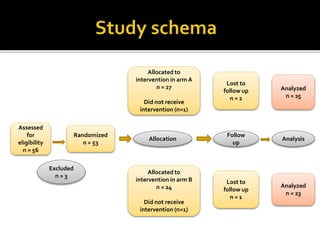
Assessed
for
eligibility
n = 56
Randomized
n = 53
Excluded
n = 3
Allocated to
intervention in arm A
n = 27
Did not receive
intervention (n=1)
Allocated to
intervention in arm B
n = 24
Did not receive
intervention (n=1)
Allocation
Lost to
follow up
n = 2
Lost to
follow up
n = 1
Analyzed
n = 25
Analyzed
n = 23
Follow
up
Analysis
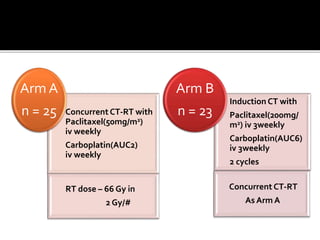
Concurrent CT-RT with
Paclitaxel(50mg/m2)
iv weekly
Carboplatin(AUC2)
iv weekly
RT dose – 66 Gy in
2 Gy/#
Arm A
n = 25
Induction CT with
Paclitaxel(200mg/
m2) iv 3weekly
Carboplatin(AUC6)
iv 3weekly
2 cycles
Concurrent CT-RT
As Arm A
Arm B
n = 23
Baseline characteristics
 Age & sex distribution, performance status,T & N stages and
histology were similar in the two arms (p>0.05).
 Sex distribution – male in Arm A – 88%
Arm B – 95.65% [p = 0.61]
 Smoker – in Arm A – 84%
Arm B – 86.95% [p = 1.00]
Median follow up
 Arm A – 8 months (2 – 14months)
 Arm B – 8 months (2-16 months).
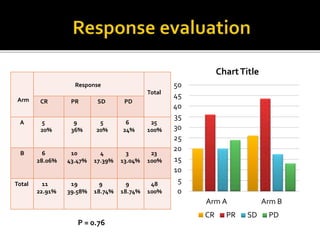
Arm
Response
Total
CR PR SD PD
A 5
20%
9
36%
5
20%
6
24%
25
100%
B 6
28.06%
10
43.47%
4
17.39%
3
13.04%
23
100%
Total 11
22.91%
19
39.58%
9
18.74%
9
18.74%
48
100% 0
5
10
15
20
25
30
35
40
45
50
Arm A Arm B
ChartTitle
CR PR SD PD
P = 0.76
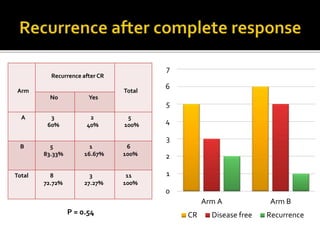
Arm
Recurrence after CR
Total
No Yes
A 3
60%
2
40%
5
100%
B 5
83.33%
1
16.67%
6
100%
Total 8
72.72%
3
27.27%
11
100%
0
1
2
3
4
5
6
7
Arm A Arm B
CR Disease free RecurrenceP = 0.54
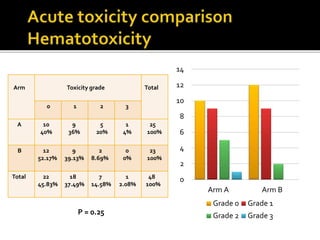
Arm Toxicity grade Total
0 1 2 3
A 10
40%
9
36%
5
20%
1
4%
25
100%
B 12
52.17%
9
39.13%
2
8.69%
0
0%
23
100%
Total 22
45.83%
18
37.49%
7
14.58%
1
2.08%
48
100%
0
2
4
6
8
10
12
14
Arm A Arm B
Grade 0 Grade 1
Grade 2 Grade 3P = 0.25
Arm
Toxicity grade
Total
0 1 2 3
A 11
44%
9
36%
4
16%
1
4%
25
100%
B 7
30.43%
12
52.17%
4
17.39%
0
0%
23
100%
Total 18
37.49%
21
43.74%
8
16.67%
1
2.08%
48
100%
0
2
4
6
8
10
12
14
Arm A Arm B
Grade 0 Grade 1
Grade 2 Grade 3
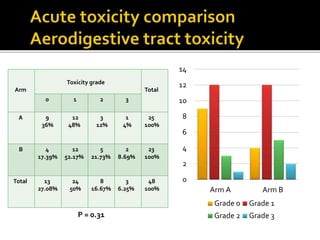
P = 1.00
Arm
Toxicity grade
Total
0 1 2 3
A 9
36%
12
48%
3
12%
1
4%
25
100%
B 4
17.39%
12
52.17%
5
21.73%
2
8.69%
23
100%
Total 13
27.08%
24
50%
8
16.67%
3
6.25%
48
100%
0
2
4
6
8
10
12
14
Arm A Arm B
Grade 0 Grade 1
Grade 2 Grade 3P = 0.31
Arm
Toxicity grade
Total0 1 2
A 19
76%
5
20%
1
4%
25
100%
B 19
82.6%
4
17.39%
0
0%
23
100%
Total 38
79.16%
9
18.74%
1
2.08%
48
100% 0
2
4
6
8
10
12
14
16
18
20
Arm A Arm B
Grade 0 Grade 1 Grade 2
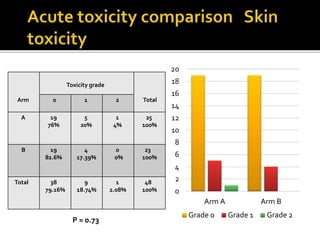
P = 0.73
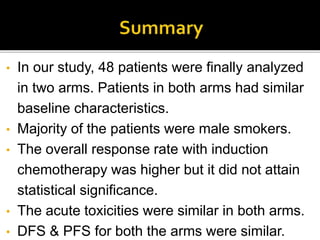
• In our study, 48 patients were finally analyzed
in two arms. Patients in both arms had similar
baseline characteristics.
• Majority of the patients were male smokers.
• The overall response rate with induction
chemotherapy was higher but it did not attain
statistical significance.
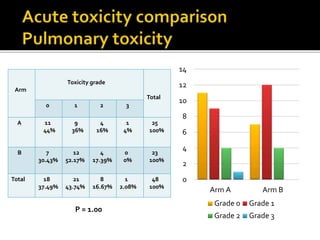
• The acute toxicities were similar in both arms.
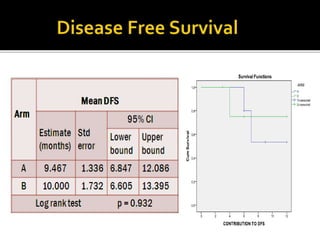
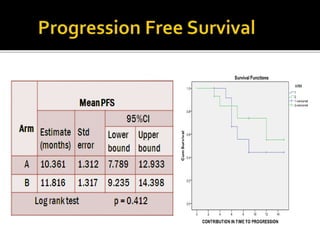
• DFS & PFS for both the arms were similar.
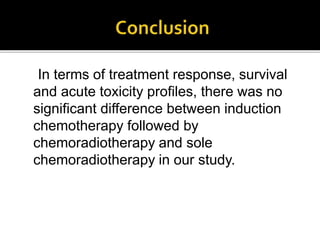
In terms of treatment response, survival
and acute toxicity profiles, there was no
significant difference between induction
chemotherapy followed by
chemoradiotherapy and sole
chemoradiotherapy in our study.
A prospective study comparing induction chemotherapy followed by

A prospective study comparing induction chemotherapy followed by

  • 1.
    Dr. Rajib Bhattacharjee,PGT, IPGME&R, Kolkata Dr. Subir Pal, PGT, IPGME&R, Kolkata Dr. Somnath Roy, SR, IPGME&R, Kolkata Dr. Siddhartha Basu, Professor & HOD, IPGME&R, Kolkata
  • 2.
     Lung canceris the major cause of cancer related deaths worldwide.  About 85% of lung cancers are of non small cell histology.  In our OPD we most commonly encounter stage III NSCLC (locally advanced).  Locally advanced disease warrants curative approach in the form of surgery or radiotherapy
  • 3.
    • Operable • StageIII A Surgery • Stage III B • Inoperable stage III A Conc. CT-RT • Stage III B • Inoperable stage III A Induction chemo f/b RT
  • 4.
    Induction chemo withCisplatin &Vinorelbin f/b RT(60Gy) was compared to RT alone CT-RT RT alone Tumor response 56% 43% Median survival 13.7 mo 9.6 mo CONCLUSION – Sequential CT-RT improved tumor response and median survival BUT 80-85% patients still die within 5 years due to loco-regional and distant failure in both the arms.
  • 5.
    CONCLUSION – Concurrentchemoradiation showed survival benefit over sequential therapy.
  • 6.
    The Jury isstill out !!!
  • 7.
    • To compareefficacy of adding induction chemotherapy to chemoradiation with chemoradiation alone. • PRIMARY END POINT 1. Response evaluation as per RECIST guidelines. 2. Comparison of acute toxicities according to RTOG/EORTC radiation morbidity criteria. • SECCONDARY END POINT 1. Disease Free Survival (DFS). 2. Progression Free Survival (PFS).
  • 8.
    Assessed for eligibility n = 56 Randomized n= 53 Excluded n = 3 Allocated to intervention in arm A n = 27 Did not receive intervention (n=1) Allocated to intervention in arm B n = 24 Did not receive intervention (n=1) Allocation Lost to follow up n = 2 Lost to follow up n = 1 Analyzed n = 25 Analyzed n = 23 Follow up Analysis
  • 9.
    Concurrent CT-RT with Paclitaxel(50mg/m2) ivweekly Carboplatin(AUC2) iv weekly RT dose – 66 Gy in 2 Gy/# Arm A n = 25 Induction CT with Paclitaxel(200mg/ m2) iv 3weekly Carboplatin(AUC6) iv 3weekly 2 cycles Concurrent CT-RT As Arm A Arm B n = 23
  • 10.
    Baseline characteristics  Age& sex distribution, performance status,T & N stages and histology were similar in the two arms (p>0.05).  Sex distribution – male in Arm A – 88% Arm B – 95.65% [p = 0.61]  Smoker – in Arm A – 84% Arm B – 86.95% [p = 1.00] Median follow up  Arm A – 8 months (2 – 14months)  Arm B – 8 months (2-16 months).
  • 11.
    Arm Response Total CR PR SDPD A 5 20% 9 36% 5 20% 6 24% 25 100% B 6 28.06% 10 43.47% 4 17.39% 3 13.04% 23 100% Total 11 22.91% 19 39.58% 9 18.74% 9 18.74% 48 100% 0 5 10 15 20 25 30 35 40 45 50 Arm A Arm B ChartTitle CR PR SD PD P = 0.76
  • 12.
    Arm Recurrence after CR Total NoYes A 3 60% 2 40% 5 100% B 5 83.33% 1 16.67% 6 100% Total 8 72.72% 3 27.27% 11 100% 0 1 2 3 4 5 6 7 Arm A Arm B CR Disease free RecurrenceP = 0.54
  • 15.
    Arm Toxicity gradeTotal 0 1 2 3 A 10 40% 9 36% 5 20% 1 4% 25 100% B 12 52.17% 9 39.13% 2 8.69% 0 0% 23 100% Total 22 45.83% 18 37.49% 7 14.58% 1 2.08% 48 100% 0 2 4 6 8 10 12 14 Arm A Arm B Grade 0 Grade 1 Grade 2 Grade 3P = 0.25
  • 16.
    Arm Toxicity grade Total 0 12 3 A 11 44% 9 36% 4 16% 1 4% 25 100% B 7 30.43% 12 52.17% 4 17.39% 0 0% 23 100% Total 18 37.49% 21 43.74% 8 16.67% 1 2.08% 48 100% 0 2 4 6 8 10 12 14 Arm A Arm B Grade 0 Grade 1 Grade 2 Grade 3 P = 1.00
  • 17.
    Arm Toxicity grade Total 0 12 3 A 9 36% 12 48% 3 12% 1 4% 25 100% B 4 17.39% 12 52.17% 5 21.73% 2 8.69% 23 100% Total 13 27.08% 24 50% 8 16.67% 3 6.25% 48 100% 0 2 4 6 8 10 12 14 Arm A Arm B Grade 0 Grade 1 Grade 2 Grade 3P = 0.31
  • 18.
    Arm Toxicity grade Total0 12 A 19 76% 5 20% 1 4% 25 100% B 19 82.6% 4 17.39% 0 0% 23 100% Total 38 79.16% 9 18.74% 1 2.08% 48 100% 0 2 4 6 8 10 12 14 16 18 20 Arm A Arm B Grade 0 Grade 1 Grade 2 P = 0.73
  • 19.
    • In ourstudy, 48 patients were finally analyzed in two arms. Patients in both arms had similar baseline characteristics. • Majority of the patients were male smokers. • The overall response rate with induction chemotherapy was higher but it did not attain statistical significance. • The acute toxicities were similar in both arms. • DFS & PFS for both the arms were similar.
  • 20.
    In terms oftreatment response, survival and acute toxicity profiles, there was no significant difference between induction chemotherapy followed by chemoradiotherapy and sole chemoradiotherapy in our study.