Plagiarism – What is all the fuss about?  Dr Fiona Duggan Head of Advice and Guidance
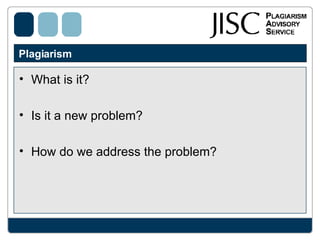
Plagiarism  What is it?  Is it a new problem? How do we address the problem?
What is plagiarism? Theft? Disease? War?  Other?
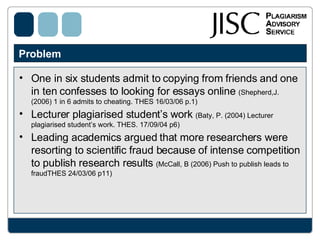
Problem  One in six students admit to copying from friends and one in ten confesses to looking for essays online  (Shepherd,J. (2006) 1 in 6 admits to cheating. THES 16/03/06 p.1) Lecturer plagiarised student’s work  (Baty, P. (2004) Lecturer plagiarised student’s work. THES. 17/09/04 p6) Leading academics argued that more researchers were resorting to scientific fraud because of intense competition to publish research results  (McCall, B (2006) Push to publish leads to fraudTHES 24/03/06 p11)
Defining plagiarism  Need a common understanding Need consistency in application Need to practice what we preach!
A new problem?  Shakespeare Martin Luther King Princess Michael of Kent
Reasons  Concept of ownership not yet developed Oral tradition of sharing resources Cryptomnesia
Current issues  Increasing consumerism in attitudes towards education Students adopting a more strategic approach to their studies Diverse nature of student population
And  Increased access to electronic resources Widespread confusion about referencing and citation Changing attitudes in popular culture e.g. sampling in music, file-sharing
And  ‘Bespoke’ essay writing services Sale of student work on e-commerce sites ‘Contract cheating’ sites  (Clarke, R & Lancaster, T (2007) Eliminating the successor to plagiarism? Identifying the usage of contract cheating sites in Duggan, F (Ed.) 2 nd  International Plagiarism Conference Proceedings, Northumbria Learning Press)
HE in FE issues  Lack of up-to-date knowledge when citing electronic resources Lack of confidence when teaching academic writing Inadequate knowledge of cultural issues relating to plagiarism Duggan, F. & Mazey, R (n.d.) Perceptions of plagiarism: An HE in FE case study Available at:  http://www.jiscpas.ac.uk  [Accessed 26/03/07]
Responses Use of detection software Revision of institutional policies and procedures  Review of assessments Increased guidance for students
Referencing and attribution An out-dated practice? Isn’t everything freely available? Negative associations
However Probably more relevant than ever in the current  knowledge-based society One of the building blocks of good academic practice A positive action rather than a negative one
So  Need to provide students with opportunities to practice Need to provide an example in our own practice Stress the positive aspects of attribution
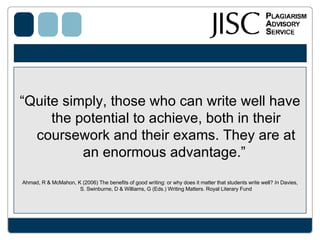
“ Quite simply, those who can write well have the potential to achieve, both in their coursework and their exams. They are at an enormous advantage.”   Ahmad, R & McMahon, K (2006) The benefits of good writing: or why does it matter that students write well?  In  Davies, S. Swinburne, D & Williams, G (Eds.) Writing Matters. Royal Literary Fund

Identifying and preventing plagiarism: issues for HE tutors in FE Colleges

  • 1.
    Plagiarism – Whatis all the fuss about? Dr Fiona Duggan Head of Advice and Guidance
  • 2.
    Plagiarism Whatis it? Is it a new problem? How do we address the problem?
  • 3.
    What is plagiarism?Theft? Disease? War? Other?
  • 4.
    Problem Onein six students admit to copying from friends and one in ten confesses to looking for essays online (Shepherd,J. (2006) 1 in 6 admits to cheating. THES 16/03/06 p.1) Lecturer plagiarised student’s work (Baty, P. (2004) Lecturer plagiarised student’s work. THES. 17/09/04 p6) Leading academics argued that more researchers were resorting to scientific fraud because of intense competition to publish research results (McCall, B (2006) Push to publish leads to fraudTHES 24/03/06 p11)
  • 5.
    Defining plagiarism Need a common understanding Need consistency in application Need to practice what we preach!
  • 6.
    A new problem? Shakespeare Martin Luther King Princess Michael of Kent
  • 7.
    Reasons Conceptof ownership not yet developed Oral tradition of sharing resources Cryptomnesia
  • 8.
    Current issues Increasing consumerism in attitudes towards education Students adopting a more strategic approach to their studies Diverse nature of student population
  • 9.
    And Increasedaccess to electronic resources Widespread confusion about referencing and citation Changing attitudes in popular culture e.g. sampling in music, file-sharing
  • 10.
    And ‘Bespoke’essay writing services Sale of student work on e-commerce sites ‘Contract cheating’ sites (Clarke, R & Lancaster, T (2007) Eliminating the successor to plagiarism? Identifying the usage of contract cheating sites in Duggan, F (Ed.) 2 nd International Plagiarism Conference Proceedings, Northumbria Learning Press)
  • 11.
    HE in FEissues Lack of up-to-date knowledge when citing electronic resources Lack of confidence when teaching academic writing Inadequate knowledge of cultural issues relating to plagiarism Duggan, F. & Mazey, R (n.d.) Perceptions of plagiarism: An HE in FE case study Available at: http://www.jiscpas.ac.uk [Accessed 26/03/07]
  • 12.
    Responses Use ofdetection software Revision of institutional policies and procedures Review of assessments Increased guidance for students
  • 13.
    Referencing and attributionAn out-dated practice? Isn’t everything freely available? Negative associations
  • 14.
    However Probably morerelevant than ever in the current knowledge-based society One of the building blocks of good academic practice A positive action rather than a negative one
  • 15.
    So Needto provide students with opportunities to practice Need to provide an example in our own practice Stress the positive aspects of attribution
  • 16.
    “ Quite simply,those who can write well have the potential to achieve, both in their coursework and their exams. They are at an enormous advantage.” Ahmad, R & McMahon, K (2006) The benefits of good writing: or why does it matter that students write well? In Davies, S. Swinburne, D & Williams, G (Eds.) Writing Matters. Royal Literary Fund