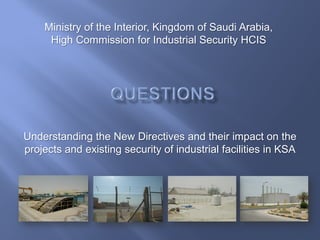
Understanding the New Directives and their impact on the
projects and existing security of industrial facilities in KSA
Ministry of the Interior, Kingdom of Saudi Arabia,
High Commission for Industrial Security HCIS
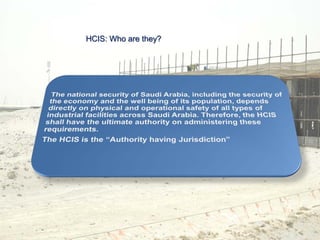
HCIS: Who are they?
HCIS: Who are they?
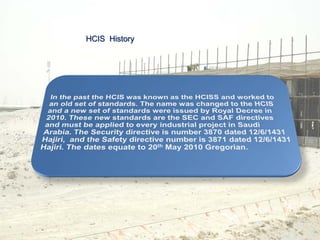
HCIS History
HCIS Approval
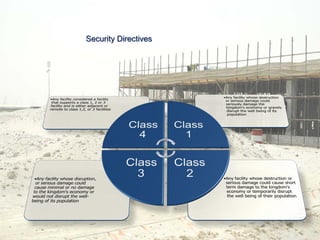
Security Directives
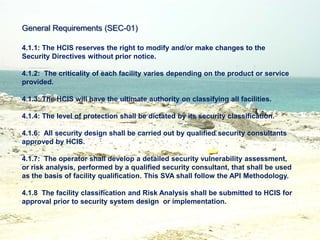
General Requirements (SEC-01)
4.1.1: The HCIS reserves the right to modify and/or make changes to the
Security Directives without prior notice.
4.1.2: The criticality of each facility varies depending on the product or service
provided.
4.1.3: The HCIS will have the ultimate authority on classifying all facilities.
4.1.4: The level of protection shall be dictated by its security classification.
4.1.6: All security design shall be carried out by qualified security consultants
approved by HCIS.
4.1.7: The operator shall develop a detailed security vulnerability assessment,
or risk analysis, performed by a qualified security consultant, that shall be used
as the basis of facility qualification. This SVA shall follow the API Methodology.
4.1.8 The facility classification and Risk Analysis shall be submitted to HCIS for
approval prior to security system design or implementation.
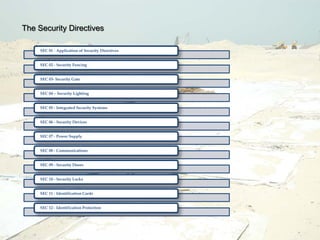
The Security Directives
SEC 01 - Application of Security Directives
SEC 02 - Security Fencing
SEC 03- Security Gate
SEC 04 – Security Lighting
SEC 05 - Integrated Security Systems
SEC 06 - Security Devices
SEC 07 - Power Supply
SEC 08 - Communications
SEC 09 - Security Doors
SEC 10 - Security Locks
SEC 11 - Identification Cards
SEC 12 - Identification Protection
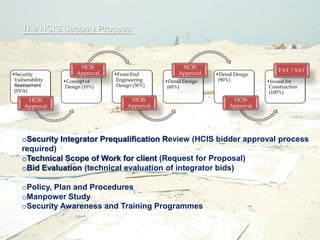
The HCIS Security Process:
•Security
Vulnerability
Assessment
(SVA)
HCIS
Approval
•Concept of
Design (10%)
HCIS
Approval •Front End
Engineering
Design (30%)
HCIS
Approval
•Detail Design
(60%)
HCIS
Approval •Detail Design
(90%)
HCIS
Approval
•Issued for
Construction
(100%)
FAT / SAT
oSecurity Integrator Prequalification Review (HCIS bidder approval process
required)
oTechnical Scope of Work for client (Request for Proposal)
oBid Evaluation (technical evaluation of integrator bids)
oPolicy, Plan and Procedures
oManpower Study
oSecurity Awareness and Training Programmes
Security Directives:
Procedure
Security
Vulnerability
Assessment
(SVA)
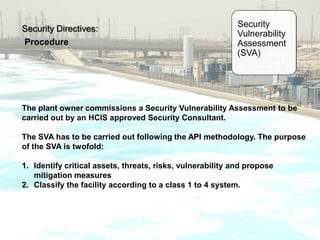
The plant owner commissions a Security Vulnerability Assessment to be
carried out by an HCIS approved Security Consultant.
The SVA has to be carried out following the API methodology. The purpose
of the SVA is twofold:
1. Identify critical assets, threats, risks, vulnerability and propose
mitigation measures
2. Classify the facility according to a class 1 to 4 system.
Security Directives:
Procedure
Concept of
design (COD)
After the approval of the Security Vulnerability Assessment, the plant
owner commissions an HCIS approved Security consultant to take the
results from the SVA and produce a security Concept of Design (COD)
This Concept of Design (also called 10% Preliminary design) provides a
design solution to the mitigation measures proposed and approved during
the SVA exercise.
Security Directives:
Procedure
Front End
Engineering
Design
(FEED)
After the approval of the concept of design (COD), the plant owner
commissions an HCIS approved Security consultant to produce a Front
End Engineering Document from the SVA and Concept of Design (COD) .
The FEED (or 30% Design) will form the basis of the Technical Scope of
Work that will form part of the Request for Proposal (RFP).
This RFP will be issued to approved System Integrators to prepare a
Tender Bid.
The TSOW and RFP need not be approved by HCIS, but the FEED
document does and the security system integrators must be approved by
the HCIS.
The EPC should submit the prequalification document of the security
system integrator to the HCIS consultant for comment/approval before
submission to the owner for transmission to and approval by the HCIS.
Security Directives:
Procedure
Detailed
Design 60%
After the award of the security contract to an approved integrator the
integrator will produce a 60% detailed design that is in accordance with the
FEED design (30%). The design will include details of all hardware and
software to be used and will detail how the software is configured to
produce an integrated system.
The 60% detailed design is submitted to the HCIS approved consultant for
comment and review before submittal by the EPC to the owner for
transmission and approval by the HCIS.
Security Directives:
Procedure
Detailed
Design 90%
After the approval of the 60% detailed design the Security Systems
integrator will produce the 90% engineering submittal. This will include
information on the total system down to individual field item level showing
location, mechanical installation and all electrical terminations
The 90% detailed design is submitted to the HCIS approved consultant for
comment and review before submittal by the EPC to the owner for
transmission and approval by the HCIS.
Security Directives:
Procedure
Issued For
Construction
After the approval of the 90% design package the Security Systems
Integrator will prepare the system for the Factory Acceptance Test (FAT)
The Security System Integrator will produce a FAT document for submittal
and approval by the HCIS before the FAT is carried out .
The FAT will be attended by the HCIS representative, the HCIS consultant,
the owner and the EPC.
The approved consultant will lead a Site Acceptance Test (SAT) and issue a
Final Completion report (100%) for the HCIS.
4.5 Requirements for Executing Fire Protection Projects (SAF)
4.5.1 Designers, suppliers, contractors shall be approved by the HCIS.
4.5.3 Contractors and suppliers shall be certified by the Ministry of Interior (Civil Defense) and Ministry
Commerce and Industry.
4.5.4 The Owner shall submit qualification documents to the HCIS for approval
4.5.5 The Owner shall ensure that the company selected for safety and fire protection related work shal
adequate engineering capabilities and qualified manpower to design, install, test and maintain the safet
fire protection systems and execute all other work requirements competently. .
4.5.7 The HCIS reserves the exclusive right to approve or reject any candidate design agency performin
work.
4.5.8 The Owner shall ensure that the company selected for safety and fire protection related work shal
prior technical experience.
4.5.11 The HCIS shall have the right to reject any equipment, system, or suppliers
4.5.14 The Owner shall not permit any start on safety and fire protection related work until HCIS approv
the design, contractor, major fire protection equipment and systems is received.
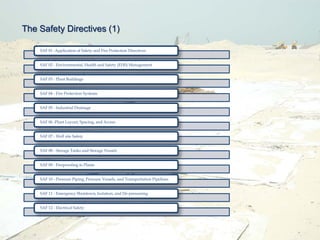
The Safety Directives (1)
SAF 01 -Application of Safety and Fire Protection Directives
SAF 02 - Environmental, Health and Safety (EHS) Management
SAF 03 - Plant Buildings
SAF 04 - Fire Protection Systems
SAF 05 - Industrial Drainage
SAF 06 -Plant Layout, Spacing, and Access
SAF 07 - Well site Safety
SAF 08 - Storage Tanks and Storage Vessels
SAF 09 - Fireproofing in Plants
SAF 10 - Pressure Piping, Pressure Vessels, and Transportation Pipelines
SAF 11 - Emergency Shutdown, Isolation, and De-pressuring
SAF 12 - Electrical Safety
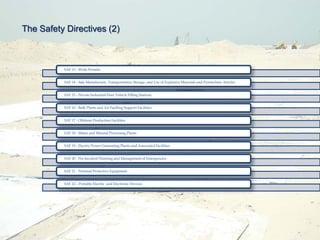
The Safety Directives (2)
SAF 13 - Work Permits
SAF 14 - Safe Manufacture, Transportation, Storage, and Use of Explosive Materials and Pyrotechnic Articles
SAF 15 - Private Industrial Fleet Vehicle Filling Stations
SAF 16 - Bulk Plants and Air Fuelling Support Facilities
SAF 17 - Offshore Production Facilities
SAF 18 - Mines and Mineral Processing Plants
SAF 19 - Electric Power Generating Plants and Associated Facilities
SAF 20 - Pre-Incident Planning and Management of Emergencies
SAF 21 - Personal Protective Equipment
SAF 22 – Portable Electric and Electronic Devices
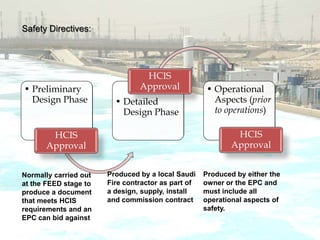
Safety Directives:
• Preliminary
Design Phase
HCIS
Approval
• Detailed
Design Phase
HCIS
Approval • Operational
Aspects (prior
to operations)
HCIS
Approval
Normally carried out
at the FEED stage to
produce a document
that meets HCIS
requirements and an
EPC can bid against
Produced by a local Saudi
Fire contractor as part of
a design, supply, install
and commission contract
Produced by either the
owner or the EPC and
must include all
operational aspects of
safety.
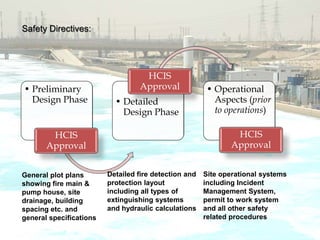
Safety Directives:
• Preliminary
Design Phase
HCIS
Approval
• Detailed
Design Phase
HCIS
Approval • Operational
Aspects (prior
to operations)
HCIS
Approval
General plot plans
showing fire main &
pump house, site
drainage, building
spacing etc. and
general specifications
Detailed fire detection and
protection layout
including all types of
extinguishing systems
and hydraulic calculations
Site operational systems
including Incident
Management System,
permit to work system
and all other safety
related procedures
Safety Directives:
Procedure
Preliminary
Design Phase
When the project is being designed at the FEED stage a preliminary design
for the site should be produced by the FEED engineers.
The FEED should take into account all 22 of the SAF standards.
The preliminary design has to be submitted to an HCIS approved
consultant for approval before the plant owner submits to HCIS for final
approval.
The HCIS consultant will produce a compliance matrix to show
compliance/non compliance to the HCIS codes and consult with the FEED
engineers to then ensure that the preliminary design is 100% in
compliance.
The preliminary design together with the compliance matrix is submitted
by the plant owner to the HCIS for approval
Safety Directives:
Procedure
The EPC will receive a bid package from the owner, based on the FEED
preliminary engineering. This includes the requirement that the EPC
selects a fire engineering company that meets the requirements of HCIS
SAF 1.
The EPC should select a fire contractor(s) that meets the requirements of
the HCIS and submit the companies pre-qualification document to the HCIS
consultant for comment. If the consultant approves the document then the
EPC should submit to the plant owner for transmission to and approval by
the HCIS.
The EPC should issue tender enquiries to the chosen approved
contractor(s)
The EPC should award the contract for the design, supply, installation and
commissioning of the fire systems to the approved fire contractor
Detailed
Design Phase
Safety Directives:
Procedure
The owner, in conjunction with the EPC will produce Site operational
systems including Incident Management System, permit to work system
and all other safety related procedures
The Incident Management System (IMS) shall meet the requirements of
SAF20 and be integrated with the Site Security Systems and the Site wide
fire alarm and fire protection system.
The IMS should be integrated from a hardware and software perspective to
produce an easy to use system that can be used to:
o Reduce loss of life
o Reduce loss or damage to assets
o Ensure any situation is controlled
o Ensure the safety of personnel and Assets
o Reduce hostile effects in the environment.
Operational
Aspects (prior
to operations)
Safety Directives:
Procedure
Operational
Aspects (prior
to operations)
The IMS must provide Fast, Effective Access to Critical Incident Data
Clear Command Communications
Common Operational Picture:
o Shared across an incident
o Shared between many agencies
Capacity to:
o Operate on a massive scale
o Operate over long timescales
o Manage massive numbers of victims and resources
o Minimise ecological and environmental damage
Safety Directives:
Procedure
The Incident Management System shall meet the requirements of the
NFPA.
NFPA 450 Emergency Medical Services and Systems
NFPA 472 Competence of Responders to Hazardous Materials/ Weapons
of Mass Destruction Incidents
NFPA 473 Competencies for EMS Personnel Responding to Hazardous
Materials / Weapons of Mass Destruction Incidents
NFPA 1006 Rescue Technician Professional Qualifications
NFPA 1620 Pre-Incident Planning
NFPA 1670 Operations and Training for Technical Rescue Incidents
NFPA 1951 Protective Ensembles for Technical Rescue Incidents
Operational
Aspects (prior
to operations)
These New Directives must be applied on all new projects
in the Kingdom of Saudi Arabia for Security and Safety.
From July 2012 they will apply to all existing industrial
facilities in Saudi Arabia.
Any plant owner not meeting the standards will face
serious consequences.
Ministry of the Interior, Kingdom of Saudi Arabia,
High Commission for Industrial Security HCIS
Understanding the New Directives and their impact on the
projects and existing security of industrial facilities in KSA
Ministry of the Interior, Kingdom of Saudi Arabia,
High Commission for Industrial Security HCIS

HCIS approval & procedure

  • 1.
    Understanding the NewDirectives and their impact on the projects and existing security of industrial facilities in KSA Ministry of the Interior, Kingdom of Saudi Arabia, High Commission for Industrial Security HCIS
  • 2.
  • 3.
  • 4.
  • 5.
  • 7.
  • 8.
    General Requirements (SEC-01) 4.1.1:The HCIS reserves the right to modify and/or make changes to the Security Directives without prior notice. 4.1.2: The criticality of each facility varies depending on the product or service provided. 4.1.3: The HCIS will have the ultimate authority on classifying all facilities. 4.1.4: The level of protection shall be dictated by its security classification. 4.1.6: All security design shall be carried out by qualified security consultants approved by HCIS. 4.1.7: The operator shall develop a detailed security vulnerability assessment, or risk analysis, performed by a qualified security consultant, that shall be used as the basis of facility qualification. This SVA shall follow the API Methodology. 4.1.8 The facility classification and Risk Analysis shall be submitted to HCIS for approval prior to security system design or implementation.
  • 9.
    The Security Directives SEC01 - Application of Security Directives SEC 02 - Security Fencing SEC 03- Security Gate SEC 04 – Security Lighting SEC 05 - Integrated Security Systems SEC 06 - Security Devices SEC 07 - Power Supply SEC 08 - Communications SEC 09 - Security Doors SEC 10 - Security Locks SEC 11 - Identification Cards SEC 12 - Identification Protection
  • 10.
    The HCIS SecurityProcess: •Security Vulnerability Assessment (SVA) HCIS Approval •Concept of Design (10%) HCIS Approval •Front End Engineering Design (30%) HCIS Approval •Detail Design (60%) HCIS Approval •Detail Design (90%) HCIS Approval •Issued for Construction (100%) FAT / SAT oSecurity Integrator Prequalification Review (HCIS bidder approval process required) oTechnical Scope of Work for client (Request for Proposal) oBid Evaluation (technical evaluation of integrator bids) oPolicy, Plan and Procedures oManpower Study oSecurity Awareness and Training Programmes
  • 11.
    Security Directives: Procedure Security Vulnerability Assessment (SVA) The plantowner commissions a Security Vulnerability Assessment to be carried out by an HCIS approved Security Consultant. The SVA has to be carried out following the API methodology. The purpose of the SVA is twofold: 1. Identify critical assets, threats, risks, vulnerability and propose mitigation measures 2. Classify the facility according to a class 1 to 4 system.
  • 12.
    Security Directives: Procedure Concept of design(COD) After the approval of the Security Vulnerability Assessment, the plant owner commissions an HCIS approved Security consultant to take the results from the SVA and produce a security Concept of Design (COD) This Concept of Design (also called 10% Preliminary design) provides a design solution to the mitigation measures proposed and approved during the SVA exercise.
  • 13.
    Security Directives: Procedure Front End Engineering Design (FEED) Afterthe approval of the concept of design (COD), the plant owner commissions an HCIS approved Security consultant to produce a Front End Engineering Document from the SVA and Concept of Design (COD) . The FEED (or 30% Design) will form the basis of the Technical Scope of Work that will form part of the Request for Proposal (RFP). This RFP will be issued to approved System Integrators to prepare a Tender Bid. The TSOW and RFP need not be approved by HCIS, but the FEED document does and the security system integrators must be approved by the HCIS. The EPC should submit the prequalification document of the security system integrator to the HCIS consultant for comment/approval before submission to the owner for transmission to and approval by the HCIS.
  • 14.
    Security Directives: Procedure Detailed Design 60% Afterthe award of the security contract to an approved integrator the integrator will produce a 60% detailed design that is in accordance with the FEED design (30%). The design will include details of all hardware and software to be used and will detail how the software is configured to produce an integrated system. The 60% detailed design is submitted to the HCIS approved consultant for comment and review before submittal by the EPC to the owner for transmission and approval by the HCIS.
  • 15.
    Security Directives: Procedure Detailed Design 90% Afterthe approval of the 60% detailed design the Security Systems integrator will produce the 90% engineering submittal. This will include information on the total system down to individual field item level showing location, mechanical installation and all electrical terminations The 90% detailed design is submitted to the HCIS approved consultant for comment and review before submittal by the EPC to the owner for transmission and approval by the HCIS.
  • 16.
    Security Directives: Procedure Issued For Construction Afterthe approval of the 90% design package the Security Systems Integrator will prepare the system for the Factory Acceptance Test (FAT) The Security System Integrator will produce a FAT document for submittal and approval by the HCIS before the FAT is carried out . The FAT will be attended by the HCIS representative, the HCIS consultant, the owner and the EPC. The approved consultant will lead a Site Acceptance Test (SAT) and issue a Final Completion report (100%) for the HCIS.
  • 18.
    4.5 Requirements forExecuting Fire Protection Projects (SAF) 4.5.1 Designers, suppliers, contractors shall be approved by the HCIS. 4.5.3 Contractors and suppliers shall be certified by the Ministry of Interior (Civil Defense) and Ministry Commerce and Industry. 4.5.4 The Owner shall submit qualification documents to the HCIS for approval 4.5.5 The Owner shall ensure that the company selected for safety and fire protection related work shal adequate engineering capabilities and qualified manpower to design, install, test and maintain the safet fire protection systems and execute all other work requirements competently. . 4.5.7 The HCIS reserves the exclusive right to approve or reject any candidate design agency performin work. 4.5.8 The Owner shall ensure that the company selected for safety and fire protection related work shal prior technical experience. 4.5.11 The HCIS shall have the right to reject any equipment, system, or suppliers 4.5.14 The Owner shall not permit any start on safety and fire protection related work until HCIS approv the design, contractor, major fire protection equipment and systems is received.
  • 19.
    The Safety Directives(1) SAF 01 -Application of Safety and Fire Protection Directives SAF 02 - Environmental, Health and Safety (EHS) Management SAF 03 - Plant Buildings SAF 04 - Fire Protection Systems SAF 05 - Industrial Drainage SAF 06 -Plant Layout, Spacing, and Access SAF 07 - Well site Safety SAF 08 - Storage Tanks and Storage Vessels SAF 09 - Fireproofing in Plants SAF 10 - Pressure Piping, Pressure Vessels, and Transportation Pipelines SAF 11 - Emergency Shutdown, Isolation, and De-pressuring SAF 12 - Electrical Safety
  • 20.
    The Safety Directives(2) SAF 13 - Work Permits SAF 14 - Safe Manufacture, Transportation, Storage, and Use of Explosive Materials and Pyrotechnic Articles SAF 15 - Private Industrial Fleet Vehicle Filling Stations SAF 16 - Bulk Plants and Air Fuelling Support Facilities SAF 17 - Offshore Production Facilities SAF 18 - Mines and Mineral Processing Plants SAF 19 - Electric Power Generating Plants and Associated Facilities SAF 20 - Pre-Incident Planning and Management of Emergencies SAF 21 - Personal Protective Equipment SAF 22 – Portable Electric and Electronic Devices
  • 21.
    Safety Directives: • Preliminary DesignPhase HCIS Approval • Detailed Design Phase HCIS Approval • Operational Aspects (prior to operations) HCIS Approval Normally carried out at the FEED stage to produce a document that meets HCIS requirements and an EPC can bid against Produced by a local Saudi Fire contractor as part of a design, supply, install and commission contract Produced by either the owner or the EPC and must include all operational aspects of safety.
  • 22.
    Safety Directives: • Preliminary DesignPhase HCIS Approval • Detailed Design Phase HCIS Approval • Operational Aspects (prior to operations) HCIS Approval General plot plans showing fire main & pump house, site drainage, building spacing etc. and general specifications Detailed fire detection and protection layout including all types of extinguishing systems and hydraulic calculations Site operational systems including Incident Management System, permit to work system and all other safety related procedures
  • 23.
    Safety Directives: Procedure Preliminary Design Phase Whenthe project is being designed at the FEED stage a preliminary design for the site should be produced by the FEED engineers. The FEED should take into account all 22 of the SAF standards. The preliminary design has to be submitted to an HCIS approved consultant for approval before the plant owner submits to HCIS for final approval. The HCIS consultant will produce a compliance matrix to show compliance/non compliance to the HCIS codes and consult with the FEED engineers to then ensure that the preliminary design is 100% in compliance. The preliminary design together with the compliance matrix is submitted by the plant owner to the HCIS for approval
  • 24.
    Safety Directives: Procedure The EPCwill receive a bid package from the owner, based on the FEED preliminary engineering. This includes the requirement that the EPC selects a fire engineering company that meets the requirements of HCIS SAF 1. The EPC should select a fire contractor(s) that meets the requirements of the HCIS and submit the companies pre-qualification document to the HCIS consultant for comment. If the consultant approves the document then the EPC should submit to the plant owner for transmission to and approval by the HCIS. The EPC should issue tender enquiries to the chosen approved contractor(s) The EPC should award the contract for the design, supply, installation and commissioning of the fire systems to the approved fire contractor Detailed Design Phase
  • 25.
    Safety Directives: Procedure The owner,in conjunction with the EPC will produce Site operational systems including Incident Management System, permit to work system and all other safety related procedures The Incident Management System (IMS) shall meet the requirements of SAF20 and be integrated with the Site Security Systems and the Site wide fire alarm and fire protection system. The IMS should be integrated from a hardware and software perspective to produce an easy to use system that can be used to: o Reduce loss of life o Reduce loss or damage to assets o Ensure any situation is controlled o Ensure the safety of personnel and Assets o Reduce hostile effects in the environment. Operational Aspects (prior to operations)
  • 26.
    Safety Directives: Procedure Operational Aspects (prior tooperations) The IMS must provide Fast, Effective Access to Critical Incident Data Clear Command Communications Common Operational Picture: o Shared across an incident o Shared between many agencies Capacity to: o Operate on a massive scale o Operate over long timescales o Manage massive numbers of victims and resources o Minimise ecological and environmental damage
  • 27.
    Safety Directives: Procedure The IncidentManagement System shall meet the requirements of the NFPA. NFPA 450 Emergency Medical Services and Systems NFPA 472 Competence of Responders to Hazardous Materials/ Weapons of Mass Destruction Incidents NFPA 473 Competencies for EMS Personnel Responding to Hazardous Materials / Weapons of Mass Destruction Incidents NFPA 1006 Rescue Technician Professional Qualifications NFPA 1620 Pre-Incident Planning NFPA 1670 Operations and Training for Technical Rescue Incidents NFPA 1951 Protective Ensembles for Technical Rescue Incidents Operational Aspects (prior to operations)
  • 28.
    These New Directivesmust be applied on all new projects in the Kingdom of Saudi Arabia for Security and Safety. From July 2012 they will apply to all existing industrial facilities in Saudi Arabia. Any plant owner not meeting the standards will face serious consequences. Ministry of the Interior, Kingdom of Saudi Arabia, High Commission for Industrial Security HCIS
  • 29.
    Understanding the NewDirectives and their impact on the projects and existing security of industrial facilities in KSA Ministry of the Interior, Kingdom of Saudi Arabia, High Commission for Industrial Security HCIS