API 571:Damage Mechanisms
Affecting Fixed Equipment in
the Refining Industry
PUSAT PEMBANGUNAN TENAGA INDUSTRI
(PUSPATRI)
5th – 9th November 2007
API 571 Practice Question
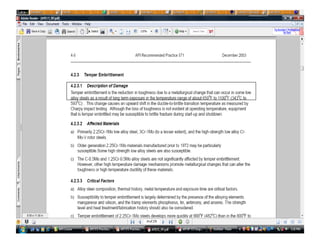
66. What is the definition of temper embrittlement?
1. Reduction in toughness due to mechanical change
2. Increase in toughness due to metallurgical change
3. Heating below 6500F
4. Reduction in toughness due to metallurgical change
API 571 Practice Question
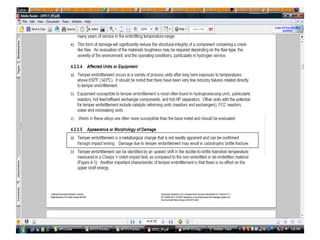
67. How is temper embrittlement confirmed?
1. Through impact testing
2. Through tension testing
3. Through bend test
4. None of the above
API 571 Practice Question
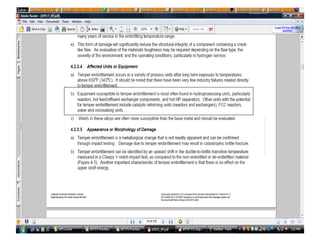
68. In which equipment is temper embrittlement found?
1. Cooling towers
2. Hydroprocessing unit
3. Welds
4. Cokers
API 571 Practice Question
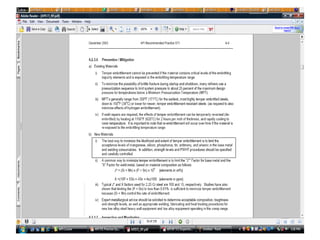
69. What is the best way to minimize the likelihood and extent of
temper embrittlement?
1. Limit acceptance levels of sulphur in welding consumables
2. Limit the level of iron in the base metals
3. Limit acceptance levels of managanese, silicon, phosporus, tin
and antimony in base metals.
4. None of the above
API 571 Practice Question
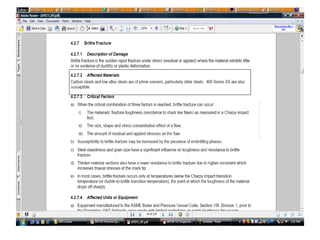
70. Brittle fracture occurs in which of the following materials?
1. The 300 series stainless steel
2. Carbon and low alloy steels
3. Aluminum
4. copper
API 571 Practice Question
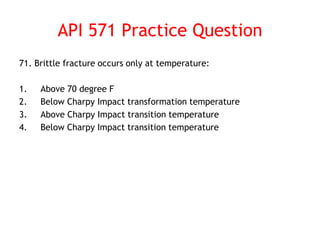
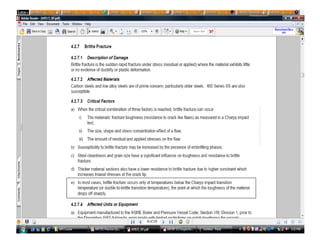
71. Brittle fracture occurs only at temperature:
1. Above 70 degree F
2. Below Charpy Impact transformation temperature
3. Above Charpy Impact transition temperature
4. Below Charpy Impact transition temperature
API 571 Practice Question
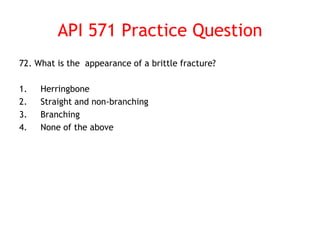
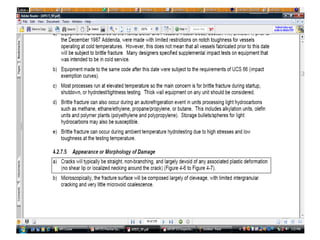
72. What is the appearance of a brittle fracture?
1. Herringbone
2. Straight and non-branching
3. Branching
4. None of the above
API 571 Practice Question
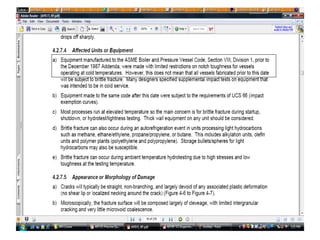
73. Equipment manufactured before what date was made with limited
restrictions on notch toughness?
1. December 1988 addenda
2. October 1957 addenda
3. January 1964 addenda
4. December 1987 addenda
API 571 Practice Question
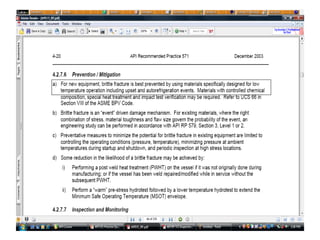
74. For new equipment, brittle fracture is best prevented by:
1. Using materials specifically designed for low temperature
operation
2. Using materials specifically designed for medium temperature
operation
3. Using a start up temperature above 1000F
4. Operating temperature below the lower transformation level.
API 571 Practice Question
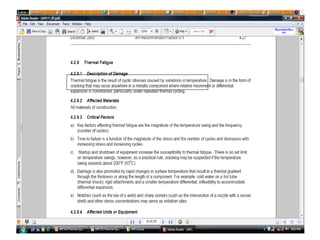
75. Thermal fatigue is defined as:
1. Cyclic stress below transition temperature
2. Fatigue due to low temperature operations
3. The result of cyclic stress caused by variations in temperature
4. 1 and 2 above
API 571 Practice Question
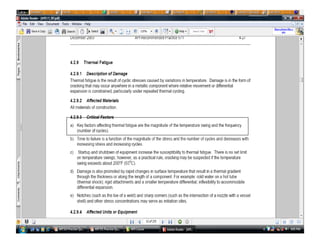
89. What one key factor affects thermal fatigue?
1. Magnitude of temperature swing
2. Start-up
3. Shutdown
4. 2 and 3 above
API 571 Practice Question
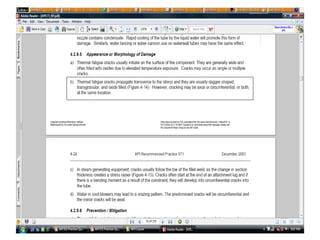
91. Thermal fatigue crack propagate:
1. Parallel to the stress
2. In an herringbone pattern
3. Transverse to the stress
4. Any of the above
API 571 Practice Question
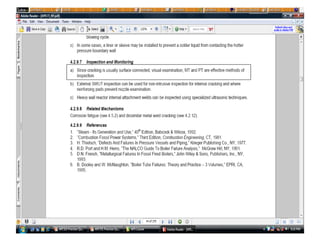
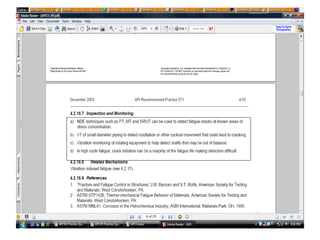
96. What are effective methods of inspecting for fatigue cracking?
1. UT
2. VT
3. MT & PT
4. Both 2 & 3
API 571 Practice Question
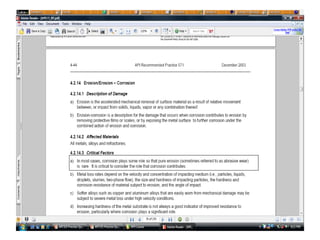
117. Pure erosion is sometimes referred to as:
1. Corrosive wear
2. Abrasive wear
3. Deburring
4. Cohesive wear
API 571 Practice Question
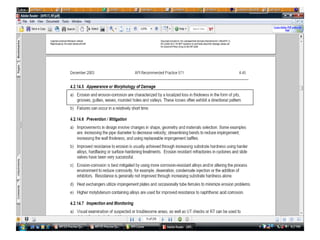
116. Erosion and erosion corrosion are characterized by a local loss in
thickness in the form of:
1. Pits
2. Grooves
3. Valleys
4. All the above
API 571 Practice Question
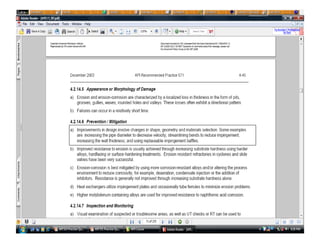
119. Which of the following is/are methods of preventing corrosion?
1. Increase pipe diameter
2. Decreasing wall thickness
3. Using replaceable impingement baffle
4. 1 and 3 above
API 571 Practice Question
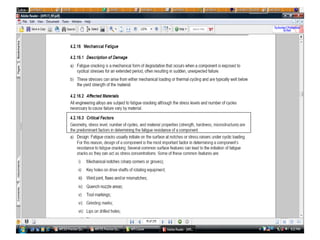
120. Which of the following is a critical factor for mechanical fatigue?
1. Geometry
2. Stress level
3. Number of cycle
4. All the above
API 571 Practice Question
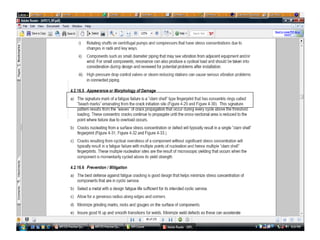
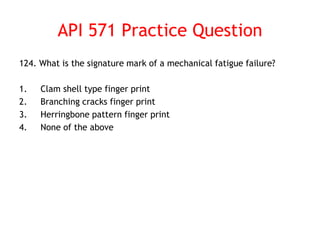
124. What is the signature mark of a mechanical fatigue failure?
1. Clam shell type finger print
2. Branching cracks finger print
3. Herringbone pattern finger print
4. None of the above
API 571 Practice Question
131. What inspection are done to rotating equipment to detect
evidence of mechanical fatigue?
1. PT
2. MT
3. Vibration monitoring
4. All the above
API 571 Practice Question
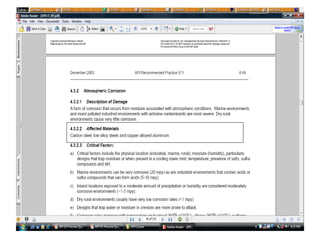
132. Which of the following material is affected by atmospheric
corrosion?
1. The 300 series stainless steel
2. Monel
3. The 400 series stainless steel
4. Copper alloyed aluminum
API 571 Practice Question
133. What is one inspection technique that can be used to detect
atmospheric corrosion.
1. UT
2. RT
3. MT
4. ET
API 571 Practice Question
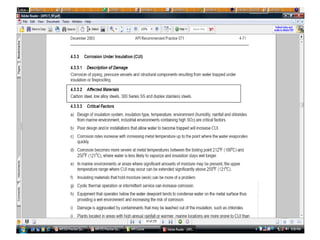
134. Corrosion under insulation (CUI) affects which of the following
materials?
1. Carbon steel
2. 300 series stainless steel
3. Duplex stainless steel
4. All the above
API 571 Practice Question
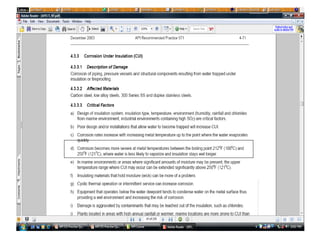
135. For CUI situations corrosion becomes more severe at metal
temperatures between:
1. 2120F and 2500F
2. 2120F and 1000C
3. 1000F and 1210F
4. None of the above
API 571 Practice Question
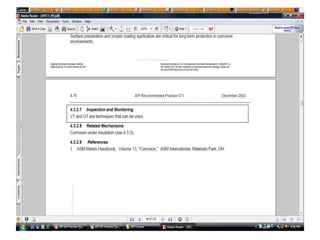
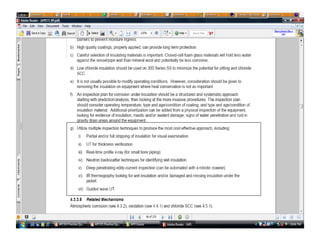
136. Which of the following are inspection and monitoring methods
for CUI?
1. Real time profile x-ray
2. IR thermography
3. Guided wave UT
4. All the above
API 571 Practice Question
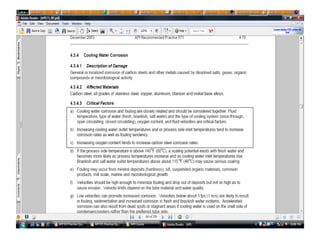
137. Which is the following is a critical factor for cooling water
corrosion?
1. Decreasing cooling water outlet temperature
2. Decreasing O2 content
3. Decreasing process side inlet temperatures
4. None of the above
API 571 Practice Question
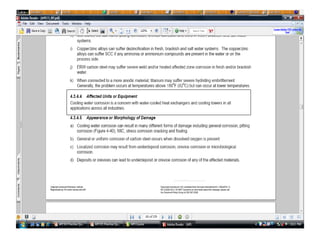
138. Which of the following equipment is affected by cooling water
corrosion?
1. Water cooled heat exchangers
2. FCC units
3. Cooling towers
4. 1 & 3 above
API 571 Practice Question
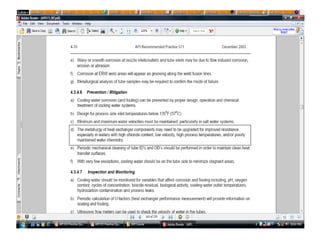
139. Which of the following is a prevention/mitigation method for
cooling water corrosion?
1. Coating all surfaces with grease
2. Allow fouling to occur
3. Lower the velocity of water flow
4. Upgrading the metallurgy
API 571 Practice Question
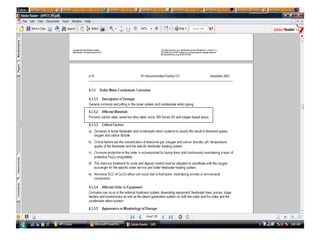
140. What material is primarily affected by boiler water condensate
corrosion?
1. Aluminum
2. Carbon steel
3. 300 series stainless steel
4. None of the above
API 571 Practice Question
141. What type of carbon dioxide corrosion is found in condensate
Return system?
1. Deep valleys
2. Chloride stress corrosion cracking
3. Smooth grooving
4. None of the above
API 571 Practice Question
142. Which materials are affected by sulfidation?
1. All iron based materials
2. Aluminum
3. Titanium and zirconium
4. All the above
API 571 Practice Question
143. What is the most common appearance of damage for sulfidation?
1. Gross pitting
2. Uniform thinning
3. Branching crack
4. None of the above
API 571 Practice Question
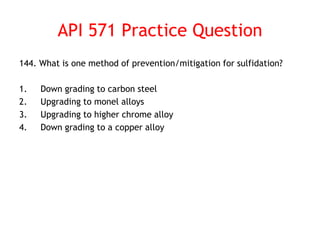
144. What is one method of prevention/mitigation for sulfidation?
1. Down grading to carbon steel
2. Upgrading to monel alloys
3. Upgrading to higher chrome alloy
4. Down grading to a copper alloy
API 571 Practice Question
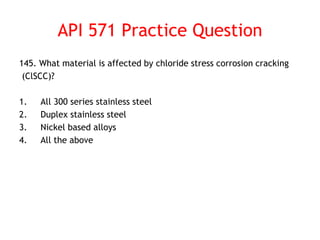
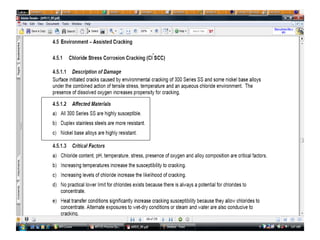
145. What material is affected by chloride stress corrosion cracking
(ClSCC)?
1. All 300 series stainless steel
2. Duplex stainless steel
3. Nickel based alloys
4. All the above
API 571 Practice Question
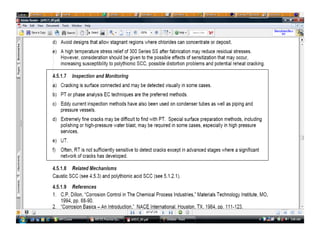
146. What are the preferred method to inspect ClSCC?
1. PT
2. RT
3. Phase analysis EC
4. No 1 & 3 above
API 571 Practice Question
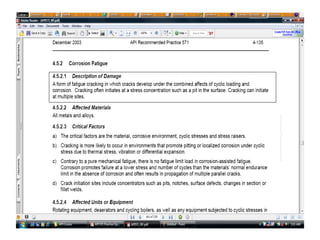
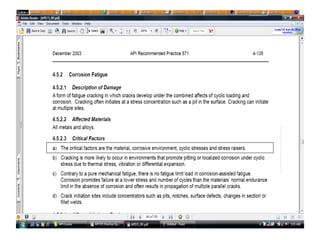
147. Corrosion fatigue is defined as:
1. Cracks developing under the combined affects of cyclic loading
and corrosion
2. Corrosion from tired materials
3. Corrosion caused by copper impregnation
4. None of the above
API 571 Practice Question
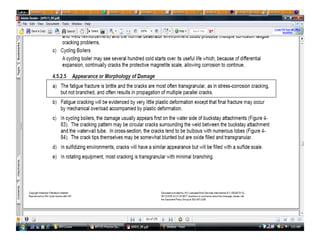
148. What is the appearance damage for corrosion fatigue?
1. Transgranular and branching
2. Intergranular
3. Herringbone pattern
4. Transgranular but not branching
API 571 Practice Question
149. What are the critical factors of corrosion fatigue?
1. Corrosive environment
2. Cyclic stress
3. Stress raisers
4. All the above
API 571 Practice Question
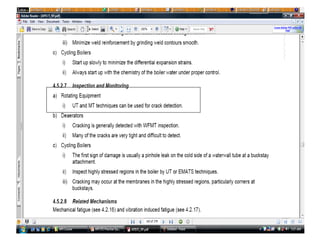
150. Which of the following is an inspection technique for crack
detection for corrosion fatigue on rotating equipment?
1. UT
2. MT
3. RT
4. No 1 & 2 above
API 571 Practice Question
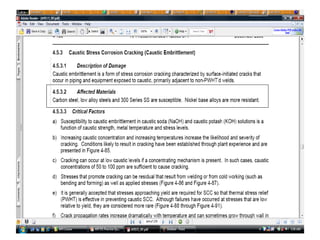
151. Which of the following material is susceptible to caustic stress
corrosion cracking (CSCC)?
1. Carbon steel
2. Low alloy steel
3. The 300 series stainless steel
4. All the above
API 571 Practice Question
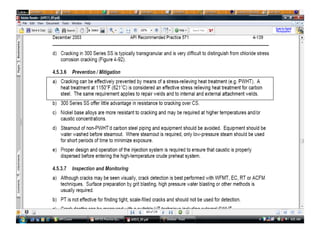
152. How can CSCC be prevented in carbon steels?
1. Stress relieving at 1150 F
2. Operating at below 750 F
3. Stress relieving at 700 F
4. None of the above
API 571 Practice Question
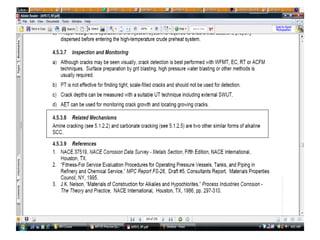
153. What are some related mechanism to CSCC?
1. Sulfide cracking
2. Amine cracking
3. Carbonate cracking
4. No 2 & 3 above
API 571 Practice Question
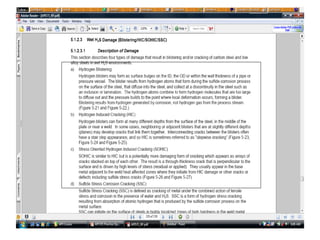
154. Name two of the four type of damage that result from wet H2S?
1. Hydrogen blistering
2. Sulfide stress corrosion cracking
3. Carbonate cracking
4. No 1 & 2 above
API 571 Practice Question
155. What material is affected by wet H2S?
1. Copper alloys
2. Monel
3. 300 series stainless steel
4. Carbon steel and low alloys steel
API 571 Practice Question
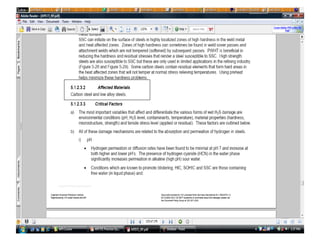
156. Which of the following is an important variable that affects and
differentiates the various forms of wet H2S?
1. Environmental conditions
2. Material properties
3. Tensile stress level
4. All the above
API 571 Practice Question
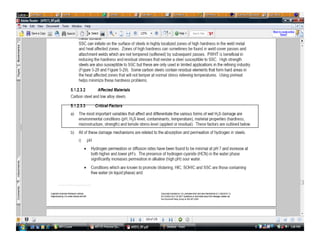
157. What units or equipment are affected by wet H2S?
1. All unit where wet H2S is present
2. 300 series stainless steel are present
3. Temperatures below 205 F
4. None of the above
API 571 Practice Question
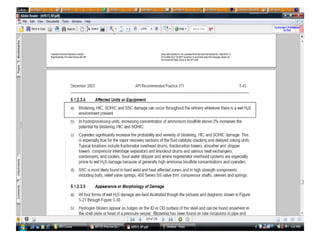
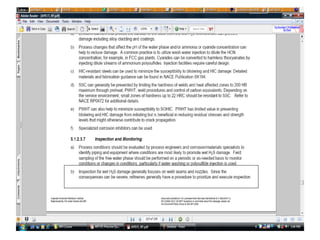
158. Where does wet H2S damage generally focus?
1. Most processes
2. Weld seams and nozzles
3. Cooling towers
4. All the above
API 571 Practice Question
159. Which of the following material is less affected by high
temperature hydrogen attack?
1. 2.25 Cr – 1Mo
2. 5Cr – 0.5 Mo
3. C-0.5 Mo
4. All the aboove
API 571 Practice Question
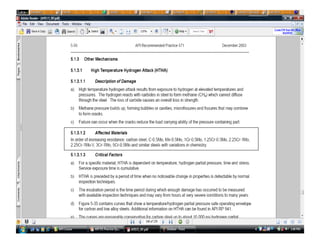
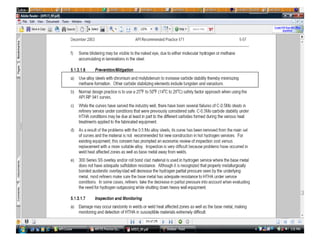
160. What carbide stabilizing elements are used as preventive
measure HTHA?
1. Tungsten
2. Vanadium
3. Chromium
4. All the above
API 571 Practice Question
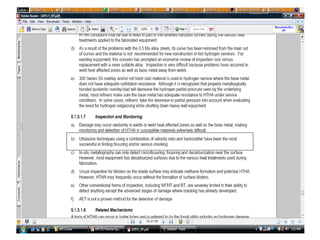
161. What inspection methods are best to find fissuring and/or serious
cracking caused by HTHA?
1. MT
2. Backscatter UT technique
3. Velocity ratio UT technique
4. No 2 & 3 above
API 571 Practice Question
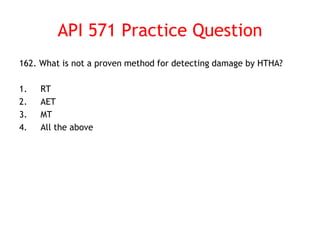
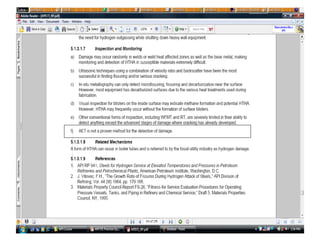
162. What is not a proven method for detecting damage by HTHA?
1. RT
2. AET
3. MT
4. All the above
API 571 Practise Question.ppt

API 571 Practise Question.ppt

  • 1.
    API 571:Damage Mechanisms AffectingFixed Equipment in the Refining Industry PUSAT PEMBANGUNAN TENAGA INDUSTRI (PUSPATRI) 5th – 9th November 2007
  • 2.
    API 571 PracticeQuestion 66. What is the definition of temper embrittlement? 1. Reduction in toughness due to mechanical change 2. Increase in toughness due to metallurgical change 3. Heating below 6500F 4. Reduction in toughness due to metallurgical change
  • 4.
    API 571 PracticeQuestion 67. How is temper embrittlement confirmed? 1. Through impact testing 2. Through tension testing 3. Through bend test 4. None of the above
  • 6.
    API 571 PracticeQuestion 68. In which equipment is temper embrittlement found? 1. Cooling towers 2. Hydroprocessing unit 3. Welds 4. Cokers
  • 8.
    API 571 PracticeQuestion 69. What is the best way to minimize the likelihood and extent of temper embrittlement? 1. Limit acceptance levels of sulphur in welding consumables 2. Limit the level of iron in the base metals 3. Limit acceptance levels of managanese, silicon, phosporus, tin and antimony in base metals. 4. None of the above
  • 10.
    API 571 PracticeQuestion 70. Brittle fracture occurs in which of the following materials? 1. The 300 series stainless steel 2. Carbon and low alloy steels 3. Aluminum 4. copper
  • 12.
    API 571 PracticeQuestion 71. Brittle fracture occurs only at temperature: 1. Above 70 degree F 2. Below Charpy Impact transformation temperature 3. Above Charpy Impact transition temperature 4. Below Charpy Impact transition temperature
  • 14.
    API 571 PracticeQuestion 72. What is the appearance of a brittle fracture? 1. Herringbone 2. Straight and non-branching 3. Branching 4. None of the above
  • 16.
    API 571 PracticeQuestion 73. Equipment manufactured before what date was made with limited restrictions on notch toughness? 1. December 1988 addenda 2. October 1957 addenda 3. January 1964 addenda 4. December 1987 addenda
  • 18.
    API 571 PracticeQuestion 74. For new equipment, brittle fracture is best prevented by: 1. Using materials specifically designed for low temperature operation 2. Using materials specifically designed for medium temperature operation 3. Using a start up temperature above 1000F 4. Operating temperature below the lower transformation level.
  • 20.
    API 571 PracticeQuestion 75. Thermal fatigue is defined as: 1. Cyclic stress below transition temperature 2. Fatigue due to low temperature operations 3. The result of cyclic stress caused by variations in temperature 4. 1 and 2 above
  • 22.
    API 571 PracticeQuestion 89. What one key factor affects thermal fatigue? 1. Magnitude of temperature swing 2. Start-up 3. Shutdown 4. 2 and 3 above
  • 24.
    API 571 PracticeQuestion 91. Thermal fatigue crack propagate: 1. Parallel to the stress 2. In an herringbone pattern 3. Transverse to the stress 4. Any of the above
  • 26.
    API 571 PracticeQuestion 96. What are effective methods of inspecting for fatigue cracking? 1. UT 2. VT 3. MT & PT 4. Both 2 & 3
  • 28.
    API 571 PracticeQuestion 117. Pure erosion is sometimes referred to as: 1. Corrosive wear 2. Abrasive wear 3. Deburring 4. Cohesive wear
  • 30.
    API 571 PracticeQuestion 116. Erosion and erosion corrosion are characterized by a local loss in thickness in the form of: 1. Pits 2. Grooves 3. Valleys 4. All the above
  • 32.
    API 571 PracticeQuestion 119. Which of the following is/are methods of preventing corrosion? 1. Increase pipe diameter 2. Decreasing wall thickness 3. Using replaceable impingement baffle 4. 1 and 3 above
  • 34.
    API 571 PracticeQuestion 120. Which of the following is a critical factor for mechanical fatigue? 1. Geometry 2. Stress level 3. Number of cycle 4. All the above
  • 36.
    API 571 PracticeQuestion 124. What is the signature mark of a mechanical fatigue failure? 1. Clam shell type finger print 2. Branching cracks finger print 3. Herringbone pattern finger print 4. None of the above
  • 38.
    API 571 PracticeQuestion 131. What inspection are done to rotating equipment to detect evidence of mechanical fatigue? 1. PT 2. MT 3. Vibration monitoring 4. All the above
  • 40.
    API 571 PracticeQuestion 132. Which of the following material is affected by atmospheric corrosion? 1. The 300 series stainless steel 2. Monel 3. The 400 series stainless steel 4. Copper alloyed aluminum
  • 42.
    API 571 PracticeQuestion 133. What is one inspection technique that can be used to detect atmospheric corrosion. 1. UT 2. RT 3. MT 4. ET
  • 44.
    API 571 PracticeQuestion 134. Corrosion under insulation (CUI) affects which of the following materials? 1. Carbon steel 2. 300 series stainless steel 3. Duplex stainless steel 4. All the above
  • 46.
    API 571 PracticeQuestion 135. For CUI situations corrosion becomes more severe at metal temperatures between: 1. 2120F and 2500F 2. 2120F and 1000C 3. 1000F and 1210F 4. None of the above
  • 48.
    API 571 PracticeQuestion 136. Which of the following are inspection and monitoring methods for CUI? 1. Real time profile x-ray 2. IR thermography 3. Guided wave UT 4. All the above
  • 50.
    API 571 PracticeQuestion 137. Which is the following is a critical factor for cooling water corrosion? 1. Decreasing cooling water outlet temperature 2. Decreasing O2 content 3. Decreasing process side inlet temperatures 4. None of the above
  • 52.
    API 571 PracticeQuestion 138. Which of the following equipment is affected by cooling water corrosion? 1. Water cooled heat exchangers 2. FCC units 3. Cooling towers 4. 1 & 3 above
  • 54.
    API 571 PracticeQuestion 139. Which of the following is a prevention/mitigation method for cooling water corrosion? 1. Coating all surfaces with grease 2. Allow fouling to occur 3. Lower the velocity of water flow 4. Upgrading the metallurgy
  • 56.
    API 571 PracticeQuestion 140. What material is primarily affected by boiler water condensate corrosion? 1. Aluminum 2. Carbon steel 3. 300 series stainless steel 4. None of the above
  • 58.
    API 571 PracticeQuestion 141. What type of carbon dioxide corrosion is found in condensate Return system? 1. Deep valleys 2. Chloride stress corrosion cracking 3. Smooth grooving 4. None of the above
  • 60.
    API 571 PracticeQuestion 142. Which materials are affected by sulfidation? 1. All iron based materials 2. Aluminum 3. Titanium and zirconium 4. All the above
  • 62.
    API 571 PracticeQuestion 143. What is the most common appearance of damage for sulfidation? 1. Gross pitting 2. Uniform thinning 3. Branching crack 4. None of the above
  • 64.
    API 571 PracticeQuestion 144. What is one method of prevention/mitigation for sulfidation? 1. Down grading to carbon steel 2. Upgrading to monel alloys 3. Upgrading to higher chrome alloy 4. Down grading to a copper alloy
  • 66.
    API 571 PracticeQuestion 145. What material is affected by chloride stress corrosion cracking (ClSCC)? 1. All 300 series stainless steel 2. Duplex stainless steel 3. Nickel based alloys 4. All the above
  • 68.
    API 571 PracticeQuestion 146. What are the preferred method to inspect ClSCC? 1. PT 2. RT 3. Phase analysis EC 4. No 1 & 3 above
  • 70.
    API 571 PracticeQuestion 147. Corrosion fatigue is defined as: 1. Cracks developing under the combined affects of cyclic loading and corrosion 2. Corrosion from tired materials 3. Corrosion caused by copper impregnation 4. None of the above
  • 72.
    API 571 PracticeQuestion 148. What is the appearance damage for corrosion fatigue? 1. Transgranular and branching 2. Intergranular 3. Herringbone pattern 4. Transgranular but not branching
  • 74.
    API 571 PracticeQuestion 149. What are the critical factors of corrosion fatigue? 1. Corrosive environment 2. Cyclic stress 3. Stress raisers 4. All the above
  • 76.
    API 571 PracticeQuestion 150. Which of the following is an inspection technique for crack detection for corrosion fatigue on rotating equipment? 1. UT 2. MT 3. RT 4. No 1 & 2 above
  • 78.
    API 571 PracticeQuestion 151. Which of the following material is susceptible to caustic stress corrosion cracking (CSCC)? 1. Carbon steel 2. Low alloy steel 3. The 300 series stainless steel 4. All the above
  • 80.
    API 571 PracticeQuestion 152. How can CSCC be prevented in carbon steels? 1. Stress relieving at 1150 F 2. Operating at below 750 F 3. Stress relieving at 700 F 4. None of the above
  • 82.
    API 571 PracticeQuestion 153. What are some related mechanism to CSCC? 1. Sulfide cracking 2. Amine cracking 3. Carbonate cracking 4. No 2 & 3 above
  • 84.
    API 571 PracticeQuestion 154. Name two of the four type of damage that result from wet H2S? 1. Hydrogen blistering 2. Sulfide stress corrosion cracking 3. Carbonate cracking 4. No 1 & 2 above
  • 86.
    API 571 PracticeQuestion 155. What material is affected by wet H2S? 1. Copper alloys 2. Monel 3. 300 series stainless steel 4. Carbon steel and low alloys steel
  • 88.
    API 571 PracticeQuestion 156. Which of the following is an important variable that affects and differentiates the various forms of wet H2S? 1. Environmental conditions 2. Material properties 3. Tensile stress level 4. All the above
  • 90.
    API 571 PracticeQuestion 157. What units or equipment are affected by wet H2S? 1. All unit where wet H2S is present 2. 300 series stainless steel are present 3. Temperatures below 205 F 4. None of the above
  • 92.
    API 571 PracticeQuestion 158. Where does wet H2S damage generally focus? 1. Most processes 2. Weld seams and nozzles 3. Cooling towers 4. All the above
  • 94.
    API 571 PracticeQuestion 159. Which of the following material is less affected by high temperature hydrogen attack? 1. 2.25 Cr – 1Mo 2. 5Cr – 0.5 Mo 3. C-0.5 Mo 4. All the aboove
  • 96.
    API 571 PracticeQuestion 160. What carbide stabilizing elements are used as preventive measure HTHA? 1. Tungsten 2. Vanadium 3. Chromium 4. All the above
  • 98.
    API 571 PracticeQuestion 161. What inspection methods are best to find fissuring and/or serious cracking caused by HTHA? 1. MT 2. Backscatter UT technique 3. Velocity ratio UT technique 4. No 2 & 3 above
  • 100.
    API 571 PracticeQuestion 162. What is not a proven method for detecting damage by HTHA? 1. RT 2. AET 3. MT 4. All the above