1
EU Circular Economy Work -
the Built Environment
Josefina Lindblom
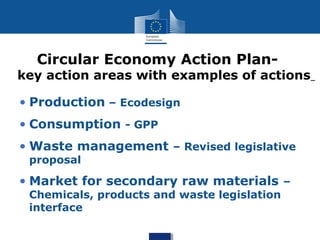
Circular Economy Action Plan-
key action areas with examples of actions
• Production – Ecodesign
• Consumption - GPP
• Waste management – Revised legislative
proposal
• Market for secondary raw materials –
Chemicals, products and waste legislation
interface
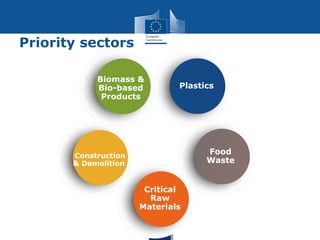
Priority sectors
Biomass &
Bio-based
Products
Plastics
Food
Waste
Construction
& Demolition
Critical
Raw
Materials
3
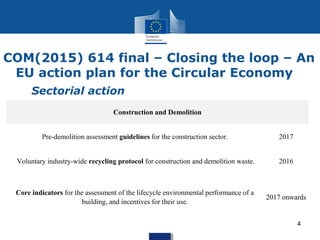
COM(2015) 614 final – Closing the loop – An
EU action plan for the Circular Economy
• Sectorial action
4
Construction and Demolition
Pre-demolition assessment guidelines for the construction sector. 2017
Voluntary industry-wide recycling protocol for construction and demolition waste. 2016
Core indicators for the assessment of the lifecycle environmental performance of a
building, and incentives for their use.
2017 onwards
5
Framework with core
indicators
http://susproc.jrc.ec.europa.eu/Efficient_Buildings/
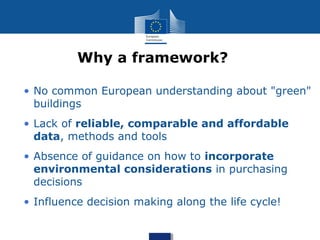
• No common European understanding about "green"
buildings
• Lack of reliable, comparable and affordable
data, methods and tools
• Absence of guidance on how to incorporate
environmental considerations in purchasing
decisions
• Influence decision making along the life cycle!
Why a framework?
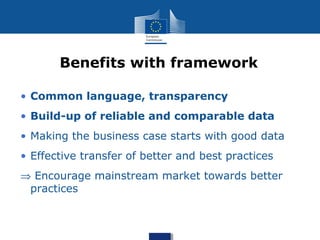
• Common language, transparency
• Build-up of reliable and comparable data
• Making the business case starts with good data
• Effective transfer of better and best practices
⇒ Encourage mainstream market towards better
practices
Benefits with framework
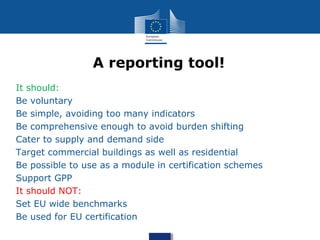
• It should:
• Be voluntary
• Be simple, avoiding too many indicators
• Be comprehensive enough to avoid burden shifting
• Cater to supply and demand side
• Target commercial buildings as well as residential
• Be possible to use as a module in certification schemes
• Support GPP
• It should NOT:
• Set EU wide benchmarks
• Be used for EU certification
A reporting tool!
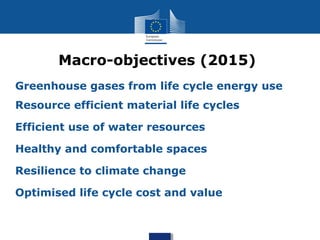
 Greenhouse gases from life cycle energy use
Resource efficient material life cycles
 Efficient use of water resources
 Healthy and comfortable spaces
• Resilience to climate change
• Optimised life cycle cost and value
Macro-objectives (2015)
2016 - Broad scoping exercise to identify
indicators linked to the macro
objectives, followed by public
consultation.
Indicator presentation from November – currently
under revision based on further consultation:
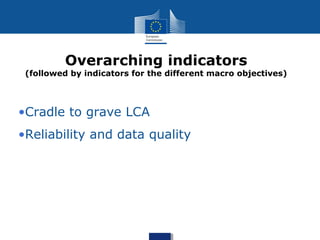
•Cradle to grave LCA
•Reliability and data quality
Overarching indicators
(followed by indicators for the different macro objectives)
•Operational energy consumption
•Operational and embodied energy GWP
Greenhouse gases from life cycle energy
use
•Service life bill of materials
•Construction and demolition waste
Resource efficient material life cycles
•Mains drinking water
Efficient use of water resources
•Airborne pollutant levels
•Indoor air class (ventilation, CO2, humidity)
Healthy and comfortable spaces
•Occupant thermal comfort
•Additional cooling energy required
Resilience to climate change
•Life cycle costs (utility, acquisition and
maintenance)
•Value and risk factors
Optimised life cycle cost and value
• Finalise indicator identification based on
stakeholder input - early spring
• Guidelines for indicator use - spring
• Finalised framework - June
• In parallel, planning for implementation!
Next steps in the coming months
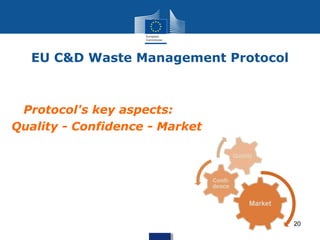
EU C&D Waste Management Protocol
• Protocol's key aspects:
Quality - Confidence - Market
20
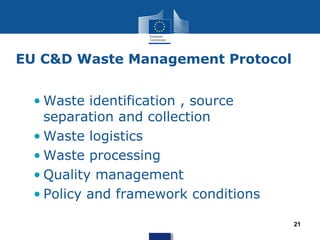
EU C&D Waste Management Protocol
21
• Waste identification , source
separation and collection
• Waste logistics
• Waste processing
• Quality management
• Policy and framework conditions
22

EU Circular Economy Programme and the Built Environment #cethinking

  • 1.
    1 EU Circular EconomyWork - the Built Environment Josefina Lindblom
  • 2.
    Circular Economy ActionPlan- key action areas with examples of actions • Production – Ecodesign • Consumption - GPP • Waste management – Revised legislative proposal • Market for secondary raw materials – Chemicals, products and waste legislation interface
  • 3.
  • 4.
    COM(2015) 614 final– Closing the loop – An EU action plan for the Circular Economy • Sectorial action 4 Construction and Demolition Pre-demolition assessment guidelines for the construction sector. 2017 Voluntary industry-wide recycling protocol for construction and demolition waste. 2016 Core indicators for the assessment of the lifecycle environmental performance of a building, and incentives for their use. 2017 onwards
  • 5.
  • 6.
    • No commonEuropean understanding about "green" buildings • Lack of reliable, comparable and affordable data, methods and tools • Absence of guidance on how to incorporate environmental considerations in purchasing decisions • Influence decision making along the life cycle! Why a framework?
  • 7.
    • Common language,transparency • Build-up of reliable and comparable data • Making the business case starts with good data • Effective transfer of better and best practices ⇒ Encourage mainstream market towards better practices Benefits with framework
  • 8.
    • It should: •Be voluntary • Be simple, avoiding too many indicators • Be comprehensive enough to avoid burden shifting • Cater to supply and demand side • Target commercial buildings as well as residential • Be possible to use as a module in certification schemes • Support GPP • It should NOT: • Set EU wide benchmarks • Be used for EU certification A reporting tool!
  • 9.
     Greenhouse gasesfrom life cycle energy use Resource efficient material life cycles  Efficient use of water resources  Healthy and comfortable spaces • Resilience to climate change • Optimised life cycle cost and value Macro-objectives (2015)
  • 10.
    2016 - Broadscoping exercise to identify indicators linked to the macro objectives, followed by public consultation.
  • 11.
    Indicator presentation fromNovember – currently under revision based on further consultation:
  • 12.
    •Cradle to graveLCA •Reliability and data quality Overarching indicators (followed by indicators for the different macro objectives)
  • 13.
    •Operational energy consumption •Operationaland embodied energy GWP Greenhouse gases from life cycle energy use
  • 14.
    •Service life billof materials •Construction and demolition waste Resource efficient material life cycles
  • 15.
    •Mains drinking water Efficientuse of water resources
  • 16.
    •Airborne pollutant levels •Indoorair class (ventilation, CO2, humidity) Healthy and comfortable spaces
  • 17.
    •Occupant thermal comfort •Additionalcooling energy required Resilience to climate change
  • 18.
    •Life cycle costs(utility, acquisition and maintenance) •Value and risk factors Optimised life cycle cost and value
  • 19.
    • Finalise indicatoridentification based on stakeholder input - early spring • Guidelines for indicator use - spring • Finalised framework - June • In parallel, planning for implementation! Next steps in the coming months
  • 20.
    EU C&D WasteManagement Protocol • Protocol's key aspects: Quality - Confidence - Market 20
  • 21.
    EU C&D WasteManagement Protocol 21 • Waste identification , source separation and collection • Waste logistics • Waste processing • Quality management • Policy and framework conditions
  • 22.

Editor's Notes

  • #3 Production Ecodesign (CE aspects), standards to be developed on material efficiency to be used for future ecodesign requirements on durability, reparability and recyclability of products. Consumption GPP to enhance integration of CE requirements, reinforcing use in Commission procurement and EU funds. Waste management Revised legislation proposal on waste. Market for secondary raw materials Address the interface between chemicals, products and waste legislation.
  • #4 Construction & Demolition Objectives Make buildings more resource efficient Actions Facilitate the assessment of the environmental performance of buildings, via the development of core indicators. Ensure adequate waste management including reuse and recycling of construction material, via the development of pre-demolition guidelines and voluntary recycling protocols. Plastics Objectives Increase efficiency in recycling - less than 25% of plastic waste collected is recycled, and about 50% goes to landfill Actions New strategy on plastics including marine litter (less leakage to nature, higher recyclability and more use of secondary plastics). A more ambitious target for the recycling of plastic packaging in the legislative proposal on waste.(already in the waste proposal) Food Waste Objectives Reach Sustainable Development Goal to halve food waste by 2030 – today around 100 million tonnes of food are wasted annually in the EU. Actions Develop an EU methodology to measure food waste. Create a platform for the SDG on food waste and to share best practice and results achieved. Clarify EU legislation relating to waste, food and feed, and facilitate food donation. Improve the use and understanding of date marking along the food chain (e.g."best before" label). Critical Raw Materials Objectives Increasing efficient use and recovery of CRMs. Actions Prepare a report on best practices and options for further action at the EU level. Incentives/requirements in the waste directives. Biomass & bio-based products Objectives Support an efficient use of wood and bio-based products Increase recycling of bio-waste Actions Promote an efficient use of bio-based resources through a series of measures, such as the promotion of the cascading use of biomass and support to innovation in the bio-economy New target for recycling wood packaging and a provision to ensure the separate collection of bio-waste
  • #5 The EU Protocol and the Pre-demolition audits: Improve C&D Waste collection, separation and process Boost demand for C&D Waste recycled materials
  • #21 The first measure rolled out in the area of Construction and Demolition Waste management is the adoption of a Protocol. The overall aim of this Protocol is to increase confidence in the C&D waste management process and the trust in the quality of C&D recycled materials. It includes good practices from across the EU that can be sources of inspiration for both policy makers and industry practitioners. It also includes an overview of definitions and a checklist for practitioners.This initiative has built on the active participation and contribution from industry and national government officials. All 28 Member States of the European Union have been involved and it is a tool for all MS. The Protocol covers all components of the C&D waste management chain, apart from waste prevention. Extra info: It was developed together with industry, national authorities and the European Commission. 50 experts from industry and 15 Member State worked together in two Task Forces. This Protocol involves the following stakeholders: - Industry practitioners; construction sector (including renovation companies and demolition contractors), - Construction product manufacturers, - Waste treatment and recycling companies; - Transport and logistics firms - Public authorities (at local, regional, national and EU levels); - Quality certification bodies for buildings and infrastructure; - Clients of C&D recycled materials.
  • #22 Structure of the Protocol : The Protocol consists of 5 components. The first three are based on the C&D waste management chain and two are of a horizontal nature: a. Waste identification, source separation and collection; b. Waste logistics; c. Waste processing; d. Quality management; e. Policy and framework conditions.
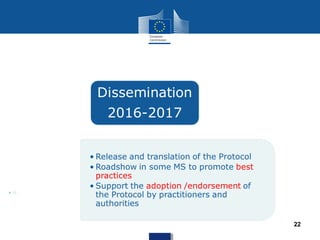
  • #23 We are in the beginning of the work in turning the Protocol into an implementation and adoption success. This will be done through endorsement by industry practioners and public authorities at national and regional level across Europe. Support It concerns the adoption/endorsement by practitioners (the industry) and authorities (mainly local authorities and public purchasers). The EC would encourage and help them to adopt/endorse/implement the Protocol. The EC is currently considering - to support investments in this sector through the EFSI (Juncker Plan) cf. "ECONOMIC STUDY WITH REGARD TO THE DEVELOPMENT AND IMPLEMENTATION OF INITIATIVES FOSTERING INVESTMENT AND INNOVATION IN CONSTRUCTION AND DEMOLITION WASTE RECYCLING INFRASTRUCTURE" on going. - promotion in some MS, cf. "PUBLIC RELATIONS EVENTS TO PROMOTE BEST PRACTICE PRE-DEMOLITION AND RENOVATION WORK AUDITS" IN THE CONTEXT OF THE CONSTRUCTION & DEMOLITION WASTE MANAGEMENT PROTOCOL - exploration with stakeholders, early movers' initiatives on voluntary basis.