Eurotech M2M Technical Building Blocks Focus on a
Multi-Service Gateway Approach and Standards-
Compliant Software Elements
Eurotech's Everyware Software
Framework (ESF)
Features & Benefits
 Efficient application development
 Programming resources
availability
 100% Java
 Cloud ready
 Modular, leveraging OSGi
 Maximum investment protection
 Device independent
Eurotech, Hitachi and Oracle
together ensure successful and
deterministic development and
deployment of M2M solutions
for a broad range of vertical
markets.
Providing a competitive advantage to customers and partners by leveraging industry
standards and years of experience in challenging machine-to-machine (M2M) projects
Overview
M2M projects present many challenges, even with hardware designed exactly to customer
specifications. Success can be best assured when these three major conditions are met:
 Effective implementation of the customer’s business logic on the device side
 Scalable and affordable methods for optimum device and data management
 Simple integration of distributed devices into different enterprise applications by effectively
separating the producers and consumers of data
Eurotech assures a strong foundation for M2M applications by relying on leading industry partners
(Oracle’s Java Embedded Technologies, Hitachi SuperJ OSGiTM platform) to provide the
technology basis for device, network, and service abstraction as well as efficient development.
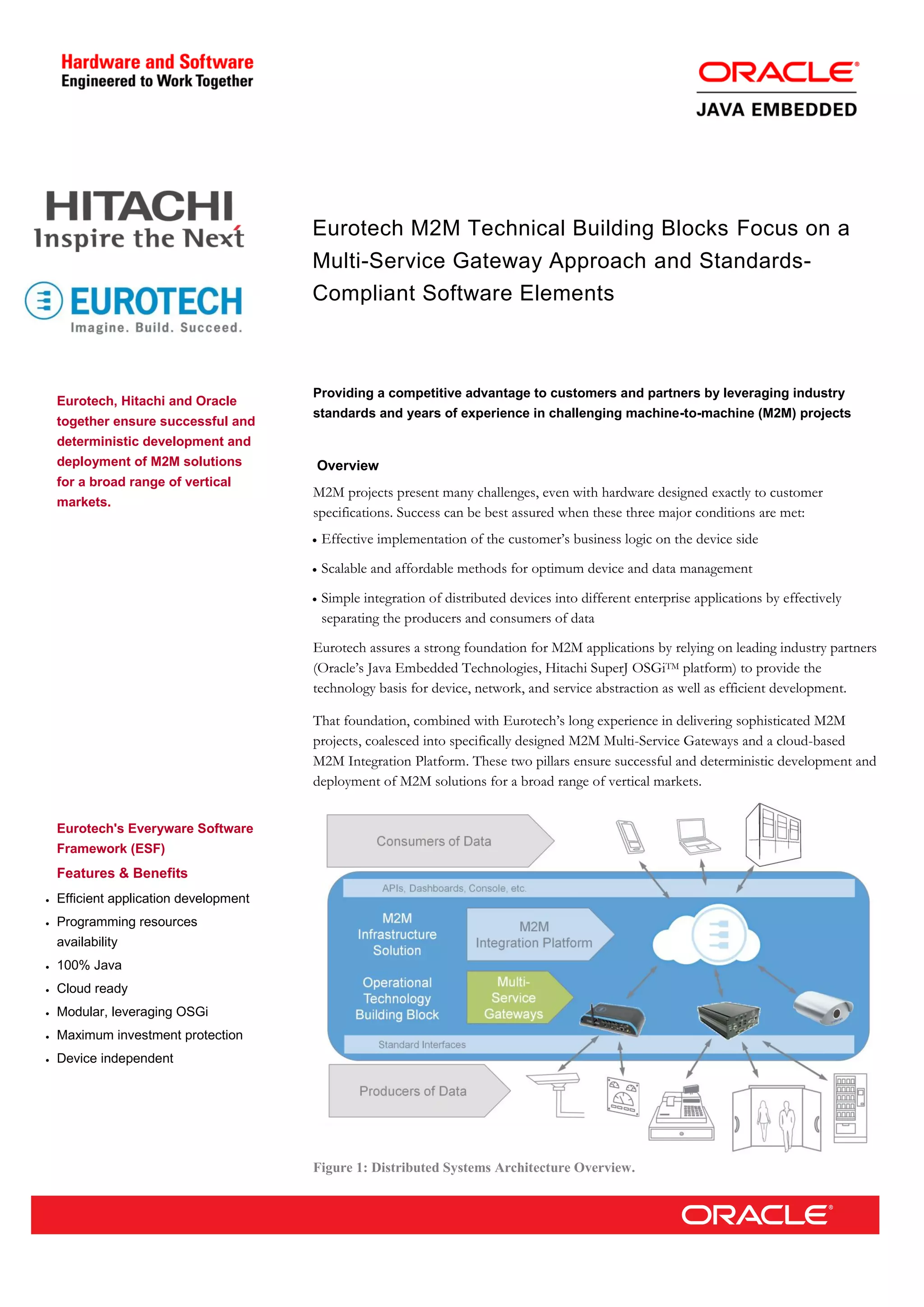
That foundation, combined with Eurotech’s long experience in delivering sophisticated M2M
projects, coalesced into specifically designed M2M Multi-Service Gateways and a cloud-based
M2M Integration Platform. These two pillars ensure successful and deterministic development and
deployment of M2M solutions for a broad range of vertical markets.
Figure 1: Distributed Systems Architecture Overview.
Eurotech M2M Technical Building Blocks Focus on a Multi-Service Gateway Approach and
Standards-Compliant Software Elements
Copyright © 2013, Oracle and/or its affiliates. All rights reserved. Oracle and Java are registered trademarks of Oracle and/or its affiliates. Other names may be trademarks of their respective owners. Intel and
Intel Xeon are trademarks or registered trademarks of Intel Corporation. All SPARC trademarks are used under license and are trademarks or registered trademarks of SPARC International, Inc. AMD, Opteron,
the AMD logo, and the AMD Opteron logo are trademarks or registered trademarks of Advanced Micro Devices. UNIX is a registered trademark of The Open Group. 0113
OSGi is a trademark or a registered trademark of the OSGi Alliance in the United States, other countries, or both. SuperJ is a registered trademark of Hitachi Solutions, Ltd.
Helping Customers and Partners Focus on Their Core Competencies
Connected devices and M2M solutions enable companies to provide higher value through
services, improving efficiency through data collection and 2-way customer feedback by utilizing
connected devices. Regardless of whether they are end users or system integrators, it is all about
providing enabling platforms, not just components!
The Multi-Service Gateway Approach
 Minimizes customer development risk by utilizing “off the shelf” purpose-built devices
designed to meet vertical market value propositions
 Provides design flexibility by leveraging the Multi-Service Gateway approach to integrate and
consolidate data streams and future-proof investments
 Reduces design complexity while introducing the Application Lifecycle Management approach
The benefits of IT-centric application development using ESF to implement business logic in
smart edge devices / service gateways are:
- Simplifying application development for smart M2M Multi-Service Gateways with
Everyware Software Framework (ESF), a Java/OSGi based application framework
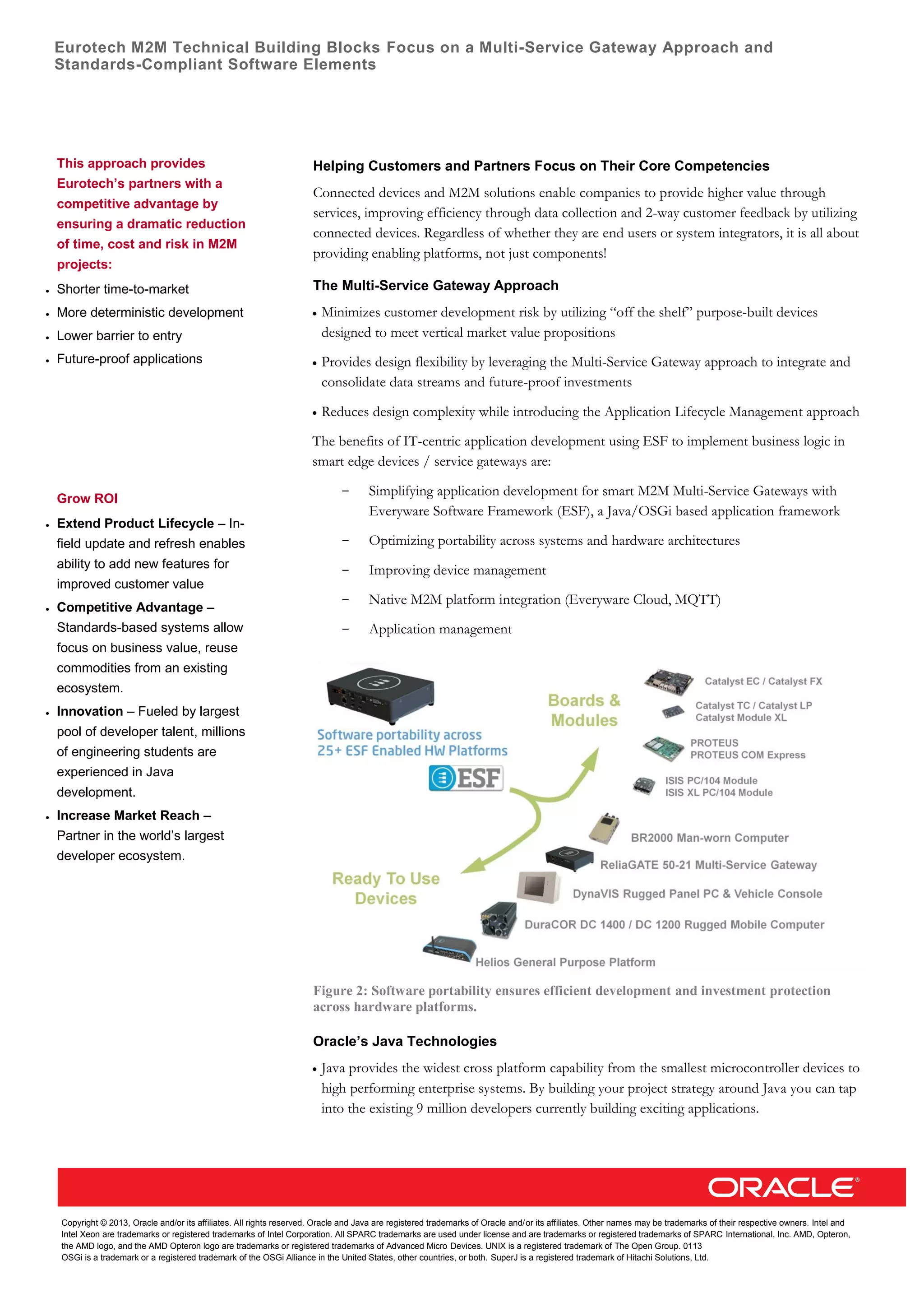
- Optimizing portability across systems and hardware architectures
- Improving device management
- Native M2M platform integration (Everyware Cloud, MQTT)
- Application management
Figure 2: Software portability ensures efficient development and investment protection
across hardware platforms.
Oracle’s Java Technologies
 Java provides the widest cross platform capability from the smallest microcontroller devices to
high performing enterprise systems. By building your project strategy around Java you can tap
into the existing 9 million developers currently building exciting applications.
This approach provides
Eurotech’s partners with a
competitive advantage by
ensuring a dramatic reduction
of time, cost and risk in M2M
projects:
 Shorter time-to-market
 More deterministic development
 Lower barrier to entry
 Future-proof applications
Grow ROI
 Extend Product Lifecycle – In-
field update and refresh enables
ability to add new features for
improved customer value
 Competitive Advantage –
Standards-based systems allow
focus on business value, reuse
commodities from an existing
ecosystem.
 Innovation – Fueled by largest
pool of developer talent, millions
of engineering students are
experienced in Java
development.
 Increase Market Reach –
Partner in the world’s largest
developer ecosystem.
Eurotech M2M Technical Building Blocks Focus on a Multi-Service Gateway Approach and
Standards-Compliant Software Elements
Copyright © 2013, Oracle and/or its affiliates. All rights reserved. Oracle and Java are registered trademarks of Oracle and/or its affiliates. Other names may be trademarks of their respective owners. Intel and
Intel Xeon are trademarks or registered trademarks of Intel Corporation. All SPARC trademarks are used under license and are trademarks or registered trademarks of SPARC International, Inc. AMD, Opteron,
the AMD logo, and the AMD Opteron logo are trademarks or registered trademarks of Advanced Micro Devices. UNIX is a registered trademark of The Open Group. 0113
OSGi is a trademark or a registered trademark of the OSGi Alliance in the United States, other countries, or both. SuperJ is a registered trademark of Hitachi Solutions, Ltd.
 Oracle Java Embedded is ideal for application code development in any connected device,
enabling a robust software infrastructure for service delivery platforms. Portability across
devices is achieved through using a common set of Java APIs on multiple devices. This
enables easy code development through software simulation before porting onto your
embedded product and reducing time to market.
 Oracle Java SE Embedded is targeted at gateway devices, which typically use a Linux
operating system, with various CPU versions available, including ARM and x86 instruction
sets. The performance of the Java VM can improve the increasing number of multi-core
systems through its thread aware application model.
Hitachi SuperJ Applications Ecosystem for the OSGi Service Platform
Hitachi’s SuperJ Applications Ecosystem is a framework for the OSGi (Open Services Gateway
Initiative) Service Platform. SuperJ facilitates the modularization of software components and
applications and assures interoperability of applications and services over a variety of M2M
devices.
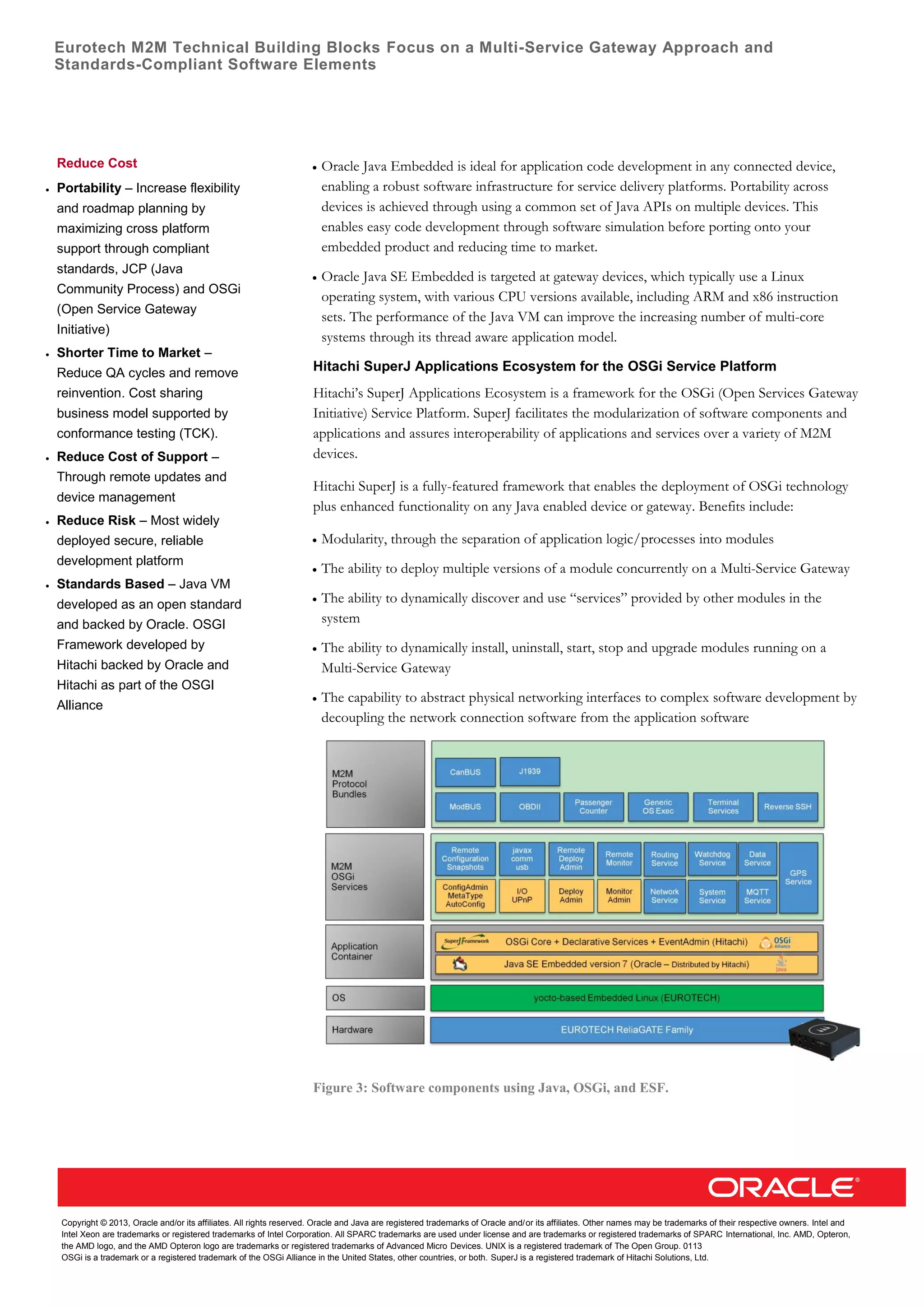
Hitachi SuperJ is a fully-featured framework that enables the deployment of OSGi technology
plus enhanced functionality on any Java enabled device or gateway. Benefits include:
 Modularity, through the separation of application logic/processes into modules
 The ability to deploy multiple versions of a module concurrently on a Multi-Service Gateway
 The ability to dynamically discover and use “services” provided by other modules in the
system
 The ability to dynamically install, uninstall, start, stop and upgrade modules running on a
Multi-Service Gateway
 The capability to abstract physical networking interfaces to complex software development by
decoupling the network connection software from the application software
Figure 3: Software components using Java, OSGi, and ESF.
Reduce Cost
 Portability – Increase flexibility
and roadmap planning by
maximizing cross platform
support through compliant
standards, JCP (Java
Community Process) and OSGi
(Open Service Gateway
Initiative)
 Shorter Time to Market –
Reduce QA cycles and remove
reinvention. Cost sharing
business model supported by
conformance testing (TCK).
 Reduce Cost of Support –
Through remote updates and
device management
 Reduce Risk – Most widely
deployed secure, reliable
development platform
 Standards Based – Java VM
developed as an open standard
and backed by Oracle. OSGI
Framework developed by
Hitachi backed by Oracle and
Hitachi as part of the OSGI
Alliance
Eurotech M2M Technical Building Blocks Focus on a Multi-Service Gateway Approach and
Standards-Compliant Software Elements
Copyright © 2013, Oracle and/or its affiliates. All rights reserved. Oracle and Java are registered trademarks of Oracle and/or its affiliates. Other names may be trademarks of their respective owners. Intel and
Intel Xeon are trademarks or registered trademarks of Intel Corporation. All SPARC trademarks are used under license and are trademarks or registered trademarks of SPARC International, Inc. AMD, Opteron,
the AMD logo, and the AMD Opteron logo are trademarks or registered trademarks of Advanced Micro Devices. UNIX is a registered trademark of The Open Group. 0113
OSGi is a trademark or a registered trademark of the OSGi Alliance in the United States, other countries, or both. SuperJ is a registered trademark of Hitachi Solutions, Ltd.
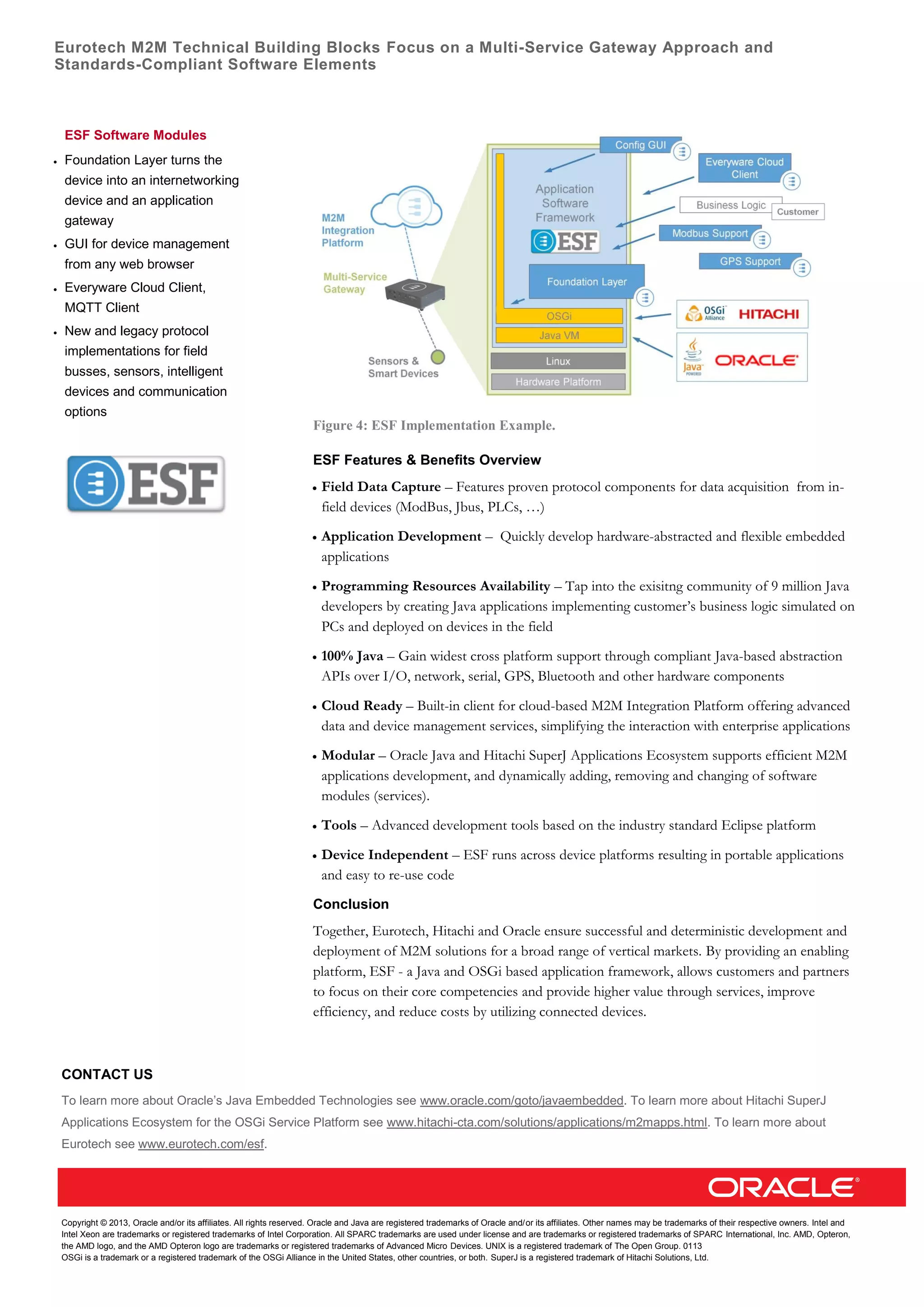
Figure 4: ESF Implementation Example.
ESF Features & Benefits Overview
 Field Data Capture – Features proven protocol components for data acquisition from in-
field devices (ModBus, Jbus, PLCs, …)
 Application Development – Quickly develop hardware-abstracted and flexible embedded
applications
 Programming Resources Availability – Tap into the exisitng community of 9 million Java
developers by creating Java applications implementing customer’s business logic simulated on
PCs and deployed on devices in the field
 100% Java – Gain widest cross platform support through compliant Java-based abstraction
APIs over I/O, network, serial, GPS, Bluetooth and other hardware components
 Cloud Ready – Built-in client for cloud-based M2M Integration Platform offering advanced
data and device management services, simplifying the interaction with enterprise applications
 Modular – Oracle Java and Hitachi SuperJ Applications Ecosystem supports efficient M2M
applications development, and dynamically adding, removing and changing of software
modules (services).
 Tools – Advanced development tools based on the industry standard Eclipse platform
 Device Independent – ESF runs across device platforms resulting in portable applications
and easy to re-use code
Conclusion
Together, Eurotech, Hitachi and Oracle ensure successful and deterministic development and
deployment of M2M solutions for a broad range of vertical markets. By providing an enabling
platform, ESF - a Java and OSGi based application framework, allows customers and partners
to focus on their core competencies and provide higher value through services, improve
efficiency, and reduce costs by utilizing connected devices.
CONTACT US
To learn more about Oracle’s Java Embedded Technologies see www.oracle.com/goto/javaembedded. To learn more about Hitachi SuperJ
Applications Ecosystem for the OSGi Service Platform see www.hitachi-cta.com/solutions/applications/m2mapps.html. To learn more about
Eurotech see www.eurotech.com/esf.
ESF Software Modules
 Foundation Layer turns the
device into an internetworking
device and an application
gateway
 GUI for device management
from any web browser
 Everyware Cloud Client,
MQTT Client
 New and legacy protocol
implementations for field
busses, sensors, intelligent
devices and communication
options

Eurotech M2M Building Blocks and Multi-Service Gateway Approach

  • 1.
    Eurotech M2M TechnicalBuilding Blocks Focus on a Multi-Service Gateway Approach and Standards- Compliant Software Elements Eurotech's Everyware Software Framework (ESF) Features & Benefits  Efficient application development  Programming resources availability  100% Java  Cloud ready  Modular, leveraging OSGi  Maximum investment protection  Device independent Eurotech, Hitachi and Oracle together ensure successful and deterministic development and deployment of M2M solutions for a broad range of vertical markets. Providing a competitive advantage to customers and partners by leveraging industry standards and years of experience in challenging machine-to-machine (M2M) projects Overview M2M projects present many challenges, even with hardware designed exactly to customer specifications. Success can be best assured when these three major conditions are met:  Effective implementation of the customer’s business logic on the device side  Scalable and affordable methods for optimum device and data management  Simple integration of distributed devices into different enterprise applications by effectively separating the producers and consumers of data Eurotech assures a strong foundation for M2M applications by relying on leading industry partners (Oracle’s Java Embedded Technologies, Hitachi SuperJ OSGiTM platform) to provide the technology basis for device, network, and service abstraction as well as efficient development. That foundation, combined with Eurotech’s long experience in delivering sophisticated M2M projects, coalesced into specifically designed M2M Multi-Service Gateways and a cloud-based M2M Integration Platform. These two pillars ensure successful and deterministic development and deployment of M2M solutions for a broad range of vertical markets. Figure 1: Distributed Systems Architecture Overview.
  • 2.
    Eurotech M2M TechnicalBuilding Blocks Focus on a Multi-Service Gateway Approach and Standards-Compliant Software Elements Copyright © 2013, Oracle and/or its affiliates. All rights reserved. Oracle and Java are registered trademarks of Oracle and/or its affiliates. Other names may be trademarks of their respective owners. Intel and Intel Xeon are trademarks or registered trademarks of Intel Corporation. All SPARC trademarks are used under license and are trademarks or registered trademarks of SPARC International, Inc. AMD, Opteron, the AMD logo, and the AMD Opteron logo are trademarks or registered trademarks of Advanced Micro Devices. UNIX is a registered trademark of The Open Group. 0113 OSGi is a trademark or a registered trademark of the OSGi Alliance in the United States, other countries, or both. SuperJ is a registered trademark of Hitachi Solutions, Ltd. Helping Customers and Partners Focus on Their Core Competencies Connected devices and M2M solutions enable companies to provide higher value through services, improving efficiency through data collection and 2-way customer feedback by utilizing connected devices. Regardless of whether they are end users or system integrators, it is all about providing enabling platforms, not just components! The Multi-Service Gateway Approach  Minimizes customer development risk by utilizing “off the shelf” purpose-built devices designed to meet vertical market value propositions  Provides design flexibility by leveraging the Multi-Service Gateway approach to integrate and consolidate data streams and future-proof investments  Reduces design complexity while introducing the Application Lifecycle Management approach The benefits of IT-centric application development using ESF to implement business logic in smart edge devices / service gateways are: - Simplifying application development for smart M2M Multi-Service Gateways with Everyware Software Framework (ESF), a Java/OSGi based application framework - Optimizing portability across systems and hardware architectures - Improving device management - Native M2M platform integration (Everyware Cloud, MQTT) - Application management Figure 2: Software portability ensures efficient development and investment protection across hardware platforms. Oracle’s Java Technologies  Java provides the widest cross platform capability from the smallest microcontroller devices to high performing enterprise systems. By building your project strategy around Java you can tap into the existing 9 million developers currently building exciting applications. This approach provides Eurotech’s partners with a competitive advantage by ensuring a dramatic reduction of time, cost and risk in M2M projects:  Shorter time-to-market  More deterministic development  Lower barrier to entry  Future-proof applications Grow ROI  Extend Product Lifecycle – In- field update and refresh enables ability to add new features for improved customer value  Competitive Advantage – Standards-based systems allow focus on business value, reuse commodities from an existing ecosystem.  Innovation – Fueled by largest pool of developer talent, millions of engineering students are experienced in Java development.  Increase Market Reach – Partner in the world’s largest developer ecosystem.
  • 3.
    Eurotech M2M TechnicalBuilding Blocks Focus on a Multi-Service Gateway Approach and Standards-Compliant Software Elements Copyright © 2013, Oracle and/or its affiliates. All rights reserved. Oracle and Java are registered trademarks of Oracle and/or its affiliates. Other names may be trademarks of their respective owners. Intel and Intel Xeon are trademarks or registered trademarks of Intel Corporation. All SPARC trademarks are used under license and are trademarks or registered trademarks of SPARC International, Inc. AMD, Opteron, the AMD logo, and the AMD Opteron logo are trademarks or registered trademarks of Advanced Micro Devices. UNIX is a registered trademark of The Open Group. 0113 OSGi is a trademark or a registered trademark of the OSGi Alliance in the United States, other countries, or both. SuperJ is a registered trademark of Hitachi Solutions, Ltd.  Oracle Java Embedded is ideal for application code development in any connected device, enabling a robust software infrastructure for service delivery platforms. Portability across devices is achieved through using a common set of Java APIs on multiple devices. This enables easy code development through software simulation before porting onto your embedded product and reducing time to market.  Oracle Java SE Embedded is targeted at gateway devices, which typically use a Linux operating system, with various CPU versions available, including ARM and x86 instruction sets. The performance of the Java VM can improve the increasing number of multi-core systems through its thread aware application model. Hitachi SuperJ Applications Ecosystem for the OSGi Service Platform Hitachi’s SuperJ Applications Ecosystem is a framework for the OSGi (Open Services Gateway Initiative) Service Platform. SuperJ facilitates the modularization of software components and applications and assures interoperability of applications and services over a variety of M2M devices. Hitachi SuperJ is a fully-featured framework that enables the deployment of OSGi technology plus enhanced functionality on any Java enabled device or gateway. Benefits include:  Modularity, through the separation of application logic/processes into modules  The ability to deploy multiple versions of a module concurrently on a Multi-Service Gateway  The ability to dynamically discover and use “services” provided by other modules in the system  The ability to dynamically install, uninstall, start, stop and upgrade modules running on a Multi-Service Gateway  The capability to abstract physical networking interfaces to complex software development by decoupling the network connection software from the application software Figure 3: Software components using Java, OSGi, and ESF. Reduce Cost  Portability – Increase flexibility and roadmap planning by maximizing cross platform support through compliant standards, JCP (Java Community Process) and OSGi (Open Service Gateway Initiative)  Shorter Time to Market – Reduce QA cycles and remove reinvention. Cost sharing business model supported by conformance testing (TCK).  Reduce Cost of Support – Through remote updates and device management  Reduce Risk – Most widely deployed secure, reliable development platform  Standards Based – Java VM developed as an open standard and backed by Oracle. OSGI Framework developed by Hitachi backed by Oracle and Hitachi as part of the OSGI Alliance
  • 4.
    Eurotech M2M TechnicalBuilding Blocks Focus on a Multi-Service Gateway Approach and Standards-Compliant Software Elements Copyright © 2013, Oracle and/or its affiliates. All rights reserved. Oracle and Java are registered trademarks of Oracle and/or its affiliates. Other names may be trademarks of their respective owners. Intel and Intel Xeon are trademarks or registered trademarks of Intel Corporation. All SPARC trademarks are used under license and are trademarks or registered trademarks of SPARC International, Inc. AMD, Opteron, the AMD logo, and the AMD Opteron logo are trademarks or registered trademarks of Advanced Micro Devices. UNIX is a registered trademark of The Open Group. 0113 OSGi is a trademark or a registered trademark of the OSGi Alliance in the United States, other countries, or both. SuperJ is a registered trademark of Hitachi Solutions, Ltd. Figure 4: ESF Implementation Example. ESF Features & Benefits Overview  Field Data Capture – Features proven protocol components for data acquisition from in- field devices (ModBus, Jbus, PLCs, …)  Application Development – Quickly develop hardware-abstracted and flexible embedded applications  Programming Resources Availability – Tap into the exisitng community of 9 million Java developers by creating Java applications implementing customer’s business logic simulated on PCs and deployed on devices in the field  100% Java – Gain widest cross platform support through compliant Java-based abstraction APIs over I/O, network, serial, GPS, Bluetooth and other hardware components  Cloud Ready – Built-in client for cloud-based M2M Integration Platform offering advanced data and device management services, simplifying the interaction with enterprise applications  Modular – Oracle Java and Hitachi SuperJ Applications Ecosystem supports efficient M2M applications development, and dynamically adding, removing and changing of software modules (services).  Tools – Advanced development tools based on the industry standard Eclipse platform  Device Independent – ESF runs across device platforms resulting in portable applications and easy to re-use code Conclusion Together, Eurotech, Hitachi and Oracle ensure successful and deterministic development and deployment of M2M solutions for a broad range of vertical markets. By providing an enabling platform, ESF - a Java and OSGi based application framework, allows customers and partners to focus on their core competencies and provide higher value through services, improve efficiency, and reduce costs by utilizing connected devices. CONTACT US To learn more about Oracle’s Java Embedded Technologies see www.oracle.com/goto/javaembedded. To learn more about Hitachi SuperJ Applications Ecosystem for the OSGi Service Platform see www.hitachi-cta.com/solutions/applications/m2mapps.html. To learn more about Eurotech see www.eurotech.com/esf. ESF Software Modules  Foundation Layer turns the device into an internetworking device and an application gateway  GUI for device management from any web browser  Everyware Cloud Client, MQTT Client  New and legacy protocol implementations for field busses, sensors, intelligent devices and communication options