Unified Device Management 
via Java-enabled Network Devices 
Tal Lavian 
Rob Duncan
Agenda 
• Unified Management for Unified Networks 
• Openness - Virtual community 
development, Domain experts 
• Open Service Interface - values 
• Architecture and technology concepts 
• Strong security 
• Java SNMP MIB API 
• Summary
Purpose 
• To introduce the new Open 
Networking Architecture that is based 
on Java-enabled Network Devices
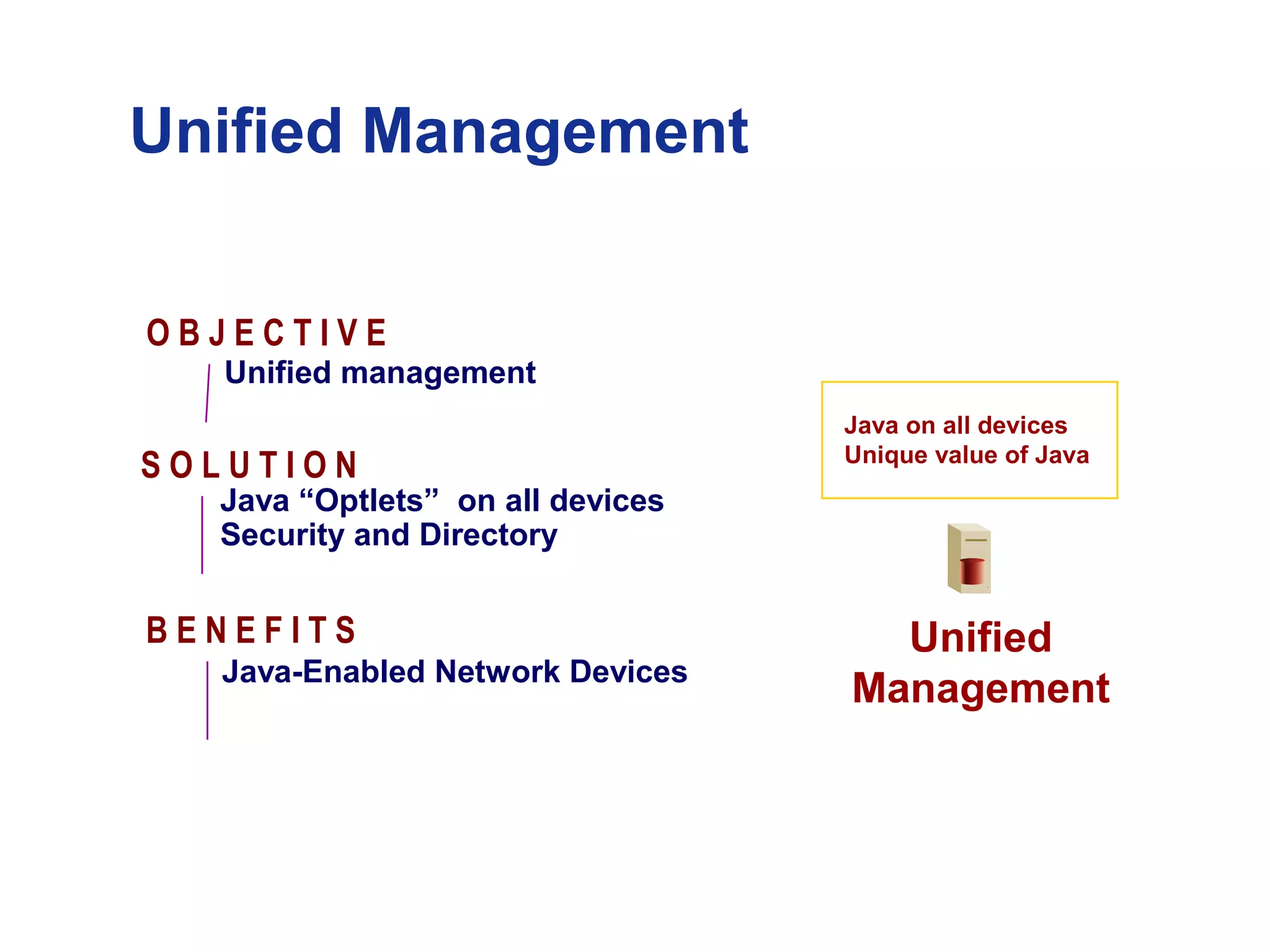
Unified Management 
O B J E C T I V E 
Unified management 
S O L U T I O N 
Java “Optlets” on all devices 
Security and Directory 
B E N E F I T S 
Java-Enabled Network Devices 
Java on all devices 
Unique value of Java 
Unified 
Management
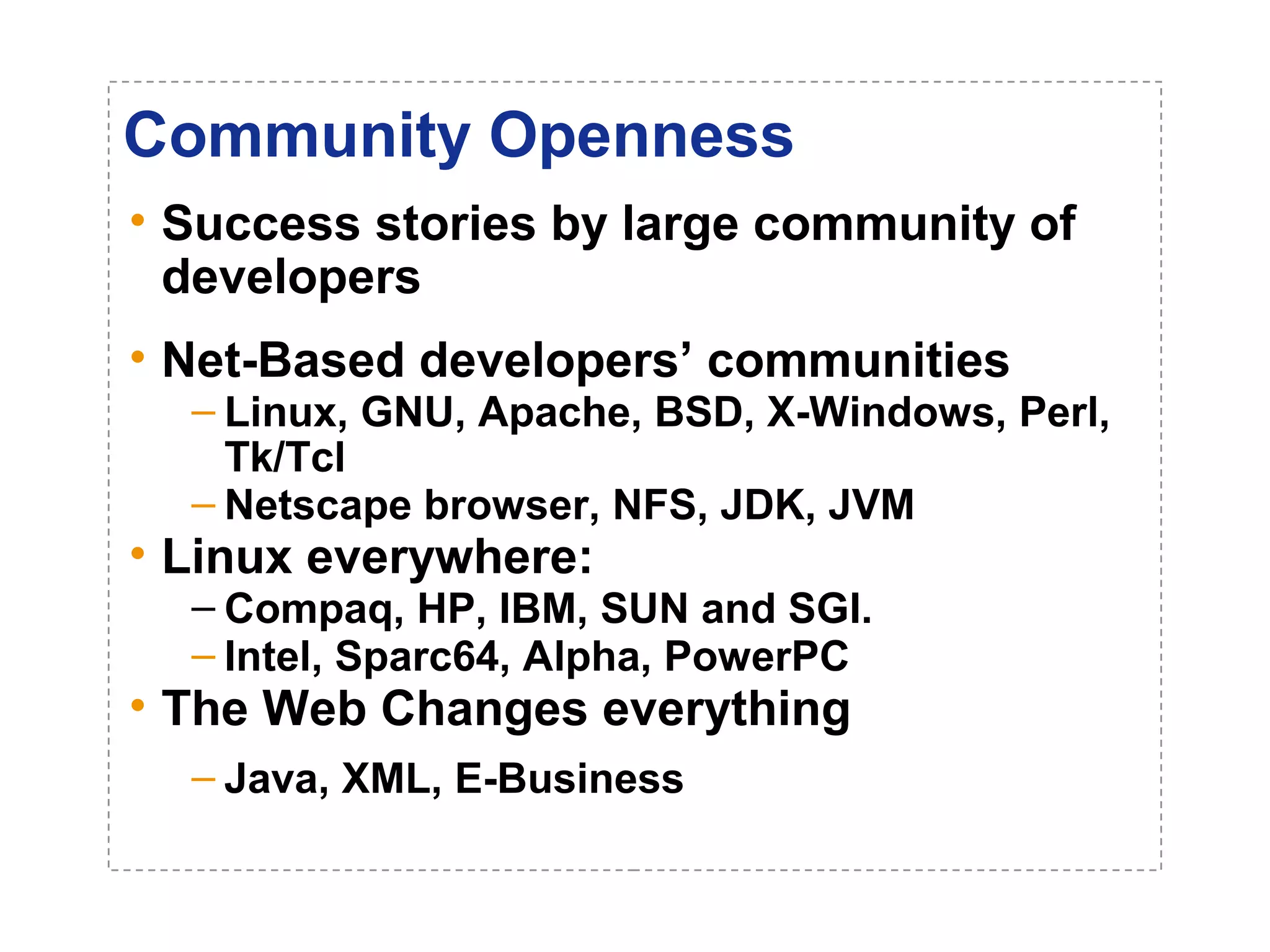
Community Openness 
• Success stories by large community of 
developers 
• Net-Based developers’ communities 
– Linux, GNU, Apache, BSD, X-Windows, Perl, 
Tk/Tcl 
– Netscape browser, NFS, JDK, JVM 
• Linux everywhere: 
– Compaq, HP, IBM, SUN and SGI. 
– Intel, Sparc64, Alpha, PowerPC 
• The Web Changes everything 
– Java, XML, E-Business
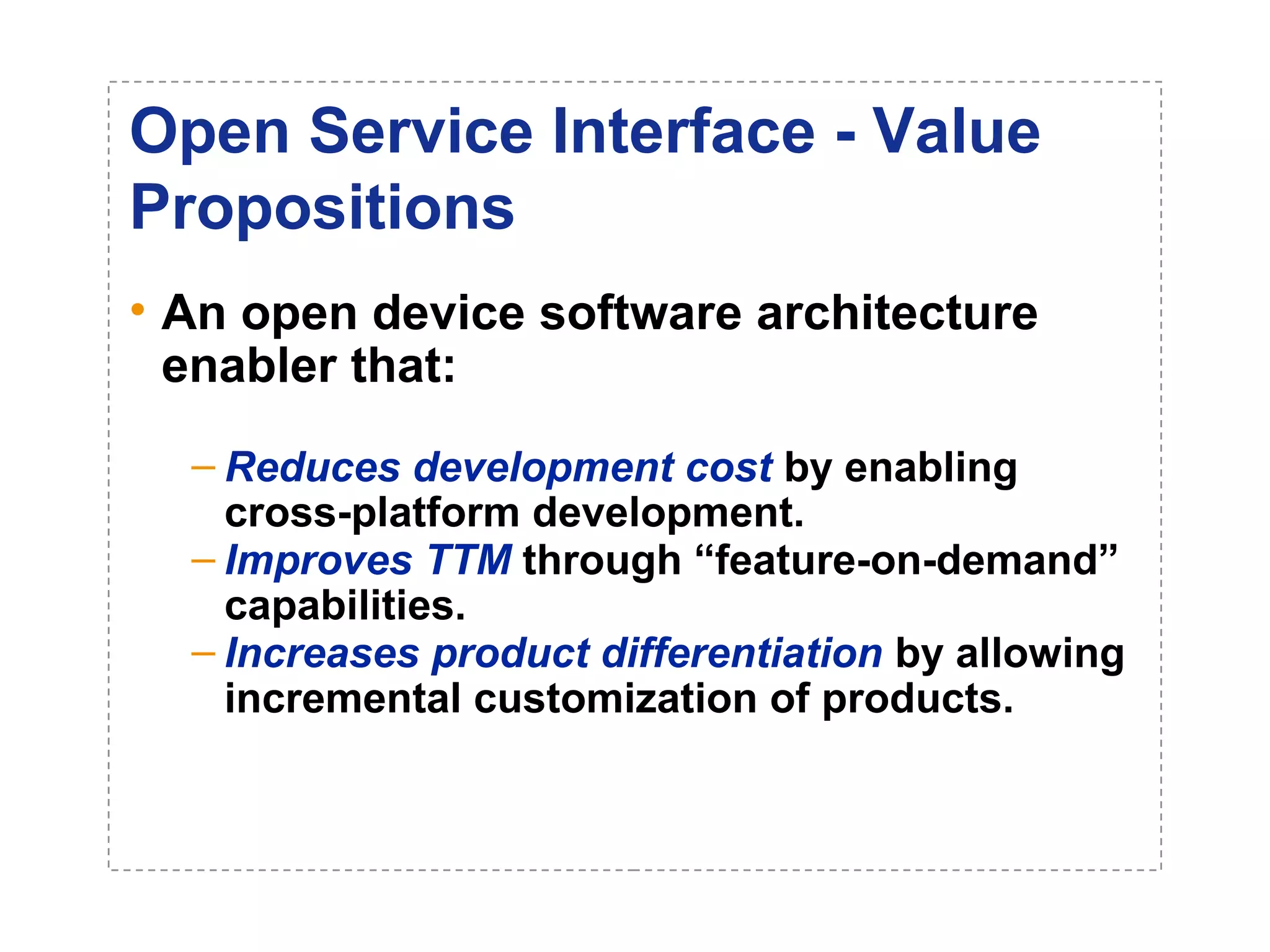
Open Service Interface - Value 
Propositions 
• An open device software architecture 
enabler that: 
– Reduces development cost by enabling 
cross-platform development. 
– Improves TTM through “feature-on-demand” 
capabilities. 
– Increases product differentiation by allowing 
incremental customization of products.
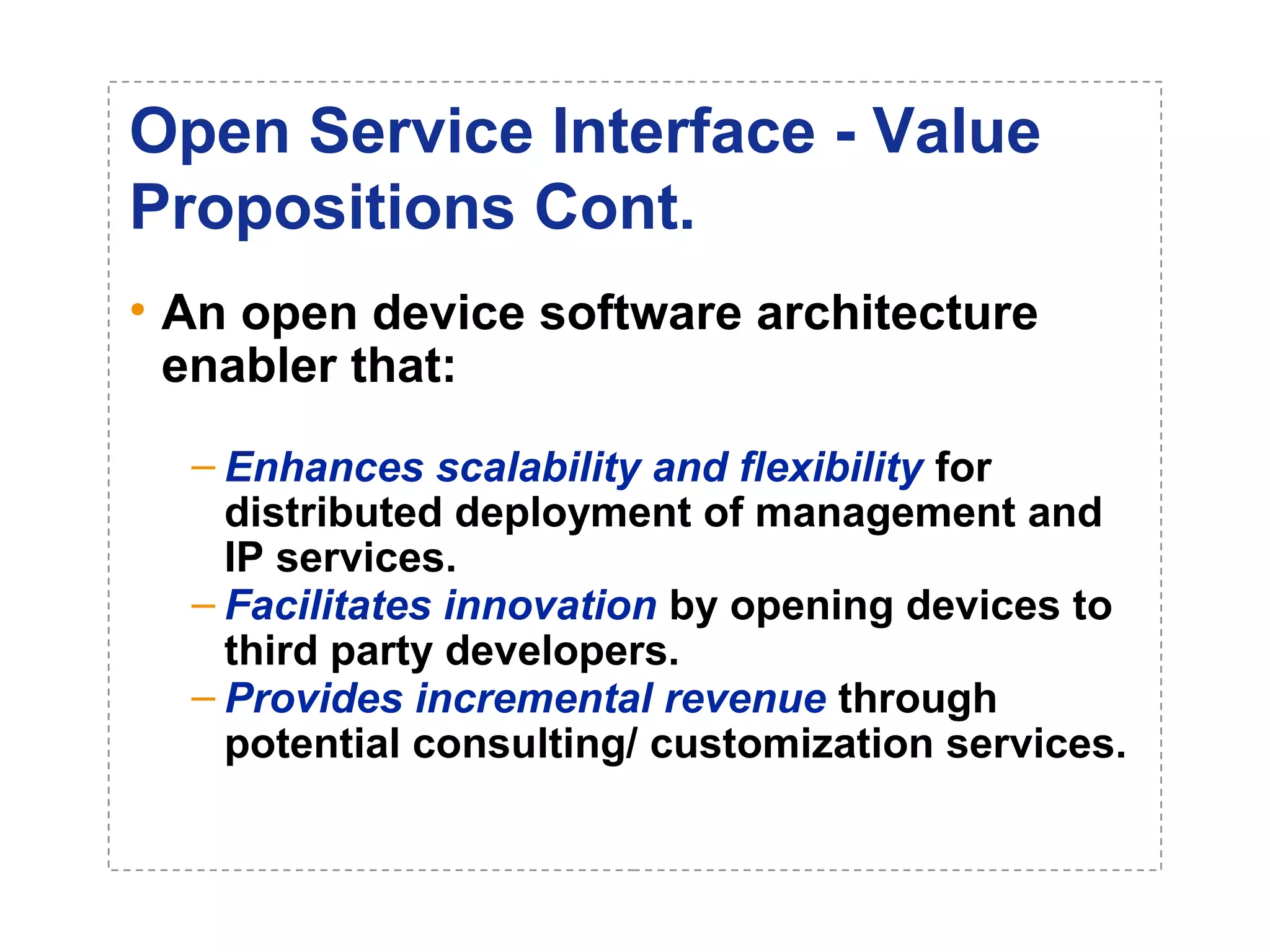
Open Service Interface - Value 
Propositions Cont. 
• An open device software architecture 
enabler that: 
– Enhances scalability and flexibility for 
distributed deployment of management and 
IP services. 
– Facilitates innovation by opening devices to 
third party developers. 
– Provides incremental revenue through 
potential consulting/ customization services.
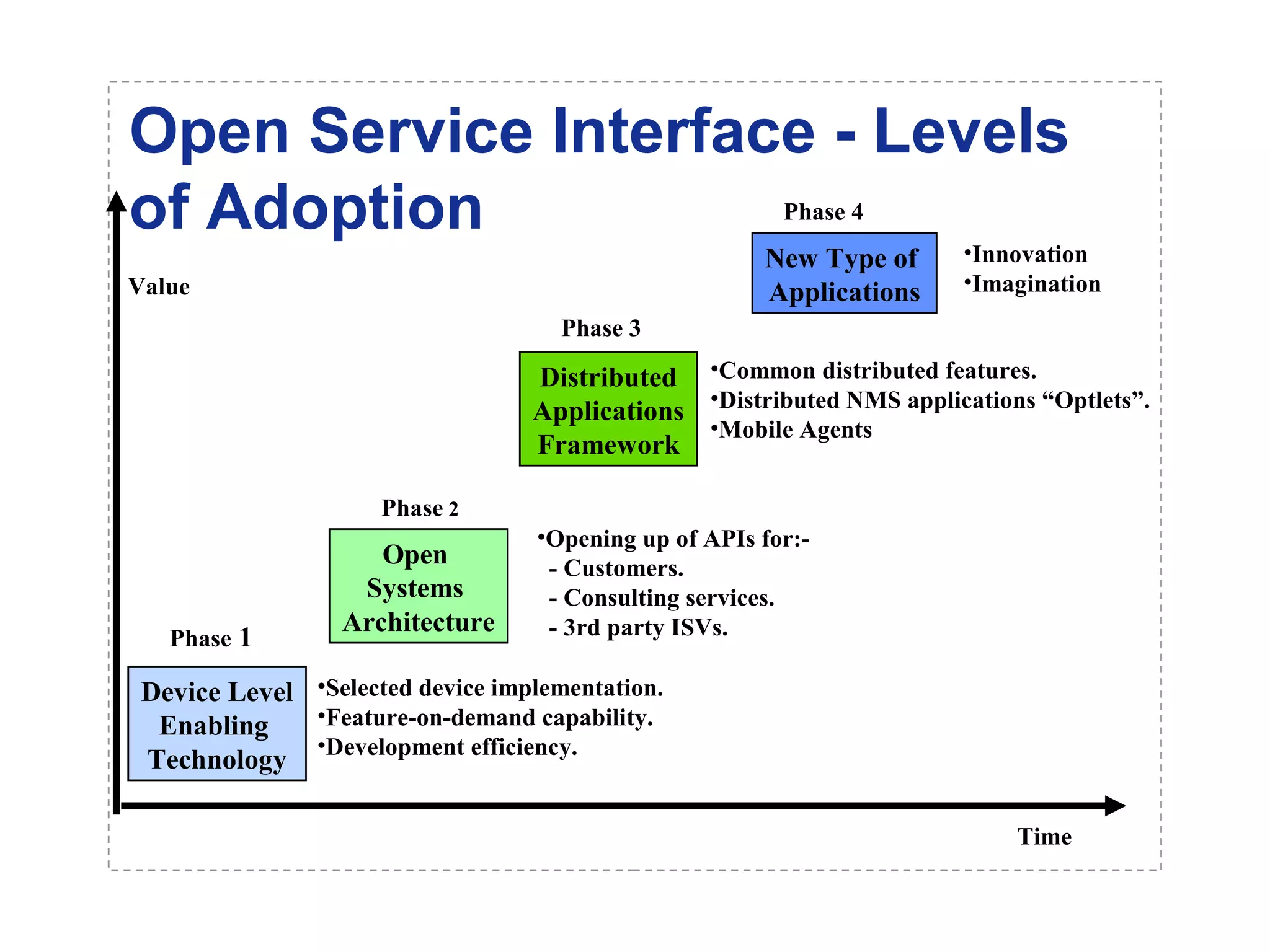
Open Service Interface - Levels 
of Adoption 
Phase 1 
Device Level 
Enabling 
Technology 
Time 
Phase 3 
Distributed 
Applications 
Framework 
Phase 2 
•Selected device implementation. 
•Feature-on-demand capability. 
•Development efficiency. 
Phase 4 
•Common distributed features. 
•Distributed NMS applications “Optlets”. 
•Mobile Agents 
Open 
Systems 
Architecture 
•Opening up of APIs for:- 
- Customers. 
- Consulting services. 
- 3rd party ISVs. 
Value 
New Type of 
Applications 
•Innovation 
•Imagination
Java-enabled Network Devices 
• What we have accomplished: 
– Java-enabled Device Architecture 
– JVM for Switch, Router 
– JVM for Network device 
– Java SNMP MIB API 
• include proxy mode for devices with no JVM,
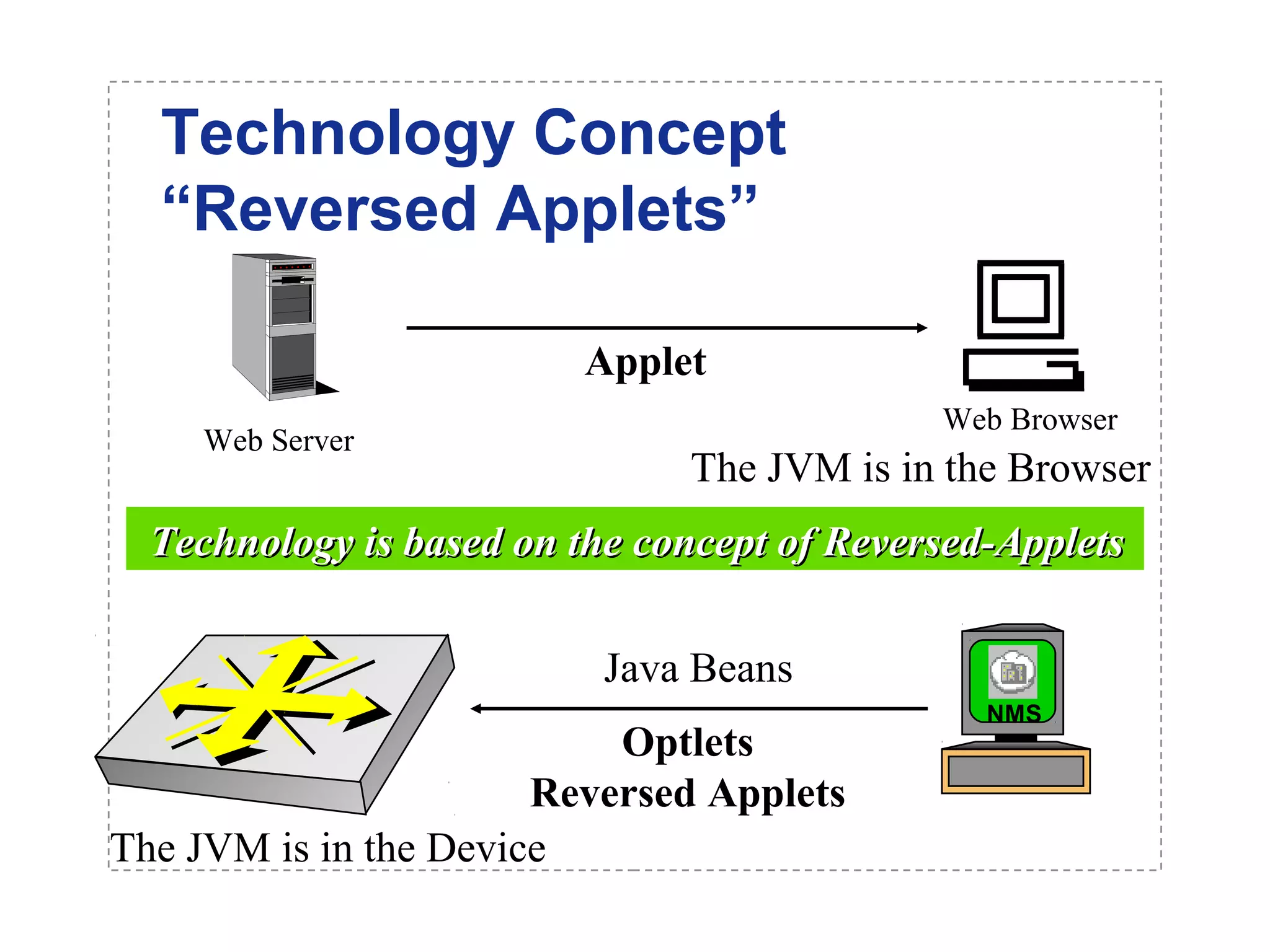
Technology Concept 
“Reversed Applets” 
Java Beans 
Optlets 
Reversed Applets 
NMS 
Web Server 
The JVM is in the Device 
Web Browser 
Applet 
The JVM is in the Browser 
Technology is based on tthhee ccoonncceepptt ooff RReevveerrsseedd--AApppplleettss
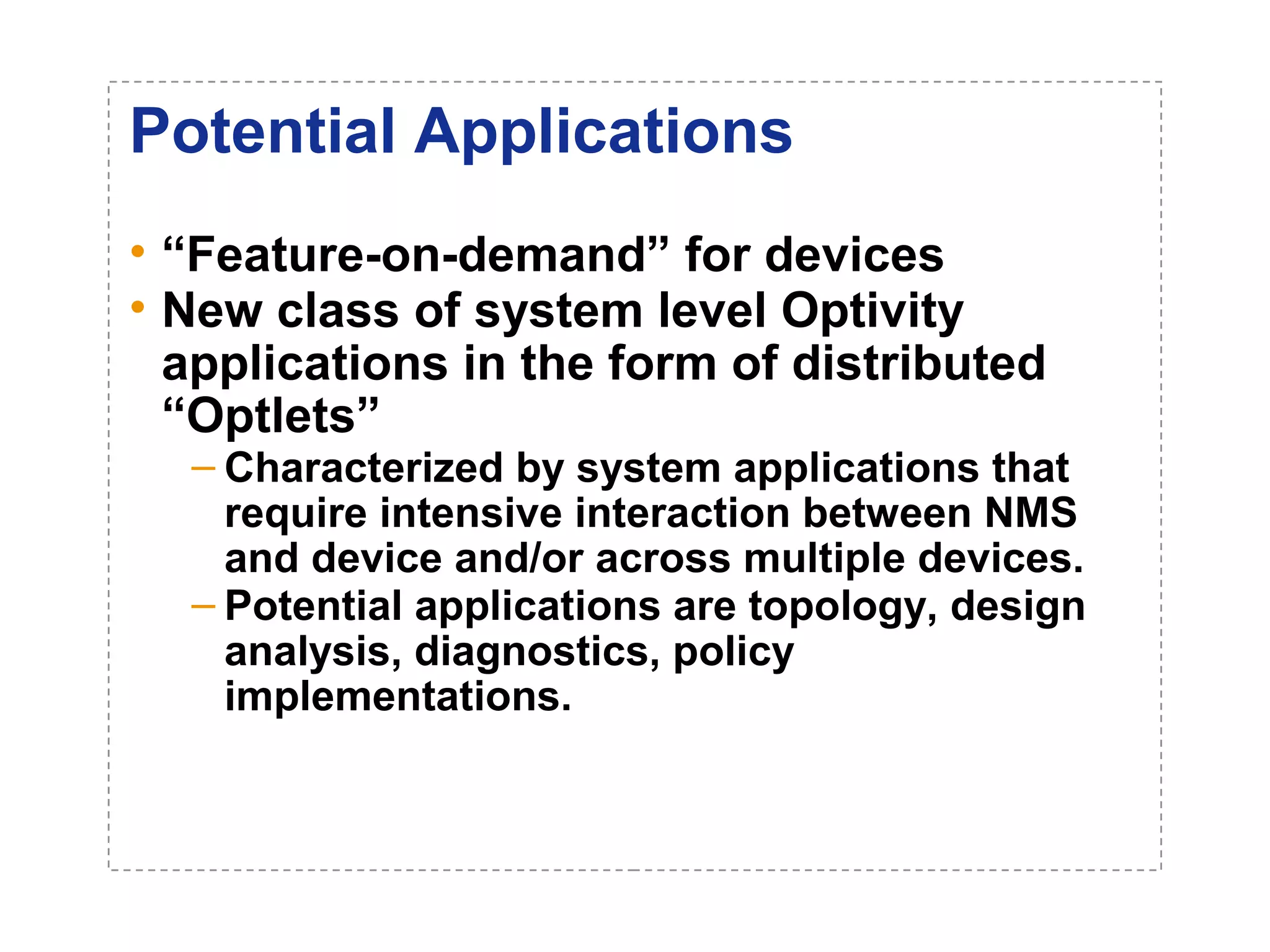
Potential Applications 
• “Feature-on-demand” for devices 
• New class of system level Optivity 
applications in the form of distributed 
“Optlets” 
– Characterized by system applications that 
require intensive interaction between NMS 
and device and/or across multiple devices. 
– Potential applications are topology, design 
analysis, diagnostics, policy 
implementations.
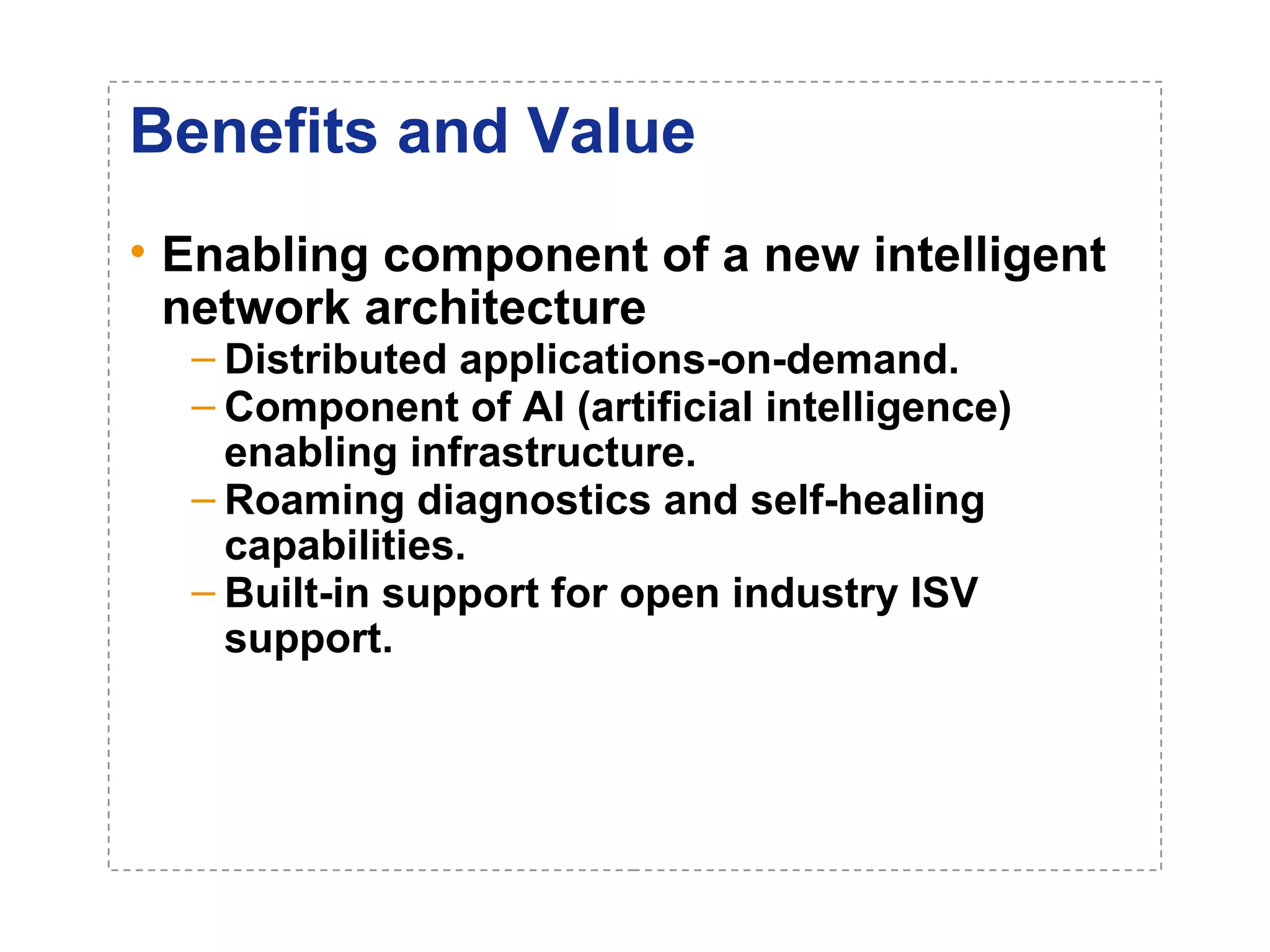
Benefits and Value 
• Enabling component of a new intelligent 
network architecture 
– Distributed applications-on-demand. 
– Component of AI (artificial intelligence) 
enabling infrastructure. 
– Roaming diagnostics and self-healing 
capabilities. 
– Built-in support for open industry ISV 
support.
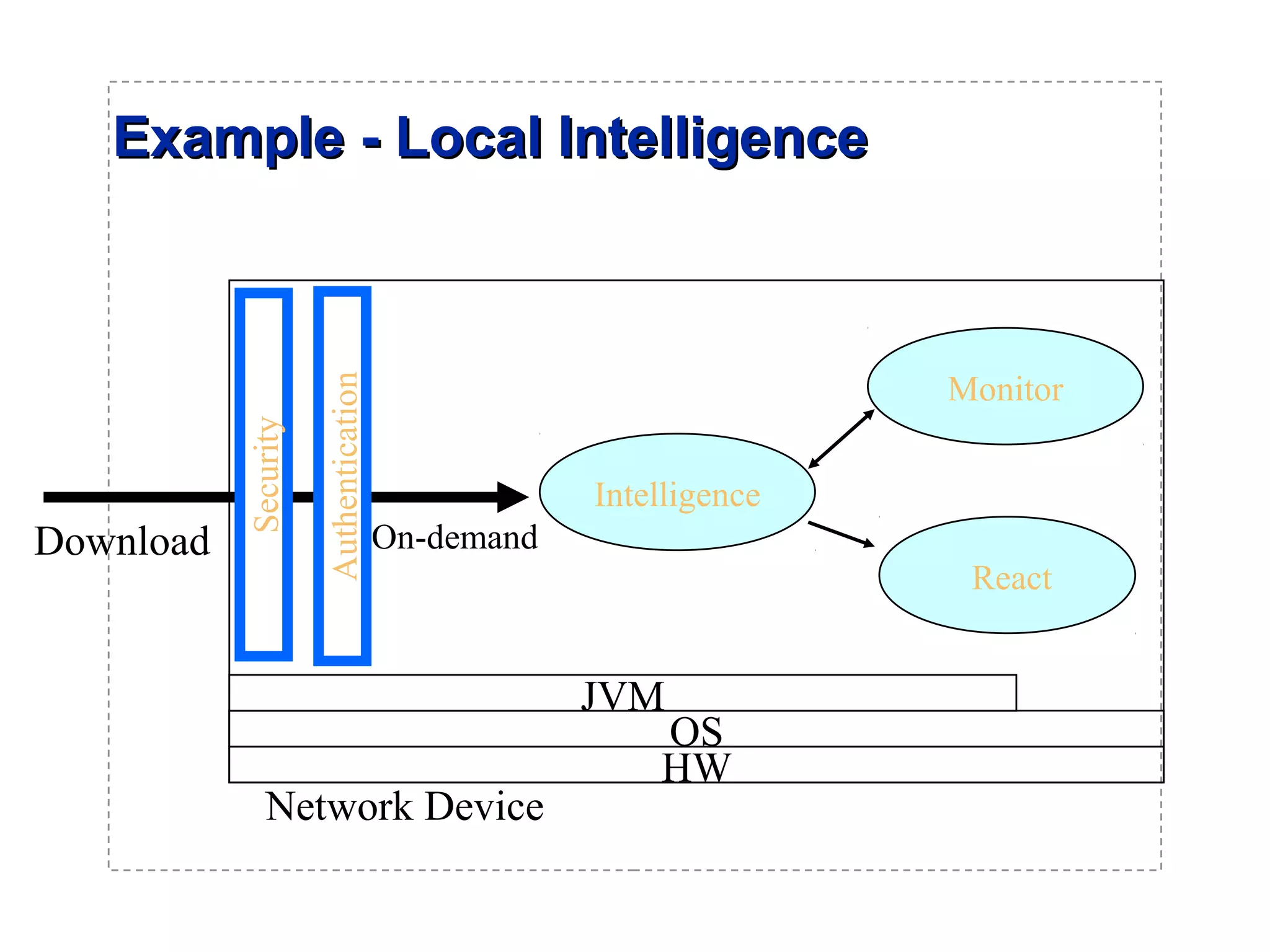
EExxaammppllee -- LLooccaall IInntteelllliiggeennccee 
Network Device 
Download 
OS 
JVM 
HW 
Monitor 
React 
Authentication 
Security 
Intelligence 
On-demand
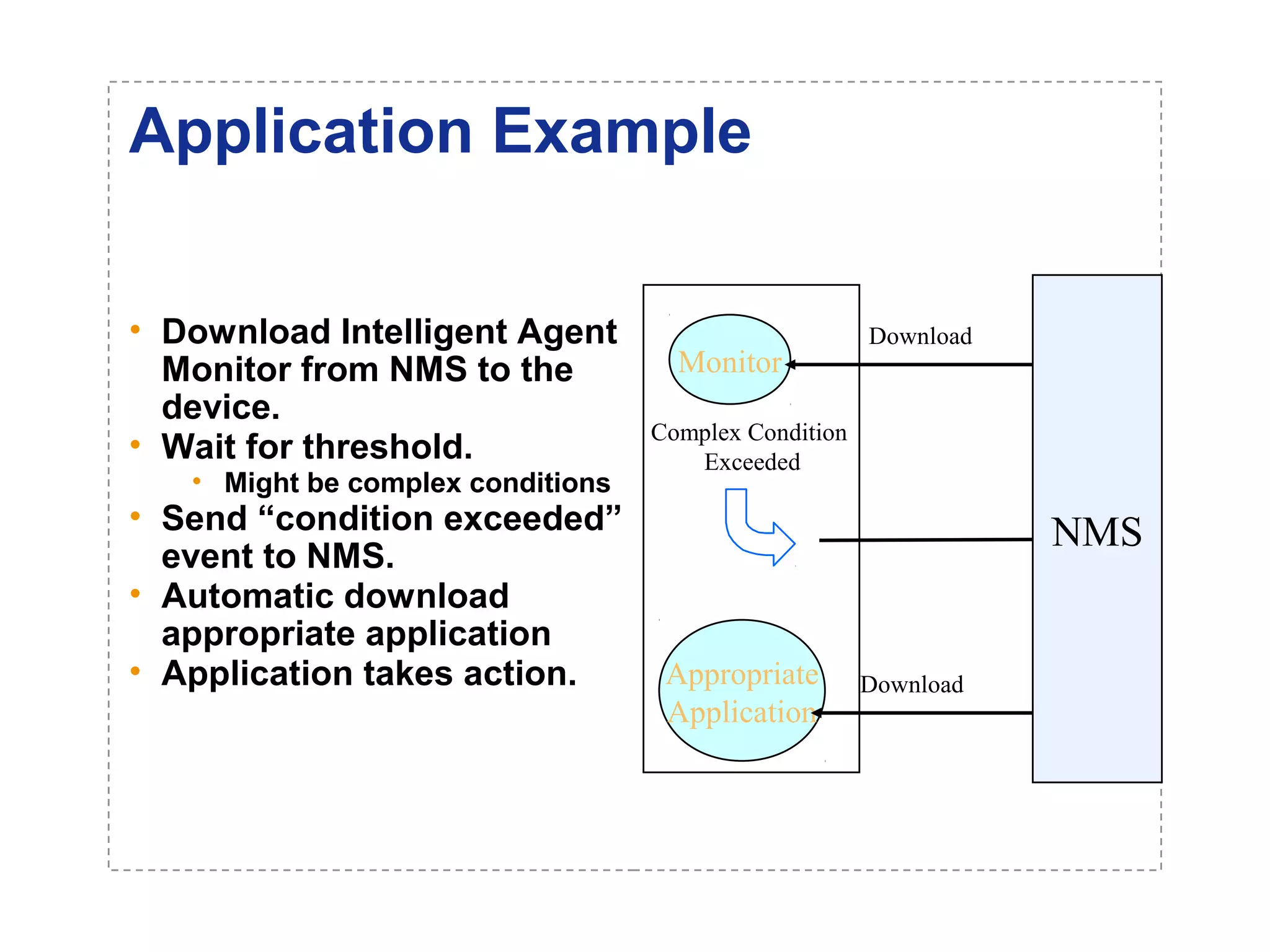
Application Example 
• Download Intelligent Agent 
Monitor from NMS to the 
device. 
• Wait for threshold. 
• Might be complex conditions 
• Send “condition exceeded” 
event to NMS. 
• Automatic download 
appropriate application 
• Application takes action. 
Monitor 
Appropriate 
Application 
Download 
Download 
Complex Condition 
Exceeded 
NMS
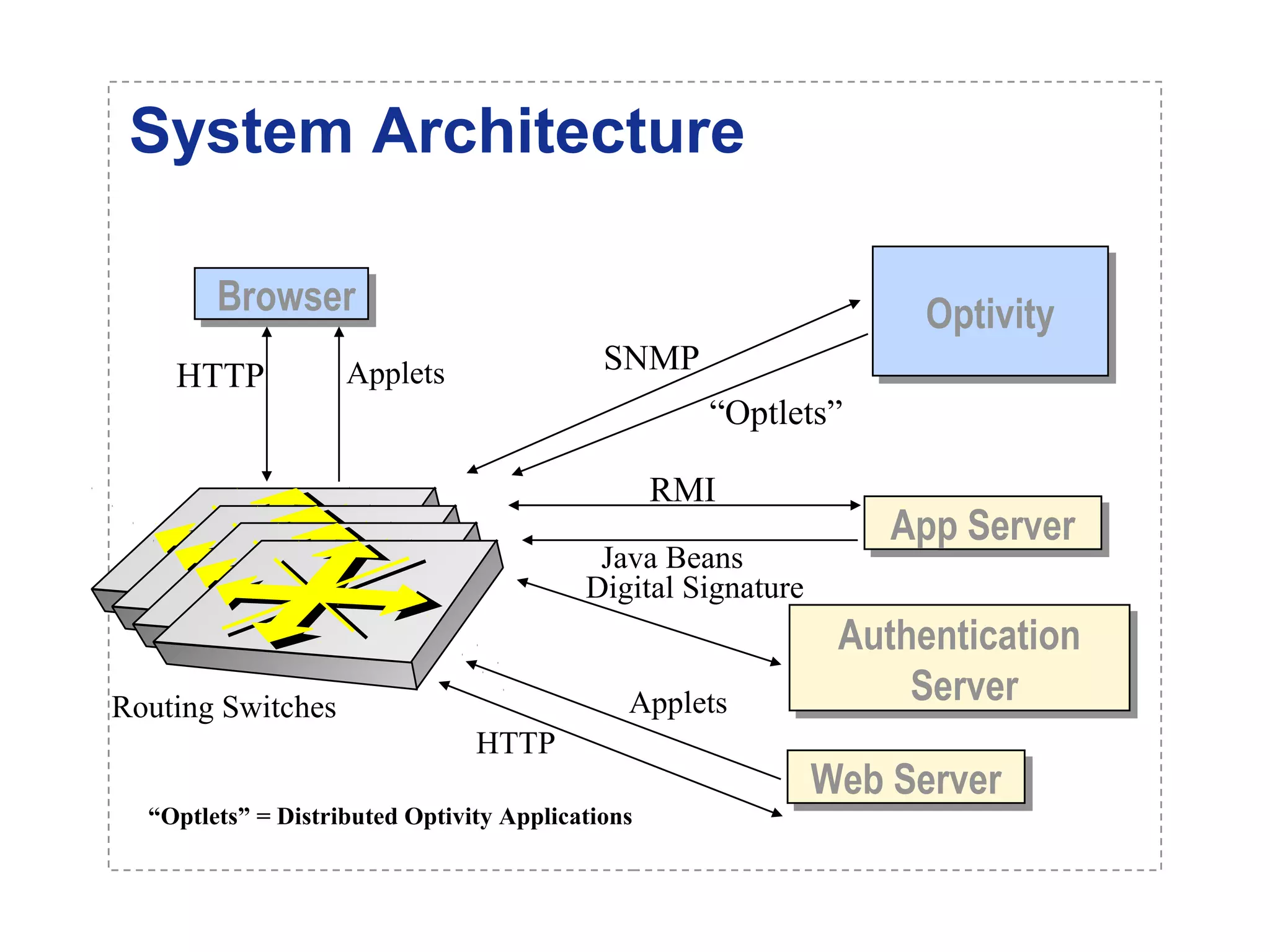
System Architecture 
BBrroowwsseerr OOppttiivviittyy 
“Optlets” 
AApppp SSeerrvveerr 
Authentication 
HTTP Applets SNMP 
RMI 
Java Beans 
Digital Signature 
Server 
Routing Switches 
WWeebb SSeerrvveerr 
HTTP 
Applets 
“Optlets” = Distributed Optivity Applications
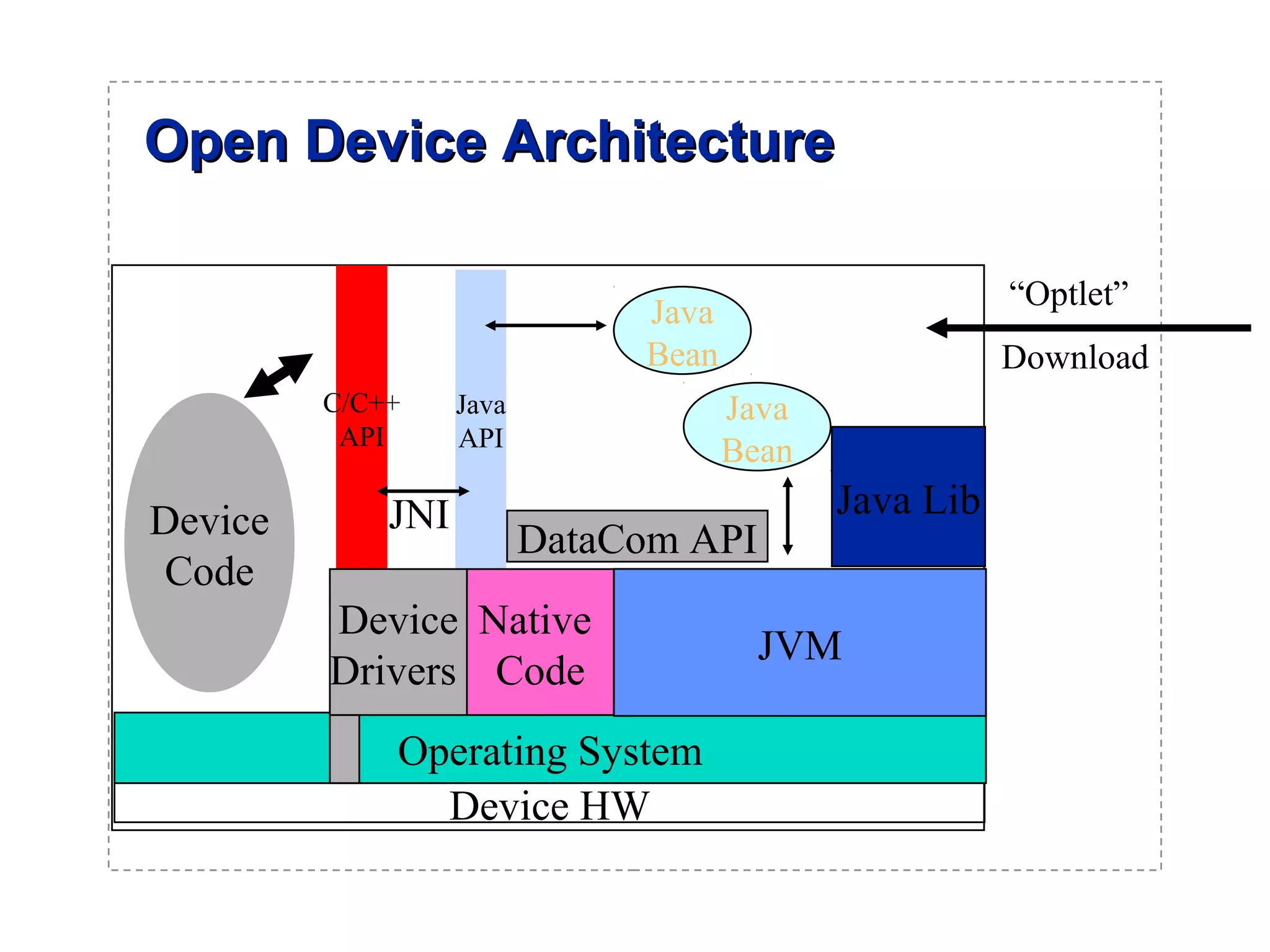
OOppeenn DDeevviiccee AArrcchhiitteeccttuurree 
“Optlet” 
Download 
JNI 
Operating System 
Device HW 
JVM 
Java 
Bean 
Java 
Bean 
Java Lib 
C/C++ 
API 
Java 
API 
Device 
Code 
DataCom API 
Native 
Code 
Device 
Drivers
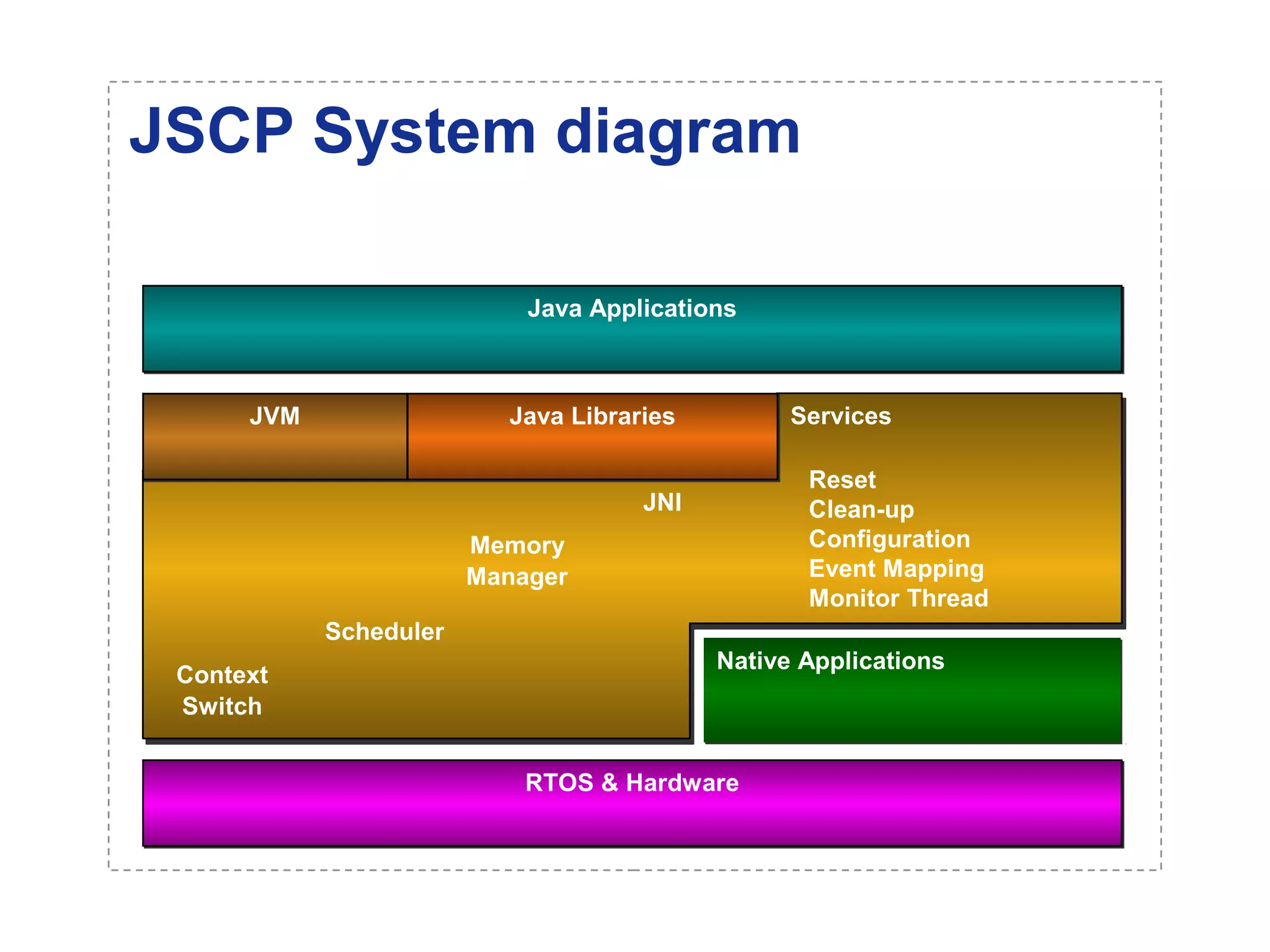
JSCP System diagram 
JJaavvaa AApppplliiccaattiioonnss 
JJVVMM JJaavvaa LLiibbrraarriieess Services 
Reset 
Clean-up 
Configuration 
Event Mapping 
Monitor Thread 
JNI 
Memory 
Manager 
Scheduler 
Context 
Switch 
NNaattiivvee AApppplliiccaattiioonnss 
RRTTOOSS && HHaarrddwwaarree
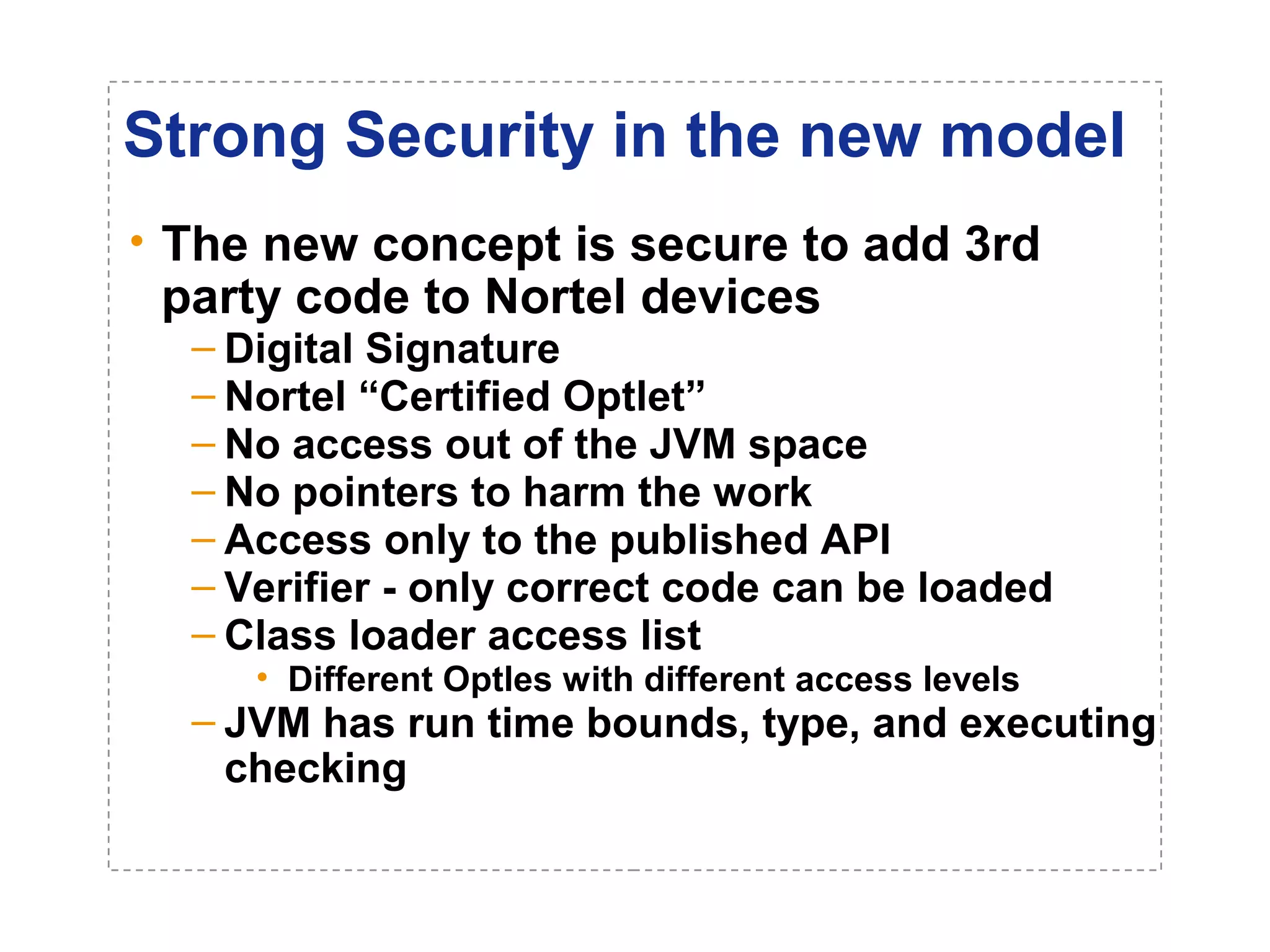
Strong Security in the new model 
• The new concept is secure to add 3rd 
party code to Nortel devices 
– Digital Signature 
– Nortel “Certified Optlet” 
– No access out of the JVM space 
– No pointers to harm the work 
– Access only to the published API 
– Verifier - only correct code can be loaded 
– Class loader access list 
• Different Optles with different access levels 
– JVM has run time bounds, type, and executing 
checking
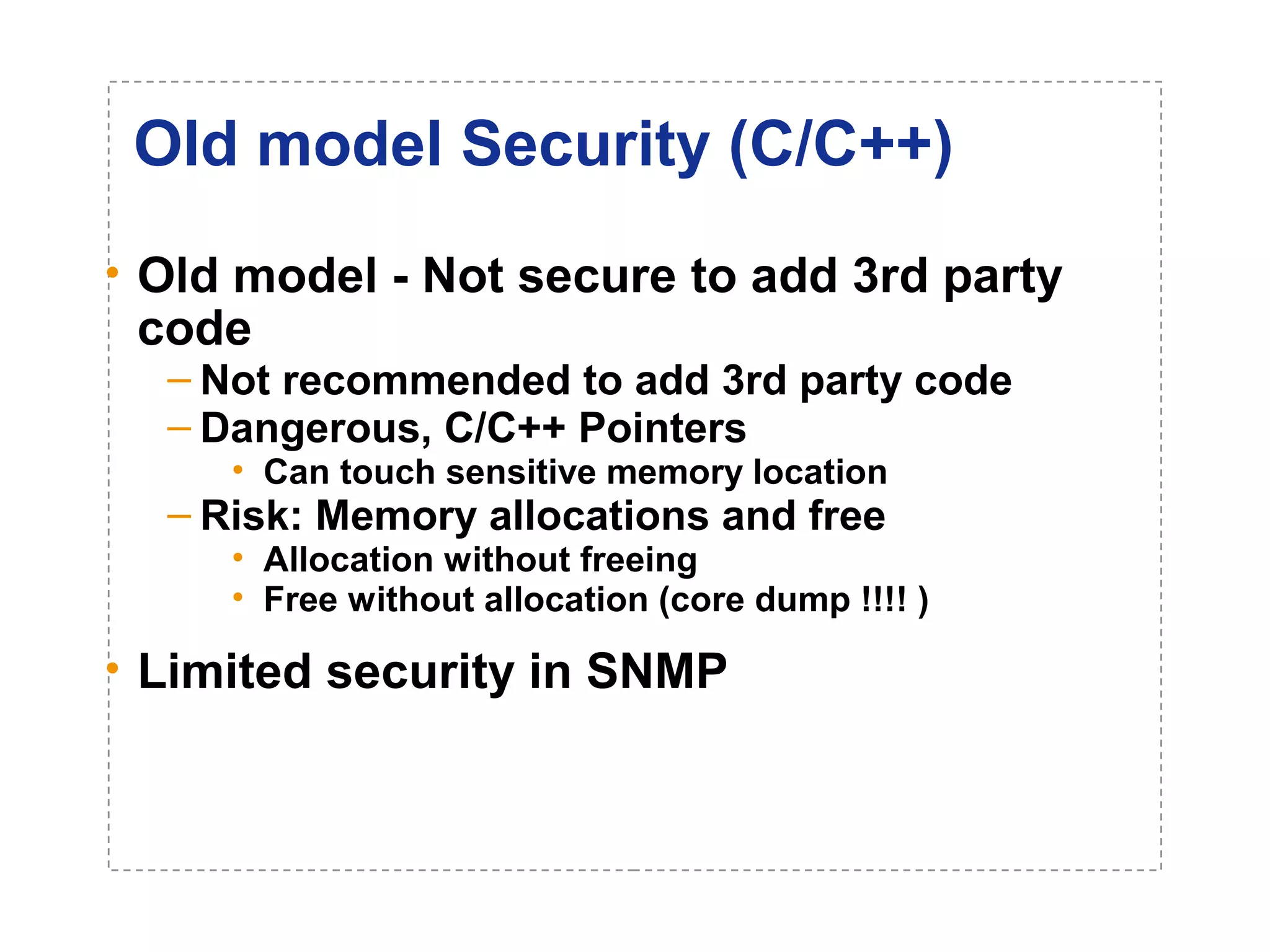
Old model Security (C/C++) 
• Old model - Not secure to add 3rd party 
code 
– Not recommended to add 3rd party code 
– Dangerous, C/C++ Pointers 
• Can touch sensitive memory location 
– Risk: Memory allocations and free 
• Allocation without freeing 
• Free without allocation (core dump !!!! ) 
• Limited security in SNMP
Java SNMP MIB API 
• Portable across a range of network 
devices 
• Extensible 
• Simple and convenient for client use 
• Consistent with SNMP model 
• Hide unnecessary SNMP details 
• Permit optimized access 
• Re-use MIB documentation
MIB API Generation 
• Most of the Java code is generated 
automatically 
• ASN.1 MIB definitions are converted into 
Java classes 
• Documentation and commentary in the 
MIB definitions is placed as Javadoc 
formal comments 
• HTML documentation generated from 
Javadoc
MIB Objects 
• The MIB data model is structured as a 
tree 
• API represents MIB groups with Java 
classes 
• MIB variables are represented with 
accessor methods 
• Conceptual tables are represented with 
iterators 
• API converts SNMP data values into 
standard Java types
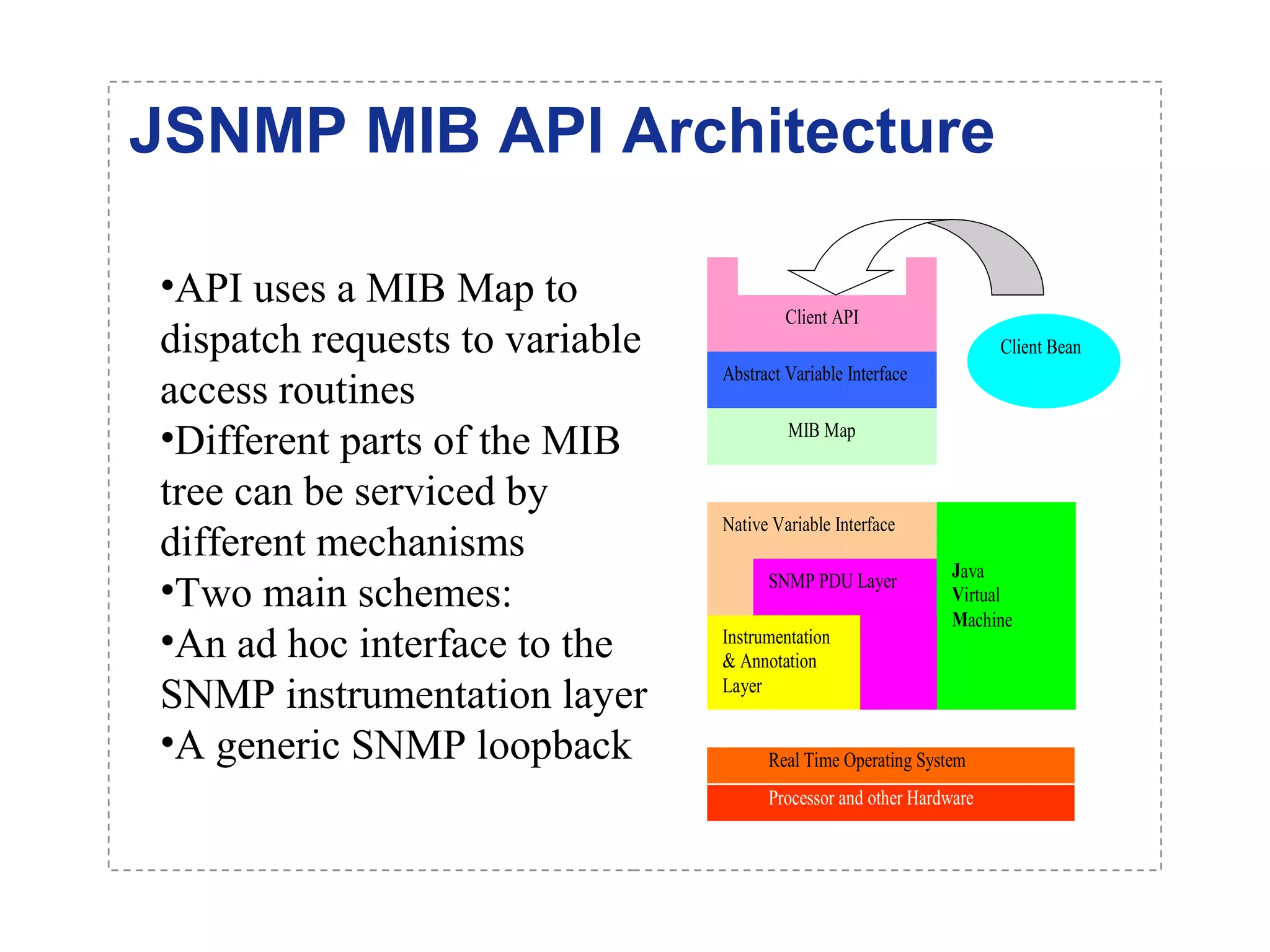
JSNMP MIB API Architecture 
Java 
Virtual 
Machine 
Client API 
Abstract Variable Interface 
MIB Map 
Native Variable Interface 
SNMP PDU Layer 
Instrumentation 
& Annotation 
Layer 
Real Time Operating System 
Processor and other Hardware 
Client Bean 
•API uses a MIB Map to 
dispatch requests to variable 
access routines 
•Different parts of the MIB 
tree can be serviced by 
different mechanisms 
•Two main schemes: 
•An ad hoc interface to the 
SNMP instrumentation layer 
•A generic SNMP loopback
Advantages of MIB map 
• Allows immediate generic implementation of 
the entire MIB via the loopback scheme 
• Enables optimized native implementation of 
key MIB variables for maximum efficiency 
• Permits definition of pseudo-MIB variables 
for extending MIB dynamically 
• Provides site for centralized access 
management
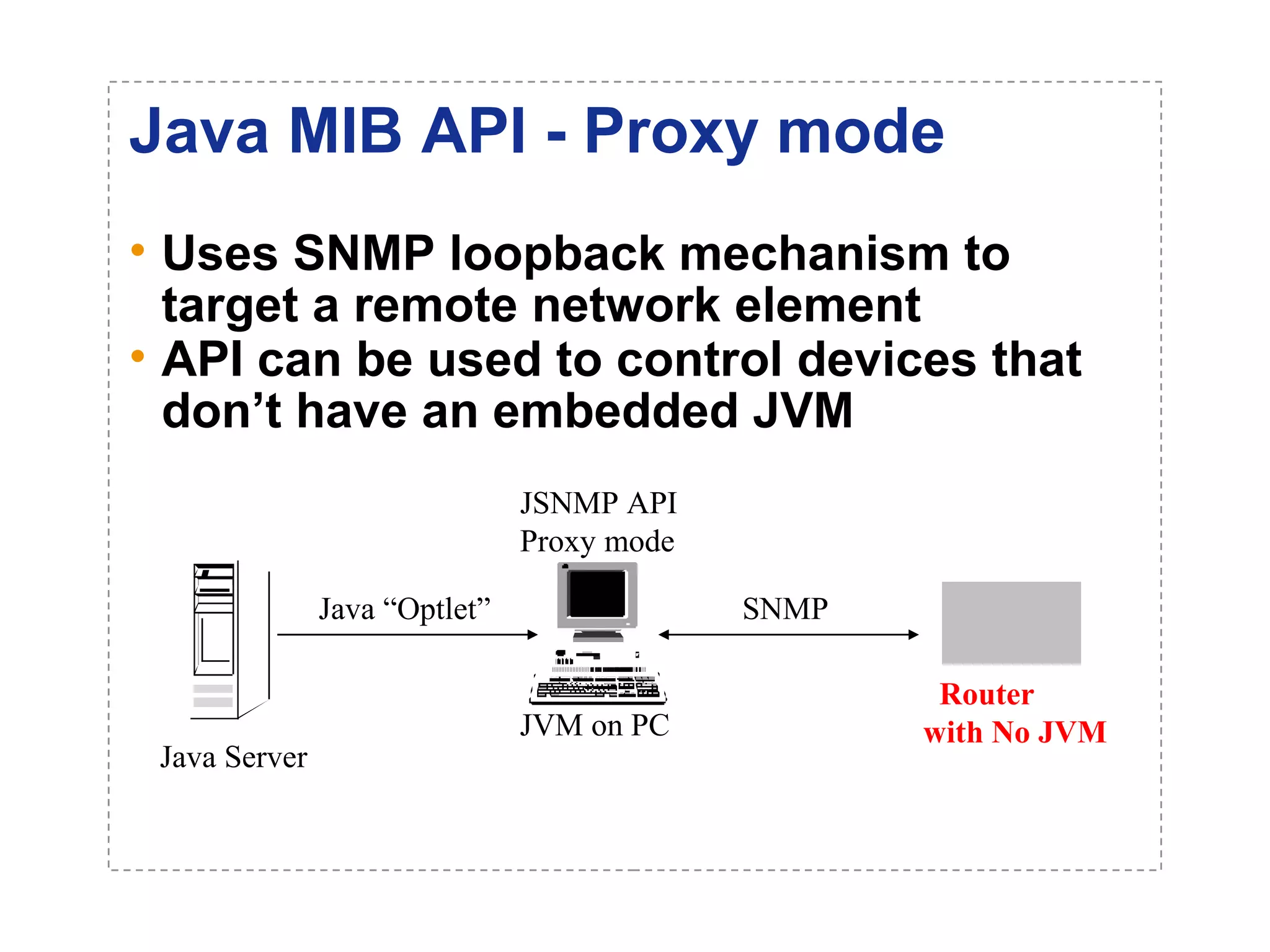
Java MIB API - Proxy mode 
• Uses SNMP loopback mechanism to 
target a remote network element 
• API can be used to control devices that 
don’t have an embedded JVM 
Router 
JVM on PC with No JVM 
Java Server 
Java “Optlet” 
JSNMP API 
Proxy mode 
SNMP
Summary 
• Openness - successfully proven paradigm 
• Domain experts - virtual community 
• Allows innovations and added value 
• dynamic agents vs. static agents 
• Dynamic Loading 
• Strong Security 
• An enabling-technology 
• Take it, and make it work for you

Unified Device Management via Java-enabled Network Devices

  • 1.
    Unified Device Management via Java-enabled Network Devices Tal Lavian Rob Duncan
  • 2.
    Agenda • UnifiedManagement for Unified Networks • Openness - Virtual community development, Domain experts • Open Service Interface - values • Architecture and technology concepts • Strong security • Java SNMP MIB API • Summary
  • 3.
    Purpose • Tointroduce the new Open Networking Architecture that is based on Java-enabled Network Devices
  • 4.
    Unified Management OB J E C T I V E Unified management S O L U T I O N Java “Optlets” on all devices Security and Directory B E N E F I T S Java-Enabled Network Devices Java on all devices Unique value of Java Unified Management
  • 5.
    Community Openness •Success stories by large community of developers • Net-Based developers’ communities – Linux, GNU, Apache, BSD, X-Windows, Perl, Tk/Tcl – Netscape browser, NFS, JDK, JVM • Linux everywhere: – Compaq, HP, IBM, SUN and SGI. – Intel, Sparc64, Alpha, PowerPC • The Web Changes everything – Java, XML, E-Business
  • 6.
    Open Service Interface- Value Propositions • An open device software architecture enabler that: – Reduces development cost by enabling cross-platform development. – Improves TTM through “feature-on-demand” capabilities. – Increases product differentiation by allowing incremental customization of products.
  • 7.
    Open Service Interface- Value Propositions Cont. • An open device software architecture enabler that: – Enhances scalability and flexibility for distributed deployment of management and IP services. – Facilitates innovation by opening devices to third party developers. – Provides incremental revenue through potential consulting/ customization services.
  • 8.
    Open Service Interface- Levels of Adoption Phase 1 Device Level Enabling Technology Time Phase 3 Distributed Applications Framework Phase 2 •Selected device implementation. •Feature-on-demand capability. •Development efficiency. Phase 4 •Common distributed features. •Distributed NMS applications “Optlets”. •Mobile Agents Open Systems Architecture •Opening up of APIs for:- - Customers. - Consulting services. - 3rd party ISVs. Value New Type of Applications •Innovation •Imagination
  • 9.
    Java-enabled Network Devices • What we have accomplished: – Java-enabled Device Architecture – JVM for Switch, Router – JVM for Network device – Java SNMP MIB API • include proxy mode for devices with no JVM,
  • 10.
    Technology Concept “ReversedApplets” Java Beans Optlets Reversed Applets NMS Web Server The JVM is in the Device Web Browser Applet The JVM is in the Browser Technology is based on tthhee ccoonncceepptt ooff RReevveerrsseedd--AApppplleettss
  • 11.
    Potential Applications •“Feature-on-demand” for devices • New class of system level Optivity applications in the form of distributed “Optlets” – Characterized by system applications that require intensive interaction between NMS and device and/or across multiple devices. – Potential applications are topology, design analysis, diagnostics, policy implementations.
  • 12.
    Benefits and Value • Enabling component of a new intelligent network architecture – Distributed applications-on-demand. – Component of AI (artificial intelligence) enabling infrastructure. – Roaming diagnostics and self-healing capabilities. – Built-in support for open industry ISV support.
  • 13.
    EExxaammppllee -- LLooccaallIInntteelllliiggeennccee Network Device Download OS JVM HW Monitor React Authentication Security Intelligence On-demand
  • 14.
    Application Example •Download Intelligent Agent Monitor from NMS to the device. • Wait for threshold. • Might be complex conditions • Send “condition exceeded” event to NMS. • Automatic download appropriate application • Application takes action. Monitor Appropriate Application Download Download Complex Condition Exceeded NMS
  • 15.
    System Architecture BBrroowwsseerrOOppttiivviittyy “Optlets” AApppp SSeerrvveerr Authentication HTTP Applets SNMP RMI Java Beans Digital Signature Server Routing Switches WWeebb SSeerrvveerr HTTP Applets “Optlets” = Distributed Optivity Applications
  • 16.
    OOppeenn DDeevviiccee AArrcchhiitteeccttuurree “Optlet” Download JNI Operating System Device HW JVM Java Bean Java Bean Java Lib C/C++ API Java API Device Code DataCom API Native Code Device Drivers
  • 17.
    JSCP System diagram JJaavvaa AApppplliiccaattiioonnss JJVVMM JJaavvaa LLiibbrraarriieess Services Reset Clean-up Configuration Event Mapping Monitor Thread JNI Memory Manager Scheduler Context Switch NNaattiivvee AApppplliiccaattiioonnss RRTTOOSS && HHaarrddwwaarree
  • 18.
    Strong Security inthe new model • The new concept is secure to add 3rd party code to Nortel devices – Digital Signature – Nortel “Certified Optlet” – No access out of the JVM space – No pointers to harm the work – Access only to the published API – Verifier - only correct code can be loaded – Class loader access list • Different Optles with different access levels – JVM has run time bounds, type, and executing checking
  • 19.
    Old model Security(C/C++) • Old model - Not secure to add 3rd party code – Not recommended to add 3rd party code – Dangerous, C/C++ Pointers • Can touch sensitive memory location – Risk: Memory allocations and free • Allocation without freeing • Free without allocation (core dump !!!! ) • Limited security in SNMP
  • 20.
    Java SNMP MIBAPI • Portable across a range of network devices • Extensible • Simple and convenient for client use • Consistent with SNMP model • Hide unnecessary SNMP details • Permit optimized access • Re-use MIB documentation
  • 21.
    MIB API Generation • Most of the Java code is generated automatically • ASN.1 MIB definitions are converted into Java classes • Documentation and commentary in the MIB definitions is placed as Javadoc formal comments • HTML documentation generated from Javadoc
  • 22.
    MIB Objects •The MIB data model is structured as a tree • API represents MIB groups with Java classes • MIB variables are represented with accessor methods • Conceptual tables are represented with iterators • API converts SNMP data values into standard Java types
  • 23.
    JSNMP MIB APIArchitecture Java Virtual Machine Client API Abstract Variable Interface MIB Map Native Variable Interface SNMP PDU Layer Instrumentation & Annotation Layer Real Time Operating System Processor and other Hardware Client Bean •API uses a MIB Map to dispatch requests to variable access routines •Different parts of the MIB tree can be serviced by different mechanisms •Two main schemes: •An ad hoc interface to the SNMP instrumentation layer •A generic SNMP loopback
  • 24.
    Advantages of MIBmap • Allows immediate generic implementation of the entire MIB via the loopback scheme • Enables optimized native implementation of key MIB variables for maximum efficiency • Permits definition of pseudo-MIB variables for extending MIB dynamically • Provides site for centralized access management
  • 25.
    Java MIB API- Proxy mode • Uses SNMP loopback mechanism to target a remote network element • API can be used to control devices that don’t have an embedded JVM Router JVM on PC with No JVM Java Server Java “Optlet” JSNMP API Proxy mode SNMP
  • 26.
    Summary • Openness- successfully proven paradigm • Domain experts - virtual community • Allows innovations and added value • dynamic agents vs. static agents • Dynamic Loading • Strong Security • An enabling-technology • Take it, and make it work for you