

The Lean Startup#leanstartupEric Ries (@ericries)http://StartupLessonsLearned.blogspot.com
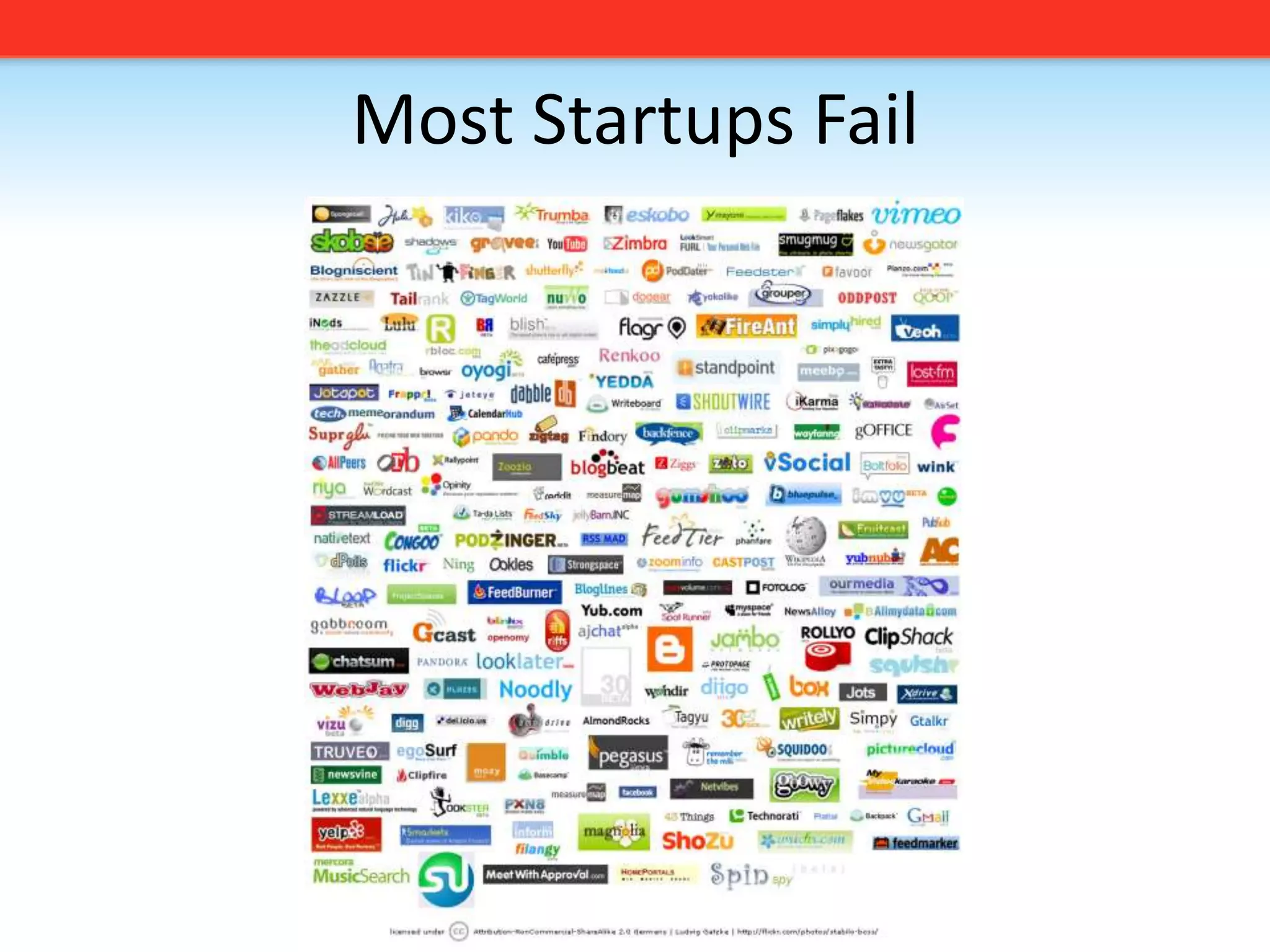
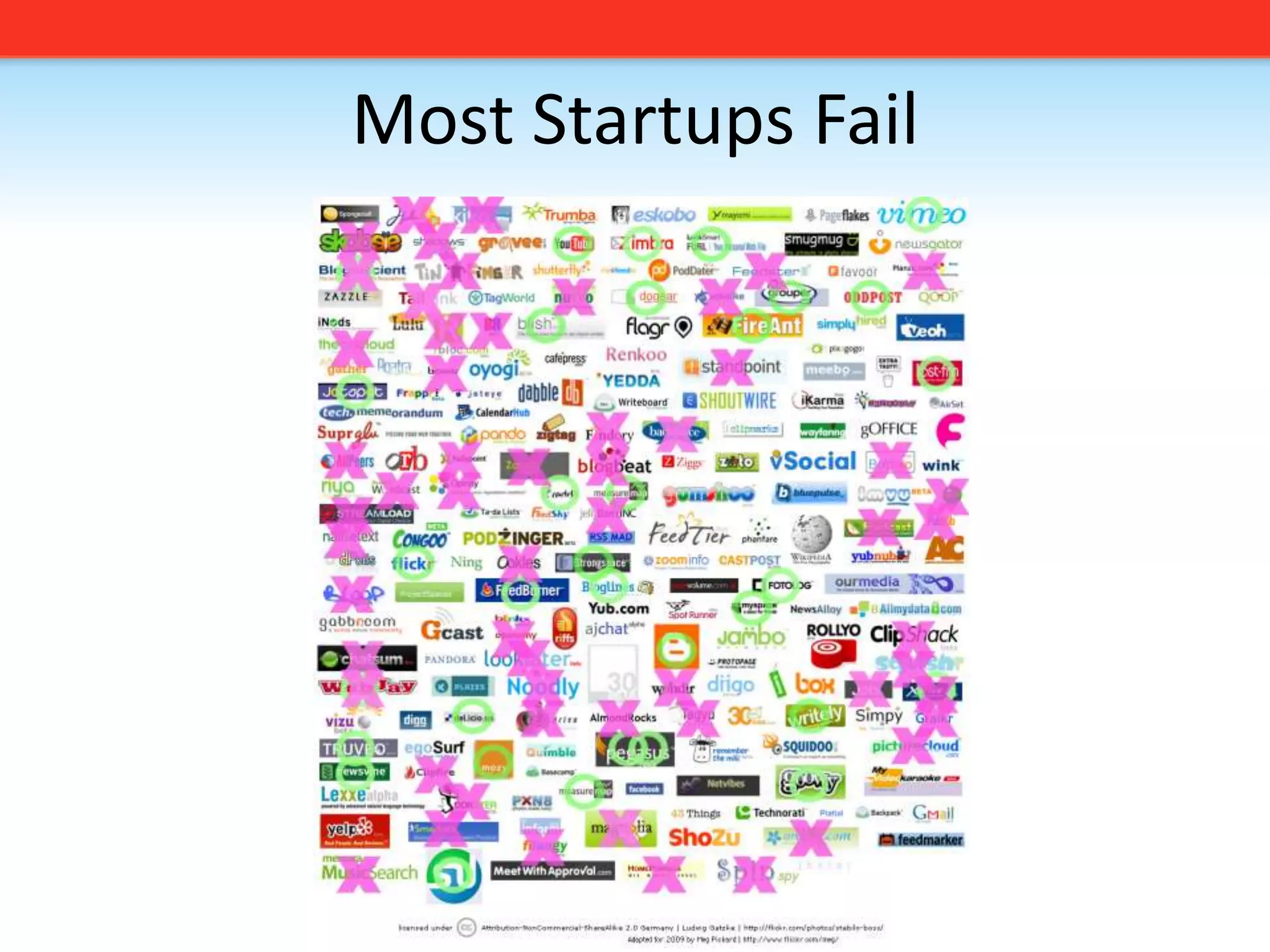
Most Startups Fail
Most Startups Fail
Most Startups Fail
Most Startups FailBut it doesn’t have to be that way. We can do better. This talk is about how.
What is a startup?A startup is a human institution designed to deliver a new product or service under conditions of extreme uncertainty. Nothing to do with size of company, sector of the economy, or industry
A Tale of Two Startups
Startup #1
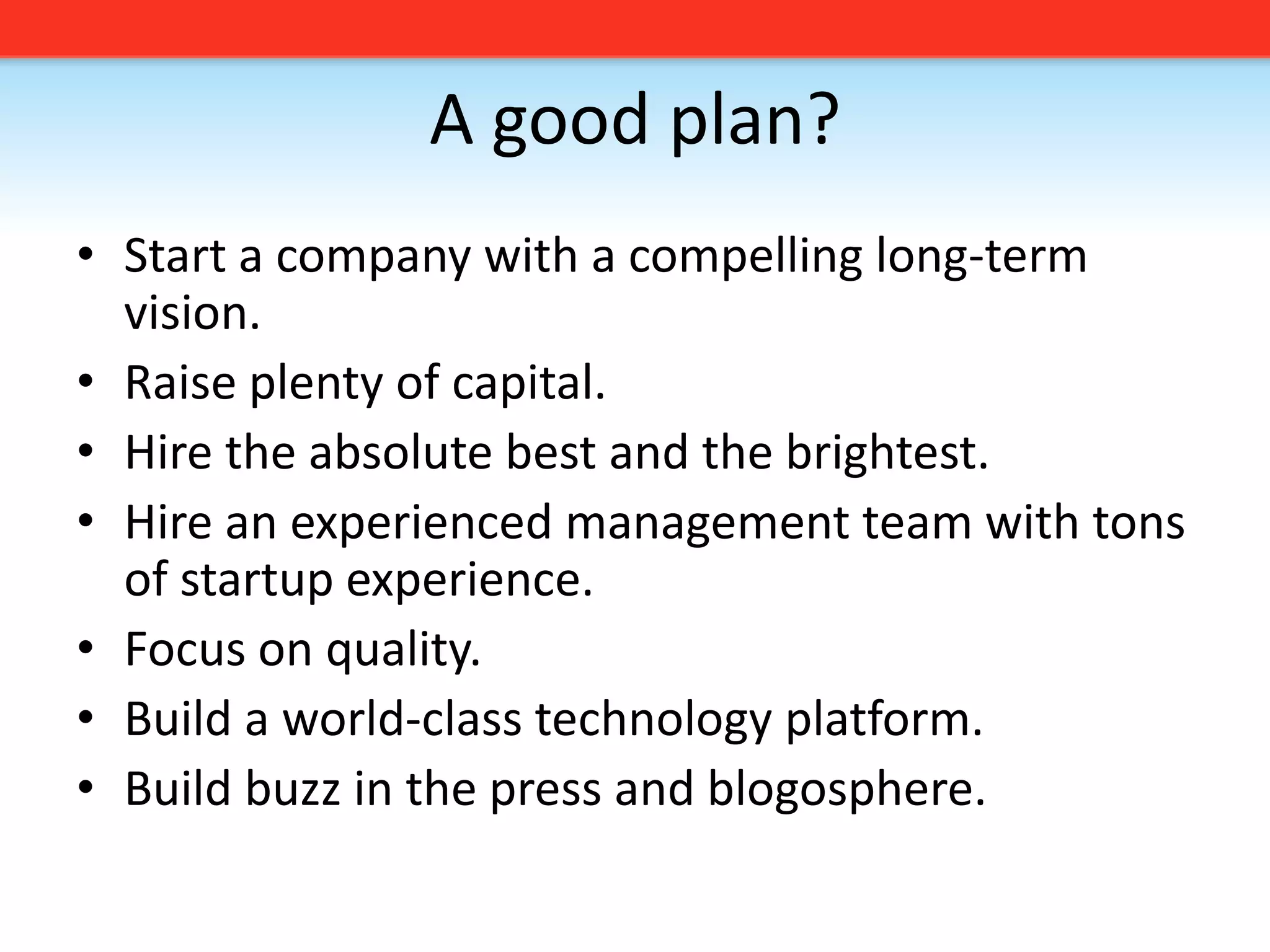
A good plan?Start a company with a compelling long-term vision. Raise plenty of capital.Hire the absolute best and the brightest.Hire an experienced management team with tons of startup experience.Focus on quality. Build a world-class technology platform.Build buzz in the press and blogosphere.
Achieving FailureCompany failed utterly, $40MM and five years of pain.Crippled by “shadow beliefs” that destroyed the effort of all those smart people.
Shadow Belief #1We know what customers want.
Shadow Belief #2We can accurately predict the future.
Shadow Belief #3Advancing the plan is progress.
A good plan?Start a company with a compelling long-term vision. Raise plenty of capital.Hire the absolute best and the brightest.Hire an experienced management team with tons of startup experience.Focus on quality. Build a world-class technology platform.Build buzz in the press and blogosphere.
Startup #2
IMVU 
IMVU 
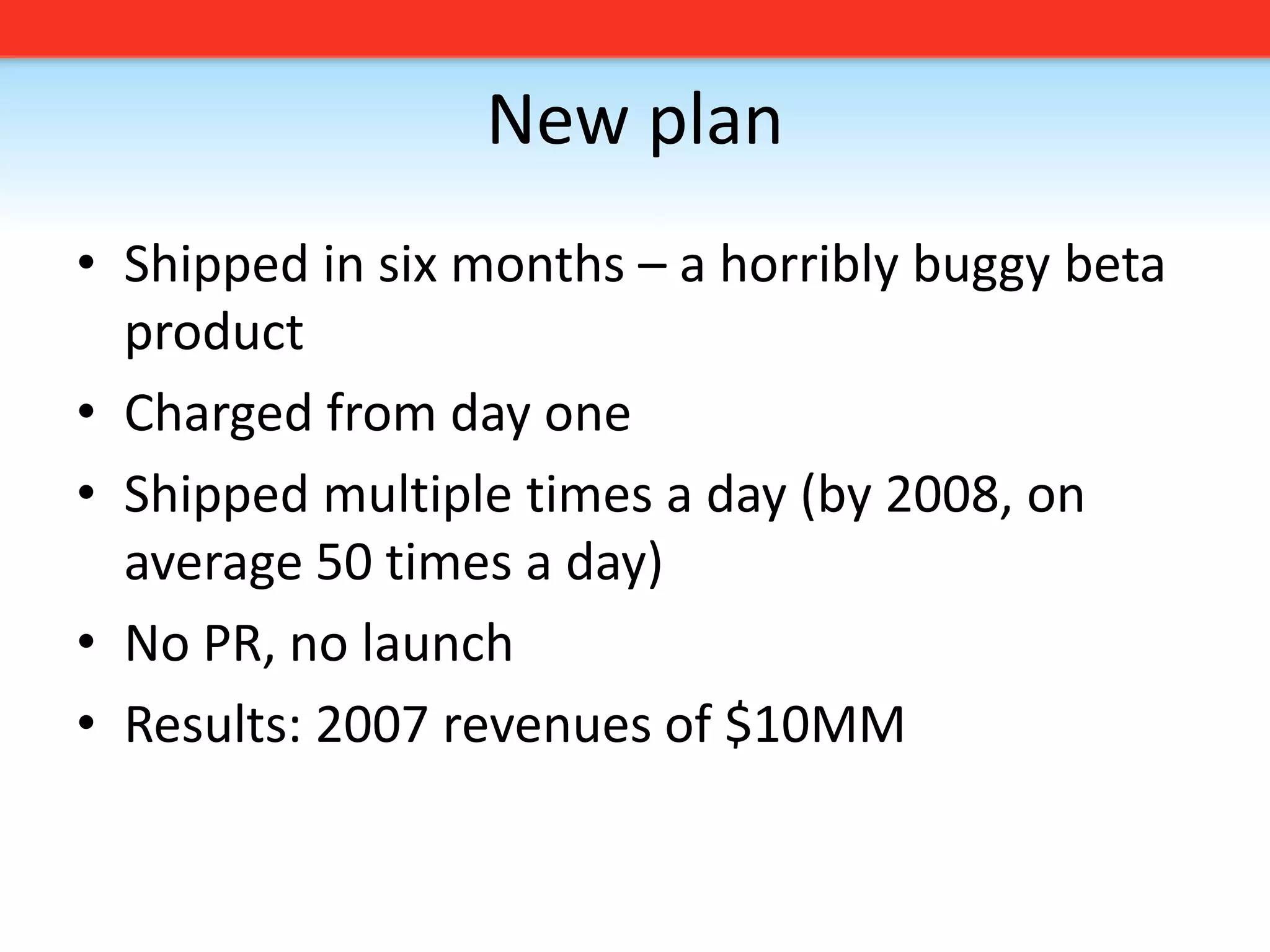
New planShipped in six months – a horribly buggy beta productCharged from day oneShipped multiple times a day (by 2008, on average 50 times a day)No PR, no launchResults: 2007 revenues of $10MM
Lean Startups Go FasterCommodity technology stack, highly leveraged (free/open source, user-generated content, SEM).Customer development – find out what customers want before you build it. Agile (lean) product development – but tuned to the startup condition.
Commodity technology stackLeverage = for each ounce of effort you invest in your product, you take advantage of the efforts of thousands or millions of others.It’s easy to see how high-leverage technology is driving costs down.More important is its impact on speed.Time to bring a new product to market is falling rapidly.
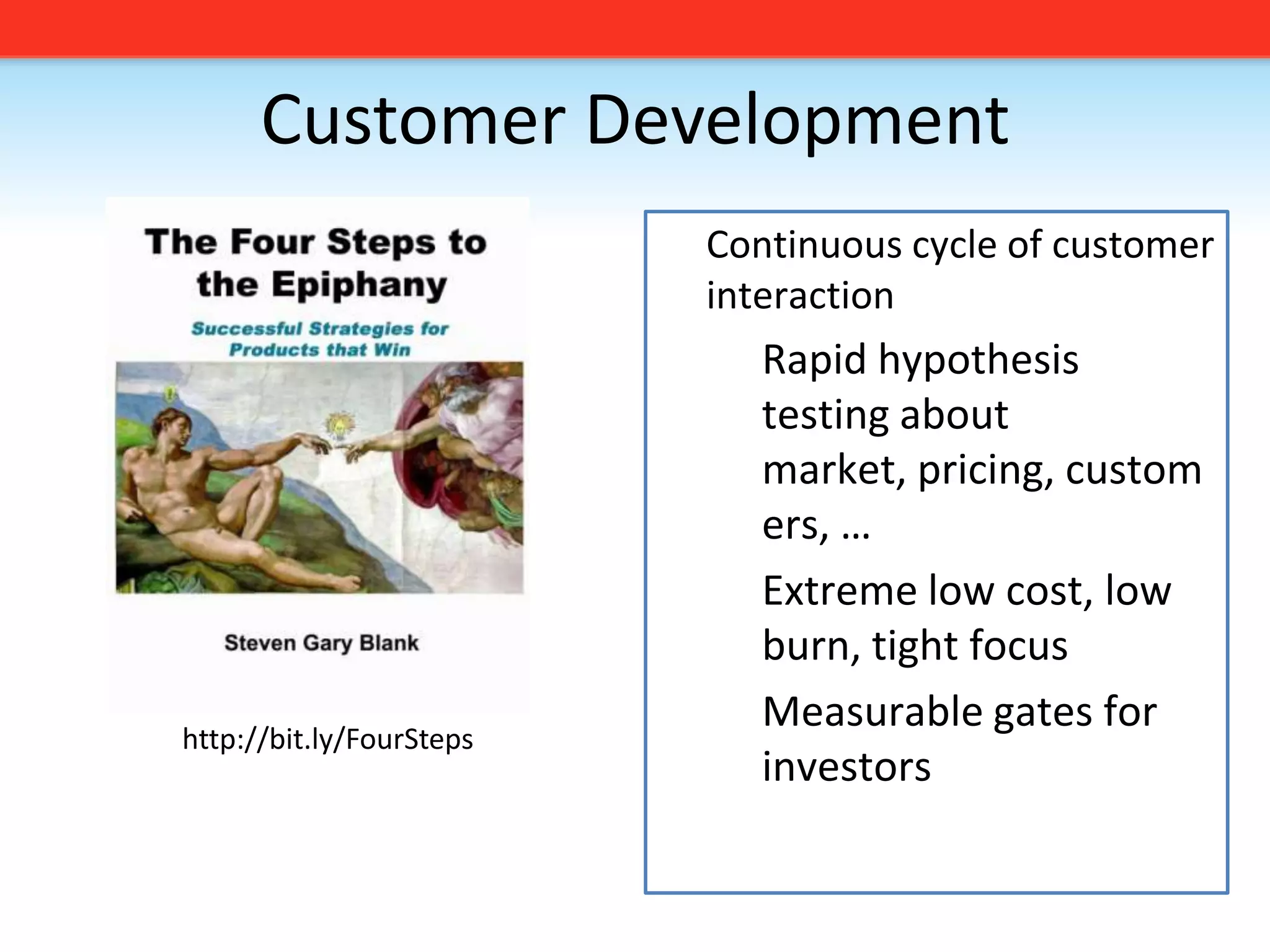
Customer DevelopmentContinuous cycle of customer interaction
Rapid hypothesis testing about market, pricing, customers, …
Extreme low cost, low burn, tight focus
Measurable gates for investorshttp://bit.ly/FourSteps
Agile Product Development(A tale of two startups, revisited)Principles drawn from Lean Manufacturing and Toyota Production System
These examples are drawn from software startups, but increasingly:
All products require software
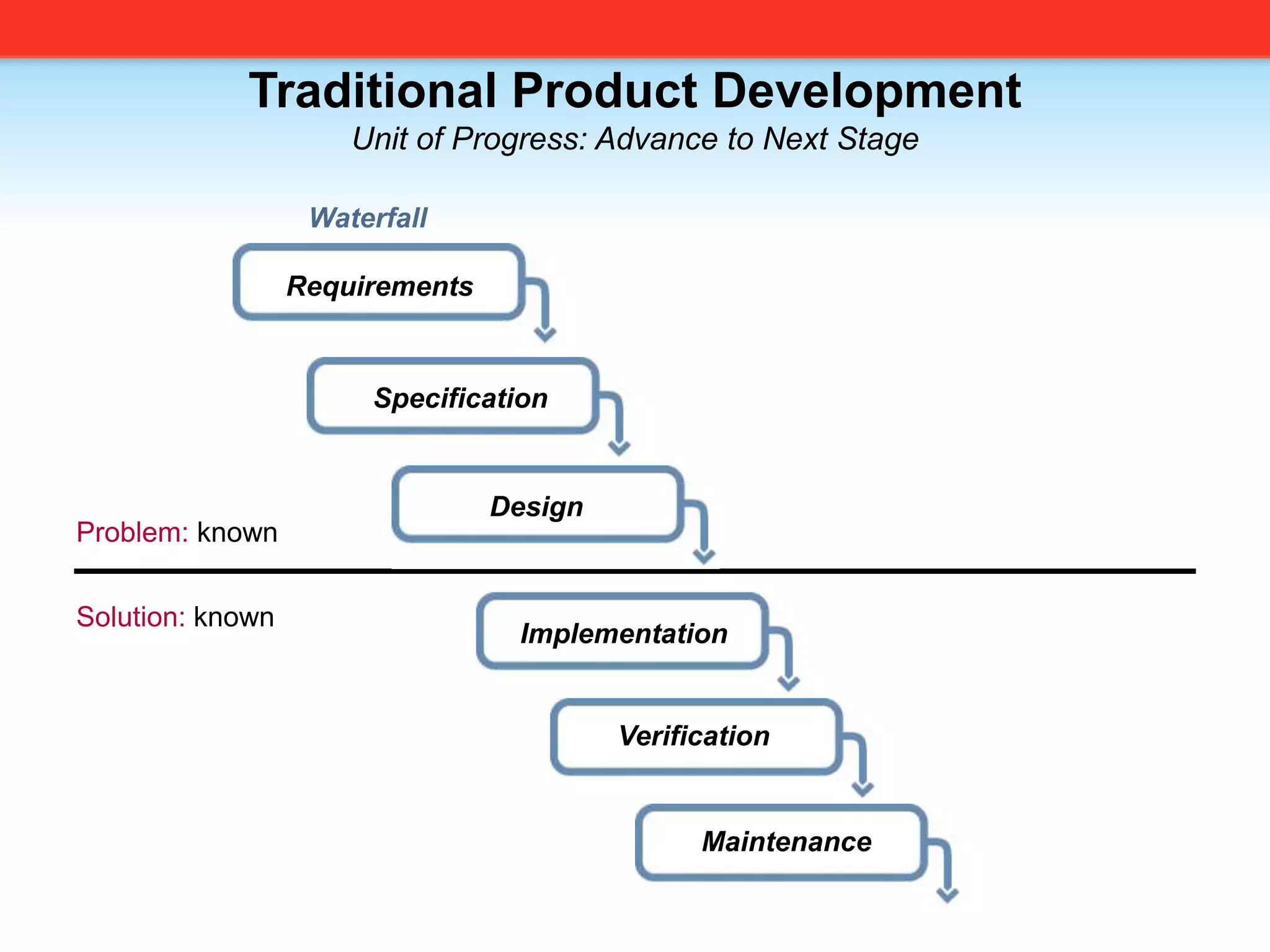
All companies are operating in a startup-like environment of extreme uncertaintyTraditional Product DevelopmentUnit of Progress: Advance to Next StageWaterfallRequirementsSpecificationDesignProblem: knownSolution: knownImplementationVerificationMaintenance
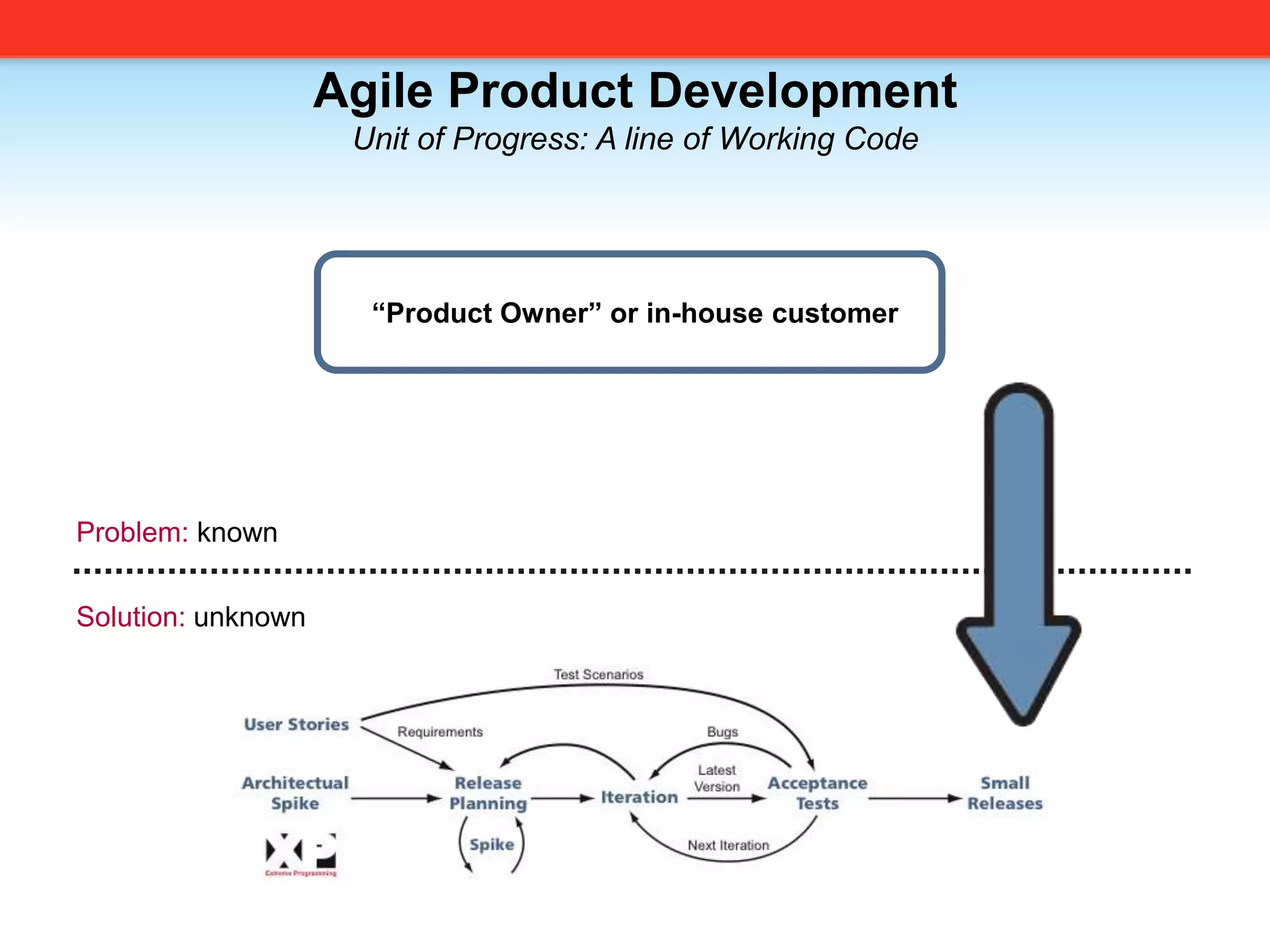
Agile Product DevelopmentUnit of Progress: A line of Working Code“Product Owner” or in-house customerProblem: knownSolution: unknown
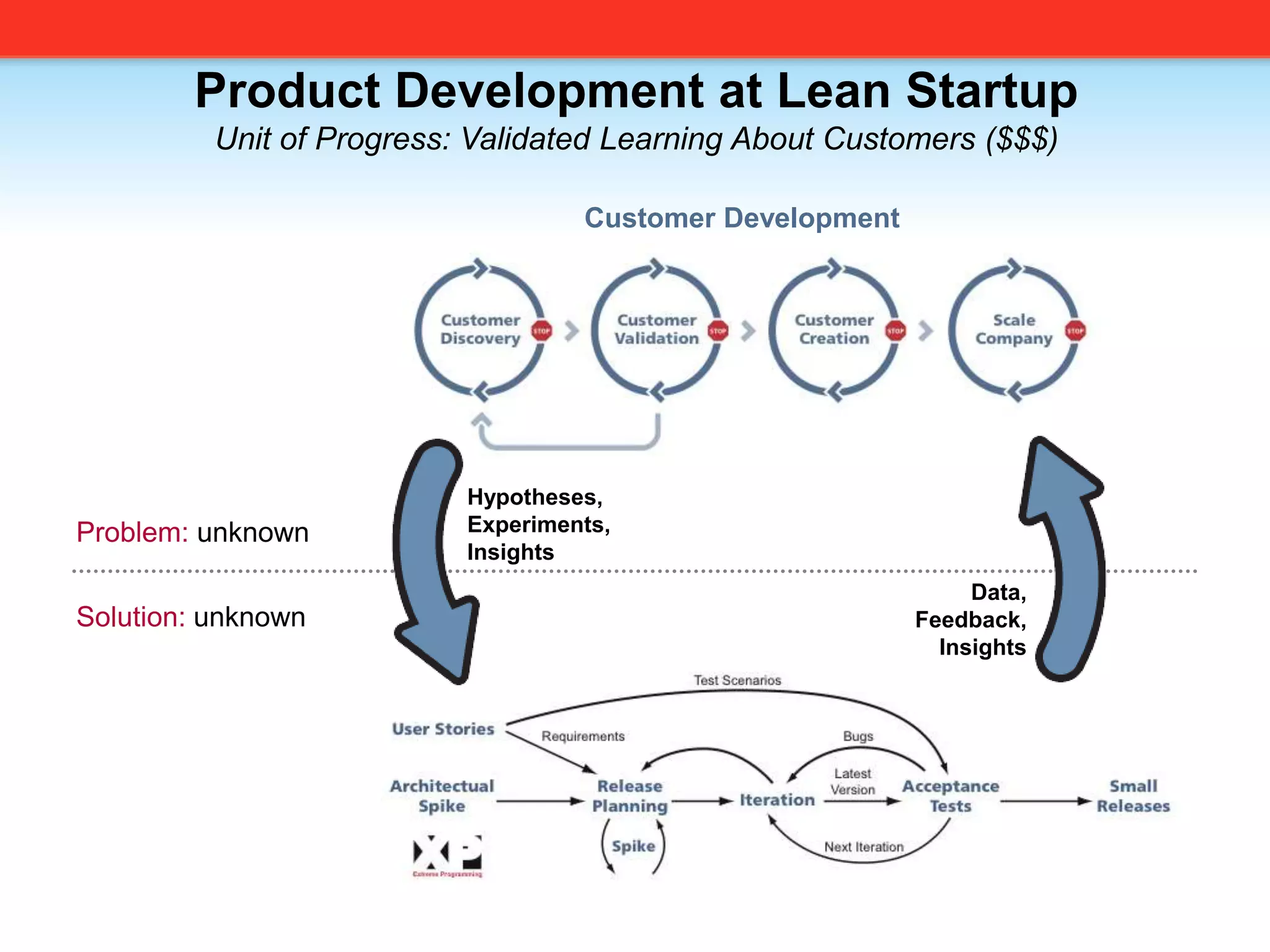
Product Development at Lean StartupUnit of Progress: Validated Learning About Customers ($$$)Customer DevelopmentHypotheses,Experiments,InsightsProblem: unknownData,Feedback,InsightsSolution: unknown
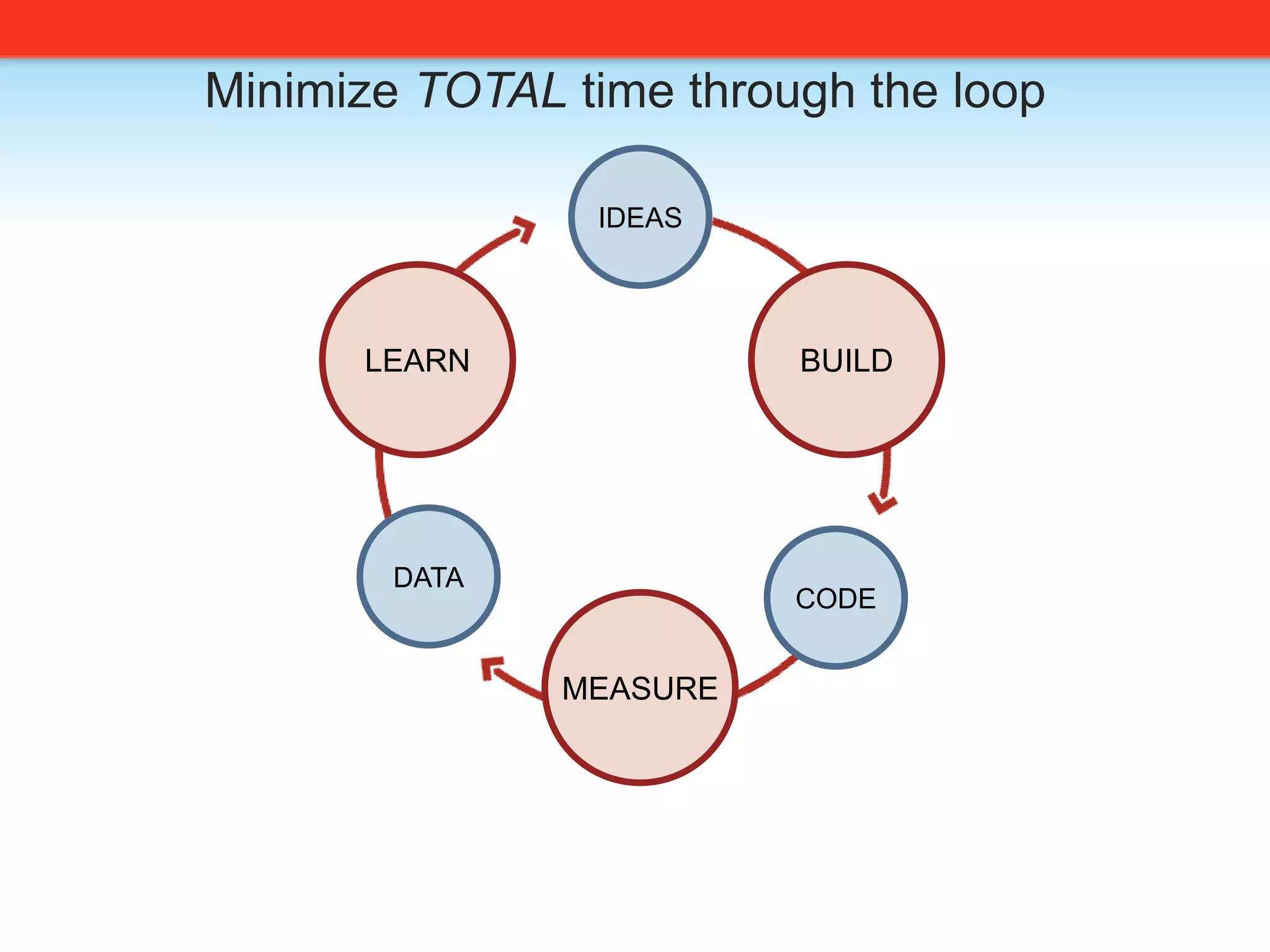
Minimize TOTAL time through the loopIDEASLEARNBUILDDATACODEMEASURE
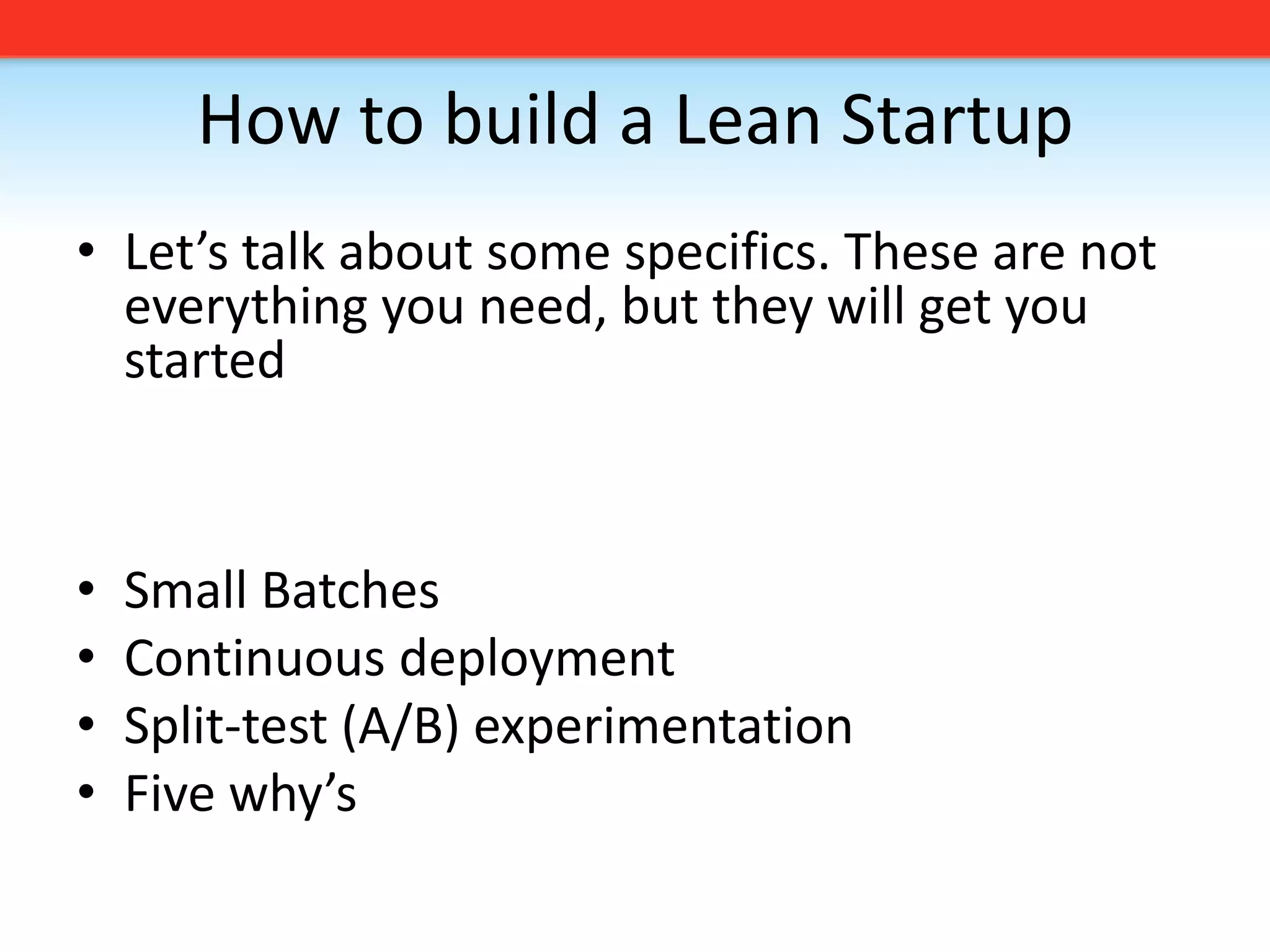
How to build a Lean StartupLet’s talk about some specifics. These are not everything you need, but they will get you startedSmall BatchesContinuous deploymentSplit-test (A/B) experimentationFive why’s
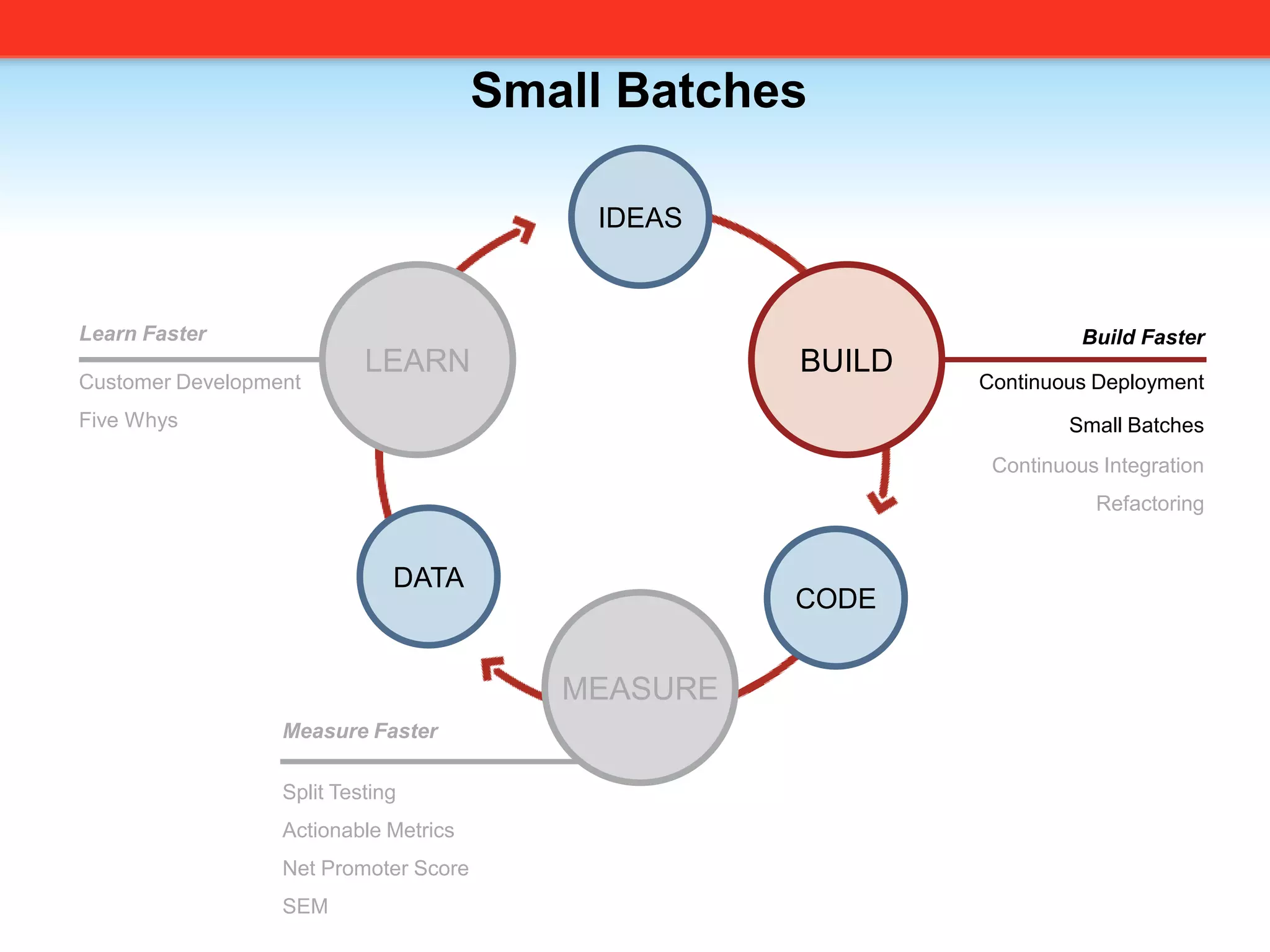
Small BatchesIDEASLEARNBUILDLearn FasterCustomer DevelopmentFive WhysBuild FasterContinuous DeploymentSmall BatchesContinuous IntegrationRefactoringDATACODEMEASUREMeasure FasterSplit TestingActionable MetricsNet Promoter ScoreSEM
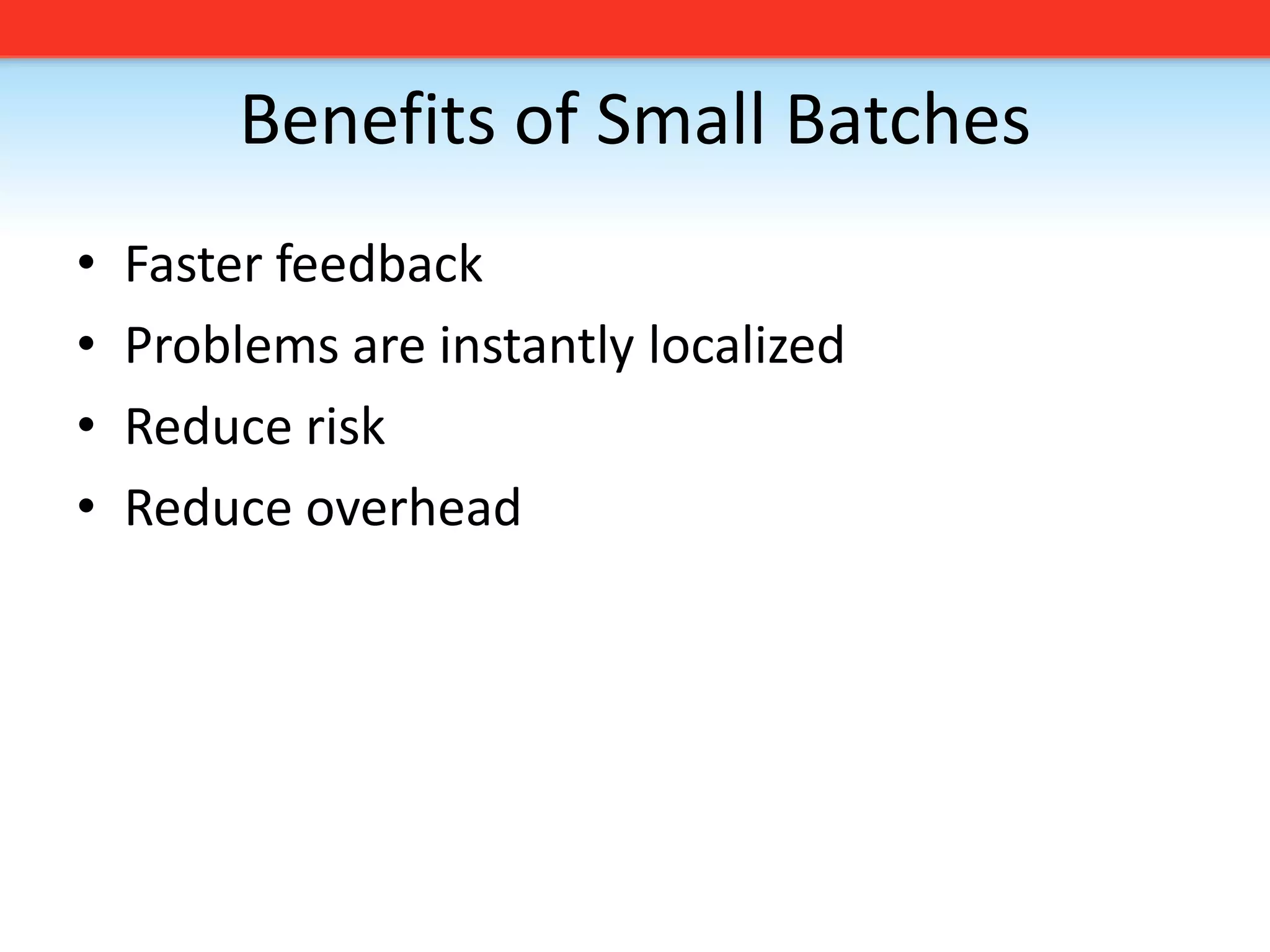
Benefits of Small BatchesFaster feedbackProblems are instantly localizedReduce riskReduce overhead
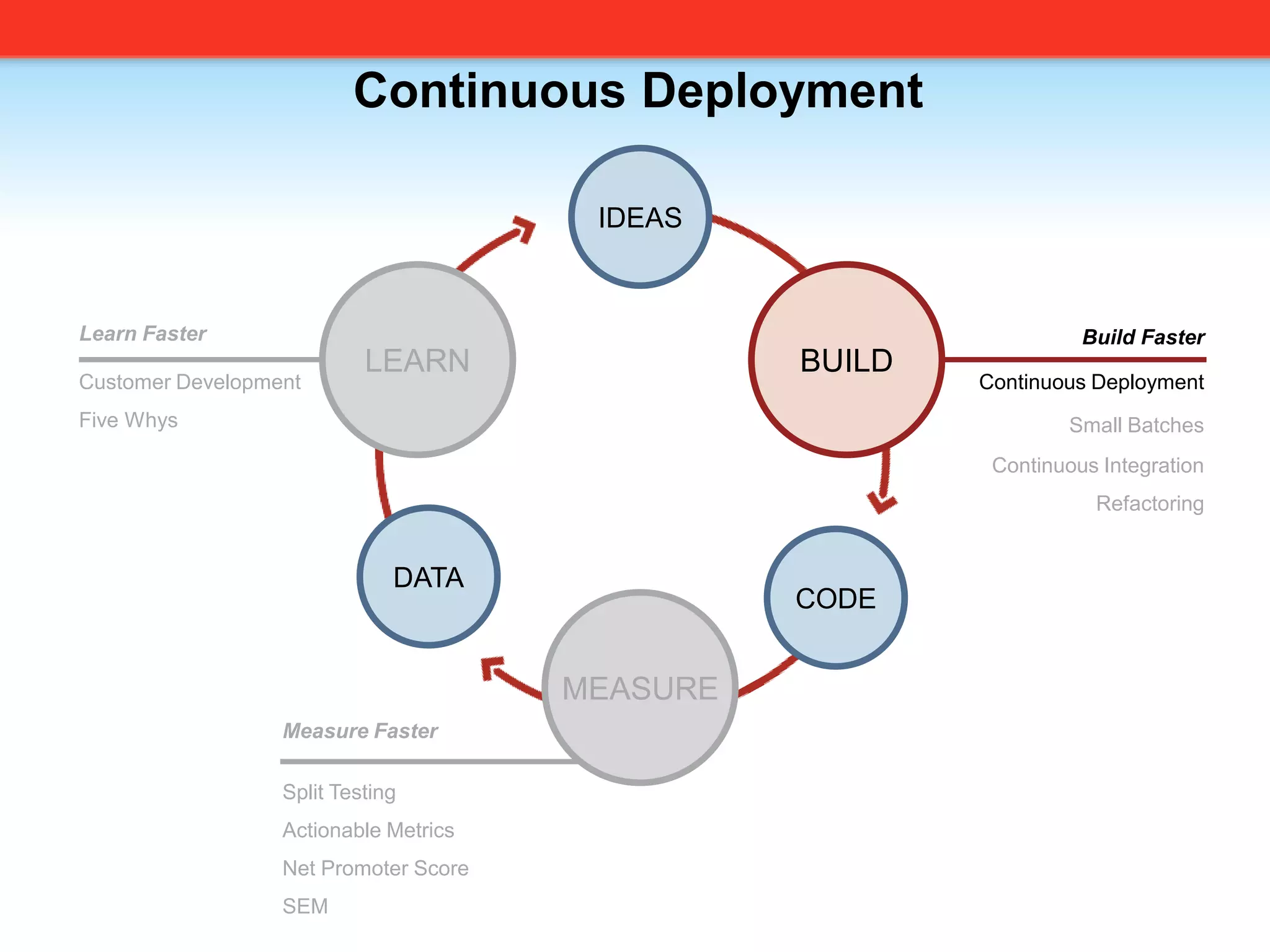
Continuous DeploymentIDEASLEARNBUILDLearn FasterCustomer DevelopmentFive WhysBuild FasterContinuous DeploymentSmall BatchesContinuous IntegrationRefactoringDATACODEMEASUREMeasure FasterSplit TestingActionable MetricsNet Promoter ScoreSEM
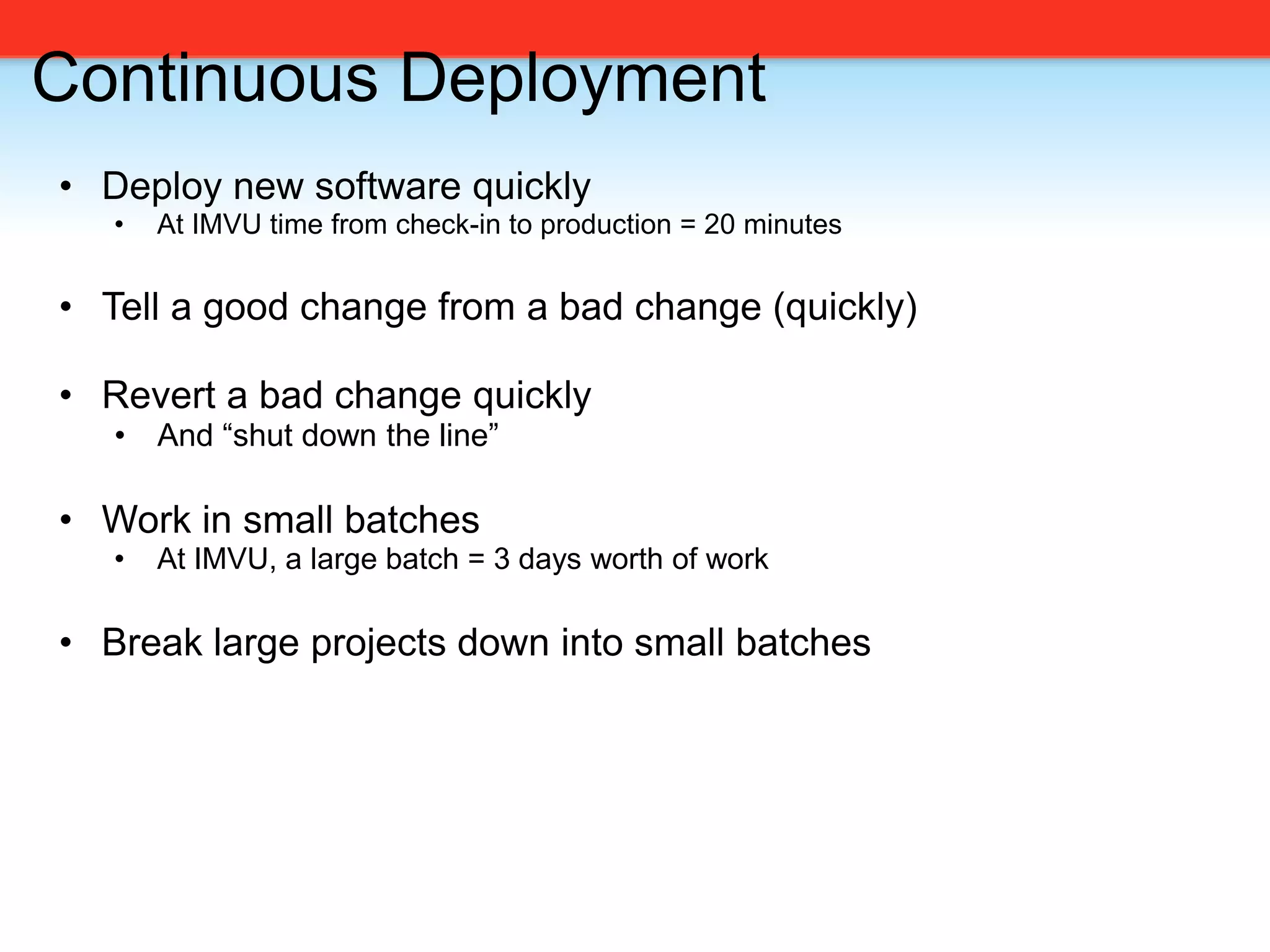
Continuous DeploymentDeploy new software quickly
At IMVU time from check-in to production = 20 minutes
Tell a good change from a bad change (quickly)
Revert a bad change quickly
And “shut down the line”
Work in small batches

The Lean Startup fbFund Edition

  • 1.
    The Lean Startup#leanstartupEricRies (@ericries)http://StartupLessonsLearned.blogspot.com
  • 2.
  • 3.
  • 4.
  • 5.
    Most Startups FailButit doesn’t have to be that way. We can do better. This talk is about how.
  • 6.
    What is astartup?A startup is a human institution designed to deliver a new product or service under conditions of extreme uncertainty. Nothing to do with size of company, sector of the economy, or industry
  • 7.
    A Tale ofTwo Startups
  • 8.
  • 9.
    A good plan?Starta company with a compelling long-term vision. Raise plenty of capital.Hire the absolute best and the brightest.Hire an experienced management team with tons of startup experience.Focus on quality. Build a world-class technology platform.Build buzz in the press and blogosphere.
  • 10.
    Achieving FailureCompany failedutterly, $40MM and five years of pain.Crippled by “shadow beliefs” that destroyed the effort of all those smart people.
  • 11.
    Shadow Belief #1Weknow what customers want.
  • 12.
    Shadow Belief #2Wecan accurately predict the future.
  • 13.
    Shadow Belief #3Advancingthe plan is progress.
  • 14.
    A good plan?Starta company with a compelling long-term vision. Raise plenty of capital.Hire the absolute best and the brightest.Hire an experienced management team with tons of startup experience.Focus on quality. Build a world-class technology platform.Build buzz in the press and blogosphere.
  • 15.
  • 16.
  • 17.
  • 18.
    New planShipped insix months – a horribly buggy beta productCharged from day oneShipped multiple times a day (by 2008, on average 50 times a day)No PR, no launchResults: 2007 revenues of $10MM
  • 19.
    Lean Startups GoFasterCommodity technology stack, highly leveraged (free/open source, user-generated content, SEM).Customer development – find out what customers want before you build it. Agile (lean) product development – but tuned to the startup condition.
  • 20.
    Commodity technology stackLeverage= for each ounce of effort you invest in your product, you take advantage of the efforts of thousands or millions of others.It’s easy to see how high-leverage technology is driving costs down.More important is its impact on speed.Time to bring a new product to market is falling rapidly.
  • 21.
  • 22.
    Rapid hypothesis testingabout market, pricing, customers, …
  • 23.
    Extreme low cost,low burn, tight focus
  • 24.
    Measurable gates forinvestorshttp://bit.ly/FourSteps
  • 25.
    Agile Product Development(Atale of two startups, revisited)Principles drawn from Lean Manufacturing and Toyota Production System
  • 26.
    These examples aredrawn from software startups, but increasingly:
  • 27.
  • 28.
    All companies areoperating in a startup-like environment of extreme uncertaintyTraditional Product DevelopmentUnit of Progress: Advance to Next StageWaterfallRequirementsSpecificationDesignProblem: knownSolution: knownImplementationVerificationMaintenance
  • 29.
    Agile Product DevelopmentUnitof Progress: A line of Working Code“Product Owner” or in-house customerProblem: knownSolution: unknown
  • 30.
    Product Development atLean StartupUnit of Progress: Validated Learning About Customers ($$$)Customer DevelopmentHypotheses,Experiments,InsightsProblem: unknownData,Feedback,InsightsSolution: unknown
  • 31.
    Minimize TOTAL timethrough the loopIDEASLEARNBUILDDATACODEMEASURE
  • 32.
    How to builda Lean StartupLet’s talk about some specifics. These are not everything you need, but they will get you startedSmall BatchesContinuous deploymentSplit-test (A/B) experimentationFive why’s
  • 33.
    Small BatchesIDEASLEARNBUILDLearn FasterCustomerDevelopmentFive WhysBuild FasterContinuous DeploymentSmall BatchesContinuous IntegrationRefactoringDATACODEMEASUREMeasure FasterSplit TestingActionable MetricsNet Promoter ScoreSEM
  • 34.
    Benefits of SmallBatchesFaster feedbackProblems are instantly localizedReduce riskReduce overhead
  • 35.
    Continuous DeploymentIDEASLEARNBUILDLearn FasterCustomerDevelopmentFive WhysBuild FasterContinuous DeploymentSmall BatchesContinuous IntegrationRefactoringDATACODEMEASUREMeasure FasterSplit TestingActionable MetricsNet Promoter ScoreSEM
  • 36.
  • 37.
    At IMVU timefrom check-in to production = 20 minutes
  • 38.
    Tell a goodchange from a bad change (quickly)
  • 39.
    Revert a badchange quickly
  • 40.
    And “shut downthe line”
  • 41.
  • 42.
    At IMVU, alarge batch = 3 days worth of work
  • 43.
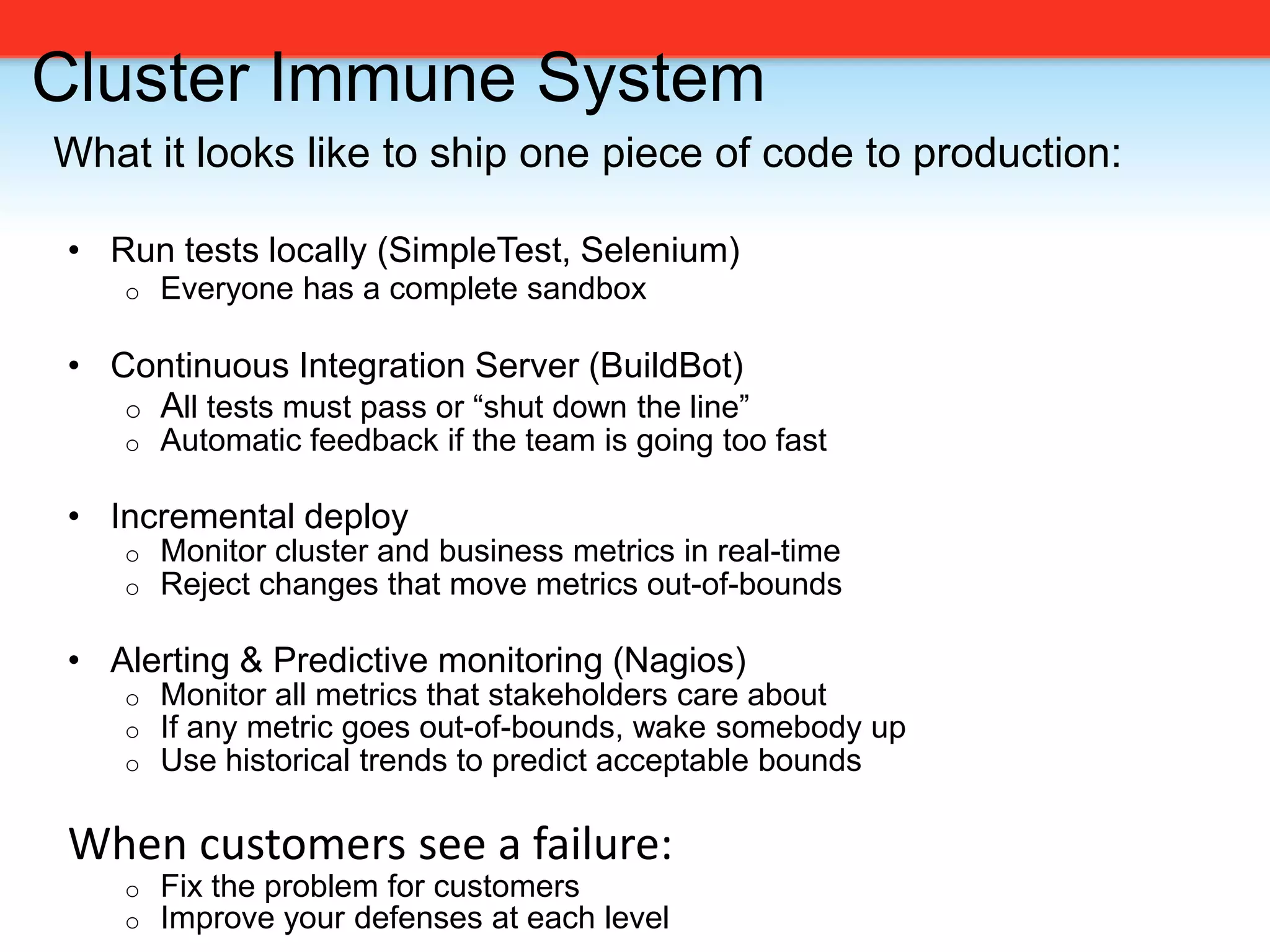
    Break large projectsdown into small batchesCluster Immune SystemWhat it looks like to ship one piece of code to production:Run tests locally (SimpleTest, Selenium)
  • 44.
    Everyone has acomplete sandbox
  • 45.
  • 46.
    All tests mustpass or “shut down the line”
  • 47.
    Automatic feedback ifthe team is going too fast
  • 48.
  • 49.
    Monitor cluster andbusiness metrics in real-time
  • 50.
    Reject changes thatmove metrics out-of-bounds
  • 51.
    Alerting & Predictivemonitoring (Nagios)
  • 52.
    Monitor all metricsthat stakeholders care about
  • 53.
    If any metricgoes out-of-bounds, wake somebody up
  • 54.
    Use historical trendsto predict acceptable boundsWhen customers see a failure:Fix the problem for customers
  • 55.
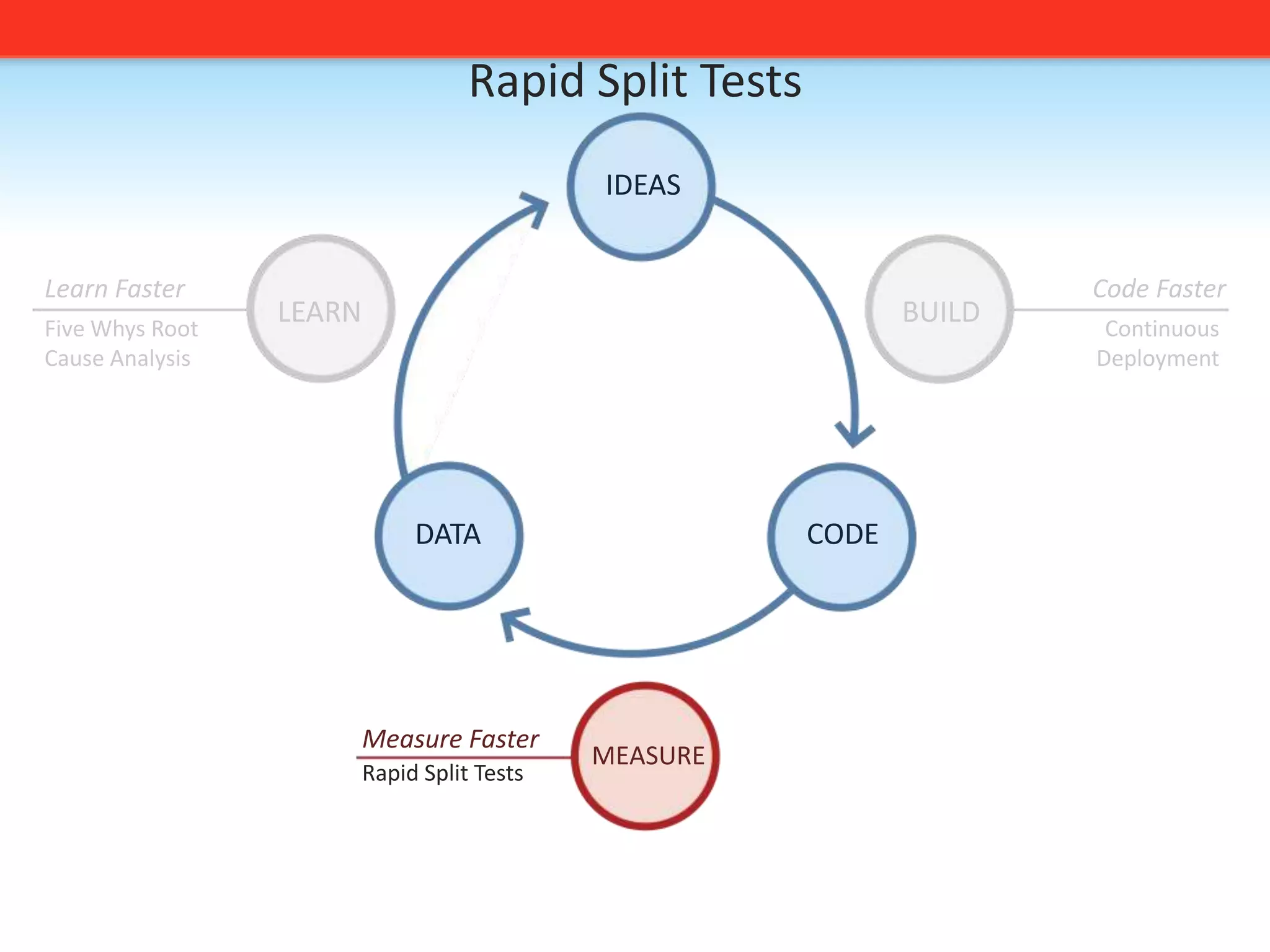
    Improve your defensesat each levelRapid Split TestsIDEASCode FasterLearn FasterBUILDLEARNContinuousDeploymentFive Whys RootCause AnalysisCODEDATAMeasure FasterMEASURERapid Split Tests
  • 56.
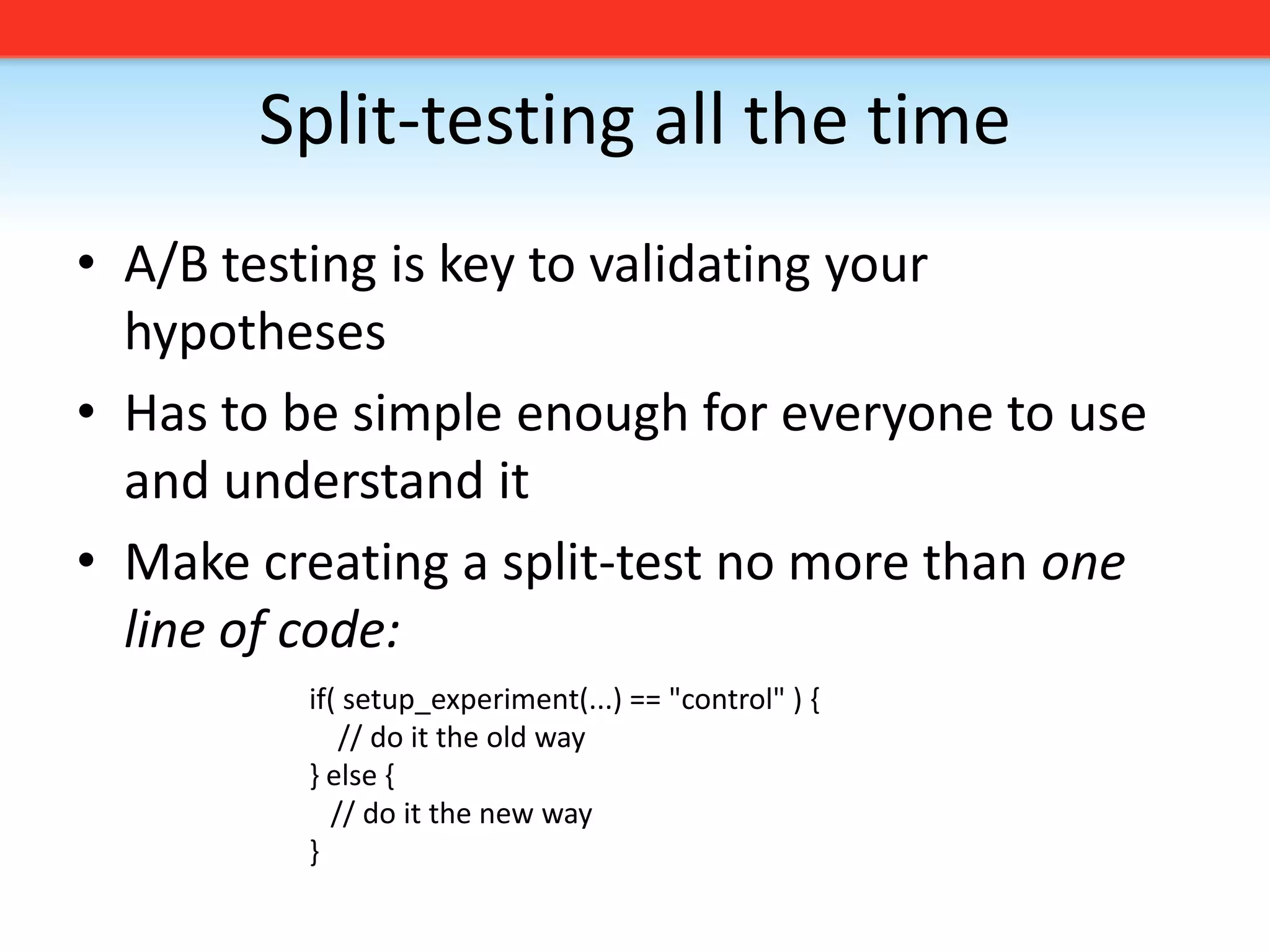
    Split-testing all thetimeA/B testing is key to validating your hypothesesHas to be simple enough for everyone to use and understand itMake creating a split-test no more than one line of code:if( setup_experiment(...) == "control" ) { // do it the old way} else { // do it the new way}
  • 57.
    The AAA’s ofMetricsActionableAccessibleAuditable
  • 58.
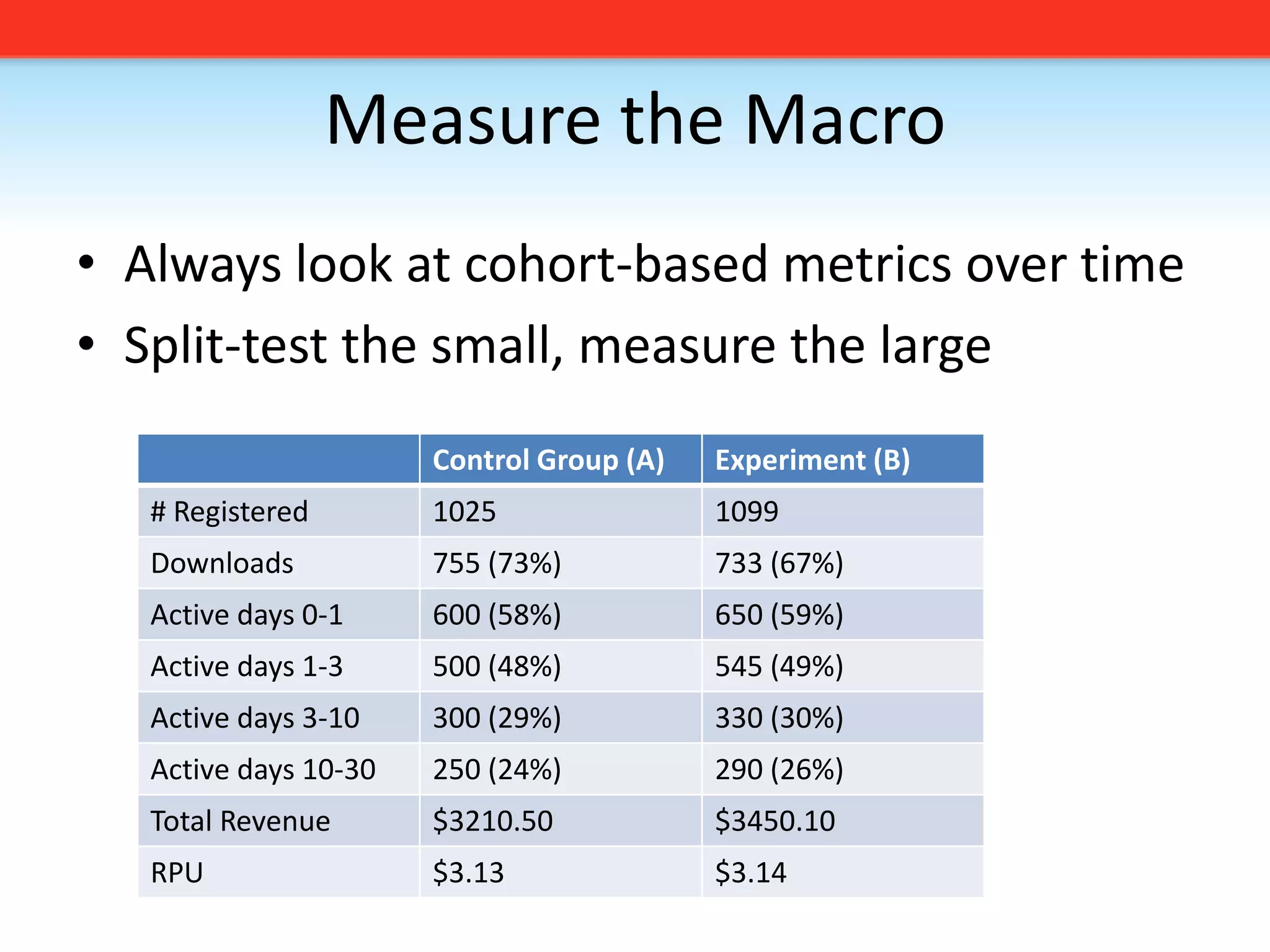
    Measure the MacroAlwayslook at cohort-based metrics over timeSplit-test the small, measure the large
  • 59.
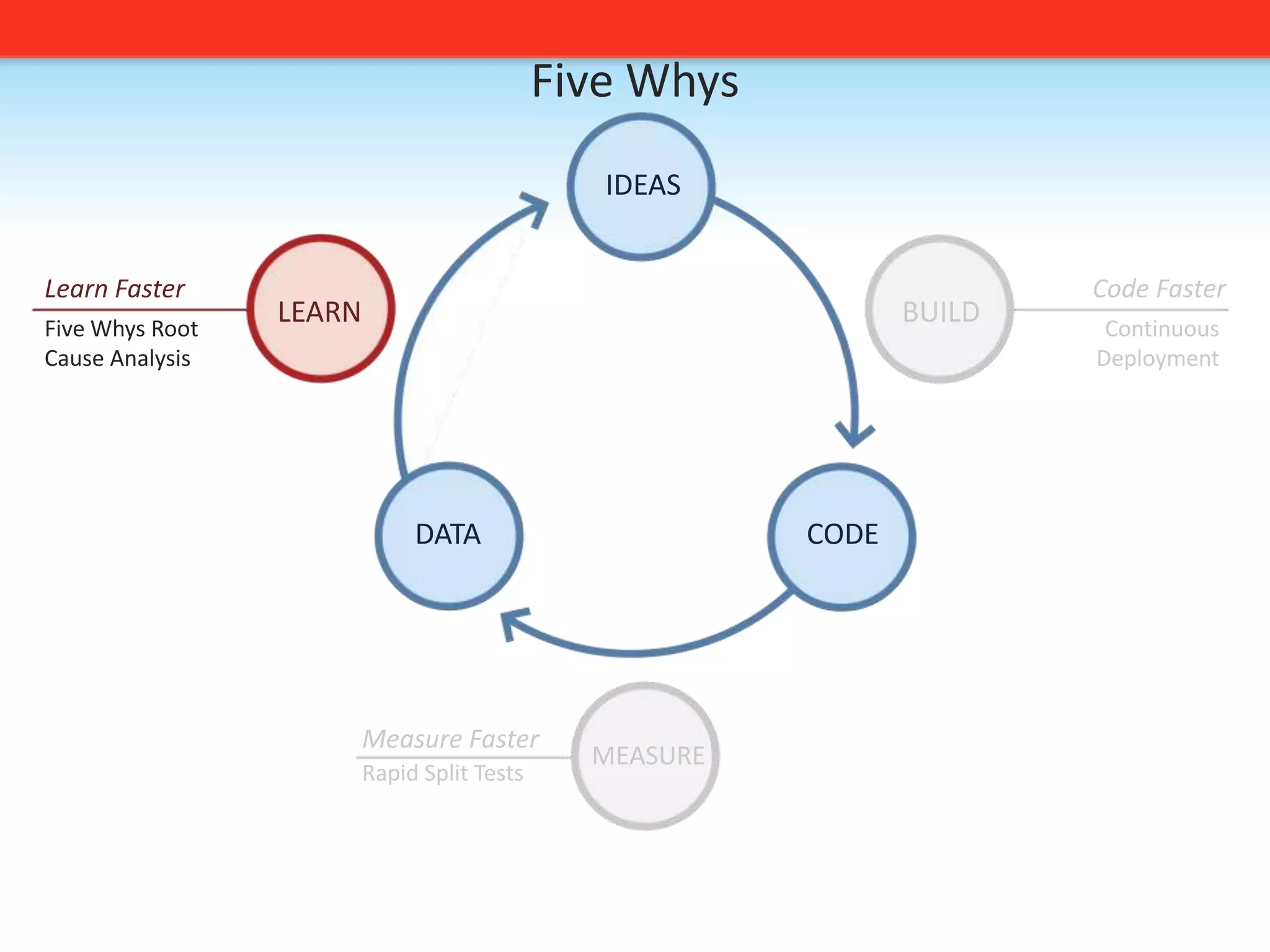
    Five WhysIDEASCode FasterLearnFasterBUILDLEARNContinuousDeploymentFive Whys RootCause AnalysisCODEDATAMeasure FasterMEASURERapid Split Tests
  • 60.
    Five Whys RootCause AnalysisA technique for continuous improvement of company process.
  • 61.
    Ask “why” fivetimes when something unexpected happens.
  • 62.
    Make proportional investmentsin prevention at all five levels of the hierarchy.
  • 63.
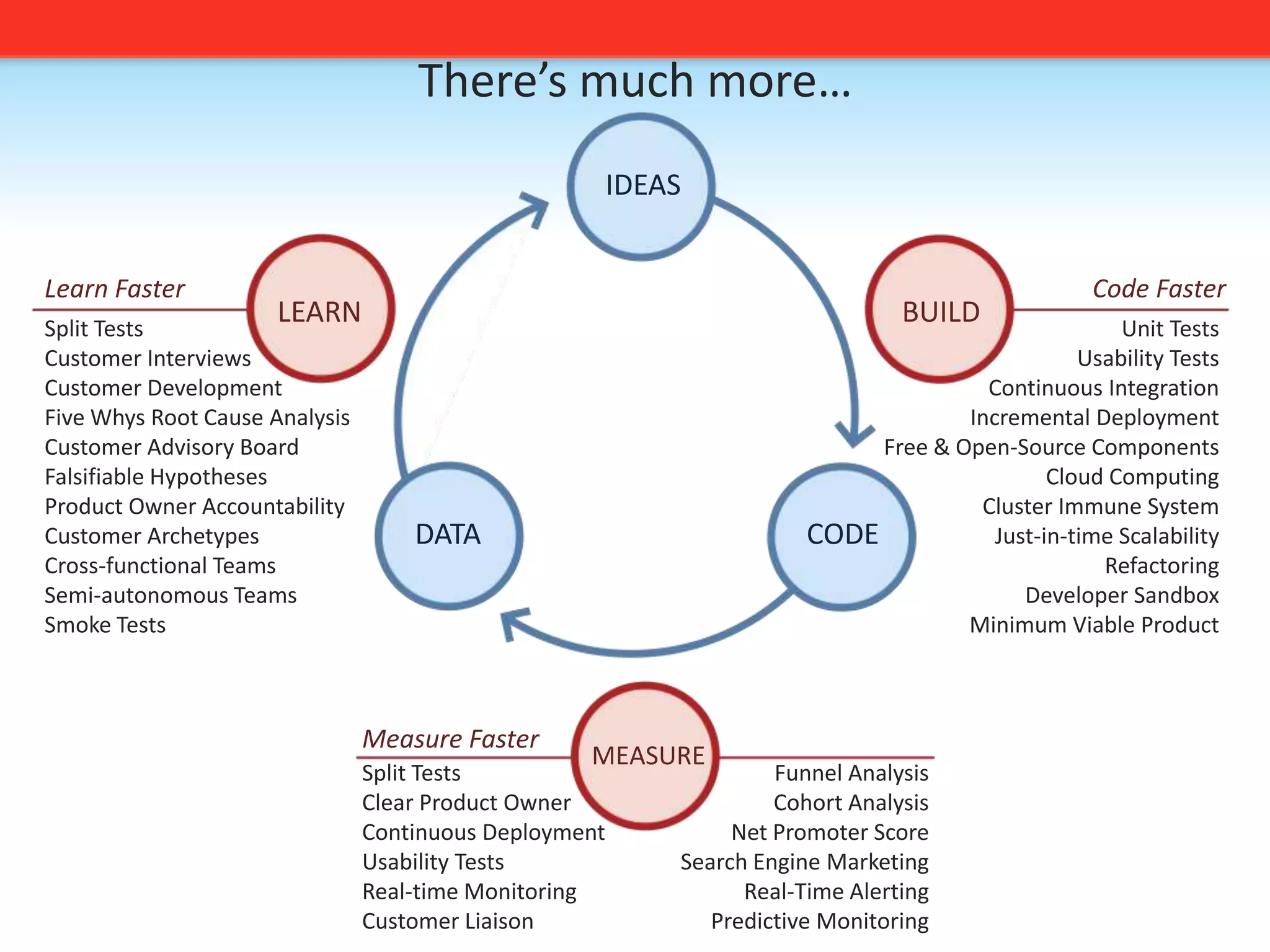
    Behind every supposedtechnical problem is usually a human problem. Fix the cause, not just the symptom.There’s much more…IDEASCode FasterLearn FasterBUILDLEARNUnit TestsUsability TestsContinuous IntegrationIncremental DeploymentFree & Open-Source ComponentsCloud ComputingCluster Immune SystemJust-in-time ScalabilityRefactoringDeveloper SandboxMinimum Viable ProductSplit TestsCustomer InterviewsCustomer DevelopmentFive Whys Root Cause AnalysisCustomer Advisory BoardFalsifiable HypothesesProduct Owner AccountabilityCustomer ArchetypesCross-functional TeamsSemi-autonomous TeamsSmoke TestsCODEDATAMeasure FasterMEASURESplit TestsClear Product OwnerContinuous DeploymentUsability TestsReal-time MonitoringCustomer LiaisonFunnel AnalysisCohort AnalysisNet Promoter ScoreSearch Engine MarketingReal-Time AlertingPredictive Monitoring
  • 64.
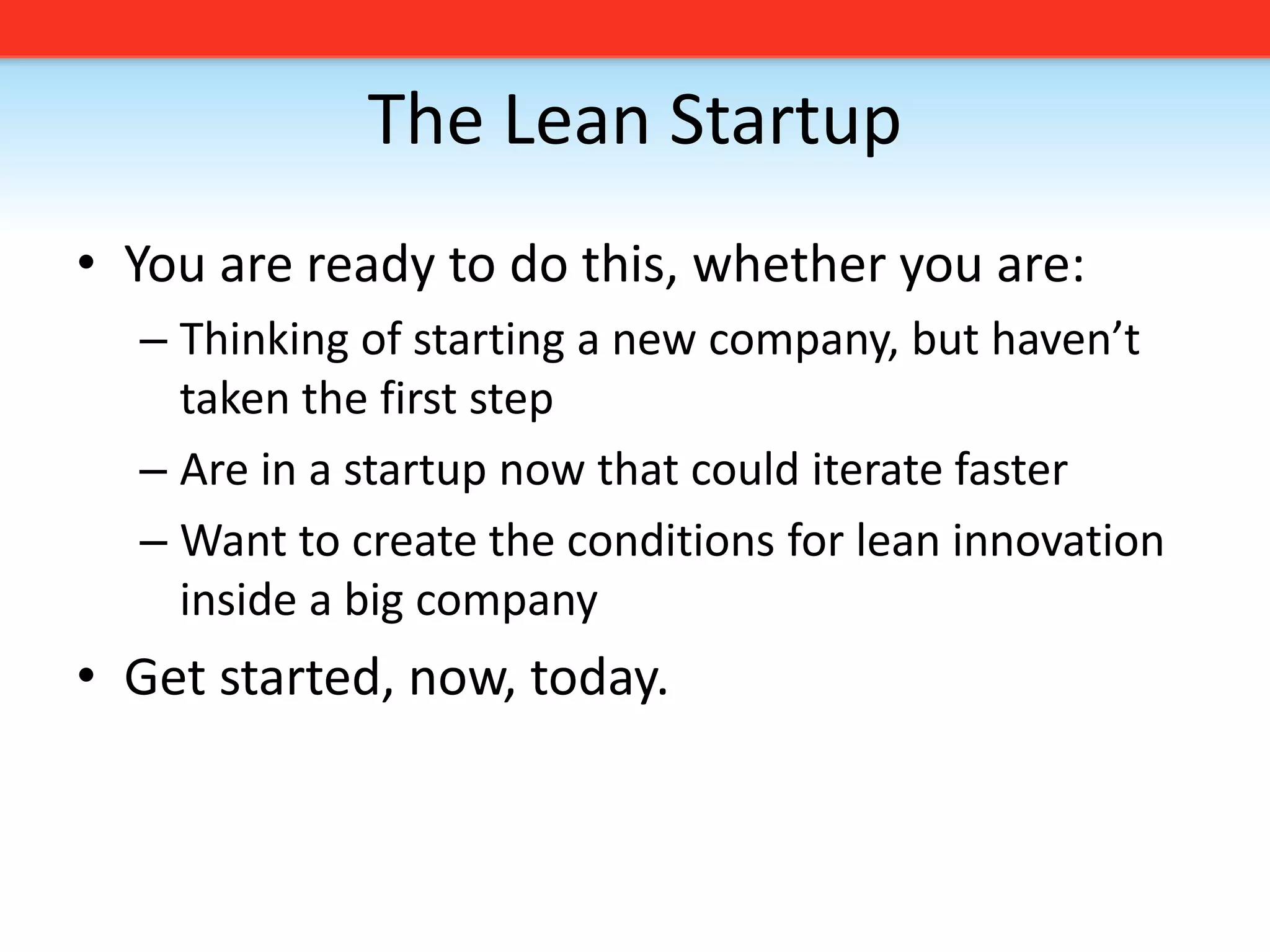
    The Lean StartupYouare ready to do this, whether you are:Thinking of starting a new company, but haven’t taken the first stepAre in a startup now that could iterate fasterWant to create the conditions for lean innovation inside a big companyGet started, now, today.
  • 65.
  • 66.
  • 67.
    Getting in touch(#leanstartup)
  • 68.
  • 69.
  • 70.
  • 71.
    October 30, 2009in San Francisco
  • 72.
  • 73.