INTRODUCTION
• Hybridization Crossingbetween two genetically dissimilar parent is called
hybridization
• Hybridization between individuals from different species belonging to the same
genus or two different genera, is termed as distant hybridization or wide
hybridization, and such crosses are known as distant crosses or wide crosses
• This is because individuals used for hybridization in such cases are more distantly
related.
3.
History of distanthybridization
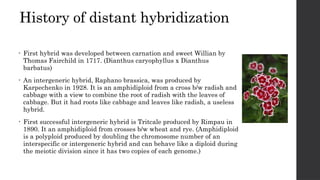
• First hybrid was developed between carnation and sweet Willian by
Thomas Fairchild in 1717. (Dianthus caryophyllus x Dianthus
barbatus)
• An intergeneric hybrid, Raphano brassica, was produced by
Karpechenko in 1928. It is an amphidiploid from a cross b/w radish and
cabbage with a view to combine the root of radish with the leaves of
cabbage. But it had roots like cabbage and leaves like radish, a useless
hybrid.
• First successful intergeneric hybrid is Tritcale produced by Rimpau in
1890. It an amphidiploid from crosses b/w wheat and rye. (Amphidiploid
is a polyploid produced by doubling the chromosome number of an
interspecific or intergeneric hybrid and can behave like a diploid during
the meiotic division since it has two copies of each genome.)
4.
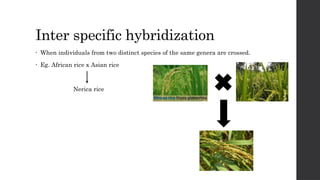
Inter specific hybridization
•When individuals from two distinct species of the same genera are crossed.
• Eg. African rice x Asian rice
Nerica rice
5.
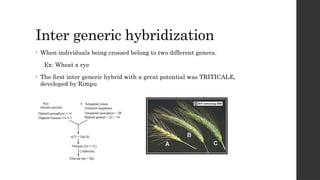
Inter generic hybridization
•When individuals being crossed belong to two different genera.
Ex: Wheat x rye
• The first inter generic hybrid with a great potential was TRITICALE,
developed by Rimpu
6.
Objective
• To transfersome desirable character from wild relatives those are not available in cultivated
varieties.
Eg. Many disease resistance and, insect resistance genes
• Wide adaptability: (i.e. drought-resistance, cold tolerance etc.)
• Quality improvement (Eg. fibre quality in Cotton)
• Yield improvement (Eg. Oats, Tobacco, Maize, Sugarcane)
• Other characters (Eg. CMS, Earliness, dwarfness, morphological characters)
• Creation of Novel genotypes: New species or F1 hybrids not existing in nature.
7.
BARRIERS TO THEPRODUCTION
OF DISTANT HYBRIDS
• Cross Incompatibility
• Hybrid Inviability
• Hybrid Sterility
8.
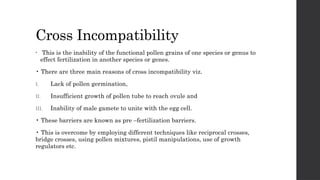
Cross Incompatibility
• Thisis the inability of the functional pollen grains of one species or genus to
effect fertilization in another species or genes.
• There are three main reasons of cross incompatibility viz.
I. Lack of pollen germination,
II. Insufficient growth of pollen tube to reach ovule and
III. Inability of male gamete to unite with the egg cell.
• These barriers are known as pre –fertilization barriers.
• This is overcome by employing different techniques like reciprocal crosses,
bridge crosses, using pollen mixtures, pistil manipulations, use of growth
regulators etc.
9.
Examples
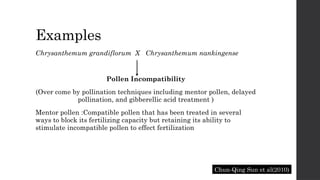
Chrysanthemum grandiflorum XChrysanthemum nankingense
Pollen Incompatibility
(Over come by pollination techniques including mentor pollen, delayed
pollination, and gibberellic acid treatment )
Mentor pollen :Compatible pollen that has been treated in several
ways to block its fertilizing capacity but retaining its ability to
stimulate incompatible pollen to effect fertilization
Chun-Qing Sun et al(2010)
10.
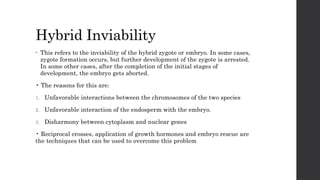
Hybrid Inviability
• Thisrefers to the inviability of the hybrid zygote or embryo. In some cases,
zygote formation occurs, but further development of the zygote is arrested.
In some other cases, after the completion of the initial stages of
development, the embryo gets aborted.
• The reasons for this are:
1. Unfavorable interactions between the chromosomes of the two species
2. Unfavorable interaction of the endosperm with the embryo.
3. Disharmony between cytoplasm and nuclear genes
• Reciprocal crosses, application of growth hormones and embryo rescue are
the techniques that can be used to overcome this problem
11.
Examples
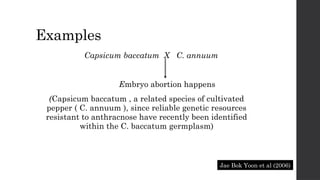
Capsicum baccatum XC. annuum
Embryo abortion happens
(Capsicum baccatum , a related species of cultivated
pepper ( C. annuum ), since reliable genetic resources
resistant to anthracnose have recently been identified
within the C. baccatum germplasm)
Jae Bok Yoon et al (2006)
12.
Hybrid Sterility
• Thisrefers to the inability of a hybrid to produce viable offspring. This is
more prominent in the case of intergeneric crosses. The major reason for
hybrid sterility is the lack of structural homology between the chromosomes
of the two species.
• This may lead to meiotic abnormalities like chromosome scattering,
chromosome extension, lagging of chromosome in the anaphase, formation of
anaphase bridge, development of chromosome rings and chains, and irregular
and unequal anaphase separations.
• These irregularities may lead to aberrations in chromosome structure. Lack
of homology between chromosomes may also lead to incomplete pairing of
chromosomes.
• Sterility caused by structural differences between the chromosomes of two
species can be overcome by amphidiploidization using colchicine.
13.
Examples
• African rice(Oryza glaberrima Steud), has many important traits, such as
tolerance to heat, drought, aluminum toxicity, and disease.
• Hybrids from crosses between species, such as between African and Asian
rice varieties, have stronger hybrid vigor and greater yield potential than
those within subspecies;
• these hybrids can also incorporate many important traits from the parents.
• However, such hybrids often show severe hybrid sterility (HS)
Yongyao Xie et al (2017)
14.
EMBRYO RESCUE
Embryo rescue:
• When embryos fails to develop due to endosperm degeneration, embryo
culture is used to recover hybrid plants; this is called hybrid rescue.
• e.g :- H. vulgare x Secale cereale.
• Embryo rescue generally used to overcome endosperm degeneration.
Embryo culture.
• A. Proembryo dissected 3 to 5 days after pollination
• B. Proembryo culture on solid agar media
• C. Plantlet developing from embryo
• D. Plantlet transplanted into soil.
16.
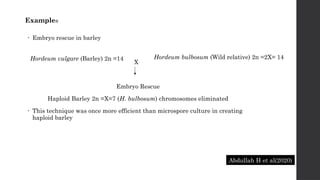
• Embryo rescuein barley
X
Embryo Rescue
Haploid Barley 2n =X=7 (H. bulbosum) chromosomes eliminated
• This technique was once more efficient than microspore culture in creating
haploid barley
Hordeum vulgare (Barley) 2n =14 Hordeum bulbosum (Wild relative) 2n =2X= 14
Examples
Abdullah H et al(2020)
17.
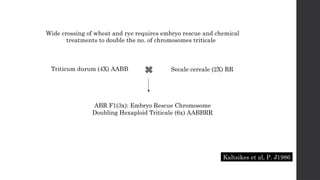
Wide crossing ofwheat and rye requires embryo rescue and chemical
treatments to double the no. of chromosomes triticale
Triticum durum (4X) AABB Secale cereale (2X) RR
ABR F1(3x): Embryo Rescue Chromosome
Doubling Hexaploid Triticale (6x) AABBRR
Kaltsikes et al, P. J1986
18.
Limitations of embryorescue
• High cost of obtaining new plantlets .
• Sometimes deleterious mutations may be induced during the in vitro phase.
• A sophisticated tissue culture laboratory and a dependable greenhouse are
essential for success.
• Specialized skill for carrying out the various operations are required.
19.
Applications of widehybridization in
crop improvement
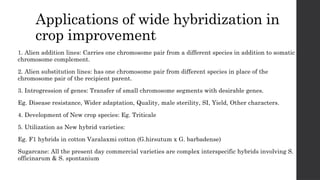
1. Alien addition lines: Carries one chromosome pair from a different species in addition to somatic
chromosome complement.
2. Alien substitution lines: has one chromosome pair from different species in place of the
chromosome pair of the recipient parent.
3. Introgression of genes: Transfer of small chromosome segments with desirable genes.
Eg. Disease resistance, Wider adaptation, Quality, male sterility, SI, Yield, Other characters.
4. Development of New crop species: Eg. Triticale
5. Utilization as New hybrid varieties:
Eg. F1 hybrids in cotton Varalaxmi cotton (G.hirsutum x G. barbadense)
Sugarcane: All the present day commercial varieties are complex interspecific hybrids involving S.
officinarum & S. spontanium
20.
Limitations of Distanthybridization
1. Incompatible crosses
2. F1 sterility
3. Problems in creating new species
4. Lack of homoeology between chromosome of the parental species
5. Undesirable linkages
6. Problems in the transfer of recessive oligogenes and quantitative traits
7. Lack of flowering in F1
8. Problems in using improved varieties in distant hybridization
9. Dormancy
21.
Achievements
A. Transfer ofspecific characters
• Distant hybridization has been the most commonly used for the transfer of
specific characters
• e.g., disease resistance from wild to cultivated species.
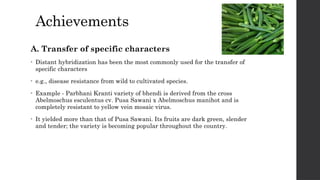
• Example - Parbhani Kranti variety of bhendi is derived from the cross
Abelmoschus esculentus cv. Pusa Sawani x Abelmoschus manihot and is
completely resistant to yellow vein mosaic virus.
• It yielded more than that of Pusa Sawani. Its fruits are dark green, slender
and tender; the variety is becoming popular throughout the country.
22.
B. Production ofcytoplasmic male
sterile lines.
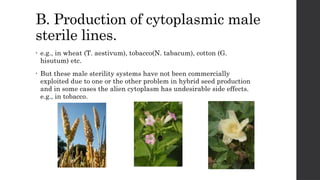
• e.g., in wheat (T. aestivum), tobacco(N. tabacum), cotton (G.
hisutum) etc.
• But these male sterility systems have not been commercially
exploited due to one or the other problem in hybrid seed production
and in some cases the alien cytoplasm has undesirable side effects.
e.g., in tobacco.
23.
• C. Distanthybridization has been employed for the
development of new crop varieties
• Sugarcane appears to be a special case where improvement is based on
distant hybridization involving S. officinarum (2n=80), S. spontaneum
(2n=40-218) and other sps. of Saccharum. These commercial varieties
are not only more resistant to diseases and pests in comparison to S.
officinarum, but are also more productive.
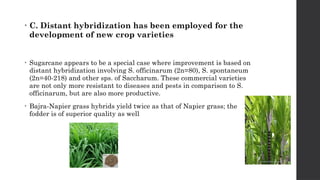
• Bajra-Napier grass hybrids yield twice as that of Napier grass; the
fodder is of superior quality as well
24.
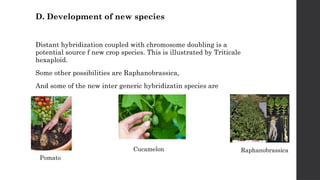
D. Development ofnew species
Distant hybridization coupled with chromosome doubling is a
potential source f new crop species. This is illustrated by Triticale
hexaploid.
Some other possibilities are Raphanobrassica,
And some of the new inter generic hybridizatin species are
Pomato
Cucamelon Raphanobrassica
25.
References
• Sun, C.Q., Huang, Z. Z., Wang, Y. L., Chen, F. D., Teng, N. J., Fang, W. M., & Liu, Z. L.
(2011). Overcoming pre-fertilization barriers in the wide cross between Chrysanthemum
grandiflorum (Ramat.) Kitamura and C. nankingense (Nakai) Tzvel. by using special
pollination techniques. Euphytica, 178, 195-202.
• Yoon, J. B., Yang, D. C., Do, J. W., & Park, H. G. (2006). Overcoming two post-fertilization
genetic barriers in interspecific hybridization between Capsicum annuum and C. baccatum
for introgression of anthracnose resistance. Breeding Science, 56(1), 31-38.
• Xie, Y., Xu, P., Huang, J., Ma, S., Xie, X., Tao, D., ... & Liu, Y. G. (2017). Interspecific
hybrid sterility in rice is mediated by OgTPR1 at the S1 locus encoding a peptidase-like
protein. Molecular plant, 10(8), 1137-1140.
• Mohammed, A. H., Morrison, J. I., & Baldwin, B. S. (2020). Interspecific crosses between
domestic and wild barley and embryo rescue to overcome sexual incompatibilities.
Agrosystems, Geosciences & Environment, 3(1), e20130.
• Kaltsikes, P. J., & Gustafson, J. P. (1986). Triticale (Triticosecale): Production through
embryo culture. In Crops I (pp. 523-529). Berlin, Heidelberg: Springer Berlin Heidelberg.