Mastering Work Intake:
The Key to Sustainability and
Flow
by Thomas M. Cagley and Jeremy Willets
Grounding: A Definition Of Work Intake
● The way an organization decides
what to do, how to spend its
resources, and how to deploy its
people.
● “Intake” refers to both how and the
amount of work taken into a team or
organization.
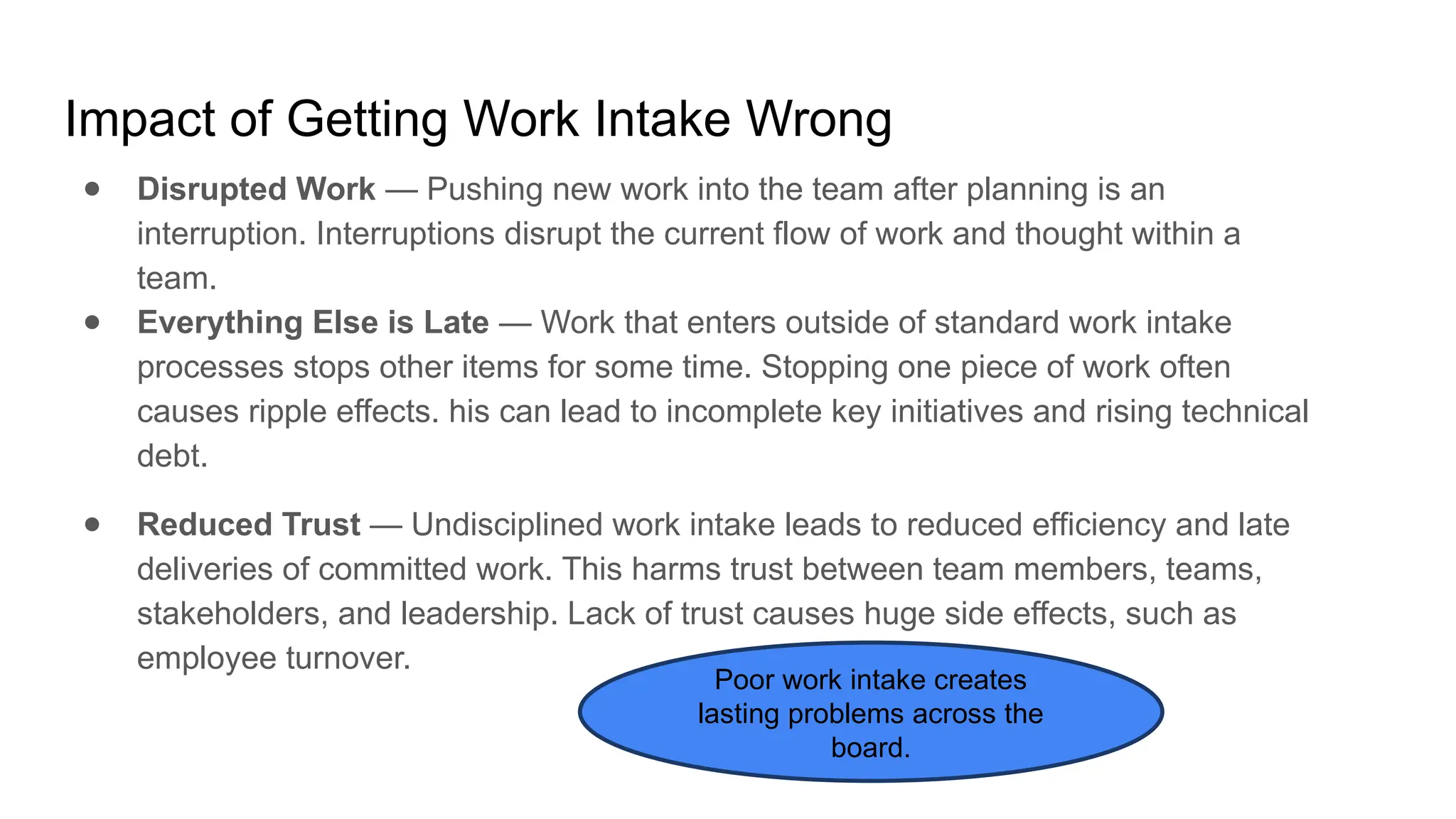
Impact of Getting Work Intake Wrong
● Disrupted Work — Pushing new work into the team after planning is an
interruption. Interruptions disrupt the current flow of work and thought within a
team.
● Everything Else is Late — Work that enters outside of standard work intake
processes stops other items for some time. Stopping one piece of work often
causes ripple effects. his can lead to incomplete key initiatives and rising technical
debt.
● Reduced Trust — Undisciplined work intake leads to reduced efficiency and late
deliveries of committed work. This harms trust between team members, teams,
stakeholders, and leadership. Lack of trust causes huge side effects, such as
employee turnover.
Poor work intake creates
lasting problems across the
board.
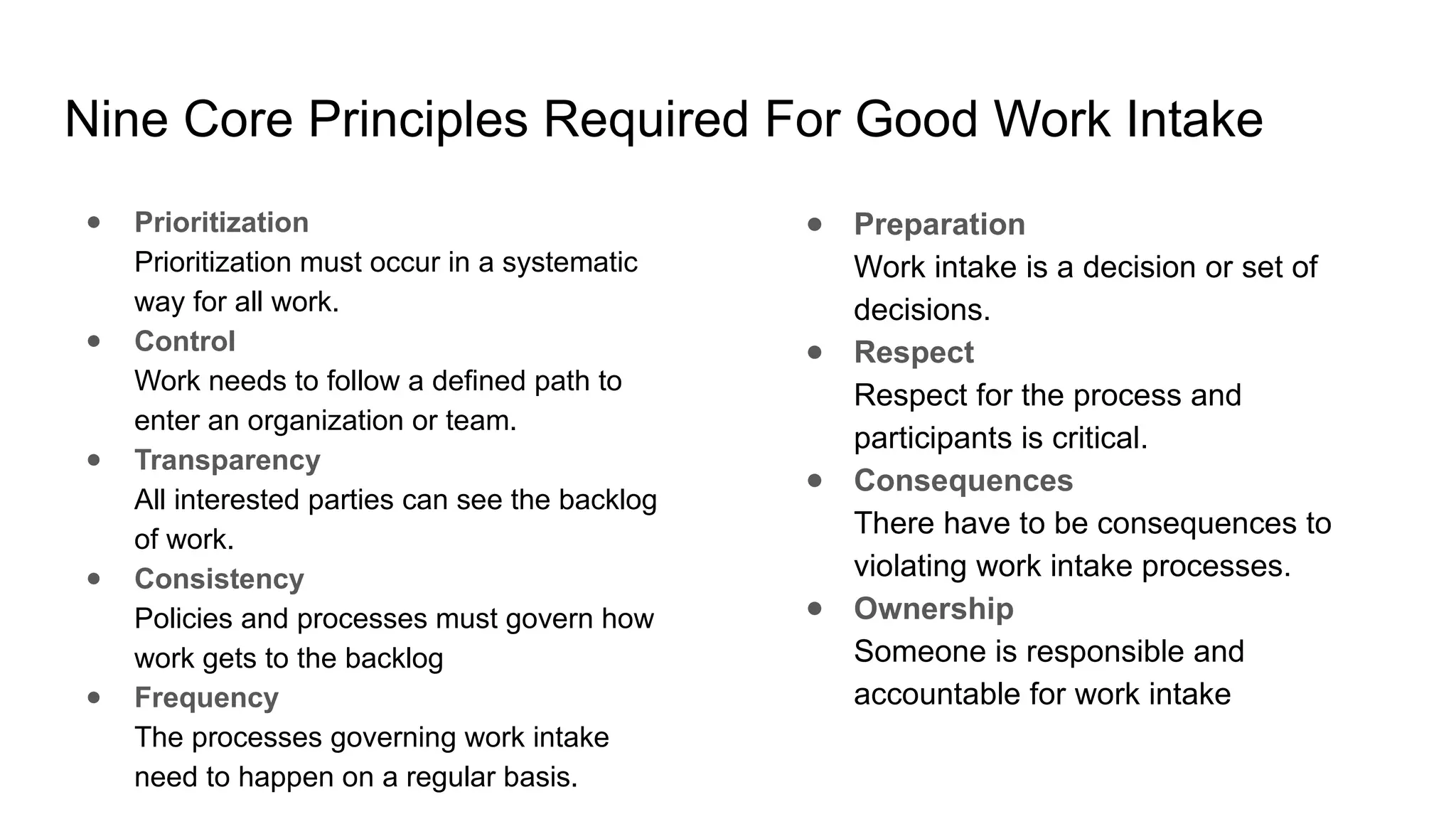
Nine Core Principles Required For Good Work Intake
● Prioritization
Prioritization must occur in a systematic
way for all work.
● Control
Work needs to follow a defined path to
enter an organization or team.
● Transparency
All interested parties can see the backlog
of work.
● Consistency
Policies and processes must govern how
work gets to the backlog
● Frequency
The processes governing work intake
need to happen on a regular basis.
● Preparation
Work intake is a decision or set of
decisions.
● Respect
Respect for the process and
participants is critical.
● Consequences
There have to be consequences to
violating work intake processes.
● Ownership
Someone is responsible and
accountable for work intake
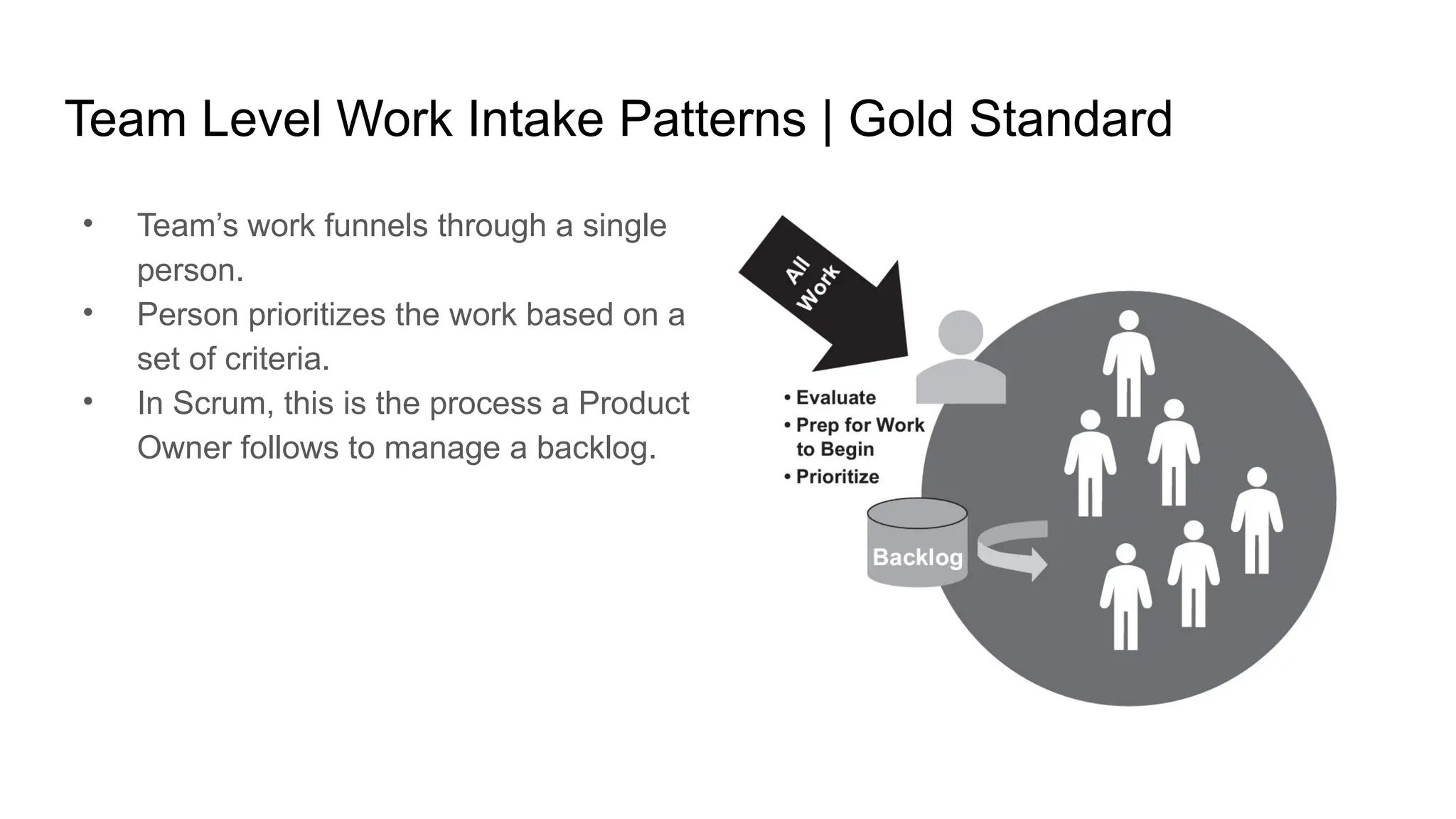
Team Level Work Intake Patterns | Gold Standard
• Team’s work funnels through a single
person.
• Person prioritizes the work based on a
set of criteria.
• In Scrum, this is the process a Product
Owner follows to manage a backlog.
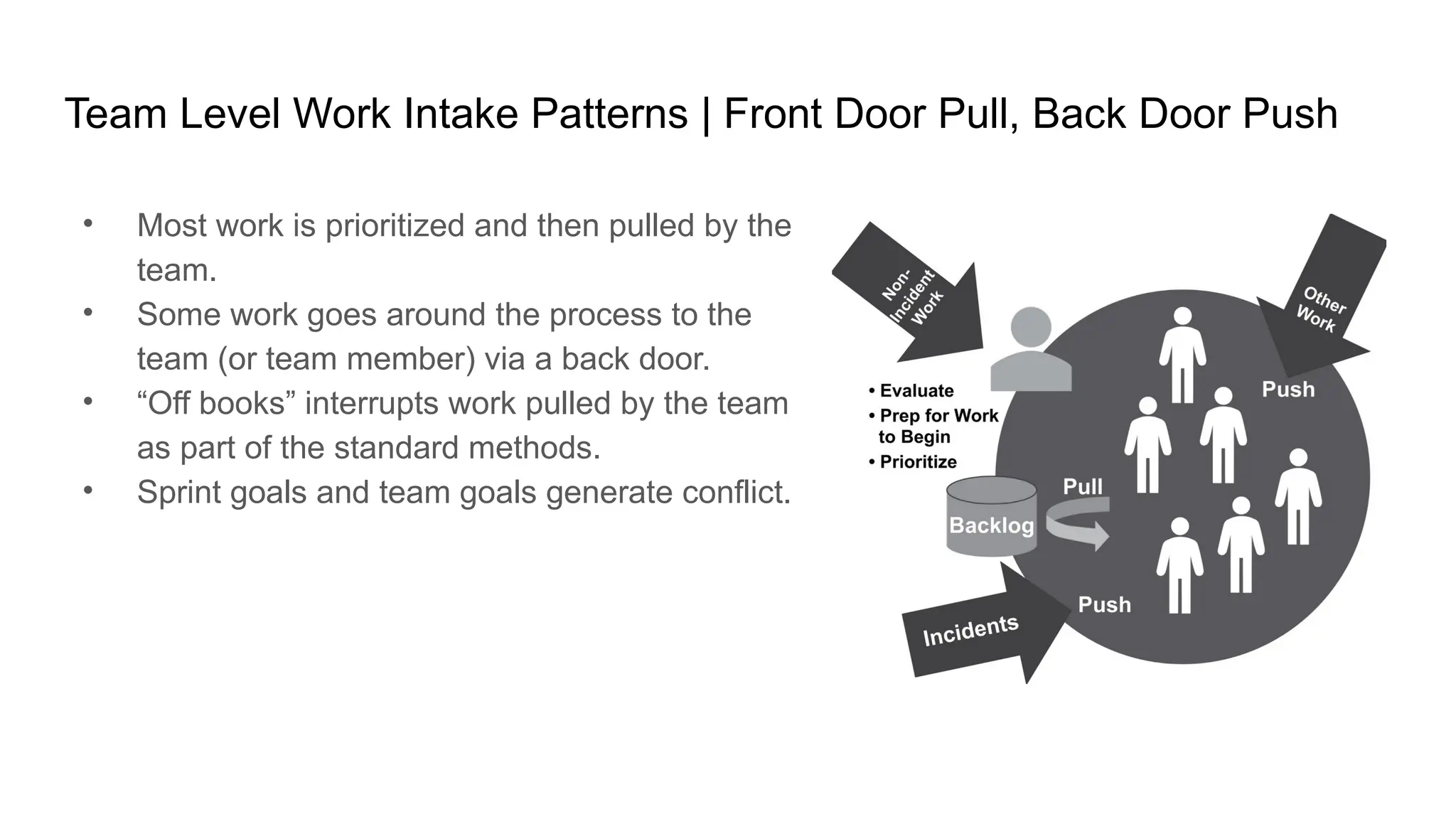
Team Level Work Intake Patterns | Front Door Pull, Back Door Push
• Most work is prioritized and then pulled by the
team.
• Some work goes around the process to the
team (or team member) via a back door.
• “Off books” interrupts work pulled by the team
as part of the standard methods.
• Sprint goals and team goals generate conflict.
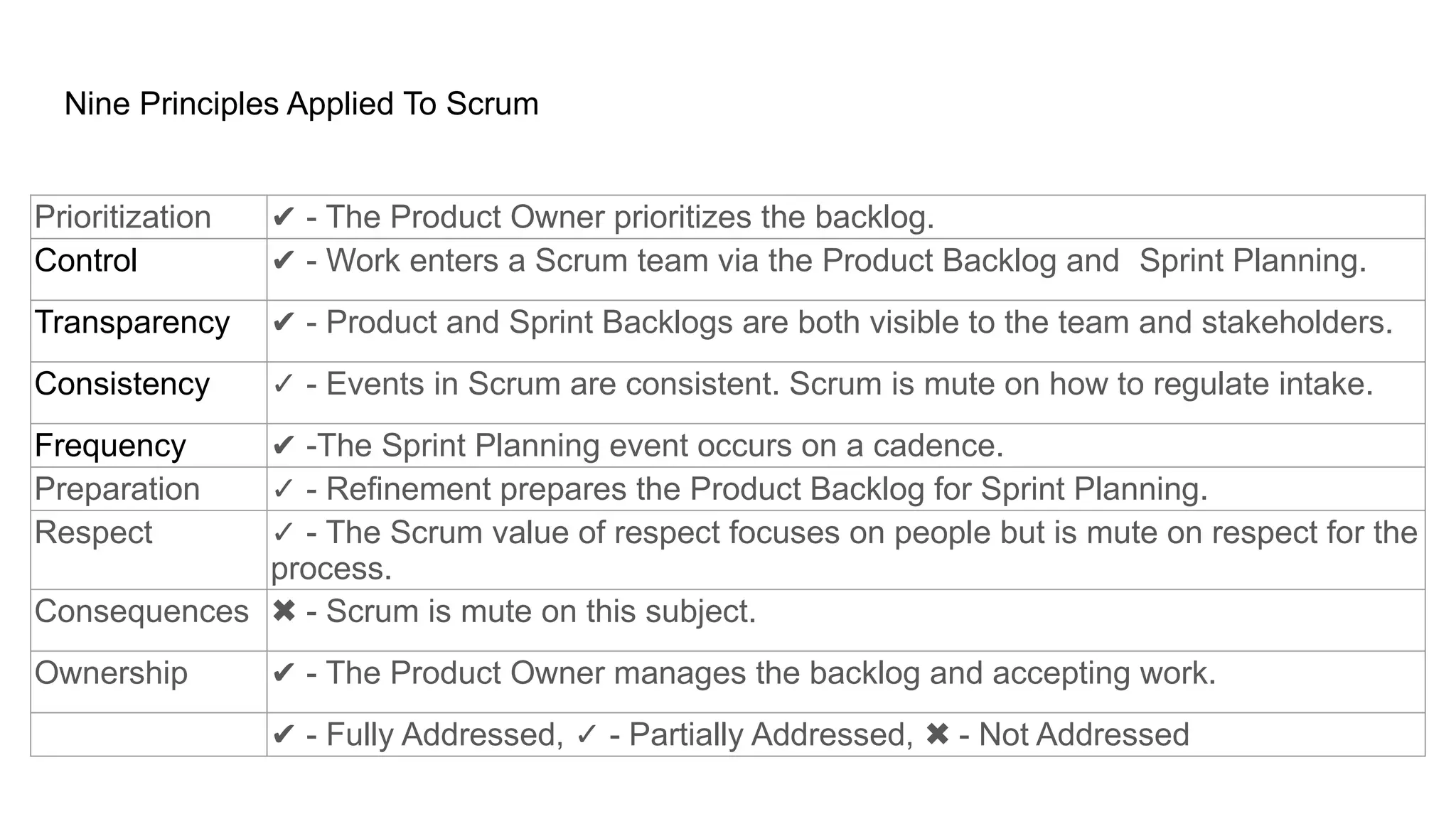
Nine Principles Applied To Scrum
Prioritization ✔ - The Product Owner prioritizes the backlog.
Control ✔ - Work enters a Scrum team via the Product Backlog and Sprint Planning.
Transparency ✔ - Product and Sprint Backlogs are both visible to the team and stakeholders.
Consistency ✓ - Events in Scrum are consistent. Scrum is mute on how to regulate intake.
Frequency ✔ -The Sprint Planning event occurs on a cadence.
Preparation ✓ - Refinement prepares the Product Backlog for Sprint Planning.
Respect ✓ - The Scrum value of respect focuses on people but is mute on respect for the
process.
Consequences ✖ - Scrum is mute on this subject.
Ownership ✔ - The Product Owner manages the backlog and accepting work.
✔ - Fully Addressed, - Partially Addressed, - Not Addressed
✓ ✖
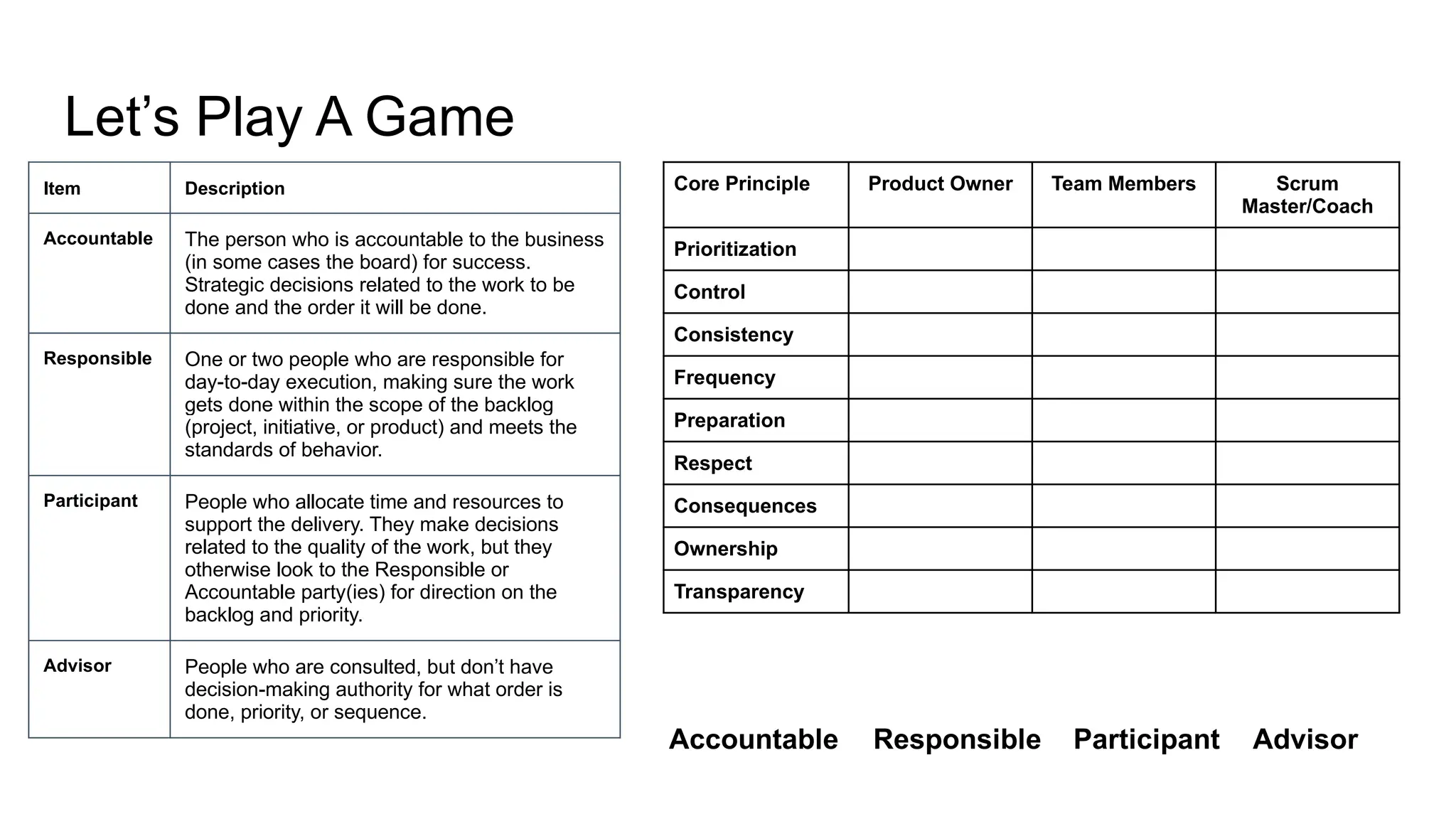
Let’s Play A Game
Core Principle Product Owner Team Members Scrum
Master/Coach
Prioritization
Control
Consistency
Frequency
Preparation
Respect
Consequences
Ownership
Transparency
Item Description
Accountable The person who is accountable to the business
(in some cases the board) for success.
Strategic decisions related to the work to be
done and the order it will be done.
Responsible One or two people who are responsible for
day-to-day execution, making sure the work
gets done within the scope of the backlog
(project, initiative, or product) and meets the
standards of behavior.
Participant People who allocate time and resources to
support the delivery. They make decisions
related to the quality of the work, but they
otherwise look to the Responsible or
Accountable party(ies) for direction on the
backlog and priority.
Advisor People who are consulted, but don’t have
decision-making authority for what order is
done, priority, or sequence.
Accountable Responsible Participant Advisor
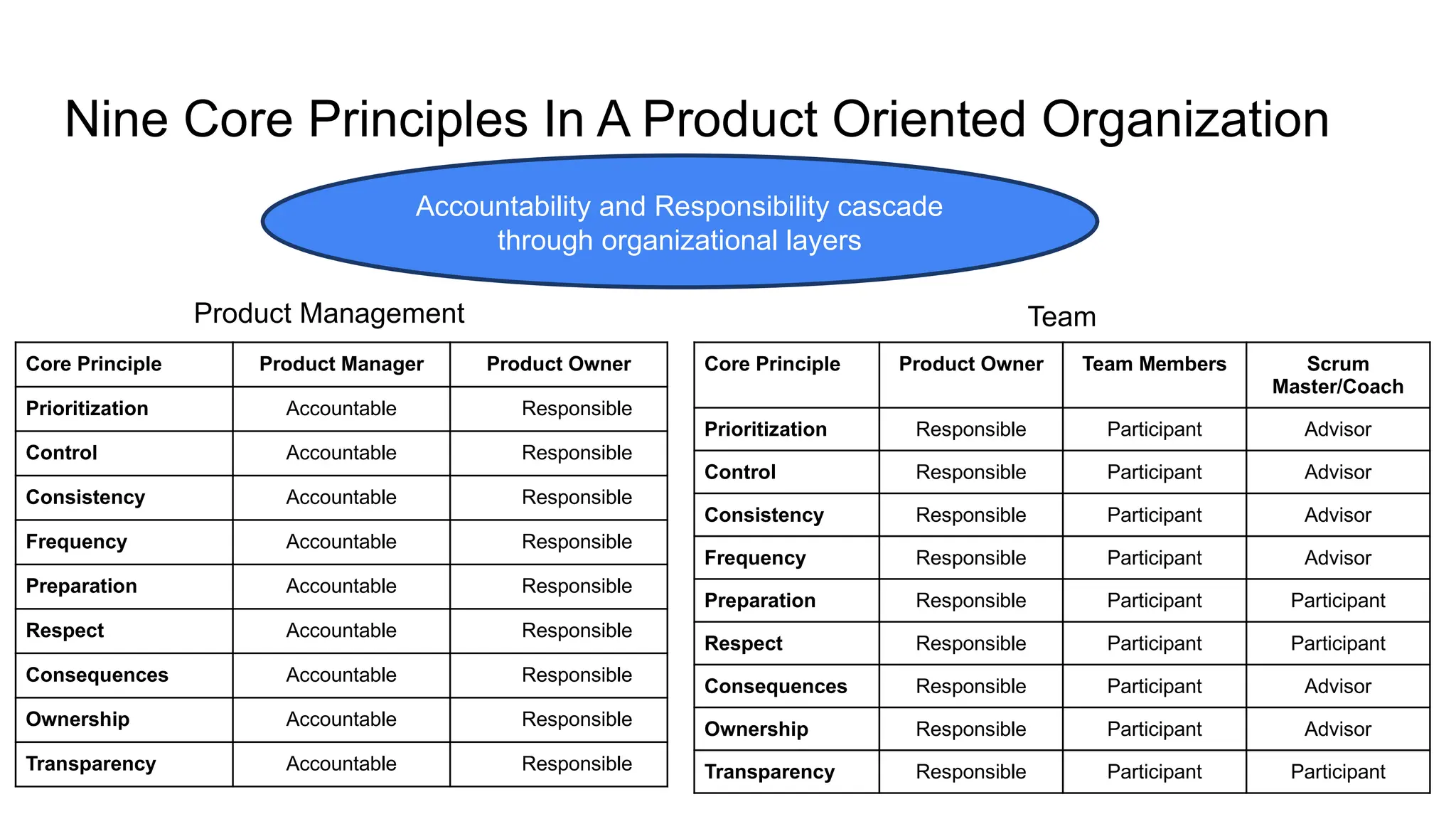
Nine Core Principles In A Product Oriented Organization
Core Principle Product Owner Team Members Scrum
Master/Coach
Prioritization Responsible Participant Advisor
Control Responsible Participant Advisor
Consistency Responsible Participant Advisor
Frequency Responsible Participant Advisor
Preparation Responsible Participant Participant
Respect Responsible Participant Participant
Consequences Responsible Participant Advisor
Ownership Responsible Participant Advisor
Transparency Responsible Participant Participant
Core Principle Product Manager Product Owner
Prioritization Accountable Responsible
Control Accountable Responsible
Consistency Accountable Responsible
Frequency Accountable Responsible
Preparation Accountable Responsible
Respect Accountable Responsible
Consequences Accountable Responsible
Ownership Accountable Responsible
Transparency Accountable Responsible
Accountability and Responsibility cascade
through organizational layers
Product Management Team
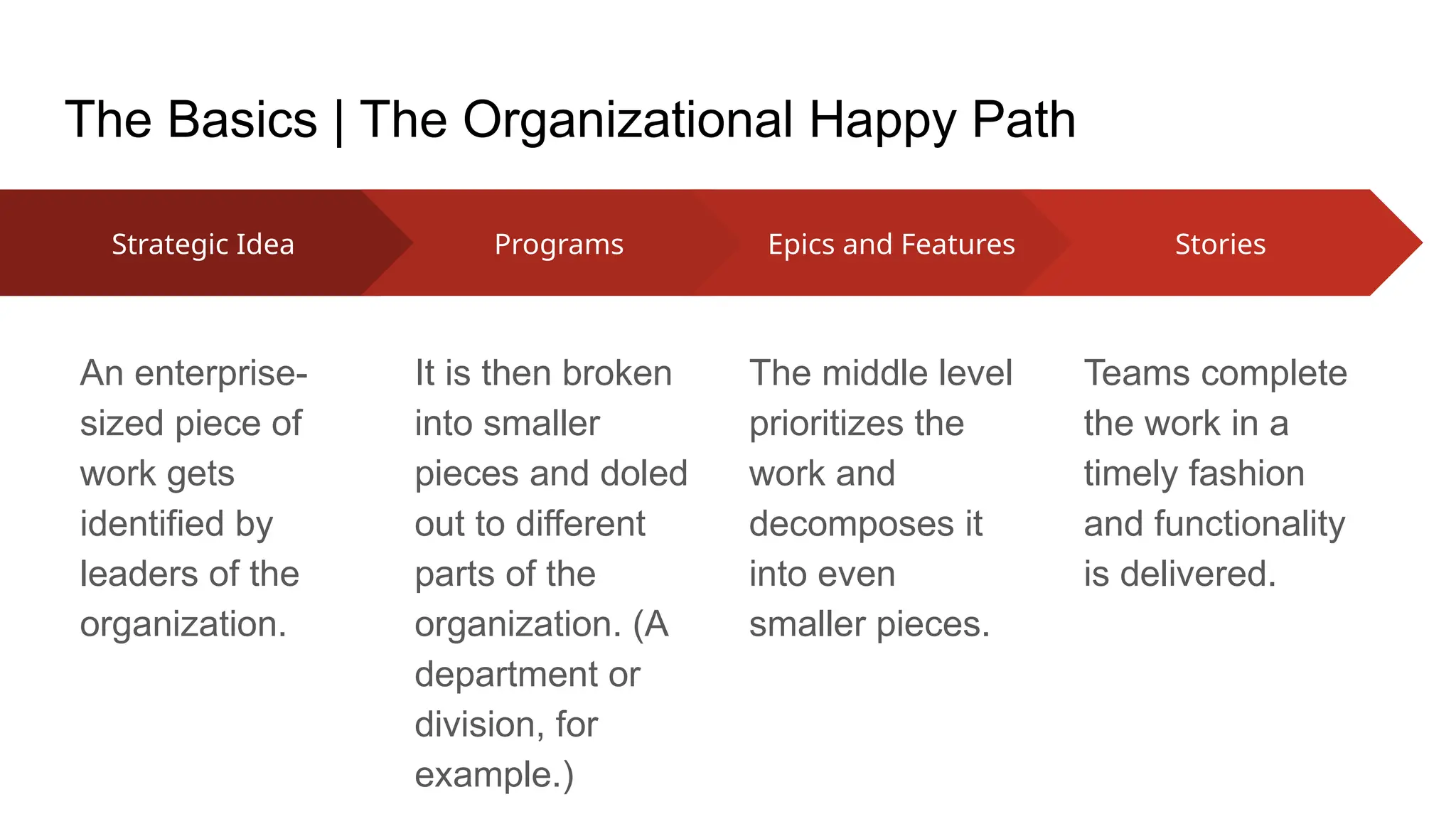
The Basics | The Organizational Happy Path
Strategic Idea
An enterprise-
sized piece of
work gets
identified by
leaders of the
organization.
Programs
It is then broken
into smaller
pieces and doled
out to different
parts of the
organization. (A
department or
division, for
example.)
Epics and Features
The middle level
prioritizes the
work and
decomposes it
into even
smaller pieces.
Stories
Teams complete
the work in a
timely fashion
and functionality
is delivered.
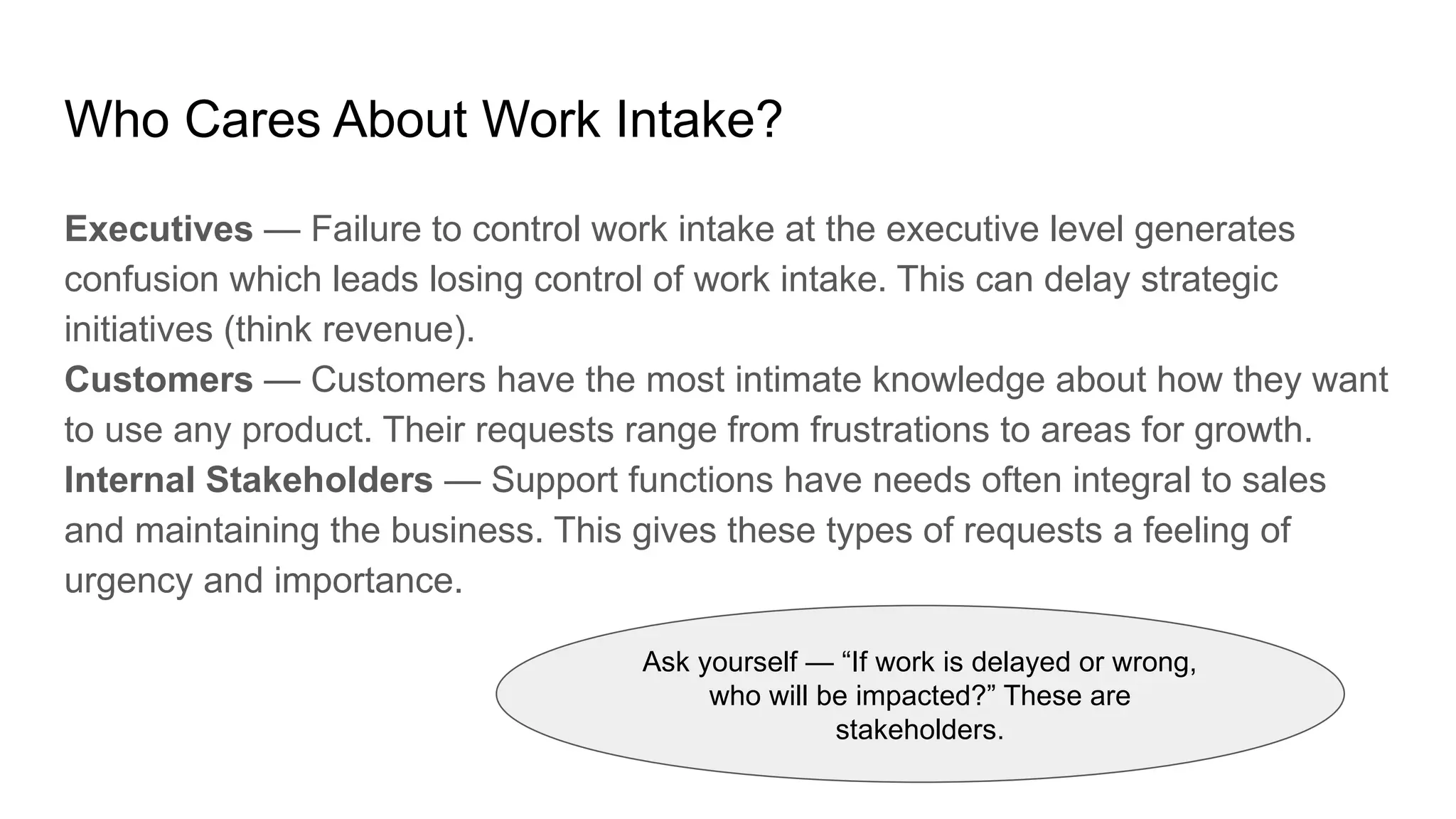
Who Cares About Work Intake?
Executives — Failure to control work intake at the executive level generates
confusion which leads losing control of work intake. This can delay strategic
initiatives (think revenue).
Customers — Customers have the most intimate knowledge about how they want
to use any product. Their requests range from frustrations to areas for growth.
Internal Stakeholders — Support functions have needs often integral to sales
and maintaining the business. This gives these types of requests a feeling of
urgency and importance.
Ask yourself — “If work is delayed or wrong,
who will be impacted?” These are
stakeholders.
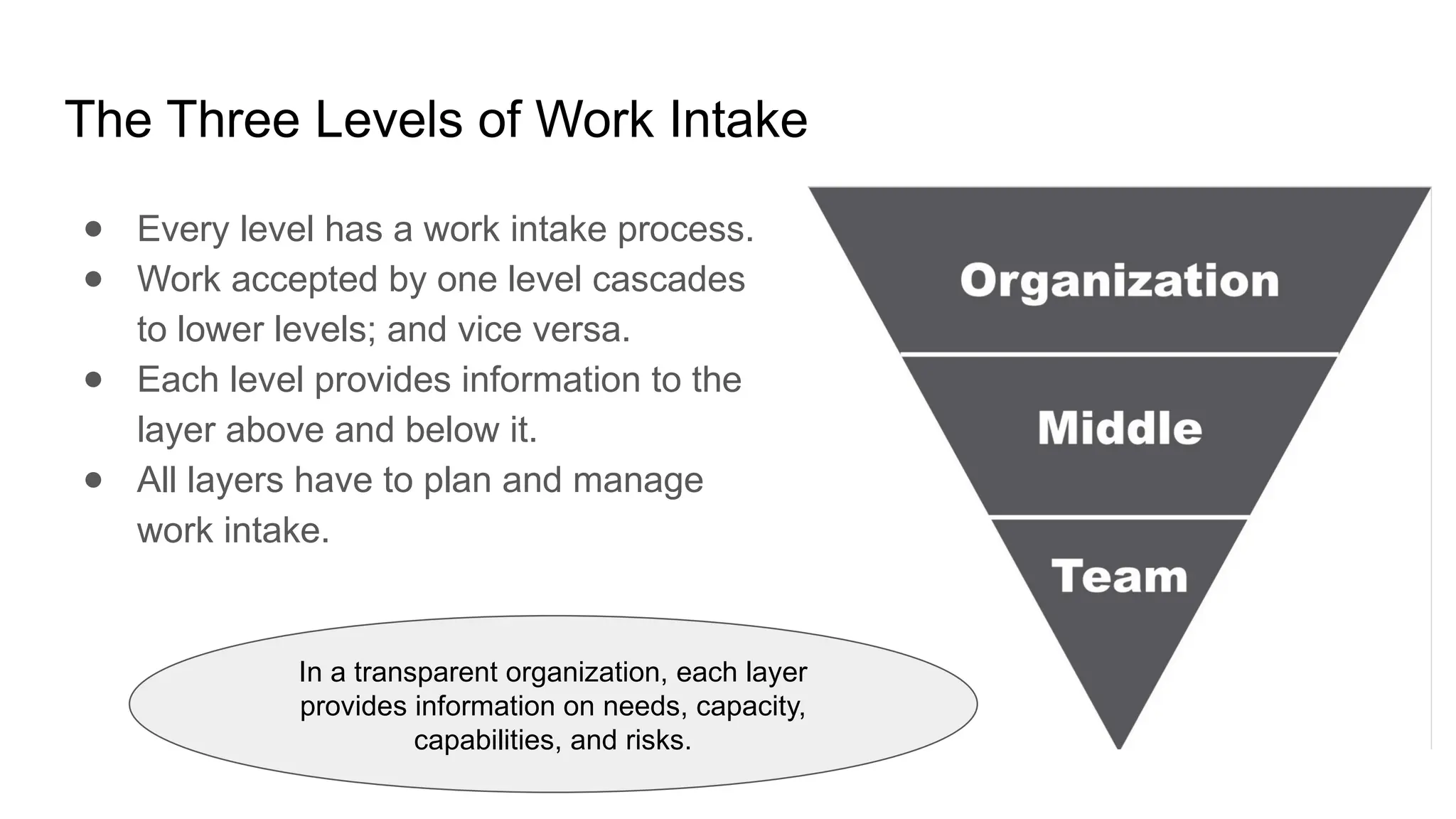
The Three Levels of Work Intake
● Every level has a work intake process.
● Work accepted by one level cascades
to lower levels; and vice versa.
● Each level provides information to the
layer above and below it.
● All layers have to plan and manage
work intake.
In a transparent organization, each layer
provides information on needs, capacity,
capabilities, and risks.
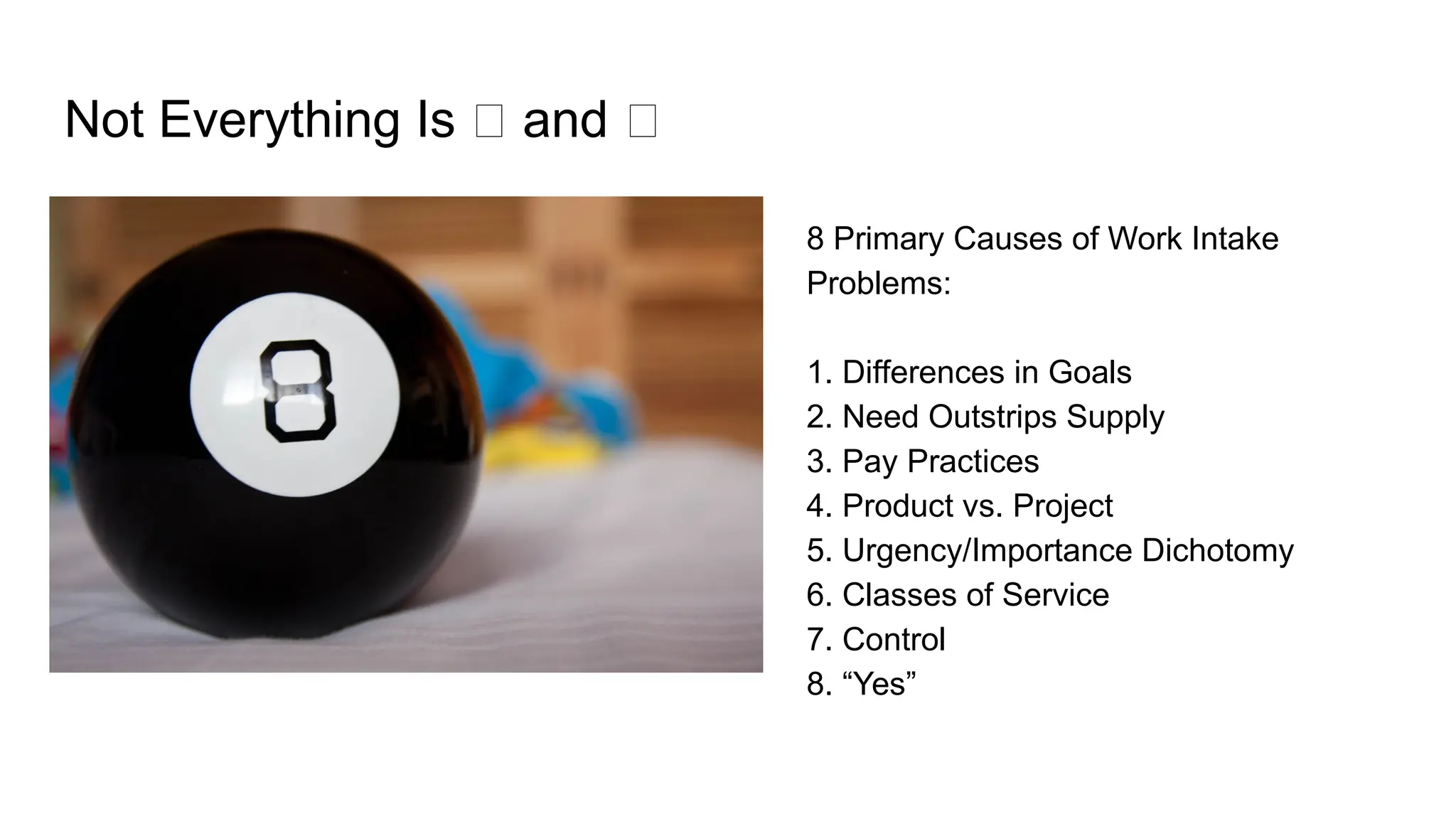
Not Everything Is 🌈 and 🦄
8 Primary Causes of Work Intake
Problems:
1. Differences in Goals
2. Need Outstrips Supply
3. Pay Practices
4. Product vs. Project
5. Urgency/Importance Dichotomy
6. Classes of Service
7. Control
8. “Yes”
Cause #1: Differences in Goals (Goal Conflict)
● Teams want to complete work in an orderly manner.
● But someone else wants a piece of work done immediately.
● It does not matter whether it’s planned work, ad-hoc, based on a contract, emergency,
or an evolutionary change.
● The outcome of conflicting goals is teams accepting work they had not planned.
● Acceptance is either overt or covert.
Cause #1: Differences in Goals (Goal Conflict)
Questions to help identify if you have goal conflict are:
● Do team members, managers, or executives value different time horizons?
● Are there different perspectives on what market the product is serving?
● When goal conflict occurs, is there an incentive to compromise or adopt a middle
ground?
● Is there trust between team members or teams?
● Are disagreements and arguments about approaches common?
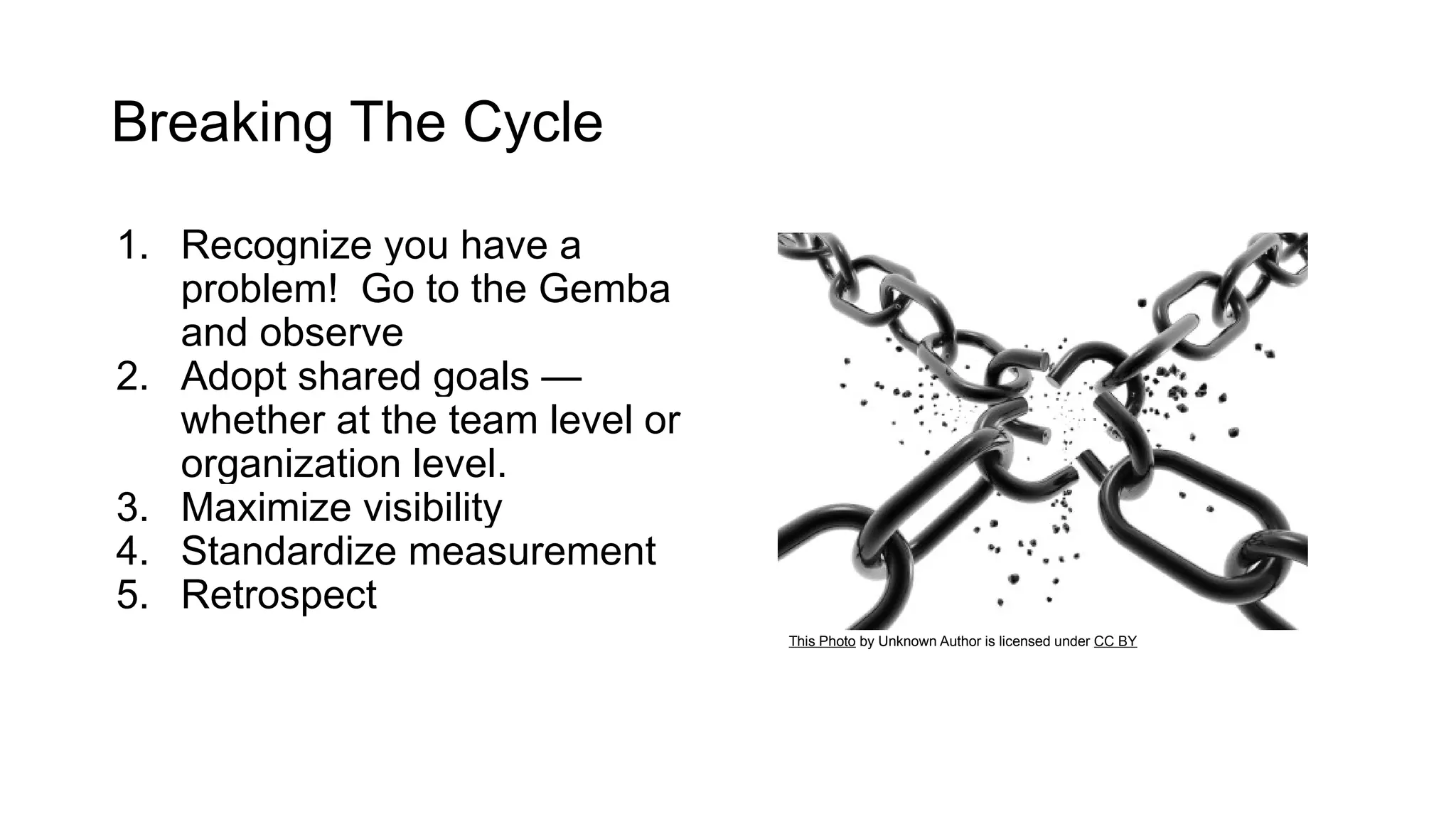
Breaking The Cycle
1. Recognize you have a
problem! Go to the Gemba
and observe
2. Adopt shared goals —
whether at the team level or
organization level.
3. Maximize visibility
4. Standardize measurement
5. Retrospect
This Photo by Unknown Author is licensed under CC BY
Call to Action!
“The first choice we make
each and every day is,
'Will we act upon life, or
will we merely be acted
upon?”
Stephen Covey
Call to Action
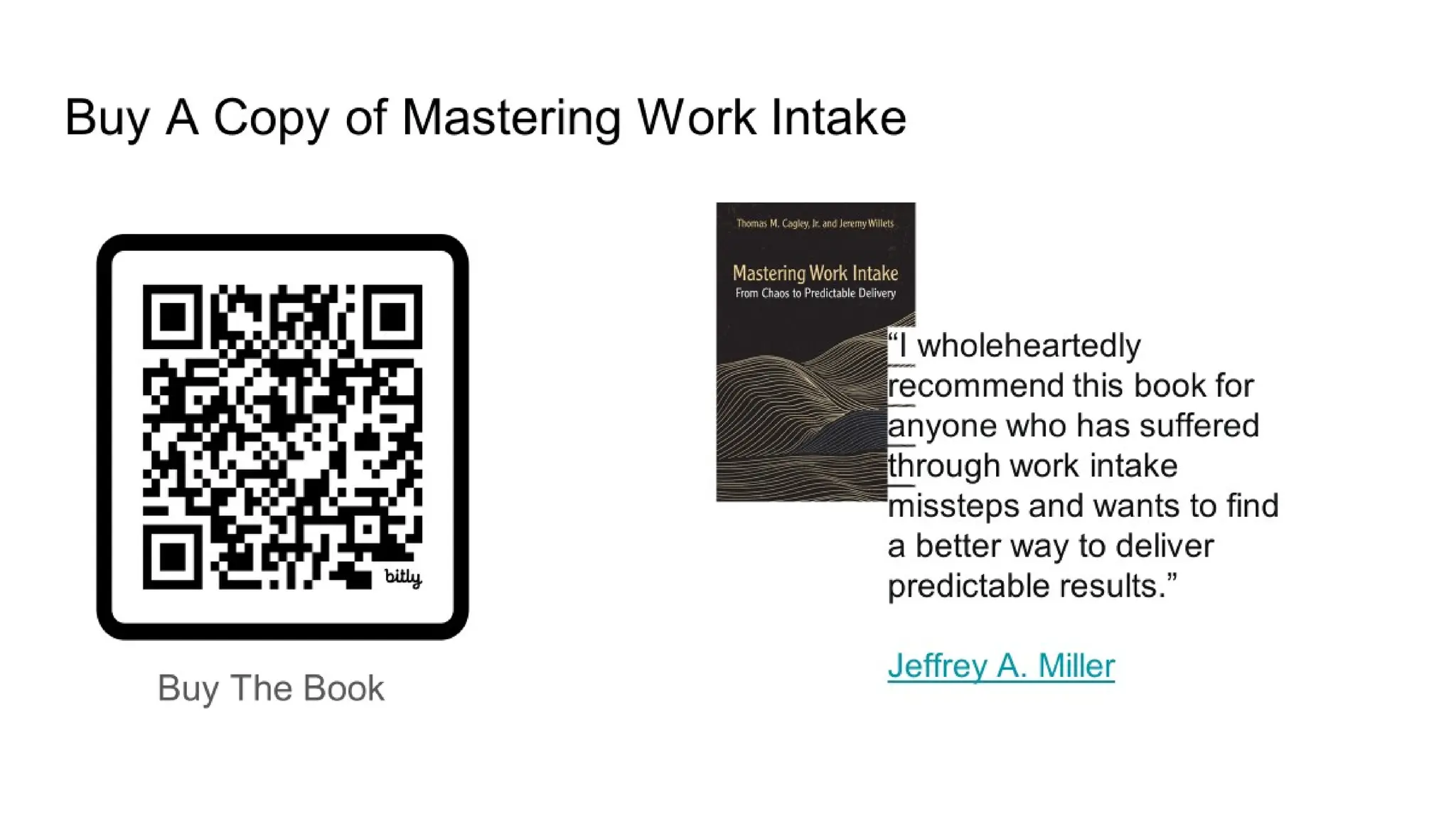
Buy The Book
Maven.com Workshop Mailing List
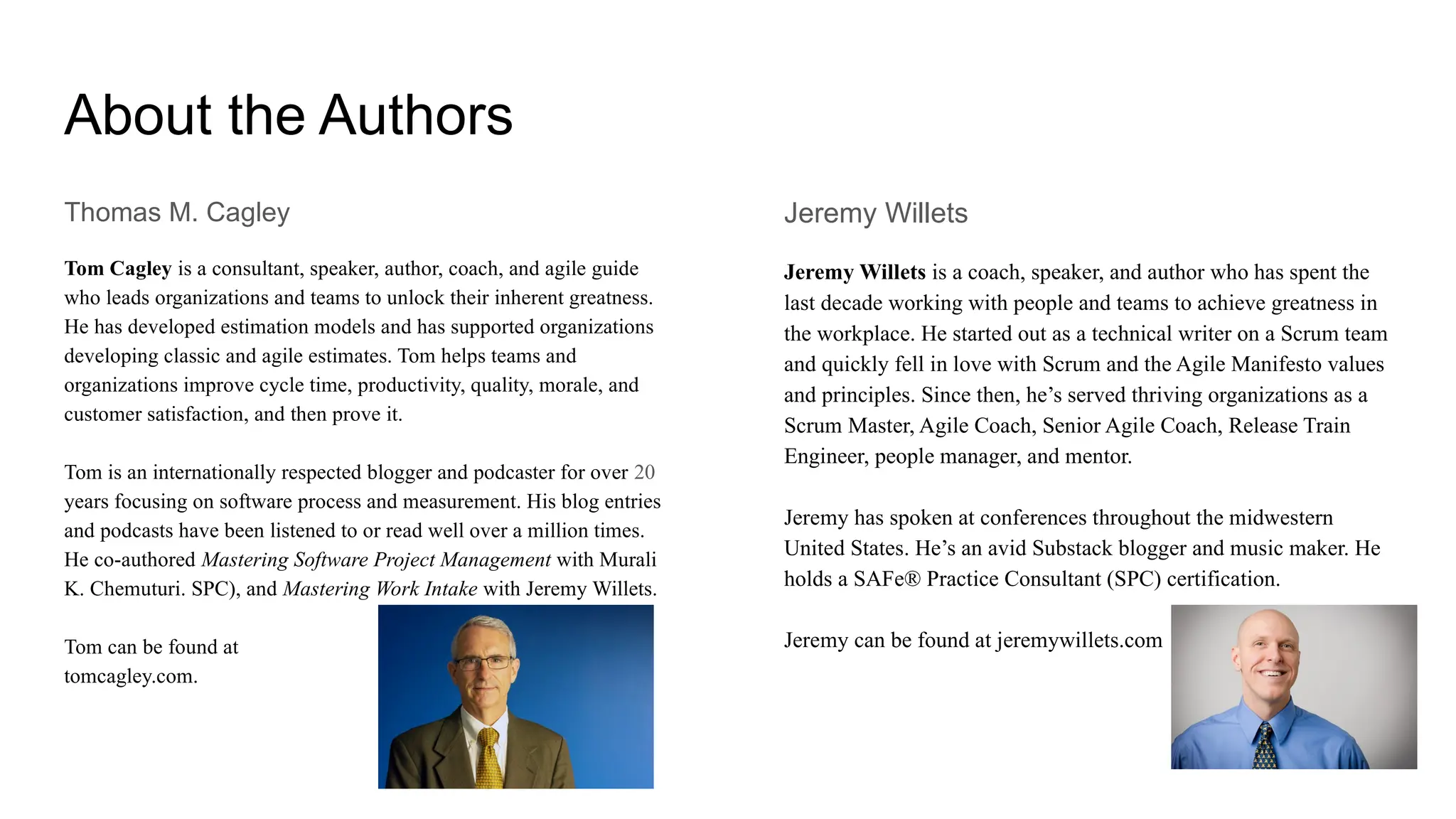
About the Authors
Thomas M. Cagley
Tom Cagley is a consultant, speaker, author, coach, and agile guide
who leads organizations and teams to unlock their inherent greatness.
He has developed estimation models and has supported organizations
developing classic and agile estimates. Tom helps teams and
organizations improve cycle time, productivity, quality, morale, and
customer satisfaction, and then prove it.
Tom is an internationally respected blogger and podcaster for over 20
years focusing on software process and measurement. His blog entries
and podcasts have been listened to or read well over a million times.
He co-authored Mastering Software Project Management with Murali
K. Chemuturi. SPC), and Mastering Work Intake with Jeremy Willets.
Tom can be found at
tomcagley.com.
Jeremy Willets
Jeremy Willets is a coach, speaker, and author who has spent the
last decade working with people and teams to achieve greatness in
the workplace. He started out as a technical writer on a Scrum team
and quickly fell in love with Scrum and the Agile Manifesto values
and principles. Since then, he’s served thriving organizations as a
Scrum Master, Agile Coach, Senior Agile Coach, Release Train
Engineer, people manager, and mentor.
Jeremy has spoken at conferences throughout the midwestern
United States. He’s an avid Substack blogger and music maker. He
holds a SAFe® Practice Consultant (SPC) certification.
Jeremy can be found at jeremywillets.com

Hands-on Agile #64: Mastering Work Intake w/ Jeremy Willets and Tom Cagley

  • 1.
    Mastering Work Intake: TheKey to Sustainability and Flow by Thomas M. Cagley and Jeremy Willets
  • 2.
    Grounding: A DefinitionOf Work Intake ● The way an organization decides what to do, how to spend its resources, and how to deploy its people. ● “Intake” refers to both how and the amount of work taken into a team or organization.
  • 3.
    Impact of GettingWork Intake Wrong ● Disrupted Work — Pushing new work into the team after planning is an interruption. Interruptions disrupt the current flow of work and thought within a team. ● Everything Else is Late — Work that enters outside of standard work intake processes stops other items for some time. Stopping one piece of work often causes ripple effects. his can lead to incomplete key initiatives and rising technical debt. ● Reduced Trust — Undisciplined work intake leads to reduced efficiency and late deliveries of committed work. This harms trust between team members, teams, stakeholders, and leadership. Lack of trust causes huge side effects, such as employee turnover. Poor work intake creates lasting problems across the board.
  • 4.
    Nine Core PrinciplesRequired For Good Work Intake ● Prioritization Prioritization must occur in a systematic way for all work. ● Control Work needs to follow a defined path to enter an organization or team. ● Transparency All interested parties can see the backlog of work. ● Consistency Policies and processes must govern how work gets to the backlog ● Frequency The processes governing work intake need to happen on a regular basis. ● Preparation Work intake is a decision or set of decisions. ● Respect Respect for the process and participants is critical. ● Consequences There have to be consequences to violating work intake processes. ● Ownership Someone is responsible and accountable for work intake
  • 5.
    Team Level WorkIntake Patterns | Gold Standard • Team’s work funnels through a single person. • Person prioritizes the work based on a set of criteria. • In Scrum, this is the process a Product Owner follows to manage a backlog.
  • 6.
    Team Level WorkIntake Patterns | Front Door Pull, Back Door Push • Most work is prioritized and then pulled by the team. • Some work goes around the process to the team (or team member) via a back door. • “Off books” interrupts work pulled by the team as part of the standard methods. • Sprint goals and team goals generate conflict.
  • 7.
    Nine Principles AppliedTo Scrum Prioritization ✔ - The Product Owner prioritizes the backlog. Control ✔ - Work enters a Scrum team via the Product Backlog and Sprint Planning. Transparency ✔ - Product and Sprint Backlogs are both visible to the team and stakeholders. Consistency ✓ - Events in Scrum are consistent. Scrum is mute on how to regulate intake. Frequency ✔ -The Sprint Planning event occurs on a cadence. Preparation ✓ - Refinement prepares the Product Backlog for Sprint Planning. Respect ✓ - The Scrum value of respect focuses on people but is mute on respect for the process. Consequences ✖ - Scrum is mute on this subject. Ownership ✔ - The Product Owner manages the backlog and accepting work. ✔ - Fully Addressed, - Partially Addressed, - Not Addressed ✓ ✖
  • 8.
    Let’s Play AGame Core Principle Product Owner Team Members Scrum Master/Coach Prioritization Control Consistency Frequency Preparation Respect Consequences Ownership Transparency Item Description Accountable The person who is accountable to the business (in some cases the board) for success. Strategic decisions related to the work to be done and the order it will be done. Responsible One or two people who are responsible for day-to-day execution, making sure the work gets done within the scope of the backlog (project, initiative, or product) and meets the standards of behavior. Participant People who allocate time and resources to support the delivery. They make decisions related to the quality of the work, but they otherwise look to the Responsible or Accountable party(ies) for direction on the backlog and priority. Advisor People who are consulted, but don’t have decision-making authority for what order is done, priority, or sequence. Accountable Responsible Participant Advisor
  • 9.
    Nine Core PrinciplesIn A Product Oriented Organization Core Principle Product Owner Team Members Scrum Master/Coach Prioritization Responsible Participant Advisor Control Responsible Participant Advisor Consistency Responsible Participant Advisor Frequency Responsible Participant Advisor Preparation Responsible Participant Participant Respect Responsible Participant Participant Consequences Responsible Participant Advisor Ownership Responsible Participant Advisor Transparency Responsible Participant Participant Core Principle Product Manager Product Owner Prioritization Accountable Responsible Control Accountable Responsible Consistency Accountable Responsible Frequency Accountable Responsible Preparation Accountable Responsible Respect Accountable Responsible Consequences Accountable Responsible Ownership Accountable Responsible Transparency Accountable Responsible Accountability and Responsibility cascade through organizational layers Product Management Team
  • 10.
    The Basics |The Organizational Happy Path Strategic Idea An enterprise- sized piece of work gets identified by leaders of the organization. Programs It is then broken into smaller pieces and doled out to different parts of the organization. (A department or division, for example.) Epics and Features The middle level prioritizes the work and decomposes it into even smaller pieces. Stories Teams complete the work in a timely fashion and functionality is delivered.
  • 11.
    Who Cares AboutWork Intake? Executives — Failure to control work intake at the executive level generates confusion which leads losing control of work intake. This can delay strategic initiatives (think revenue). Customers — Customers have the most intimate knowledge about how they want to use any product. Their requests range from frustrations to areas for growth. Internal Stakeholders — Support functions have needs often integral to sales and maintaining the business. This gives these types of requests a feeling of urgency and importance. Ask yourself — “If work is delayed or wrong, who will be impacted?” These are stakeholders.
  • 12.
    The Three Levelsof Work Intake ● Every level has a work intake process. ● Work accepted by one level cascades to lower levels; and vice versa. ● Each level provides information to the layer above and below it. ● All layers have to plan and manage work intake. In a transparent organization, each layer provides information on needs, capacity, capabilities, and risks.
  • 13.
    Not Everything Is🌈 and 🦄 8 Primary Causes of Work Intake Problems: 1. Differences in Goals 2. Need Outstrips Supply 3. Pay Practices 4. Product vs. Project 5. Urgency/Importance Dichotomy 6. Classes of Service 7. Control 8. “Yes”
  • 14.
    Cause #1: Differencesin Goals (Goal Conflict) ● Teams want to complete work in an orderly manner. ● But someone else wants a piece of work done immediately. ● It does not matter whether it’s planned work, ad-hoc, based on a contract, emergency, or an evolutionary change. ● The outcome of conflicting goals is teams accepting work they had not planned. ● Acceptance is either overt or covert.
  • 15.
    Cause #1: Differencesin Goals (Goal Conflict) Questions to help identify if you have goal conflict are: ● Do team members, managers, or executives value different time horizons? ● Are there different perspectives on what market the product is serving? ● When goal conflict occurs, is there an incentive to compromise or adopt a middle ground? ● Is there trust between team members or teams? ● Are disagreements and arguments about approaches common?
  • 16.
    Breaking The Cycle 1.Recognize you have a problem! Go to the Gemba and observe 2. Adopt shared goals — whether at the team level or organization level. 3. Maximize visibility 4. Standardize measurement 5. Retrospect This Photo by Unknown Author is licensed under CC BY
  • 17.
    Call to Action! “Thefirst choice we make each and every day is, 'Will we act upon life, or will we merely be acted upon?” Stephen Covey
  • 18.
    Call to Action BuyThe Book Maven.com Workshop Mailing List
  • 20.
    About the Authors ThomasM. Cagley Tom Cagley is a consultant, speaker, author, coach, and agile guide who leads organizations and teams to unlock their inherent greatness. He has developed estimation models and has supported organizations developing classic and agile estimates. Tom helps teams and organizations improve cycle time, productivity, quality, morale, and customer satisfaction, and then prove it. Tom is an internationally respected blogger and podcaster for over 20 years focusing on software process and measurement. His blog entries and podcasts have been listened to or read well over a million times. He co-authored Mastering Software Project Management with Murali K. Chemuturi. SPC), and Mastering Work Intake with Jeremy Willets. Tom can be found at tomcagley.com. Jeremy Willets Jeremy Willets is a coach, speaker, and author who has spent the last decade working with people and teams to achieve greatness in the workplace. He started out as a technical writer on a Scrum team and quickly fell in love with Scrum and the Agile Manifesto values and principles. Since then, he’s served thriving organizations as a Scrum Master, Agile Coach, Senior Agile Coach, Release Train Engineer, people manager, and mentor. Jeremy has spoken at conferences throughout the midwestern United States. He’s an avid Substack blogger and music maker. He holds a SAFe® Practice Consultant (SPC) certification. Jeremy can be found at jeremywillets.com

Editor's Notes

  • #1 Agile and Lean embrace the idea that teams and organizations pull prioritized work. But what happens when work gets pushed on a team or organization? If you’ve seen this anti-pattern, you’re no longer dealing with work “intake” — you’re dealing with work “entry.” Pushing work kills sustainable pace and consistent flow of value delivery. Mastering the work intake challenge could very well make or break your career. Or even your company. In this session, we’ll start by defining work intake. Then, we’ll focus on how work enters different levels of organizations and discuss strategies for recognizing and solving work intake anti-patterns.
  • #4 Taken from Chapter 2: What Does Good Work Intake Look Like? Discuss how the principles can influence how work intake is practiced. Consider how lack of transparency reduces trust, which increases pressure to adopt poor behaviors, like jumping the queue.
  • #11 Taken from Chapter 4: Who Cares About Work Intake? Callout statement: Identifying stakeholders is often problematic (or at least only partially done). Linking impact to the identification of stakeholders often helps broaden discussion of who is a stakeholder.
  • #12 Taken from Chapter 5: Three Levels of Work Intake Potential discussion question: What does transparency mean in an organization? Potential answer: Transparency involves openness, clarity, and accessibility of information within an organization.