Discovery vs Delivery
d-pereira.com
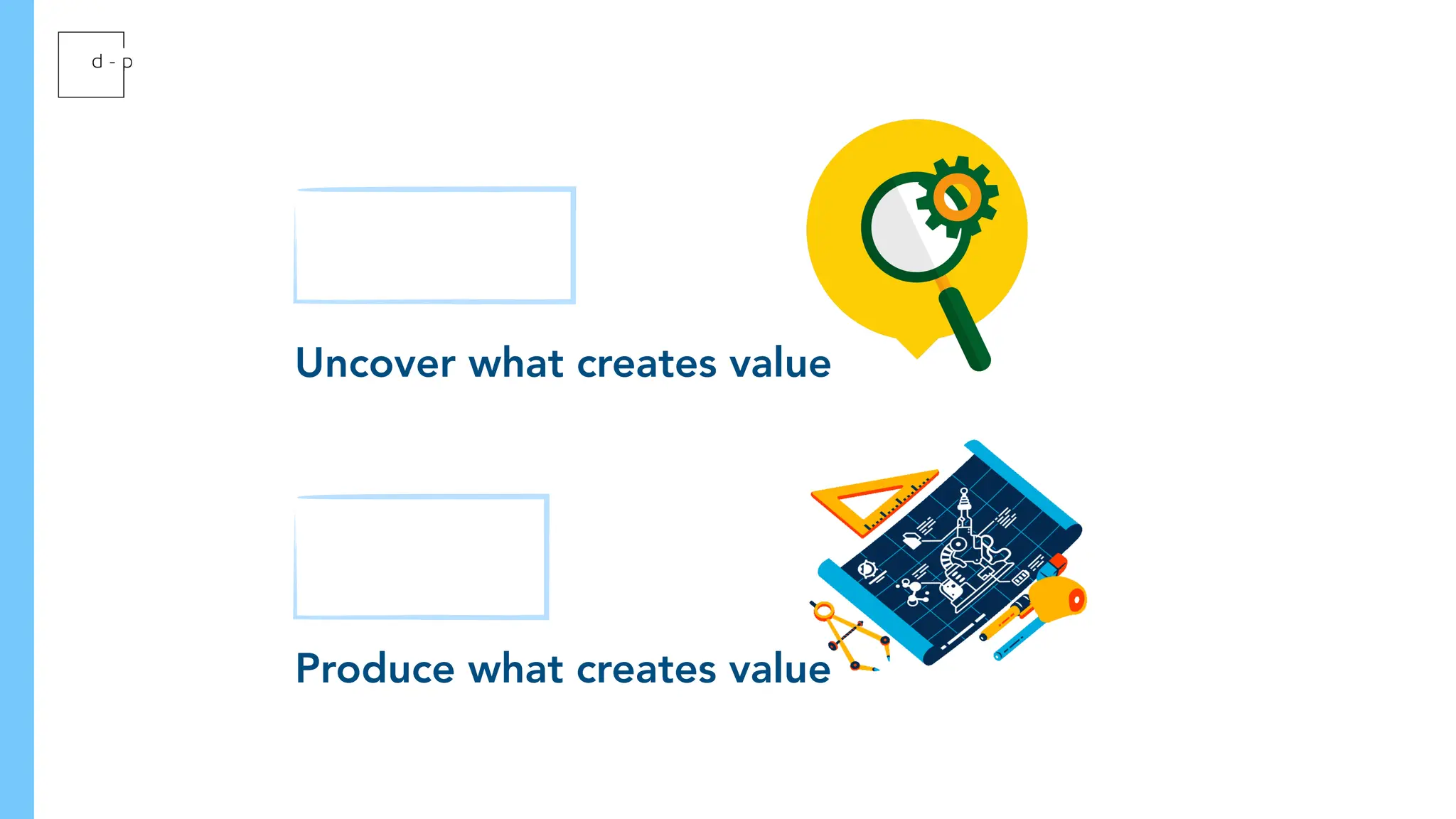
Produce what creates value
Uncover what creates value
Discovery
Delivery
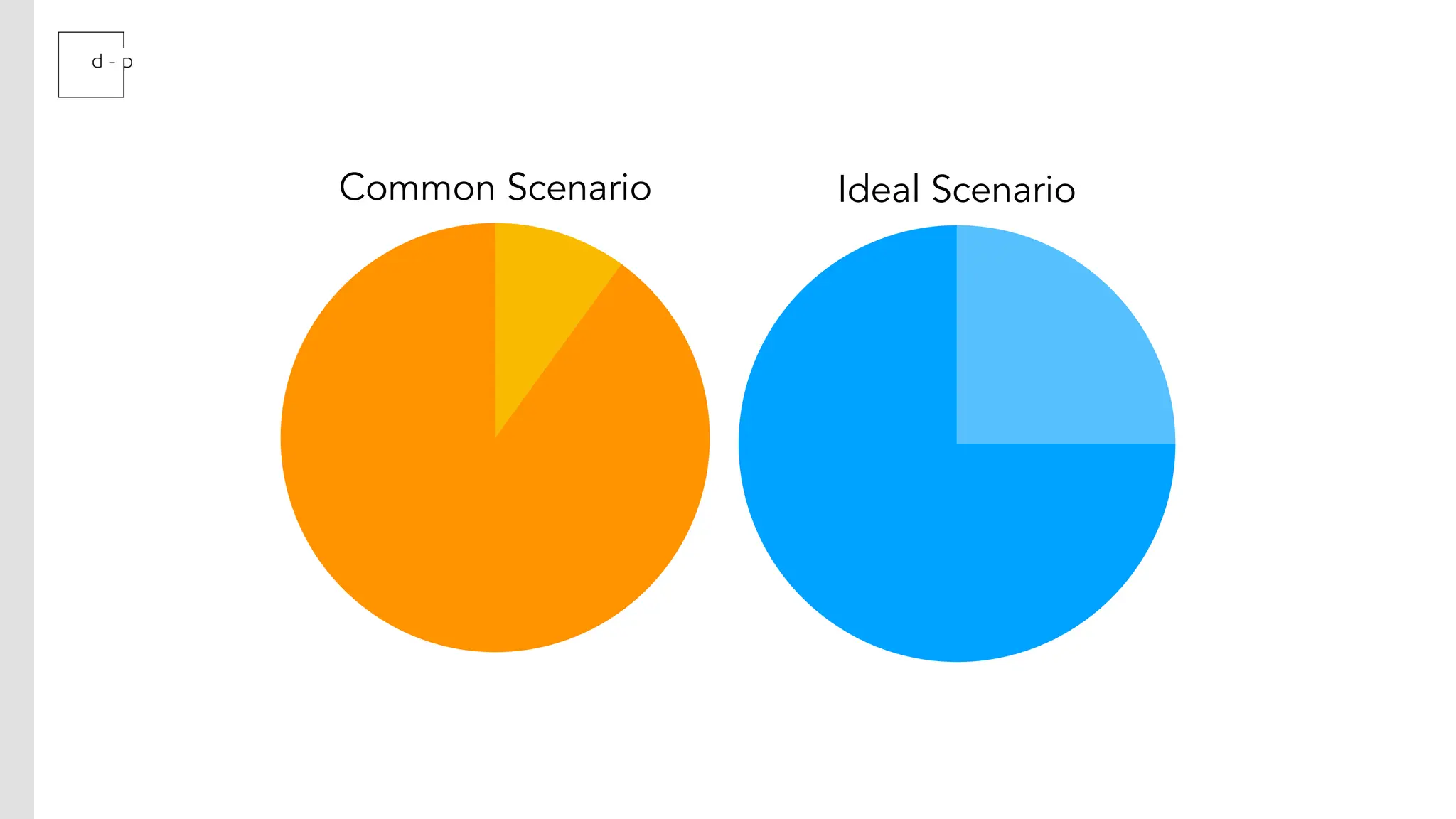
Common Scenario
Delivery
90 %
Discovery
10 %
Ideal Scenario
Discovery
75 %
Delivery
25 %
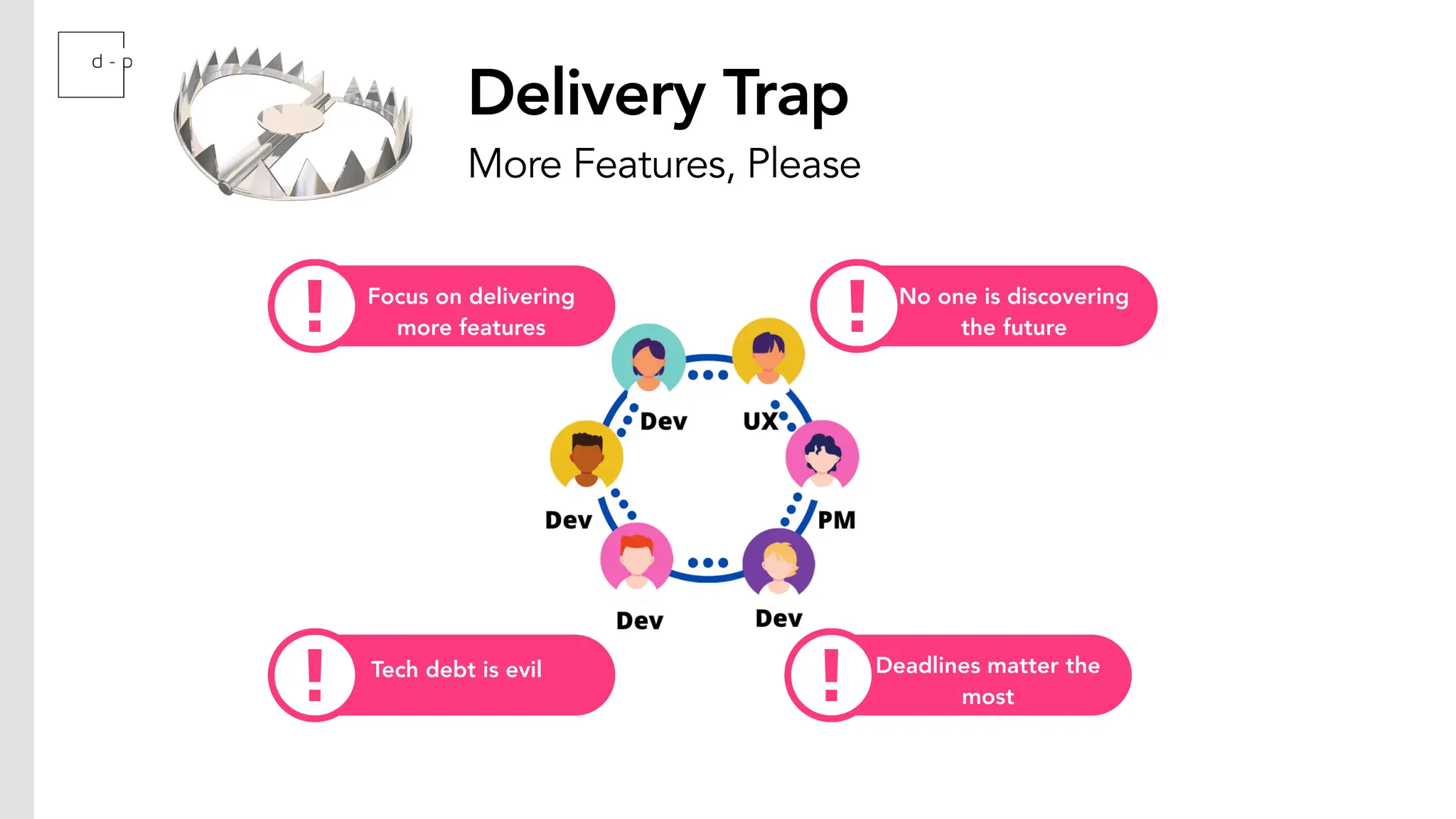
Delivery Trap
More Features, Please
Focus on delivering
more features
No one is discovering
the future
Tech debt is evil Deadlines matter the
most
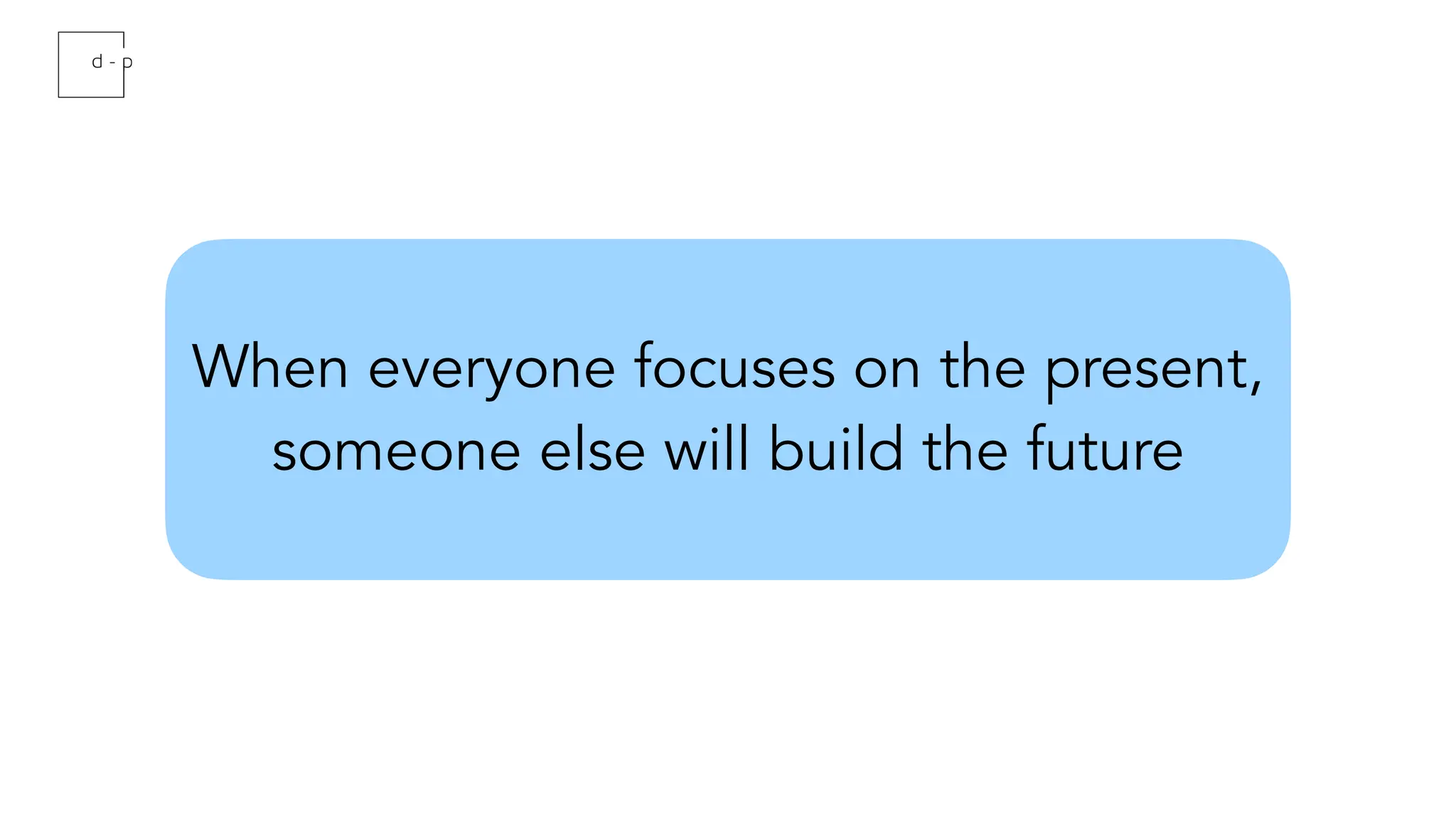
When everyone focuses on the present,
someone else will build the future
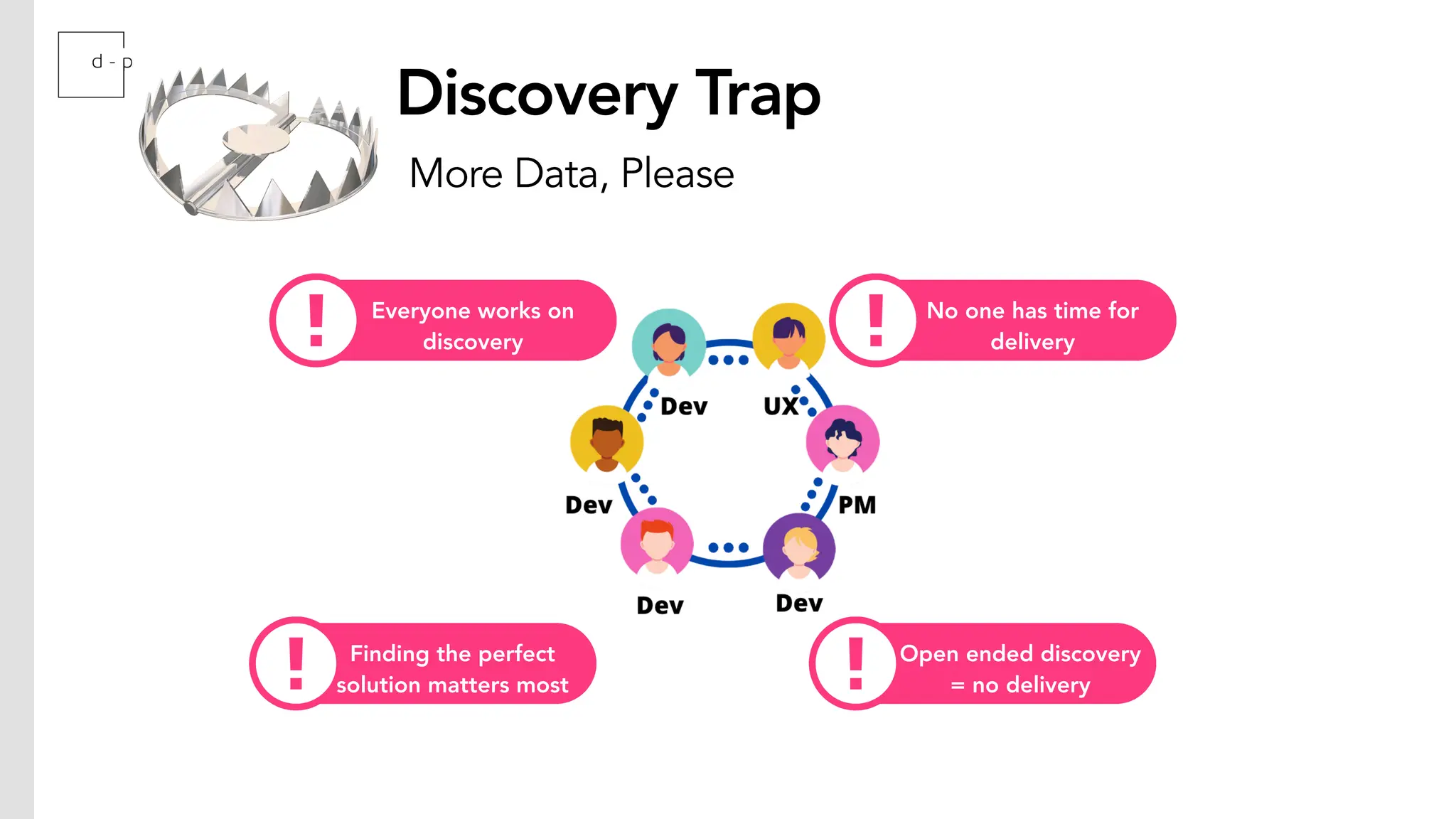
Discovery Trap
More Data, Please
Everyone works on
discovery
No one has time for
delivery
Finding the perfect
solution matters most
Open ended discovery
= no delivery
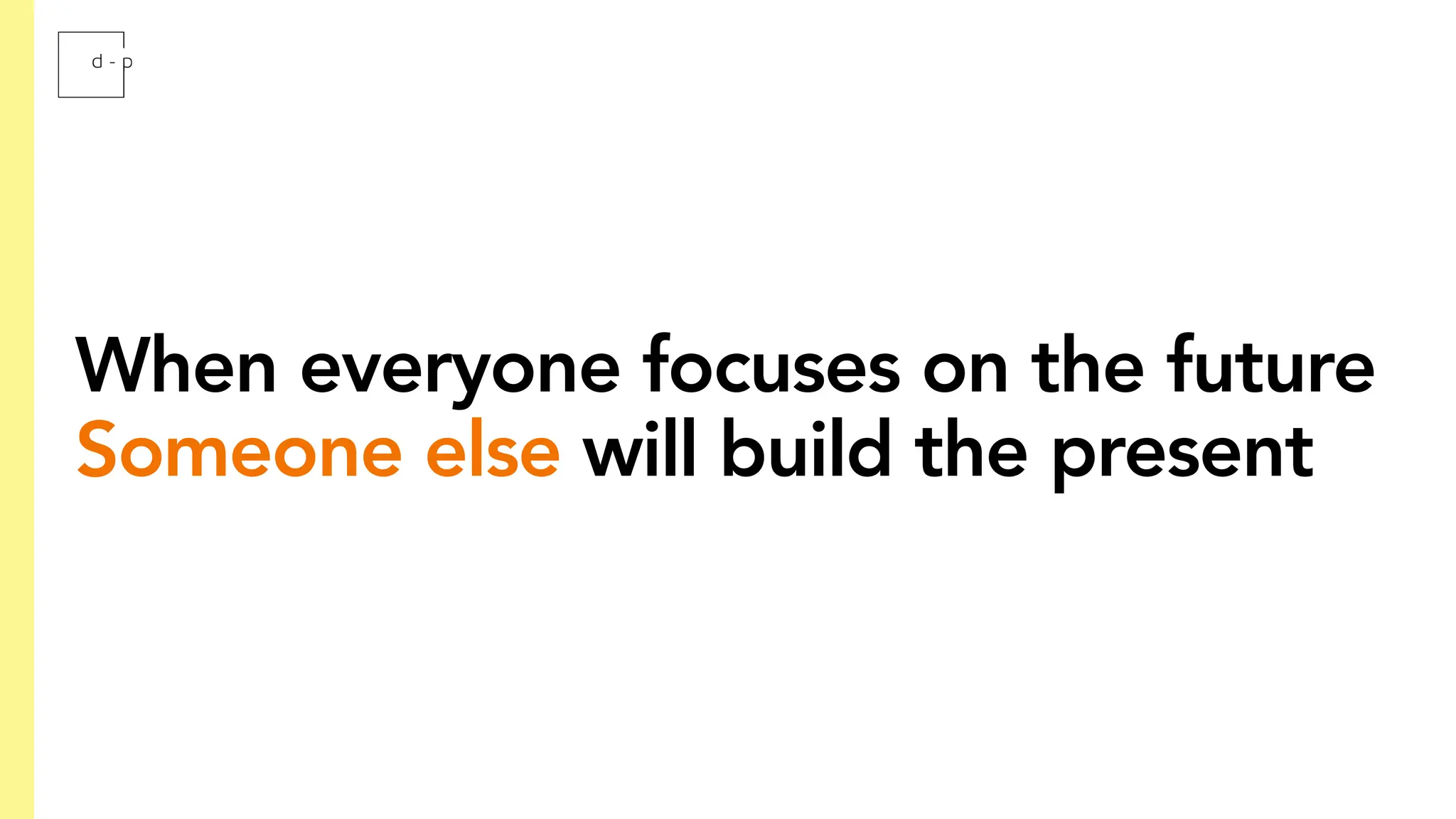
When everyone focuses on the future
Someone else will build the present
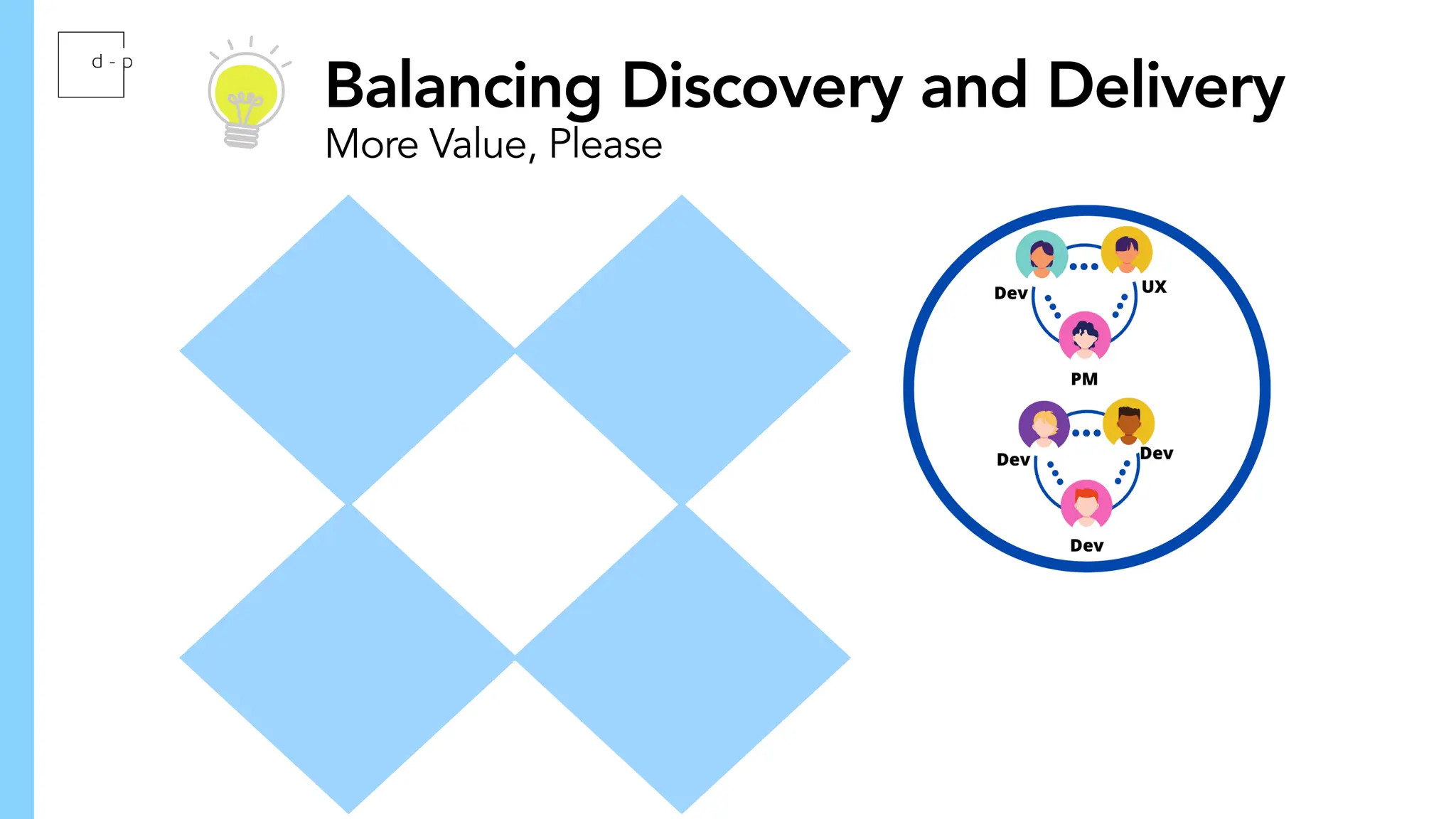
Balancing Discovery and Delivery
More Value, Please
Half team
focuses on
problems
Half team
focuses on
solutions
Everyone is
accountable
end to end
Mindset
‘
fi
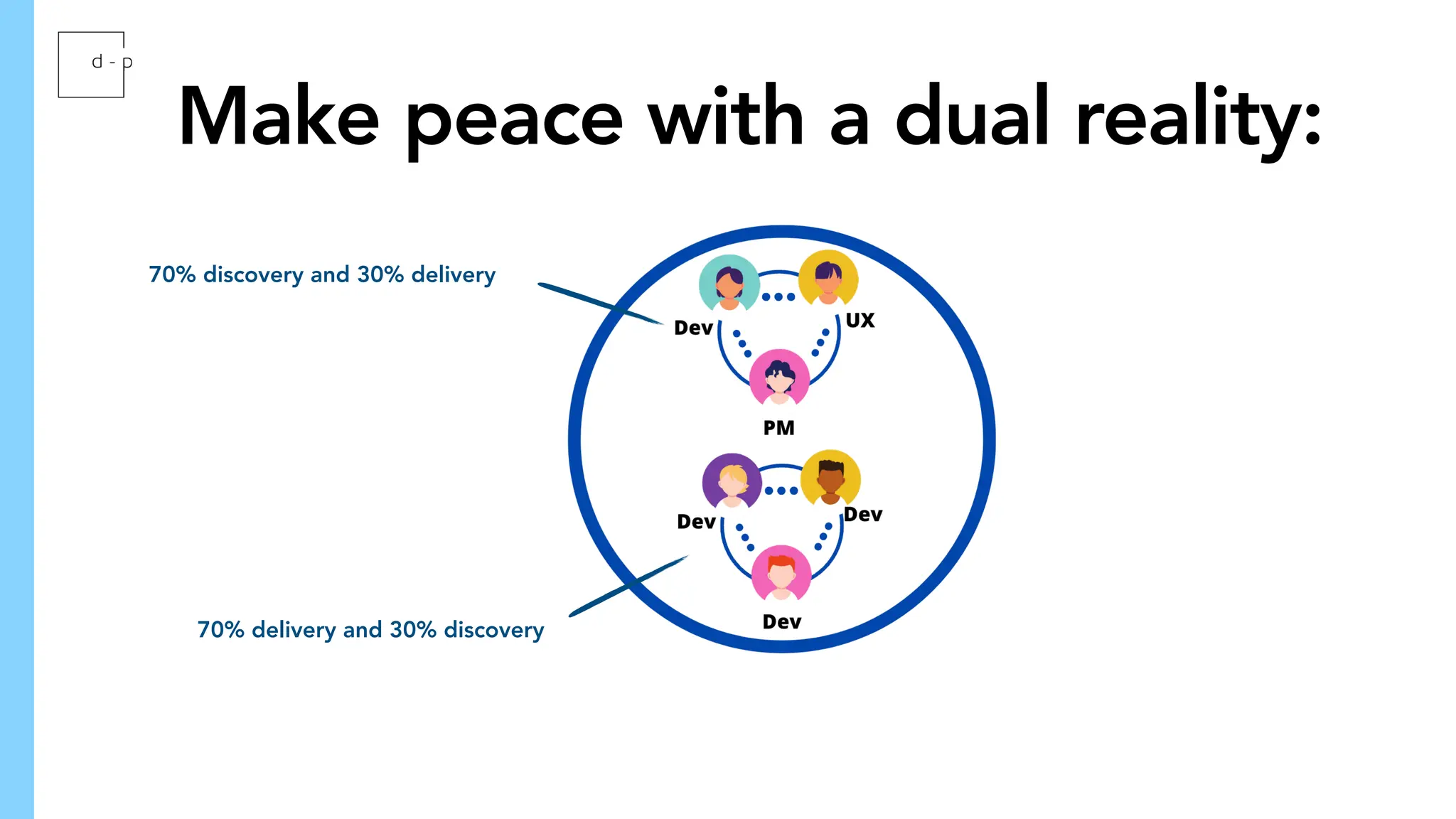
Make peace with a dual reality:
70% discovery and 30% delivery
70% delivery and 30% discovery
Discovery Journey
SVPG Partner
“The purpose of product discovery is to
quickly separate the good ideas from the bad.
The output of product discovery is a validated
product backlog. Specifically, this means
getting answers to four critical questions: Will
the user buy this (or choose to use it)?
Can the user figure out how to use this? Can
our engineers build this? Can our stakeholders
support this?”
Marty Cagan
d-pereira.com
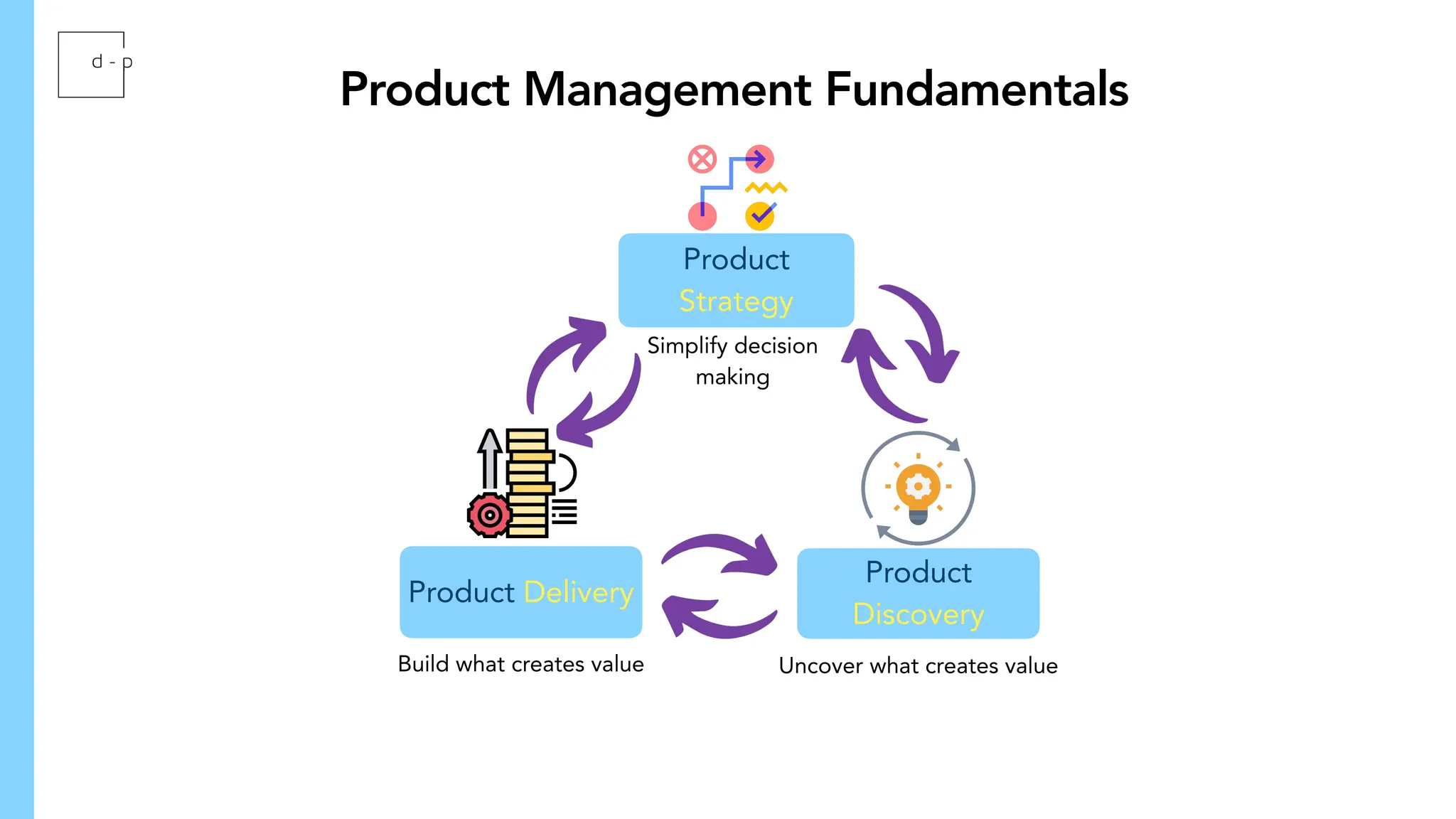
Product
Strategy
Simplify decision
making
Product
Discovery
Uncover what creates value
Product Delivery
Build what creates value
Product Management Fundamentals
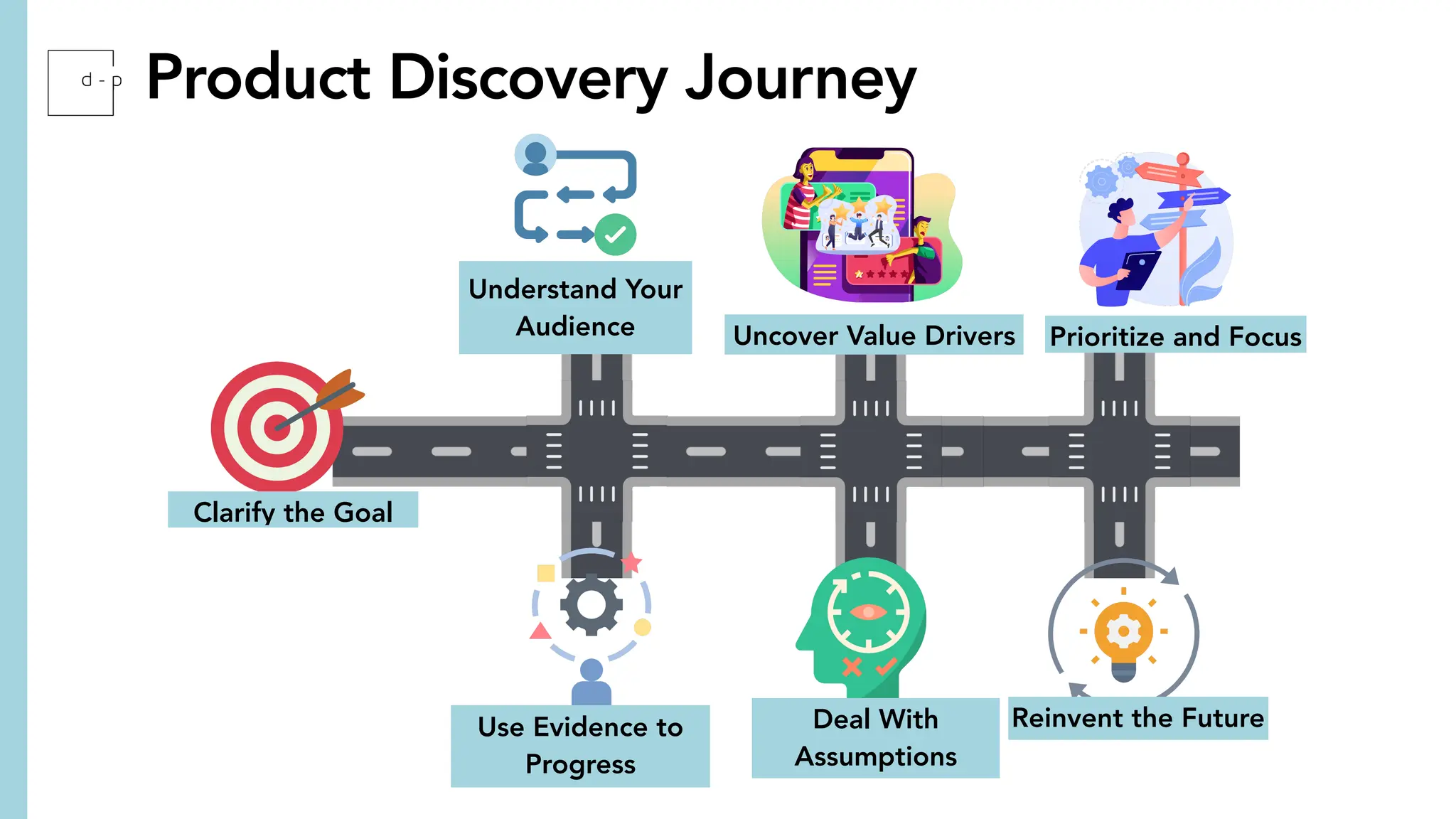
Clarify the Goal
Understand Your
Audience Uncover Value Drivers
Reinvent the Future
Deal With
Assumptions
Use Evidence to
Progress
Prioritize and Focus
Product Discovery Journey
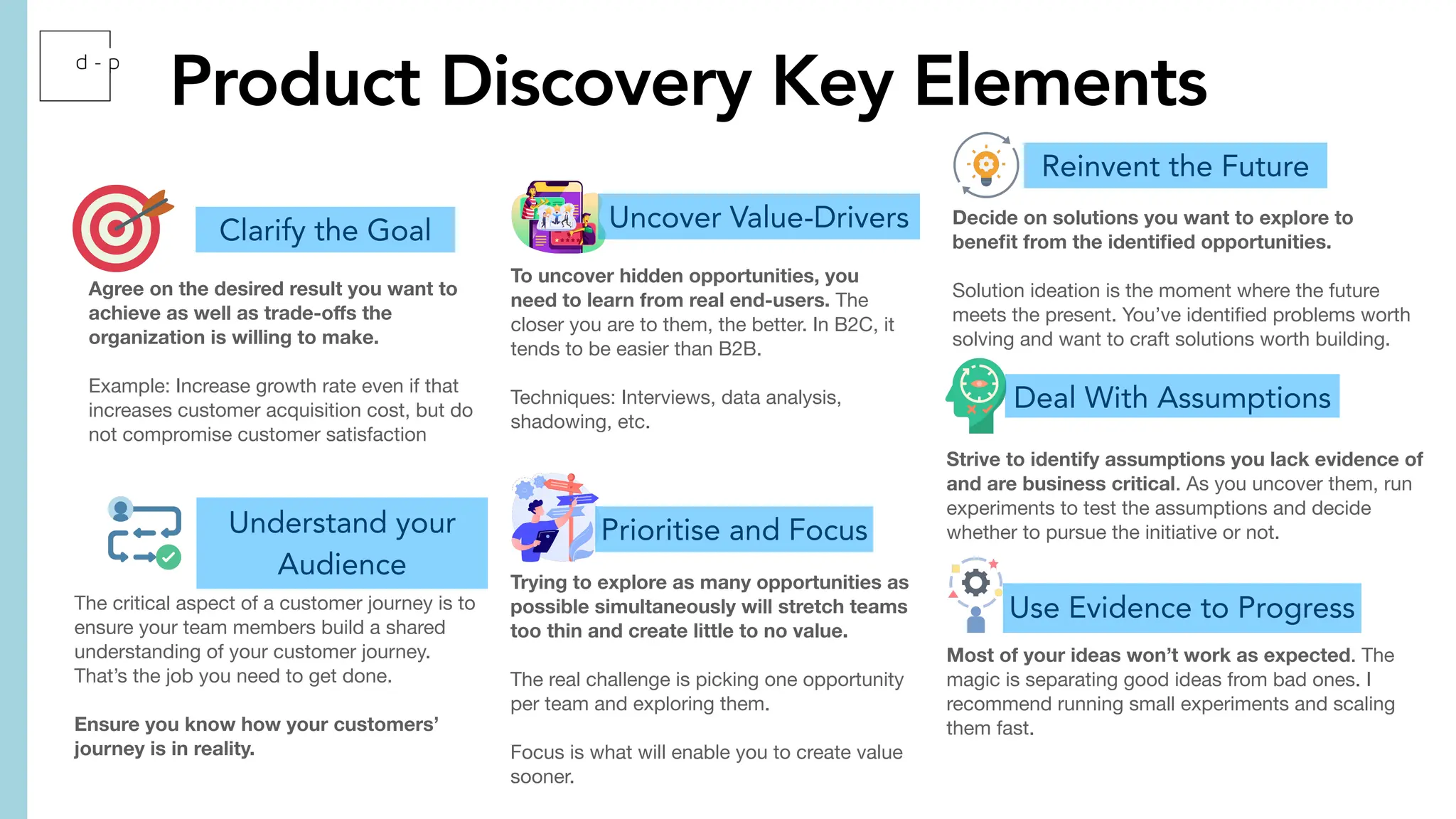
Product Discovery Key Elements
Clarify the Goal
Understand your
Audience
Uncover Value-Drivers
Reinvent the Future
Deal With Assumptions
Use Evidence to Progress
Prioritise and Focus
Agree on the desired result you want to
achieve as well as trade-o
ff
s the
organization is willing to make.
Example: Increase growth rate even if that
increases customer acquisition cost, but do
not compromise customer satisfaction
The critical aspect of a customer journey is to
ensure your team members build a shared
understanding of your customer journey.
That’s the job you need to get done.
Ensure you know how your customers’
journey is in reality.
To uncover hidden opportunities, you
need to learn from real end-users. The
closer you are to them, the better. In B2C, it
tends to be easier than B2B.
Techniques: Interviews, data analysis,
shadowing, etc.
Trying to explore as many opportunities as
possible simultaneously will stretch teams
too thin and create little to no value.
The real challenge is picking one opportunity
per team and exploring them.
Focus is what will enable you to create value
sooner.
Decide on solutions you want to explore to
bene
fi
t from the identi
fi
ed opportunities.
Solution ideation is the moment where the future
meets the present. You’ve identi
fi
ed problems worth
solving and want to craft solutions worth building.
Strive to identify assumptions you lack evidence of
and are business critical. As you uncover them, run
experiments to test the assumptions and decide
whether to pursue the initiative or not.
Most of your ideas won’t work as expected. The
magic is separating good ideas from bad ones. I
recommend running small experiments and scaling
them fast.
Succeeding with
Product Discovery
Absent or irrelevant
Value Proposition
Accelerates decision
No more than once a month
Customer Interviews
Frequent and insightful
Ignored or unspoken
Identifying Assumptions
Known and prioritized
Weak or no evidence
Testing Assumptions
Incrementally tested from
weak to strong evidence
High commitment to
single solutions
Ideation
Explore multiple solutions
for the same problem
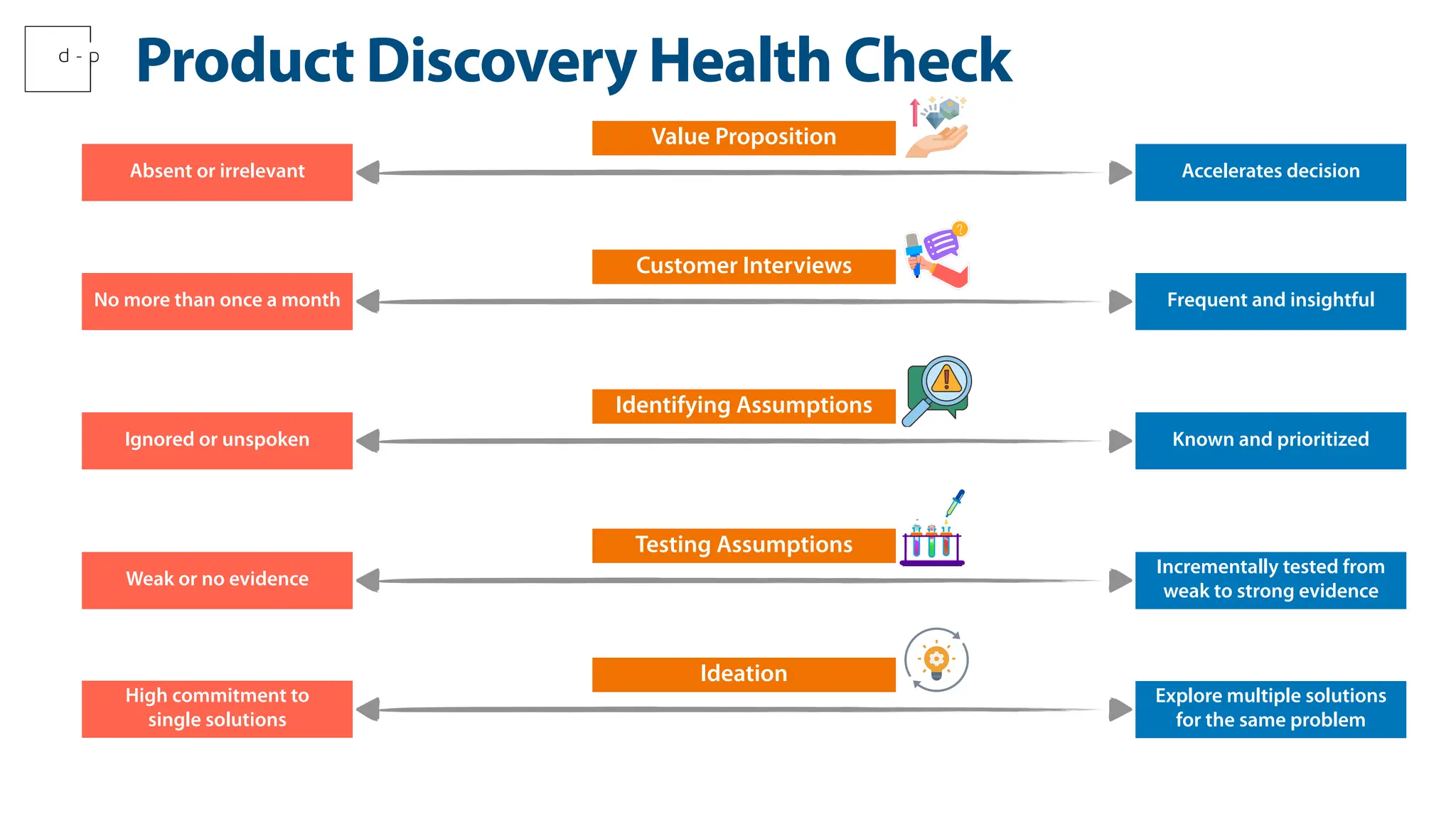
Product Discovery Health Check
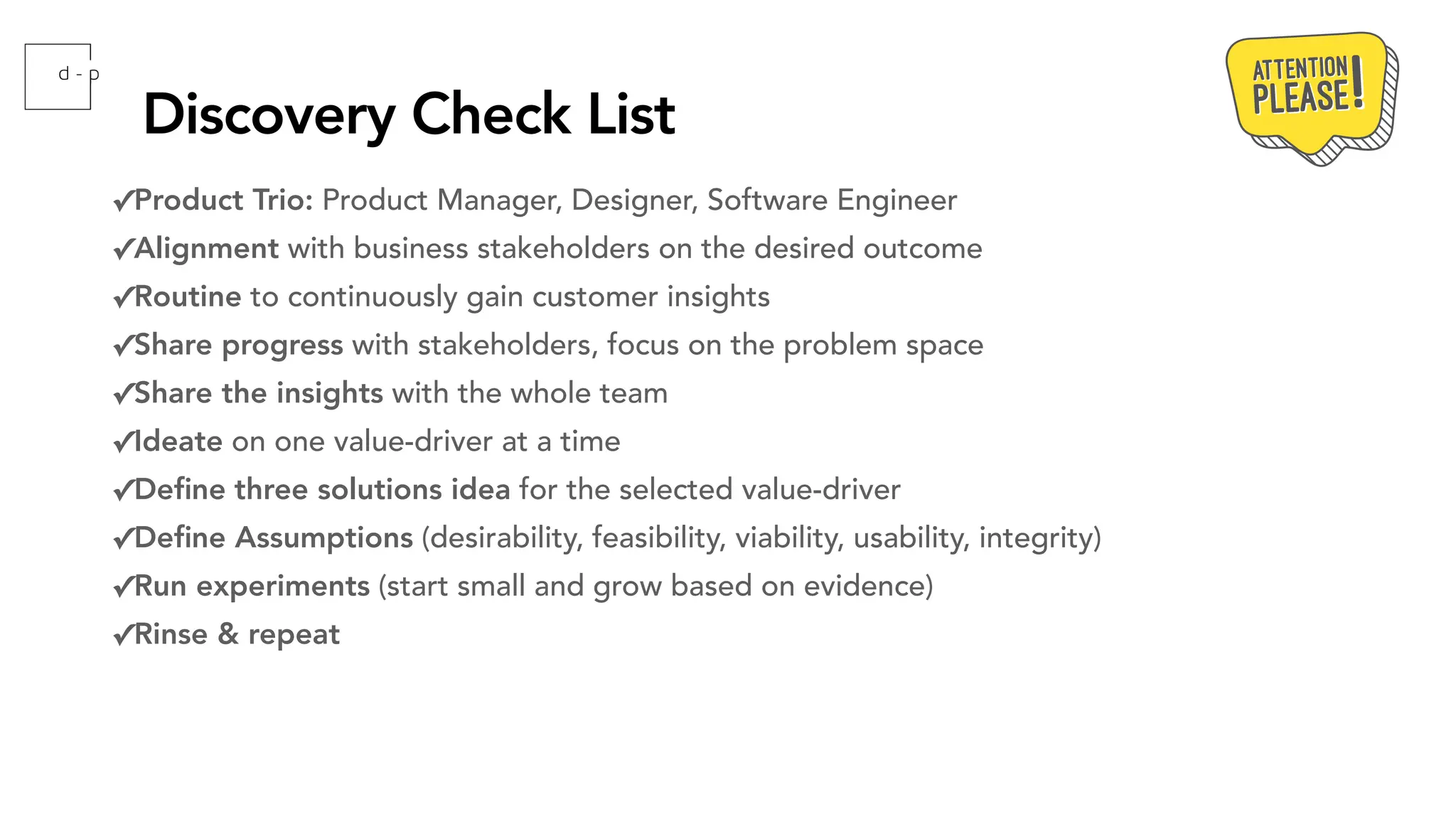
Discovery Check List
✓Product Trio: Product Manager, Designer, Software Engineer
✓Alignment with business stakeholders on the desired outcome
✓Routine to continuously gain customer insights
✓Share progress with stakeholders, focus on the problem space
✓Share the insights with the whole team
✓Ideate on one value-driver at a time
✓De
fi
ne three solutions idea for the selected value-driver
✓De
fi
ne Assumptions (desirability, feasibility, viability, usability, integrity)
✓Run experiments (start small and grow based on evidence)
✓Rinse & repeat
Thank you!
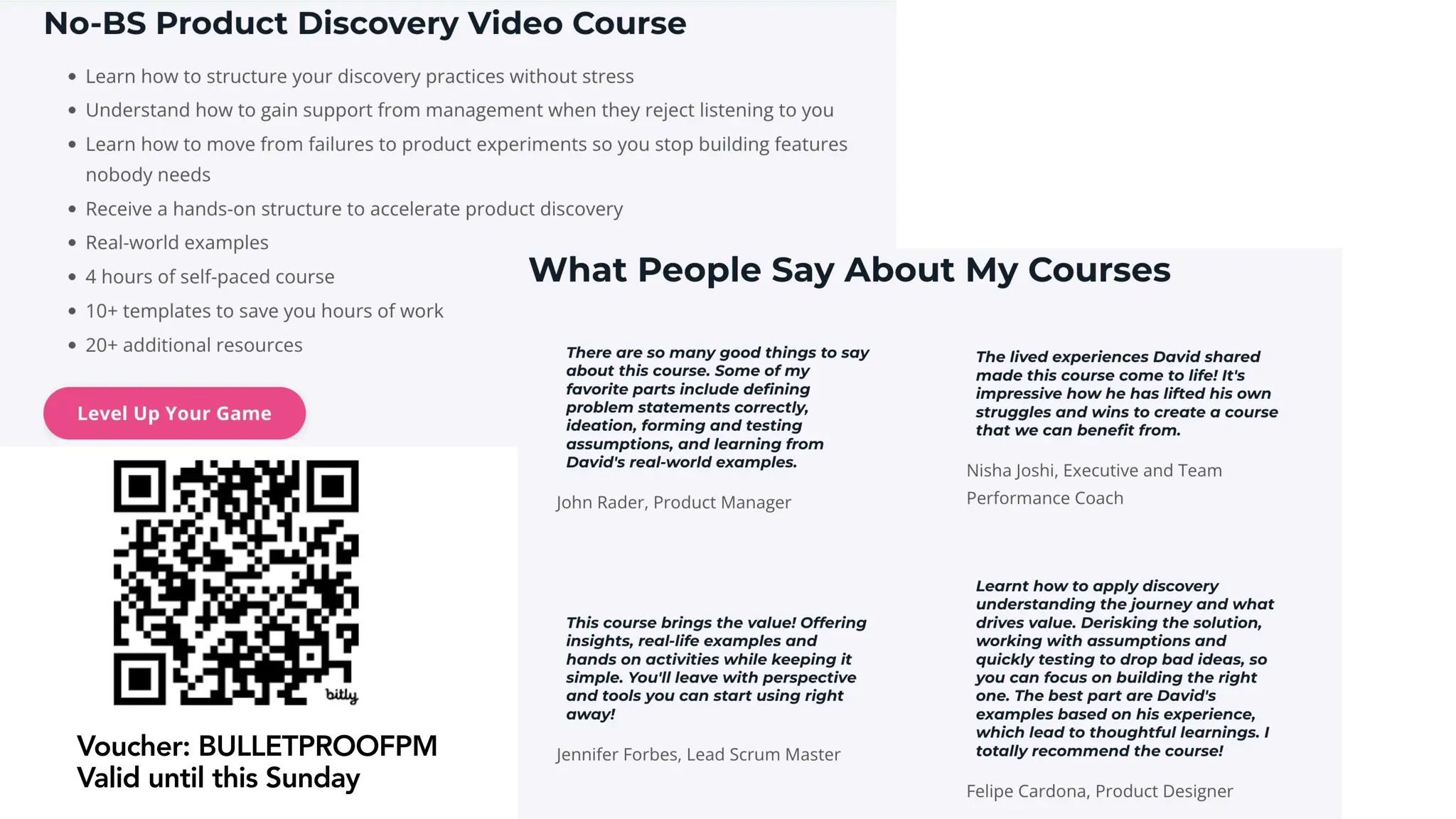
Voucher: BULLETPROOFPM
Valid until this Sunday

How to Overcome Common Mistakes with Product Discovery

  • 2.
  • 3.
    Produce what createsvalue Uncover what creates value Discovery Delivery
  • 4.
    Common Scenario Delivery 90 % Discovery 10% Ideal Scenario Discovery 75 % Delivery 25 %
  • 5.
    Delivery Trap More Features,Please Focus on delivering more features No one is discovering the future Tech debt is evil Deadlines matter the most
  • 6.
    When everyone focuseson the present, someone else will build the future
  • 7.
    Discovery Trap More Data,Please Everyone works on discovery No one has time for delivery Finding the perfect solution matters most Open ended discovery = no delivery
  • 8.
    When everyone focuseson the future Someone else will build the present
  • 9.
    Balancing Discovery andDelivery More Value, Please Half team focuses on problems Half team focuses on solutions Everyone is accountable end to end Mindset ‘ fi
  • 10.
    Make peace witha dual reality: 70% discovery and 30% delivery 70% delivery and 30% discovery
  • 11.
  • 12.
    SVPG Partner “The purposeof product discovery is to quickly separate the good ideas from the bad. The output of product discovery is a validated product backlog. Specifically, this means getting answers to four critical questions: Will the user buy this (or choose to use it)? Can the user figure out how to use this? Can our engineers build this? Can our stakeholders support this?” Marty Cagan d-pereira.com
  • 13.
    Product Strategy Simplify decision making Product Discovery Uncover whatcreates value Product Delivery Build what creates value Product Management Fundamentals
  • 14.
    Clarify the Goal UnderstandYour Audience Uncover Value Drivers Reinvent the Future Deal With Assumptions Use Evidence to Progress Prioritize and Focus Product Discovery Journey
  • 15.
    Product Discovery KeyElements Clarify the Goal Understand your Audience Uncover Value-Drivers Reinvent the Future Deal With Assumptions Use Evidence to Progress Prioritise and Focus Agree on the desired result you want to achieve as well as trade-o ff s the organization is willing to make. Example: Increase growth rate even if that increases customer acquisition cost, but do not compromise customer satisfaction The critical aspect of a customer journey is to ensure your team members build a shared understanding of your customer journey. That’s the job you need to get done. Ensure you know how your customers’ journey is in reality. To uncover hidden opportunities, you need to learn from real end-users. The closer you are to them, the better. In B2C, it tends to be easier than B2B. Techniques: Interviews, data analysis, shadowing, etc. Trying to explore as many opportunities as possible simultaneously will stretch teams too thin and create little to no value. The real challenge is picking one opportunity per team and exploring them. Focus is what will enable you to create value sooner. Decide on solutions you want to explore to bene fi t from the identi fi ed opportunities. Solution ideation is the moment where the future meets the present. You’ve identi fi ed problems worth solving and want to craft solutions worth building. Strive to identify assumptions you lack evidence of and are business critical. As you uncover them, run experiments to test the assumptions and decide whether to pursue the initiative or not. Most of your ideas won’t work as expected. The magic is separating good ideas from bad ones. I recommend running small experiments and scaling them fast.
  • 16.
  • 17.
    Absent or irrelevant ValueProposition Accelerates decision No more than once a month Customer Interviews Frequent and insightful Ignored or unspoken Identifying Assumptions Known and prioritized Weak or no evidence Testing Assumptions Incrementally tested from weak to strong evidence High commitment to single solutions Ideation Explore multiple solutions for the same problem Product Discovery Health Check
  • 18.
    Discovery Check List ✓ProductTrio: Product Manager, Designer, Software Engineer ✓Alignment with business stakeholders on the desired outcome ✓Routine to continuously gain customer insights ✓Share progress with stakeholders, focus on the problem space ✓Share the insights with the whole team ✓Ideate on one value-driver at a time ✓De fi ne three solutions idea for the selected value-driver ✓De fi ne Assumptions (desirability, feasibility, viability, usability, integrity) ✓Run experiments (start small and grow based on evidence) ✓Rinse & repeat
  • 19.
  • 20.