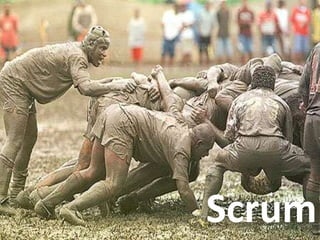
Introduction to Scrum
ScrumBenefitsWhere it comes fromWhat it isHow it worksScrum in corporate environmentscontent
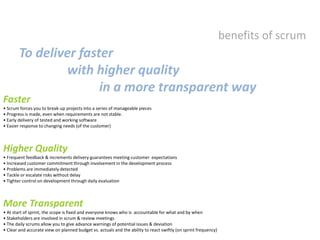
benefits of scrumTo deliver faster 		with higher quality 			in a more transparent way Faster  Scrum forces you to break-up projects into a series of manageable pieces
 Progress is made, even when requirements are not stable.
 Early delivery of tested and working software
 Easier response to changing needs (of the customer) Higher Quality  Frequent feedback & increments delivery guarantees meeting customer  expectations
 Increased customer commitment through involvement in the development process
 Problems are immediately detected
 Tackle or escalate risks without delay
 Tighter control on development through daily evaluation More Transparent  At start of sprint, the scope is fixed and everyone knows who is  accountable for what and by when
 Stakeholders are involved in scrum & review meetings
 The daily scrums allow you to give advance warnings of potential issues & deviation
 Clear and accurate view on planned budget vs. actuals and the ability to react swiftly (on sprint frequency) Scrum
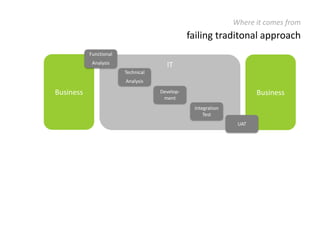
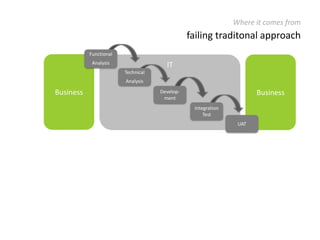
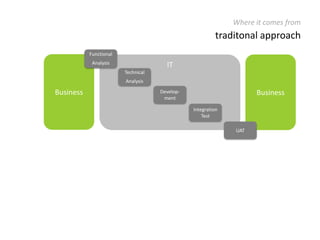
Where it comes fromfailing traditonal approachFunctional AnalysisBusinessBusinessITTechnicalAnalysisDevelop-mentIntegration TestUAT
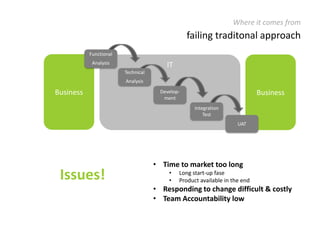
Where it comes fromfailing traditonal approachFunctional AnalysisBusinessBusinessITTechnicalAnalysisDevelop-mentIntegration TestUATTime to market too long
Long start-up fase
Product available in the end
Responding to change difficult & costly
Team Accountability lowIssues!
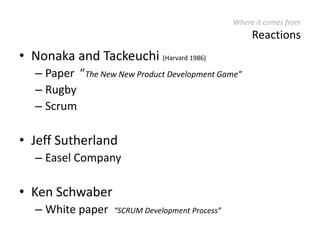
Where it comes from ReactionsNonaka and Tackeuchi (Harvard 1986)Paper  ”The New New Product Development Game”RugbyScrumJeff SutherlandEasel CompanyKen SchwaberWhite paper  “SCRUM Development Process”
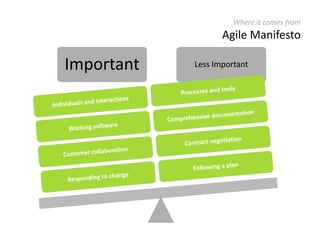
Where it comes from Agile Manifesto
Where it comes from Agile ValuesFocus on short, iterative development cycles
	Short time to functionality
	High visibility of progress
	Customer centricity
Efficient operational control: planning, progress, cost
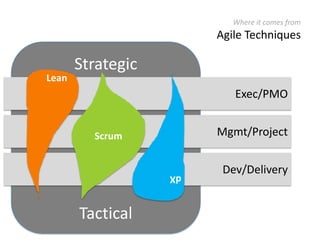
Best practices industry-based frameworksWhere it comes from Agile TechniquesStrategicTactical       LeandXScrumExec/PMOMgmt/ProjectDev/Delivery
Where it comes fromtraditonal approachFunctional AnalysisBusinessBusinessITTechnicalAnalysisDevelop-mentIntegration TestUAT
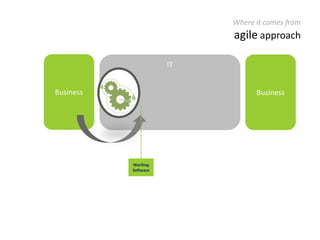
Where it comes from agile approachBusinessBusinessITWorking Software
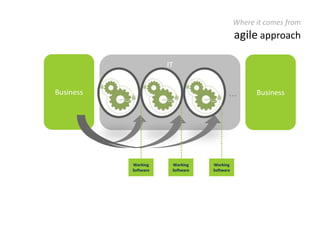
Where it comes from agile approachBusinessBusinessIT...Working SoftwareWorking SoftwareWorking Software
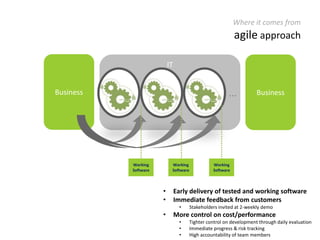
Where it comes from agile approachBusinessBusinessIT...Working SoftwareWorking SoftwareWorking SoftwareEarly delivery of tested and working software
Immediate feedback from customers
Stakeholders invited at 2-weekly demo
More control on cost/performance
Tighter control on development through daily evaluation
Immediate progress & risk tracking
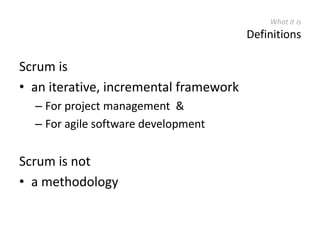
High accountability of team membersWhat it is DefinitionsScrum is an iterative, incremental frameworkFor project management  &For agile software developmentScrum is nota methodology
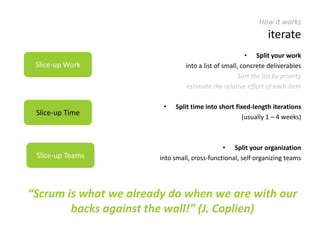
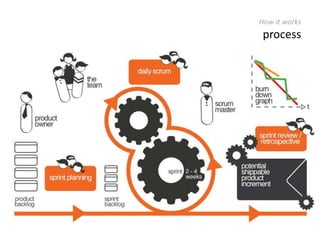
How it works iterateSplit your work 		into a list of small, concrete deliverables 			Sort the list by priority 			estimate the relative effort of each itemSplit time into short fixed-length iterations (usually 1 – 4 weeks)Split your organization 		into small, cross-functional, self organizing teamsSlice-up WorkSlice-up TimeSlice-up Teams“Scrum is what we already do when we are with our backs against the wall!” (J. Coplien)
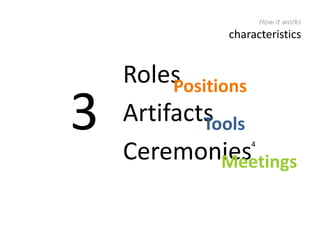
How it works characteristicsRolesArtifactsCeremoniesPositions3Tools4Meetings
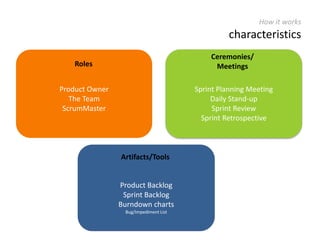
How it works characteristicsProduct OwnerThe TeamScrumMasterSprint Planning MeetingDaily Stand-upSprint ReviewSprint RetrospectiveCeremonies/MeetingsRolesProduct BacklogSprint BacklogBurndown chartsBug/Impediment ListArtifacts/Tools
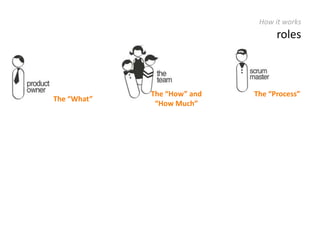
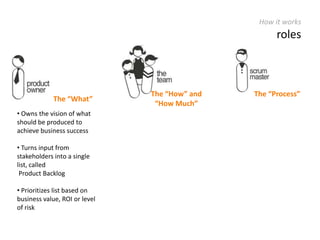
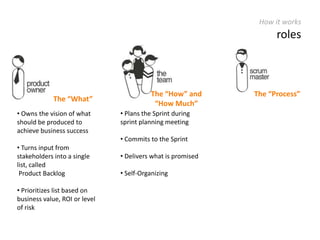
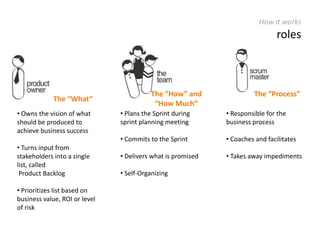
How it works rolesThe “How” and “How Much”The “Process”The “What”
How it works rolesThe “How” and “How Much”The “Process”The “What” Owns the vision of what should be produced to achieve business success
Turns input from stakeholders into a single list, called Product Backlog Prioritizes list based on business value, ROI or level of riskHow it works rolesThe “How” and “How Much”The “Process”The “What” Plans the Sprint during sprint planning meeting

Introducton to Scrum

  • 1.
  • 2.
    ScrumBenefitsWhere it comesfromWhat it isHow it worksScrum in corporate environmentscontent
  • 3.
    benefits of scrumTodeliver faster with higher quality in a more transparent way Faster Scrum forces you to break-up projects into a series of manageable pieces
  • 4.
    Progress ismade, even when requirements are not stable.
  • 5.
    Early deliveryof tested and working software
  • 6.
    Easier responseto changing needs (of the customer) Higher Quality Frequent feedback & increments delivery guarantees meeting customer expectations
  • 7.
    Increased customercommitment through involvement in the development process
  • 8.
    Problems areimmediately detected
  • 9.
    Tackle orescalate risks without delay
  • 10.
    Tighter controlon development through daily evaluation More Transparent At start of sprint, the scope is fixed and everyone knows who is accountable for what and by when
  • 11.
    Stakeholders areinvolved in scrum & review meetings
  • 12.
    The dailyscrums allow you to give advance warnings of potential issues & deviation
  • 13.
    Clear andaccurate view on planned budget vs. actuals and the ability to react swiftly (on sprint frequency) Scrum
  • 14.
    Where it comesfromfailing traditonal approachFunctional AnalysisBusinessBusinessITTechnicalAnalysisDevelop-mentIntegration TestUAT
  • 15.
    Where it comesfromfailing traditonal approachFunctional AnalysisBusinessBusinessITTechnicalAnalysisDevelop-mentIntegration TestUAT
  • 16.
    Where it comesfromfailing traditonal approachFunctional AnalysisBusinessBusinessITTechnicalAnalysisDevelop-mentIntegration TestUATTime to market too long
  • 17.
  • 18.
  • 19.
    Responding to changedifficult & costly
  • 20.
  • 21.
    Where it comesfrom ReactionsNonaka and Tackeuchi (Harvard 1986)Paper  ”The New New Product Development Game”RugbyScrumJeff SutherlandEasel CompanyKen SchwaberWhite paper “SCRUM Development Process”
  • 22.
    Where it comesfrom Agile Manifesto
  • 23.
    Where it comesfrom Agile ValuesFocus on short, iterative development cycles
  • 24.
    Short time tofunctionality
  • 25.
  • 26.
  • 27.
    Efficient operational control:planning, progress, cost
  • 28.
    Best practices industry-basedframeworksWhere it comes from Agile TechniquesStrategicTactical LeandXScrumExec/PMOMgmt/ProjectDev/Delivery
  • 29.
    Where it comesfromtraditonal approachFunctional AnalysisBusinessBusinessITTechnicalAnalysisDevelop-mentIntegration TestUAT
  • 30.
    Where it comesfrom agile approachBusinessBusinessITWorking Software
  • 31.
    Where it comesfrom agile approachBusinessBusinessIT...Working SoftwareWorking SoftwareWorking Software
  • 32.
    Where it comesfrom agile approachBusinessBusinessIT...Working SoftwareWorking SoftwareWorking SoftwareEarly delivery of tested and working software
  • 33.
  • 34.
  • 35.
    More control oncost/performance
  • 36.
    Tighter control ondevelopment through daily evaluation
  • 37.
  • 38.
    High accountability ofteam membersWhat it is DefinitionsScrum is an iterative, incremental frameworkFor project management &For agile software developmentScrum is nota methodology
  • 39.
    How it worksiterateSplit your work into a list of small, concrete deliverables Sort the list by priority estimate the relative effort of each itemSplit time into short fixed-length iterations (usually 1 – 4 weeks)Split your organization into small, cross-functional, self organizing teamsSlice-up WorkSlice-up TimeSlice-up Teams“Scrum is what we already do when we are with our backs against the wall!” (J. Coplien)
  • 40.
    How it workscharacteristicsRolesArtifactsCeremoniesPositions3Tools4Meetings
  • 41.
    How it workscharacteristicsProduct OwnerThe TeamScrumMasterSprint Planning MeetingDaily Stand-upSprint ReviewSprint RetrospectiveCeremonies/MeetingsRolesProduct BacklogSprint BacklogBurndown chartsBug/Impediment ListArtifacts/Tools
  • 42.
    How it worksrolesThe “How” and “How Much”The “Process”The “What”
  • 43.
    How it worksrolesThe “How” and “How Much”The “Process”The “What” Owns the vision of what should be produced to achieve business success
  • 44.
    Turns input fromstakeholders into a single list, called Product Backlog Prioritizes list based on business value, ROI or level of riskHow it works rolesThe “How” and “How Much”The “Process”The “What” Plans the Sprint during sprint planning meeting
  • 45.
    Commits tothe Sprint
  • 46.
    Delivers whatis promised
  • 47.
  • 48.
    Owns thevision of what should be produced to achieve business success
  • 49.
    Turns input fromstakeholders into a single list, called Product Backlog Prioritizes list based on business value, ROI or level of riskHow it works rolesThe “How” and “How Much”The “Process”The “What” Responsible for the business process
  • 50.
    Coaches andfacilitates
  • 51.
    Takes awayimpediments
  • 52.
    Plans theSprint during sprint planning meeting
  • 53.
    Commits tothe Sprint
  • 54.
    Delivers whatis promised
  • 55.
  • 56.
    Owns thevision of what should be produced to achieve business success
  • 57.
    Turns input fromstakeholders into a single list, called Product Backlog Prioritizes list based on business value, ROI or level of riskHow it works artifacts
  • 58.
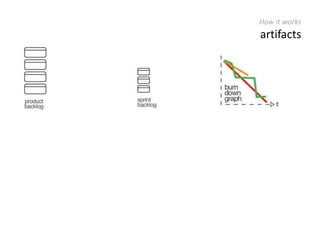
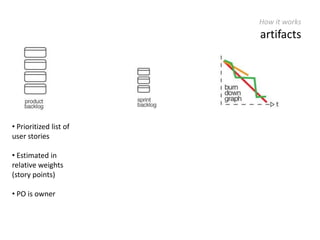
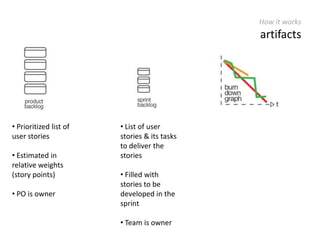
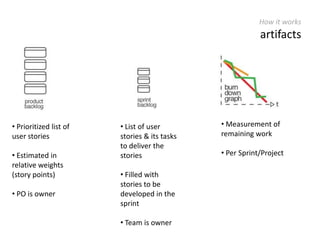
    How it worksartifacts Prioritized list of user stories
  • 59.
    Estimated inrelative weights (story points)
  • 60.
    PO isownerHow it works artifacts Prioritized list of user stories
  • 61.
    Estimated inrelative weights (story points)
  • 62.
    PO isowner
  • 63.
    List ofuser stories & its tasks to deliver the stories
  • 64.
    Filled withstories to be developed in the sprint
  • 65.
    Team isownerHow it works artifacts Measurement of remaining work
  • 66.
  • 67.
    Prioritized listof user stories
  • 68.
    Estimated inrelative weights (story points)
  • 69.
    PO isowner
  • 70.
    List ofuser stories & its tasks to deliver the stories
  • 71.
    Filled withstories to be developed in the sprint
  • 72.
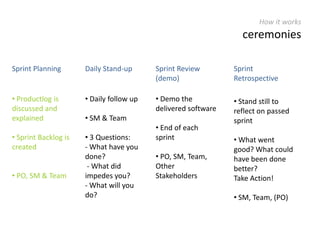
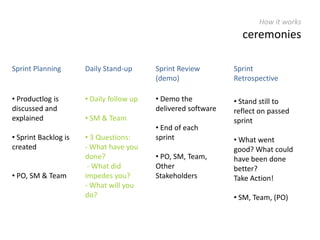
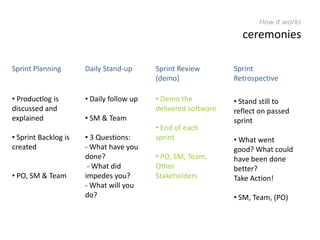
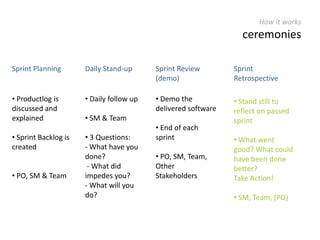
    Team isownerHow it works ceremoniesSprint PlanningDaily Stand-upSprint Review (demo)Sprint Retrospective Productlog is discussed and explained
  • 73.
    Sprint Backlogis created
  • 74.
    PO, SM& Team
  • 75.
  • 76.
    SM &Team
  • 77.
    3 Questions:-What have you done? - What did impedes you? - What will you do? Demo the delivered software
  • 78.
    End ofeach sprint
  • 79.
    PO, SM,Team, Other Stakeholders Stand still to reflect on passed sprint
  • 80.
    What wentgood? What could have been done better?Take Action! SM, Team, (PO)How it works ceremoniesSprint PlanningDaily Stand-upSprint Review (demo)Sprint Retrospective Productlog is discussed and explained
  • 81.
    Sprint Backlogis created
  • 82.
    PO, SM& Team
  • 83.
  • 84.
    SM &Team
  • 85.
    3 Questions:-What have you done? - What did impedes you? - What will you do? Demo the delivered software
  • 86.
    End ofeach sprint
  • 87.
    PO, SM,Team, Other Stakeholders Stand still to reflect on passed sprint
  • 88.
    What wentgood? What could have been done better?Take Action! SM, Team, (PO)How it works ceremoniesSprint PlanningDaily Stand-upSprint Review (demo)Sprint Retrospective Productlog is discussed and explained
  • 89.
    Sprint Backlogis created
  • 90.
    PO, SM& Team
  • 91.
  • 92.
    SM &Team
  • 93.
    3 Questions:-What have you done? - What did impedes you? - What will you do? Demo the delivered software
  • 94.
    End ofeach sprint
  • 95.
    PO, SM,Team, Other Stakeholders Stand still to reflect on passed sprint
  • 96.
    What wentgood? What could have been done better?Take Action! SM, Team, (PO)How it works ceremoniesSprint PlanningDaily Stand-upSprint Review (demo)Sprint Retrospective Productlog is discussed and explained
  • 97.
    Sprint Backlogis created
  • 98.
    PO, SM& Team
  • 99.
  • 100.
    SM &Team
  • 101.
    3 Questions:-What have you done? - What did impedes you? - What will you do? Demo the delivered software
  • 102.
    End ofeach sprint
  • 103.
    PO, SM,Team, Other Stakeholders Stand still to reflect on passed sprint
  • 104.
    What wentgood? What could have been done better?Take Action! SM, Team, (PO)How it works process
  • 105.
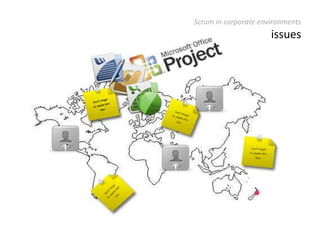
    Scrum in corporateenvironments issues
  • 106.
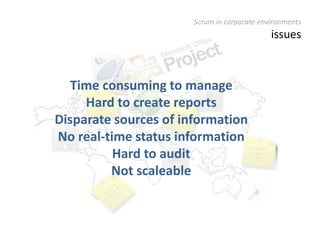
    Scrum in corporateenvironments issuesTime consuming to manageHard to create reportsDisparate sources of informationNo real-time status informationHard to auditNot scaleable
  • 107.
    Scrum in corporateenvironments solution
  • 108.
    Scrum in corporateenvironments solutionpmScrum is a pragmatic scrum tool that supports project teams endorsing the scrum framework - over multiple projects - in distributed teams 
  • 109.
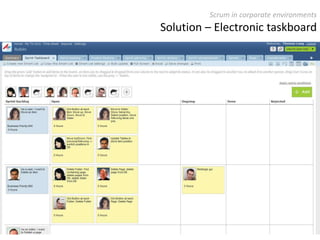
    Scrum in corporateenvironments Solution – Electronic taskboard
  • 110.
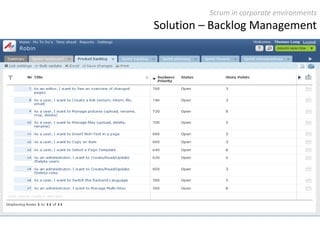
    Scrum in corporateenvironments Solution – Backlog Management
  • 111.
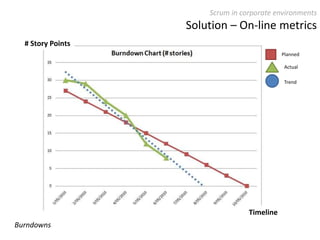
    Scrum in corporateenvironments Solution – On-line metrics# Story PointsPlannedActualTrendTimelineBurndowns
  • 112.
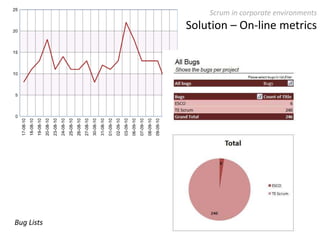
    Scrum in corporateenvironments Solution – On-line metricsBug Lists
  • 113.
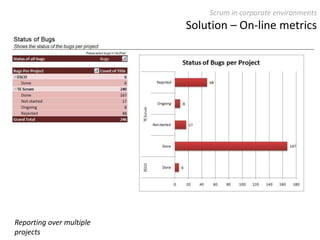
    Scrum in corporateenvironments Solution – On-line metricsReporting over multiple projects
  • 114.
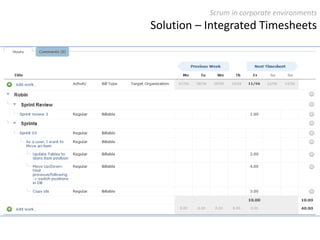
    Scrum in corporateenvironments Solution – Integrated Timesheets
  • 115.
    Scrum in corporateenvironments solutionpmScrum is a pragmatic scrum tool that supports project teams endorsing the scrum framework - over multiple projects - in distributed teams Reduces risksReduces costsIncreases benefitsIncreases transparency
  • 116.
    Frans VanhaelewijckProduct Managerfrans.vanhaelewijck@pmscrum.comMobile:+32 (0) 495 24 66 11www.pmscrum.com sales@pmscrum.com

Editor's Notes

  • #4 Zeggen dat er hier bij analisten veel oefeningen/spelletjes bijkomen.Ook bij ontwikkelaars spelletjes, maar veel minder.Hierna oefening Waterval doen!
  • #7 Add waterfall linkTime axis with long cycles when are requirements document ready (finaal requirements...)Uitleg over de driehoek -> fix features, plan resources + schedule
  • #9 Add waterfall linkTime axis with long cycles when are requirements document ready (finaal requirements...)Uitleg over de driehoek -> fix features, plan resources + schedule
  • #11 Welke bestaan er? Eerst probleen solven.Lean, scrum, xp : difference and how dowe support them