HANDHAND
INSTRUMENTSINSTRUMENTS
Flow chart
 IntroductionIntroduction
 HistoryHistory
 MaterialsMaterials
 Properties of materials usedProperties of materials used
 NomenclatureNomenclature
 ClassificationClassification
 Instrument formulaInstrument formula
 Instrument designInstrument design
 Various hand instruments techniquesVarious hand instruments techniques
 Individual instrumentsIndividual instruments
 Maintenance of instrumentsMaintenance of instruments
• sharpening of instrumentssharpening of instruments
• SterilizationSterilization
INTRODUCTIONINTRODUCTION
In order to perform intricate andIn order to perform intricate and
detailed procedures associated withdetailed procedures associated with
conservative dentistry ,the dentists mustconservative dentistry ,the dentists must
have a complete knowledge of the purposehave a complete knowledge of the purpose
and application of the many instrumentsand application of the many instruments
required.required.
Hand Instruments remain an essentialHand Instruments remain an essential
part of the armamentarium for qualitypart of the armamentarium for quality
restorative dentistry.restorative dentistry.
HISTORY
The best guide to the future is toThe best guide to the future is to
study about the paststudy about the past.
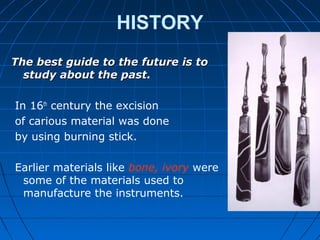
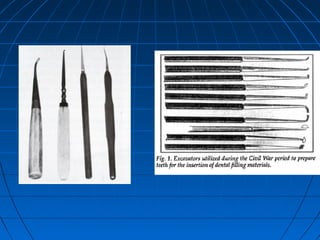
In 16th
century the excision
of carious material was done
by using burning stick.
Earlier materials like bone, ivory were
some of the materials used to
manufacture the instruments.
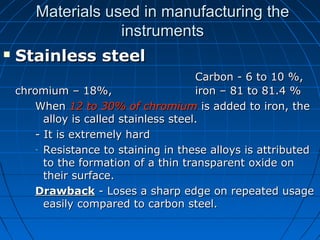
Materials used in manufacturing theMaterials used in manufacturing the
instrumentsinstruments
 Stainless steelStainless steel
Carbon - 6 to 10 %,Carbon - 6 to 10 %,
chromium – 18%,chromium – 18%, iron – 81 to 81.4 %iron – 81 to 81.4 %
WhenWhen 12 to 30% of chromium12 to 30% of chromium is added to iron, theis added to iron, the
alloy is called stainless steel.alloy is called stainless steel.
- It is extremely hard- It is extremely hard
- Resistance to staining in these alloys is attributedResistance to staining in these alloys is attributed
to the formation of a thin transparent oxide onto the formation of a thin transparent oxide on
their surface.their surface.
DrawbackDrawback - Loses a sharp edge on repeated usage- Loses a sharp edge on repeated usage
easily compared to carbon steel.easily compared to carbon steel.
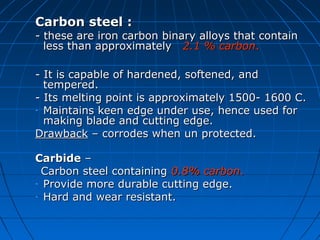
Carbon steel :Carbon steel :
-- these are iron carbon binary alloys that containthese are iron carbon binary alloys that contain
less than approximatelyless than approximately 2.1 % carbon2.1 % carbon..
- It is capable of hardened, softened, and- It is capable of hardened, softened, and
tempered.tempered.
- Its melting point is approximately 1500- 1600 C.- Its melting point is approximately 1500- 1600 C.
- Maintains keen edge under use, hence used forMaintains keen edge under use, hence used for
making blade and cutting edge.making blade and cutting edge.
DrawbackDrawback – corrodes when un protected.– corrodes when un protected.
CarbideCarbide ––
Carbon steel containingCarbon steel containing 0.8% carbon0.8% carbon..
- Provide more durable cutting edge.Provide more durable cutting edge.
- Hard and wear resistant.Hard and wear resistant.

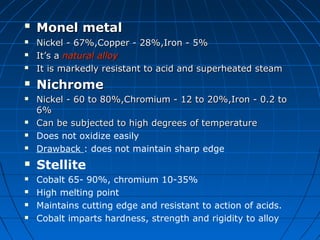
Monel metalMonel metal
 Nickel - 67%,Copper - 28%,Iron - 5%Nickel - 67%,Copper - 28%,Iron - 5%
 It’s aIt’s a natural alloynatural alloy
 It is markedly resistant to acid and superheated steamIt is markedly resistant to acid and superheated steam
 NichromeNichrome
 Nickel - 60 to 80%,Chromium - 12 to 20%,Iron - 0.2 toNickel - 60 to 80%,Chromium - 12 to 20%,Iron - 0.2 to
6%6%
 Can be subjected to high degrees of temperatureCan be subjected to high degrees of temperature
 Does not oxidize easily
 Drawback : does not maintain sharp edge
 Stellite
 Cobalt 65- 90%, chromium 10-35%
 High melting point
 Maintains cutting edge and resistant to action of acids.
 Cobalt imparts hardness, strength and rigidity to alloy
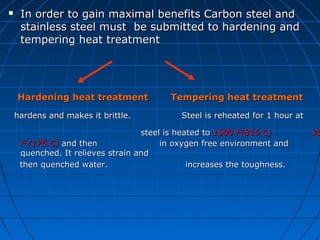
 In order to gain maximal benefits Carbon steel andIn order to gain maximal benefits Carbon steel and
stainless steel must be submitted to hardening andstainless steel must be submitted to hardening and
tempering heat treatmenttempering heat treatment
Hardening heat treatmentHardening heat treatment Tempering heat treatmentTempering heat treatment
hardens and makes it brittle. Steel is reheated for 1 hour athardens and makes it brittle. Steel is reheated for 1 hour at
steel is heated tosteel is heated to 1500 F(815 C)1500 F(815 C) 3535
F (176 C)F (176 C) and then in oxygen free environment andand then in oxygen free environment and
quenched. It relieves strain andquenched. It relieves strain and
then quenched water.then quenched water. increases the toughness.increases the toughness.
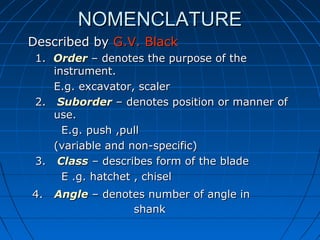
NOMENCLATURENOMENCLATURE
Described byDescribed by G.V. BlackG.V. Black
1.1. OrderOrder – denotes the purpose of the– denotes the purpose of the
instrument.instrument.
E.g. excavator, scalerE.g. excavator, scaler
2.2. SuborderSuborder – denotes position or manner of– denotes position or manner of
use.use.
E.g. push ,pullE.g. push ,pull
(variable and non-specific)(variable and non-specific)
3.3. ClassClass – describes form of the blade– describes form of the blade
E .g. hatchet , chiselE .g. hatchet , chisel
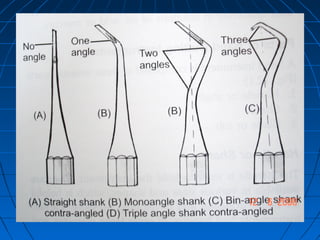
4.4. AngleAngle – denotes number of angle in– denotes number of angle in
shankshank
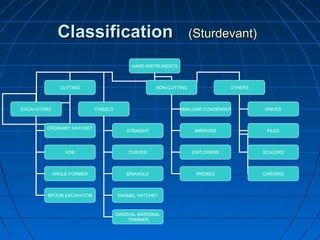
ClassificationClassification (Sturdevant)(Sturdevant)
HAND INSTRUMENTS
CUTTING NON-CUTTING
EXCAVATORS
ORDINARY HATCHET
HOE
CHISELS
ANGLE FORMER
SPOON EXCAVATOR
STRAIGHT
CURVED
BINANGLE
ENAMEL HATCHET
GINGIVAL MARGINAL
TRIMMER
AMALGAM CONDENSER
MIRRORS
EXPLORERS
PROBES
OTHERS
KNIVES
FILES
SCALERS
CARVERS
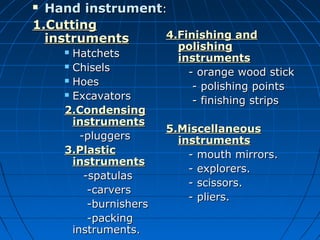
 Hand instrumentHand instrument::
1.Cutting1.Cutting
instrumentsinstruments
 HatchetsHatchets
 ChiselsChisels
 HoesHoes
 ExcavatorsExcavators
2.Condensing2.Condensing
instrumentsinstruments
-pluggers-pluggers
3.Plastic3.Plastic
instrumentsinstruments
-spatulas-spatulas
-carvers-carvers
-burnishers-burnishers
-packing-packing
instruments.instruments.
4.Finishing and4.Finishing and
polishingpolishing
instrumentsinstruments
- orange wood stick- orange wood stick
- polishing points- polishing points
- finishing strips- finishing strips
5.Miscellaneous5.Miscellaneous
instrumentsinstruments
- mouth mirrors.- mouth mirrors.
- explorers.- explorers.
- scissors.- scissors.
- pliers.- pliers.
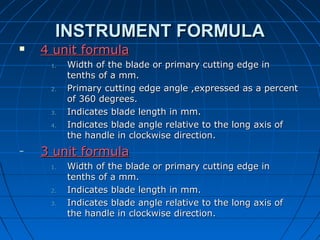
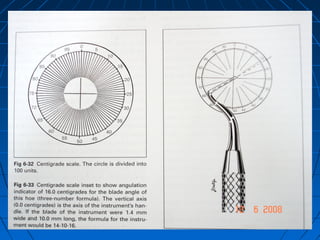
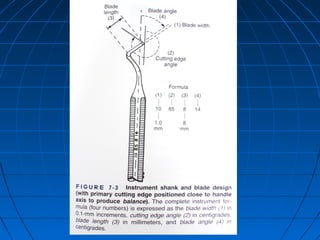
INSTRUMENT FORMULAINSTRUMENT FORMULA
 4 unit formula4 unit formula
1.1. Width of the blade or primary cutting edge inWidth of the blade or primary cutting edge in
tenths of a mm.tenths of a mm.
2.2. Primary cutting edge angle ,expressed as a percentPrimary cutting edge angle ,expressed as a percent
of 360 degrees.of 360 degrees.
3.3. Indicates blade length in mm.Indicates blade length in mm.
4.4. Indicates blade angle relative to the long axis ofIndicates blade angle relative to the long axis of
the handle in clockwise direction.the handle in clockwise direction.
– 3 unit formula3 unit formula
1.1. Width of the blade or primary cutting edge inWidth of the blade or primary cutting edge in
tenths of a mm.tenths of a mm.
2.2. Indicates blade length in mm.Indicates blade length in mm.
3.3. Indicates blade angle relative to the long axis ofIndicates blade angle relative to the long axis of
the handle in clockwise direction.the handle in clockwise direction.
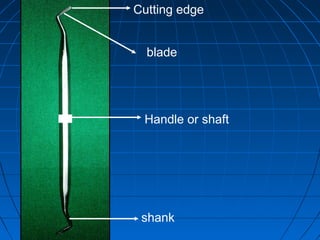
blade
Cutting edge
Handle or shaft
shank
INSTRUMENTSINSTRUMENTS
A)A) direct cuttingdirect cutting
instrument-instrument-
forces applied inforces applied in
the same planethe same plane
of blade andof blade and
handle.handle.
B)B) Single planedSingle planed
C)C) Can be used inCan be used in
both direct andboth direct and
lateral cutting.lateral cutting.
B)B) lateral cutting instrument-lateral cutting instrument-
force applied at right angle toforce applied at right angle to
blade and handleblade and handle
Double planedDouble planed
used only in lateral cuttingused only in lateral cutting
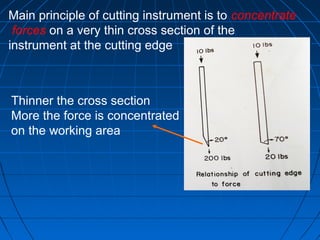
Thinner the cross section
More the force is concentrated
on the working area
Main principle of cutting instrument is to concentrate
forces on a very thin cross section of the
instrument at the cutting edge
2.2. ContranglingContrangling
depends on length of the blade and angulation in shankdepends on length of the blade and angulation in shank..
PurposePurpose--
-mainly to gain access.-mainly to gain access.
-instruments are designed such that-instruments are designed such that
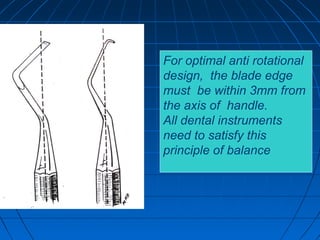
working point isworking point is within 3mmwithin 3mm from the axis of handle.from the axis of handle.
-short blade and small blade angles require only binangle-short blade and small blade angles require only binangle
contrangling.contrangling.
-longer blade and greater blade angle require triple angle-longer blade and greater blade angle require triple angle
contrangling.contrangling.
Greater angles are used inGreater angles are used in ––
-posterior teeth-posterior teeth
-incisal portion of proximal cavities-incisal portion of proximal cavities inin
anteriorsanteriors..
For optimal anti rotational
design, the blade edge
must be within 3mm from
the axis of handle.
All dental instruments
need to satisfy this
principle of balance.
For optimal anti rotational
design, the blade edge
must be within 3mm from
the axis of handle.
All dental instruments
need to satisfy this
principle of balance
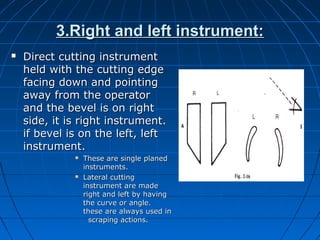
3.Right and left instrument:3.Right and left instrument:
 Direct cutting instrumentDirect cutting instrument
held with the cutting edgeheld with the cutting edge
facing down and pointingfacing down and pointing
away from the operatoraway from the operator
and the bevel is on rightand the bevel is on right
side, it is right instrument.side, it is right instrument.
if bevel is on the left, leftif bevel is on the left, left
instrument.instrument.
 These are single planedThese are single planed
instruments.instruments.
 Lateral cuttingLateral cutting
instrument are madeinstrument are made
right and left by havingright and left by having
the curve or angle.the curve or angle.
these are always used inthese are always used in
scraping actions.scraping actions.
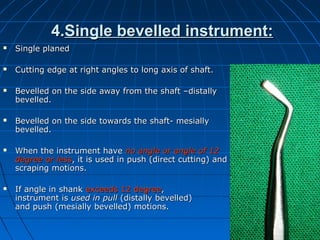
4.4.Single bevelled instrument:Single bevelled instrument:
 Single planedSingle planed
 Cutting edge at right angles to long axis of shaft.Cutting edge at right angles to long axis of shaft.
 Bevelled on the side away from the shaft –distallyBevelled on the side away from the shaft –distally
bevelled.bevelled.
 Bevelled on the side towards the shaft- mesiallyBevelled on the side towards the shaft- mesially
bevelled.bevelled.
 When the instrument haveWhen the instrument have no angle or angle ofno angle or angle of 1212
degree or lessdegree or less, it is used in push (direct cutting) and, it is used in push (direct cutting) and
scraping motions.scraping motions.
 If angle in shankIf angle in shank exceeds 12 degreeexceeds 12 degree,,
instrument isinstrument is used in pullused in pull (distally bevelled)(distally bevelled)
and push (mesially bevelled) motions.and push (mesially bevelled) motions.
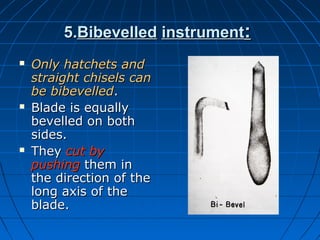
5.5.BibevelledBibevelled instrumentinstrument::
 Only hatchets andOnly hatchets and
straight chisels canstraight chisels can
be bibevelledbe bibevelled..
 Blade is equallyBlade is equally
bevelled on bothbevelled on both
sides.sides.
 TheyThey cut bycut by
pushingpushing them inthem in
the direction of thethe direction of the
long axis of thelong axis of the
blade.blade.
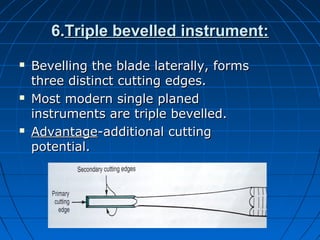
6.6.Triple bevelled instrument:Triple bevelled instrument:
 Bevelling the blade laterally, formsBevelling the blade laterally, forms
three distinct cutting edges.three distinct cutting edges.
 Most modern single planedMost modern single planed
instruments are triple bevelled.instruments are triple bevelled.
 AdvantageAdvantage-additional cutting-additional cutting
potential.potential.
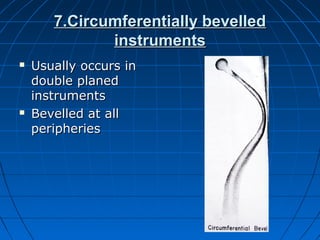
7.Circumferentially bevelled7.Circumferentially bevelled
instrumentsinstruments
 Usually occurs inUsually occurs in
double planeddouble planed
instrumentsinstruments
 Bevelled at allBevelled at all
peripheriesperipheries
8.Single ended and double ended8.Single ended and double ended
instrumentsinstruments
 The most modern instruments are doubleThe most modern instruments are double
ended.ended.
 Single planed instruments with no angleSingle planed instruments with no angle
in the shank have potential 5 cuttingin the shank have potential 5 cutting
movements. They are –movements. They are –
 vertical,right ,left,push and pullvertical,right ,left,push and pull
 Mesially and distally bevelled single planedMesially and distally bevelled single planed
instruments the 4 movements areinstruments the 4 movements are
 vertical,right ,left ,push or pull.vertical,right ,left ,push or pull.
Hand instrument techniquesHand instrument techniques
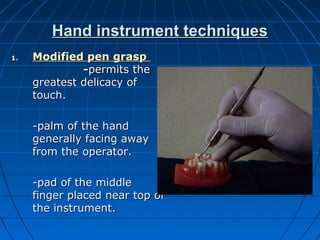
1.1. Modified pen graspModified pen grasp
--permits thepermits the
greatest delicacy ofgreatest delicacy of
touch.touch.
-palm of the hand-palm of the hand
generally facing awaygenerally facing away
from the operator.from the operator.
-pad of the middle-pad of the middle
finger placed near top offinger placed near top of
the instrument.the instrument.
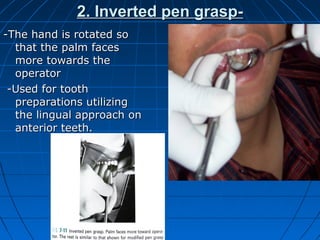
2. Inverted pen grasp-2. Inverted pen grasp-
-The hand is rotated so-The hand is rotated so
that the palm facesthat the palm faces
more towards themore towards the
operatoroperator
-Used for tooth-Used for tooth
preparations utilizingpreparations utilizing
the lingual approach onthe lingual approach on
anterior teeth.anterior teeth.
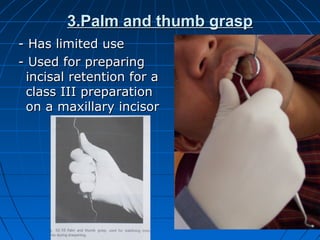
3.Palm and thumb grasp3.Palm and thumb grasp
- Has limited use- Has limited use
- Used for preparing- Used for preparing
incisal retention for aincisal retention for a
class III preparationclass III preparation
on a maxillary incisoron a maxillary incisor
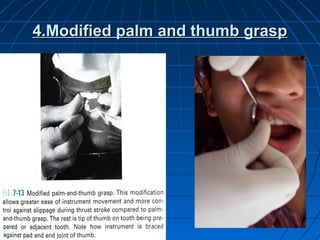
4.Modified palm and thumb grasp4.Modified palm and thumb grasp
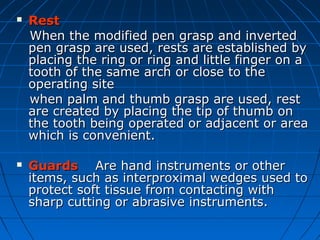
 RestRest
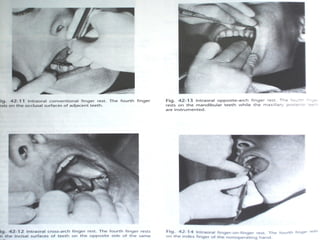
When the modified pen grasp and invertedWhen the modified pen grasp and inverted
pen grasp are used, rests are established bypen grasp are used, rests are established by
placing the ring or ring and little finger on aplacing the ring or ring and little finger on a
tooth of the same arch or close to thetooth of the same arch or close to the
operating siteoperating site
when palm and thumb grasp are used, restwhen palm and thumb grasp are used, rest
are created by placing the tip of thumb onare created by placing the tip of thumb on
the tooth being operated or adjacent or areathe tooth being operated or adjacent or area
which is convenient.which is convenient.
 GuardsGuards Are hand instruments or otherAre hand instruments or other
items, such as interproximal wedges used toitems, such as interproximal wedges used to
protect soft tissue from contacting withprotect soft tissue from contacting with
sharp cutting or abrasive instruments.sharp cutting or abrasive instruments.
INDIVIDUAL INSTRUMENTSINDIVIDUAL INSTRUMENTS
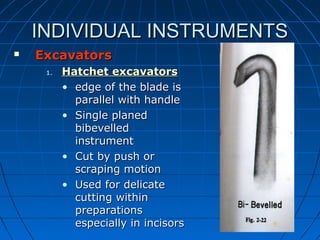
 ExcavatorsExcavators
1.1. Hatchet excavatorsHatchet excavators
• edge of the blade isedge of the blade is
parallel with handleparallel with handle
• Single planedSingle planed
bibevelledbibevelled
instrumentinstrument
• Cut by push orCut by push or
scraping motionscraping motion
• Used for delicateUsed for delicate
cutting withincutting within
preparationspreparations
especially in incisorsespecially in incisors
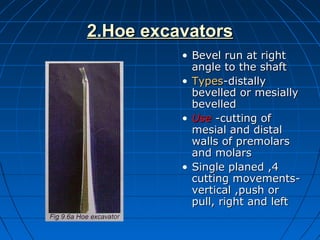
2.Hoe excavators2.Hoe excavators
• Bevel run at rightBevel run at right
angle to the shaftangle to the shaft
• TypesTypes-distally-distally
bevelled or mesiallybevelled or mesially
bevelledbevelled
• UseUse -cutting of-cutting of
mesial and distalmesial and distal
walls of premolarswalls of premolars
and molarsand molars
• Single planed ,4Single planed ,4
cutting movements-cutting movements-
vertical ,push orvertical ,push or
pull, right and leftpull, right and left
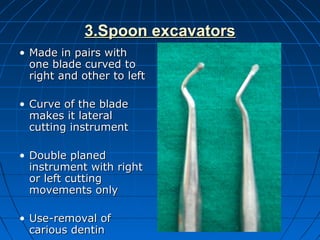
3.Spoon excavators3.Spoon excavators
• Made in pairs withMade in pairs with
one blade curved toone blade curved to
right and other to leftright and other to left
• Curve of the bladeCurve of the blade
makes it lateralmakes it lateral
cutting instrumentcutting instrument
• Double planedDouble planed
instrument with rightinstrument with right
or left cuttingor left cutting
movements onlymovements only
• Use-removal ofUse-removal of
carious dentincarious dentin
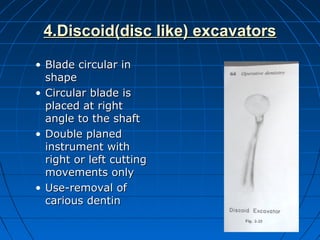
4.Discoid(disc like) excavators4.Discoid(disc like) excavators
• Blade circular inBlade circular in
shapeshape
• Circular blade isCircular blade is
placed at rightplaced at right
angle to the shaftangle to the shaft
• Double planedDouble planed
instrument withinstrument with
right or left cuttingright or left cutting
movements onlymovements only
• Use-removal ofUse-removal of
carious dentincarious dentin
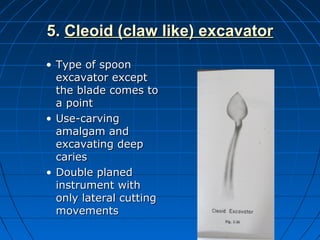
5.5. Cleoid (claw like) excavatorCleoid (claw like) excavator
• Type of spoonType of spoon
excavator exceptexcavator except
the blade comes tothe blade comes to
a pointa point
• Use-carvingUse-carving
amalgam andamalgam and
excavating deepexcavating deep
cariescaries
• Double planedDouble planed
instrument withinstrument with
only lateral cuttingonly lateral cutting
movementsmovements
• CHISELSCHISELS
• Mainly intended for cutting enamel.Mainly intended for cutting enamel.
• Used to smoothen cavity walls.Used to smoothen cavity walls.
• Usually bevelled on one side only.Usually bevelled on one side only.
• Used to sharpen cavity preparation.Used to sharpen cavity preparation.
 4 types of Chisel4 types of Chisel
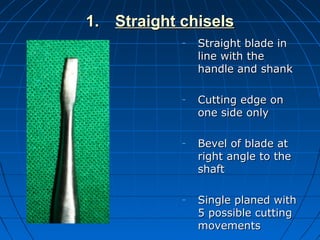
1.1. Straight chiselsStraight chisels
– Straight blade inStraight blade in
line with theline with the
handle and shankhandle and shank
– Cutting edge onCutting edge on
one side onlyone side only
– Bevel of blade atBevel of blade at
right angle to theright angle to the
shaftshaft
– Single planed withSingle planed with
5 possible cutting5 possible cutting
movementsmovements
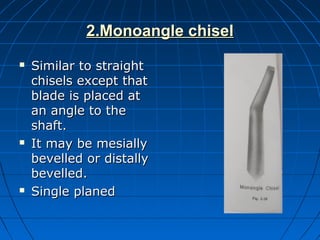
2.Monoangle chisel2.Monoangle chisel
 Similar to straightSimilar to straight
chisels except thatchisels except that
blade is placed atblade is placed at
an angle to thean angle to the
shaft.shaft.
 It may be mesiallyIt may be mesially
bevelled or distallybevelled or distally
bevelled.bevelled.
 Single planedSingle planed
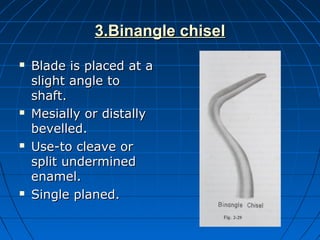
3.Binangle chisel3.Binangle chisel
 Blade is placed at aBlade is placed at a
slight angle toslight angle to
shaft.shaft.
 Mesially or distallyMesially or distally
bevelled.bevelled.
 Use-to cleave orUse-to cleave or
split underminedsplit undermined
enamel.enamel.
 Single planed.Single planed.
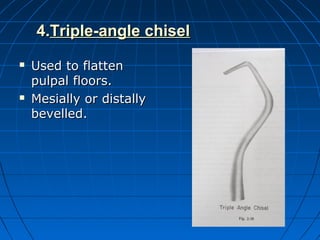
4.4.Triple-angle chiselTriple-angle chisel
 Used to flattenUsed to flatten
pulpal floors.pulpal floors.
 Mesially or distallyMesially or distally
bevelled.bevelled.
Special forms of chiselsSpecial forms of chisels
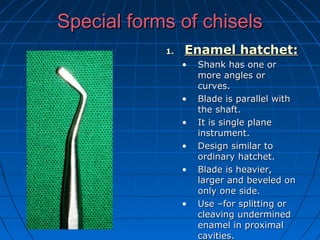
1.1. Enamel hatchet:Enamel hatchet:
• Shank has one orShank has one or
more angles ormore angles or
curves.curves.
• Blade is parallel withBlade is parallel with
the shaft.the shaft.
• It is single planeIt is single plane
instrument.instrument.
• Design similar toDesign similar to
ordinary hatchet.ordinary hatchet.
• Blade is heavier,Blade is heavier,
larger and beveled onlarger and beveled on
only one side.only one side.
• Use –for splitting orUse –for splitting or
cleaving underminedcleaving undermined
enamel in proximalenamel in proximal
cavities.cavities.
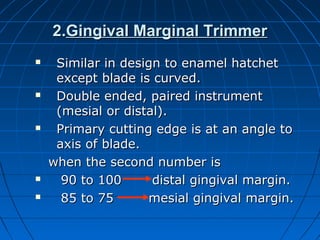
2.2.Gingival Marginal TrimmerGingival Marginal Trimmer
 Similar in design to enamel hatchetSimilar in design to enamel hatchet
except blade is curved.except blade is curved.
 Double ended, paired instrumentDouble ended, paired instrument
(mesial or distal).(mesial or distal).
 Primary cutting edge is at an angle toPrimary cutting edge is at an angle to
axis of blade.axis of blade.
when the second number iswhen the second number is
 90 to 100 distal gingival margin.90 to 100 distal gingival margin.
 85 to 75 mesial gingival margin.85 to 75 mesial gingival margin.
 The 100 and 75 pairs are for inlay orThe 100 and 75 pairs are for inlay or
onlay preparations with steep gingivalonlay preparations with steep gingival
bevels.bevels.
 90 and 85 pairs are for amalgam90 and 85 pairs are for amalgam
preparations with gingival enamel bevelspreparations with gingival enamel bevels
that decline slight gingivally.that decline slight gingivally.
 Primarily lateral cutting instrument.Primarily lateral cutting instrument.
 Used in pull and push motions to sharpenUsed in pull and push motions to sharpen
point and line angels.point and line angels.
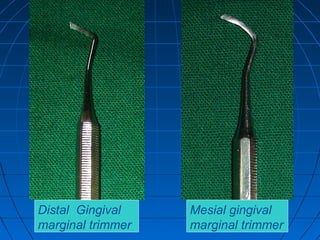
Distal Gingival
marginal trimmer
Mesial gingival
marginal trimmer
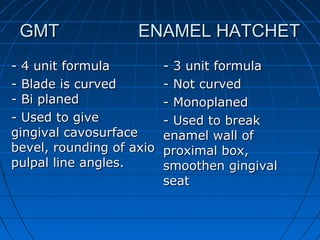
GMT ENAMEL HATCHETGMT ENAMEL HATCHET
- 4 unit formula- 4 unit formula
- Blade is curved- Blade is curved
- Bi planed- Bi planed
- Used to give- Used to give
gingival cavosurfacegingival cavosurface
bevel, rounding of axiobevel, rounding of axio
pulpal line angles.pulpal line angles.
- 3 unit formula- 3 unit formula
- Not curved- Not curved
- Monoplaned- Monoplaned
- Used to break- Used to break
enamel wall ofenamel wall of
proximal box,proximal box,
smoothen gingivalsmoothen gingival
seatseat
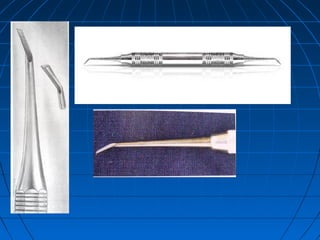
3.3.Angle FormerAngle Former
 Are made by grinding the bevel at anAre made by grinding the bevel at an
angle of 80 degree with the shaft,angle of 80 degree with the shaft,
forming an acute angle with the long axisforming an acute angle with the long axis
of the shaft.of the shaft.
 Single planed instrument.Single planed instrument.
 Used to cut line and point angles.Used to cut line and point angles.
 They share three cutting potentialsThey share three cutting potentials
vertical, push and pull.vertical, push and pull.
4.4.Wedelstaedt Chisels.Wedelstaedt Chisels.
 Its like a straight chisel, with a slightIts like a straight chisel, with a slight
vertical curvature in the shank.vertical curvature in the shank.
 Bevelled on only one side of the shank.Bevelled on only one side of the shank.
 Single planed instruments with threeSingle planed instruments with three
cutting motions, vertical, right and left.cutting motions, vertical, right and left.
 Mesially bevelled used in pushMesially bevelled used in push
movement, distally bevelled in pullmovement, distally bevelled in pull
motions.motions.
USE-USE-
 For cleaving undermined enamel.For cleaving undermined enamel.
 For shaping walls.For shaping walls.
 Used primarily on anterior teeth.Used primarily on anterior teeth.
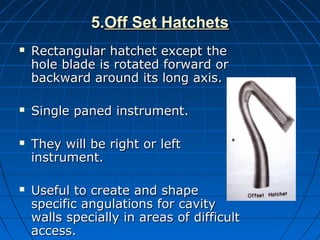
5.5.Off Set HatchetsOff Set Hatchets
 Rectangular hatchet except theRectangular hatchet except the
hole blade is rotated forward orhole blade is rotated forward or
backward around its long axis.backward around its long axis.
 Single paned instrument.Single paned instrument.
 They will be right or leftThey will be right or left
instrument.instrument.
 Useful to create and shapeUseful to create and shape
specific angulations for cavityspecific angulations for cavity
walls specially in areas of difficultwalls specially in areas of difficult
access.access.
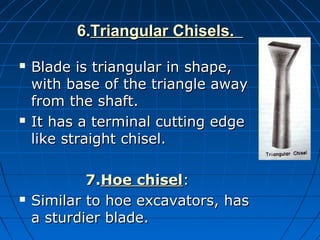
6.6.Triangular Chisels.Triangular Chisels.
 Blade is triangular in shape,Blade is triangular in shape,
with base of the triangle awaywith base of the triangle away
from the shaft.from the shaft.
 It has a terminal cutting edgeIt has a terminal cutting edge
like straight chisel.like straight chisel.
7.7.Hoe chiselHoe chisel::
 Similar to hoe excavators, hasSimilar to hoe excavators, has
a sturdier blade.a sturdier blade.
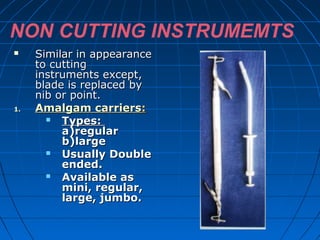
NON CUTTING INSTRUMEMTS
 Similar in appearanceSimilar in appearance
to cuttingto cutting
instruments except,instruments except,
blade is replaced byblade is replaced by
nib or point.nib or point.
1.1. Amalgam carriersAmalgam carriers::
 Types:Types:
a)regulara)regular
b)largeb)large
 Usually DoubleUsually Double
ended.ended.
 Available asAvailable as
mini, regular,mini, regular,
large, jumbo.large, jumbo.

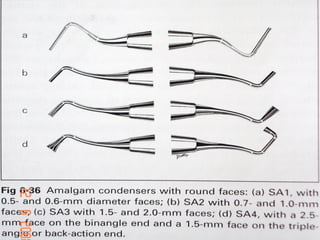
2.2.Condensers:Condensers:
 Working ends or nibs are round with flatWorking ends or nibs are round with flat
ends.ends.
 Shapes-round,triangular,rectangular orShapes-round,triangular,rectangular or
diamond.diamond.
 Vertical condensationVertical condensation: amalgam: amalgam
condensed against preparation floorcondensed against preparation floor
through vertical pressure.through vertical pressure.
 Lateral condensationsLateral condensations: condensed against: condensed against
vertical walls of preparation.vertical walls of preparation.
3.Carvers3.Carvers
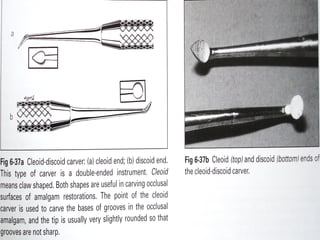
1.1.Cleoid-discoid carversCleoid-discoid carvers::
• Use:-occlusal carving of amalgamUse:-occlusal carving of amalgam
restoration.restoration.
• - carving occlusal surfaces of posterior resin- carving occlusal surfaces of posterior resin
composite restoration.composite restoration.
2.2.Walls no.3 carversWalls no.3 carvers :-used for carving:-used for carving
occlusal surfaces.occlusal surfaces.
-for shaping cusps and carving facial and-for shaping cusps and carving facial and
lingual walls of large amalgam restorations.lingual walls of large amalgam restorations.
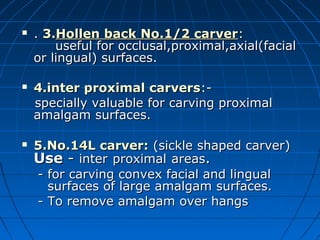
 .. 3.3.Hollen back No.1/2 carverHollen back No.1/2 carver::
useful for occlusal,proximal,axial(facialuseful for occlusal,proximal,axial(facial
or lingual) surfaces.or lingual) surfaces.
 4.inter proximal carvers4.inter proximal carvers:-:-
specially valuable for carving proximalspecially valuable for carving proximal
amalgam surfaces.amalgam surfaces.
 5.No.14L carver:5.No.14L carver: (sickle shaped carver)(sickle shaped carver)
UseUse -- interinter proximalproximal areasareas..
- for carving convex facial and lingual- for carving convex facial and lingual
surfaces of large amalgam surfaces.surfaces of large amalgam surfaces.
- To remove amalgam over hangs- To remove amalgam over hangs
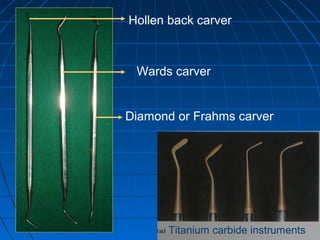
Hollen back carver
Diamond or Frahms carver
Titanium carbide instruments
Wards carver
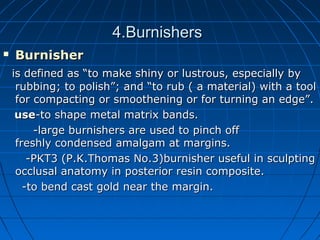
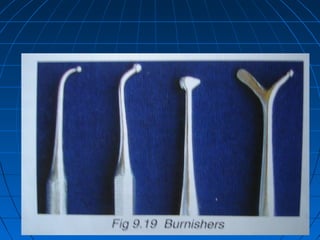
4.Burnishers4.Burnishers
 BurnisherBurnisher
is defined as “to make shiny or lustrous, especially byis defined as “to make shiny or lustrous, especially by
rubbing; to polish”; and “to rub ( a material) with a toolrubbing; to polish”; and “to rub ( a material) with a tool
for compacting or smoothening or for turning an edge”.for compacting or smoothening or for turning an edge”.
useuse-to shape metal matrix bands.-to shape metal matrix bands.
-large burnishers are used to pinch off-large burnishers are used to pinch off
freshly condensed amalgam at margins.freshly condensed amalgam at margins.
-PKT3 (P.K.Thomas No.3)burnisher useful in sculpting-PKT3 (P.K.Thomas No.3)burnisher useful in sculpting
occlusal anatomy in posterior resin composite.occlusal anatomy in posterior resin composite.
-to bend cast gold near the margin.-to bend cast gold near the margin.
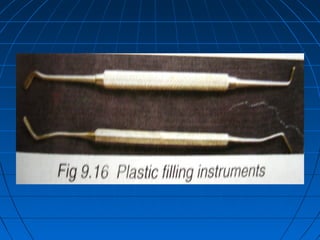
5.Plastic instruments5.Plastic instruments
 Originally they were Used with silicatesOriginally they were Used with silicates
and acrylic resins .and acrylic resins .
 Now used to carry and shape toothNow used to carry and shape tooth
colored restorative materials .colored restorative materials .
 It is a double ended instrument.It is a double ended instrument.
 Available as hard plastic and metal.Available as hard plastic and metal.
 use- to eliminate abrasion of metal byuse- to eliminate abrasion of metal by
the quartz in resin composite, whichthe quartz in resin composite, which
cause grayness.cause grayness.
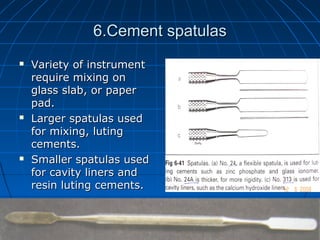
6.Cement spatulas6.Cement spatulas
 Variety of instrumentVariety of instrument
require mixing onrequire mixing on
glass slab, or paperglass slab, or paper
pad.pad.
 Larger spatulas usedLarger spatulas used
for mixing, lutingfor mixing, luting
cements.cements.
 Smaller spatulas usedSmaller spatulas used
for cavity liners andfor cavity liners and
resin luting cements.resin luting cements.
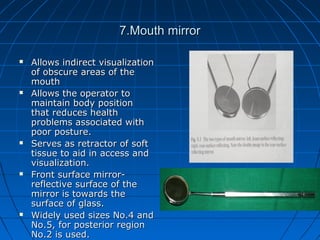
7.Mouth mirror7.Mouth mirror
 Allows indirect visualizationAllows indirect visualization
of obscure areas of theof obscure areas of the
mouthmouth
 Allows the operator toAllows the operator to
maintain body positionmaintain body position
that reduces healththat reduces health
problems associated withproblems associated with
poor posture.poor posture.
 Serves as retractor of softServes as retractor of soft
tissue to aid in access andtissue to aid in access and
visualization.visualization.
 Front surface mirror-Front surface mirror-
reflective surface of thereflective surface of the
mirror is towards themirror is towards the
surface of glass.surface of glass.
 Widely used sizes No.4 andWidely used sizes No.4 and
No.5, for posterior regionNo.5, for posterior region
No.2 is used.No.2 is used.
 Normal mouth mirror reflects a secondary imageNormal mouth mirror reflects a secondary image
from the front of the glass in addition to mainfrom the front of the glass in addition to main
image from the silvered backing.image from the silvered backing.
 This can be avoided by using front surface mirrorThis can be avoided by using front surface mirror
where the reflective coating is deposited on thewhere the reflective coating is deposited on the
front of the glass or the base, revealing fine detailfront of the glass or the base, revealing fine detail
more clearlymore clearly
 Unfortunately, this coated surface gets wearedUnfortunately, this coated surface gets weared
easily, thus it does not last longereasily, thus it does not last longer
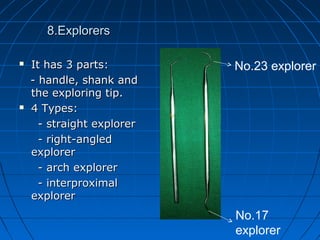
8.Explorers8.Explorers
 It has 3 parts:It has 3 parts:
- handle, shank and- handle, shank and
the exploring tip.the exploring tip.
 4 Types:4 Types:
- straight explorer- straight explorer
- right-angled- right-angled
explorerexplorer
- arch explorer- arch explorer
- interproximal- interproximal
explorerexplorer
No.23 explorer
No.17
explorer
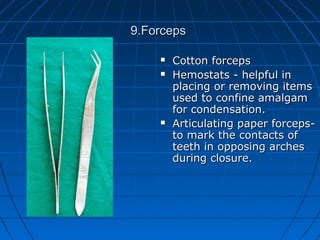
9.Forceps9.Forceps
 Cotton forcepsCotton forceps
 Hemostats - helpful inHemostats - helpful in
placing or removing itemsplacing or removing items
used to confine amalgamused to confine amalgam
for condensation.for condensation.
 Articulating paper forceps-Articulating paper forceps-
to mark the contacts ofto mark the contacts of
teeth in opposing archesteeth in opposing arches
during closure.during closure.
Maintainance of hand instrumentsMaintainance of hand instruments
• Instruments with dull cutting edge cause:Instruments with dull cutting edge cause:
 Prolong operating timeProlong operating time
 More painMore pain
 Less controllableLess controllable
 Reduce quality and precision in toothReduce quality and precision in tooth
preparation.preparation.
sharpening of hand instruments:sharpening of hand instruments:
types of sharpening equipementstypes of sharpening equipements::
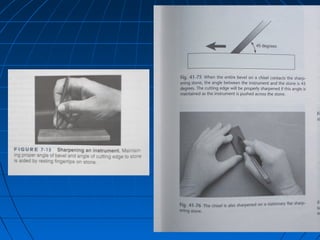
1.Stationary sharpening equipements1.Stationary sharpening equipements::
-most frequently used.-most frequently used.
-also called oil stone.-also called oil stone.
-available as coarse,medium or fine grit.-available as coarse,medium or fine grit.
-shapes:flat,grooved,cylindric and tapered.-shapes:flat,grooved,cylindric and tapered.
Materials used for sharpeningMaterials used for sharpening
instrumentsinstruments
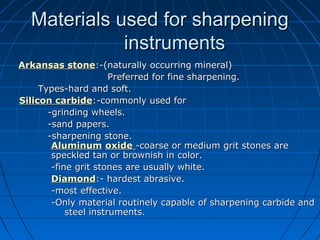
Arkansas stoneArkansas stone:-(naturally occurring mineral):-(naturally occurring mineral)
Preferred for fine sharpening.Preferred for fine sharpening.
Types-hard and soft.Types-hard and soft.
Silicon carbideSilicon carbide:-commonly used for:-commonly used for
-grinding wheels.-grinding wheels.
-sand papers.-sand papers.
-sharpening stone.-sharpening stone.
AluminumAluminum oxideoxide -coarse or medium grit stones are-coarse or medium grit stones are
speckled tan or brownish in color.speckled tan or brownish in color.
-fine grit stones are usually white.-fine grit stones are usually white.
DiamondDiamond:- hardest abrasive.:- hardest abrasive.
-most effective.-most effective.
-Only material routinely capable of sharpening carbide and-Only material routinely capable of sharpening carbide and
steel instruments.steel instruments.
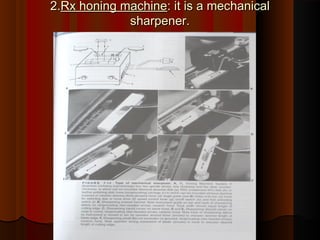
2.2.Rx honing machineRx honing machine: it is a mechanical: it is a mechanical
sharpener.sharpener.
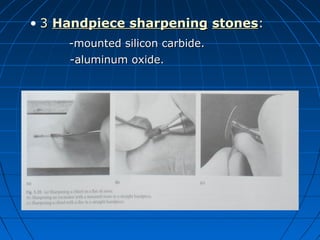
• 33 Handpiece sharpeningHandpiece sharpening stonesstones::
-mounted silicon carbide.-mounted silicon carbide.
-aluminum oxide.-aluminum oxide.
References
 Operative dentistry – modern theory & practice
Marzook, Simonton, gross (1st edition)
 Pichard’s manual of operative dentistry (8th edition)
Kidd, Smith & Watson
 Principles & practice of operative dentistry
(2ndedition) Gerald T . Charbeneau et al
 Studervant
 Fundamentals of operative dentistry.
A Contemporary approach
Summit, Robbins, Schwartz
THANK YOUTHANK YOU

Hand instruments and instrumentation

  • 1.
  • 2.
    Flow chart  IntroductionIntroduction HistoryHistory  MaterialsMaterials  Properties of materials usedProperties of materials used  NomenclatureNomenclature  ClassificationClassification  Instrument formulaInstrument formula  Instrument designInstrument design  Various hand instruments techniquesVarious hand instruments techniques  Individual instrumentsIndividual instruments  Maintenance of instrumentsMaintenance of instruments • sharpening of instrumentssharpening of instruments • SterilizationSterilization
  • 3.
    INTRODUCTIONINTRODUCTION In order toperform intricate andIn order to perform intricate and detailed procedures associated withdetailed procedures associated with conservative dentistry ,the dentists mustconservative dentistry ,the dentists must have a complete knowledge of the purposehave a complete knowledge of the purpose and application of the many instrumentsand application of the many instruments required.required. Hand Instruments remain an essentialHand Instruments remain an essential part of the armamentarium for qualitypart of the armamentarium for quality restorative dentistry.restorative dentistry.
  • 4.
    HISTORY The best guideto the future is toThe best guide to the future is to study about the paststudy about the past. In 16th century the excision of carious material was done by using burning stick. Earlier materials like bone, ivory were some of the materials used to manufacture the instruments.
  • 6.
    Materials used inmanufacturing theMaterials used in manufacturing the instrumentsinstruments  Stainless steelStainless steel Carbon - 6 to 10 %,Carbon - 6 to 10 %, chromium – 18%,chromium – 18%, iron – 81 to 81.4 %iron – 81 to 81.4 % WhenWhen 12 to 30% of chromium12 to 30% of chromium is added to iron, theis added to iron, the alloy is called stainless steel.alloy is called stainless steel. - It is extremely hard- It is extremely hard - Resistance to staining in these alloys is attributedResistance to staining in these alloys is attributed to the formation of a thin transparent oxide onto the formation of a thin transparent oxide on their surface.their surface. DrawbackDrawback - Loses a sharp edge on repeated usage- Loses a sharp edge on repeated usage easily compared to carbon steel.easily compared to carbon steel.
  • 7.
    Carbon steel :Carbonsteel : -- these are iron carbon binary alloys that containthese are iron carbon binary alloys that contain less than approximatelyless than approximately 2.1 % carbon2.1 % carbon.. - It is capable of hardened, softened, and- It is capable of hardened, softened, and tempered.tempered. - Its melting point is approximately 1500- 1600 C.- Its melting point is approximately 1500- 1600 C. - Maintains keen edge under use, hence used forMaintains keen edge under use, hence used for making blade and cutting edge.making blade and cutting edge. DrawbackDrawback – corrodes when un protected.– corrodes when un protected. CarbideCarbide –– Carbon steel containingCarbon steel containing 0.8% carbon0.8% carbon.. - Provide more durable cutting edge.Provide more durable cutting edge. - Hard and wear resistant.Hard and wear resistant.
  • 8.
     Monel metalMonel metal Nickel - 67%,Copper - 28%,Iron - 5%Nickel - 67%,Copper - 28%,Iron - 5%  It’s aIt’s a natural alloynatural alloy  It is markedly resistant to acid and superheated steamIt is markedly resistant to acid and superheated steam  NichromeNichrome  Nickel - 60 to 80%,Chromium - 12 to 20%,Iron - 0.2 toNickel - 60 to 80%,Chromium - 12 to 20%,Iron - 0.2 to 6%6%  Can be subjected to high degrees of temperatureCan be subjected to high degrees of temperature  Does not oxidize easily  Drawback : does not maintain sharp edge  Stellite  Cobalt 65- 90%, chromium 10-35%  High melting point  Maintains cutting edge and resistant to action of acids.  Cobalt imparts hardness, strength and rigidity to alloy
  • 9.
     In orderto gain maximal benefits Carbon steel andIn order to gain maximal benefits Carbon steel and stainless steel must be submitted to hardening andstainless steel must be submitted to hardening and tempering heat treatmenttempering heat treatment Hardening heat treatmentHardening heat treatment Tempering heat treatmentTempering heat treatment hardens and makes it brittle. Steel is reheated for 1 hour athardens and makes it brittle. Steel is reheated for 1 hour at steel is heated tosteel is heated to 1500 F(815 C)1500 F(815 C) 3535 F (176 C)F (176 C) and then in oxygen free environment andand then in oxygen free environment and quenched. It relieves strain andquenched. It relieves strain and then quenched water.then quenched water. increases the toughness.increases the toughness.
  • 10.
    NOMENCLATURENOMENCLATURE Described byDescribed byG.V. BlackG.V. Black 1.1. OrderOrder – denotes the purpose of the– denotes the purpose of the instrument.instrument. E.g. excavator, scalerE.g. excavator, scaler 2.2. SuborderSuborder – denotes position or manner of– denotes position or manner of use.use. E.g. push ,pullE.g. push ,pull (variable and non-specific)(variable and non-specific) 3.3. ClassClass – describes form of the blade– describes form of the blade E .g. hatchet , chiselE .g. hatchet , chisel 4.4. AngleAngle – denotes number of angle in– denotes number of angle in shankshank
  • 12.
    ClassificationClassification (Sturdevant)(Sturdevant) HAND INSTRUMENTS CUTTINGNON-CUTTING EXCAVATORS ORDINARY HATCHET HOE CHISELS ANGLE FORMER SPOON EXCAVATOR STRAIGHT CURVED BINANGLE ENAMEL HATCHET GINGIVAL MARGINAL TRIMMER AMALGAM CONDENSER MIRRORS EXPLORERS PROBES OTHERS KNIVES FILES SCALERS CARVERS
  • 13.
     Hand instrumentHandinstrument:: 1.Cutting1.Cutting instrumentsinstruments  HatchetsHatchets  ChiselsChisels  HoesHoes  ExcavatorsExcavators 2.Condensing2.Condensing instrumentsinstruments -pluggers-pluggers 3.Plastic3.Plastic instrumentsinstruments -spatulas-spatulas -carvers-carvers -burnishers-burnishers -packing-packing instruments.instruments. 4.Finishing and4.Finishing and polishingpolishing instrumentsinstruments - orange wood stick- orange wood stick - polishing points- polishing points - finishing strips- finishing strips 5.Miscellaneous5.Miscellaneous instrumentsinstruments - mouth mirrors.- mouth mirrors. - explorers.- explorers. - scissors.- scissors. - pliers.- pliers.
  • 14.
    INSTRUMENT FORMULAINSTRUMENT FORMULA 4 unit formula4 unit formula 1.1. Width of the blade or primary cutting edge inWidth of the blade or primary cutting edge in tenths of a mm.tenths of a mm. 2.2. Primary cutting edge angle ,expressed as a percentPrimary cutting edge angle ,expressed as a percent of 360 degrees.of 360 degrees. 3.3. Indicates blade length in mm.Indicates blade length in mm. 4.4. Indicates blade angle relative to the long axis ofIndicates blade angle relative to the long axis of the handle in clockwise direction.the handle in clockwise direction. – 3 unit formula3 unit formula 1.1. Width of the blade or primary cutting edge inWidth of the blade or primary cutting edge in tenths of a mm.tenths of a mm. 2.2. Indicates blade length in mm.Indicates blade length in mm. 3.3. Indicates blade angle relative to the long axis ofIndicates blade angle relative to the long axis of the handle in clockwise direction.the handle in clockwise direction.
  • 17.
  • 18.
    INSTRUMENTSINSTRUMENTS A)A) direct cuttingdirectcutting instrument-instrument- forces applied inforces applied in the same planethe same plane of blade andof blade and handle.handle. B)B) Single planedSingle planed C)C) Can be used inCan be used in both direct andboth direct and lateral cutting.lateral cutting. B)B) lateral cutting instrument-lateral cutting instrument- force applied at right angle toforce applied at right angle to blade and handleblade and handle Double planedDouble planed used only in lateral cuttingused only in lateral cutting
  • 19.
    Thinner the crosssection More the force is concentrated on the working area Main principle of cutting instrument is to concentrate forces on a very thin cross section of the instrument at the cutting edge
  • 20.
    2.2. ContranglingContrangling depends onlength of the blade and angulation in shankdepends on length of the blade and angulation in shank.. PurposePurpose-- -mainly to gain access.-mainly to gain access. -instruments are designed such that-instruments are designed such that working point isworking point is within 3mmwithin 3mm from the axis of handle.from the axis of handle. -short blade and small blade angles require only binangle-short blade and small blade angles require only binangle contrangling.contrangling. -longer blade and greater blade angle require triple angle-longer blade and greater blade angle require triple angle contrangling.contrangling. Greater angles are used inGreater angles are used in –– -posterior teeth-posterior teeth -incisal portion of proximal cavities-incisal portion of proximal cavities inin anteriorsanteriors..
  • 21.
    For optimal antirotational design, the blade edge must be within 3mm from the axis of handle. All dental instruments need to satisfy this principle of balance. For optimal anti rotational design, the blade edge must be within 3mm from the axis of handle. All dental instruments need to satisfy this principle of balance
  • 22.
    3.Right and leftinstrument:3.Right and left instrument:  Direct cutting instrumentDirect cutting instrument held with the cutting edgeheld with the cutting edge facing down and pointingfacing down and pointing away from the operatoraway from the operator and the bevel is on rightand the bevel is on right side, it is right instrument.side, it is right instrument. if bevel is on the left, leftif bevel is on the left, left instrument.instrument.  These are single planedThese are single planed instruments.instruments.  Lateral cuttingLateral cutting instrument are madeinstrument are made right and left by havingright and left by having the curve or angle.the curve or angle. these are always used inthese are always used in scraping actions.scraping actions.
  • 23.
    4.4.Single bevelled instrument:Singlebevelled instrument:  Single planedSingle planed  Cutting edge at right angles to long axis of shaft.Cutting edge at right angles to long axis of shaft.  Bevelled on the side away from the shaft –distallyBevelled on the side away from the shaft –distally bevelled.bevelled.  Bevelled on the side towards the shaft- mesiallyBevelled on the side towards the shaft- mesially bevelled.bevelled.  When the instrument haveWhen the instrument have no angle or angle ofno angle or angle of 1212 degree or lessdegree or less, it is used in push (direct cutting) and, it is used in push (direct cutting) and scraping motions.scraping motions.  If angle in shankIf angle in shank exceeds 12 degreeexceeds 12 degree,, instrument isinstrument is used in pullused in pull (distally bevelled)(distally bevelled) and push (mesially bevelled) motions.and push (mesially bevelled) motions.
  • 24.
    5.5.BibevelledBibevelled instrumentinstrument::  Onlyhatchets andOnly hatchets and straight chisels canstraight chisels can be bibevelledbe bibevelled..  Blade is equallyBlade is equally bevelled on bothbevelled on both sides.sides.  TheyThey cut bycut by pushingpushing them inthem in the direction of thethe direction of the long axis of thelong axis of the blade.blade.
  • 25.
    6.6.Triple bevelled instrument:Triplebevelled instrument:  Bevelling the blade laterally, formsBevelling the blade laterally, forms three distinct cutting edges.three distinct cutting edges.  Most modern single planedMost modern single planed instruments are triple bevelled.instruments are triple bevelled.  AdvantageAdvantage-additional cutting-additional cutting potential.potential.
  • 26.
    7.Circumferentially bevelled7.Circumferentially bevelled instrumentsinstruments Usually occurs inUsually occurs in double planeddouble planed instrumentsinstruments  Bevelled at allBevelled at all peripheriesperipheries
  • 27.
    8.Single ended anddouble ended8.Single ended and double ended instrumentsinstruments  The most modern instruments are doubleThe most modern instruments are double ended.ended.  Single planed instruments with no angleSingle planed instruments with no angle in the shank have potential 5 cuttingin the shank have potential 5 cutting movements. They are –movements. They are –  vertical,right ,left,push and pullvertical,right ,left,push and pull  Mesially and distally bevelled single planedMesially and distally bevelled single planed instruments the 4 movements areinstruments the 4 movements are  vertical,right ,left ,push or pull.vertical,right ,left ,push or pull.
  • 28.
    Hand instrument techniquesHandinstrument techniques 1.1. Modified pen graspModified pen grasp --permits thepermits the greatest delicacy ofgreatest delicacy of touch.touch. -palm of the hand-palm of the hand generally facing awaygenerally facing away from the operator.from the operator. -pad of the middle-pad of the middle finger placed near top offinger placed near top of the instrument.the instrument.
  • 29.
    2. Inverted pengrasp-2. Inverted pen grasp- -The hand is rotated so-The hand is rotated so that the palm facesthat the palm faces more towards themore towards the operatoroperator -Used for tooth-Used for tooth preparations utilizingpreparations utilizing the lingual approach onthe lingual approach on anterior teeth.anterior teeth.
  • 30.
    3.Palm and thumbgrasp3.Palm and thumb grasp - Has limited use- Has limited use - Used for preparing- Used for preparing incisal retention for aincisal retention for a class III preparationclass III preparation on a maxillary incisoron a maxillary incisor
  • 31.
    4.Modified palm andthumb grasp4.Modified palm and thumb grasp
  • 32.
     RestRest When themodified pen grasp and invertedWhen the modified pen grasp and inverted pen grasp are used, rests are established bypen grasp are used, rests are established by placing the ring or ring and little finger on aplacing the ring or ring and little finger on a tooth of the same arch or close to thetooth of the same arch or close to the operating siteoperating site when palm and thumb grasp are used, restwhen palm and thumb grasp are used, rest are created by placing the tip of thumb onare created by placing the tip of thumb on the tooth being operated or adjacent or areathe tooth being operated or adjacent or area which is convenient.which is convenient.  GuardsGuards Are hand instruments or otherAre hand instruments or other items, such as interproximal wedges used toitems, such as interproximal wedges used to protect soft tissue from contacting withprotect soft tissue from contacting with sharp cutting or abrasive instruments.sharp cutting or abrasive instruments.
  • 34.
    INDIVIDUAL INSTRUMENTSINDIVIDUAL INSTRUMENTS ExcavatorsExcavators 1.1. Hatchet excavatorsHatchet excavators • edge of the blade isedge of the blade is parallel with handleparallel with handle • Single planedSingle planed bibevelledbibevelled instrumentinstrument • Cut by push orCut by push or scraping motionscraping motion • Used for delicateUsed for delicate cutting withincutting within preparationspreparations especially in incisorsespecially in incisors
  • 35.
    2.Hoe excavators2.Hoe excavators •Bevel run at rightBevel run at right angle to the shaftangle to the shaft • TypesTypes-distally-distally bevelled or mesiallybevelled or mesially bevelledbevelled • UseUse -cutting of-cutting of mesial and distalmesial and distal walls of premolarswalls of premolars and molarsand molars • Single planed ,4Single planed ,4 cutting movements-cutting movements- vertical ,push orvertical ,push or pull, right and leftpull, right and left
  • 36.
    3.Spoon excavators3.Spoon excavators •Made in pairs withMade in pairs with one blade curved toone blade curved to right and other to leftright and other to left • Curve of the bladeCurve of the blade makes it lateralmakes it lateral cutting instrumentcutting instrument • Double planedDouble planed instrument with rightinstrument with right or left cuttingor left cutting movements onlymovements only • Use-removal ofUse-removal of carious dentincarious dentin
  • 37.
    4.Discoid(disc like) excavators4.Discoid(disclike) excavators • Blade circular inBlade circular in shapeshape • Circular blade isCircular blade is placed at rightplaced at right angle to the shaftangle to the shaft • Double planedDouble planed instrument withinstrument with right or left cuttingright or left cutting movements onlymovements only • Use-removal ofUse-removal of carious dentincarious dentin
  • 38.
    5.5. Cleoid (clawlike) excavatorCleoid (claw like) excavator • Type of spoonType of spoon excavator exceptexcavator except the blade comes tothe blade comes to a pointa point • Use-carvingUse-carving amalgam andamalgam and excavating deepexcavating deep cariescaries • Double planedDouble planed instrument withinstrument with only lateral cuttingonly lateral cutting movementsmovements
  • 39.
    • CHISELSCHISELS • Mainlyintended for cutting enamel.Mainly intended for cutting enamel. • Used to smoothen cavity walls.Used to smoothen cavity walls. • Usually bevelled on one side only.Usually bevelled on one side only. • Used to sharpen cavity preparation.Used to sharpen cavity preparation.  4 types of Chisel4 types of Chisel
  • 40.
    1.1. Straight chiselsStraightchisels – Straight blade inStraight blade in line with theline with the handle and shankhandle and shank – Cutting edge onCutting edge on one side onlyone side only – Bevel of blade atBevel of blade at right angle to theright angle to the shaftshaft – Single planed withSingle planed with 5 possible cutting5 possible cutting movementsmovements
  • 41.
    2.Monoangle chisel2.Monoangle chisel Similar to straightSimilar to straight chisels except thatchisels except that blade is placed atblade is placed at an angle to thean angle to the shaft.shaft.  It may be mesiallyIt may be mesially bevelled or distallybevelled or distally bevelled.bevelled.  Single planedSingle planed
  • 42.
    3.Binangle chisel3.Binangle chisel Blade is placed at aBlade is placed at a slight angle toslight angle to shaft.shaft.  Mesially or distallyMesially or distally bevelled.bevelled.  Use-to cleave orUse-to cleave or split underminedsplit undermined enamel.enamel.  Single planed.Single planed.
  • 43.
    4.4.Triple-angle chiselTriple-angle chisel Used to flattenUsed to flatten pulpal floors.pulpal floors.  Mesially or distallyMesially or distally bevelled.bevelled.
  • 44.
    Special forms ofchiselsSpecial forms of chisels 1.1. Enamel hatchet:Enamel hatchet: • Shank has one orShank has one or more angles ormore angles or curves.curves. • Blade is parallel withBlade is parallel with the shaft.the shaft. • It is single planeIt is single plane instrument.instrument. • Design similar toDesign similar to ordinary hatchet.ordinary hatchet. • Blade is heavier,Blade is heavier, larger and beveled onlarger and beveled on only one side.only one side. • Use –for splitting orUse –for splitting or cleaving underminedcleaving undermined enamel in proximalenamel in proximal cavities.cavities.
  • 45.
    2.2.Gingival Marginal TrimmerGingivalMarginal Trimmer  Similar in design to enamel hatchetSimilar in design to enamel hatchet except blade is curved.except blade is curved.  Double ended, paired instrumentDouble ended, paired instrument (mesial or distal).(mesial or distal).  Primary cutting edge is at an angle toPrimary cutting edge is at an angle to axis of blade.axis of blade. when the second number iswhen the second number is  90 to 100 distal gingival margin.90 to 100 distal gingival margin.  85 to 75 mesial gingival margin.85 to 75 mesial gingival margin.
  • 46.
     The 100and 75 pairs are for inlay orThe 100 and 75 pairs are for inlay or onlay preparations with steep gingivalonlay preparations with steep gingival bevels.bevels.  90 and 85 pairs are for amalgam90 and 85 pairs are for amalgam preparations with gingival enamel bevelspreparations with gingival enamel bevels that decline slight gingivally.that decline slight gingivally.  Primarily lateral cutting instrument.Primarily lateral cutting instrument.  Used in pull and push motions to sharpenUsed in pull and push motions to sharpen point and line angels.point and line angels.
  • 47.
    Distal Gingival marginal trimmer Mesialgingival marginal trimmer
  • 48.
    GMT ENAMEL HATCHETGMTENAMEL HATCHET - 4 unit formula- 4 unit formula - Blade is curved- Blade is curved - Bi planed- Bi planed - Used to give- Used to give gingival cavosurfacegingival cavosurface bevel, rounding of axiobevel, rounding of axio pulpal line angles.pulpal line angles. - 3 unit formula- 3 unit formula - Not curved- Not curved - Monoplaned- Monoplaned - Used to break- Used to break enamel wall ofenamel wall of proximal box,proximal box, smoothen gingivalsmoothen gingival seatseat
  • 49.
    3.3.Angle FormerAngle Former Are made by grinding the bevel at anAre made by grinding the bevel at an angle of 80 degree with the shaft,angle of 80 degree with the shaft, forming an acute angle with the long axisforming an acute angle with the long axis of the shaft.of the shaft.  Single planed instrument.Single planed instrument.  Used to cut line and point angles.Used to cut line and point angles.  They share three cutting potentialsThey share three cutting potentials vertical, push and pull.vertical, push and pull.
  • 51.
    4.4.Wedelstaedt Chisels.Wedelstaedt Chisels. Its like a straight chisel, with a slightIts like a straight chisel, with a slight vertical curvature in the shank.vertical curvature in the shank.  Bevelled on only one side of the shank.Bevelled on only one side of the shank.  Single planed instruments with threeSingle planed instruments with three cutting motions, vertical, right and left.cutting motions, vertical, right and left.  Mesially bevelled used in pushMesially bevelled used in push movement, distally bevelled in pullmovement, distally bevelled in pull motions.motions. USE-USE-  For cleaving undermined enamel.For cleaving undermined enamel.  For shaping walls.For shaping walls.  Used primarily on anterior teeth.Used primarily on anterior teeth.
  • 53.
    5.5.Off Set HatchetsOffSet Hatchets  Rectangular hatchet except theRectangular hatchet except the hole blade is rotated forward orhole blade is rotated forward or backward around its long axis.backward around its long axis.  Single paned instrument.Single paned instrument.  They will be right or leftThey will be right or left instrument.instrument.  Useful to create and shapeUseful to create and shape specific angulations for cavityspecific angulations for cavity walls specially in areas of difficultwalls specially in areas of difficult access.access.
  • 54.
    6.6.Triangular Chisels.Triangular Chisels. Blade is triangular in shape,Blade is triangular in shape, with base of the triangle awaywith base of the triangle away from the shaft.from the shaft.  It has a terminal cutting edgeIt has a terminal cutting edge like straight chisel.like straight chisel. 7.7.Hoe chiselHoe chisel::  Similar to hoe excavators, hasSimilar to hoe excavators, has a sturdier blade.a sturdier blade.
  • 55.
    NON CUTTING INSTRUMEMTS Similar in appearanceSimilar in appearance to cuttingto cutting instruments except,instruments except, blade is replaced byblade is replaced by nib or point.nib or point. 1.1. Amalgam carriersAmalgam carriers::  Types:Types: a)regulara)regular b)largeb)large  Usually DoubleUsually Double ended.ended.  Available asAvailable as mini, regular,mini, regular, large, jumbo.large, jumbo. 
  • 56.
    2.2.Condensers:Condensers:  Working endsor nibs are round with flatWorking ends or nibs are round with flat ends.ends.  Shapes-round,triangular,rectangular orShapes-round,triangular,rectangular or diamond.diamond.  Vertical condensationVertical condensation: amalgam: amalgam condensed against preparation floorcondensed against preparation floor through vertical pressure.through vertical pressure.  Lateral condensationsLateral condensations: condensed against: condensed against vertical walls of preparation.vertical walls of preparation.
  • 58.
    3.Carvers3.Carvers 1.1.Cleoid-discoid carversCleoid-discoid carvers:: •Use:-occlusal carving of amalgamUse:-occlusal carving of amalgam restoration.restoration. • - carving occlusal surfaces of posterior resin- carving occlusal surfaces of posterior resin composite restoration.composite restoration. 2.2.Walls no.3 carversWalls no.3 carvers :-used for carving:-used for carving occlusal surfaces.occlusal surfaces. -for shaping cusps and carving facial and-for shaping cusps and carving facial and lingual walls of large amalgam restorations.lingual walls of large amalgam restorations.
  • 60.
     .. 3.3.Hollenback No.1/2 carverHollen back No.1/2 carver:: useful for occlusal,proximal,axial(facialuseful for occlusal,proximal,axial(facial or lingual) surfaces.or lingual) surfaces.  4.inter proximal carvers4.inter proximal carvers:-:- specially valuable for carving proximalspecially valuable for carving proximal amalgam surfaces.amalgam surfaces.  5.No.14L carver:5.No.14L carver: (sickle shaped carver)(sickle shaped carver) UseUse -- interinter proximalproximal areasareas.. - for carving convex facial and lingual- for carving convex facial and lingual surfaces of large amalgam surfaces.surfaces of large amalgam surfaces. - To remove amalgam over hangs- To remove amalgam over hangs
  • 61.
    Hollen back carver Diamondor Frahms carver Titanium carbide instruments Wards carver
  • 62.
    4.Burnishers4.Burnishers  BurnisherBurnisher is definedas “to make shiny or lustrous, especially byis defined as “to make shiny or lustrous, especially by rubbing; to polish”; and “to rub ( a material) with a toolrubbing; to polish”; and “to rub ( a material) with a tool for compacting or smoothening or for turning an edge”.for compacting or smoothening or for turning an edge”. useuse-to shape metal matrix bands.-to shape metal matrix bands. -large burnishers are used to pinch off-large burnishers are used to pinch off freshly condensed amalgam at margins.freshly condensed amalgam at margins. -PKT3 (P.K.Thomas No.3)burnisher useful in sculpting-PKT3 (P.K.Thomas No.3)burnisher useful in sculpting occlusal anatomy in posterior resin composite.occlusal anatomy in posterior resin composite. -to bend cast gold near the margin.-to bend cast gold near the margin.
  • 64.
    5.Plastic instruments5.Plastic instruments Originally they were Used with silicatesOriginally they were Used with silicates and acrylic resins .and acrylic resins .  Now used to carry and shape toothNow used to carry and shape tooth colored restorative materials .colored restorative materials .  It is a double ended instrument.It is a double ended instrument.  Available as hard plastic and metal.Available as hard plastic and metal.  use- to eliminate abrasion of metal byuse- to eliminate abrasion of metal by the quartz in resin composite, whichthe quartz in resin composite, which cause grayness.cause grayness.
  • 66.
    6.Cement spatulas6.Cement spatulas Variety of instrumentVariety of instrument require mixing onrequire mixing on glass slab, or paperglass slab, or paper pad.pad.  Larger spatulas usedLarger spatulas used for mixing, lutingfor mixing, luting cements.cements.  Smaller spatulas usedSmaller spatulas used for cavity liners andfor cavity liners and resin luting cements.resin luting cements.
  • 67.
    7.Mouth mirror7.Mouth mirror Allows indirect visualizationAllows indirect visualization of obscure areas of theof obscure areas of the mouthmouth  Allows the operator toAllows the operator to maintain body positionmaintain body position that reduces healththat reduces health problems associated withproblems associated with poor posture.poor posture.  Serves as retractor of softServes as retractor of soft tissue to aid in access andtissue to aid in access and visualization.visualization.  Front surface mirror-Front surface mirror- reflective surface of thereflective surface of the mirror is towards themirror is towards the surface of glass.surface of glass.  Widely used sizes No.4 andWidely used sizes No.4 and No.5, for posterior regionNo.5, for posterior region No.2 is used.No.2 is used.
  • 68.
     Normal mouthmirror reflects a secondary imageNormal mouth mirror reflects a secondary image from the front of the glass in addition to mainfrom the front of the glass in addition to main image from the silvered backing.image from the silvered backing.  This can be avoided by using front surface mirrorThis can be avoided by using front surface mirror where the reflective coating is deposited on thewhere the reflective coating is deposited on the front of the glass or the base, revealing fine detailfront of the glass or the base, revealing fine detail more clearlymore clearly  Unfortunately, this coated surface gets wearedUnfortunately, this coated surface gets weared easily, thus it does not last longereasily, thus it does not last longer
  • 69.
    8.Explorers8.Explorers  It has3 parts:It has 3 parts: - handle, shank and- handle, shank and the exploring tip.the exploring tip.  4 Types:4 Types: - straight explorer- straight explorer - right-angled- right-angled explorerexplorer - arch explorer- arch explorer - interproximal- interproximal explorerexplorer No.23 explorer No.17 explorer
  • 70.
    9.Forceps9.Forceps  Cotton forcepsCottonforceps  Hemostats - helpful inHemostats - helpful in placing or removing itemsplacing or removing items used to confine amalgamused to confine amalgam for condensation.for condensation.  Articulating paper forceps-Articulating paper forceps- to mark the contacts ofto mark the contacts of teeth in opposing archesteeth in opposing arches during closure.during closure.
  • 71.
    Maintainance of handinstrumentsMaintainance of hand instruments • Instruments with dull cutting edge cause:Instruments with dull cutting edge cause:  Prolong operating timeProlong operating time  More painMore pain  Less controllableLess controllable  Reduce quality and precision in toothReduce quality and precision in tooth preparation.preparation. sharpening of hand instruments:sharpening of hand instruments: types of sharpening equipementstypes of sharpening equipements:: 1.Stationary sharpening equipements1.Stationary sharpening equipements:: -most frequently used.-most frequently used. -also called oil stone.-also called oil stone. -available as coarse,medium or fine grit.-available as coarse,medium or fine grit. -shapes:flat,grooved,cylindric and tapered.-shapes:flat,grooved,cylindric and tapered.
  • 72.
    Materials used forsharpeningMaterials used for sharpening instrumentsinstruments Arkansas stoneArkansas stone:-(naturally occurring mineral):-(naturally occurring mineral) Preferred for fine sharpening.Preferred for fine sharpening. Types-hard and soft.Types-hard and soft. Silicon carbideSilicon carbide:-commonly used for:-commonly used for -grinding wheels.-grinding wheels. -sand papers.-sand papers. -sharpening stone.-sharpening stone. AluminumAluminum oxideoxide -coarse or medium grit stones are-coarse or medium grit stones are speckled tan or brownish in color.speckled tan or brownish in color. -fine grit stones are usually white.-fine grit stones are usually white. DiamondDiamond:- hardest abrasive.:- hardest abrasive. -most effective.-most effective. -Only material routinely capable of sharpening carbide and-Only material routinely capable of sharpening carbide and steel instruments.steel instruments.
  • 74.
    2.2.Rx honing machineRxhoning machine: it is a mechanical: it is a mechanical sharpener.sharpener.
  • 75.
    • 33 HandpiecesharpeningHandpiece sharpening stonesstones:: -mounted silicon carbide.-mounted silicon carbide. -aluminum oxide.-aluminum oxide.
  • 76.
    References  Operative dentistry– modern theory & practice Marzook, Simonton, gross (1st edition)  Pichard’s manual of operative dentistry (8th edition) Kidd, Smith & Watson  Principles & practice of operative dentistry (2ndedition) Gerald T . Charbeneau et al  Studervant  Fundamentals of operative dentistry. A Contemporary approach Summit, Robbins, Schwartz
  • 77.