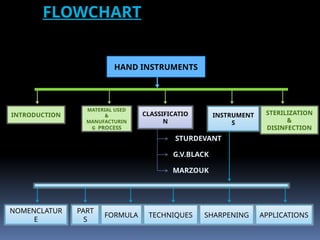
FLOWCHART
HAND INSTRUMENTS
MATERIAL USED
&
MANUFACTURIN
GPROCESS
CLASSIFICATIO
N
INTRODUCTION STERILIZATION
&
DISINFECTION
INSTRUMENT
S
TECHNIQUES
NOMENCLATUR
E
PART
S
FORMULA
STURDEVANT
G.V.BLACK
MARZOUK
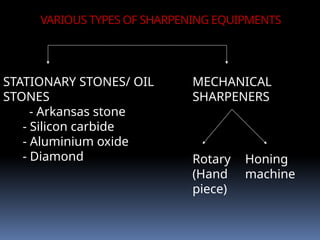
SHARPENING APPLICATIONS
3.
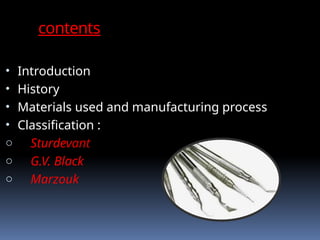
• Introduction
• History
•Materials used and manufacturing process
• Classification :
o Sturdevant
o G.V. Black
o Marzouk
contents
4.
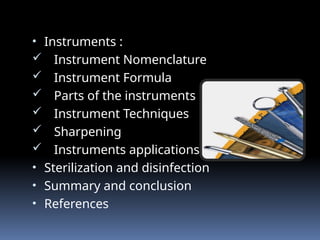
• Instruments :
Instrument Nomenclature
Instrument Formula
Parts of the instruments
Instrument Techniques
Sharpening
Instruments applications
• Sterilization and disinfection
• Summary and conclusion
• References
5.
INTRODUCTION
“INSTRUMENT” refers toa tool, device or
implement used for specific purpose or
type of work and is preferred in
professional or scientific fields.
6.
INTRODUCTION
• To performthe intricate and detailed
procedures, the dentist must have a
complete knowledge of the purpose,
availability and application of the many
instruments required.
7.
Earlier hand instrumentswere made up of carbon
steel.
Composition :
Carbon : 1-12%
Manganese : 0.2%
Silicon : 0.2%
Iron : 98.4%-98.6%
These instruments were harder and maintained
the sharpness but were prone to rusting on
sterilization.
MATERIALS USED
8.
Stainless Steel :
Itspreferred for most instruments.
Composition :
Carbon : 0.6%-1%
Chromium : 18%
Iron : 81%-81.4%
It’s a passive instrument and can withstand
repeated sterilization cycles but they soon
become blunt so therefore they require
sharpening.
Hard (0.5%-1.5% carbon)
Types
Soft ( 0.5% carbon)
≤
9.
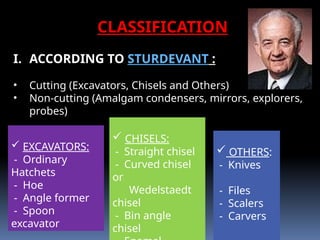
CLASSIFICATION
I. ACCORDING TOSTURDEVANT :
• Cutting (Excavators, Chisels and Others)
• Non-cutting (Amalgam condensers, mirrors, explorers,
probes)
EXCAVATORS:
- Ordinary
Hatchets
- Hoe
- Angle former
- Spoon
excavator
CHISELS:
- Straight chisel
- Curved chisel
or
Wedelstaedt
chisel
- Bin angle
chisel
OTHERS:
- Knives
- Files
- Scalers
- Carvers
10.
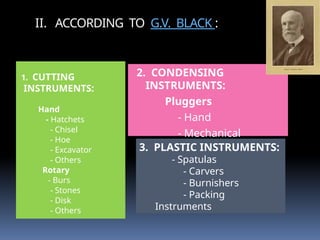
II. ACCORDING TOG.V. BLACK :
1. CUTTING
INSTRUMENTS:
Hand
- Hatchets
- Chisel
- Hoe
- Excavator
- Others
Rotary
- Burs
- Stones
- Disk
- Others
2. CONDENSING
INSTRUMENTS:
Pluggers
- Hand
- Mechanical
3. PLASTIC INSTRUMENTS:
- Spatulas
- Carvers
- Burnishers
- Packing
Instruments
11.
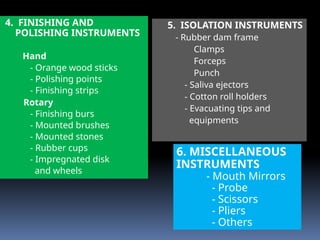
4. FINISHING AND
POLISHINGINSTRUMENTS
Hand
- Orange wood sticks
- Polishing points
- Finishing strips
Rotary
- Finishing burs
- Mounted brushes
- Mounted stones
- Rubber cups
- Impregnated disk
and wheels
5. ISOLATION INSTRUMENTS
- Rubber dam frame
Clamps
Forceps
Punch
- Saliva ejectors
- Cotton roll holders
- Evacuating tips and
equipments
6. MISCELLANEOUS
INSTRUMENTS
- Mouth Mirrors
- Probe
- Scissors
- Pliers
- Others
12.
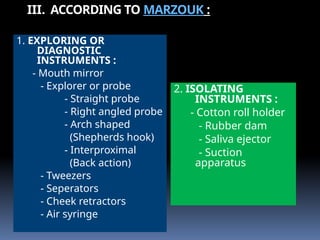
III. ACCORDING TOMARZOUK :
1. EXPLORING OR
DIAGNOSTIC
INSTRUMENTS :
- Mouth mirror
- Explorer or probe
- Straight probe
- Right angled probe
- Arch shaped
(Shepherds hook)
- Interproximal
(Back action)
- Tweezers
- Seperators
- Cheek retractors
- Air syringe
2. ISOLATING
INSTRUMENTS :
- Cotton roll holder
- Rubber dam
- Saliva ejector
- Suction
apparatus
13.
3. HAND CUTTINGINSTRUMENTS :
Excavators
- Spoon excavator
- Cleiod
- Discoid
- Hatchet excavator
- Hoe
Chisels
- Straight chisel
- Mono angle chisel
- Bin angle chisel
- Triple angle chisel
Special types of chisels or modified chisels
- Wedelsteadt chisel
- Enamel hatchet
- Gingival marginal trimmer
- Angle former
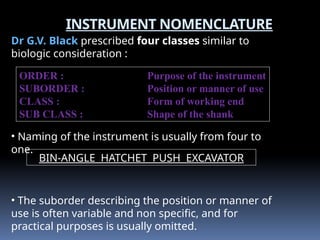
INSTRUMENT NOMENCLATURE
Dr G.V.Black prescribed four classes similar to
biologic consideration :
ORDER : Purpose of the instrument
SUBORDER : Position or manner of use
CLASS : Form of working end
SUB CLASS : Shape of the shank
BIN-ANGLE HATCHET PUSH EXCAVATOR
• Naming of the instrument is usually from four to
one.
• The suborder describing the position or manner of
use is often variable and non specific, and for
practical purposes is usually omitted.
17.
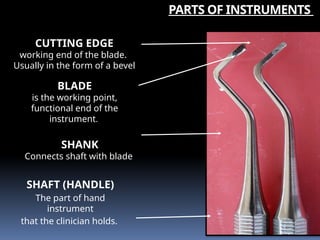
PARTS OF INSTRUMENTS
SHAFT(HANDLE)
The part of hand
instrument
that the clinician holds.
SHANK
Connects shaft with blade
CUTTING EDGE
working end of the blade.
Usually in the form of a bevel
BLADE
is the working point,
functional end of the
instrument.
18.
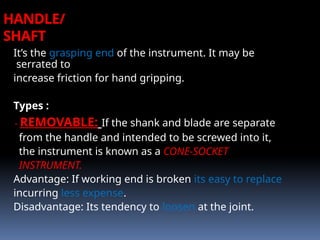
HANDLE/
SHAFT
It’s the graspingend of the instrument. It may be
serrated to
increase friction for hand gripping.
Types :
- REMOVABLE: If the shank and blade are separate
from the handle and intended to be screwed into it,
the instrument is known as a CONE-SOCKET
INSTRUMENT.
Advantage: If working end is broken its easy to replace
incurring less expense.
Disadvantage: Its tendency to loosen at the joint.
19.
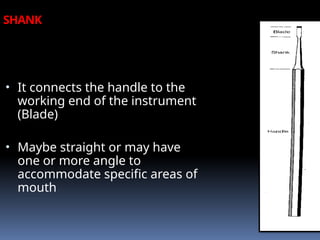
SHANK
• It connectsthe handle to the
working end of the instrument
(Blade)
• Maybe straight or may have
one or more angle to
accommodate specific areas of
mouth
20.
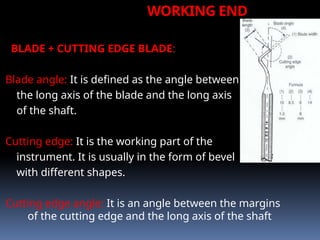
WORKING END
BLADE +CUTTING EDGE BLADE:
Blade angle: It is defined as the angle between
the long axis of the blade and the long axis
of the shaft.
Cutting edge: It is the working part of the
instrument. It is usually in the form of bevel
with different shapes.
Cutting edge angle: It is an angle between the margins
of the cutting edge and the long axis of the shaft
21.
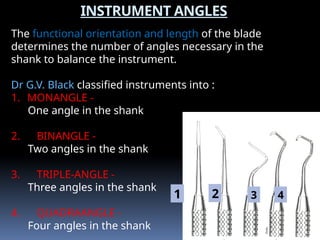
INSTRUMENT ANGLES
The functionalorientation and length of the blade
determines the number of angles necessary in the
shank to balance the instrument.
Dr G.V. Black classified instruments into :
1. MONANGLE -
One angle in the shank
2. BINANGLE -
Two angles in the shank
3. TRIPLE-ANGLE -
Three angles in the shank
4. QUADRAANGLE -
Four angles in the shank
1 2 3 4
22.
In orderto cut hard enamel and dentin using
hand instruments much force has to be
generated at the tip of the instrument.
At the same time the instruments should not
rotate while its in use.
BALANCING
23.
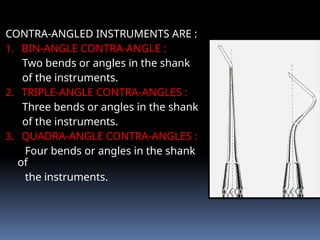
CONTRA-ANGLED INSTRUMENTS ARE:
1. BIN-ANGLE CONTRA-ANGLE :
Two bends or angles in the shank
of the instruments.
2. TRIPLE-ANGLE CONTRA-ANGLES :
Three bends or angles in the shank
of the instruments.
3. QUADRA-ANGLE CONTRA-ANGLES :
Four bends or angles in the shank
of
the instruments.
24.
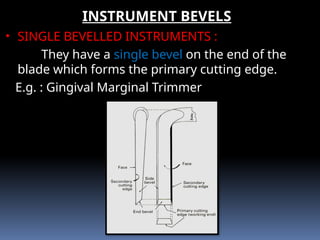
INSTRUMENT BEVELS
• SINGLEBEVELLED INSTRUMENTS :
They have a single bevel on the end of the
blade which forms the primary cutting edge.
E.g. : Gingival Marginal Trimmer
25.
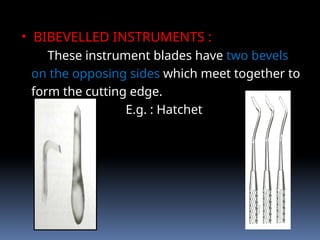
• BIBEVELLED INSTRUMENTS:
These instrument blades have two bevels
on the opposing sides which meet together to
form the cutting edge.
E.g. : Hatchet
26.
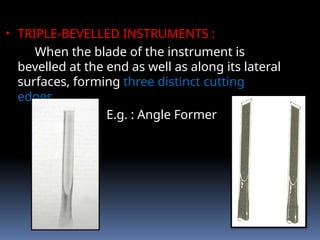
• TRIPLE-BEVELLED INSTRUMENTS:
When the blade of the instrument is
bevelled at the end as well as along its lateral
surfaces, forming three distinct cutting
edges.
E.g. : Angle Former
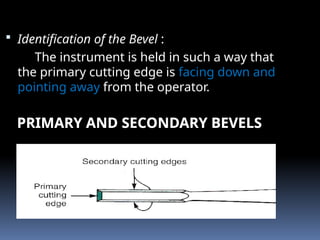
Identification ofthe Bevel :
The instrument is held in such a way that
the primary cutting edge is facing down and
pointing away from the operator.
PRIMARY AND SECONDARY BEVELS
29.
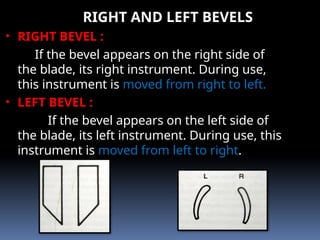
• RIGHT BEVEL:
If the bevel appears on the right side of
the blade, its right instrument. During use,
this instrument is moved from right to left.
• LEFT BEVEL :
If the bevel appears on the left side of
the blade, its left instrument. During use, this
instrument is moved from left to right.
RIGHT AND LEFT BEVELS
30.
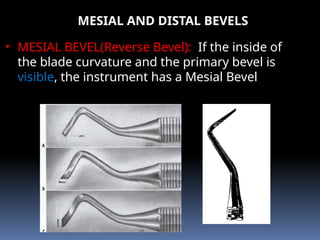
MESIAL AND DISTALBEVELS
• MESIAL BEVEL(Reverse Bevel): If the inside of
the blade curvature and the primary bevel is
visible, the instrument has a Mesial Bevel
31.
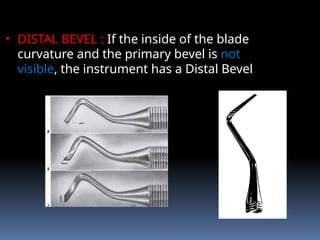
• DISTAL BEVEL: If the inside of the blade
curvature and the primary bevel is not
visible, the instrument has a Distal Bevel
32.
INSTRUMENT FORMULA
DrG.V Black, Northwestern University developed a
numeric formula to describe the dimensions and
angles
of the working end of a hand cutting instrument.
• THREE unit Formula
• FOUR unit Formula
33.
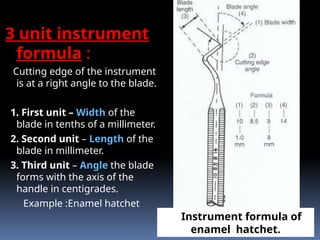
3 unit instrument
formula:
Cutting edge of the instrument
is at a right angle to the blade.
1. First unit – Width of the
blade in tenths of a millimeter.
2. Second unit – Length of the
blade in millimeter.
3. Third unit – Angle the blade
forms with the axis of the
handle in centigrades.
Example :Enamel hatchet
Instrument formula of
enamel hatchet.
34.
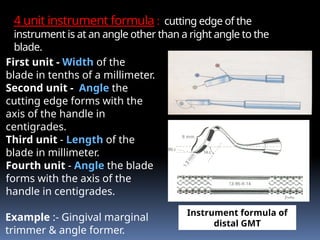
4 unit instrumentformula : cutting edge of the
instrument is at an angle other than a right angle to the
blade.
First unit - Width of the
blade in tenths of a millimeter.
Second unit - Angle the
cutting edge forms with the
axis of the handle in
centigrades.
Third unit - Length of the
blade in millimeter.
Fourth unit - Angle the blade
forms with the axis of the
handle in centigrades.
Example :- Gingival marginal
trimmer & angle former.
Instrument formula of
distal GMT
35.
HAND INSTRUMENT TECHNIQUES
•Instrument Grasps :
Definition: These are the manners of holding the
instruments which if not held properly will result in loss
of efficiency and accumulation of unnecessary strain on
the operator.
Adv: - Instrument can be held in different areas for
maximum comfort of the operator.
- Provides greater flexibility of movement.
- Better operator efficiency.
Different grasps :
1) Pen grasp (Not an acceptable grasp)
2) Modified pen grasp
3) Inverted pen grasp
4) Palm and thumb grasp
5) Modified palm and thumb grasp
Used universally
36.
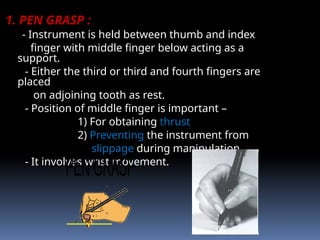
1. PEN GRASP:
- Instrument is held between thumb and index
finger with middle finger below acting as a
support.
- Either the third or third and fourth fingers are
placed
on adjoining tooth as rest.
- Position of middle finger is important –
1) For obtaining thrust
2) Preventing the instrument from
slippage during manipulation.
- It involves wrist movement.
37.
Adv : -More flexibility of movement.
- Less power.
- Greatest versatility of movement.
- More comfortable.
- Limits application of pressure.
Disadv : Bracing is difficult because only the
ring
and little fingers are used.
38.
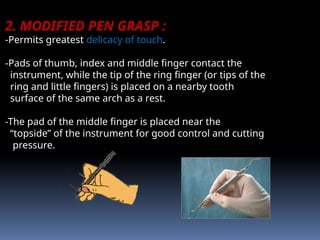
2. MODIFIED PENGRASP :
-Permits greatest delicacy of touch.
-Pads of thumb, index and middle finger contact the
instrument, while the tip of the ring finger (or tips of the
ring and little fingers) is placed on a nearby tooth
surface of the same arch as a rest.
-The pad of the middle finger is placed near the
“topside” of the instrument for good control and cutting
pressure.
39.
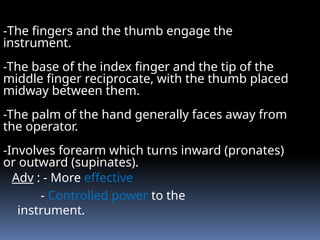
Adv : -More effective
- Controlled power to the
instrument.
-The fingers and the thumb engage the
instrument.
-The base of the index finger and the tip of the
middle finger reciprocate, with the thumb placed
midway between them.
-The palm of the hand generally faces away from
the operator.
-Involves forearm which turns inward (pronates)
or outward (supinates).
40.
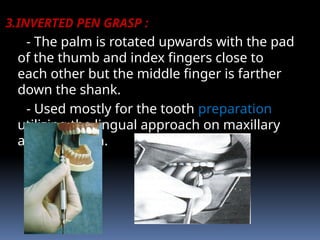
3.INVERTED PEN GRASP:
- The palm is rotated upwards with the pad
of the thumb and index fingers close to
each other but the middle finger is farther
down the shank.
- Used mostly for the tooth preparation
utilizing the lingual approach on maxillary
anterior teeth.
41.
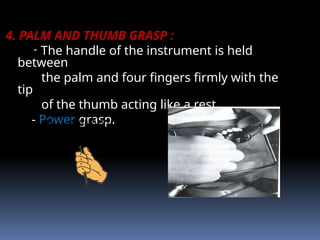
4. PALM ANDTHUMB GRASP :
- The handle of the instrument is held
between
the palm and four fingers firmly with the
tip
of the thumb acting like a rest.
- Power grasp.
42.
Adv :
- Morecontrol and precision.
- Limited movement.
- Enhance bracing (a forward thrust with the
arm of wrist can be controlled by the opposing
action from the thumb, which is braced against
the teeth).
- Gives the possibility of applying pressure
precisely.
Example : holding a hand piece for cutting incisal
retention for Class III preparation on maxillary
incisor.
43.
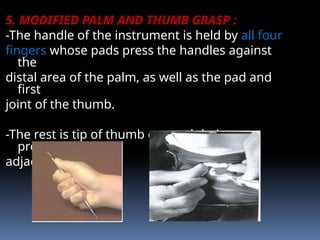
5. MODIFIED PALMAND THUMB GRASP :
-The handle of the instrument is held by all four
fingers whose pads press the handles against
the
distal area of the palm, as well as the pad and
first
joint of the thumb.
-The rest is tip of thumb on tooth being
prepared or
adjacent teeth.
44.
Adv :-
- Mostvaluable aid in operating inside and
outside the mouth.
- Allows greater ease of instrument
movement.
- More control against slippage during
thrust stroke compared to palm and thumb
grasp.
- Grasping the handle under the first joint of
the ring and little finger acts as a stabilizer.
- More delicate manipulation.
45.
• REST :
-It is to stabilize the hand and instrument by
providing a firm fulcrum as movement are
made to activate the instrument.
- Is required for steady hand during operative
procedures.
Adv :
- A good finger rest prevents injury and
laceration of the gingiva and surrounding
tissues.
- The ring finger is preferred as finger rest.
46.
SHARPENING HAND INSTRUMENTS
“Noman has ever yet become a good and
efficient dentist until after he has learned to
keep his instrument sharp” - Dr G.V. Black
DETECTION OF A DULL CUTTING INSTRUMENT
1) Visibility of a reflection of the cutting edge.
Sharp edge – does not reflect light
Dull edge – reflect light
2) Obvious irregularities in the cutting edge
3) Won’t cut tooth structure.
47.
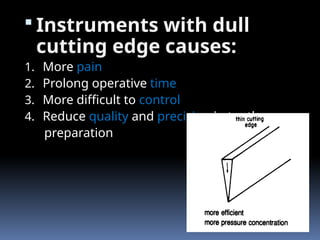
Instruments withdull
cutting edge causes:
1. More pain
2. Prolong operative time
3. More difficult to control
4. Reduce quality and precision in tooth
preparation
48.
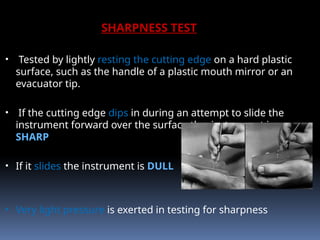
SHARPNESS TEST
• Testedby lightly resting the cutting edge on a hard plastic
surface, such as the handle of a plastic mouth mirror or an
evacuator tip.
• If the cutting edge dips in during an attempt to slide the
instrument forward over the surface the instrument is
SHARP
• If it slides the instrument is DULL
• Very light pressure is exerted in testing for sharpness
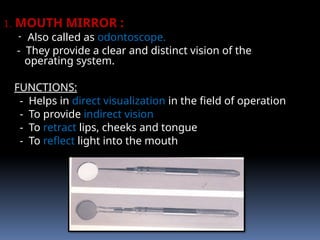
1. MOUTH MIRROR:
- Also called as odontoscope.
- They provide a clear and distinct vision of the
operating system.
FUNCTIONS:
- Helps in direct visualization in the field of operation
- To provide indirect vision
- To retract lips, cheeks and tongue
- To reflect light into the mouth
51.
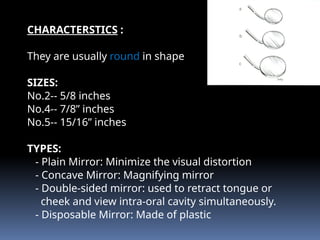
CHARACTERSTICS :
They areusually round in shape
SIZES:
No.2-- 5/8 inches
No.4-- 7/8” inches
No.5-- 15/16” inches
TYPES:
- Plain Mirror: Minimize the visual distortion
- Concave Mirror: Magnifying mirror
- Double-sided mirror: used to retract tongue or
cheek and view intra-oral cavity simultaneously.
- Disposable Mirror: Made of plastic
52.
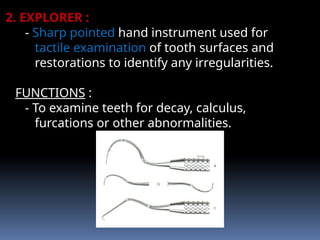
2. EXPLORER :
-Sharp pointed hand instrument used for
tactile examination of tooth surfaces and
restorations to identify any irregularities.
FUNCTIONS :
- To examine teeth for decay, calculus,
furcations or other abnormalities.
53.
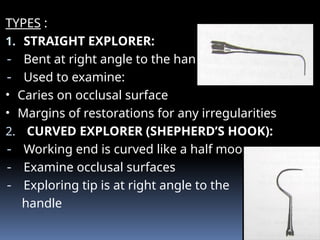
TYPES :
1. STRAIGHTEXPLORER:
- Bent at right angle to the handle
- Used to examine:
• Caries on occlusal surface
• Margins of restorations for any irregularities
2. CURVED EXPLORER (SHEPHERD’S HOOK):
- Working end is curved like a half moon.
- Examine occlusal surfaces
- Exploring tip is at right angle to the
handle
54.
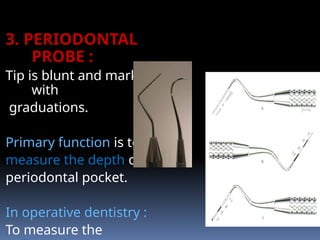
3. PERIODONTAL
PROBE :
Tipis blunt and marked
with
graduations.
Primary function is to
measure the depth of
periodontal pocket.
In operative dentistry :
To measure the
55.
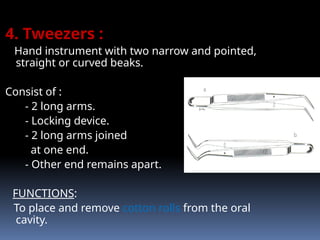
4. Tweezers :
Handinstrument with two narrow and pointed,
straight or curved beaks.
Consist of :
- 2 long arms.
- Locking device.
- 2 long arms joined
at one end.
- Other end remains apart.
FUNCTIONS:
To place and remove cotton rolls from the oral
cavity.
56.
Uses:
- Useful incarrying things to and from mouth.
- Carrying cotton rolls, cotton pledges, sponge
pellets to and around the cavity.
- Carrying saliva soaked cotton rolls from the
oral cavity to the waste disposal unit.
57.
EXCAVATORS
They areused for removal of caries and
refinement of the internal parts of
preparation.
1. Ordinary Hatchet
2. Hoe
3. Angle former
4. Spoon excavator
58.
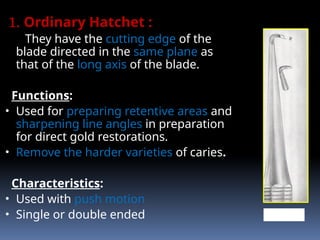
1. Ordinary Hatchet:
They have the cutting edge of the
blade directed in the same plane as
that of the long axis of the blade.
Functions:
• Used for preparing retentive areas and
sharpening line angles in preparation
for direct gold restorations.
• Remove the harder varieties of caries.
Characteristics:
• Used with push motion
• Single or double ended HATCHET
59.
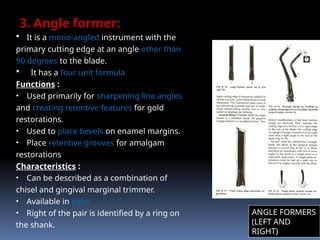
3. Angle former:
It is a mono-angled instrument with the
primary cutting edge at an angle other than
90 degrees to the blade.
It has a four unit formula
Functions :
• Used primarily for sharpening line angles
and creating retentive features for gold
restorations.
• Used to place bevels on enamel margins.
• Place retentive grooves for amalgam
restorations
Characteristics :
• Can be described as a combination of
chisel and gingival marginal trimmer.
• Available in pairs
• Right of the pair is identified by a ring on
the shank.
ANGLE FORMERS
(LEFT AND
RIGHT)
60.
CHISELS
They are theinstruments designed after an ordinary carpenter’s
tool and intended for cutting enamel.
Chisel – Straight, Mono angle, Bin-angle, Triple angle
Special types of chisels :
1. Enamel Hatchet
2. Off angle Hatchet
3. Jeffery Hatchet
4. Gingival Marginal Trimmer
5. Wedelstaedt chisel
6. Triangular chisel
7. Hoe chisel
61.
Special types ofchisels :-
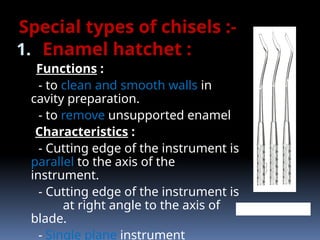
1. Enamel hatchet :
Functions :
- to clean and smooth walls in
cavity preparation.
- to remove unsupported enamel
Characteristics :
- Cutting edge of the instrument is
parallel to the axis of the
instrument.
- Cutting edge of the instrument is
at right angle to the axis of
blade.
- Single plane instrument
ENAMEL HATCHET
62.
3. Gingival marginaltrimmer :
It’s a modified Enamel Hatchet.
There are two distinct modifications :
- Blade is curved which makes it a double planed
instrument and enhances its lateral scrapping.
- The primary cutting edge is at an angle (other than
perpendicular) to the axis of the blade.
Functions :
- To bevel gingival cavosurface margin of proximal
occlusal preparations.
- Used for rounding off or bevelling of the axiopulpal
line angle of the two surface preparations.
- Removal of unsupported enamel.
63.
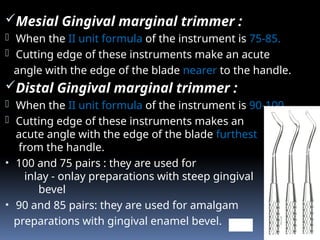
Mesial Gingival marginaltrimmer :
- When the II unit formula of the instrument is 75-85.
- Cutting edge of these instruments make an acute
angle with the edge of the blade nearer to the handle.
Distal Gingival marginal trimmer :
- When the II unit formula of the instrument is 90-100
- Cutting edge of these instruments makes an
acute angle with the edge of the blade furthest
from the handle.
• 100 and 75 pairs : they are used for
inlay - onlay preparations with steep gingival
bevel
• 90 and 85 pairs: they are used for amalgam
preparations with gingival enamel bevel. GMT
64.
INSTRUMENTS USED FORRESTORING THE
TEETH
1. Mixing instruments
2. Plastic instruments
3. Condensors
4. Burnishing instruments
5. Carving and finishing
instruments
65.
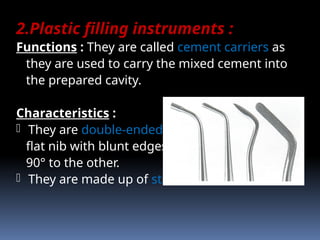
2.Plastic filling instruments:
Functions : They are called cement carriers as
they are used to carry the mixed cement into
the prepared cavity.
Characteristics :
- They are double-ended instruments having a
flat nib with blunt edges on each end, one at
90° to the other.
- They are made up of stainless steel.
66.
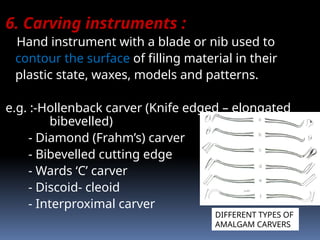
6. Carving instruments:
Hand instrument with a blade or nib used to
contour the surface of filling material in their
plastic state, waxes, models and patterns.
e.g. :-Hollenback carver (Knife edged – elongated
bibevelled)
- Diamond (Frahm’s) carver
- Bibevelled cutting edge
- Wards ‘C’ carver
- Discoid- cleoid
- Interproximal carver
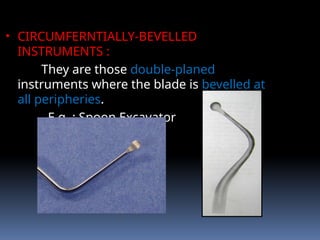
DIFFERENT TYPES OF
AMALGAM CARVERS
67.
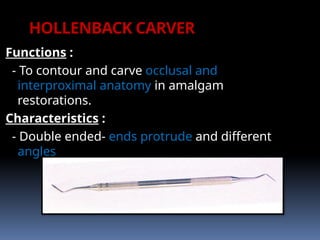
HOLLENBACK CARVER
Functions :
-To contour and carve occlusal and
interproximal anatomy in amalgam
restorations.
Characteristics :
- Double ended- ends protrude and different
angles
68.
6. FINISHING INSTRUMENTS
FINISHINGrefers to the removal of surface
irregularities by a process of cutting and or
grinding.
POLISHING refers to the production of a
perfectly smooth and shiny surface. The
polishing materials does not cut or grind but fills
fine scratches on the surface of the restoration
to produce a smooth surface.
69.
SUMMARY AND CONCLUSION
Theremoval and shaping of tooth
structure are essential aspects of restorative
dentistry. Modern high speed equipments
has eliminated the need for many hand
instruments for tooth preparation, but hand
cutting instruments are still important for
finishing many tooth preparations and thus
hand cutting instruments remain an
essential part of the armamentarium for
quality restorative dentistry.