The CMIS solution for Tenix's
M113 Program
William P. Hall (PhD)
Documentation Systems Analyst, Tenix Defence
Paul Brouwers (CMII Cert.)
Design Resources Manager, TD Land
CMIS
MRP
Production
Procurement
RAM
Relex
Opus
LSA
TeraText SGML
TECHNICAL
PUBLICATIONS
CAD
ACAD
CATIA
LORA
CMIS
MRP
Production
Procurement
RAM
Relex
Opus
LSALSA
TeraText SGML
TECHNICAL
PUBLICATIONS
CAD
ACAD
CATIA
LORALORA
MRP = Mfg. Resource Planning
CAD = Computer Aided Design
LORA = Level of Repair Analysis
RAM = Reliability & Maintainability
LSA = Logistic Support Analysis
Our project knowledge revolves around
CMIS
Scope
• Some introductory comments about Tenix
– History & experience with large, complex projects
• Critical issues relating to management of project
data, information and knowledge
• A new project allowed us to embody our
understanding with the latest product lifecycle
management technology
• Focus on how we have extended the core
technology to encompass content management
Company started as AMECON with
building warships (Marine Division)
• $A 7 BN ANZAC project to build 10 frigates for
Australian (8) and New Zealand (2) Navies
• Signed Nov. 1989 - 8 ships already delivered
• Project Protector - preferred tenderer for new
ships for NZ
Tenix Group / Tenix Defence
• One of Australia’s largest private companies, with
defence and commercial clients in Australia, New
Zealand, Fiji, Philippines, USA and Europe
• Defence is largest of 6 business units, it includes:
– Marine (defence & commercial shipbuilding,
logistic support, etc)
– Land (rebuilding as new 350 M113's, other heavy
vehicle work, logistic & base support, etc.)
– Aerospace (systems integration, logistic support)
– Electronic Systems (systems design, integration,
related software)
(http://www.tenix.com/)
Some Land Division jobsM113A1 "Upgrade“
(Another country in the region recently procured around 100 new LAVs for approx. $600 M)
• The Australian Army M113A1s were originally
brought into service during the early 1960’s.
• The purpose of the M113 Upgrade Contract is to
improve protection, mobility, communications and
firepower.
• Tenix is turning 350 "well used" hulls into new
state-of-the-art vehicles with totally new technical
data packs for a contract value of $A 391 M.
Requirements for safe & effective
operation of all products we build
• Capability when when the client needs it
– Reliably does what it is supposed to
– Available for service when needed
– Maintainable - problems can be fixed when they arise
– Supportable - critical needs available in supply chain
– Operable within limits of human knowledge & capacity
• Health, safety and operational knowledge issues
– Heavy/complex engineering systems can kill!
• Life-cycle cost
– Minimise acquisition cost
– Minimise documentation, support & maintenance costs
– Facilitate "lean maintenance" philosophy
Major quality issues in delivering tech
data and knowledge
• Client's operational knowledge delivery goals
– Correct
• Correct information
• Consistent across the fleet
– Applicable/Effective
• Applicable to the configuration of the individual ship/vehicle
• Effective for the point in time re engineering changes, etc.
– Available
• To who needs it, when and where it is needed
– Useable
• Readily understandable by humans
• Readily managed & processed in computer systems
• Supplier's knowledge production and usage goals
– Fast – High quality – Low cost
– Eliminate rework!
• Total configuration management is the answer
What we are building on
• ANZAC SHIP PROJECT
– experience!
– Lessons learned
• ARCHITECTURE GOALS FOR A LARGE PROJECT
Crossbow
Validates and integrates/
Normalises data across
15 legacy systems
TeraText
Content management
AMPS
Navy's
maint
mgmt
CSARS
Provides corrective
feedback from AMPS
into supplier/Navy
knowledge development
activities
DESIGN / ENG
PRODUCT DATA
MANAGEMENT
• Product Model
• CAD / Drawing
Mgmt
• Config Mgmt
• Eng Change
• Workflow
Process
Control
• Doco Revision
& Release
DOCO CONTENT
MANAGEMENT
DOCUMENT
AUTHORING
LSAR
DATABASE
LOGISTIC
ANALYSIS
TOOLS
(prime)
PRODUCT CONFIG
MANAGEMENT
• Product Model
• Drawing Mgmt
• Config Mgmt
• Change Request
• Workflow
Process
Control
• Doco Revision
& Release
MAINTENANCE
MANAGEMENT
• Schedule
• Resource Reqs
• Procedures
• Completion
• Downtime
• Resource Usage
RECORDING
REPORTING
ANALYSIS
TOOLS
(prime)
•
•
•
SUPPLY SYSTEM
change request
configchange
doco change
ECO
change effected
doco
change
order
released
doco
change
EC /
doco
change
request
maintenance
history
doco
server
Analysis &
optimisation
orders receipts
change task
doco change
shared systems?
data change
& Release
Tenix/RAN architecture for managing ANZAC
Ship technical data and content
UPDATE
MAINT DATA
/
PROCEDURE
UPDATE
CONFIG
Navy Systems
15 legacy
systems!
MRP
SYSTEM
Plan
Fabricate
Assemble
config changes
The M113 challange
7 variants
~25 builds
350 vehicles
• Coherently manage all data and documents required to
support the M113 fleet through life
– Engineering data (well known solutions for this)
– Technical data and publication content
The CMIS solution for Tenix's M113 Program
Big enough project to support
current best practice
Knowledge is our most important asset
• Data and documentation are the most important
assets to the company
• CMIS is the custodian AND guardian of the
Company’s data and documents
– Secure Vaults and Stores
– Encrypted
– Access control
• CM II compliant
– Only recognized commercial CM doctrine
– Qualified by Institute of CM
Background
• Contract: All CM in M113 Project according to
– TRAMM (Technical Regulation Army Maint Mgmt)
– MIL-STD-973 (Configuration management)
• Other standards
– Naming follows H6 (US Fed Item Name Directory)
– NATO Commodity Codes forms part type
• Rule: CMIS manages all tech data for all projects
– Engineering data
– Source documents
– Technical Publication content
• No part released until all metadata correct
CMIS was conceived as an "umbrella"
system
• Single user interface
• Data normalization applies to all project data and
document components from the start
• Common workflow management environment
• Single point:
– electronic signoff
– engineering change management and tracking
– cost and schedule control
• The umbrella covers everything!
Overview
• CMIS provides primary user interface
• Two major modules
– PDM – product data manager – Matrix10
• Configuration management
• Workflow process
• Object management
– ANZAC experience proved value of content
management
• Authoring activities delegated from Matrix10
• Configuration management of elements within documents
• Paragraph version management & reuse
• Authoring in S1000D - deliver any required structured/
unstructured format
Configuration management
The source of all data generated starts at the
concept phase of the product and grows with
the product!*
SOME QUOTES:
Configuration management is a
discipline
not
an overhead!*
* Some mad person
Configuration Management
• Very distinct phases of CM
– Development
– Production
– In service
• Analysis of data types has determined two
distinct types
– Objects
– Content
• To manage these we require two distinct
processes
– CM of objects - provided in Matrix10 PDM
environment
– CM of content - delegated to TeraText
Configuration Management
• Baseline management for each engineering
phase
• Principles
– Items (like Systems) have a lifecycle within the
engineering phase.
– Items are “promoted” to the next phase through
approval only.
– Items are NEVER deleted – they have “history”.
Preliminary
Review
Release
Obsolete
Focus on:
Document and content management
It is configuration management of “blocks of
text”
It is configuration management to the lowest
level inside a document!
What is a document?
• The entire history of all versions?
• Each set of variants?
• Each separate version?
• Each rendition – SGML, HTML, PDF?
• Each component
– volume, chapter, division, warning …?
• TeraText uses the Document Management
Alliance model which concurrently
supports all of these concepts and provides
a framework for managing them
What is TeraText:
• Embodies world wide state-of-the-art in information
systems research in a commercial product
– Fully web enabled text database system (not relational)
– Data compression for CPU efficiency and speed
• High performance compressed/inverted file indexes
• typical index ~ size of text
– Real-time simultaneous indexing/search/retrieval
– Very sophisticated search engine works against index
– Standards based
• XML/SGML/RTF/PDF etc.
• Z39.50, MARC, etc.
– Distributed architecture
– Scalability to multi-terabyte data, 10,000's users
– http://www.teratext com
TeraText
TeraText
Users Manual
This is section 1
of the document
This
is the
Work File System
Chapter
Section
Document
PDF
Fragment
Fragment
Graphic
Storage and
sembly RulesDis/as
WEB Protocol
Save
Edit
Content Management in the
M113 Upgrade
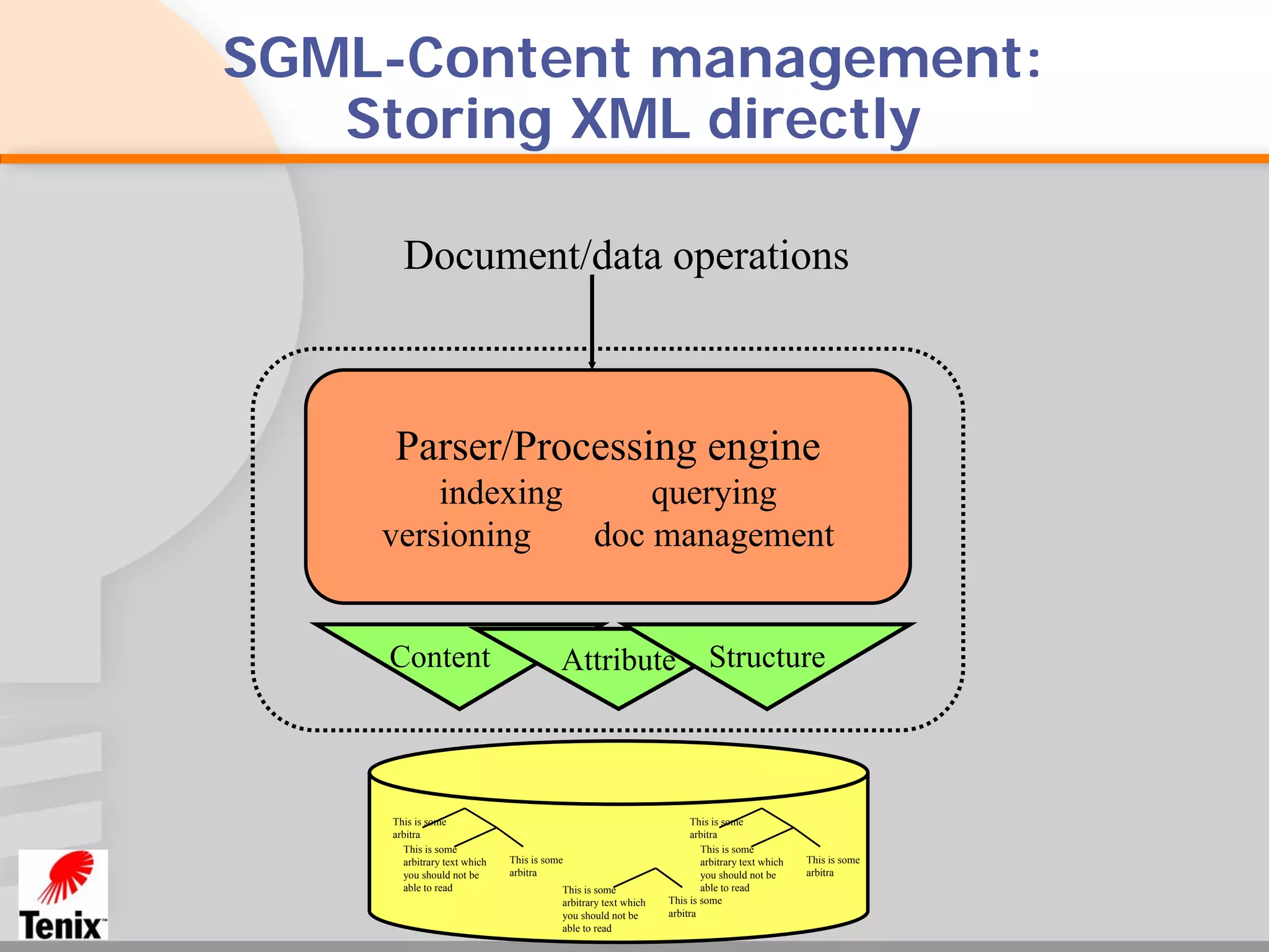
SGML-Content management:
Storing XML directly
Parser/Processing engine
indexing querying
versioning doc management
Content Attribute Structure
Document/data operations
This is some
arbitrary text which
you should not be
able to read
This is some
arbitra
This is some
arbitra
This is some
arbitrary text which
you should not be
able to read
This is some
arbitra
This is some
arbitra
This is some
arbitrary text which
you should not be
able to read
This is some
arbitra
HTTP/HTML
Z39.50
TeraText:
Web interface overhead
TeraText
Application server
Application
Workflow
XML engine
Document Manager
TeraText DBS
XML engine
Content query
Object Management
Repository
Ace
Ace
XML Engine
XML Engine
User Interface Module
Workflow
Enactment
Service
Document
Version
ManagerMetadata
Support
XML/SGML
Parser
PDM
(Matrix10)
Tech Documents
(TeraText)
Document
Authoring
(FM+)
EC process
Managing document technical data
• Authoring process
for controlled
changes to
authored content
• Achieves
– Consistency (via
standards base,
DTD and EDD)
– Reuse
Technical manuals and data modules are
managed with CMIS lifecycle process in
same way as any other configuration items
We are addressing the content
management challenge by…
• Adopting a long term view of the
content
• Ensuring the document model
supports authoring at the document,
component and fragment levels
• Truly sharing (reusing) common texts
vs rekeying common texts
• Direct sourcing of PDM data into parts
lists tables
• Supporting auditable review processes
and version control
• Using tools and content model to
assess impact of change
• Building documentation set using
industry standards and tools
• Using COTS authoring tools
• Applying industry standards for long
life content
Users
Manual
Maintenance
Manual
Reuse
Texts
Publishing
and Review
Processes
COTS
authoring
tools
Vehicle
Variants
What real world problems are solved?
• The in-service life for an APC is many decades
– Most documents contain configuration sensitive content
– File system does not track the changes through time
– Lifetime of a word processor format is about 5 years
– DMS does not provide point-in-time support
– TeraText Content Management System manages versions
and provides point-in-time search across versions
– SGML(~XML) is essentially unchanged since 1986
• Many versions of each manual, changes to individual
vehicles etc, leads to many hundreds of documents
– DMS typically limited to about 100,000 pieces
– TeraText Content Management System scales to many
hundreds of thousands of documents and millions of
configuration sensitive components
What real world problems are solved?
• About 80% of content is common to all
manuals
– DMS only manages whole documents and does not know
what is common to other documents
– TeraText Content Management system manages the
components that make up the document
– Reuse, don't rewrite!
• Only small component may change in a
document
– DMS or file system requires whole document to be stored
again
– TeraText Content Management System stores
common components once and tracks versions of
components as well as whole documents
– Know "where used"
What real world problems are solved?
• May need to strip out classified material for unclassified
users
– static documents don’t allow for changed details
– TeraText can strip out elements on-the-fly
• Need to support hypertext link management
– a word processor alone cannot validate links between
multiple documents
– TeraText manages links and link validation
• Need to support collaborative authoring of large
documents
– TeraText allows whole documents or individual
components to be edited
The cost/benefit equation for content
management vs DMS
Implementation
Initialdocumentset
Proliferation of configurations
In-service maintenance
CMIS
Traditional DMS
Cost
Time Note: CMIS cost is for first project only.
Our major success factors to stay ahead
of the competition
• In the starting blocks
– Complex project with no legacy systems
– Limited budget emphasised need to work smart
– Management willing to try new solutions
• Success on the track
– Knowing what was possible/practical
• Leveraging prior successes
• Continuing R&D to track technology with specifications
– Project controlled by end-users who had to
deliver physical and knowledge products
– In-country application implementation and
interfacing expertise
Thank You!
Now, what does it look like?
ILS Data tab in Tree ViewILS Data tab in Tree View
Browser based - we could be doing this
anywhere in the world!
• Note that we are working on an end-user PC
• The only reason the presentation isn't live is that
– Our development environment is on an isolated
server.
– No one "plays" with live data!
Data Modules associated with Hardware
Part 15004514 in the eMatrix PDM
Data Module Graphics associated with Part
15004514 in the eMatrix PDM
Operations and TeraText Interface Screen
for Equipment Overview Data Module
Online View of Data
Module retrieved from
the Tenix CMISII
TeraText Repository
Annotation points
Option to retrieve previous versions of a
Data Module from the Tenix CMISII
TeraText Repository
Facility to check a Data Module out of the TeraText
repository for editing and launch it in the editor of
choice [currently FrameMaker], convert it to SGML
and check it back in to the repository [Check-in]
Authoring Environment
• Tenix modified FrameMaker to use the TeraText
Interface.
• The CMIS option on the tool bar accesses
functions to help authors find and insert:
– Warnings, cautions and notes
– Data module references (links)
– External source publication references (links)
– Data module graphics, and
– to save the data modules in SGML format.
CMIS functions
Insert a CautionInsert a Caution
Searching TeraText database
for a Graphic element
Capturing contextual knowledge with links
and annotations in the ANZAC Ship Project
• Explicit and implicit links encode contextual knowledge
• Links are 2-way connections
• Annotations are the key to converting implicit contextual
knowledge to codified explicit knowledge
CONTENT MANAGEMENT REPOSITORY
ANNOTATION
METADATA
-------------------------
PRIMARY LINK
-------------------------
ANNOTATION
TEXT
-------------------------
SECONDARY
LINKS
ANNOTATION
METADATA
-------------------------
PRIMARY LINK
-------------------------
ANNOTATION
TEXT
-------------------------
SECONDARY
LINKS
SOURCE
REGISTRY
PRIMARY DOCUMENT
METADATA
---------------------------------
CONTENT
PRIMARY
OBJECTS
(i.e., <para>)
PRIMARY
OBJECTS
(i.e., <para>)
1:1
Document
element
(i.e., <para>)
PRIMARY
OBJECTS
(i.e., <para>)
PRIMARY
OBJECTS
(i.e., <para>)
PRIMARY
OBJECTS
(i.e., <para>)
0:many
OTHER
DELIVERABLES
AND
SOURCE
DOCUMENTS
SOURCE REPOSITORY
ANNOTATION
METADATA
-------------------------
PRIMARY LINK
-------------------------
ANNOTATION
TEXT
-------------------------
SECONDARY
LINKS
Document
element
(i.e., <para>)
Annotations
• Annotations provide the key to capturing context
Source registry reference
Annotation may
be added here
Yellow marker
indicates
annotation exists
here. Click on
marker to see it
Annotations in CMIS
Annotations in CMIS
Technical Manuals list page identifies and shows
lifecycle status of manuals produced for the
selected vehicle
Tracking document work
• The Technical
Manual is generated
as a background
process.
• When the generate
manual process has
been completed an
email is sent to the
manual owners
group.
Generating a deliverable document
Technical manual delivery files are stored in
3 formats: on-line, PDF and SGML
Browser view
Acrobat PDF view
SGML version and the associated graphic
elements are delivered in a ZIP File
EXTRA SLIDES
Our latest best practices:
Land Division
• Domain expertise in:
– Design and manufacture of Armoured
Personnel Carriers
– Upgrade of military vehicles
– Design, manufacture, modification and
repair support of all kinds of major
military vehicles
– Civilian support, armoured & heavy
vehicle maintenance, warehousing at
military sites
• Present major vehicle projects
– Australian Army M113 project
– ASLAV Phase 3 Project
Configuration and knowledge management
architecture goals for a large project
• Product and textual
data are structured
and are managed as
content
• Production mgmt data
is transactional and is
managed as records
and fields
• Goal is to manage
all project data
within a single
configuration
management
umbrella MRP / PRODUCTION MGMT
• MBOM
• Production planning
• Production schedule
• Procurement
• Warehousing
• Establish & release workorders
Project
Schedule
HRM
Accounting
CS2
RFT
Capability requirements Documentation requirements
PRODUCT MODELS
(structured designs )
MODELS / BOMs:
• Component definitions
• Component hierarchies
- System
- Physical structural
- Availability
OBJECTS MANAGED
• Drawings
• Parts lists
• Configurations
• Component metadata
DOCUMENT MODELS
(structured documents )
MODELS:
• Element definitions
- Content
- Attributes
• Element hierarchies
• Element sequences
OUTPUT OBJECTS
• Contract/subcontract
documents
• Procedures/instructions
• Deliverable documents
• All other controlled
documents
COMMON REQUIREMENTS
• Config control / Change mgmt
- Develop/Author
- Release
- Effectivity
• Workflow management
- Configuration changes
- Document changes
- Other business objects
• Track and control source data
Link element to component
Manage elements
LSA tools
LSAR database
Managedesignactivities
EBOMEBOM
Manage documentation
activities
Catalogue
Drawings
Users - Interfaces
CMIS
MRP
CAD
RAM
Tech
Pubs
ACAD
CATIA
TeraText
SGML
Relex
Opus
Production
Procurement
SGML-DMS:
The traditional approach
Parsing Engine
fragment/coalesce
Content Relation
Full Text Indexing
Engine
Relational Engine
Content Attribute, Structure, Content
Document/data operations
Traditional DBMS:
Web interface overhead
Web server
Application logic
XML engine
Document Manager
Object Manager
RDBMS
Workflow Content Query
HTTP/HTML
SQL
ODBC/CORBA…
ODMA?
Custom
SQL
SQL
WAPI
Custom
CGI/ISAPI
CGI/Java…
Omnimark/
Perl…
Custom
C++/Java
SQL
Custom/WfMC Custom

Hall brouwers2004tenixmatrixinovsummitcmis(present)

  • 1.
    The CMIS solutionfor Tenix's M113 Program William P. Hall (PhD) Documentation Systems Analyst, Tenix Defence Paul Brouwers (CMII Cert.) Design Resources Manager, TD Land
  • 2.
    CMIS MRP Production Procurement RAM Relex Opus LSA TeraText SGML TECHNICAL PUBLICATIONS CAD ACAD CATIA LORA CMIS MRP Production Procurement RAM Relex Opus LSALSA TeraText SGML TECHNICAL PUBLICATIONS CAD ACAD CATIA LORALORA MRP= Mfg. Resource Planning CAD = Computer Aided Design LORA = Level of Repair Analysis RAM = Reliability & Maintainability LSA = Logistic Support Analysis Our project knowledge revolves around CMIS
  • 3.
    Scope • Some introductorycomments about Tenix – History & experience with large, complex projects • Critical issues relating to management of project data, information and knowledge • A new project allowed us to embody our understanding with the latest product lifecycle management technology • Focus on how we have extended the core technology to encompass content management
  • 4.
    Company started asAMECON with building warships (Marine Division) • $A 7 BN ANZAC project to build 10 frigates for Australian (8) and New Zealand (2) Navies • Signed Nov. 1989 - 8 ships already delivered • Project Protector - preferred tenderer for new ships for NZ
  • 5.
    Tenix Group /Tenix Defence • One of Australia’s largest private companies, with defence and commercial clients in Australia, New Zealand, Fiji, Philippines, USA and Europe • Defence is largest of 6 business units, it includes: – Marine (defence & commercial shipbuilding, logistic support, etc) – Land (rebuilding as new 350 M113's, other heavy vehicle work, logistic & base support, etc.) – Aerospace (systems integration, logistic support) – Electronic Systems (systems design, integration, related software) (http://www.tenix.com/)
  • 6.
    Some Land DivisionjobsM113A1 "Upgrade“ (Another country in the region recently procured around 100 new LAVs for approx. $600 M) • The Australian Army M113A1s were originally brought into service during the early 1960’s. • The purpose of the M113 Upgrade Contract is to improve protection, mobility, communications and firepower. • Tenix is turning 350 "well used" hulls into new state-of-the-art vehicles with totally new technical data packs for a contract value of $A 391 M.
  • 7.
    Requirements for safe& effective operation of all products we build • Capability when when the client needs it – Reliably does what it is supposed to – Available for service when needed – Maintainable - problems can be fixed when they arise – Supportable - critical needs available in supply chain – Operable within limits of human knowledge & capacity • Health, safety and operational knowledge issues – Heavy/complex engineering systems can kill! • Life-cycle cost – Minimise acquisition cost – Minimise documentation, support & maintenance costs – Facilitate "lean maintenance" philosophy
  • 8.
    Major quality issuesin delivering tech data and knowledge • Client's operational knowledge delivery goals – Correct • Correct information • Consistent across the fleet – Applicable/Effective • Applicable to the configuration of the individual ship/vehicle • Effective for the point in time re engineering changes, etc. – Available • To who needs it, when and where it is needed – Useable • Readily understandable by humans • Readily managed & processed in computer systems • Supplier's knowledge production and usage goals – Fast – High quality – Low cost – Eliminate rework! • Total configuration management is the answer
  • 9.
    What we arebuilding on • ANZAC SHIP PROJECT – experience! – Lessons learned • ARCHITECTURE GOALS FOR A LARGE PROJECT
  • 10.
    Crossbow Validates and integrates/ Normalisesdata across 15 legacy systems TeraText Content management AMPS Navy's maint mgmt CSARS Provides corrective feedback from AMPS into supplier/Navy knowledge development activities DESIGN / ENG PRODUCT DATA MANAGEMENT • Product Model • CAD / Drawing Mgmt • Config Mgmt • Eng Change • Workflow Process Control • Doco Revision & Release DOCO CONTENT MANAGEMENT DOCUMENT AUTHORING LSAR DATABASE LOGISTIC ANALYSIS TOOLS (prime) PRODUCT CONFIG MANAGEMENT • Product Model • Drawing Mgmt • Config Mgmt • Change Request • Workflow Process Control • Doco Revision & Release MAINTENANCE MANAGEMENT • Schedule • Resource Reqs • Procedures • Completion • Downtime • Resource Usage RECORDING REPORTING ANALYSIS TOOLS (prime) • • • SUPPLY SYSTEM change request configchange doco change ECO change effected doco change order released doco change EC / doco change request maintenance history doco server Analysis & optimisation orders receipts change task doco change shared systems? data change & Release Tenix/RAN architecture for managing ANZAC Ship technical data and content UPDATE MAINT DATA / PROCEDURE UPDATE CONFIG Navy Systems 15 legacy systems! MRP SYSTEM Plan Fabricate Assemble config changes
  • 11.
    The M113 challange 7variants ~25 builds 350 vehicles • Coherently manage all data and documents required to support the M113 fleet through life – Engineering data (well known solutions for this) – Technical data and publication content
  • 12.
    The CMIS solutionfor Tenix's M113 Program Big enough project to support current best practice
  • 13.
    Knowledge is ourmost important asset • Data and documentation are the most important assets to the company • CMIS is the custodian AND guardian of the Company’s data and documents – Secure Vaults and Stores – Encrypted – Access control • CM II compliant – Only recognized commercial CM doctrine – Qualified by Institute of CM
  • 14.
    Background • Contract: AllCM in M113 Project according to – TRAMM (Technical Regulation Army Maint Mgmt) – MIL-STD-973 (Configuration management) • Other standards – Naming follows H6 (US Fed Item Name Directory) – NATO Commodity Codes forms part type • Rule: CMIS manages all tech data for all projects – Engineering data – Source documents – Technical Publication content • No part released until all metadata correct
  • 15.
    CMIS was conceivedas an "umbrella" system • Single user interface • Data normalization applies to all project data and document components from the start • Common workflow management environment • Single point: – electronic signoff – engineering change management and tracking – cost and schedule control • The umbrella covers everything!
  • 16.
    Overview • CMIS providesprimary user interface • Two major modules – PDM – product data manager – Matrix10 • Configuration management • Workflow process • Object management – ANZAC experience proved value of content management • Authoring activities delegated from Matrix10 • Configuration management of elements within documents • Paragraph version management & reuse • Authoring in S1000D - deliver any required structured/ unstructured format
  • 17.
    Configuration management The sourceof all data generated starts at the concept phase of the product and grows with the product!* SOME QUOTES: Configuration management is a discipline not an overhead!* * Some mad person
  • 18.
    Configuration Management • Verydistinct phases of CM – Development – Production – In service • Analysis of data types has determined two distinct types – Objects – Content • To manage these we require two distinct processes – CM of objects - provided in Matrix10 PDM environment – CM of content - delegated to TeraText
  • 19.
    Configuration Management • Baselinemanagement for each engineering phase • Principles – Items (like Systems) have a lifecycle within the engineering phase. – Items are “promoted” to the next phase through approval only. – Items are NEVER deleted – they have “history”. Preliminary Review Release Obsolete
  • 20.
    Focus on: Document andcontent management It is configuration management of “blocks of text” It is configuration management to the lowest level inside a document!
  • 21.
    What is adocument? • The entire history of all versions? • Each set of variants? • Each separate version? • Each rendition – SGML, HTML, PDF? • Each component – volume, chapter, division, warning …? • TeraText uses the Document Management Alliance model which concurrently supports all of these concepts and provides a framework for managing them
  • 22.
    What is TeraText: •Embodies world wide state-of-the-art in information systems research in a commercial product – Fully web enabled text database system (not relational) – Data compression for CPU efficiency and speed • High performance compressed/inverted file indexes • typical index ~ size of text – Real-time simultaneous indexing/search/retrieval – Very sophisticated search engine works against index – Standards based • XML/SGML/RTF/PDF etc. • Z39.50, MARC, etc. – Distributed architecture – Scalability to multi-terabyte data, 10,000's users – http://www.teratext com
  • 23.
  • 24.
  • 25.
    Users Manual This issection 1 of the document This is the Work File System Chapter Section Document PDF Fragment Fragment Graphic Storage and sembly RulesDis/as WEB Protocol Save Edit Content Management in the M113 Upgrade
  • 26.
    SGML-Content management: Storing XMLdirectly Parser/Processing engine indexing querying versioning doc management Content Attribute Structure Document/data operations This is some arbitrary text which you should not be able to read This is some arbitra This is some arbitra This is some arbitrary text which you should not be able to read This is some arbitra This is some arbitra This is some arbitrary text which you should not be able to read This is some arbitra
  • 27.
    HTTP/HTML Z39.50 TeraText: Web interface overhead TeraText Applicationserver Application Workflow XML engine Document Manager TeraText DBS XML engine Content query Object Management Repository Ace Ace XML Engine XML Engine User Interface Module Workflow Enactment Service Document Version ManagerMetadata Support XML/SGML Parser
  • 28.
    PDM (Matrix10) Tech Documents (TeraText) Document Authoring (FM+) EC process Managingdocument technical data • Authoring process for controlled changes to authored content • Achieves – Consistency (via standards base, DTD and EDD) – Reuse
  • 29.
    Technical manuals anddata modules are managed with CMIS lifecycle process in same way as any other configuration items
  • 30.
    We are addressingthe content management challenge by… • Adopting a long term view of the content • Ensuring the document model supports authoring at the document, component and fragment levels • Truly sharing (reusing) common texts vs rekeying common texts • Direct sourcing of PDM data into parts lists tables • Supporting auditable review processes and version control • Using tools and content model to assess impact of change • Building documentation set using industry standards and tools • Using COTS authoring tools • Applying industry standards for long life content Users Manual Maintenance Manual Reuse Texts Publishing and Review Processes COTS authoring tools Vehicle Variants
  • 31.
    What real worldproblems are solved? • The in-service life for an APC is many decades – Most documents contain configuration sensitive content – File system does not track the changes through time – Lifetime of a word processor format is about 5 years – DMS does not provide point-in-time support – TeraText Content Management System manages versions and provides point-in-time search across versions – SGML(~XML) is essentially unchanged since 1986 • Many versions of each manual, changes to individual vehicles etc, leads to many hundreds of documents – DMS typically limited to about 100,000 pieces – TeraText Content Management System scales to many hundreds of thousands of documents and millions of configuration sensitive components
  • 32.
    What real worldproblems are solved? • About 80% of content is common to all manuals – DMS only manages whole documents and does not know what is common to other documents – TeraText Content Management system manages the components that make up the document – Reuse, don't rewrite! • Only small component may change in a document – DMS or file system requires whole document to be stored again – TeraText Content Management System stores common components once and tracks versions of components as well as whole documents – Know "where used"
  • 33.
    What real worldproblems are solved? • May need to strip out classified material for unclassified users – static documents don’t allow for changed details – TeraText can strip out elements on-the-fly • Need to support hypertext link management – a word processor alone cannot validate links between multiple documents – TeraText manages links and link validation • Need to support collaborative authoring of large documents – TeraText allows whole documents or individual components to be edited
  • 34.
    The cost/benefit equationfor content management vs DMS Implementation Initialdocumentset Proliferation of configurations In-service maintenance CMIS Traditional DMS Cost Time Note: CMIS cost is for first project only.
  • 35.
    Our major successfactors to stay ahead of the competition • In the starting blocks – Complex project with no legacy systems – Limited budget emphasised need to work smart – Management willing to try new solutions • Success on the track – Knowing what was possible/practical • Leveraging prior successes • Continuing R&D to track technology with specifications – Project controlled by end-users who had to deliver physical and knowledge products – In-country application implementation and interfacing expertise
  • 36.
    Thank You! Now, whatdoes it look like?
  • 37.
    ILS Data tabin Tree ViewILS Data tab in Tree View
  • 38.
    Browser based -we could be doing this anywhere in the world! • Note that we are working on an end-user PC • The only reason the presentation isn't live is that – Our development environment is on an isolated server. – No one "plays" with live data!
  • 39.
    Data Modules associatedwith Hardware Part 15004514 in the eMatrix PDM
  • 40.
    Data Module Graphicsassociated with Part 15004514 in the eMatrix PDM
  • 41.
    Operations and TeraTextInterface Screen for Equipment Overview Data Module
  • 42.
    Online View ofData Module retrieved from the Tenix CMISII TeraText Repository Annotation points
  • 43.
    Option to retrieveprevious versions of a Data Module from the Tenix CMISII TeraText Repository
  • 44.
    Facility to checka Data Module out of the TeraText repository for editing and launch it in the editor of choice [currently FrameMaker], convert it to SGML and check it back in to the repository [Check-in]
  • 45.
    Authoring Environment • Tenixmodified FrameMaker to use the TeraText Interface. • The CMIS option on the tool bar accesses functions to help authors find and insert: – Warnings, cautions and notes – Data module references (links) – External source publication references (links) – Data module graphics, and – to save the data modules in SGML format.
  • 46.
  • 47.
  • 48.
  • 53.
    Capturing contextual knowledgewith links and annotations in the ANZAC Ship Project • Explicit and implicit links encode contextual knowledge • Links are 2-way connections • Annotations are the key to converting implicit contextual knowledge to codified explicit knowledge CONTENT MANAGEMENT REPOSITORY ANNOTATION METADATA ------------------------- PRIMARY LINK ------------------------- ANNOTATION TEXT ------------------------- SECONDARY LINKS ANNOTATION METADATA ------------------------- PRIMARY LINK ------------------------- ANNOTATION TEXT ------------------------- SECONDARY LINKS SOURCE REGISTRY PRIMARY DOCUMENT METADATA --------------------------------- CONTENT PRIMARY OBJECTS (i.e., <para>) PRIMARY OBJECTS (i.e., <para>) 1:1 Document element (i.e., <para>) PRIMARY OBJECTS (i.e., <para>) PRIMARY OBJECTS (i.e., <para>) PRIMARY OBJECTS (i.e., <para>) 0:many OTHER DELIVERABLES AND SOURCE DOCUMENTS SOURCE REPOSITORY ANNOTATION METADATA ------------------------- PRIMARY LINK ------------------------- ANNOTATION TEXT ------------------------- SECONDARY LINKS Document element (i.e., <para>)
  • 54.
    Annotations • Annotations providethe key to capturing context Source registry reference Annotation may be added here Yellow marker indicates annotation exists here. Click on marker to see it
  • 55.
  • 56.
  • 57.
    Technical Manuals listpage identifies and shows lifecycle status of manuals produced for the selected vehicle
  • 58.
  • 59.
    • The Technical Manualis generated as a background process. • When the generate manual process has been completed an email is sent to the manual owners group. Generating a deliverable document
  • 60.
    Technical manual deliveryfiles are stored in 3 formats: on-line, PDF and SGML
  • 61.
  • 62.
  • 63.
    SGML version andthe associated graphic elements are delivered in a ZIP File
  • 64.
  • 65.
    Our latest bestpractices: Land Division • Domain expertise in: – Design and manufacture of Armoured Personnel Carriers – Upgrade of military vehicles – Design, manufacture, modification and repair support of all kinds of major military vehicles – Civilian support, armoured & heavy vehicle maintenance, warehousing at military sites • Present major vehicle projects – Australian Army M113 project – ASLAV Phase 3 Project
  • 66.
    Configuration and knowledgemanagement architecture goals for a large project • Product and textual data are structured and are managed as content • Production mgmt data is transactional and is managed as records and fields • Goal is to manage all project data within a single configuration management umbrella MRP / PRODUCTION MGMT • MBOM • Production planning • Production schedule • Procurement • Warehousing • Establish & release workorders Project Schedule HRM Accounting CS2 RFT Capability requirements Documentation requirements PRODUCT MODELS (structured designs ) MODELS / BOMs: • Component definitions • Component hierarchies - System - Physical structural - Availability OBJECTS MANAGED • Drawings • Parts lists • Configurations • Component metadata DOCUMENT MODELS (structured documents ) MODELS: • Element definitions - Content - Attributes • Element hierarchies • Element sequences OUTPUT OBJECTS • Contract/subcontract documents • Procedures/instructions • Deliverable documents • All other controlled documents COMMON REQUIREMENTS • Config control / Change mgmt - Develop/Author - Release - Effectivity • Workflow management - Configuration changes - Document changes - Other business objects • Track and control source data Link element to component Manage elements LSA tools LSAR database Managedesignactivities EBOMEBOM Manage documentation activities Catalogue Drawings
  • 67.
  • 68.
    SGML-DMS: The traditional approach ParsingEngine fragment/coalesce Content Relation Full Text Indexing Engine Relational Engine Content Attribute, Structure, Content Document/data operations
  • 69.
    Traditional DBMS: Web interfaceoverhead Web server Application logic XML engine Document Manager Object Manager RDBMS Workflow Content Query HTTP/HTML SQL ODBC/CORBA… ODMA? Custom SQL SQL WAPI Custom CGI/ISAPI CGI/Java… Omnimark/ Perl… Custom C++/Java SQL Custom/WfMC Custom