Learn How Snapshots CAN be Backups
In this webinar we cover:
For audio playback and Q&A go to:
http://bit.ly/SnapshotBU
Available On Demand
1. The types of snapshot technologies
(they’re not all the same)
2. The weaknesses of snapshots
3. How to create a primary storage architecture
that overcomes these weaknesses
4. The benefits of a primary storage
architecture that protects itself
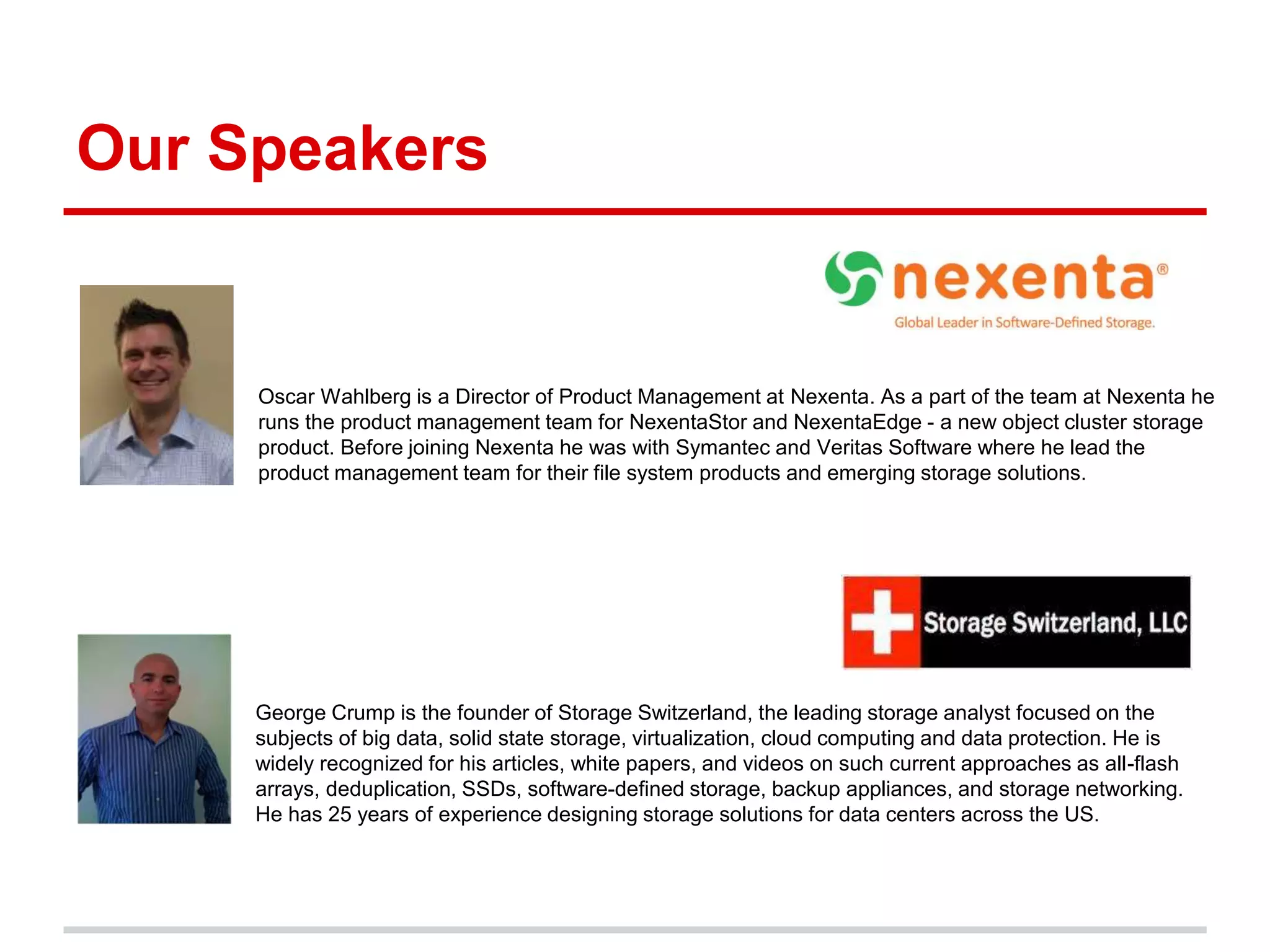
Our Speakers
Oscar Wahlberg is a Director of Product Management at Nexenta. As a part of the team at Nexenta he
runs the product management team for NexentaStor and NexentaEdge - a new object cluster storage
product. Before joining Nexenta he was with Symantec and Veritas Software where he lead the
product management team for their file system products and emerging storage solutions.
George Crump is the founder of Storage Switzerland, the leading storage analyst focused on the
subjects of big data, solid state storage, virtualization, cloud computing and data protection. He is
widely recognized for his articles, white papers, and videos on such current approaches as all-flash
arrays, deduplication, SSDs, software-defined storage, backup appliances, and storage networking.
He has 25 years of experience designing storage solutions for data centers across the US.
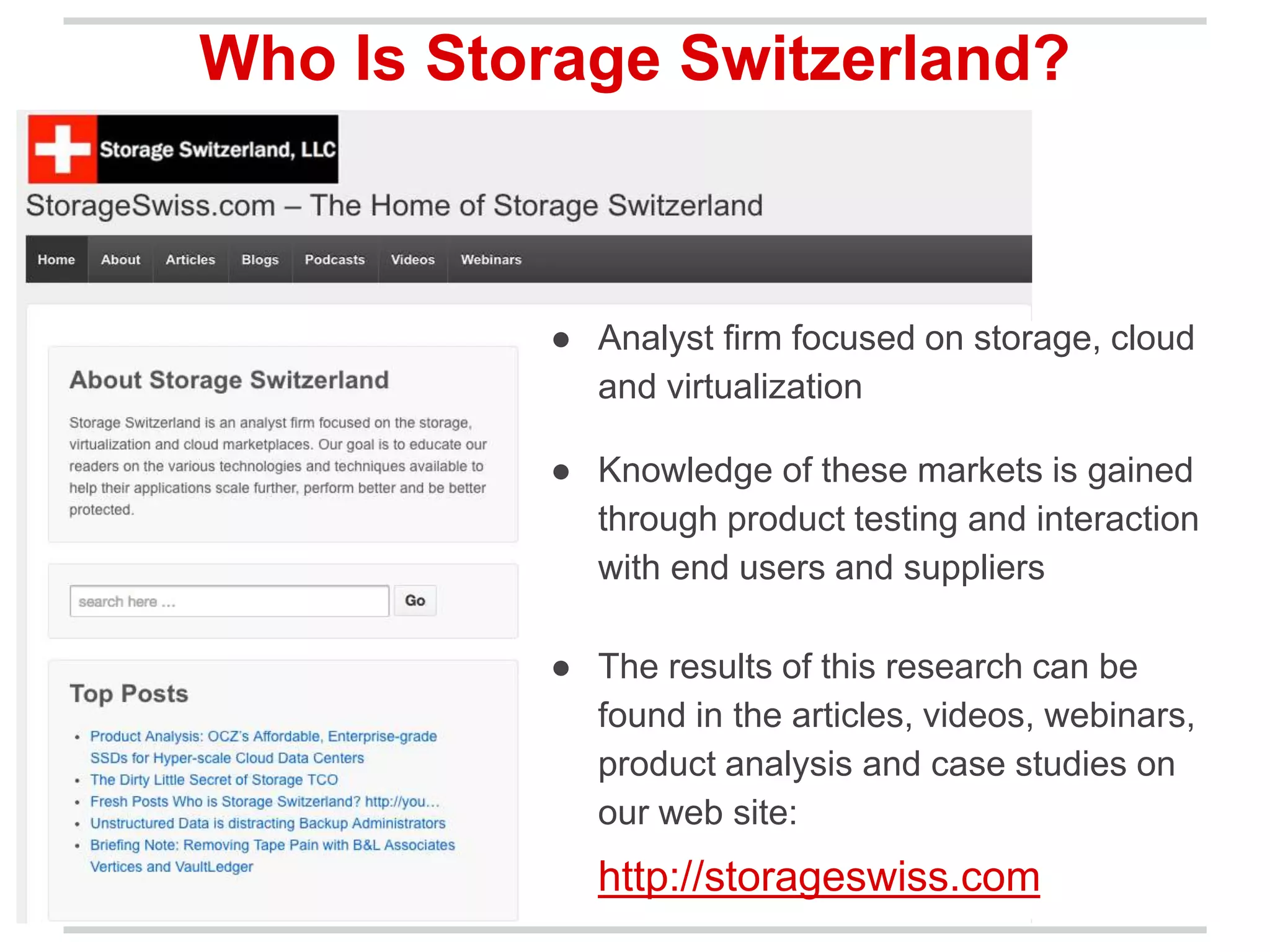
● Analyst firm focused on storage, cloud
and virtualization
● Knowledge of these markets is gained
through product testing and interaction
with end users and suppliers
● The results of this research can be
found in the articles, videos, webinars,
product analysis and case studies on
our web site:
http://storageswiss.com
Who Is Storage Switzerland?
3
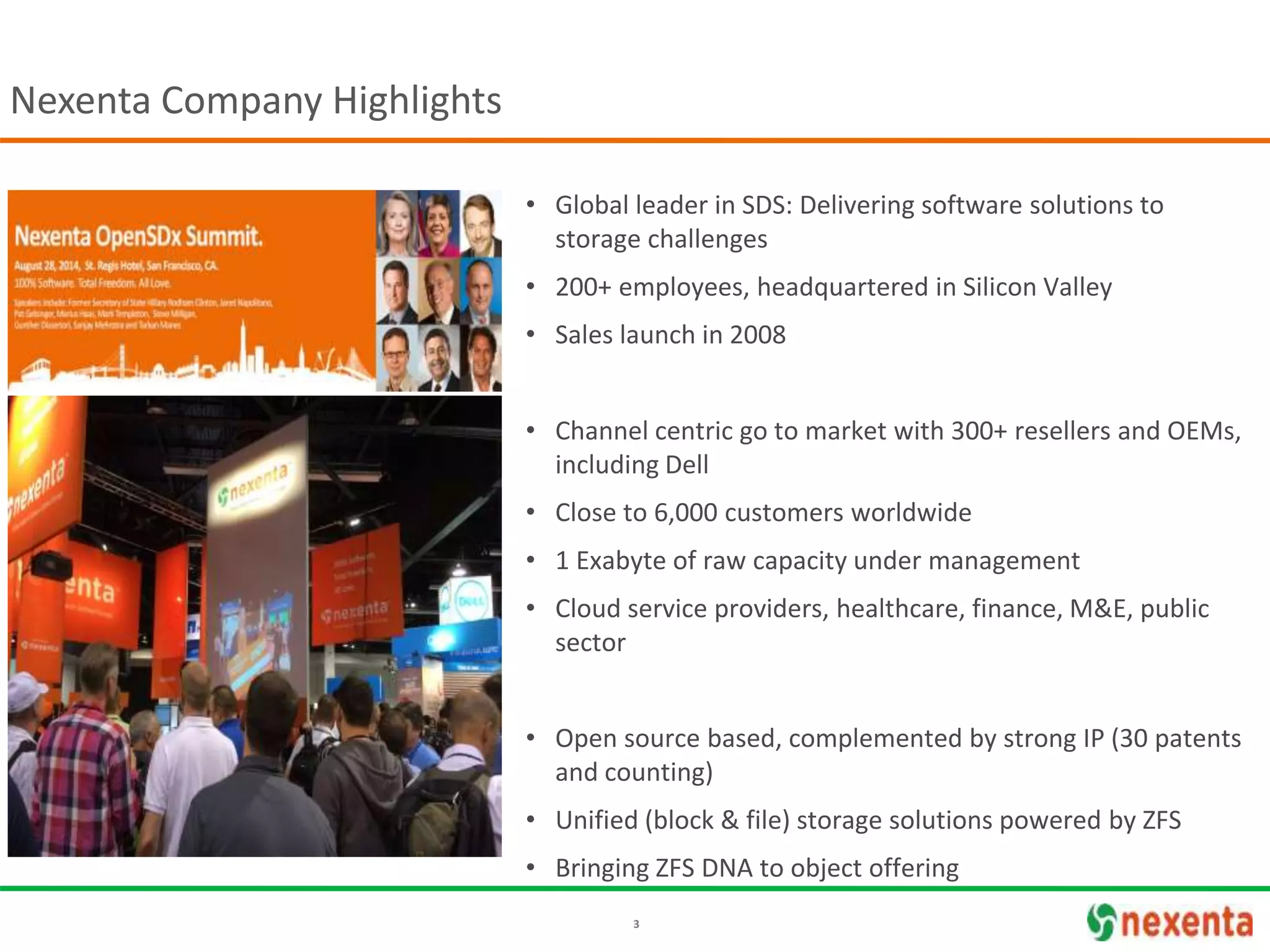
• Global leader in SDS: Delivering software solutions to
storage challenges
• 200+ employees, headquartered in Silicon Valley
• Sales launch in 2008
• Channel centric go to market with 300+ resellers and OEMs,
including Dell
• Close to 6,000 customers worldwide
• 1 Exabyte of raw capacity under management
• Cloud service providers, healthcare, finance, M&E, public
sector
• Open source based, complemented by strong IP (30 patents
and counting)
• Unified (block & file) storage solutions powered by ZFS
• Bringing ZFS DNA to object offering
Nexenta Company Highlights
Polling Question
What is your biggest data protection
challenge?
A) Getting backups done on time
B) Protecting data more frequently
C) Meeting each application’s RPO/RTO
D) Lowering the cost of data protection
E) All of the above
Polling Question
What is your biggest data protection
challenge?
State of Data Protection
• Applications are increasing in number
• Application data is growing
• Unstructured data is growing
• RPO/RTO is becoming
increasingly strict
The Storage Switzerland Data
Protection Philosophy
● Set Service Level Objectives
● Develop a “3-2-1” Data Protection
Strategy
● Develop a Tiered Recovery
Strategy
Set Objectives
Don’t Broker Agreements
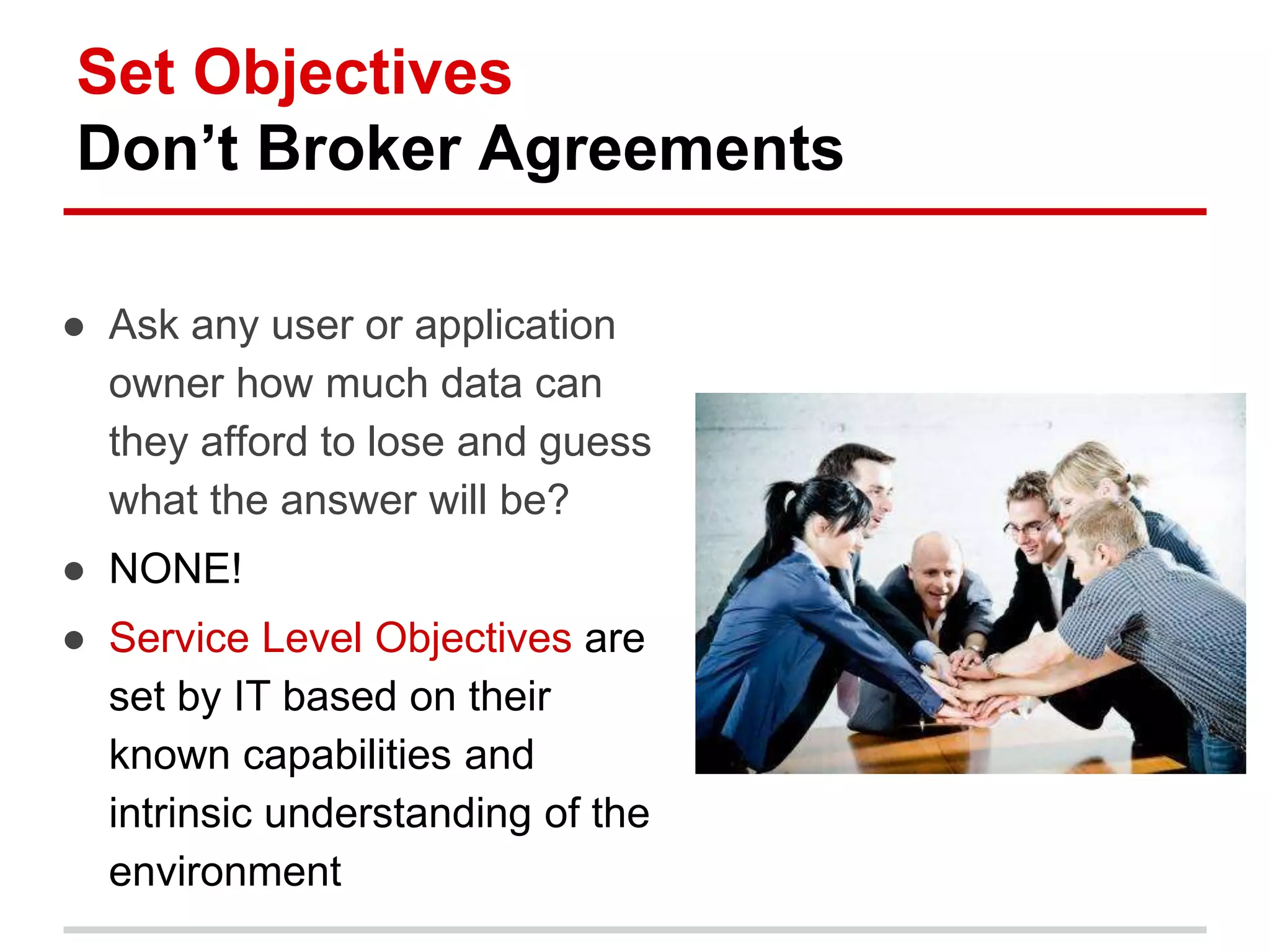
● Ask any user or application
owner how much data can
they afford to lose and guess
what the answer will be?
● NONE!
● Service Level Objectives are
set by IT based on their
known capabilities and
intrinsic understanding of the
environment
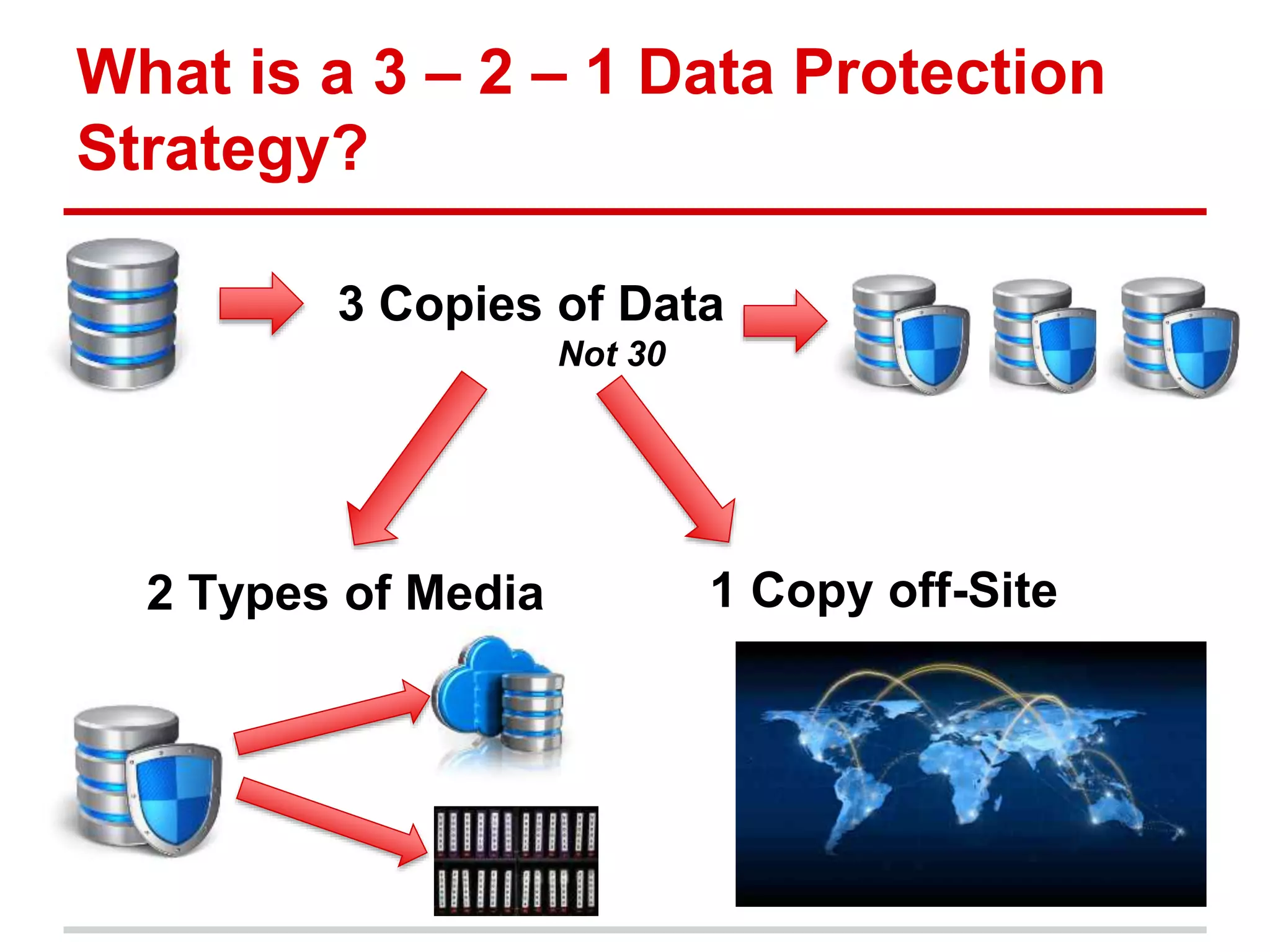
What is a 3 – 2 – 1 Data Protection
Strategy?
3 Copies of Data
Not 30
2 Types of Media 1 Copy off-Site
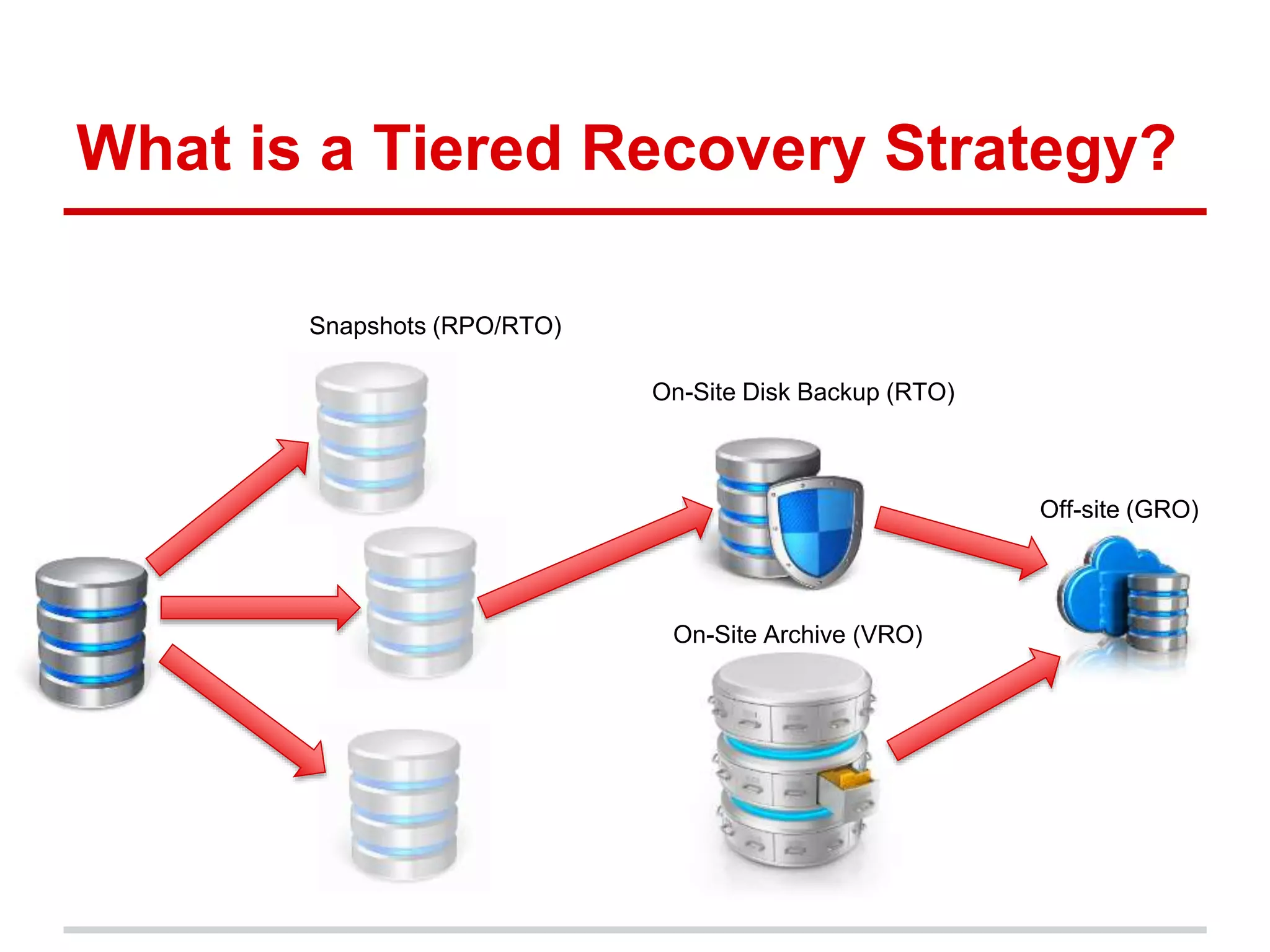
What is a Tiered Recovery Strategy?
Snapshots (RPO/RTO)
On-Site Disk Backup (RTO)
On-Site Archive (VRO)
Off-site (GRO)
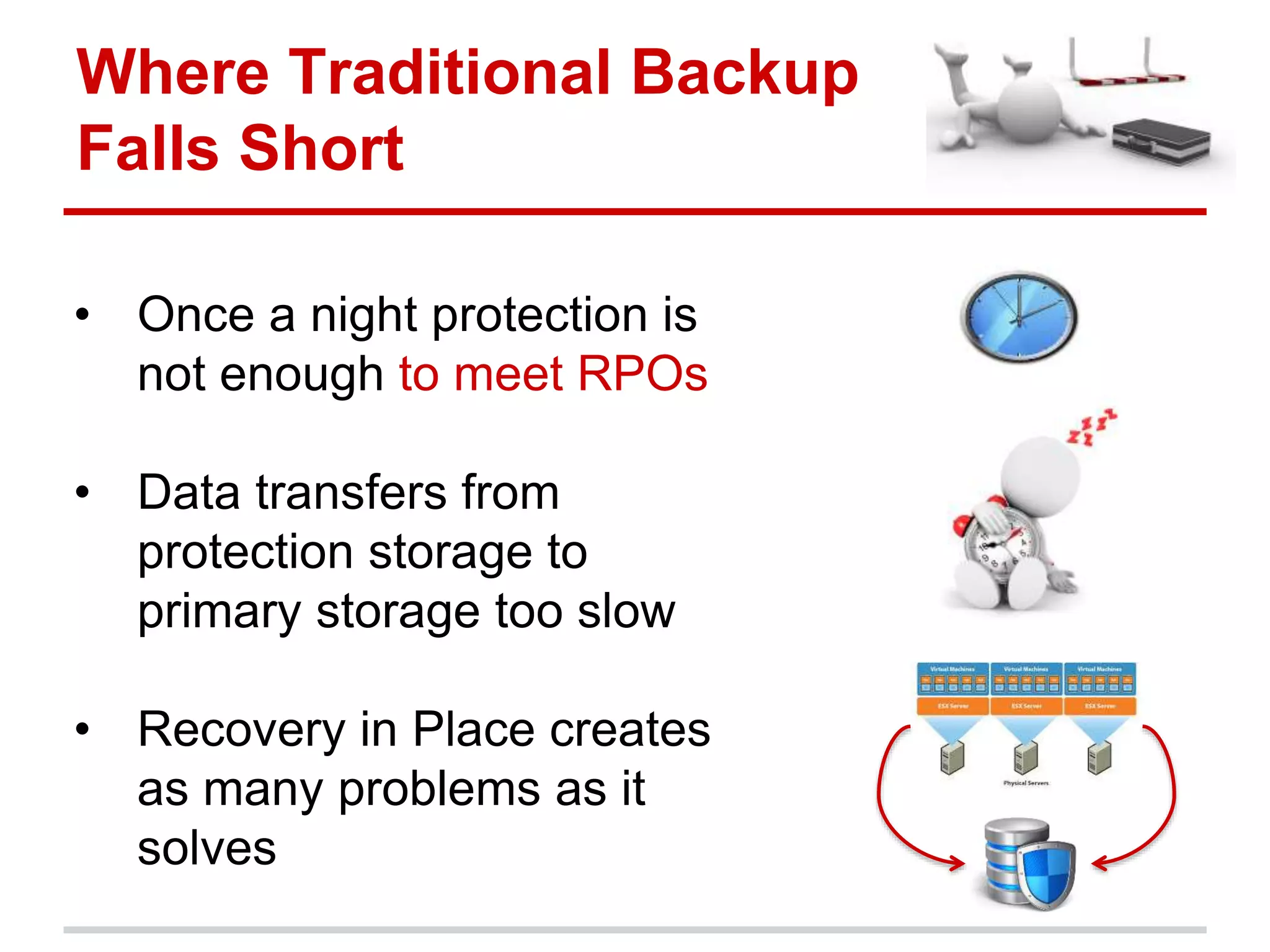
Where Traditional Backup
Falls Short
• Once a night protection is
not enough to meet RPOs
• Data transfers from
protection storage to
primary storage too slow
• Recovery in Place creates
as many problems as it
solves
Primary Storage Has To Carry
More of the Backup Burden
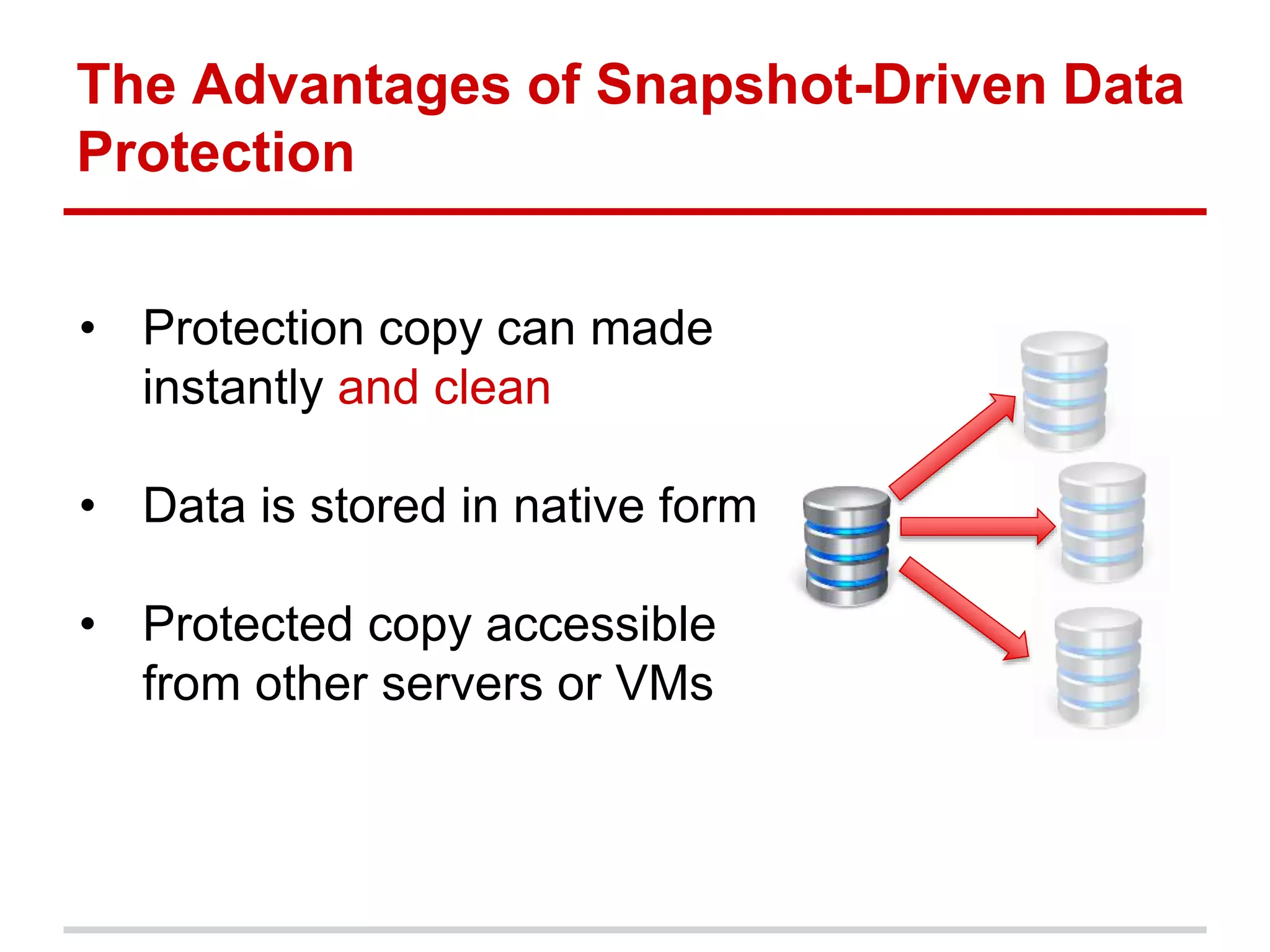
The Advantages of Snapshot-Driven Data
Protection
• Protection copy can made
instantly and clean
• Data is stored in native form
• Protected copy accessible
from other servers or VMs
Addressing the Weaknesses of
Snapshots
• Snapshots are vulnerable to
storage system failure –
Implement two systems on-
site, snapshots on both
• If the site fails so do your
snapshots – Implement a 3rd
system off-site
Addressing the Weaknesses of
Snapshots
• Storage system has to support a high
number of active snapshots
– Use a re-directed
snapshot technology
• Long term retention of data
eventually gets expensive
– Backup up snapshots to
disk/cloud/tape for retention
and indexing
(meets the “2” in 3-2-1 strategy)
• Storage systems are coming down in price
dramatically
• Software-defined storage promised to drive that
price down even further, while maintaining
features and performance
• SDS also introduces
flexibility
Addressing the price problem of
Self-Protecting Primary Storage
17
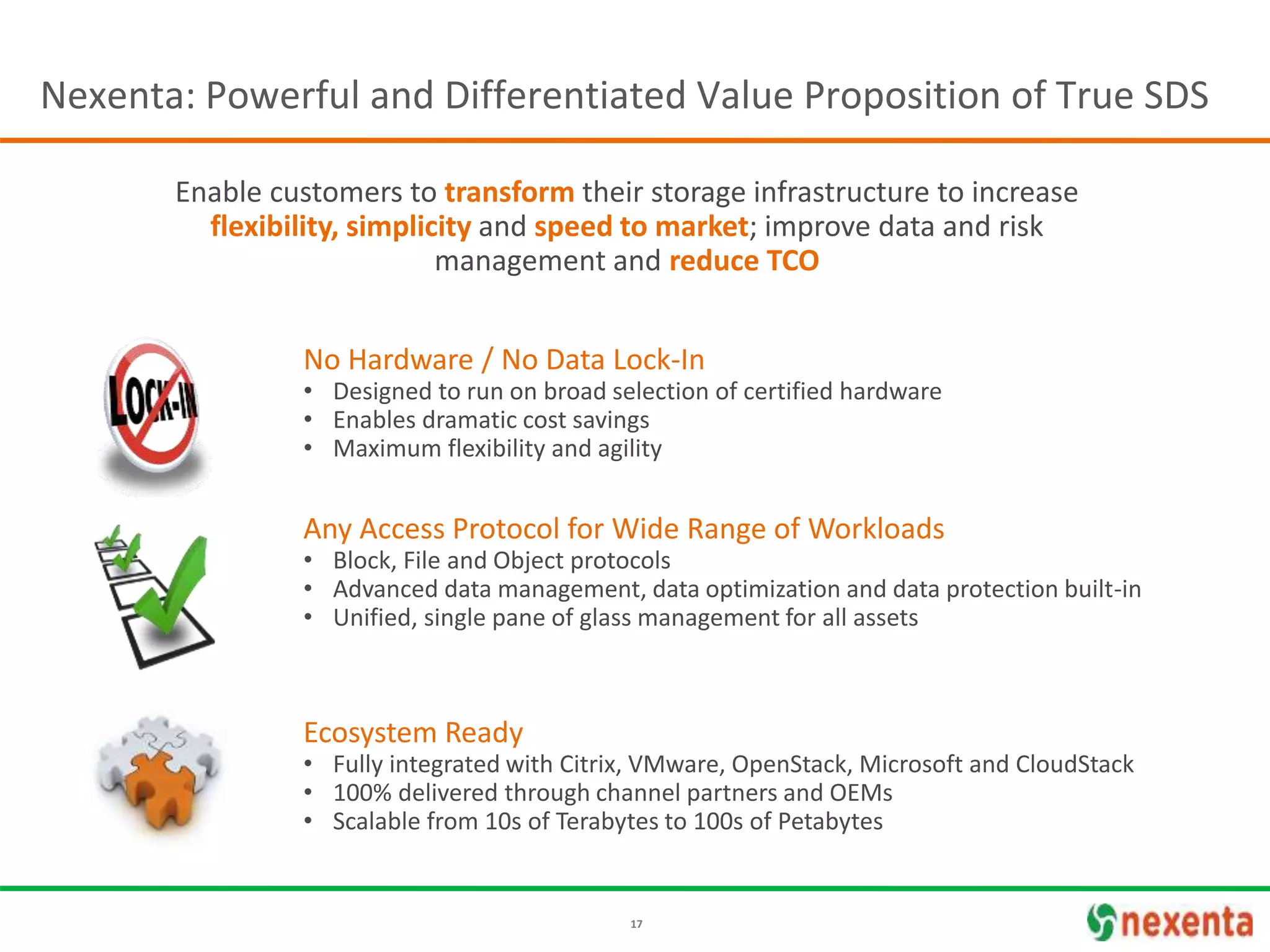
No Hardware / No Data Lock-In
• Designed to run on broad selection of certified hardware
• Enables dramatic cost savings
• Maximum flexibility and agility
Ecosystem Ready
• Fully integrated with Citrix, VMware, OpenStack, Microsoft and CloudStack
• 100% delivered through channel partners and OEMs
• Scalable from 10s of Terabytes to 100s of Petabytes
Any Access Protocol for Wide Range of Workloads
• Block, File and Object protocols
• Advanced data management, data optimization and data protection built-in
• Unified, single pane of glass management for all assets
Enable customers to transform their storage infrastructure to increase
flexibility, simplicity and speed to market; improve data and risk
management and reduce TCO
Nexenta: Powerful and Differentiated Value Proposition of True SDS
18
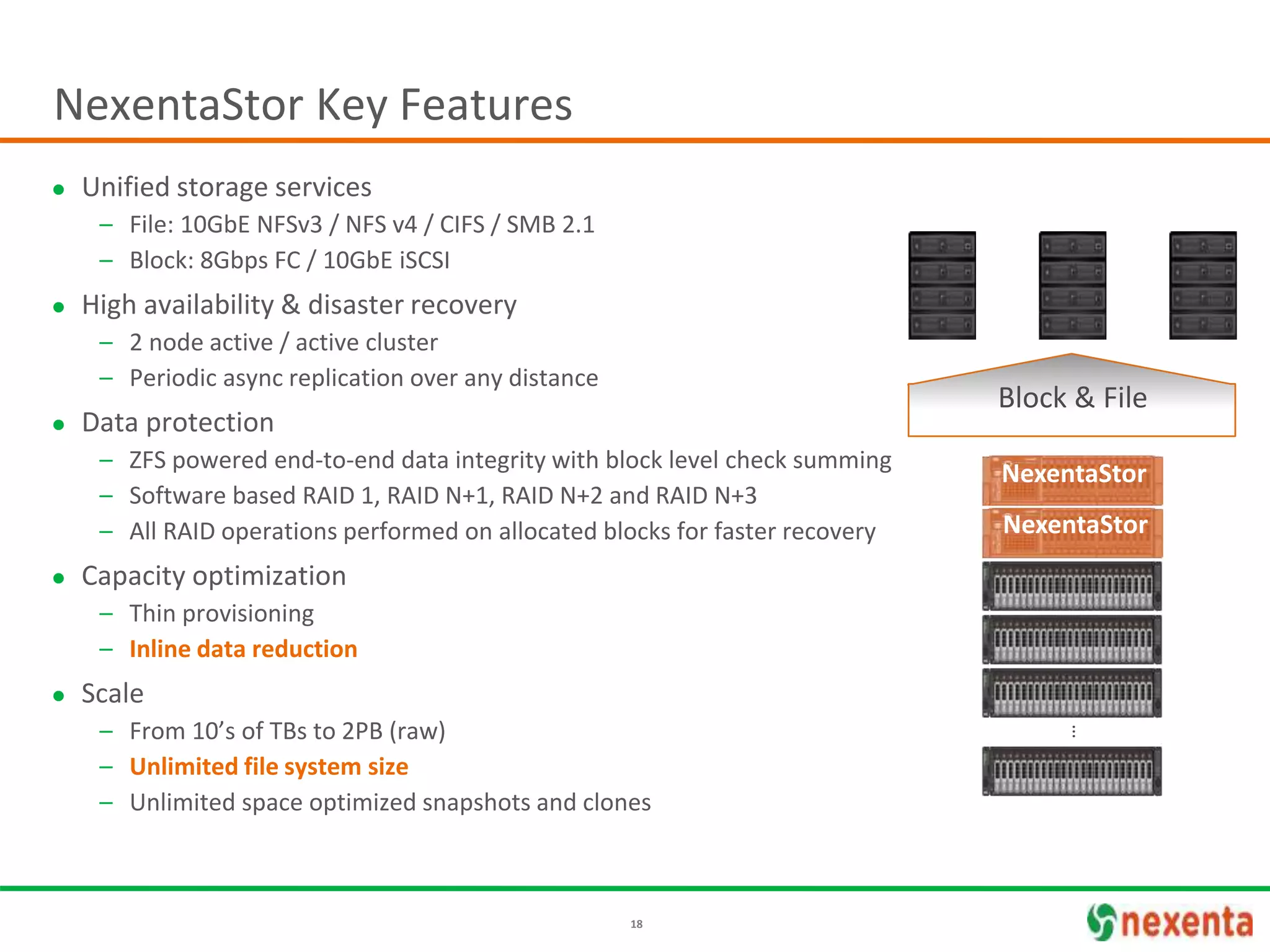
 Unified storage services
– File: 10GbE NFSv3 / NFS v4 / CIFS / SMB 2.1
– Block: 8Gbps FC / 10GbE iSCSI
 High availability & disaster recovery
– 2 node active / active cluster
– Periodic async replication over any distance
 Data protection
– ZFS powered end-to-end data integrity with block level check summing
– Software based RAID 1, RAID N+1, RAID N+2 and RAID N+3
– All RAID operations performed on allocated blocks for faster recovery
 Capacity optimization
– Thin provisioning
– Inline data reduction
 Scale
– From 10’s of TBs to 2PB (raw)
– Unlimited file system size
– Unlimited space optimized snapshots and clones
NexentaStor Key Features
…
Block & File
NexentaStor
NexentaStor
19
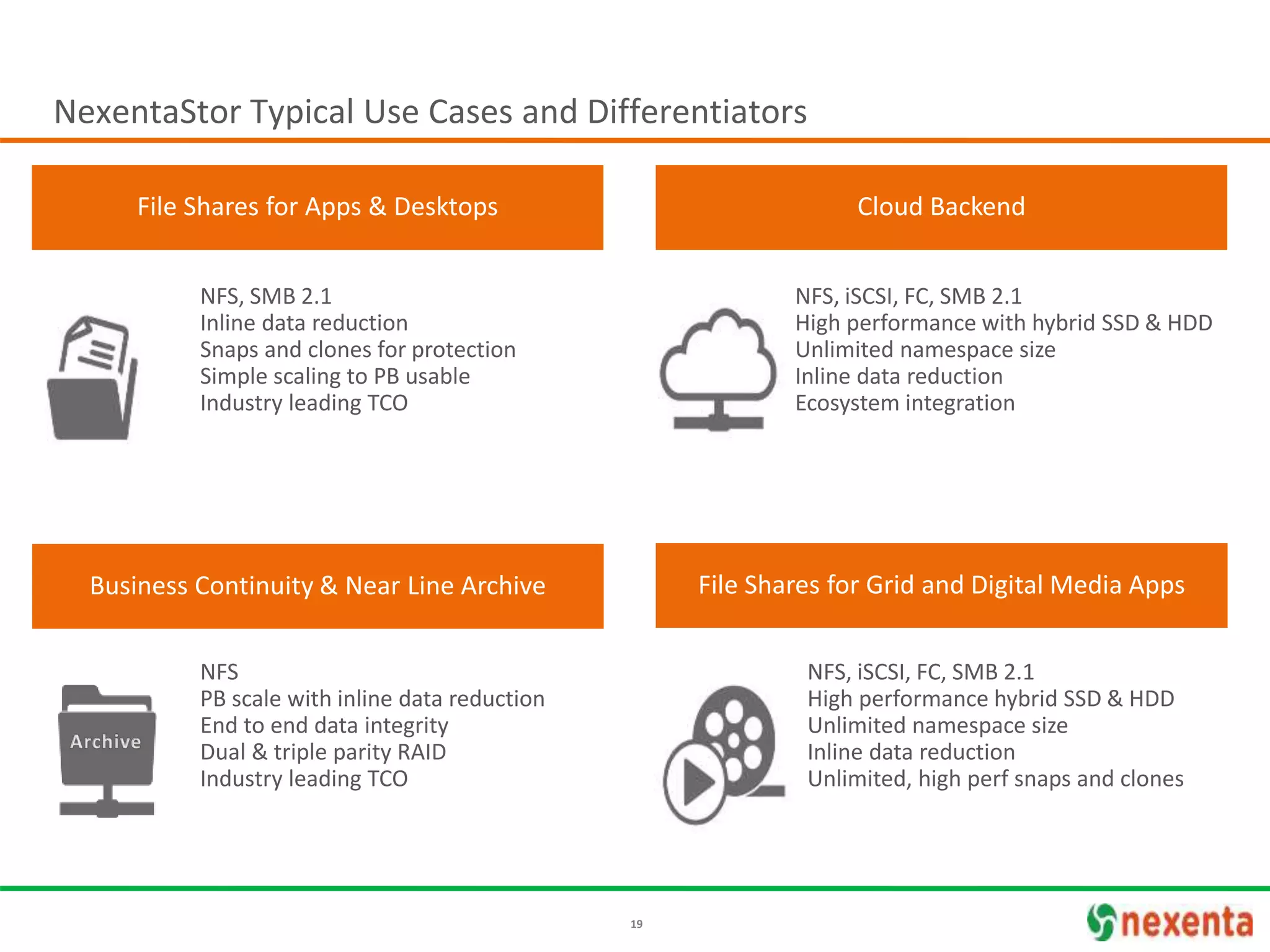
NexentaStor Typical Use Cases and Differentiators
File Shares for Apps & Desktops
NFS, SMB 2.1
Inline data reduction
Snaps and clones for protection
Simple scaling to PB usable
Industry leading TCO
Cloud Backend
NFS, iSCSI, FC, SMB 2.1
High performance with hybrid SSD & HDD
Unlimited namespace size
Inline data reduction
Ecosystem integration
Business Continuity & Near Line Archive
NFS
PB scale with inline data reduction
End to end data integrity
Dual & triple parity RAID
Industry leading TCO
File Shares for Grid and Digital Media Apps
NFS, iSCSI, FC, SMB 2.1
High performance hybrid SSD & HDD
Unlimited namespace size
Inline data reduction
Unlimited, high perf snaps and clones
20
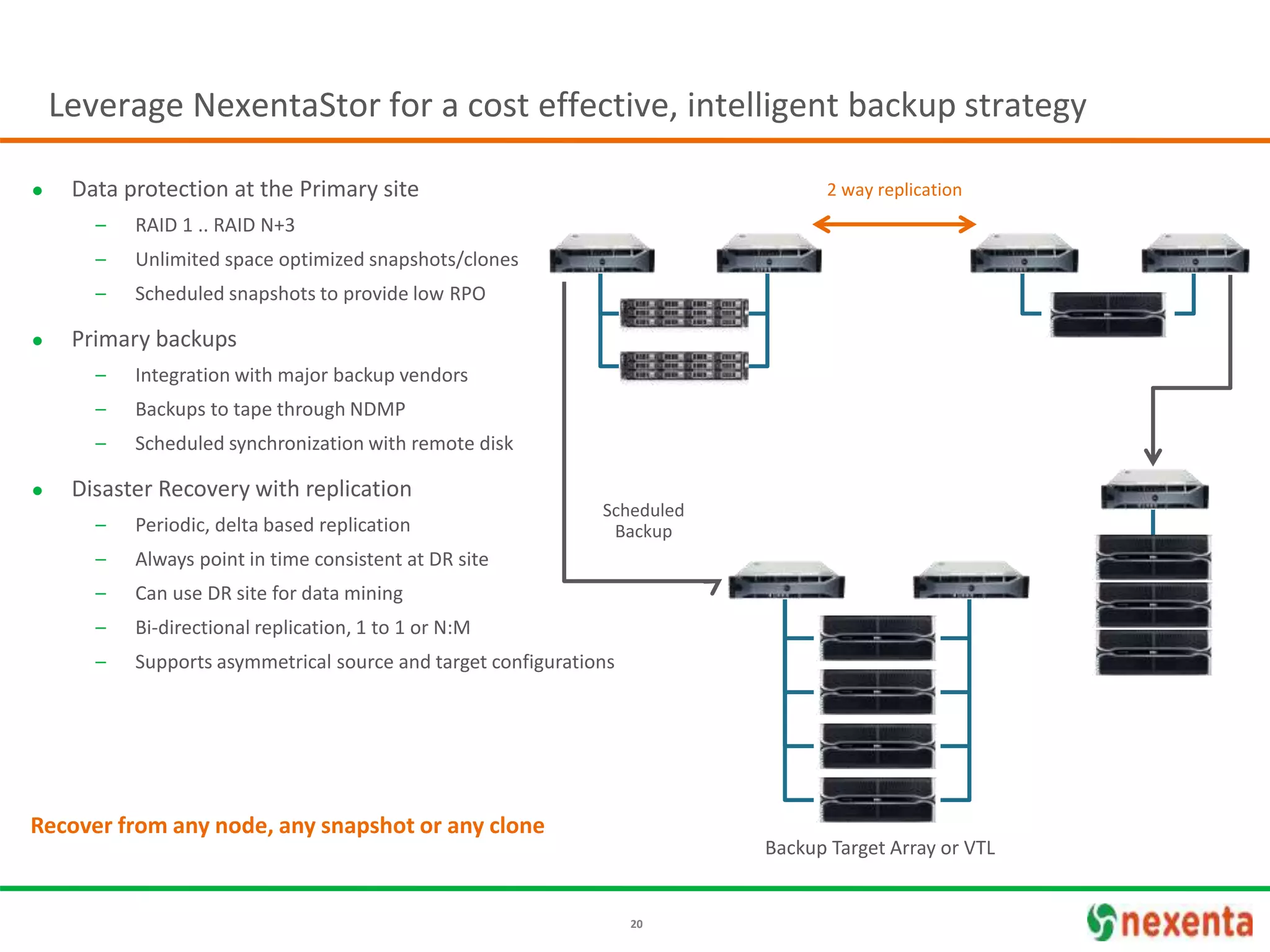
Leverage NexentaStor for a cost effective, intelligent backup strategy
 Data protection at the Primary site
– RAID 1 .. RAID N+3
– Unlimited space optimized snapshots/clones
– Scheduled snapshots to provide low RPO
 Primary backups
– Integration with major backup vendors
– Backups to tape through NDMP
– Scheduled synchronization with remote disk
 Disaster Recovery with replication
– Periodic, delta based replication
– Always point in time consistent at DR site
– Can use DR site for data mining
– Bi-directional replication, 1 to 1 or N:M
– Supports asymmetrical source and target configurations
2 way replication
Recover from any node, any snapshot or any clone
Scheduled
Backup
Backup Target Array or VTL
Thank you!
Storage Switzerland
http://www.storageswiss.com
gcrump@storage-switzerland.com
StorageSwiss on Twitter:
http://twitter.com/storageswiss
StorageSwiss on YouTube:
http://www.youtube.com/user/storageswiss
Nexenta
http://www.nexenta.com
Nexenta on Twitter:
http://twitter.com/nexenta
Nexenta on Facebook:
http://www.facebook.com/nexenta
Learn How Snapshots CAN be Backups
For complete Audio and Q&A please register for the On Demand Version at:
http://bit.ly/SnapshotBU

Webinar: How Snapshots CAN be Backups

  • 1.
    Learn How SnapshotsCAN be Backups In this webinar we cover: For audio playback and Q&A go to: http://bit.ly/SnapshotBU Available On Demand 1. The types of snapshot technologies (they’re not all the same) 2. The weaknesses of snapshots 3. How to create a primary storage architecture that overcomes these weaknesses 4. The benefits of a primary storage architecture that protects itself
  • 2.
    Our Speakers Oscar Wahlbergis a Director of Product Management at Nexenta. As a part of the team at Nexenta he runs the product management team for NexentaStor and NexentaEdge - a new object cluster storage product. Before joining Nexenta he was with Symantec and Veritas Software where he lead the product management team for their file system products and emerging storage solutions. George Crump is the founder of Storage Switzerland, the leading storage analyst focused on the subjects of big data, solid state storage, virtualization, cloud computing and data protection. He is widely recognized for his articles, white papers, and videos on such current approaches as all-flash arrays, deduplication, SSDs, software-defined storage, backup appliances, and storage networking. He has 25 years of experience designing storage solutions for data centers across the US.
  • 3.
    ● Analyst firmfocused on storage, cloud and virtualization ● Knowledge of these markets is gained through product testing and interaction with end users and suppliers ● The results of this research can be found in the articles, videos, webinars, product analysis and case studies on our web site: http://storageswiss.com Who Is Storage Switzerland?
  • 4.
    3 • Global leaderin SDS: Delivering software solutions to storage challenges • 200+ employees, headquartered in Silicon Valley • Sales launch in 2008 • Channel centric go to market with 300+ resellers and OEMs, including Dell • Close to 6,000 customers worldwide • 1 Exabyte of raw capacity under management • Cloud service providers, healthcare, finance, M&E, public sector • Open source based, complemented by strong IP (30 patents and counting) • Unified (block & file) storage solutions powered by ZFS • Bringing ZFS DNA to object offering Nexenta Company Highlights
  • 5.
    Polling Question What isyour biggest data protection challenge? A) Getting backups done on time B) Protecting data more frequently C) Meeting each application’s RPO/RTO D) Lowering the cost of data protection E) All of the above
  • 6.
    Polling Question What isyour biggest data protection challenge?
  • 7.
    State of DataProtection • Applications are increasing in number • Application data is growing • Unstructured data is growing • RPO/RTO is becoming increasingly strict
  • 8.
    The Storage SwitzerlandData Protection Philosophy ● Set Service Level Objectives ● Develop a “3-2-1” Data Protection Strategy ● Develop a Tiered Recovery Strategy
  • 9.
    Set Objectives Don’t BrokerAgreements ● Ask any user or application owner how much data can they afford to lose and guess what the answer will be? ● NONE! ● Service Level Objectives are set by IT based on their known capabilities and intrinsic understanding of the environment
  • 10.
    What is a3 – 2 – 1 Data Protection Strategy? 3 Copies of Data Not 30 2 Types of Media 1 Copy off-Site
  • 11.
    What is aTiered Recovery Strategy? Snapshots (RPO/RTO) On-Site Disk Backup (RTO) On-Site Archive (VRO) Off-site (GRO)
  • 12.
    Where Traditional Backup FallsShort • Once a night protection is not enough to meet RPOs • Data transfers from protection storage to primary storage too slow • Recovery in Place creates as many problems as it solves
  • 13.
    Primary Storage HasTo Carry More of the Backup Burden
  • 14.
    The Advantages ofSnapshot-Driven Data Protection • Protection copy can made instantly and clean • Data is stored in native form • Protected copy accessible from other servers or VMs
  • 15.
    Addressing the Weaknessesof Snapshots • Snapshots are vulnerable to storage system failure – Implement two systems on- site, snapshots on both • If the site fails so do your snapshots – Implement a 3rd system off-site
  • 16.
    Addressing the Weaknessesof Snapshots • Storage system has to support a high number of active snapshots – Use a re-directed snapshot technology • Long term retention of data eventually gets expensive – Backup up snapshots to disk/cloud/tape for retention and indexing (meets the “2” in 3-2-1 strategy)
  • 17.
    • Storage systemsare coming down in price dramatically • Software-defined storage promised to drive that price down even further, while maintaining features and performance • SDS also introduces flexibility Addressing the price problem of Self-Protecting Primary Storage
  • 18.
    17 No Hardware /No Data Lock-In • Designed to run on broad selection of certified hardware • Enables dramatic cost savings • Maximum flexibility and agility Ecosystem Ready • Fully integrated with Citrix, VMware, OpenStack, Microsoft and CloudStack • 100% delivered through channel partners and OEMs • Scalable from 10s of Terabytes to 100s of Petabytes Any Access Protocol for Wide Range of Workloads • Block, File and Object protocols • Advanced data management, data optimization and data protection built-in • Unified, single pane of glass management for all assets Enable customers to transform their storage infrastructure to increase flexibility, simplicity and speed to market; improve data and risk management and reduce TCO Nexenta: Powerful and Differentiated Value Proposition of True SDS
  • 19.
    18  Unified storageservices – File: 10GbE NFSv3 / NFS v4 / CIFS / SMB 2.1 – Block: 8Gbps FC / 10GbE iSCSI  High availability & disaster recovery – 2 node active / active cluster – Periodic async replication over any distance  Data protection – ZFS powered end-to-end data integrity with block level check summing – Software based RAID 1, RAID N+1, RAID N+2 and RAID N+3 – All RAID operations performed on allocated blocks for faster recovery  Capacity optimization – Thin provisioning – Inline data reduction  Scale – From 10’s of TBs to 2PB (raw) – Unlimited file system size – Unlimited space optimized snapshots and clones NexentaStor Key Features … Block & File NexentaStor NexentaStor
  • 20.
    19 NexentaStor Typical UseCases and Differentiators File Shares for Apps & Desktops NFS, SMB 2.1 Inline data reduction Snaps and clones for protection Simple scaling to PB usable Industry leading TCO Cloud Backend NFS, iSCSI, FC, SMB 2.1 High performance with hybrid SSD & HDD Unlimited namespace size Inline data reduction Ecosystem integration Business Continuity & Near Line Archive NFS PB scale with inline data reduction End to end data integrity Dual & triple parity RAID Industry leading TCO File Shares for Grid and Digital Media Apps NFS, iSCSI, FC, SMB 2.1 High performance hybrid SSD & HDD Unlimited namespace size Inline data reduction Unlimited, high perf snaps and clones
  • 21.
    20 Leverage NexentaStor fora cost effective, intelligent backup strategy  Data protection at the Primary site – RAID 1 .. RAID N+3 – Unlimited space optimized snapshots/clones – Scheduled snapshots to provide low RPO  Primary backups – Integration with major backup vendors – Backups to tape through NDMP – Scheduled synchronization with remote disk  Disaster Recovery with replication – Periodic, delta based replication – Always point in time consistent at DR site – Can use DR site for data mining – Bi-directional replication, 1 to 1 or N:M – Supports asymmetrical source and target configurations 2 way replication Recover from any node, any snapshot or any clone Scheduled Backup Backup Target Array or VTL
  • 22.
    Thank you! Storage Switzerland http://www.storageswiss.com gcrump@storage-switzerland.com StorageSwisson Twitter: http://twitter.com/storageswiss StorageSwiss on YouTube: http://www.youtube.com/user/storageswiss Nexenta http://www.nexenta.com Nexenta on Twitter: http://twitter.com/nexenta Nexenta on Facebook: http://www.facebook.com/nexenta
  • 23.
    Learn How SnapshotsCAN be Backups For complete Audio and Q&A please register for the On Demand Version at: http://bit.ly/SnapshotBU