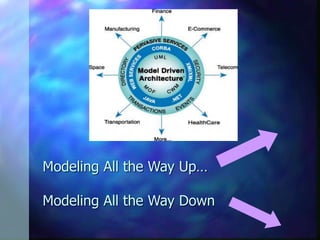
Modeling All the Way Up…
Modeling All the Way Down
People Share Design with Models
 Models—abstractions—are ancient in
 Engineering
 Architecture
 Ship-building
 Traffic control
 Workflow
 Maintenance
 …
People Talk to Computers with Symbols
while (x < 10) {
printf (stdout, array[x]);
x++;
}
What’s wrong with this (non)-picture?
Let’s look at Enterprise IT as an example.
Enterprise IT Must Deal With
 Business Factors:
 Defining & meeting changing business requirements
 Complex & changing business processes
 Shifting enterprise/application boundaries
 Semantic integration with customers, supplies &
partners
 Technological Factors:
 Barriers to interoperability & integration
 Development & maintenance obstacles
 Evolving & unstable technology suites
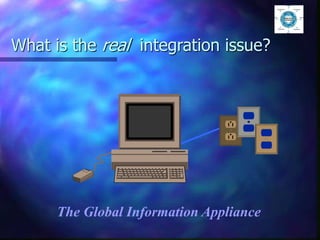
What is the real integration issue?
The Global Information Appliance
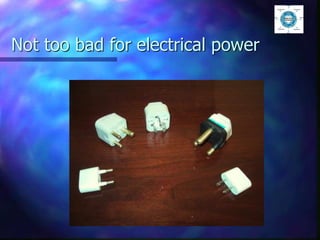
Not too bad for electrical power
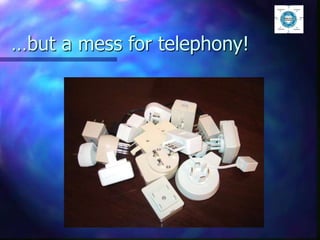
…but a mess for telephony!
Heterogeneity is Permanent
 Programming languages
 ~3 million COBOL programmers
 ~1.6 million VB programmers
 ~1.1 million C/C++ programmers
 Operating systems
 Unix, MVS, VMS, MacOS, Windows (all 8!), PalmOS…
 Windows 3.1: it’s still out there!
 Embedded devices (mobile, set-top, etc.)
 Networks
 Ethernet, ATM, IP, SS7, Firewire, USB
 Bluetooth, 802.11b, HomeRF
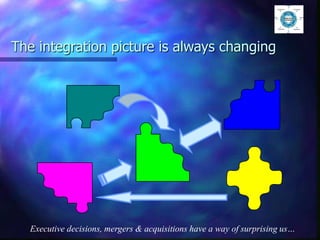
The integration picture is always changing
Executive decisions, mergers & acquisitions have a way of surprising us…
Roadkill on the Info Highway
…and doing things “the way we always do them” isn’t the answer.
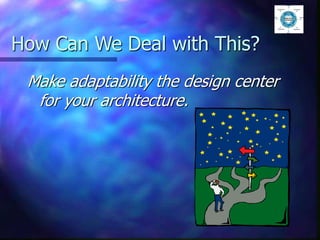
How Can We Deal with This?
Make adaptability the design center
for your architecture.
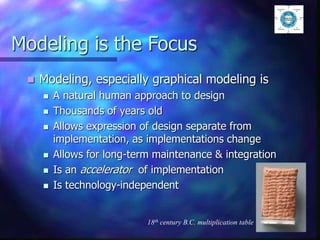
Modeling is the Focus
 Modeling, especially graphical modeling is
 A natural human approach to design
 Thousands of years old
 Allows expression of design separate from
implementation, as implementations change
 Allows for long-term maintenance & integration
 Is an accelerator of implementation
 Is technology-independent
18th century B.C. multiplication table
OMG’s Mission Since 1989
 Develop an architecture, using appropriate
technology, for modeling & distributed
application integration, guaranteeing:
 reusability of components
 interoperability & portability
 basis in commercially available software
 Specifications freely available
 Implementations exist
 Member-controlled not-for-profit
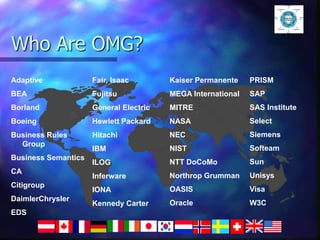
Who Are OMG?
Adaptive
BEA
Borland
Boeing
Business Rules
Group
Business Semantics
CA
Citigroup
DaimlerChrysler
EDS
Fair, Isaac
Fujitsu
General Electric
Hewlett Packard
Hitachi
IBM
ILOG
Inferware
IONA
Kennedy Carter
Kaiser Permanente
MEGA International
MITRE
NASA
NEC
NIST
NTT DoCoMo
Northrop Grumman
OASIS
Oracle
PRISM
SAP
SAS Institute
Select
Siemens
Softeam
Sun
Unisys
Visa
W3C
OMG’s Best-Known Successes
 Common Object Request Broker Architecture
 CORBA® remains the only language- and platform-neutral
interoperability standard
 Unified Modeling Language
 UMLTM remains the world’s only standardized modeling language
 Common Warehouse Metamodel
 CWMTM, the integration of the last two data warehousing initiatives
 Meta-Object Facility
 MOFTM, the repository standard
 XML Metadata Interchange
 XMITM, the XML-UML standard
Protecting Software Investment
 The problem remains
 Tracking the next best thing, retaining staff;
 Protecting your investment in existing software base;
 Integrating what you’ve built,
 With what you’re building,
 With what you will build!
 Architectures ought to be
 Stable descriptions lasting decades
 Capable of communicating the designers’ vision
 Testable, simulatable, executable
The Model Driven Architecture
 OMG’s Model Driven Architecture (MDATM) initiative is aimed
precisely at this problem
 You have an opportunity to increase your bottom line by
integrating your assets
 Industry standards support that goal by future-proofing your
application design
 The MDA will help you integrate the mix you have today, and
give you an architecture to support the unexpected
 Focus on integrating legacy applications
 Ensure smooth integration of COTS applications
 Models are testable and simulatable
 The aim: a 20-year software architecture
What is Model Driven Architecture?
 A Better Way to Specify and Design & Develop
 Based on modeling standards like UML, MOF
 Is extensible to all modeling problems
 Supports full lifecycle: analysis, design,
implementation, deployment, maintenance,
evolution & integration with later systems
 Builds in Interoperability and Portability
 Lowers initial cost and maximizes ROI
Modeling: Key Concepts
 Emphasis on transformation techniques
 Based on a standard metamodeling framework;
there will be many metamodels, and plenty of
modeling languages (including UML)
 Clear semantics, expressed consistently
 Potentially many levels of abstraction
 Enduring architectures are the focus
 Maintenance and integration aren’t pretty, but they
are the main job of IT
 Graphical languages as well as textual ones
 Some generic, some domain-specific, just like the
textual language world
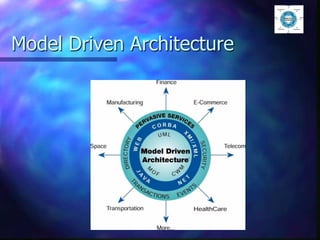
Model Driven Architecture
Leveraging UML is Critical
 The Unified Modeling Language is the successor to the
dozens of OO A&D notations of the early ’90s
 Result of an OMG standardization completed in ’97
 Complemented with metadata (MOF) and XML
interoperability specifications (XMI)
 Venture-neutral worldwide certification easily available
 Standardization primed the market
 Hundreds of books
 Dozens of commercial tools
 Widely available training
 Supported by an open process
 UML 2.0 updates came from 54 companies
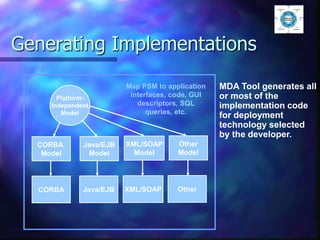
Generating Implementations
MDA Tool generates all
or most of the
implementation code
for deployment
technology selected
by the developer.
CORBA Java/EJB XML/SOAP Other
Map PSM to application
interfaces, code, GUI
descriptors, SQL
queries, etc.
Platform-
Independent
Model
CORBA
Model
Java/EJB
Model
XML/SOAP
Model
Other
Model
Data Integration Works Too
 MOF is the key here, behind the UML scene
 With one modeling language
 Anything can be modeled
 User must map (code) from domain to modeling language
constructs
 MOF enables definition of multiple modeling
languages
 Specific to various domains
 Semantics captured in metamodels
 User no longer needs to “map”, tools do
UML Myths
 MDA is just about code generation
 MDA is just programming with UML
 MDA and DSL are different things
 UML is too big & complex
Code Generation is just one feature
 Sometimes we’ll be able to generate all the
 Code
 Schemas
 Deployment descriptors
 Sometimes we won’t; but we’ll still have the
modeling values of
 Clear, sharable graphical expression
 Flexible transformation for agile retargeting
 An enduring description of the system
 Architecture matters (that’s why MDA)
MDA is more than UML!
 MDA is a meta-design pattern:
 Discover multiple syntaxes for one semantic
 Capture that semantic in a machine-readable
model
 Standardize the transformations to multiple
syntaxes
 UML is a good general design and
implementation language, but MOF provides
the integration across languages
MDA and DSL are the Same!
 Domain-Specific Languages (DSL’s) are a way
to capture design semantics in languages
closely fitted to specific problem areas
(application domains)
 Do we really want every programmer using a
different language
 It pays to have a central way to query, view
and transform languages (MOF)
 MDA actually offers two routes to
standardized DSL’s: MOF-defined languages
and UML profiles
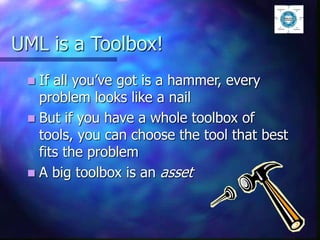
UML is a Toolbox!
 If all you’ve got is a hammer, every
problem looks like a nail
 But if you have a whole toolbox of
tools, you can choose the tool that best
fits the problem
 A big toolbox is an asset
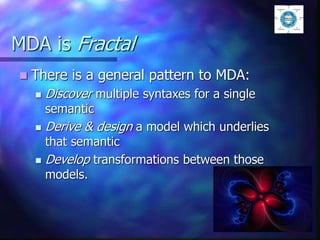
MDA is Fractal
 There is a general pattern to MDA:
 Discover multiple syntaxes for a single
semantic
 Derive & design a model which underlies
that semantic
 Develop transformations between those
models.
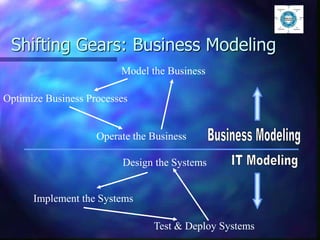
Shifting Gears: Business Modeling
Model the Business
Optimize Business Processes
Operate the Business
Design the Systems
Implement the Systems
Test & Deploy Systems
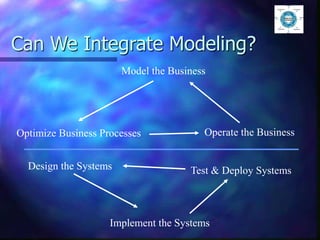
Can We Integrate Modeling?
Model the Business
Optimize Business Processes Operate the Business
Design the Systems
Implement the Systems
Test & Deploy Systems
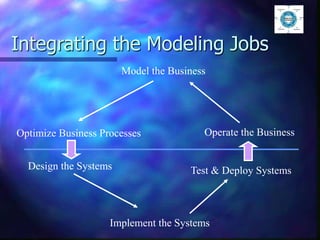
Integrating the Modeling Jobs
Model the Business
Optimize Business Processes Operate the Business
Design the Systems
Implement the Systems
Test & Deploy Systems
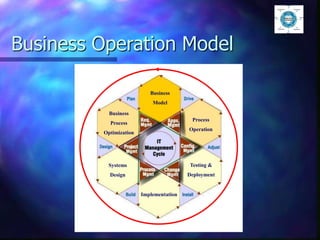
Business Operation Model
Business
Model
Business
Process
Optimization
Process
Operation
Testing &
Deployment
Implementation
Systems
Design
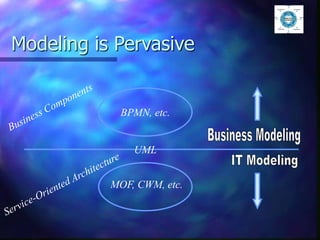
Modeling is Pervasive
UML
BPMN, etc.
MOF, CWM, etc.
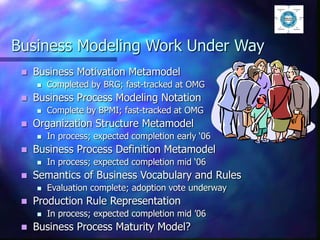
Business Modeling Work Under Way
 Business Motivation Metamodel
 Completed by BRG; fast-tracked at OMG
 Business Process Modeling Notation
 Complete by BPMI; fast-tracked at OMG
 Organization Structure Metamodel
 In process; expected completion early ‘06
 Business Process Definition Metamodel
 In process; expected completion mid ‘06
 Semantics of Business Vocabulary and Rules
 Evaluation complete; adoption vote underway
 Production Rule Representation
 In process; expected completion mid ’06
 Business Process Maturity Model?
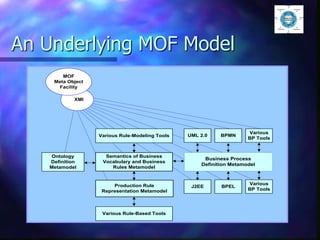
An Underlying MOF Model
Semantics of Business
Vocabulary and Business
Rules Metamodel
XMI
MOF
Meta Object
Facility
Ontology
Definition
Metamodel
Various Rule-Based Tools
Production Rule
Representation Metamodel
Various Rule-Modeling Tools
Business Process
Definition Metamodel
J2EE
UML 2.0
BPEL
Various
BP Tools
BPMN
Various
BP Tools
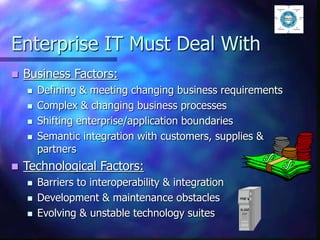
Enterprise IT Must Deal With
 Business Factors:
 Defining & meeting changing business requirements
 Complex & changing business processes
 Shifting enterprise/application boundaries
 Semantic integration with customers, supplies &
partners
 Technological Factors:
 Barriers to interoperability & integration
 Development & maintenance obstacles
 Evolving & unstable technology suites
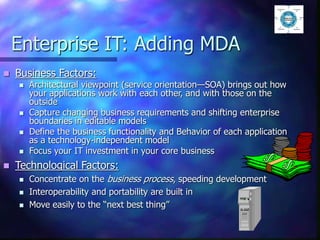
Enterprise IT: Adding MDA
 Business Factors:
 Architectural viewpoint (service orientation—SOA) brings out how
your applications work with each other, and with those on the
outside
 Capture changing business requirements and shifting enterprise
boundaries in editable models
 Define the business functionality and Behavior of each application
as a technology-independent model
 Focus your IT investment in your core business
 Technological Factors:
 Concentrate on the business process, speeding development
 Interoperability and portability are built in
 Move easily to the “next best thing”
MDA Benefits
 Full support for your “20 year architecture” across the
application lifecycle
 Smooth integration across intra- and inter-business
boundaries (across deployment technologies)
 Reduced costs from beginning to end
 Reuse of applications, code, training and people
 Technology-independent representation of the business
 Scalability, robustness & security via generated code
 Stable model-based approach maximizes ROI
 Rapid inclusion of the next best thing
The CIO Problem Solver
To Get More Information
 MDA Information Page
 http://www.omg.org/mda/
 OMG General Information
 http://www.omg.org/
 Contact the Author
 soley@omg.org
 This presentation
 http://www.omg.org/~soley/mdaupdown.ppt

ERP_Up_Down.ppt

  • 1.
    Modeling All theWay Up… Modeling All the Way Down
  • 2.
    People Share Designwith Models  Models—abstractions—are ancient in  Engineering  Architecture  Ship-building  Traffic control  Workflow  Maintenance  …
  • 3.
    People Talk toComputers with Symbols while (x < 10) { printf (stdout, array[x]); x++; } What’s wrong with this (non)-picture? Let’s look at Enterprise IT as an example.
  • 4.
    Enterprise IT MustDeal With  Business Factors:  Defining & meeting changing business requirements  Complex & changing business processes  Shifting enterprise/application boundaries  Semantic integration with customers, supplies & partners  Technological Factors:  Barriers to interoperability & integration  Development & maintenance obstacles  Evolving & unstable technology suites
  • 5.
    What is thereal integration issue? The Global Information Appliance
  • 6.
    Not too badfor electrical power
  • 7.
    …but a messfor telephony!
  • 8.
    Heterogeneity is Permanent Programming languages  ~3 million COBOL programmers  ~1.6 million VB programmers  ~1.1 million C/C++ programmers  Operating systems  Unix, MVS, VMS, MacOS, Windows (all 8!), PalmOS…  Windows 3.1: it’s still out there!  Embedded devices (mobile, set-top, etc.)  Networks  Ethernet, ATM, IP, SS7, Firewire, USB  Bluetooth, 802.11b, HomeRF
  • 9.
    The integration pictureis always changing Executive decisions, mergers & acquisitions have a way of surprising us…
  • 10.
    Roadkill on theInfo Highway …and doing things “the way we always do them” isn’t the answer.
  • 11.
    How Can WeDeal with This? Make adaptability the design center for your architecture.
  • 12.
    Modeling is theFocus  Modeling, especially graphical modeling is  A natural human approach to design  Thousands of years old  Allows expression of design separate from implementation, as implementations change  Allows for long-term maintenance & integration  Is an accelerator of implementation  Is technology-independent 18th century B.C. multiplication table
  • 13.
    OMG’s Mission Since1989  Develop an architecture, using appropriate technology, for modeling & distributed application integration, guaranteeing:  reusability of components  interoperability & portability  basis in commercially available software  Specifications freely available  Implementations exist  Member-controlled not-for-profit
  • 14.
    Who Are OMG? Adaptive BEA Borland Boeing BusinessRules Group Business Semantics CA Citigroup DaimlerChrysler EDS Fair, Isaac Fujitsu General Electric Hewlett Packard Hitachi IBM ILOG Inferware IONA Kennedy Carter Kaiser Permanente MEGA International MITRE NASA NEC NIST NTT DoCoMo Northrop Grumman OASIS Oracle PRISM SAP SAS Institute Select Siemens Softeam Sun Unisys Visa W3C
  • 15.
    OMG’s Best-Known Successes Common Object Request Broker Architecture  CORBA® remains the only language- and platform-neutral interoperability standard  Unified Modeling Language  UMLTM remains the world’s only standardized modeling language  Common Warehouse Metamodel  CWMTM, the integration of the last two data warehousing initiatives  Meta-Object Facility  MOFTM, the repository standard  XML Metadata Interchange  XMITM, the XML-UML standard
  • 16.
    Protecting Software Investment The problem remains  Tracking the next best thing, retaining staff;  Protecting your investment in existing software base;  Integrating what you’ve built,  With what you’re building,  With what you will build!  Architectures ought to be  Stable descriptions lasting decades  Capable of communicating the designers’ vision  Testable, simulatable, executable
  • 17.
    The Model DrivenArchitecture  OMG’s Model Driven Architecture (MDATM) initiative is aimed precisely at this problem  You have an opportunity to increase your bottom line by integrating your assets  Industry standards support that goal by future-proofing your application design  The MDA will help you integrate the mix you have today, and give you an architecture to support the unexpected  Focus on integrating legacy applications  Ensure smooth integration of COTS applications  Models are testable and simulatable  The aim: a 20-year software architecture
  • 18.
    What is ModelDriven Architecture?  A Better Way to Specify and Design & Develop  Based on modeling standards like UML, MOF  Is extensible to all modeling problems  Supports full lifecycle: analysis, design, implementation, deployment, maintenance, evolution & integration with later systems  Builds in Interoperability and Portability  Lowers initial cost and maximizes ROI
  • 19.
    Modeling: Key Concepts Emphasis on transformation techniques  Based on a standard metamodeling framework; there will be many metamodels, and plenty of modeling languages (including UML)  Clear semantics, expressed consistently  Potentially many levels of abstraction  Enduring architectures are the focus  Maintenance and integration aren’t pretty, but they are the main job of IT  Graphical languages as well as textual ones  Some generic, some domain-specific, just like the textual language world
  • 20.
  • 21.
    Leveraging UML isCritical  The Unified Modeling Language is the successor to the dozens of OO A&D notations of the early ’90s  Result of an OMG standardization completed in ’97  Complemented with metadata (MOF) and XML interoperability specifications (XMI)  Venture-neutral worldwide certification easily available  Standardization primed the market  Hundreds of books  Dozens of commercial tools  Widely available training  Supported by an open process  UML 2.0 updates came from 54 companies
  • 22.
    Generating Implementations MDA Toolgenerates all or most of the implementation code for deployment technology selected by the developer. CORBA Java/EJB XML/SOAP Other Map PSM to application interfaces, code, GUI descriptors, SQL queries, etc. Platform- Independent Model CORBA Model Java/EJB Model XML/SOAP Model Other Model
  • 23.
    Data Integration WorksToo  MOF is the key here, behind the UML scene  With one modeling language  Anything can be modeled  User must map (code) from domain to modeling language constructs  MOF enables definition of multiple modeling languages  Specific to various domains  Semantics captured in metamodels  User no longer needs to “map”, tools do
  • 24.
    UML Myths  MDAis just about code generation  MDA is just programming with UML  MDA and DSL are different things  UML is too big & complex
  • 25.
    Code Generation isjust one feature  Sometimes we’ll be able to generate all the  Code  Schemas  Deployment descriptors  Sometimes we won’t; but we’ll still have the modeling values of  Clear, sharable graphical expression  Flexible transformation for agile retargeting  An enduring description of the system  Architecture matters (that’s why MDA)
  • 26.
    MDA is morethan UML!  MDA is a meta-design pattern:  Discover multiple syntaxes for one semantic  Capture that semantic in a machine-readable model  Standardize the transformations to multiple syntaxes  UML is a good general design and implementation language, but MOF provides the integration across languages
  • 27.
    MDA and DSLare the Same!  Domain-Specific Languages (DSL’s) are a way to capture design semantics in languages closely fitted to specific problem areas (application domains)  Do we really want every programmer using a different language  It pays to have a central way to query, view and transform languages (MOF)  MDA actually offers two routes to standardized DSL’s: MOF-defined languages and UML profiles
  • 28.
    UML is aToolbox!  If all you’ve got is a hammer, every problem looks like a nail  But if you have a whole toolbox of tools, you can choose the tool that best fits the problem  A big toolbox is an asset
  • 29.
    MDA is Fractal There is a general pattern to MDA:  Discover multiple syntaxes for a single semantic  Derive & design a model which underlies that semantic  Develop transformations between those models.
  • 30.
    Shifting Gears: BusinessModeling Model the Business Optimize Business Processes Operate the Business Design the Systems Implement the Systems Test & Deploy Systems
  • 31.
    Can We IntegrateModeling? Model the Business Optimize Business Processes Operate the Business Design the Systems Implement the Systems Test & Deploy Systems
  • 32.
    Integrating the ModelingJobs Model the Business Optimize Business Processes Operate the Business Design the Systems Implement the Systems Test & Deploy Systems
  • 33.
  • 34.
  • 35.
    Business Modeling WorkUnder Way  Business Motivation Metamodel  Completed by BRG; fast-tracked at OMG  Business Process Modeling Notation  Complete by BPMI; fast-tracked at OMG  Organization Structure Metamodel  In process; expected completion early ‘06  Business Process Definition Metamodel  In process; expected completion mid ‘06  Semantics of Business Vocabulary and Rules  Evaluation complete; adoption vote underway  Production Rule Representation  In process; expected completion mid ’06  Business Process Maturity Model?
  • 36.
    An Underlying MOFModel Semantics of Business Vocabulary and Business Rules Metamodel XMI MOF Meta Object Facility Ontology Definition Metamodel Various Rule-Based Tools Production Rule Representation Metamodel Various Rule-Modeling Tools Business Process Definition Metamodel J2EE UML 2.0 BPEL Various BP Tools BPMN Various BP Tools
  • 37.
    Enterprise IT MustDeal With  Business Factors:  Defining & meeting changing business requirements  Complex & changing business processes  Shifting enterprise/application boundaries  Semantic integration with customers, supplies & partners  Technological Factors:  Barriers to interoperability & integration  Development & maintenance obstacles  Evolving & unstable technology suites
  • 38.
    Enterprise IT: AddingMDA  Business Factors:  Architectural viewpoint (service orientation—SOA) brings out how your applications work with each other, and with those on the outside  Capture changing business requirements and shifting enterprise boundaries in editable models  Define the business functionality and Behavior of each application as a technology-independent model  Focus your IT investment in your core business  Technological Factors:  Concentrate on the business process, speeding development  Interoperability and portability are built in  Move easily to the “next best thing”
  • 39.
    MDA Benefits  Fullsupport for your “20 year architecture” across the application lifecycle  Smooth integration across intra- and inter-business boundaries (across deployment technologies)  Reduced costs from beginning to end  Reuse of applications, code, training and people  Technology-independent representation of the business  Scalability, robustness & security via generated code  Stable model-based approach maximizes ROI  Rapid inclusion of the next best thing The CIO Problem Solver
  • 40.
    To Get MoreInformation  MDA Information Page  http://www.omg.org/mda/  OMG General Information  http://www.omg.org/  Contact the Author  soley@omg.org  This presentation  http://www.omg.org/~soley/mdaupdown.ppt