1
School of Nursing & Midwifery
Department of Adult Health Nursing
P.by: Habtemariam Mulugeta
College of Medicine &
Health Sciences
Habtemariam M.
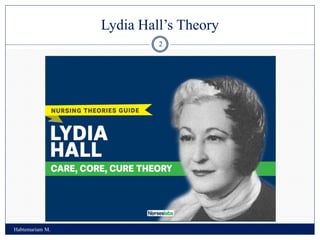
Lydia Hall’s Theory
Habtemariam M.
2
Biography of Lydia E. Hall
Habtemariam M.
3
 Lydia Eloise Hall was born in New York City on September
21, 1906.
 Diploma in nursing; York Hospital School of Nursing in 1927
Pennsylvania.
 BSc degree in public health nursing in 1932; Teacher’s
College at Columbia University in New York.
 a number of years in clinical practice.
 MSc degree in the teaching of natural life sciences from
Columbia University in 1942.
Cont.
Habtemariam M.
4
 she pursued a doctorate and completed all of the
requirements except for the dissertation.
 In 1945, she married Reginald A. Hall who was a native
of England.
 Authored 21 publications and a bulk of the articles and
addresses regarding her nursing theory
 Awarded for Distinguished Achievement in Nursing
Practice from Colombia University
Cont.
Habtemariam M.
5
 She developed the Care, Cure, Core model of nursing.
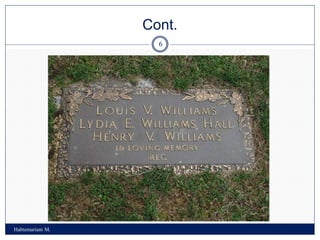
 Hall died on February 27, 1969, at Queens Hospital in
New York.
 Genrose Alfano continued her work at the Loeb Center
until the focus of the center was changed to that of
custodial care in 1985.
Cont.
Habtemariam M.
6
Cont.
Habtemariam M.
7
 She was an innovator, motivator, and mentor to nurses in
all phases of their careers
 she advocate for chronically ill patients and worked to
involve the community in public health issues as well.
 She Designed and Developed the Loeb Center for Nursing
at Montifiore Hospital in New York.
 She applied her theory in nursing practice but Hall did not
research her theory.
Lydia Hall’s: Care, Core, Cure
Habtemariam M.
8
 “Care, Cure, Core Theory,” aka the “Three Cs of Lydia
Hall.”
 Description
• It define Nursing as the “participation in care, core and cure
aspects of patient care, where CARE is the sole function of nurses,
whereas the CORE and CURE are shared with other members of the
health team.”
• The major purpose of care is to achieve an interpersonal
relationship with the individual that will facilitate the
development of the core.
Cont.
Habtemariam M.
9
 As Hall says; “To look at and listen to self is often too
difficult without the help of a significant figure (nurturer)
who has learned how to hold up a mirror and sounding
board to invite the behaver to look and listen to himself. If
he accepts the invitation, he will explore the concerns in
his acts and as he listens to his exploration through the
reflection of the nurse, he may uncover in sequence his
difficulties, the problem area, his problem, and eventually
the threat which is dictating his out-of-control behavior.”
Theoretical Sources
Habtemariam M.
10
 Carl Rogers’ Philosophy of client centered therapy
(“patients achieve maximal potential through a learning
process”)
 Rogerian Therapeutic Approach ( the use of reflection)
 Rogers’ Theory of Motivation for Change
 Harry Stack Sullivan’s Interpersonal Behavior Theory
 John Dewey’s Educational Theories
Concepts
Habtemariam M.
11
 Behavior – as everything that is said or done.
 Behavior is dictated by feelings both conscious and unconscious.
 Reflection –selected verbalizations of patients are repeated back to them
with different phraseology to invite them to explore feelings further.
 Self-awareness – refers to the state of being that nurses endeavor to help
their patients achieve.
 The more self awareness a person has of their feelings, the more
control they have over their behavior.
Central Concepts
Habtemariam M.
12
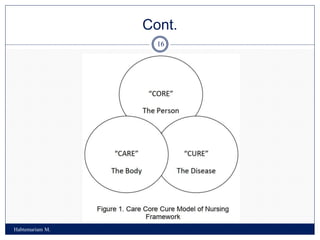
 Care – alludes the “hands on”, intimate bodily care aspect
of nursing of the patient and implies a comforting,
nurturing relationship.
 While intimate physical care is given, the patient and the
nurse develop a close relationship representing the
teaching and learning aspect of nursing.
 The natural and biological sciences (the Body).
Cont.
Habtemariam M.
13
 Core – involves the therapeutic use of self in
communicating with the patient.
 The nurse through the use of reflective technique helps
the patient clarify motives and goals, facilitating the
process of increasing the patients self awareness.
 The social sciences (the person).
Cont.
Habtemariam M.
14
 Cure – is the aspect of nursing involved with the
administration of medications and treatments.
 The nurse functions in his role as an investigator and
potential cause of pain related to skills such as injections
and dressing changes.
 Seeing the patient and family through the medical care
aspect of nursing.
 The pathological and therapeutic sciences (the disease).
Interaction All Three Aspects
Habtemariam M.
15
 Emphasis placed on the importance of total person
 Importance placed on all three aspects functioning
together
 All three aspects interact and change in size
Cont.
Habtemariam M.
16
Assumptions
Habtemariam M.
17
The assumptions of Hall’s Care, Cure, Core Theory are as follows:
(1) The motivation and energy necessary for healing exist within the
patient, rather than in the healthcare team.
(2) The three aspects of nursing should not be viewed as functioning
independently but as interrelated.
(3) The three aspects interact, and the circles representing them
change size, depending on the patient’s total course of progress.
Paradigms and Major Assumptions
Habtemariam M.
18
 (Nursing) “Nursing can and should be professional”.
 (Person) “Patients achieve their maximal potential through a
learning process, therefore the chief therapy they need is teaching”
 (Health) “Healing may be hastened by helping people move in the
direction of self-awareness”
 (Environment) “Hospital nursing services, she did not believe that
they have patient care and teaching as their goal.”
Theoretical Assertions
Habtemariam M.
19
1) Nursing functions differently in the three interlocking
circles that constitute aspects of the patient.
2) As the patient needs less medical care, he or she needs
more professional nursing care and teaching.
3) The wholly professional nursing care will hasten
recovery.
Logical Form
Habtemariam M.
20
 Nursing care shortens patient recovery time
 Nursing care facilitates patient recovery
 Professional nursing improves patient care
 Therefore “wholly professional nursing will hasten
recovery.”
Strengths
Habtemariam M.
21
 Lydia Hall’s model appears to be completely and simply
logical.
 Her work may be viewed as the philosophy of nursing.
 The three Cs (care, core and cure) in this theory were unique.
 In all the circles of the model, the nurse is present, although
focus of the nurse’s role is on the care circle.
Weakness
Habtemariam M.
22
 The application of the theory to a population of patients of
specific age and state of illness (>= 16yrs)
 Difficult to apply to infants, small children and comatose
patients.
 Preventive health care and health maintenance is not addressed
 Provides little interaction between the nurse and the family
 Limited approach to therapeutic communication because not
all nurses can effectively use the technique of reflection and it
is not always the most effective and successful communication
tool in dealing with patients.
Applications
Habtemariam M.
23
 In buergers disease
 In operating room
 In critical care unit
 In nursing education
 In community health nursing
 In dialysis unit
Cont.
Habtemariam M.
24
Conclusion
Habtemariam M.
25
 Lydia Hall used her knowledge of psychiatry and nursing
experiences in the Loeb Center as a framework for formulating the
Care, Core and Cure Theory.
 Her model contains three independent but interconnected circles.
 The three circles are: the core, the care, and the cure.
 The core is the patient, the cure refers to the medical and nursing
interventions and the care is the nurturing provided by nurses.
 Nursing functions in all three of the circles but shares them to
different degrees with other disciplines.
Reference
Habtemariam M.
26
1. Alligood, M., & Tomey, A. (2010). Nursing theorists and their work, seventh
edition (No ed.). Maryland Heights: Mosby-Elsevier.
2. Hall, L. (1965) Another view of nursing care and quality. Address given at Catholic
University Workshop, Washington, D.C. In George, J. (Ed.). Nursing theories: the base
for professional nursing practice. Norwalk, Connecticut: Appleton & Lange.
3. George, J.B.; Nursing Theories: The Base for Professional Nursing Practice; 2000.
4. George B. Julia , Nursing Theories- The base for professional Nursing
Practice , 3rd ed. Norwalk, Appleton & Lange.
5. Betty M. Johnson and Pamela B. Webber, Theory and Reasoning in Nursing., 2nd ed.
New York, Williams & Wilkins Mariner 5th edition
6. http://nursingtheories.weebly.com/index.html
7. http://nursing-theory.org/articles/nursing-theory-definition.php
8. http://currentnursing.com/nursing_theory/development_of_nursing_the
ories.html
Acknowledgment
Habtemariam M.
27
 First I would like to express my heartfelt gratitude to
WU CMHS for giving me this chance to enhance my
knowledge and skill.
 Secondly I would like to thank my instructor Dr. Prem
Kumar for sharing me his deep knowledge, experience
and expertise.
 Last but not least I would like to thank my family and
friends in helping me in ideas and material during my
entire work.
Thank You
Habtemariam M.
28

Hall

  • 1.
    1 School of Nursing& Midwifery Department of Adult Health Nursing P.by: Habtemariam Mulugeta College of Medicine & Health Sciences Habtemariam M.
  • 2.
  • 3.
    Biography of LydiaE. Hall Habtemariam M. 3  Lydia Eloise Hall was born in New York City on September 21, 1906.  Diploma in nursing; York Hospital School of Nursing in 1927 Pennsylvania.  BSc degree in public health nursing in 1932; Teacher’s College at Columbia University in New York.  a number of years in clinical practice.  MSc degree in the teaching of natural life sciences from Columbia University in 1942.
  • 4.
    Cont. Habtemariam M. 4  shepursued a doctorate and completed all of the requirements except for the dissertation.  In 1945, she married Reginald A. Hall who was a native of England.  Authored 21 publications and a bulk of the articles and addresses regarding her nursing theory  Awarded for Distinguished Achievement in Nursing Practice from Colombia University
  • 5.
    Cont. Habtemariam M. 5  Shedeveloped the Care, Cure, Core model of nursing.  Hall died on February 27, 1969, at Queens Hospital in New York.  Genrose Alfano continued her work at the Loeb Center until the focus of the center was changed to that of custodial care in 1985.
  • 6.
  • 7.
    Cont. Habtemariam M. 7  Shewas an innovator, motivator, and mentor to nurses in all phases of their careers  she advocate for chronically ill patients and worked to involve the community in public health issues as well.  She Designed and Developed the Loeb Center for Nursing at Montifiore Hospital in New York.  She applied her theory in nursing practice but Hall did not research her theory.
  • 8.
    Lydia Hall’s: Care,Core, Cure Habtemariam M. 8  “Care, Cure, Core Theory,” aka the “Three Cs of Lydia Hall.”  Description • It define Nursing as the “participation in care, core and cure aspects of patient care, where CARE is the sole function of nurses, whereas the CORE and CURE are shared with other members of the health team.” • The major purpose of care is to achieve an interpersonal relationship with the individual that will facilitate the development of the core.
  • 9.
    Cont. Habtemariam M. 9  AsHall says; “To look at and listen to self is often too difficult without the help of a significant figure (nurturer) who has learned how to hold up a mirror and sounding board to invite the behaver to look and listen to himself. If he accepts the invitation, he will explore the concerns in his acts and as he listens to his exploration through the reflection of the nurse, he may uncover in sequence his difficulties, the problem area, his problem, and eventually the threat which is dictating his out-of-control behavior.”
  • 10.
    Theoretical Sources Habtemariam M. 10 Carl Rogers’ Philosophy of client centered therapy (“patients achieve maximal potential through a learning process”)  Rogerian Therapeutic Approach ( the use of reflection)  Rogers’ Theory of Motivation for Change  Harry Stack Sullivan’s Interpersonal Behavior Theory  John Dewey’s Educational Theories
  • 11.
    Concepts Habtemariam M. 11  Behavior– as everything that is said or done.  Behavior is dictated by feelings both conscious and unconscious.  Reflection –selected verbalizations of patients are repeated back to them with different phraseology to invite them to explore feelings further.  Self-awareness – refers to the state of being that nurses endeavor to help their patients achieve.  The more self awareness a person has of their feelings, the more control they have over their behavior.
  • 12.
    Central Concepts Habtemariam M. 12 Care – alludes the “hands on”, intimate bodily care aspect of nursing of the patient and implies a comforting, nurturing relationship.  While intimate physical care is given, the patient and the nurse develop a close relationship representing the teaching and learning aspect of nursing.  The natural and biological sciences (the Body).
  • 13.
    Cont. Habtemariam M. 13  Core– involves the therapeutic use of self in communicating with the patient.  The nurse through the use of reflective technique helps the patient clarify motives and goals, facilitating the process of increasing the patients self awareness.  The social sciences (the person).
  • 14.
    Cont. Habtemariam M. 14  Cure– is the aspect of nursing involved with the administration of medications and treatments.  The nurse functions in his role as an investigator and potential cause of pain related to skills such as injections and dressing changes.  Seeing the patient and family through the medical care aspect of nursing.  The pathological and therapeutic sciences (the disease).
  • 15.
    Interaction All ThreeAspects Habtemariam M. 15  Emphasis placed on the importance of total person  Importance placed on all three aspects functioning together  All three aspects interact and change in size
  • 16.
  • 17.
    Assumptions Habtemariam M. 17 The assumptionsof Hall’s Care, Cure, Core Theory are as follows: (1) The motivation and energy necessary for healing exist within the patient, rather than in the healthcare team. (2) The three aspects of nursing should not be viewed as functioning independently but as interrelated. (3) The three aspects interact, and the circles representing them change size, depending on the patient’s total course of progress.
  • 18.
    Paradigms and MajorAssumptions Habtemariam M. 18  (Nursing) “Nursing can and should be professional”.  (Person) “Patients achieve their maximal potential through a learning process, therefore the chief therapy they need is teaching”  (Health) “Healing may be hastened by helping people move in the direction of self-awareness”  (Environment) “Hospital nursing services, she did not believe that they have patient care and teaching as their goal.”
  • 19.
    Theoretical Assertions Habtemariam M. 19 1)Nursing functions differently in the three interlocking circles that constitute aspects of the patient. 2) As the patient needs less medical care, he or she needs more professional nursing care and teaching. 3) The wholly professional nursing care will hasten recovery.
  • 20.
    Logical Form Habtemariam M. 20 Nursing care shortens patient recovery time  Nursing care facilitates patient recovery  Professional nursing improves patient care  Therefore “wholly professional nursing will hasten recovery.”
  • 21.
    Strengths Habtemariam M. 21  LydiaHall’s model appears to be completely and simply logical.  Her work may be viewed as the philosophy of nursing.  The three Cs (care, core and cure) in this theory were unique.  In all the circles of the model, the nurse is present, although focus of the nurse’s role is on the care circle.
  • 22.
    Weakness Habtemariam M. 22  Theapplication of the theory to a population of patients of specific age and state of illness (>= 16yrs)  Difficult to apply to infants, small children and comatose patients.  Preventive health care and health maintenance is not addressed  Provides little interaction between the nurse and the family  Limited approach to therapeutic communication because not all nurses can effectively use the technique of reflection and it is not always the most effective and successful communication tool in dealing with patients.
  • 23.
    Applications Habtemariam M. 23  Inbuergers disease  In operating room  In critical care unit  In nursing education  In community health nursing  In dialysis unit
  • 24.
  • 25.
    Conclusion Habtemariam M. 25  LydiaHall used her knowledge of psychiatry and nursing experiences in the Loeb Center as a framework for formulating the Care, Core and Cure Theory.  Her model contains three independent but interconnected circles.  The three circles are: the core, the care, and the cure.  The core is the patient, the cure refers to the medical and nursing interventions and the care is the nurturing provided by nurses.  Nursing functions in all three of the circles but shares them to different degrees with other disciplines.
  • 26.
    Reference Habtemariam M. 26 1. Alligood,M., & Tomey, A. (2010). Nursing theorists and their work, seventh edition (No ed.). Maryland Heights: Mosby-Elsevier. 2. Hall, L. (1965) Another view of nursing care and quality. Address given at Catholic University Workshop, Washington, D.C. In George, J. (Ed.). Nursing theories: the base for professional nursing practice. Norwalk, Connecticut: Appleton & Lange. 3. George, J.B.; Nursing Theories: The Base for Professional Nursing Practice; 2000. 4. George B. Julia , Nursing Theories- The base for professional Nursing Practice , 3rd ed. Norwalk, Appleton & Lange. 5. Betty M. Johnson and Pamela B. Webber, Theory and Reasoning in Nursing., 2nd ed. New York, Williams & Wilkins Mariner 5th edition 6. http://nursingtheories.weebly.com/index.html 7. http://nursing-theory.org/articles/nursing-theory-definition.php 8. http://currentnursing.com/nursing_theory/development_of_nursing_the ories.html
  • 27.
    Acknowledgment Habtemariam M. 27  FirstI would like to express my heartfelt gratitude to WU CMHS for giving me this chance to enhance my knowledge and skill.  Secondly I would like to thank my instructor Dr. Prem Kumar for sharing me his deep knowledge, experience and expertise.  Last but not least I would like to thank my family and friends in helping me in ideas and material during my entire work.
  • 28.