Biography of
the Theorist
Life,Education, and Works of
Lydia Hall
The Care, Core, Cure
Model
Assumptions
Major Concepts
The Care Circle
The Core Circle
The Cure Circle
Analysis of the Theory
References
3.
Biography of
the Theorist
Life,Education, and Works of
Lydia Hall
The Care, Core, Cure
Model
Metaparadigm in Nursing
The Care Circle
The Core Circle
The Cure Circle
Assumptions
Analysis of the Theory
References
4.
Biography of
the Theorist
Life,Education, and Works of
Lydia Hall
The Care, Core, Cure
Model
Assumptions
Major Concepts
The Care Circle
The Core Circle
The Cure Circle
Application and
Analysis of the
Theory References
5.
Biography of
the Theorist
Life,Education, and Works of
Lydia Hall
The Care, Core, Cure
Model
Assumptions
Major Concepts
The Care Circle
The Core Circle
The Cure Circle
Analysis of the Theory
References
6.
Biography
of the
theorist
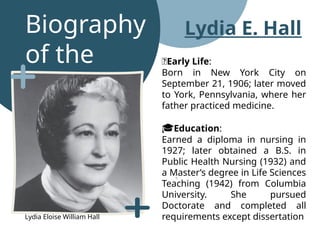
Lydia E.Hall
📍Early Life:
Born in New York City on
September 21, 1906; later moved
to York, Pennsylvania, where her
father practiced medicine.
🎓Education:
Earned a diploma in nursing in
1927; later obtained a B.S. in
Public Health Nursing (1932) and
a Master’s degree in Life Sciences
Teaching (1942) from Columbia
University. She pursued
Doctorate and completed all
requirements except dissertation
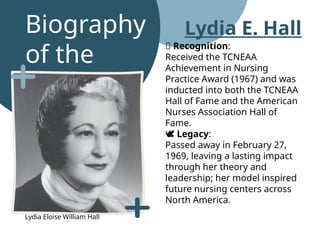
Lydia Eloise William Hall
7.
Biography
of the
theorist
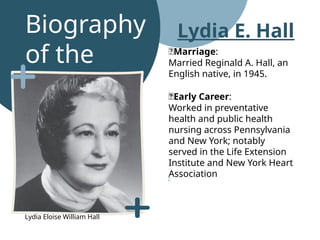
Lydia E.Hall
💍Marriage:
Married Reginald A. Hall, an
English native, in 1945.
🏥Early Career:
Worked in preventative
health and public health
nursing across Pennsylvania
and New York; notably
served in the Life Extension
Institute and New York Heart
Association
Lydia Eloise William Hall
8.
Biography
of the
theorist
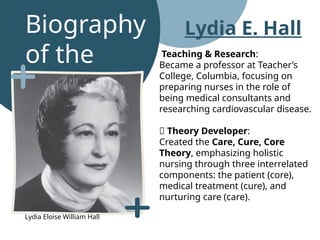
Lydia E.Hall
Lydia Eloise William Hall
Teaching & Research:
Became a professor at Teacher’s
College, Columbia, focusing on
preparing nurses in the role of
being medical consultants and
researching cardiovascular disease.
🧠 Theory Developer:
Created the Care, Cure, Core
Theory, emphasizing holistic
nursing through three interrelated
components: the patient (core),
medical treatment (cure), and
nurturing care (care).
9.
Biography
of the
theorist
Lydia E.Hall
Lydia Eloise William Hall
️
🏗️
Loeb Center Leader:
Spearheaded the creation of the
Loeb Center for Nursing and
Rehabilitation (1957–1962),
pioneering nurse-led
rehabilitative care.
📚 Publications:
Authored 21 publications and
many articles, especially in the
1960s, reflecting her work on
chronic disease and therapeutic
nursing practices.
10.
Biography
of the
theorist
Lydia E.Hall
Lydia Eloise William Hall
🏅 Recognition:
Received the TCNEAA
Achievement in Nursing
Practice Award (1967) and was
inducted into both the TCNEAA
Hall of Fame and the American
Nurses Association Hall of
Fame.
️
🕊️Legacy:
Passed away in February 27,
1969, leaving a lasting impact
through her theory and
leadership; her model inspired
future nursing centers across
North America.
11.
Metaparadigm in
Nursing
Nursing
Participation inthe care,
core, cure aspects of
patient care.
Nursing can and should
be professional
The c0re, care, cure
theory
Health
Hall viewed the patient
or client as composed
of body, pathology,
and person.
Environment
A state of self-awareness
with a conscious
selection of behaviors
that are optimal for that
individual.
Person
This concept is dealt with
in relation to the
individual
12.
The core, care,cure
theory
Cor
e
Cur
e
Car
e
THE PERSON
Therapeutic
Use of Self
THE BODY
Intimate
Bodily Care
THE DISEASE
Seeing the patient
and family through
medical care
13.
The Core
circle
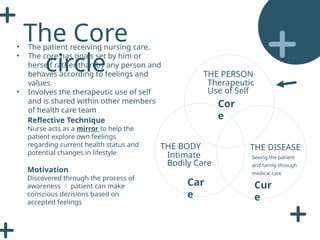
Cor
e
Cur
e
Car
e
THE PERSON
Therapeutic
Useof Self
THE BODY
Intimate
Bodily Care
THE DISEASE
Seeing the patient
and family through
medical care
• The patient receiving nursing care.
• The core has goals set by him or
herself rather than by any person and
behaves according to feelings and
values
• Involves the therapeutic use of self
and is shared within other members
of health care team
Reflective Technique
Nurse acts as a mirror to help the
patient explore own feelings
regarding current health status and
potential changes in lifestyle
Motivation
Discovered through the process of
awareness patient can make
conscious decisions based on
accepted feelings
14.
The care
circle
Cor
e
Cur
e
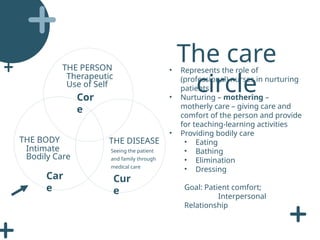
Car
e
THE PERSON
Therapeutic
Useof Self
THE BODY
Intimate
Bodily Care
THE DISEASE
Seeing the patient
and family through
medical care
• Represents the role of
(professional) nurses in nurturing
patients
• Nurturing – mothering –
motherly care – giving care and
comfort of the person and provide
for teaching-learning activities
• Providing bodily care
• Eating
• Bathing
• Elimination
• Dressing
Goal: Patient comfort;
Interpersonal
Relationship
15.
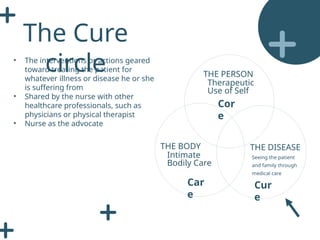
The Cure
circle
Cor
e
Cur
e
Car
e
THE PERSON
Therapeutic
Useof Self
THE BODY
Intimate
Bodily Care
THE DISEASE
Seeing the patient
and family through
medical care
• The interventions or actions geared
toward treating the patient for
whatever illness or disease he or she
is suffering from
• Shared by the nurse with other
healthcare professionals, such as
physicians or physical therapist
• Nurse as the advocate
16.
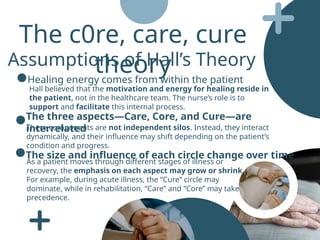
The c0re, care,cure
theory
Assumptions of Hall’s Theory
Hall believed that the motivation and energy for healing reside in
the patient, not in the healthcare team. The nurse’s role is to
support and facilitate this internal process.
The three aspects—Care, Core, and Cure—are
interrelated
Healing energy comes from within the patient
These components are not independent silos. Instead, they interact
dynamically, and their influence may shift depending on the patient’s
condition and progress.
The size and influence of each circle change over time
As a patient moves through different stages of illness or
recovery, the emphasis on each aspect may grow or shrink.
For example, during acute illness, the “Cure” circle may
dominate, while in rehabilitation, “Care” and “Core” may take
precedence.
17.
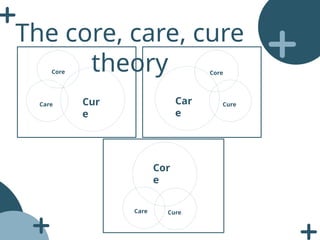
The core, care,cure
theory
Core
Care Cur
e
Core
Cure
Car
e
Cor
e
Care Cure
18.
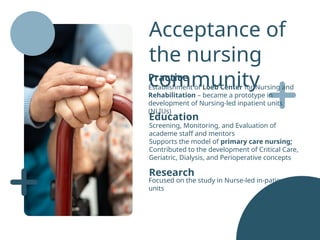
Research
Focused on thestudy in Nurse-led in-patient
units
Acceptance of
the nursing
community
Practice
Establishment of Loeb Center for Nursing and
Rehabilitation – became a prototype in
development of Nursing-led inpatient units
(NLIUs)
Education
Screening, Monitoring, and Evaluation of
academe staff and mentors
Supports the model of primary care nursing;
Contributed to the development of Critical Care,
Geriatric, Dialysis, and Perioperative concepts
19.
2. Simplicity
1. Clarity
3.Generality
4. Accessibility
5. Importance
Analysis of
the theory
five criteria
to evaluate a
theory
✔️
✔️
✔️
✔️
20.
References:
Book:
Octaviano, E. F.,& Balita, C. E. (2020). Theoretical Foundations in
Nursing: Philippine Perspective (2020 Ed.). Ultimate Learning Series.
Website:
Gonzalo, A. (2024, April 30). Lydia Hall: Care, Cure, Core nursing theory.
Nurseslabs. https://nurseslabs.com/lydia-e-halls-care-cure-core-theory/
#10 TCNEAA - Teachers College Nursing Education Alumni Association
#11 **Nursing - Care is the sole function of the nurse – while cure and care can be shared for by the other members of the health care team; Hall also stipulated that patients can take total responsibility for the care and teaching of their patients only be cared for by professional nurses
**Person
The individual is unique, capable of growth, and learning, and requires a total person (holistic) approach;
Patients achieve their maximum potential through the learning process, therefore, the chief therapy they need is TEACHING
The individual human who is 16 years or older and pass the acute stage of a long-term illness is the focus of nursing care in Hall’s work.
**Health
1. Hall stresses the need to help the person explore the meaning of his or her behavior to identify and overcome problems through developing self-identity and maturity
2. Becoming ill is a behavior. Illness is directed by feelings that are out of awareness, which are the root of adjustment difficulties. Healing may be hastened by helping people move in the direction of self-awareness
**Environment
Hall assumed that the hospital environment during treatment of acute illness creates a difficult psychological experience for the ill individual, so the nurse should create an environment conducive for self-development
Actions of the nurse should be patient-centered – to assist the individual to attain their personal goal
#14 Nurturing – mothering – motherly care – giving care and comfort of the person and provide for teaching-learning activities
Nurse is playing the role of the caregiver/surrogate
#15 E.g. administering meds, other dependent and interdependent/collaborative interventions
#16 Assumption – A statement that specifies the relationship or connection of factual concepts or phenomena
#17 Hall visualized each of the three overlapping circles as an aspect of nursing process related to the patient, to the supporting sciences and to the underlying philosophical dynamics. They change in size and overlap in relation to the patient’s phase in the disease process
For example, in cure phase, the nurse carries out the doctor’s orders in terms of administering medication, the nurse cooperates to the dietician when it comes to the patient’s nutrition
In the care phase, the nurse helps the patient in certain ADL’s like eating, bathing, toileting, ambulating, etc
In the core phase, the nurse had addressed the social and emotional needs of the patient through therapeutic communication, the patient had accepted their condition and is making effective ways to improve their quality of life
#18 Research – They have found out that in hospitals with fewer full time RNs during in-patient stays have higher risk of developing preventable complications like UTI, pneumonia, thrombosis, Pulmonary Congestion etc
#19 Why not General? Because in this theory, acute stage patients are not included and it is only applicable to adult patients. The individual must pass an acute stage of illness to successfully apply her theory. Therefore, the theory relates to only those who are ill. NOT those who are healthy and not for pediatric patients
#20 Why not General? Because in this theory, acute stage patients are not included and it is only applicable to adult patients. The individual must pass an acute stage of illness to successfully apply her theory. Therefore, the theory relates to only those who are ill. NOT those who are healthy and not for pediatric patients