Lydia Hall: Care, Cure, Core
Nursing Theory
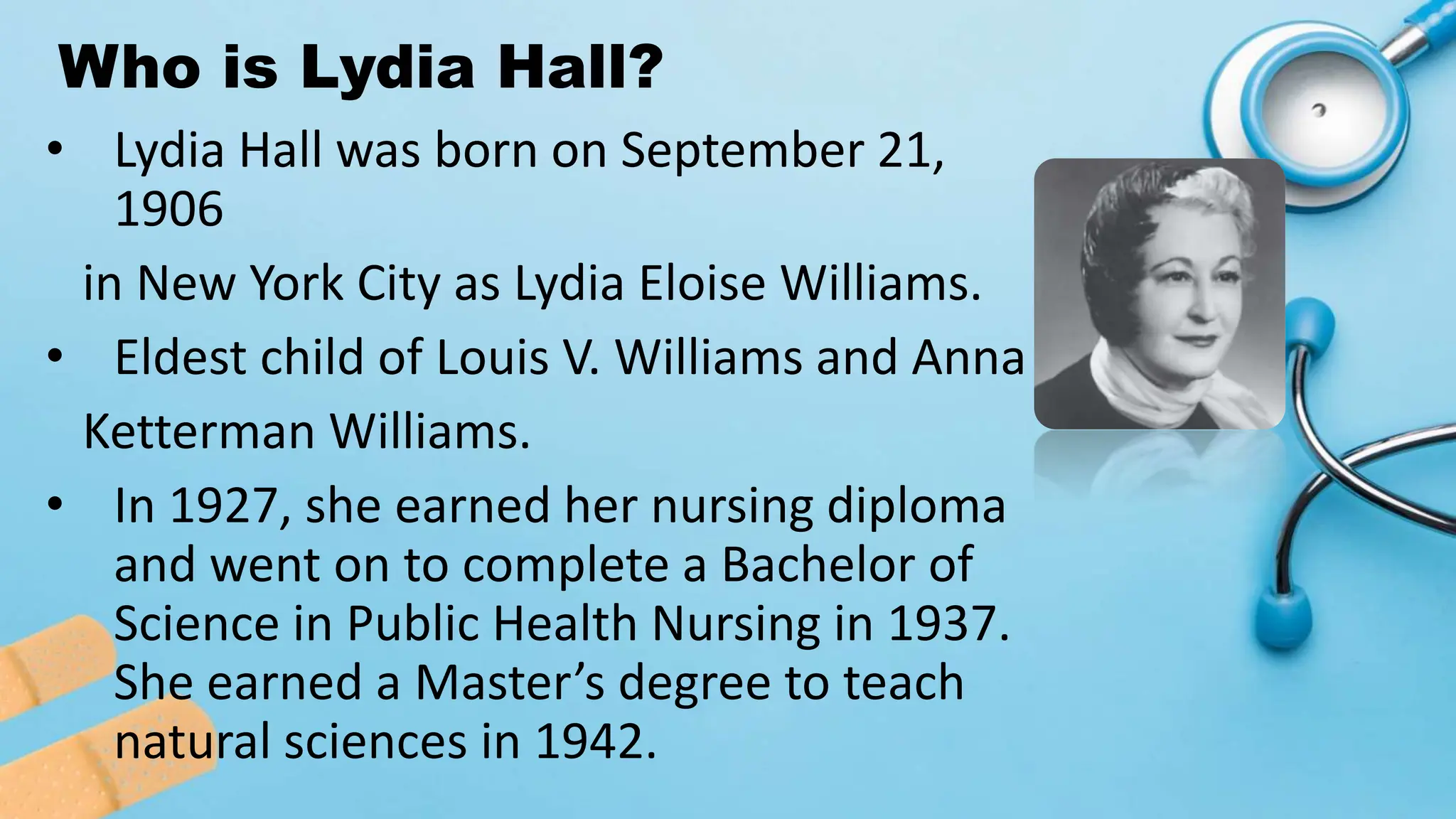
• Lydia Hall was born on September 21,
1906
in New York City as Lydia Eloise Williams.
• Eldest child of Louis V. Williams and Anna
Ketterman Williams.
• In 1927, she earned her nursing diploma
and went on to complete a Bachelor of
Science in Public Health Nursing in 1937.
She earned a Master’s degree to teach
natural sciences in 1942.
Who is Lydia Hall?
Works of Lydia Hall
• Lydia Hall also managed to balance her time in writing. In the 1960s, she
authored 21 publications and a bulk of articles regarding the Loeb Center
and her theories of long-term care and chronic disease control. Her work
was presented in “Nursing: What Is It?” in The Canadian Nurse. In 1969, it
was discussed in “The Loeb Center for Nursing and Rehabilitation” in the
International Journal of Nursing Studies. In her innovative work at the
Loeb Center, Hall argued that a need exists in society for the provision of
hospital beds grouped into units that focus on the delivery of therapeutic
nursing. The Loeb plan has been seen in many ways as similar to what
later emerged as “primary nursing.”
Career and Appointments
• Lydia Hall’s nursing experience was functional, proficient as well as
hypothetical. She spent her early years as a registered nurse working for the
Life Extension Institute of the Metropolitan Life Insurance Company in
Pennsylvania and New York where the main focus was on preventative
health.
• Hall’s interest and research in the field of rehabilitation of chronically ill
patients brought her to develop her now-famous Care, Cure, Core Theory.
She was always interested in rehabilitative nursing and the role that the
professional nurse played in the patient’s recovery and welfare.
• Hall then worked as the first director of the Loeb Center for Nursing. Her
nursing experience was in clinical nursing, nursing education, research,
and in a supervisory role. Through her leadership, the nursing-centered
care reduced rehabilitation time and length of stay by up to one-half to
one-third.
What is care, cure and core?
Core- is the patient.
Cure- refers to the medical and nursing interventions.
Care- is the nurturing provided by nurses.
Care, Cure, Core Theory
• Lydia Hall used her knowledge of psychiatry and nursing experiences in the
Loeb Center as a framework for formulating her theory. Also known as
“the Three Cs of Lydia Hall,” it contains three independent but
interconnected circles: the core, the care, and the cure.
• The core is the patient receiving nursing care. The core has goals set by
him or herself rather than by any other person, and behaves according to
his or her feelings and values.
• The cure is the attention given to patients by medical professionals. Hall
explains in the model that the cure circle is shared by the nurse with other
health professionals, such as physicians or physical therapists.
Lydia Hall’s: Care, Core, Cure
• Nursing theory in line with Lydia Hall is nothing short of revolutionary. In
the 1960s, she put down in her own simple words, her thoughts about
nursing. She did not consider herself a nurse theorist but instead talked
about her transparent thoughts and remarkable ideas of nursing care as
she learned it over the years. These lead to the development of her “Care,
Cure, Core Theory,” also known as the “Three Cs of Lydia Hall.”
Major Concepts of Care, Core, Cure
Individual
The individual human who is 16 years of age or older and past the acute stage of long-
term illness is the focus of nursing care in Hall’s work. The source of energy and
motivation for healing is the individual care recipient, not the health care provider.
Health
Health can be inferred to be a state of self-awareness with a conscious selection of
behaviors that are optimal for that individual. Hall stresses the need to help the person
explore the meaning of his or her behavior to identify and overcome problems through
developing self-identity and maturity.
Society and Environment
• The concept of society or environment is dealt with in relation to the individual. Hall is
credited with developing the concept of Loeb Center because she assumed that the
hospital environment during treatment of acute illness creates a difficult psychological
experience for the ill individual. Loeb Center focuses on providing an environment that
is conducive to self-development.
Society and Environment
• The concept of society or environment is dealt with in relation to the individual. Hall is
credited with developing the concept of Loeb Center because she assumed that the
hospital environment during treatment of acute illness creates a difficult psychological
experience for the ill individual. Loeb Center focuses on providing an environment that
is conducive to self-development.
Nursing
• is identified as consisting of participation in the care, core, and cure
aspects of patient care.
Subconcepts
• Lydia Hall’s theory has three components which are represented by three
independent but interconnected circles. The three circles are: the core, the
care, and the cure. The size of each circle constantly varies and depends on
the state of the patient.
The Care Circle
• According to the theory, nurses are focused on
performing the noble task of nurturing patients. This
circle solely represents the role of nurses, and is
focused on performing the task of nurturing patients.
Nurturing involves using the factors that make up the
concept of mothering (care and comfort of the
person) and provide for teaching-learning activities.
The Cure Circle
• The cure as explained in this theory is the aspect of
nursing which involves the administration of
medications and treatments. Hall explains in the
model that the cure circle is shared by the nurse with
other health professionals, such as physicians or
physical therapists.
The Core Circle
• The core, according to Hall’s theory, is the patient receiving nursing care. The core has
goals set by him or herself rather than by any other person and behaves according to
his or her feelings and values.
• Reflective technique is used by the professional nurse in a way the he or she acts as a
mirror to the patient to help the latter explore his or her own feelings regarding his or
her current health status and related potential changes in lifestyle.
• Motivations are discovered through the process of bringing into awareness the
feelings being experienced.
Strengths
• Lydia Hall’s model appears to be completely and simply logical. Her work
may be viewed as the philosophy of nursing.
• The three Cs (care, core and cure) in this theory were unique. In all the
circles of the model, the nurse is present, although focus of the nurse’s role
is on the care circle
• Weaknesses
Lydia Hall’s model is considered to be plain and simple in its presentation.
However, the receptiveness and resilience necessary for its utilization and
function may not be so simple for nurses whose personality, educational
preparation, and experience have not prepared them to function with
minimal structure. This and the self-imposed age and illness requirements
limit the generalizability.

514176539-Hall-s-Care-Cure-Core-Nursing-Theory.pptx

  • 1.
    Lydia Hall: Care,Cure, Core Nursing Theory
  • 2.
    • Lydia Hallwas born on September 21, 1906 in New York City as Lydia Eloise Williams. • Eldest child of Louis V. Williams and Anna Ketterman Williams. • In 1927, she earned her nursing diploma and went on to complete a Bachelor of Science in Public Health Nursing in 1937. She earned a Master’s degree to teach natural sciences in 1942. Who is Lydia Hall?
  • 3.
    Works of LydiaHall • Lydia Hall also managed to balance her time in writing. In the 1960s, she authored 21 publications and a bulk of articles regarding the Loeb Center and her theories of long-term care and chronic disease control. Her work was presented in “Nursing: What Is It?” in The Canadian Nurse. In 1969, it was discussed in “The Loeb Center for Nursing and Rehabilitation” in the International Journal of Nursing Studies. In her innovative work at the Loeb Center, Hall argued that a need exists in society for the provision of hospital beds grouped into units that focus on the delivery of therapeutic nursing. The Loeb plan has been seen in many ways as similar to what later emerged as “primary nursing.”
  • 4.
    Career and Appointments •Lydia Hall’s nursing experience was functional, proficient as well as hypothetical. She spent her early years as a registered nurse working for the Life Extension Institute of the Metropolitan Life Insurance Company in Pennsylvania and New York where the main focus was on preventative health. • Hall’s interest and research in the field of rehabilitation of chronically ill patients brought her to develop her now-famous Care, Cure, Core Theory. She was always interested in rehabilitative nursing and the role that the professional nurse played in the patient’s recovery and welfare.
  • 5.
    • Hall thenworked as the first director of the Loeb Center for Nursing. Her nursing experience was in clinical nursing, nursing education, research, and in a supervisory role. Through her leadership, the nursing-centered care reduced rehabilitation time and length of stay by up to one-half to one-third.
  • 6.
    What is care,cure and core? Core- is the patient. Cure- refers to the medical and nursing interventions. Care- is the nurturing provided by nurses.
  • 7.
    Care, Cure, CoreTheory • Lydia Hall used her knowledge of psychiatry and nursing experiences in the Loeb Center as a framework for formulating her theory. Also known as “the Three Cs of Lydia Hall,” it contains three independent but interconnected circles: the core, the care, and the cure. • The core is the patient receiving nursing care. The core has goals set by him or herself rather than by any other person, and behaves according to his or her feelings and values. • The cure is the attention given to patients by medical professionals. Hall explains in the model that the cure circle is shared by the nurse with other health professionals, such as physicians or physical therapists.
  • 8.
    Lydia Hall’s: Care,Core, Cure • Nursing theory in line with Lydia Hall is nothing short of revolutionary. In the 1960s, she put down in her own simple words, her thoughts about nursing. She did not consider herself a nurse theorist but instead talked about her transparent thoughts and remarkable ideas of nursing care as she learned it over the years. These lead to the development of her “Care, Cure, Core Theory,” also known as the “Three Cs of Lydia Hall.”
  • 9.
    Major Concepts ofCare, Core, Cure Individual The individual human who is 16 years of age or older and past the acute stage of long- term illness is the focus of nursing care in Hall’s work. The source of energy and motivation for healing is the individual care recipient, not the health care provider. Health Health can be inferred to be a state of self-awareness with a conscious selection of behaviors that are optimal for that individual. Hall stresses the need to help the person explore the meaning of his or her behavior to identify and overcome problems through developing self-identity and maturity.
  • 10.
    Society and Environment •The concept of society or environment is dealt with in relation to the individual. Hall is credited with developing the concept of Loeb Center because she assumed that the hospital environment during treatment of acute illness creates a difficult psychological experience for the ill individual. Loeb Center focuses on providing an environment that is conducive to self-development. Society and Environment • The concept of society or environment is dealt with in relation to the individual. Hall is credited with developing the concept of Loeb Center because she assumed that the hospital environment during treatment of acute illness creates a difficult psychological experience for the ill individual. Loeb Center focuses on providing an environment that is conducive to self-development. Nursing • is identified as consisting of participation in the care, core, and cure aspects of patient care.
  • 11.
    Subconcepts • Lydia Hall’stheory has three components which are represented by three independent but interconnected circles. The three circles are: the core, the care, and the cure. The size of each circle constantly varies and depends on the state of the patient.
  • 12.
    The Care Circle •According to the theory, nurses are focused on performing the noble task of nurturing patients. This circle solely represents the role of nurses, and is focused on performing the task of nurturing patients. Nurturing involves using the factors that make up the concept of mothering (care and comfort of the person) and provide for teaching-learning activities. The Cure Circle • The cure as explained in this theory is the aspect of nursing which involves the administration of medications and treatments. Hall explains in the model that the cure circle is shared by the nurse with other health professionals, such as physicians or physical therapists.
  • 13.
    The Core Circle •The core, according to Hall’s theory, is the patient receiving nursing care. The core has goals set by him or herself rather than by any other person and behaves according to his or her feelings and values. • Reflective technique is used by the professional nurse in a way the he or she acts as a mirror to the patient to help the latter explore his or her own feelings regarding his or her current health status and related potential changes in lifestyle. • Motivations are discovered through the process of bringing into awareness the feelings being experienced.
  • 14.
    Strengths • Lydia Hall’smodel appears to be completely and simply logical. Her work may be viewed as the philosophy of nursing. • The three Cs (care, core and cure) in this theory were unique. In all the circles of the model, the nurse is present, although focus of the nurse’s role is on the care circle • Weaknesses Lydia Hall’s model is considered to be plain and simple in its presentation. However, the receptiveness and resilience necessary for its utilization and function may not be so simple for nurses whose personality, educational preparation, and experience have not prepared them to function with minimal structure. This and the self-imposed age and illness requirements limit the generalizability.