LYDIA
ELOISE
HALL
CARE, CORE, CURE THEORY
BIOGRAPHY
1927 1932 1942 1945
Born in New York
City on
September
21,1906 as Lydia
Eloise Williams
The eldest child of
Louis V. Williams
and Anna
Ketterman Williams
and was named
after her maternal
grandmother
Graduated at
York Hospital
School of Nursing
in Pennsylvania
Bachelors of Science
in Public Health
Nursing
Masters Degree
in teaching
Natural Sciences,
Columbia
University
Married to Reginal
A. Hall
Died February 27,
1969 of heart
disease in
Queens Hospital
of New York
CAREER AND APPOINMENTS
1935-1940
Work at New
York Heart
Association
1941-1947
Staff nurse at
the Visiting
Nurses
Association of
New York
1950
Professor at
Teacher’s
College at
Columbia
1957-1962
Founder and
first Director of
Loeb Center
AWARDS AND HONORS
Received the
Teacher’s
College
Nursing
Education
Alumni
1967
Inducted into
the American
Nurses
Association
(ANA) Hall of
Fame
1984
Association
(TCNEAA)
Achievement
in Nursing
Practice Award
Nursing Hall of
Fame inductee
CARE
CORE
CURE
The
HALL’S THREE ASPECTS OF
NURSING
CORE
The Person
Therapeutic
use of self
CORE
The Person
Therapeutic
use of self
The Core of nursing focuses on the
recipient of care—who can be an individual,
family or community. The core of nursing
encompasses various fields of study, including
the biological, social and behavioral sciences
and humanities (Pearson, 2007). It is the
application of social sciences that focuses on
the personal knowing, therapeutic use of self
(Octaviano & Balita, 2008; Tomey & Alligood,
CARE
The Body
Intimate
bodily care
CARE
The Body
Intimate bodily
care
Hall’s Care pertains to the knowledge
and activities of nursing (Pearson, 2007).
The Body, from the inference of phenomena of
natural and biological sciences, concerns the
intimate bodily care (Tomey & Alligood, 2002).
Nursing is required when people are not
capable of performing intimate bodily care for
themselves (Parker, 2001). Nursing care is the
focus of the Care Model of Hall.
CURE
The Disease
Seeing the patient and
family through medical
care
CURE
The
Disease
Seeing the patient and
family through medical
care
Cure involves the pathological and
therapeutic sciences, focusing on the patient
and family through the medical care (Tomey &
Alligood, 2002). Cure provides the treatment of
the disease by utilizing the nursing process in
conjunction with medicine (Pearson, 2007;
Parker, 2001). Cure is the medical side in the
care of patients.
3
The three aspects
interact, and the
circles
representing them
change the size,
depending on the
patient’s total
course of progress.
2
The three aspects
of nursing should
not be viewed as
functioning
independently but
as interrelated.
ASSUMPTIONS
on and
essary
exist
atient
in the
team.
STRENGTHS
Lydia Hall’s model appears to
be completely and simply
logical. Her work may be
viewed as the philosophy of
nursing.
The three Cs (care, core, and
cure) in this theory were
unique. In all the model
circles, the nurse is present,
although the nurse’s focus is
on the care circle.
WEAKNESSES
Lydia Hall’s model is considered to be plain
and simple in its presentation. However,
the receptiveness and resilience necessary
for its utilization and function may not be
so simple for nurses whose personality,
educational preparation, and experience
have not prepared them to function with
minimal structure. This and the self-
imposed age and illness requirements
limit the generalizability.
The age requirement for applying her
theory 16 years of age and above limits
the theory since it cannot be disregarded
that nurses are faced with pediatric clients
now and then.
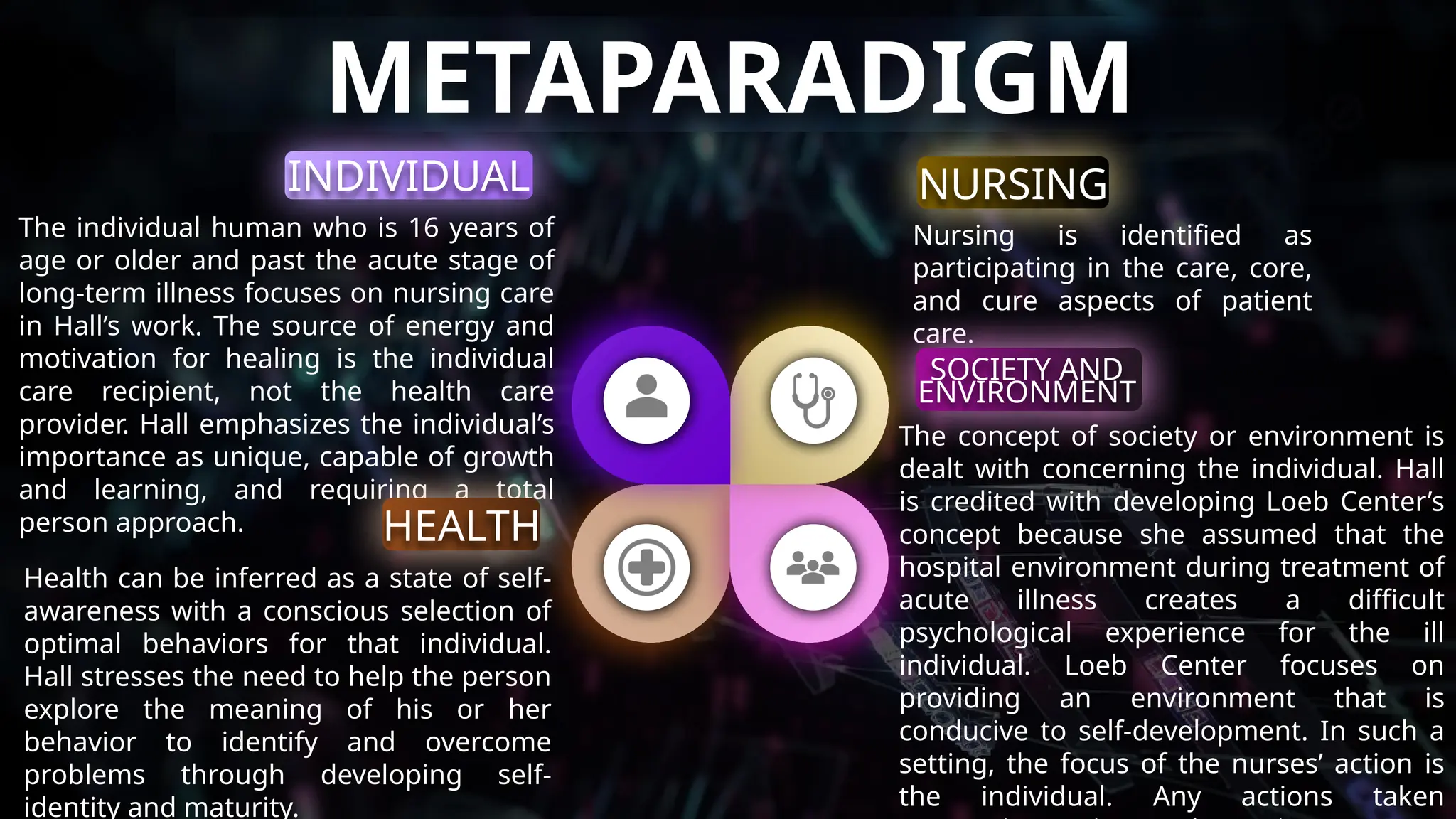
METAPARADIGM
INDIVIDUAL
The individual human who is 16 years of
age or older and past the acute stage of
long-term illness focuses on nursing care
in Hall’s work. The source of energy and
motivation for healing is the individual
care recipient, not the health care
provider. Hall emphasizes the individual’s
importance as unique, capable of growth
and learning, and requiring a total
person approach. HEALTH
Health can be inferred as a state of self-
awareness with a conscious selection of
optimal behaviors for that individual.
Hall stresses the need to help the person
explore the meaning of his or her
behavior to identify and overcome
problems through developing self-
identity and maturity.
Nursing is identified as
participating in the care, core,
and cure aspects of patient
care.
NURSING
SOCIETY AND
ENVIRONMENT
The concept of society or environment is
dealt with concerning the individual. Hall
is credited with developing Loeb Center’s
concept because she assumed that the
hospital environment during treatment of
acute illness creates a difficult
psychological experience for the ill
individual. Loeb Center focuses on
providing an environment that is
conducive to self-development. In such a
setting, the focus of the nurses’ action is
the individual. Any actions taken
ACCEPTANCE BY THE
NURSING COMMUNITY
PRACTICE
EDUCATIO
N
RESEARC
H
Hall’s guiding philosophy
belief that during the
rehabilitation phase of an
illness experience,
professional nurses where
the best prepared to
foster the rehabilitation
process.
Hall’s theory supports the model of
primary care nursing and delineates
definite ideas on the professional
nursing practice and education in terms
of screening, monitoring and evaluating
The findings of several
studies in nurse-led units
lend further support to the
benefit of the structure to
the patient outcomes,
including prevention of
complication.
THEORY ANALYSIS
CLARITY
SIMPLICITY
ACCESSIBILITY
GENERALIT
Y
The terms Hall used in her study
are define precisely. The concept of
the theory is consistent with
nursing philosophy and the
terminologist of the theory are
congruent all throughout.
There are few concept, and
relational statements flow logically
from the definition. The model
clearly demonstrates the aspects
care, core and cure and the manner
in which these elements
interrelated.
The model continues to evolve
through planned programs of
research. Continued empirical
research, especially intervention
and evidence-based studies.
In this theory, acute stage patients
are not included and it is only
appreciable to adult patients. The
individual must pass an acute stage
of illness to successfully apply her
theory, in conclusion the theory
relates only to those who are ill.
IMPORTANCE
IMPORTANCE
The concepts of nurses
being accountable and
responsible for their own
practice and pertinent and
applicable with focus on
personalized nursing care
rather than merely routine
care.
APPLICATION
APPLICATION
Nursing functions in all three
of the circle (care, core, and
cure) but shares them to
different degrees with other
disciplines.
CONCLUSION
CONCLUSION
Lydia Hall used her knowledge of
psychiatry and nursing experiences in the
Loeb Center as a framework for formulating
the Care, Core, and Cure Theory. Her model
contains three independent but
interconnected circles. The three circles are
the core, the care, and the cure.
The core is the patient. The cure
refers to the medical and nursing
interventions, and the care is the nurturing
provided by nurses. Nursing functions in all
three of the circles but shares them to
CASE STUDY
Mrs. Thompson presented
with a history of heart failure,
diabetes, and chronic pain.
Additionally, she was coping with
the recent loss of her spouse,
leading to heightened emotional
distress and exacerbation of her
medical conditions. Mrs.
Thompson's complex health status
required a nuanced approach to
address both her physical and
emotional well-being.
APPLICATION O F
The nursing team, following the principles of
the 3C's model, initiated a holistic care plan for Mrs.
Thompson. Care was provided by acknowledging and
addressing her emotional needs related to grief and
loss. Therapeutic communication techniques were
employed to create a supportive environment,
allowing Mrs. Thompson to express her feelings and
concerns. The nursing staff also collaborated with
mental health professionals to provide additional
emotional support and counseling. Care extended
beyond the traditional medical model to encompass
the nurturing dimensions of Mrs. Thompson's overall
well-being.
CARE
APPLICATION O F
Concurrently, the medical team
focused on the Cure component of the 3C's
model. Evidence-based medical
interventions were employed to manage
Mrs. Thompson's heart failure and
diabetes. Medications were adjusted, and a
comprehensive treatment plan was
developed to address her chronic pain. The
Cure aspect emphasized the importance of
medical and therapeutic interventions to
stabilize Mrs. Thompson's physiological
conditions.
CURE
APPLICATION O F
Recognizing Mrs. Thompson as an
individual with unique experiences, values, and
preferences, the nursing team incorporated the
Core aspect of the 3C's model into her care
plan. They engaged in shared decision-making,
considering Mrs. Thompson's input in the
development of her care goals. Cultural
competence was maintained throughout,
ensuring that the care provided respected her
individual beliefs and background. The Core
aspect of the model facilitated a patient-
centered approach that empowered Mrs.
CORE
The application of Lydia Hall's 3C's
model in Mrs. Thompson's case resulted
in positive outcomes. Her emotional well-
being improved as she felt supported and
heard, leading to a more collaborative
engagement in her medical care.
Physiologically, Mrs. Thompson's
conditions stabilized with the coordinated
efforts of the nursing and medical teams.
The holistic approach, encompassing
Care, Cure, and Core, contributed to a
more balanced and harmonious state for
OUTCOMES
REFLECTION
and
CONCLUSION
Mrs. Thompson's case
exemplifies the effectiveness of Lydia
Hall's 3C's model in addressing the
complex needs of patients. By
recognizing the interplay of
emotional, medical, and individual
factors, the nursing team provided a
holistic and patient-centered
approach to care. This case study
underscores the enduring relevance
of the 3C's model in guiding nurses to
restore harmony and well-being in the
THANK
YOU

LYDIA ELOISE HALL CORE, CARE, CURE THEORY.pptx

  • 1.
  • 2.
    BIOGRAPHY 1927 1932 19421945 Born in New York City on September 21,1906 as Lydia Eloise Williams The eldest child of Louis V. Williams and Anna Ketterman Williams and was named after her maternal grandmother Graduated at York Hospital School of Nursing in Pennsylvania Bachelors of Science in Public Health Nursing Masters Degree in teaching Natural Sciences, Columbia University Married to Reginal A. Hall Died February 27, 1969 of heart disease in Queens Hospital of New York
  • 3.
    CAREER AND APPOINMENTS 1935-1940 Workat New York Heart Association 1941-1947 Staff nurse at the Visiting Nurses Association of New York 1950 Professor at Teacher’s College at Columbia 1957-1962 Founder and first Director of Loeb Center
  • 4.
    AWARDS AND HONORS Receivedthe Teacher’s College Nursing Education Alumni 1967 Inducted into the American Nurses Association (ANA) Hall of Fame 1984 Association (TCNEAA) Achievement in Nursing Practice Award Nursing Hall of Fame inductee
  • 5.
  • 6.
  • 7.
  • 8.
    CORE The Person Therapeutic use ofself The Core of nursing focuses on the recipient of care—who can be an individual, family or community. The core of nursing encompasses various fields of study, including the biological, social and behavioral sciences and humanities (Pearson, 2007). It is the application of social sciences that focuses on the personal knowing, therapeutic use of self (Octaviano & Balita, 2008; Tomey & Alligood,
  • 9.
  • 10.
    CARE The Body Intimate bodily care Hall’sCare pertains to the knowledge and activities of nursing (Pearson, 2007). The Body, from the inference of phenomena of natural and biological sciences, concerns the intimate bodily care (Tomey & Alligood, 2002). Nursing is required when people are not capable of performing intimate bodily care for themselves (Parker, 2001). Nursing care is the focus of the Care Model of Hall.
  • 11.
    CURE The Disease Seeing thepatient and family through medical care
  • 12.
    CURE The Disease Seeing the patientand family through medical care Cure involves the pathological and therapeutic sciences, focusing on the patient and family through the medical care (Tomey & Alligood, 2002). Cure provides the treatment of the disease by utilizing the nursing process in conjunction with medicine (Pearson, 2007; Parker, 2001). Cure is the medical side in the care of patients.
  • 13.
    3 The three aspects interact,and the circles representing them change the size, depending on the patient’s total course of progress. 2 The three aspects of nursing should not be viewed as functioning independently but as interrelated. ASSUMPTIONS on and essary exist atient in the team.
  • 14.
    STRENGTHS Lydia Hall’s modelappears to be completely and simply logical. Her work may be viewed as the philosophy of nursing. The three Cs (care, core, and cure) in this theory were unique. In all the model circles, the nurse is present, although the nurse’s focus is on the care circle.
  • 15.
    WEAKNESSES Lydia Hall’s modelis considered to be plain and simple in its presentation. However, the receptiveness and resilience necessary for its utilization and function may not be so simple for nurses whose personality, educational preparation, and experience have not prepared them to function with minimal structure. This and the self- imposed age and illness requirements limit the generalizability. The age requirement for applying her theory 16 years of age and above limits the theory since it cannot be disregarded that nurses are faced with pediatric clients now and then.
  • 16.
    METAPARADIGM INDIVIDUAL The individual humanwho is 16 years of age or older and past the acute stage of long-term illness focuses on nursing care in Hall’s work. The source of energy and motivation for healing is the individual care recipient, not the health care provider. Hall emphasizes the individual’s importance as unique, capable of growth and learning, and requiring a total person approach. HEALTH Health can be inferred as a state of self- awareness with a conscious selection of optimal behaviors for that individual. Hall stresses the need to help the person explore the meaning of his or her behavior to identify and overcome problems through developing self- identity and maturity. Nursing is identified as participating in the care, core, and cure aspects of patient care. NURSING SOCIETY AND ENVIRONMENT The concept of society or environment is dealt with concerning the individual. Hall is credited with developing Loeb Center’s concept because she assumed that the hospital environment during treatment of acute illness creates a difficult psychological experience for the ill individual. Loeb Center focuses on providing an environment that is conducive to self-development. In such a setting, the focus of the nurses’ action is the individual. Any actions taken
  • 17.
    ACCEPTANCE BY THE NURSINGCOMMUNITY PRACTICE EDUCATIO N RESEARC H Hall’s guiding philosophy belief that during the rehabilitation phase of an illness experience, professional nurses where the best prepared to foster the rehabilitation process. Hall’s theory supports the model of primary care nursing and delineates definite ideas on the professional nursing practice and education in terms of screening, monitoring and evaluating The findings of several studies in nurse-led units lend further support to the benefit of the structure to the patient outcomes, including prevention of complication.
  • 18.
    THEORY ANALYSIS CLARITY SIMPLICITY ACCESSIBILITY GENERALIT Y The termsHall used in her study are define precisely. The concept of the theory is consistent with nursing philosophy and the terminologist of the theory are congruent all throughout. There are few concept, and relational statements flow logically from the definition. The model clearly demonstrates the aspects care, core and cure and the manner in which these elements interrelated. The model continues to evolve through planned programs of research. Continued empirical research, especially intervention and evidence-based studies. In this theory, acute stage patients are not included and it is only appreciable to adult patients. The individual must pass an acute stage of illness to successfully apply her theory, in conclusion the theory relates only to those who are ill.
  • 22.
  • 23.
    IMPORTANCE The concepts ofnurses being accountable and responsible for their own practice and pertinent and applicable with focus on personalized nursing care rather than merely routine care.
  • 24.
  • 25.
    APPLICATION Nursing functions inall three of the circle (care, core, and cure) but shares them to different degrees with other disciplines.
  • 26.
  • 27.
    CONCLUSION Lydia Hall usedher knowledge of psychiatry and nursing experiences in the Loeb Center as a framework for formulating the Care, Core, and Cure Theory. Her model contains three independent but interconnected circles. The three circles are the core, the care, and the cure. The core is the patient. The cure refers to the medical and nursing interventions, and the care is the nurturing provided by nurses. Nursing functions in all three of the circles but shares them to
  • 28.
    CASE STUDY Mrs. Thompsonpresented with a history of heart failure, diabetes, and chronic pain. Additionally, she was coping with the recent loss of her spouse, leading to heightened emotional distress and exacerbation of her medical conditions. Mrs. Thompson's complex health status required a nuanced approach to address both her physical and emotional well-being.
  • 29.
    APPLICATION O F Thenursing team, following the principles of the 3C's model, initiated a holistic care plan for Mrs. Thompson. Care was provided by acknowledging and addressing her emotional needs related to grief and loss. Therapeutic communication techniques were employed to create a supportive environment, allowing Mrs. Thompson to express her feelings and concerns. The nursing staff also collaborated with mental health professionals to provide additional emotional support and counseling. Care extended beyond the traditional medical model to encompass the nurturing dimensions of Mrs. Thompson's overall well-being. CARE
  • 30.
    APPLICATION O F Concurrently,the medical team focused on the Cure component of the 3C's model. Evidence-based medical interventions were employed to manage Mrs. Thompson's heart failure and diabetes. Medications were adjusted, and a comprehensive treatment plan was developed to address her chronic pain. The Cure aspect emphasized the importance of medical and therapeutic interventions to stabilize Mrs. Thompson's physiological conditions. CURE
  • 31.
    APPLICATION O F RecognizingMrs. Thompson as an individual with unique experiences, values, and preferences, the nursing team incorporated the Core aspect of the 3C's model into her care plan. They engaged in shared decision-making, considering Mrs. Thompson's input in the development of her care goals. Cultural competence was maintained throughout, ensuring that the care provided respected her individual beliefs and background. The Core aspect of the model facilitated a patient- centered approach that empowered Mrs. CORE
  • 32.
    The application ofLydia Hall's 3C's model in Mrs. Thompson's case resulted in positive outcomes. Her emotional well- being improved as she felt supported and heard, leading to a more collaborative engagement in her medical care. Physiologically, Mrs. Thompson's conditions stabilized with the coordinated efforts of the nursing and medical teams. The holistic approach, encompassing Care, Cure, and Core, contributed to a more balanced and harmonious state for OUTCOMES REFLECTION and
  • 33.
    CONCLUSION Mrs. Thompson's case exemplifiesthe effectiveness of Lydia Hall's 3C's model in addressing the complex needs of patients. By recognizing the interplay of emotional, medical, and individual factors, the nursing team provided a holistic and patient-centered approach to care. This case study underscores the enduring relevance of the 3C's model in guiding nurses to restore harmony and well-being in the
  • 34.