Half-life formula (M J Rhoades)
                     This is an attachment to the physics cheat sheet
                         Derivation, how it works, and Carbon dating etc

  There seems to be a lot of questions about the half life formulas, how they work, where they
came from, and how to use them. In this paper I hope to answer some of these questions and give
you a better understanding of radioactive half-life. If you do not know what radioactivity is, or
you do not understand what radiation is, go to my paper "Radiation Interactions" on
wepapes.com or scribd and review that first. For this paper I will define a few of the terms that I
will be using throughout the paper as it applies to half-life.

Half-life The term given to the amount of time it takes for half of a substance to radioactively
decay into something else

Radioactive The property or characteristic of a substance to spontaneously decay by the emission
of radiation due to its unstable nucleus

Radiation The energy in particles or waves given off by an unstable nucleus of a radioactive
substance. Now remember these definitions are as they apply to half-life

Decay The spontaneous disintegration process of the nucleus of a radioactive substance

Activity The rate of decay of a radioactive substance

Decay constant (λ) The probability per unit time that an atom will decay

Curie (ci) The unit of measure of the rate of radioactive decay equal to 3.7 x 10¹⁰ dis/sec

Becquerel (Bq) Fundamental measure of decay equal to1 disintegration / second

Mole Equals 6.022 x 10²³

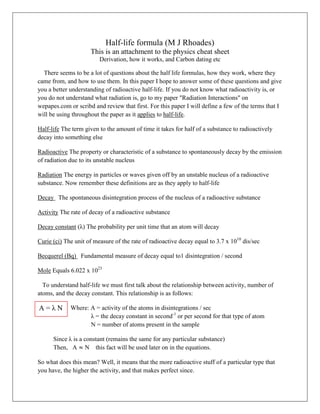
  To understand half-life we must first talk about the relationship between activity, number of
atoms, and the decay constant. This relationship is as follows:

A=λN         Where: A = activity of the atoms in disintegrations / sec
                    λ = the decay constant in second-1 or per second for that type of atom
                    N = number of atoms present in the sample

      Since λ is a constant (remains the same for any particular substance)
      Then, A ≈ N this fact will be used later on in the equations.

So what does this mean? Well, it means that the more radioactive stuff of a particular type that
you have, the higher the activity, and that makes perfect since.
Now, for those of you who do not understand calculus or dont want to understand calculus,
just move on until the formulas have been derived. I am going to put the "must know" formulas
in boxes. In most cases for high school or college you only need to use the derived formulas. For
engineering students, sorry, you have to know all of it.

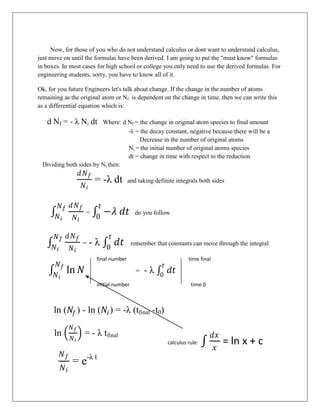
Ok, for you future Engineers let's talk about change. If the change in the number of atoms
remaining as the original atom or Nf is dependent on the change in time, then we can write this
as a differential equation which is:

   d Nf = - λ Ni dt     Where: d Nf = the change in original atom species to final amount
                                 -λ = the decay constant, negative because there will be a
                                      Decrease in the number of original atoms
                                 Ni = the initial number of original atoms species
                                 dt = change in time with respect to the reduction
 Dividing both sides by Ni then:
                      
                               = -λ dt        and taking definite integrals both sides


                   =
                     0
                         −                 do you follow


                  =-           λ   0
                                        remember that constants can move through the integral
                               final number                               time final
                                                        
     
             ln                                =   -λ    0
                                                                 
                               initial number                              time 0


      ln ( ) - ln ( ) = -λ (tfinal -t0)
               
      ln                 = - λ tfinal                                               
               
                                                                 calculus rule:             = ln x + c
                                                                                       
        
                = e-λ t
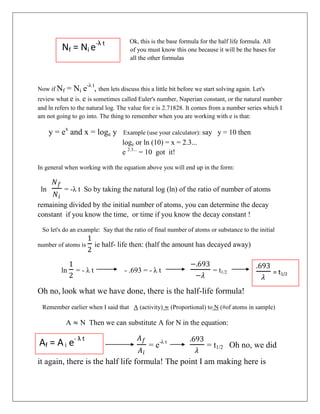
-λ t        Ok, this is the base formula for the half life formula. All
             Nf = N i e                  of you must know this one because it will be the bases for
                                         all the other formulas


Now if Nf     = Ni e-λ t, then lets discuss this a little bit before we start solving again. Let's
review what e is. e is sometimes called Euler's number, Naperian constant, or the natural number
and ln refers to the natural log. The value for e is 2.71828. It comes from a number series which I
am not going to go into. The thing to remember when you are working with e is that:

      y = ex and x = loge y           Example (use your calculator): say y = 10 then
                                      loge or ln (10) = x = 2.3...
                                      e 2.3... = 10 got it!

In general when working with the equation above you will end up in the form:

      
 ln       = -λ t So by taking the natural log (ln) of the ratio of number of atoms
     
remaining divided by the initial number of atoms, you can determine the decay
constant if you know the time, or time if you know the decay constant !

 So let's do an example: Say that the ratio of final number of atoms or substance to the initial
                        1
number of atoms is           ie half- life then: (half the amount has decayed away)
                        2
                  1                                               −.693                       .693
             ln       =-λt             - .693 = - λ t                       = t1/2                   = t1/2
                  2                                                 −                         
Oh no, look what we have done, there is the half-life formula!
 Remember earlier when I said that A (activity) ≈ (Proportional) to N (#of atoms in sample)

              A ≈ N Then we can substitute A for N in the equation:

                                                              .693
Af = A i e- λ t                                    = e-λ t                = t1/2 Oh no, we did
                                                                
it again, there is the half life formula! The point I am making here is
whether you are using activity or the number of atoms you can use the
         half-life formula to determine the values you need.
           I hope I have made the half-life formula more clear for everybody as to where it came from, if
         not, that is still ok because, as long as you memorize the boxed equations, you will still be able to
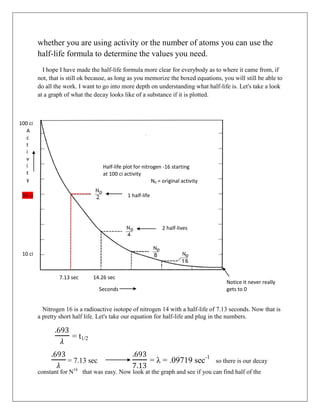
         do all the work. I want to go into more depth on understanding what half-life is. Let's take a look
         at a graph of what the decay looks like of a substance if it is plotted.


100 ci
   A
   c
   t
   i
   v
   i                                 Half-life plot for nitrogen -16 starting
   t                                 at 100 ci activity
   y                                                        N0 = original activity

 50 ci                                          1 half-life


                                                                 2 half-lives


 10 ci


                 7.13 sec        14.26 sec
                                                                                         Notice it never really
                                    Seconds                                              gets to 0


           Nitrogen 16 is a radioactive isotope of nitrogen 14 with a half-life of 7.13 seconds. Now that is
         a pretty short half life. Let's take our equation for half-life and plug in the numbers.

                .693
                        = t1/2
                  
              .693                                 .693
                       = 7.13 sec                          = λ = .09719 sec-1        so there is our decay
                                                7.13
         constant for N16 that was easy. Now look at the graph and see if you can find half of the
activity. This is the definition for half-life and we can see that 7.13 seconds has gone by. In 14.26
seconds, half of that again has decayed away. After 7 half-lives, the amount of the original
substance (N-16) is considered 0, but it is really not zero because decay is a probability and some
atoms may remain around forever. Ok, let's roll up our sleeves and get to work on a problem. this
is not a simple plug and chug problem but it will show you how all this stuff works. But before
we start, I want to give you some advice. If you are a serious student that is pursuing a scientific
degree, you need to obtain a chart of the nuclides, and you will never get a good printable copy
off the internet. I bought one from the Knolls Atomic Power Laboratory for 25$ US. You can go
online to chart of the nuclides.com and order the wall chart and booklet for 25 or you can get a
booklet with the chart in it (you have to thumb back and forth to find the page with the nuclide
on it, for 25. I personally bought both. The information contained is invaluable for any science or
engineering major. Now, I dont work for them, and I dont get any money from them, I am just
plugging them because they have an outstanding product. And something else, I talked to Dr
Miller who is one of the lead Scientist for this project and he informed me that the energy levels
(Ke) listed for the decay particles was the actual energy of the particle and does not include the
recoil energy of the mother nucleus. That may not mean much to you now, but when you hit your
engineering classes, it will be of great help, trust me. This chart lists every known nuclide, the
half-lives and so much more.

   Ok, let's get to our first problem. A 20 microgram sample of Californium 252 has a half-life of
2.646 years. Find:

 1) The number of californium-252 atoms initially present

 2) The activity of the californium-252 in curies

 3) The number of californium-252 atoms that will remain in 12 years

 4) The time it will take for the activity to reach 0.001 curies

First you have to go to the chart of the nuclides and find the gram atomic weight which equals
252.08 grams. This is the weight of one mole of atoms. We were given a 20 microgram sample.

So:

                               -6
                                          1     6.022  10 23 
 # of atoms = (20 x 10 g)                                                           = 4.78 x 10¹⁶
                                      252.08                  1
                                                                                       atoms
Next we are going to need to calculate the decay constant, so using our half-life formula:

           0.693            0.693
      λ=            =                       = 0.262 year-1 we now have to convert this to sec-1
            1/2       2.646
1          1          1
    λ = .262 year-1                                                                     = 8.3 x 10⁻⁹ sec-1
                                  365.25        24        3600 
Ok we now have our decay constant, so what is next? Oh, the activity in curies is the second part

     A = λ N Where: A = activity in disintegrations / sec
                                 λ = the decay constant in sec-1
                                 N = the number of atoms

     A = (8.3 x 10⁻⁹ sec-1) (4.78 x 10¹⁶ atoms)

     A = 3.97 x 10⁸ disintegrations / sec
            this is our answer in Bq, but we need curies right? so

                                                                   1 
     A in curies = (3.97 x 10⁸ dis/sec)                                                  = 0.01073 curies
                                                          3.7  10 10  /
Ok, we have our number of atoms in the original sample; we have the activity in curies, next # of
atoms left after 12 years. Here we are going to need the equation:

      Nf = Ni e -λ t

      Nf = (4.78 x 10¹⁶) (2.17828 - (2.62 / year) (12 years))                     Warning! as long as the units
                                                                                  are the same it's ok. Dont
      Nf = 2.06 x 10¹⁵ atoms remaining                                            mix days with minuets etc, or
                                                                                  you will be wrong


Now for the last part of the problem, the time it will take to reach an activity of 0.001curies.
for this we will need the equation:

      Af = Ai e - λ t
           
      ln          = - λ t (Remember how we did this earlier) now rearranging the
           
formula
                          
            −                       0.001 
                                −
                                       0.01073 
      t=                         =                   = 9.057 years
                                 0.262  −1
The nice thing about this problem is that it made us use all the formulas we derived, and if you
have figured this one out, you can do all the rest of the half life problems you will run into.

   Let's talk about carbon dating now. It's no harder than the problem we just worked out; you
only need to understand a couple of things about it and it will become clear. Then, we will work
a problem with carbon dating so you understand fully. First of all, the normal run of the mill
carbon is carbon-12, the carbon used in carbon dating is carbon-14. The only reason carbon
dating works at all is because of the carbon-14. Where does carbon-14 come from?

    It comes from the atmosphere. It is created in the atmosphere, when incoming cosmic rays
(Neutrons, or free Neutrons caused by other cosmic rays) reacts with a Nitrogen-14 atom. The
high energy Neutron Knocks out a proton in the Nitrogen atom, the Neutron is absorbed by the
now Carbon atom and becomes radioactive Carbon-14 with a half-life of 5,715 years. What's
nice about this half-life, it is good for determining recent life form dates. Let me explain further.
In order for you to get carbon-14 in your body, you must be eating. That is, you are alive. The
trees and plants take in the carbon-14 from the air; (they are alive) you eat the trees and plants, or
the meat from those animals that eat the trees and plants. Carbon-14 comes into equilibrium in
our bodies and in the plants etc. Now, if you or a plant dies, the intake of carbon-14 stops, and
the half-life decay clock starts. get it! So what do you think would happen if you were buried and
dug up 5,715 years later? That's right, 1/2 of the carbon-14 in your body would be gone, and if a
detector especially tuned for reading carbon-14 emission was used, they could tell the day you
died, or pretty close. Do you see how it works? The formula for the production of C-14 is as
follows:
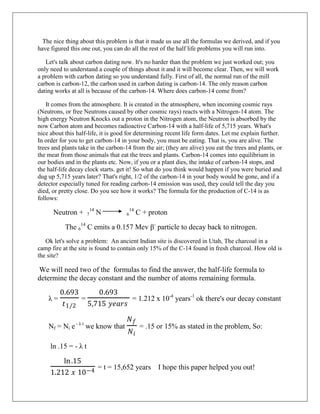
                             14                14
      Neutron +          7        N        6        C + proton

           The 614 C emits a 0.157 Mev β- particle to decay back to nitrogen.
   Ok let's solve a problem: An ancient Indian site is discovered in Utah, The charcoal in a
camp fire at the site is found to contain only 15% of the C-14 found in fresh charcoal. How old is
the site?

We will need two of the formulas to find the answer, the half-life formula to
determine the decay constant and the number of atoms remaining formula.
         0.693                    0.693
    λ=               =                          = 1.212 x 10⁻⁴ years-1 ok there's our decay constant
           1/2         5,715 

                   -λt
                                           
    Nf = Ni e            we know that                = .15 or 15% as stated in the problem, So:
                                           
     ln .15 = - λ t

           ln .15
                                  = t = 15,652 years I hope this paper helped you out!
     1.212  10 −4

Half life formula

  • 1.
    Half-life formula (MJ Rhoades) This is an attachment to the physics cheat sheet Derivation, how it works, and Carbon dating etc There seems to be a lot of questions about the half life formulas, how they work, where they came from, and how to use them. In this paper I hope to answer some of these questions and give you a better understanding of radioactive half-life. If you do not know what radioactivity is, or you do not understand what radiation is, go to my paper "Radiation Interactions" on wepapes.com or scribd and review that first. For this paper I will define a few of the terms that I will be using throughout the paper as it applies to half-life. Half-life The term given to the amount of time it takes for half of a substance to radioactively decay into something else Radioactive The property or characteristic of a substance to spontaneously decay by the emission of radiation due to its unstable nucleus Radiation The energy in particles or waves given off by an unstable nucleus of a radioactive substance. Now remember these definitions are as they apply to half-life Decay The spontaneous disintegration process of the nucleus of a radioactive substance Activity The rate of decay of a radioactive substance Decay constant (λ) The probability per unit time that an atom will decay Curie (ci) The unit of measure of the rate of radioactive decay equal to 3.7 x 10¹⁰ dis/sec Becquerel (Bq) Fundamental measure of decay equal to1 disintegration / second Mole Equals 6.022 x 10²³ To understand half-life we must first talk about the relationship between activity, number of atoms, and the decay constant. This relationship is as follows: A=λN Where: A = activity of the atoms in disintegrations / sec λ = the decay constant in second-1 or per second for that type of atom N = number of atoms present in the sample Since λ is a constant (remains the same for any particular substance) Then, A ≈ N this fact will be used later on in the equations. So what does this mean? Well, it means that the more radioactive stuff of a particular type that you have, the higher the activity, and that makes perfect since.
  • 2.
    Now, for thoseof you who do not understand calculus or dont want to understand calculus, just move on until the formulas have been derived. I am going to put the "must know" formulas in boxes. In most cases for high school or college you only need to use the derived formulas. For engineering students, sorry, you have to know all of it. Ok, for you future Engineers let's talk about change. If the change in the number of atoms remaining as the original atom or Nf is dependent on the change in time, then we can write this as a differential equation which is: d Nf = - λ Ni dt Where: d Nf = the change in original atom species to final amount -λ = the decay constant, negative because there will be a Decrease in the number of original atoms Ni = the initial number of original atoms species dt = change in time with respect to the reduction Dividing both sides by Ni then: = -λ dt and taking definite integrals both sides = 0 − do you follow =- λ 0 remember that constants can move through the integral final number time final ln = -λ 0 initial number time 0 ln ( ) - ln ( ) = -λ (tfinal -t0) ln = - λ tfinal calculus rule: = ln x + c = e-λ t
  • 3.
    -λ t Ok, this is the base formula for the half life formula. All Nf = N i e of you must know this one because it will be the bases for all the other formulas Now if Nf = Ni e-λ t, then lets discuss this a little bit before we start solving again. Let's review what e is. e is sometimes called Euler's number, Naperian constant, or the natural number and ln refers to the natural log. The value for e is 2.71828. It comes from a number series which I am not going to go into. The thing to remember when you are working with e is that: y = ex and x = loge y Example (use your calculator): say y = 10 then loge or ln (10) = x = 2.3... e 2.3... = 10 got it! In general when working with the equation above you will end up in the form: ln = -λ t So by taking the natural log (ln) of the ratio of number of atoms remaining divided by the initial number of atoms, you can determine the decay constant if you know the time, or time if you know the decay constant ! So let's do an example: Say that the ratio of final number of atoms or substance to the initial 1 number of atoms is ie half- life then: (half the amount has decayed away) 2 1 −.693 .693 ln =-λt - .693 = - λ t = t1/2 = t1/2 2 − Oh no, look what we have done, there is the half-life formula! Remember earlier when I said that A (activity) ≈ (Proportional) to N (#of atoms in sample) A ≈ N Then we can substitute A for N in the equation: .693 Af = A i e- λ t = e-λ t = t1/2 Oh no, we did it again, there is the half life formula! The point I am making here is
  • 4.
    whether you areusing activity or the number of atoms you can use the half-life formula to determine the values you need. I hope I have made the half-life formula more clear for everybody as to where it came from, if not, that is still ok because, as long as you memorize the boxed equations, you will still be able to do all the work. I want to go into more depth on understanding what half-life is. Let's take a look at a graph of what the decay looks like of a substance if it is plotted. 100 ci A c t i v i Half-life plot for nitrogen -16 starting t at 100 ci activity y N0 = original activity 50 ci 1 half-life 2 half-lives 10 ci 7.13 sec 14.26 sec Notice it never really Seconds gets to 0 Nitrogen 16 is a radioactive isotope of nitrogen 14 with a half-life of 7.13 seconds. Now that is a pretty short half life. Let's take our equation for half-life and plug in the numbers. .693 = t1/2 .693 .693 = 7.13 sec = λ = .09719 sec-1 so there is our decay 7.13 constant for N16 that was easy. Now look at the graph and see if you can find half of the
  • 5.
    activity. This isthe definition for half-life and we can see that 7.13 seconds has gone by. In 14.26 seconds, half of that again has decayed away. After 7 half-lives, the amount of the original substance (N-16) is considered 0, but it is really not zero because decay is a probability and some atoms may remain around forever. Ok, let's roll up our sleeves and get to work on a problem. this is not a simple plug and chug problem but it will show you how all this stuff works. But before we start, I want to give you some advice. If you are a serious student that is pursuing a scientific degree, you need to obtain a chart of the nuclides, and you will never get a good printable copy off the internet. I bought one from the Knolls Atomic Power Laboratory for 25$ US. You can go online to chart of the nuclides.com and order the wall chart and booklet for 25 or you can get a booklet with the chart in it (you have to thumb back and forth to find the page with the nuclide on it, for 25. I personally bought both. The information contained is invaluable for any science or engineering major. Now, I dont work for them, and I dont get any money from them, I am just plugging them because they have an outstanding product. And something else, I talked to Dr Miller who is one of the lead Scientist for this project and he informed me that the energy levels (Ke) listed for the decay particles was the actual energy of the particle and does not include the recoil energy of the mother nucleus. That may not mean much to you now, but when you hit your engineering classes, it will be of great help, trust me. This chart lists every known nuclide, the half-lives and so much more. Ok, let's get to our first problem. A 20 microgram sample of Californium 252 has a half-life of 2.646 years. Find: 1) The number of californium-252 atoms initially present 2) The activity of the californium-252 in curies 3) The number of californium-252 atoms that will remain in 12 years 4) The time it will take for the activity to reach 0.001 curies First you have to go to the chart of the nuclides and find the gram atomic weight which equals 252.08 grams. This is the weight of one mole of atoms. We were given a 20 microgram sample. So: -6 1 6.022 10 23 # of atoms = (20 x 10 g) = 4.78 x 10¹⁶ 252.08 1 atoms Next we are going to need to calculate the decay constant, so using our half-life formula: 0.693 0.693 λ= = = 0.262 year-1 we now have to convert this to sec-1 1/2 2.646
  • 6.
    1 1 1 λ = .262 year-1 = 8.3 x 10⁻⁹ sec-1 365.25 24 3600 Ok we now have our decay constant, so what is next? Oh, the activity in curies is the second part A = λ N Where: A = activity in disintegrations / sec λ = the decay constant in sec-1 N = the number of atoms A = (8.3 x 10⁻⁹ sec-1) (4.78 x 10¹⁶ atoms) A = 3.97 x 10⁸ disintegrations / sec this is our answer in Bq, but we need curies right? so 1 A in curies = (3.97 x 10⁸ dis/sec) = 0.01073 curies 3.7 10 10 / Ok, we have our number of atoms in the original sample; we have the activity in curies, next # of atoms left after 12 years. Here we are going to need the equation: Nf = Ni e -λ t Nf = (4.78 x 10¹⁶) (2.17828 - (2.62 / year) (12 years)) Warning! as long as the units are the same it's ok. Dont Nf = 2.06 x 10¹⁵ atoms remaining mix days with minuets etc, or you will be wrong Now for the last part of the problem, the time it will take to reach an activity of 0.001curies. for this we will need the equation: Af = Ai e - λ t ln = - λ t (Remember how we did this earlier) now rearranging the formula − 0.001 − 0.01073 t= = = 9.057 years 0.262 −1
  • 7.
    The nice thingabout this problem is that it made us use all the formulas we derived, and if you have figured this one out, you can do all the rest of the half life problems you will run into. Let's talk about carbon dating now. It's no harder than the problem we just worked out; you only need to understand a couple of things about it and it will become clear. Then, we will work a problem with carbon dating so you understand fully. First of all, the normal run of the mill carbon is carbon-12, the carbon used in carbon dating is carbon-14. The only reason carbon dating works at all is because of the carbon-14. Where does carbon-14 come from? It comes from the atmosphere. It is created in the atmosphere, when incoming cosmic rays (Neutrons, or free Neutrons caused by other cosmic rays) reacts with a Nitrogen-14 atom. The high energy Neutron Knocks out a proton in the Nitrogen atom, the Neutron is absorbed by the now Carbon atom and becomes radioactive Carbon-14 with a half-life of 5,715 years. What's nice about this half-life, it is good for determining recent life form dates. Let me explain further. In order for you to get carbon-14 in your body, you must be eating. That is, you are alive. The trees and plants take in the carbon-14 from the air; (they are alive) you eat the trees and plants, or the meat from those animals that eat the trees and plants. Carbon-14 comes into equilibrium in our bodies and in the plants etc. Now, if you or a plant dies, the intake of carbon-14 stops, and the half-life decay clock starts. get it! So what do you think would happen if you were buried and dug up 5,715 years later? That's right, 1/2 of the carbon-14 in your body would be gone, and if a detector especially tuned for reading carbon-14 emission was used, they could tell the day you died, or pretty close. Do you see how it works? The formula for the production of C-14 is as follows: 14 14 Neutron + 7 N 6 C + proton The 614 C emits a 0.157 Mev β- particle to decay back to nitrogen. Ok let's solve a problem: An ancient Indian site is discovered in Utah, The charcoal in a camp fire at the site is found to contain only 15% of the C-14 found in fresh charcoal. How old is the site? We will need two of the formulas to find the answer, the half-life formula to determine the decay constant and the number of atoms remaining formula. 0.693 0.693 λ= = = 1.212 x 10⁻⁴ years-1 ok there's our decay constant 1/2 5,715 -λt Nf = Ni e we know that = .15 or 15% as stated in the problem, So: ln .15 = - λ t ln .15 = t = 15,652 years I hope this paper helped you out! 1.212 10 −4