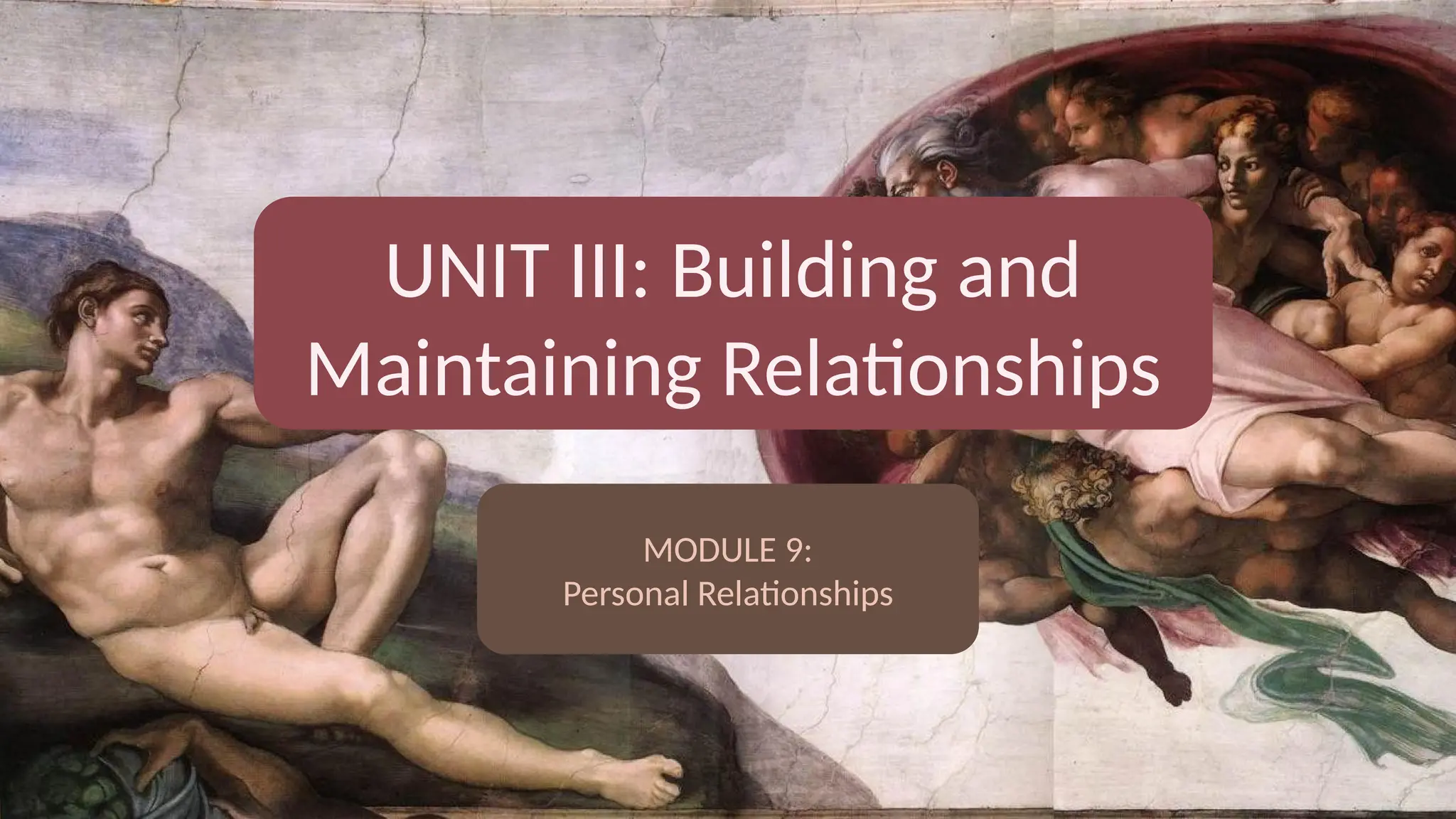
MODULE 9:
Personal Relationships
UNIT III: Building and
Maintaining Relationships
Objectives:
At the end of this module, you will be able to:
1. Discuss an understanding od teen-age relationships, including the
acceptable and unacceptable expressions of attractions,
2. Express your ways of showing attraction, love, and commitment;
and
3. Identify ways to become responsible in a relationship.
WHAT DO WE MEAN BY PERSONAL
RELATIONSHIPS?
The concept of relationship is very broad and complex. In our
model, personal relationships refer to close connections between
people, formed by emotional bonds and interactions.
Relationships are not static; they are continually evolving, and to
fully enjoy and benefit from them we need skills, information,
inspiration, practice, and social support.
THREE KINDS OF PERSONAL
RELATIONSHIPS
The concept of
“family” is an
essential
component in any
discussion of
relationships, but
this varies greatly
from person to
person.
Romantic
partnerships,
including
marriage, are
close
relationships
formed between
two people that
are built upon
affection, trust,
intimacy, and
romantic love.
A friendship can
be thought of as a
close tie between
two people that is
often built upon
mutual
experiences,
shared interests,
proximity, and
emotional
bonding.
FAMILY PARTNERSHIPS
FRIENDS
WHY ARE PERSONAL
RELATIONSHIPS
IMPORTANT?
Healthy relationships are a vital component of
health and wellbeing. There is a compelling evidence
that strong relationships contribute to a love,
healthy, and happy life.
Research shows that healthy relationships
can help you:
• Live longer. A review of 148 studies found that people with strong social
relationships are 50% less likely to die prematurely. Similarly, Dan Buettner’s
Blue Zones research calculated that committing to a life partner can add 3
years to life expectancy.
• Deal with stress. The support offered by a caring friend can provide a buffer
against the effects of stress.
• Be healthier. According to research by psychologist Sheldon Cohen, college
students who reported having strong relationships were half as likely to catch
a common cold when exposed to the virus.
• Feel richer. A survey by the National Bureau of Economic Research of 5,000
people found that doubling your group of friends has the same effect on your
wellbeing as a 50% increase income.
On the other hand, low social support is linked to a
number of health consequences, such as:
• Depression. Loneliness has long been commonly associated with depression,
and now research is baking this correlation up: a 2012 study of breast cancer
patients found that those with fewer satisfying social connections experienced
higher levels of depression, pain, and fatigue.
• Decreased immune function. The authors of the same study also found a
correlation between loneliness and immune system dysregulation, meaning
that a lack of social connections can increase your chances of becoming sick.
• Higher blood pressure. University of Chicago researchers who studied a group
of 229 adults over five years found that loneliness could predict higher blood
pressure even years later, indicating that the effects of isolation have long-
lasting consequences.
25 MOST COMMON
RELATIONSHIP PROBLEMS
1. Affairs / Infidelity / Cheating. This includes emotional infidelity, one-night
stands, internet relationships (including ‘sexting’), long- and short-term
affairs and financial infidelity.
2. Sexual issues. Particularly loss of libido and including questions around your
gender, or your partner’s gender.
3. Significant differences in core values and beliefs.
4. Life stages. You have ‘outgrown’ each other or have ‘changed’ significantly
for whatever reason.
5. Traumatic and/or Life-Changing Events.
6. Responses to prolonged periods of Stress, such as Work-Related Stress,
long-term illness, mental health issues, Financial Problems, problems with
the children, infertility, and many more.
7. Bored in or with your relationship.
8. Dealing with a jealous partner.
9. Having ‘blended’ family issues.
10. Domestic violence, which includes verbal as well as physical abuse:
THE most serious relationship problem.
11. Knowing you should not have got married in the first place!
12. Lack of responsibility regarding finances, children, health and many
other issues.
13. Unrealistic expectations. Still thinking your partner / spouse is the
princess / knight and not seeing the ‘real’ human being.
14. Addictions – substance abuse.
15.Excessive reliance on social media, at the cost of the relationship.
16.Lack of support during particularly difficult times from people that
matter to you.
17.Manipulation or over-involvement in your relationships with
family or friends.
18.Lack of communication about important matters.
19.Poor division of and/or one-sided lack of responsibility for chores
and tasks. It is not always women who complain about this
relationship problem.
20.Perceived lack of concern, care and consideration /
attentiveness: feeling the relationship is one-sided is a big one!
21.Significant personal disappointments and traumas that lead to a
change in relationship dynamics.
22. Long term depression or other mental health issues suffered by one partner
or both.
23. Significant differences in opinion on how to discipline / deal with the
children.
24. Long-term stress, particularly when not taking responsibility for doing
something positive to address the cause, or about learning to handle it if it
cannot be changed.
25. An unsupportive partner during pregnancy and/or significant problems after
the birth of your baby.
Portfolio Output: Reflections on
Personal Relationships
Write a reflection paper on your relationships, why
they are important, and how you intend to keep the
good relationships strong and healthy.
NURTURE YOUR
RELATIONSHIPS
Connect with your family
One of the biggest challenges for families to stay connected is the
busy pace of life. But Blue Zones research states that the healthiest,
longest-living people in the world all have something in common: they
put their families first.
Family support can provide comfort, support, and even influence
better health outcomes while you are sick. Relationships and family
author Mimi Doe recommends connecting with family by letting little
grievances go, spending time together, and expressing love and
compassion to one another. Of course, the same practices apply to
close friends as well. This especially important if you don’t have living
family, or have experienced difficult circumstances, such as abuse, that
would make it difficult for you to connect with your relatives.
Practice gratitude
Gratitude is one of the most accessible positive
emotions, and its effects can strengthen friendships and
intimate relationships. One 2010 study found that expressing
gratitude toward a partner can strengthen the relationship,
and this positive boost is felt by both parties—the one who
receives it. Remembering to say “thank you” when a friend
listens or your spouse brings you a cup of coffee can set off
an upward spiral of trust, closeness, and affection.
Learn to forgive
It’s normal for disagreements or betrayal to arise in relationships,
but your choice about how to handle the hurt can have a powerful
effect on the healing process. Choosing to forgive can bring about a
variety of benefits, both physical and emotional.
Fred Luskin, head of the Stanford Forgiveness Project, says it’s
easier to let go of the anger or hurt feelings associated with a
circumstance if you remind yourself that much of your distress is really
coming from the thoughts and feelings you are having right now while
remembering the event—not the event itself. Don’t be afraid to clearly
articulate why you are upset, but once the other party has listened, be
willing to lay down your anger and move on.
Be compassionate
Compassion is the willingness to be open to yourself and others,
even in painful times, with a gentle, nonjudgemental attitude. When
you feel compassionate toward another person—whether a romantic
partner, friend, relative, or colleague—you open the gates for better
communication and a stronger bond.
This doesn’t mean taking on the suffering of others, or
absorbing their emotions. Rather, compassion is the practice of
recognizing when someone else is unhappy or chose needs aren’t
being met and feeling motivated to help them. We are an imitative
species: when compassion is shown to us, we return it.
Accept others
It is also important to be accepting of the other person in
the relationship. Obviously, this does not apply in situations of
abuse or unhealthy control. Where you need foremost to
protect yourself.
But otherwise, try to understand where the person is
coming from rather than judge them. As you do for yourself,
have a realistic acceptance of the other's strengths and
weaknesses and remember that change occurs over time.
Create rituals together
With busy schedules and the presence of online social media that
offer the façade of real contact, it’s very easy to drift from friends. In
order to nurture the closeness and support of friendships, you have to
make an effort to connect.
Gallup researcher Tom Rath has found that people who
deliberately make time for gatherings or trips enjoy stronger
relationships and more positive energy. And easy way to do this is to
create a standing ritual that you can share and that doesn’t create
more stress—talking on the telephone on Fridays, for example, or
sharing a walk during lunch breaks, are ways to keep in contact with
the ones you care about the most.
Spend the right amount of time
together
Gallup researchers Jim Harter and Raksha Arora found that people
who spend 6-7 hours per day socializing (which could mean hanging out
with friends, sharing meals with family, or even emailing a colleague)
tend to be the happiest. In contrast, those who have zero interactions
(or an exhausting overload of social time) feel more stressed.
Knowing when to give your time to others and when to take some
time for yourself can be crucial in maintaining balanced, healthy
relationships as well as emotional well being.
TEN RULES FOR FINDING LOVE AND CREATING
LONG-LASTING AUTHENTIC RELATIONSHIPS
1. YOU MUST LOVE YOURSELF FIRST
Your relationship with yourself is the central template from which all others are formed. Loving yourself is a
prerequisite to creating a successful and authentic union with another.
2. PARTNERING IS A CHOICE MUST NURTURE THE RELATIONSHIP FOR IT TO THRIVE
The choice to be in a relationship is up to you. You have the ability to attract your beloved and cause the relationship
you desire to happen.
3. CREATING LOVE IS A PROCESS
Moving from “I” to “we” requires a shift in perspective and energy. Being an authentic couple is an evolution.
4. RELATIONSHIPS PROVIDE OPPORTUNITIES TO GROW
Your relationship will serve as an unofficial “lifeshop” in which you will learn about yourself and how you can grow on
your personal path.
5. COMMUNICATION IS ESSENTIAL
The open exchange of thoughts and feelings is the lifeblood of your relationship.
6. NEGOTIATION WILL BE REQUIRED
There will be times when you and your partner must work through impasses. If you do this consciously and with
respect, you will learn to create win-win outcomes.
7. YOUR RELATIONSHIP WILL BE CHALLENGED BY CHANGE
Life will present turns in the road. How you maneuver those twists and turns determines the success of your
relationship.
8. YOU MUST NURTURE THE RELATIONSHIP FOR IT TO THRIVE
Treasure your beloved and your relationship will flourish.
9. RENEWAL IS THE KEY TO LONGEVITY
Happily ever after means the ability to keep the relationship fresh and vital.
10. YOU WILL FORGET ALL THIS THE MOMENT YOU FALL IN LOVE
You know all thee rules inherently. The challenge is to remember them when fall under the enchanting spell of love.
KEEPING HEALTHY
RELATIONSHIPS
Good relationships are fun and make you feel good
about yourself. The relationships that you make in your youth
years will be a special part of your life and will teach you some
of the most important lessons about who you are.
All relationships should be based on respect and
honesty, and this is especially important when you decide to
date someone.
• Are treated with kindness and respect
• Are honest with each other
• Like to spend time together
• Take an interest in things that are important to each other
• Respect one another’s emotional, physical and sexual limits
• Can speak honestly about their feelings
In a healthy relationship, both partners:
Love should never hurt
Dating relationships can be wonderful! But while it’s important that dating partners care for each other, it’s
just as important that you take care of yourself! About 10% of high school students say they have suffered violence
from someone they date. This includes physical abuse where someone causes physical pain or injury to another
person. This can involve hitting, slapping, or kicking.
Sexual abuse is also a type of violence, and involves any kind of unwanted sexual advance. It can include
everything from unwelcome sexual comments to kissing to intercourse, but abuse doesn’t always mean that
someone hits or hurts your body.
Emotional abuse is anything that harms your self esteem or causes shame. This includes saying things that
hurt your feelings, make you feel that you aren’t worthwhile, or trying to control who you see or where you go.
Remember, you deserve healthy, happy relationships. Abuse of any type is NEVER okay.
ABUSE AND ASSAULT
Love should never hurt. But sometimes it does:
• 1 in 6 women and 1 in 33 men will be sexually assaulted in their lifetime.
• 1.5 million women are sexually assaulted or otherwise physically abused by their partners
each year.
• Over 800,000 males are sexually or physically abused by partners.
• Abuse can occur in any type of relationship—gay and straight, casual and long-term, young
and old.
• About 10% of high school students say that they have suffered violence from someone they
date.
If you are – or have been – in a relationship where you were mistreated, it’s very easy to blame
yourself. The problem is with the abuser, though, not you. It’s not your fault! Anyone can be
abused – boys and girls, men and women, gay or straight, young and old – and anyone can
become an abuser.
Break the Silence: Stop the Violence
It may shock you to know that one out of every eleven teens reports being hit or physically hurt by a boyfriend or
girlfriend in the past twelve months. But why is that, and how can we change it? In “Break The Silence: Stop the Violence,”
parents talks with teens about developing healthy, respectful relationships before they start dating.
HOW TO COMMUNICATE
Talking openly makes relationships more fun and satisfying; especially when you both talk about each other’s
needs for physical, emotional, mental and sexual health.
In a romantic relationship, it is important to communicate openly on issues of sex and sexual health. The decision
to enter into a sexual relationship is entirely up to you, and you always have the right to say “no” at any time to anything
that you don't feel comfortable with.
Though talking about sex can feel a little scary, many people find that when they get up the nerve to talk about
sex, their partner really appreciates it. It is ok to be nervous—that lets you know that what you are doing is both important
to you and also exciting.
Remember though: it is a good idea to talk about any sexual subject before you get all hot and bothered, but this
is especially important for topics which require logical thinking skills, like safer sex expectations. Having the conversation
before you are in a sexual situation makes it ore likely you will be able to act according to your own boundaries and
preferences.
So what’s to talk about?
• Sexually Transmitted Infections (STIs): This is actually an issue that all teenagers and adults must be aware of.
Anybody who engages in sexual activity is prone to have this one.
• Possibility of Pregnancy: Females who engage in sex have a high percentage of putting themselves in this kind of
situation.
• Right time for sex: You can consider your current status as a student if it is really high time to be involved in this
kind of activity. Will this make or break your future?
• Boundaries: Making the decision to set your limits in a relationship shows your maturity to assert your priorities
and respecting yourself.
MAKING THE DECISION: DECIDING WHETHER OR NOT TO HAVE SEX
The decision of whether or not to have sex is up to you, and you alone.
Therefore don’t be afraid to say “no” if that’s how you feel.
Having sex for the first time can be a huge emotional event. There are many questions and
feelings that you may want to sort out before you actually set “in the heat of the moment.”
Ask yourself:
• Am I really ready to have sex?
• How am I going to feel after I have sex?
• How do I plan to protect myself/my partner from sexually transmitted infections or
pregnancy?
• How am I going to feel about my partner afterwards?
The best way to prepare for the decision to have sex is to become comfortable with
communicating about your needs. If you don’t feel right about something, say so!
TALKING TO YOUR PARENTS
You probably think that talking to your parents about sex is impossible. You’re not alone; 83 percent of kid
your age are afraid to ask their parents about sex. Yet 51 percent of teens actually do. If you think your parents are
really nervous about raising the issue, you’re probably right. Many parents think that if they acknowledge their child
as a sexual being, their son or daughter will think it’s okay to go ahead and have sex. Some parents have said they’re
afraid kids will ask personal questions about their sex life, questions they won’t want to answer.
Think about all the adults in your life. Is there someone else’s parent– a teacher or guidance counselor,
coach, aunt, uncle, neighbor or another adult your instinctively trust? That’s the person who will give you straight
answers.
But remember; not every person your age is having sex. Even if sometimes it feels like everyone is “doing
it,” it is important to realize that this is not true. People often talk about sex in a casual manner, but this doesn’t
mean they are actually having sex.
Knowing how you feel about yourself is the first big step in handling peer pressure, it’s ok to want to enjoy
your teen years and all the fun times that can be had. It’s OK to respect yourself enough to say, “no, I'm not ready to
have sex.”
How to avoid peer or date pressure
If you’re worried about being pressured or you are currently experiencing it, know that you are not alone
and there is something you can do about it.
• Hang out with friends who also believe that it’s OK to not be ready for sex yet.
• Go out with a group of friends rather than only your date.
• Introduce your friends to your parents.
• Invite your friends to your home.
• Stick up for your friends if they are being pressured to have sex.
• Think of what you would say in advance in case someone tries to pressure you.
• Always carry money for a telephone call or cab in case you feel uncomfortable.
• Be ready to call your mom, dad or a friend to pick you up if you need to leave a date.
• Never feel obligated to “pay someone back” with sex in return for a date or gift.
• Say “no” and mean “no” if that’s how you feel.
DRUGS AND ALCOHOL
In a survey of young people ages 15-24 by the Kaiser Foundation, 9 out of 10
people surveyed reported that their peers use alcohol or illegal drugs before sex at
least some of the time. Seven out of 10 also reported that condoms are not always
used when alcohol and drugs are involved. Twenty-nine precent of those teens and
young adults surveyed said that they’ve “done more” sexually while under the
influence of drugs and alcohol than they normally would have when sober.
The effects of drugs and alcohol can make it hard to think clearly, let alone
make the best possible decisions about sex. While you’re under the influence of
drugs or alcohol it is easy to make a decision you’ll regret later– decisions that can
lead to a sexually transmitted infection or an unwanted pregnancy. Even worse,
there are some people who will use the effects of alcohol and other drugs to force
you into having sex with them.
PERSONAL DEVELOPMENT MODULE 9: PERSONAL RELATIONSHIP

PERSONAL DEVELOPMENT MODULE 9: PERSONAL RELATIONSHIP

  • 1.
    MODULE 9: Personal Relationships UNITIII: Building and Maintaining Relationships
  • 2.
    Objectives: At the endof this module, you will be able to: 1. Discuss an understanding od teen-age relationships, including the acceptable and unacceptable expressions of attractions, 2. Express your ways of showing attraction, love, and commitment; and 3. Identify ways to become responsible in a relationship.
  • 3.
    WHAT DO WEMEAN BY PERSONAL RELATIONSHIPS? The concept of relationship is very broad and complex. In our model, personal relationships refer to close connections between people, formed by emotional bonds and interactions. Relationships are not static; they are continually evolving, and to fully enjoy and benefit from them we need skills, information, inspiration, practice, and social support.
  • 4.
    THREE KINDS OFPERSONAL RELATIONSHIPS
  • 5.
    The concept of “family”is an essential component in any discussion of relationships, but this varies greatly from person to person. Romantic partnerships, including marriage, are close relationships formed between two people that are built upon affection, trust, intimacy, and romantic love. A friendship can be thought of as a close tie between two people that is often built upon mutual experiences, shared interests, proximity, and emotional bonding. FAMILY PARTNERSHIPS FRIENDS
  • 6.
    WHY ARE PERSONAL RELATIONSHIPS IMPORTANT? Healthyrelationships are a vital component of health and wellbeing. There is a compelling evidence that strong relationships contribute to a love, healthy, and happy life.
  • 7.
    Research shows thathealthy relationships can help you: • Live longer. A review of 148 studies found that people with strong social relationships are 50% less likely to die prematurely. Similarly, Dan Buettner’s Blue Zones research calculated that committing to a life partner can add 3 years to life expectancy. • Deal with stress. The support offered by a caring friend can provide a buffer against the effects of stress. • Be healthier. According to research by psychologist Sheldon Cohen, college students who reported having strong relationships were half as likely to catch a common cold when exposed to the virus. • Feel richer. A survey by the National Bureau of Economic Research of 5,000 people found that doubling your group of friends has the same effect on your wellbeing as a 50% increase income.
  • 8.
    On the otherhand, low social support is linked to a number of health consequences, such as: • Depression. Loneliness has long been commonly associated with depression, and now research is baking this correlation up: a 2012 study of breast cancer patients found that those with fewer satisfying social connections experienced higher levels of depression, pain, and fatigue. • Decreased immune function. The authors of the same study also found a correlation between loneliness and immune system dysregulation, meaning that a lack of social connections can increase your chances of becoming sick. • Higher blood pressure. University of Chicago researchers who studied a group of 229 adults over five years found that loneliness could predict higher blood pressure even years later, indicating that the effects of isolation have long- lasting consequences.
  • 9.
  • 10.
    1. Affairs /Infidelity / Cheating. This includes emotional infidelity, one-night stands, internet relationships (including ‘sexting’), long- and short-term affairs and financial infidelity. 2. Sexual issues. Particularly loss of libido and including questions around your gender, or your partner’s gender. 3. Significant differences in core values and beliefs. 4. Life stages. You have ‘outgrown’ each other or have ‘changed’ significantly for whatever reason. 5. Traumatic and/or Life-Changing Events. 6. Responses to prolonged periods of Stress, such as Work-Related Stress, long-term illness, mental health issues, Financial Problems, problems with the children, infertility, and many more. 7. Bored in or with your relationship.
  • 11.
    8. Dealing witha jealous partner. 9. Having ‘blended’ family issues. 10. Domestic violence, which includes verbal as well as physical abuse: THE most serious relationship problem. 11. Knowing you should not have got married in the first place! 12. Lack of responsibility regarding finances, children, health and many other issues. 13. Unrealistic expectations. Still thinking your partner / spouse is the princess / knight and not seeing the ‘real’ human being. 14. Addictions – substance abuse.
  • 12.
    15.Excessive reliance onsocial media, at the cost of the relationship. 16.Lack of support during particularly difficult times from people that matter to you. 17.Manipulation or over-involvement in your relationships with family or friends. 18.Lack of communication about important matters. 19.Poor division of and/or one-sided lack of responsibility for chores and tasks. It is not always women who complain about this relationship problem. 20.Perceived lack of concern, care and consideration / attentiveness: feeling the relationship is one-sided is a big one! 21.Significant personal disappointments and traumas that lead to a change in relationship dynamics.
  • 13.
    22. Long termdepression or other mental health issues suffered by one partner or both. 23. Significant differences in opinion on how to discipline / deal with the children. 24. Long-term stress, particularly when not taking responsibility for doing something positive to address the cause, or about learning to handle it if it cannot be changed. 25. An unsupportive partner during pregnancy and/or significant problems after the birth of your baby.
  • 14.
    Portfolio Output: Reflectionson Personal Relationships Write a reflection paper on your relationships, why they are important, and how you intend to keep the good relationships strong and healthy.
  • 15.
  • 16.
    Connect with yourfamily One of the biggest challenges for families to stay connected is the busy pace of life. But Blue Zones research states that the healthiest, longest-living people in the world all have something in common: they put their families first. Family support can provide comfort, support, and even influence better health outcomes while you are sick. Relationships and family author Mimi Doe recommends connecting with family by letting little grievances go, spending time together, and expressing love and compassion to one another. Of course, the same practices apply to close friends as well. This especially important if you don’t have living family, or have experienced difficult circumstances, such as abuse, that would make it difficult for you to connect with your relatives.
  • 17.
    Practice gratitude Gratitude isone of the most accessible positive emotions, and its effects can strengthen friendships and intimate relationships. One 2010 study found that expressing gratitude toward a partner can strengthen the relationship, and this positive boost is felt by both parties—the one who receives it. Remembering to say “thank you” when a friend listens or your spouse brings you a cup of coffee can set off an upward spiral of trust, closeness, and affection.
  • 18.
    Learn to forgive It’snormal for disagreements or betrayal to arise in relationships, but your choice about how to handle the hurt can have a powerful effect on the healing process. Choosing to forgive can bring about a variety of benefits, both physical and emotional. Fred Luskin, head of the Stanford Forgiveness Project, says it’s easier to let go of the anger or hurt feelings associated with a circumstance if you remind yourself that much of your distress is really coming from the thoughts and feelings you are having right now while remembering the event—not the event itself. Don’t be afraid to clearly articulate why you are upset, but once the other party has listened, be willing to lay down your anger and move on.
  • 19.
    Be compassionate Compassion isthe willingness to be open to yourself and others, even in painful times, with a gentle, nonjudgemental attitude. When you feel compassionate toward another person—whether a romantic partner, friend, relative, or colleague—you open the gates for better communication and a stronger bond. This doesn’t mean taking on the suffering of others, or absorbing their emotions. Rather, compassion is the practice of recognizing when someone else is unhappy or chose needs aren’t being met and feeling motivated to help them. We are an imitative species: when compassion is shown to us, we return it.
  • 20.
    Accept others It isalso important to be accepting of the other person in the relationship. Obviously, this does not apply in situations of abuse or unhealthy control. Where you need foremost to protect yourself. But otherwise, try to understand where the person is coming from rather than judge them. As you do for yourself, have a realistic acceptance of the other's strengths and weaknesses and remember that change occurs over time.
  • 21.
    Create rituals together Withbusy schedules and the presence of online social media that offer the façade of real contact, it’s very easy to drift from friends. In order to nurture the closeness and support of friendships, you have to make an effort to connect. Gallup researcher Tom Rath has found that people who deliberately make time for gatherings or trips enjoy stronger relationships and more positive energy. And easy way to do this is to create a standing ritual that you can share and that doesn’t create more stress—talking on the telephone on Fridays, for example, or sharing a walk during lunch breaks, are ways to keep in contact with the ones you care about the most.
  • 22.
    Spend the rightamount of time together Gallup researchers Jim Harter and Raksha Arora found that people who spend 6-7 hours per day socializing (which could mean hanging out with friends, sharing meals with family, or even emailing a colleague) tend to be the happiest. In contrast, those who have zero interactions (or an exhausting overload of social time) feel more stressed. Knowing when to give your time to others and when to take some time for yourself can be crucial in maintaining balanced, healthy relationships as well as emotional well being.
  • 23.
    TEN RULES FORFINDING LOVE AND CREATING LONG-LASTING AUTHENTIC RELATIONSHIPS
  • 24.
    1. YOU MUSTLOVE YOURSELF FIRST Your relationship with yourself is the central template from which all others are formed. Loving yourself is a prerequisite to creating a successful and authentic union with another. 2. PARTNERING IS A CHOICE MUST NURTURE THE RELATIONSHIP FOR IT TO THRIVE The choice to be in a relationship is up to you. You have the ability to attract your beloved and cause the relationship you desire to happen. 3. CREATING LOVE IS A PROCESS Moving from “I” to “we” requires a shift in perspective and energy. Being an authentic couple is an evolution. 4. RELATIONSHIPS PROVIDE OPPORTUNITIES TO GROW Your relationship will serve as an unofficial “lifeshop” in which you will learn about yourself and how you can grow on your personal path. 5. COMMUNICATION IS ESSENTIAL The open exchange of thoughts and feelings is the lifeblood of your relationship.
  • 25.
    6. NEGOTIATION WILLBE REQUIRED There will be times when you and your partner must work through impasses. If you do this consciously and with respect, you will learn to create win-win outcomes. 7. YOUR RELATIONSHIP WILL BE CHALLENGED BY CHANGE Life will present turns in the road. How you maneuver those twists and turns determines the success of your relationship. 8. YOU MUST NURTURE THE RELATIONSHIP FOR IT TO THRIVE Treasure your beloved and your relationship will flourish. 9. RENEWAL IS THE KEY TO LONGEVITY Happily ever after means the ability to keep the relationship fresh and vital. 10. YOU WILL FORGET ALL THIS THE MOMENT YOU FALL IN LOVE You know all thee rules inherently. The challenge is to remember them when fall under the enchanting spell of love.
  • 26.
    KEEPING HEALTHY RELATIONSHIPS Good relationshipsare fun and make you feel good about yourself. The relationships that you make in your youth years will be a special part of your life and will teach you some of the most important lessons about who you are. All relationships should be based on respect and honesty, and this is especially important when you decide to date someone.
  • 27.
    • Are treatedwith kindness and respect • Are honest with each other • Like to spend time together • Take an interest in things that are important to each other • Respect one another’s emotional, physical and sexual limits • Can speak honestly about their feelings In a healthy relationship, both partners:
  • 28.
    Love should neverhurt Dating relationships can be wonderful! But while it’s important that dating partners care for each other, it’s just as important that you take care of yourself! About 10% of high school students say they have suffered violence from someone they date. This includes physical abuse where someone causes physical pain or injury to another person. This can involve hitting, slapping, or kicking. Sexual abuse is also a type of violence, and involves any kind of unwanted sexual advance. It can include everything from unwelcome sexual comments to kissing to intercourse, but abuse doesn’t always mean that someone hits or hurts your body. Emotional abuse is anything that harms your self esteem or causes shame. This includes saying things that hurt your feelings, make you feel that you aren’t worthwhile, or trying to control who you see or where you go. Remember, you deserve healthy, happy relationships. Abuse of any type is NEVER okay.
  • 29.
    ABUSE AND ASSAULT Loveshould never hurt. But sometimes it does: • 1 in 6 women and 1 in 33 men will be sexually assaulted in their lifetime. • 1.5 million women are sexually assaulted or otherwise physically abused by their partners each year. • Over 800,000 males are sexually or physically abused by partners. • Abuse can occur in any type of relationship—gay and straight, casual and long-term, young and old. • About 10% of high school students say that they have suffered violence from someone they date. If you are – or have been – in a relationship where you were mistreated, it’s very easy to blame yourself. The problem is with the abuser, though, not you. It’s not your fault! Anyone can be abused – boys and girls, men and women, gay or straight, young and old – and anyone can become an abuser.
  • 30.
    Break the Silence:Stop the Violence It may shock you to know that one out of every eleven teens reports being hit or physically hurt by a boyfriend or girlfriend in the past twelve months. But why is that, and how can we change it? In “Break The Silence: Stop the Violence,” parents talks with teens about developing healthy, respectful relationships before they start dating. HOW TO COMMUNICATE Talking openly makes relationships more fun and satisfying; especially when you both talk about each other’s needs for physical, emotional, mental and sexual health. In a romantic relationship, it is important to communicate openly on issues of sex and sexual health. The decision to enter into a sexual relationship is entirely up to you, and you always have the right to say “no” at any time to anything that you don't feel comfortable with. Though talking about sex can feel a little scary, many people find that when they get up the nerve to talk about sex, their partner really appreciates it. It is ok to be nervous—that lets you know that what you are doing is both important to you and also exciting. Remember though: it is a good idea to talk about any sexual subject before you get all hot and bothered, but this is especially important for topics which require logical thinking skills, like safer sex expectations. Having the conversation before you are in a sexual situation makes it ore likely you will be able to act according to your own boundaries and preferences.
  • 31.
    So what’s totalk about? • Sexually Transmitted Infections (STIs): This is actually an issue that all teenagers and adults must be aware of. Anybody who engages in sexual activity is prone to have this one. • Possibility of Pregnancy: Females who engage in sex have a high percentage of putting themselves in this kind of situation. • Right time for sex: You can consider your current status as a student if it is really high time to be involved in this kind of activity. Will this make or break your future? • Boundaries: Making the decision to set your limits in a relationship shows your maturity to assert your priorities and respecting yourself.
  • 32.
    MAKING THE DECISION:DECIDING WHETHER OR NOT TO HAVE SEX The decision of whether or not to have sex is up to you, and you alone. Therefore don’t be afraid to say “no” if that’s how you feel. Having sex for the first time can be a huge emotional event. There are many questions and feelings that you may want to sort out before you actually set “in the heat of the moment.” Ask yourself: • Am I really ready to have sex? • How am I going to feel after I have sex? • How do I plan to protect myself/my partner from sexually transmitted infections or pregnancy? • How am I going to feel about my partner afterwards? The best way to prepare for the decision to have sex is to become comfortable with communicating about your needs. If you don’t feel right about something, say so!
  • 33.
    TALKING TO YOURPARENTS You probably think that talking to your parents about sex is impossible. You’re not alone; 83 percent of kid your age are afraid to ask their parents about sex. Yet 51 percent of teens actually do. If you think your parents are really nervous about raising the issue, you’re probably right. Many parents think that if they acknowledge their child as a sexual being, their son or daughter will think it’s okay to go ahead and have sex. Some parents have said they’re afraid kids will ask personal questions about their sex life, questions they won’t want to answer. Think about all the adults in your life. Is there someone else’s parent– a teacher or guidance counselor, coach, aunt, uncle, neighbor or another adult your instinctively trust? That’s the person who will give you straight answers. But remember; not every person your age is having sex. Even if sometimes it feels like everyone is “doing it,” it is important to realize that this is not true. People often talk about sex in a casual manner, but this doesn’t mean they are actually having sex. Knowing how you feel about yourself is the first big step in handling peer pressure, it’s ok to want to enjoy your teen years and all the fun times that can be had. It’s OK to respect yourself enough to say, “no, I'm not ready to have sex.”
  • 34.
    How to avoidpeer or date pressure If you’re worried about being pressured or you are currently experiencing it, know that you are not alone and there is something you can do about it. • Hang out with friends who also believe that it’s OK to not be ready for sex yet. • Go out with a group of friends rather than only your date. • Introduce your friends to your parents. • Invite your friends to your home. • Stick up for your friends if they are being pressured to have sex. • Think of what you would say in advance in case someone tries to pressure you. • Always carry money for a telephone call or cab in case you feel uncomfortable. • Be ready to call your mom, dad or a friend to pick you up if you need to leave a date. • Never feel obligated to “pay someone back” with sex in return for a date or gift. • Say “no” and mean “no” if that’s how you feel.
  • 35.
    DRUGS AND ALCOHOL Ina survey of young people ages 15-24 by the Kaiser Foundation, 9 out of 10 people surveyed reported that their peers use alcohol or illegal drugs before sex at least some of the time. Seven out of 10 also reported that condoms are not always used when alcohol and drugs are involved. Twenty-nine precent of those teens and young adults surveyed said that they’ve “done more” sexually while under the influence of drugs and alcohol than they normally would have when sober. The effects of drugs and alcohol can make it hard to think clearly, let alone make the best possible decisions about sex. While you’re under the influence of drugs or alcohol it is easy to make a decision you’ll regret later– decisions that can lead to a sexually transmitted infection or an unwanted pregnancy. Even worse, there are some people who will use the effects of alcohol and other drugs to force you into having sex with them.