Looking after yourself: Self-care
in OOSH
Celia Rae, MPH, MHM, BA
Senior Project Officer
Hunter Institute of Mental Health
The Hunter Institute of Mental Health is a leading
national organisation dedicated to reducing mental
illness and suicide and improving wellbeing for all
Australians.
For more than 20 years we have been delivering
successful, evidence-based mental health and
suicide prevention programs from our base in
Newcastle, NSW.
Overview
• Mental health;
• Mental illness and
accessing help;
• Burnout;
• Looking after your
wellbeing;
• Warning signs;
• Stress management
techniques;
• Mindfulness;
• Guided visualisation;
• Questions.
Taking care
Mental health and wellbeing
• Mental health is NOT mental illness;
• Often terms used interchangeably;
• We all have mental health;
• Some us of experience mental illness.
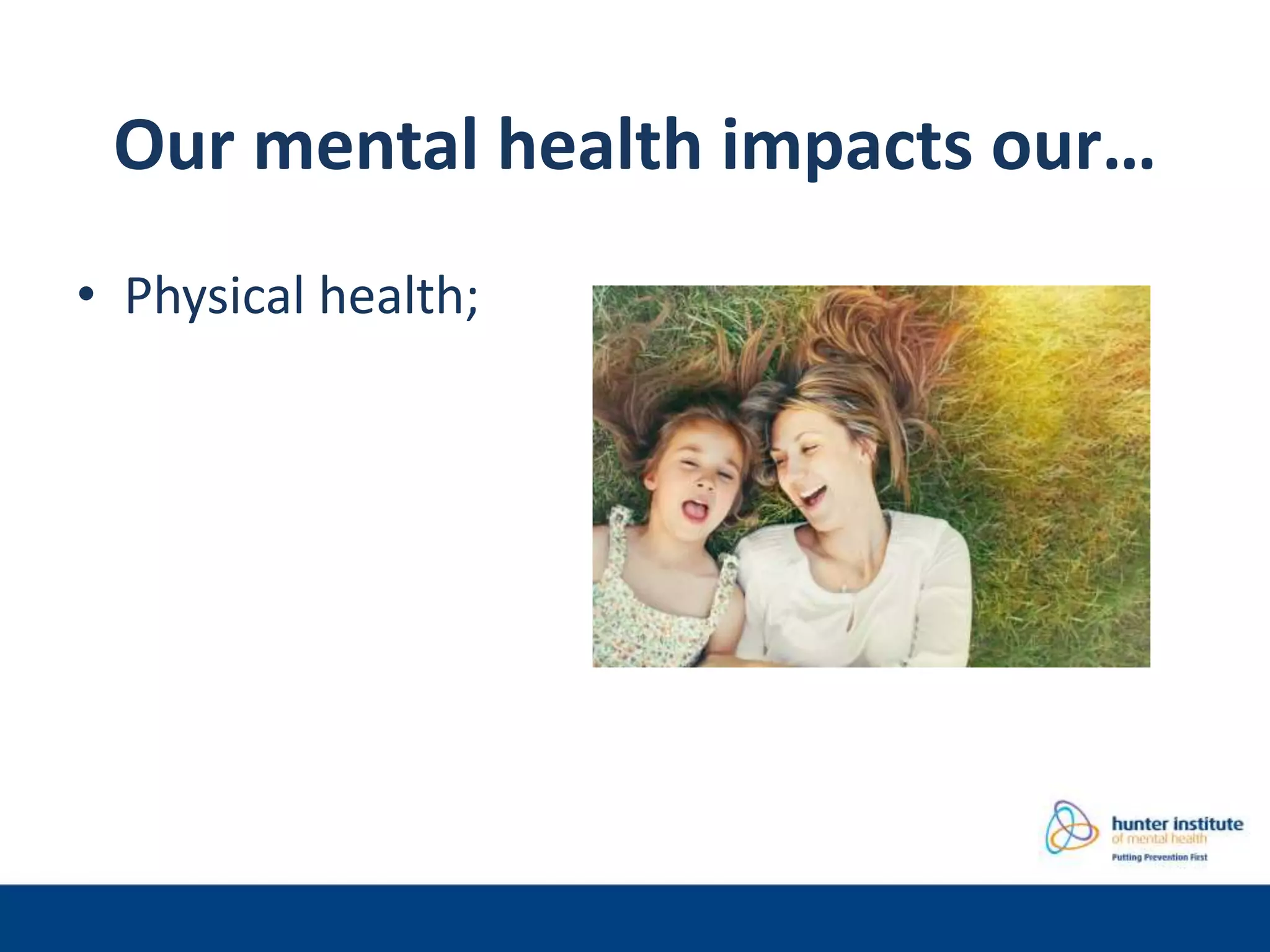
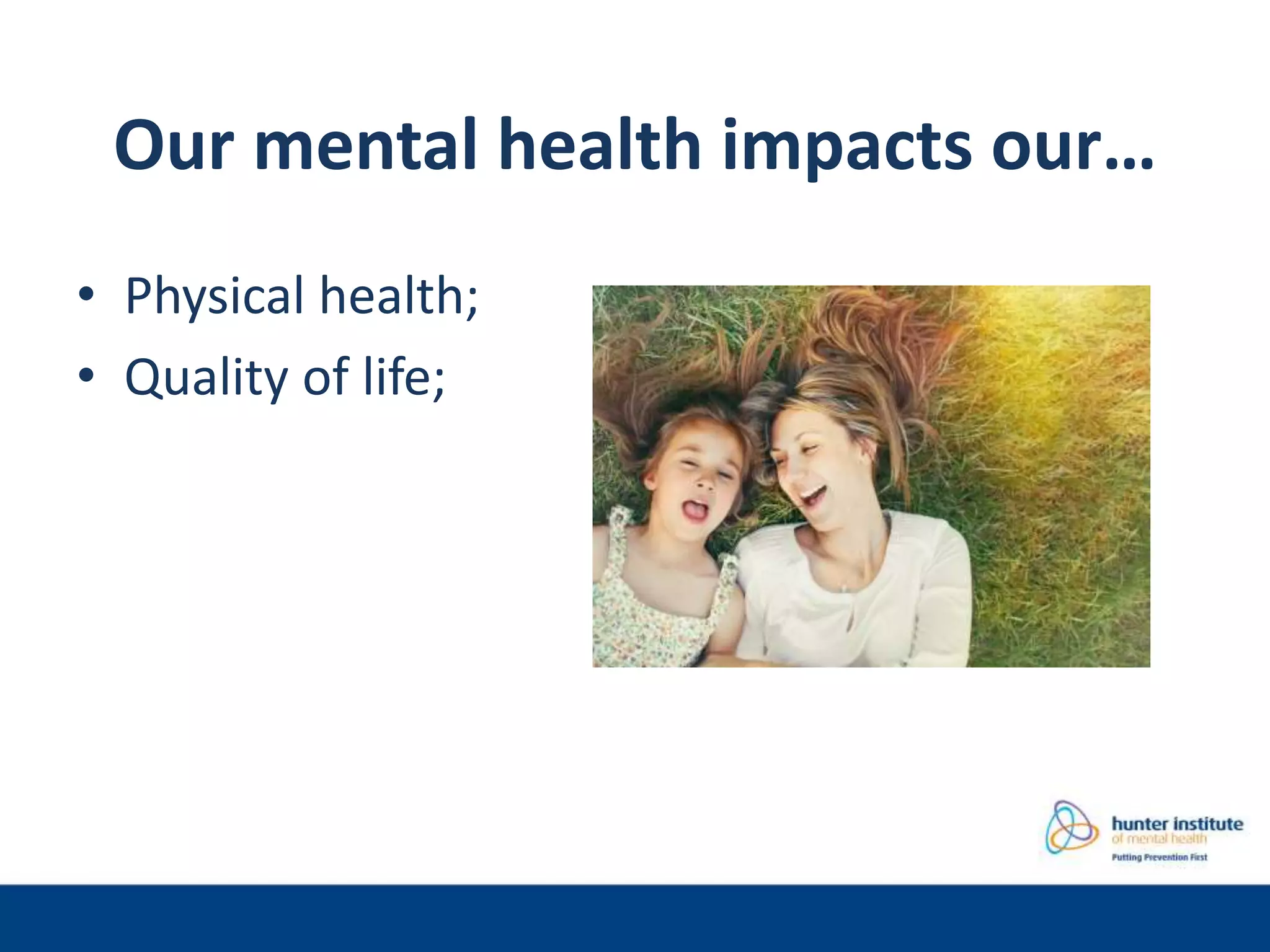
Our mental health impacts our…
• Physical health;
Physical health
• Mental illness
= higher risk of chronic physical illness;
= 3 x risk of stroke;
= 1.5 x risk of heart disease or diabetes.
• Chronic physical illness
= higher risk of mental illness;
= 2 x risk of depression and anxiety.
Our mental health impacts our…
• Physical health;
• Quality of life;
Our mental health impacts our…
• Physical health;
• Quality of life;
• Relationships;
Our mental health impacts our…
• Physical health;
• Quality of life;
• Relationships;
• Ability to cope
with stress;
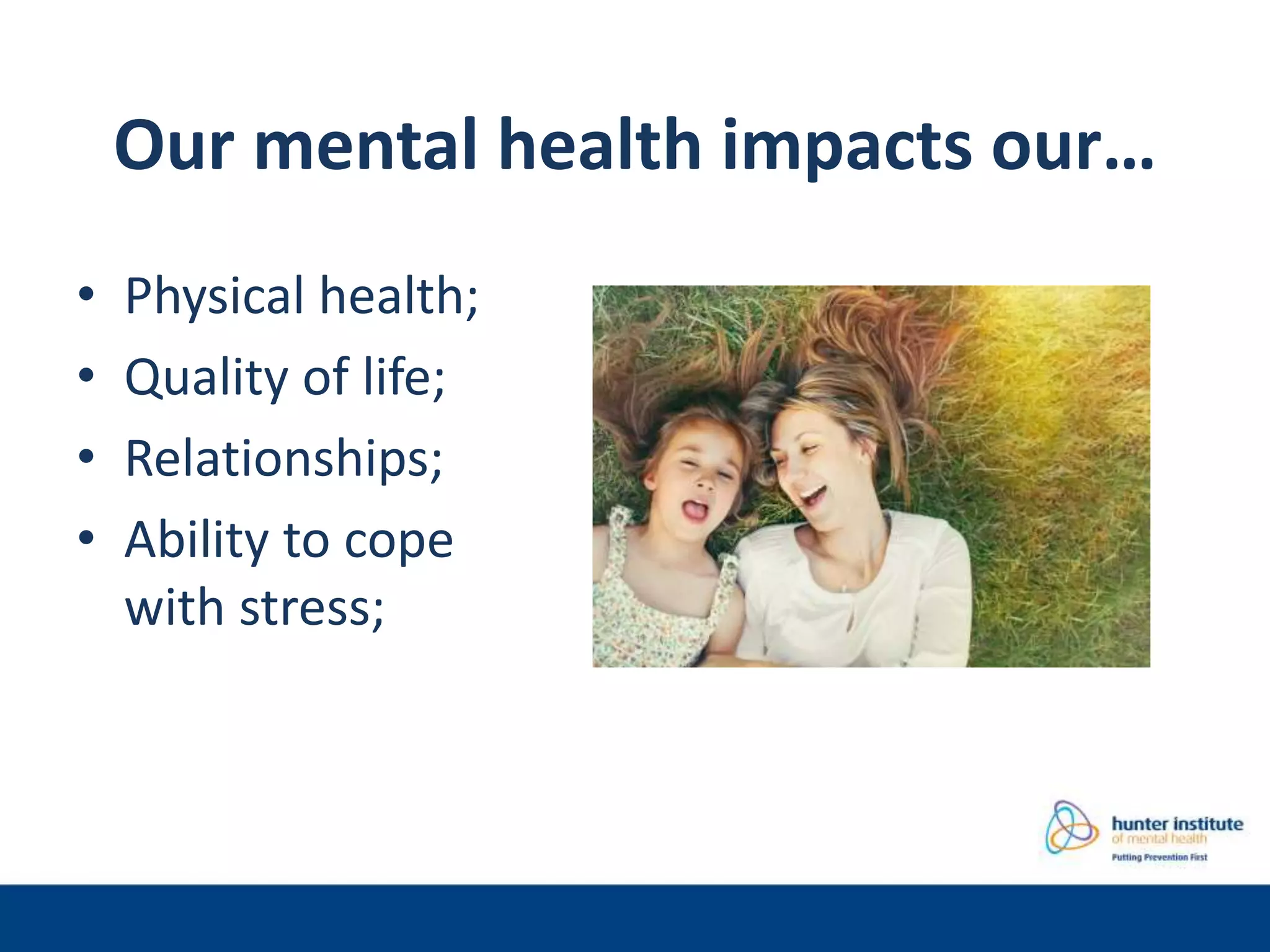
Our mental health impacts our…
• Physical health;
• Quality of life;
• Relationships;
• Ability to cope
with stress;
• Reach goals and
fulfil potential.
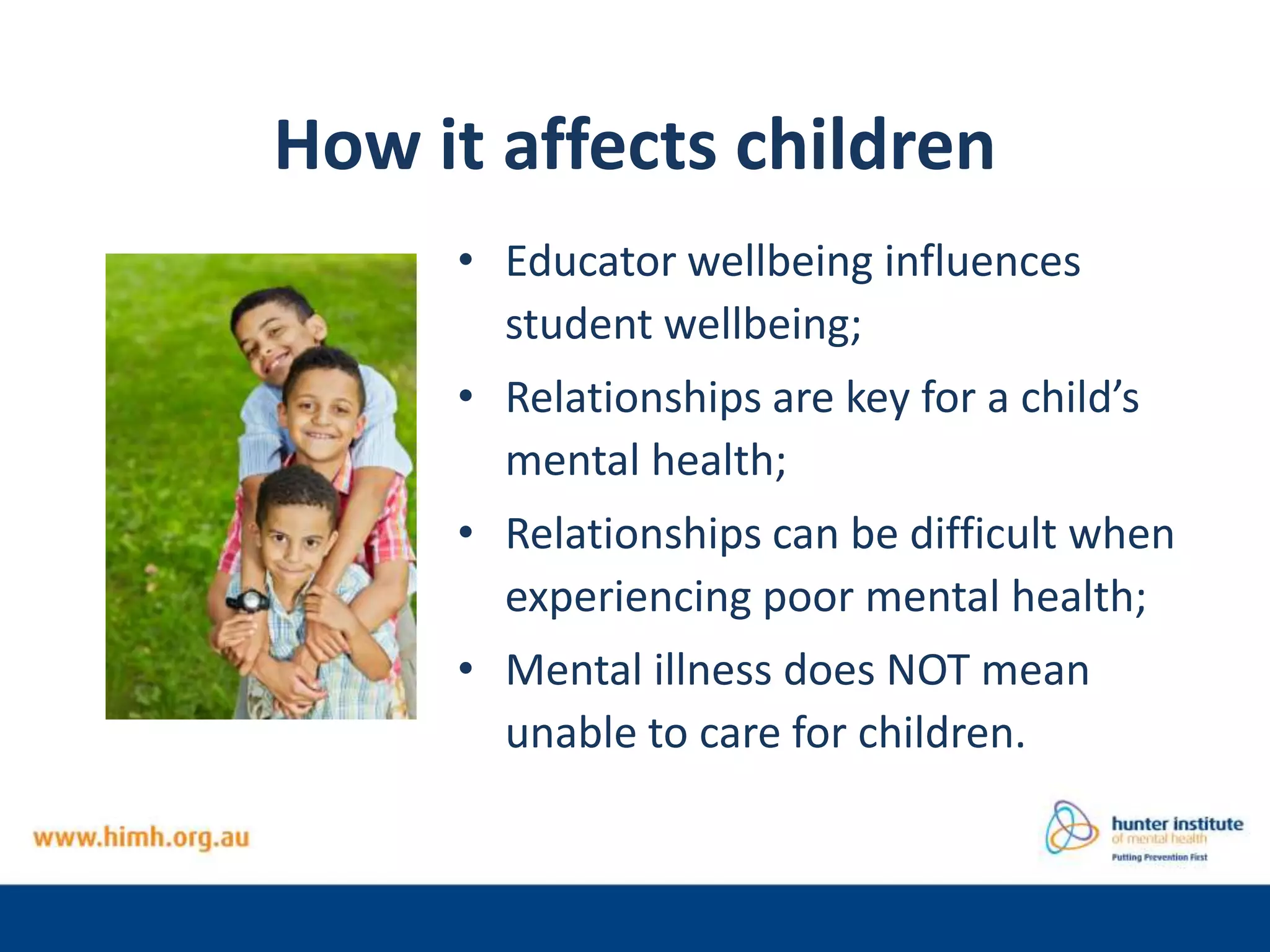
How it affects children
• Educator wellbeing influences
student wellbeing;
• Relationships are key for a child’s
mental health;
• Relationships can be difficult when
experiencing poor mental health;
• Mental illness does NOT mean
unable to care for children.
Mental illness
• Conditions that impact upon a person’s
thoughts, feelings and behaviour;
• Diagnosed by health professional;
• No single cause, combination of factors;
• Can be a single episode or ongoing;
• Common – 45% of the population will
experience mental illness in their lifetime.
Anxiety
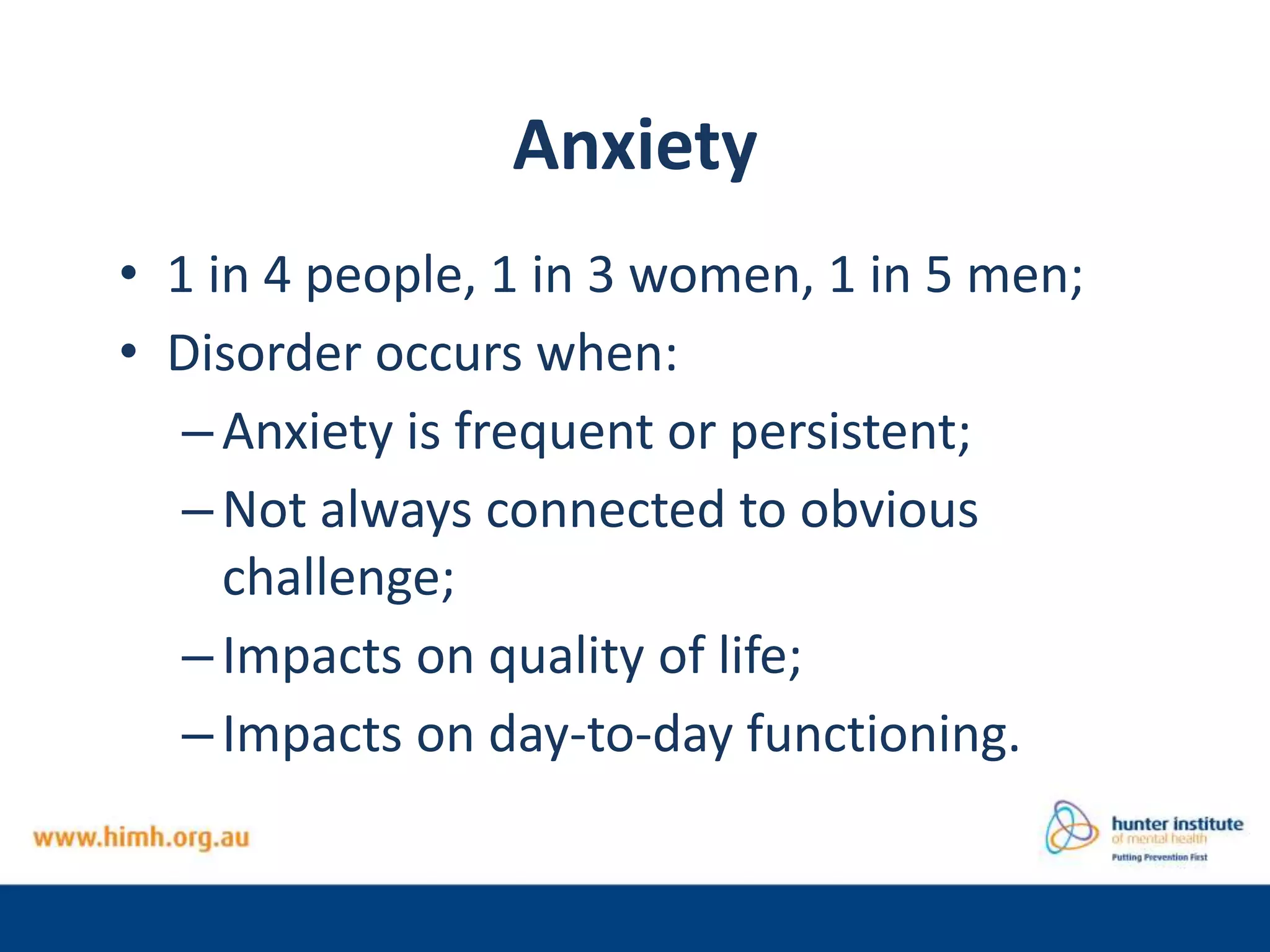
• 1 in 4 people, 1 in 3 women, 1 in 5 men;
• Disorder occurs when:
–Anxiety is frequent or persistent;
–Not always connected to obvious
challenge;
–Impacts on quality of life;
–Impacts on day-to-day functioning.
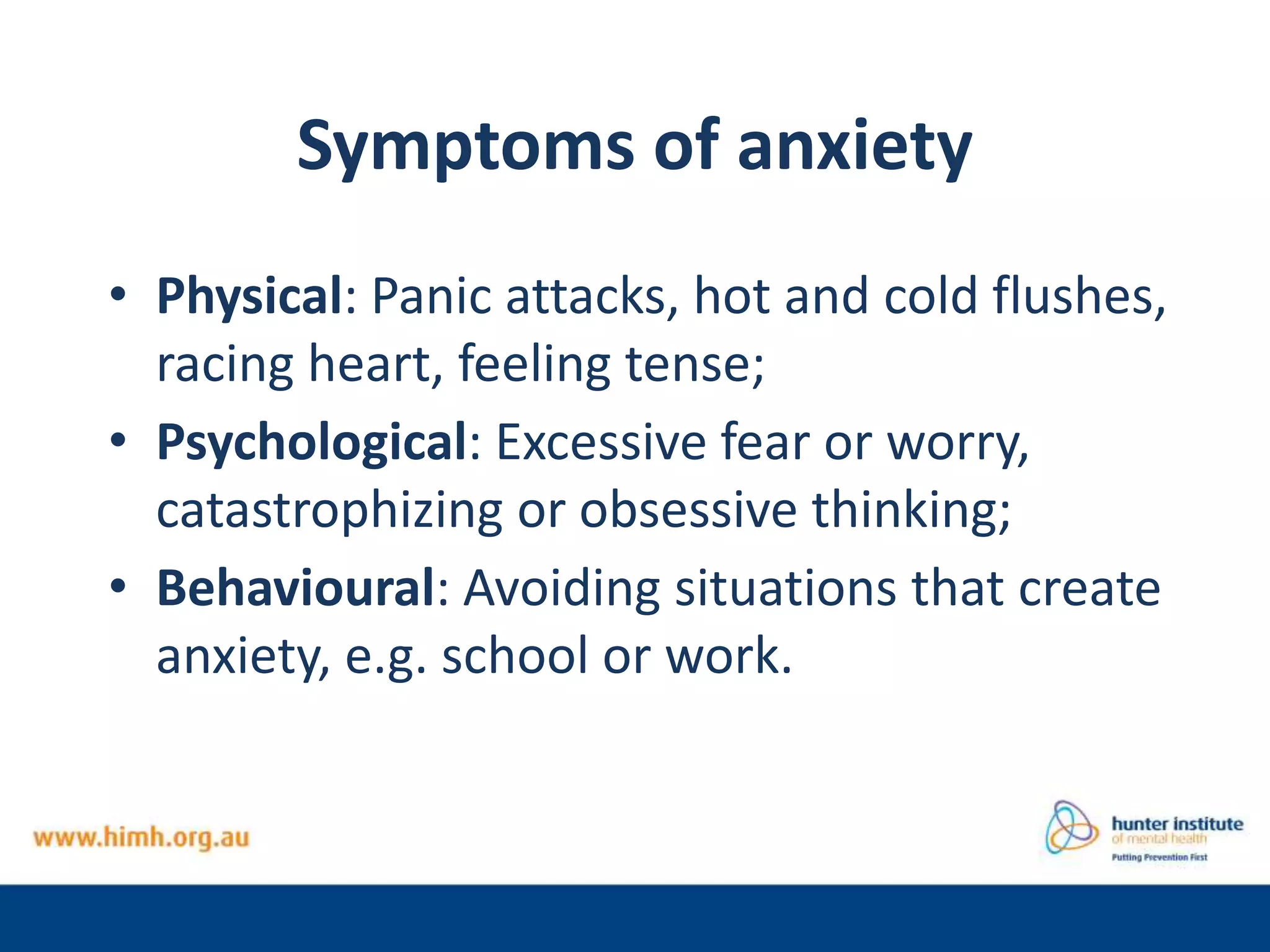
Symptoms of anxiety
• Physical: Panic attacks, hot and cold flushes,
racing heart, feeling tense;
• Psychological: Excessive fear or worry,
catastrophizing or obsessive thinking;
• Behavioural: Avoiding situations that create
anxiety, e.g. school or work.
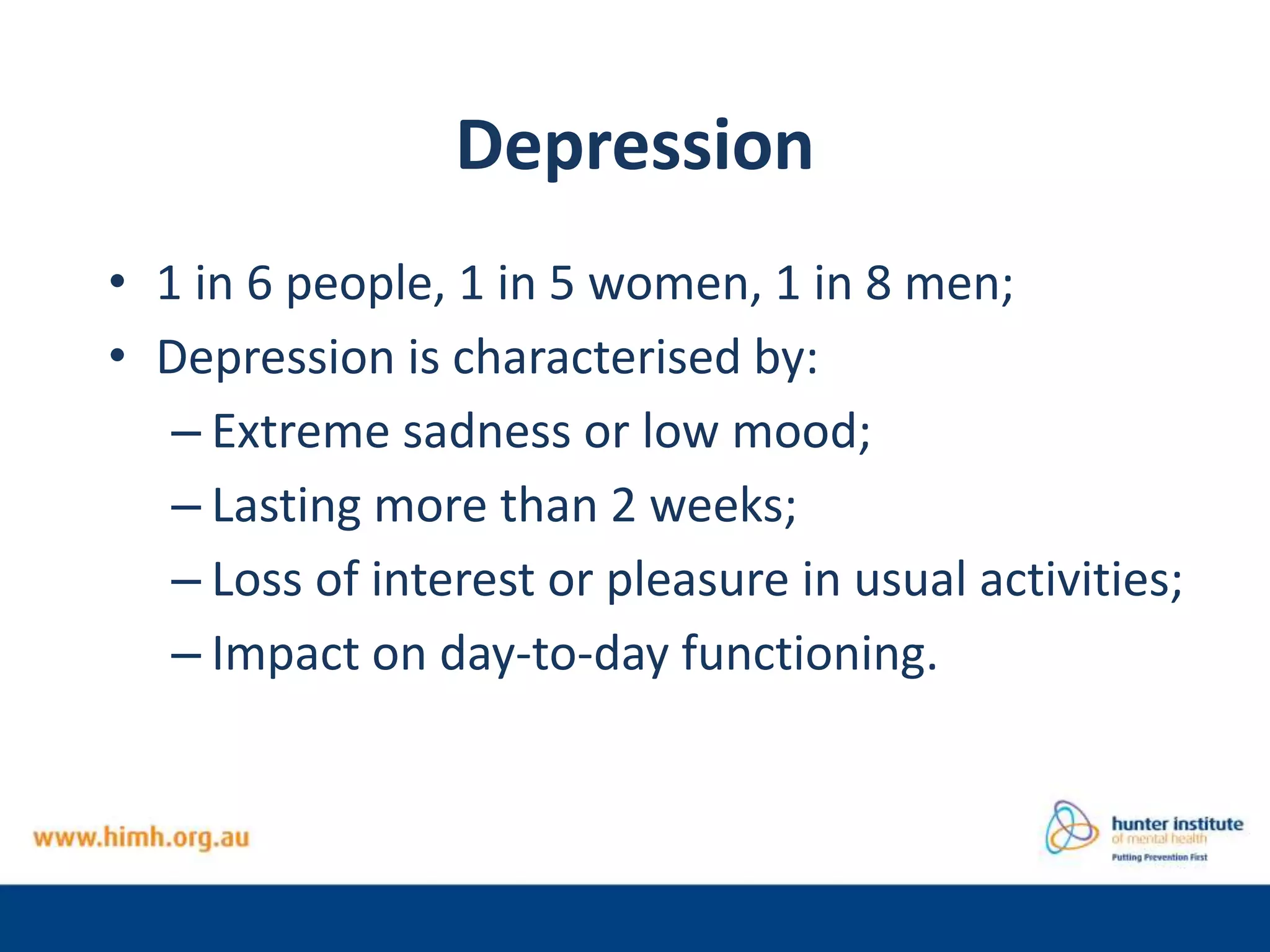
Depression
• 1 in 6 people, 1 in 5 women, 1 in 8 men;
• Depression is characterised by:
– Extreme sadness or low mood;
– Lasting more than 2 weeks;
– Loss of interest or pleasure in usual activities;
– Impact on day-to-day functioning.
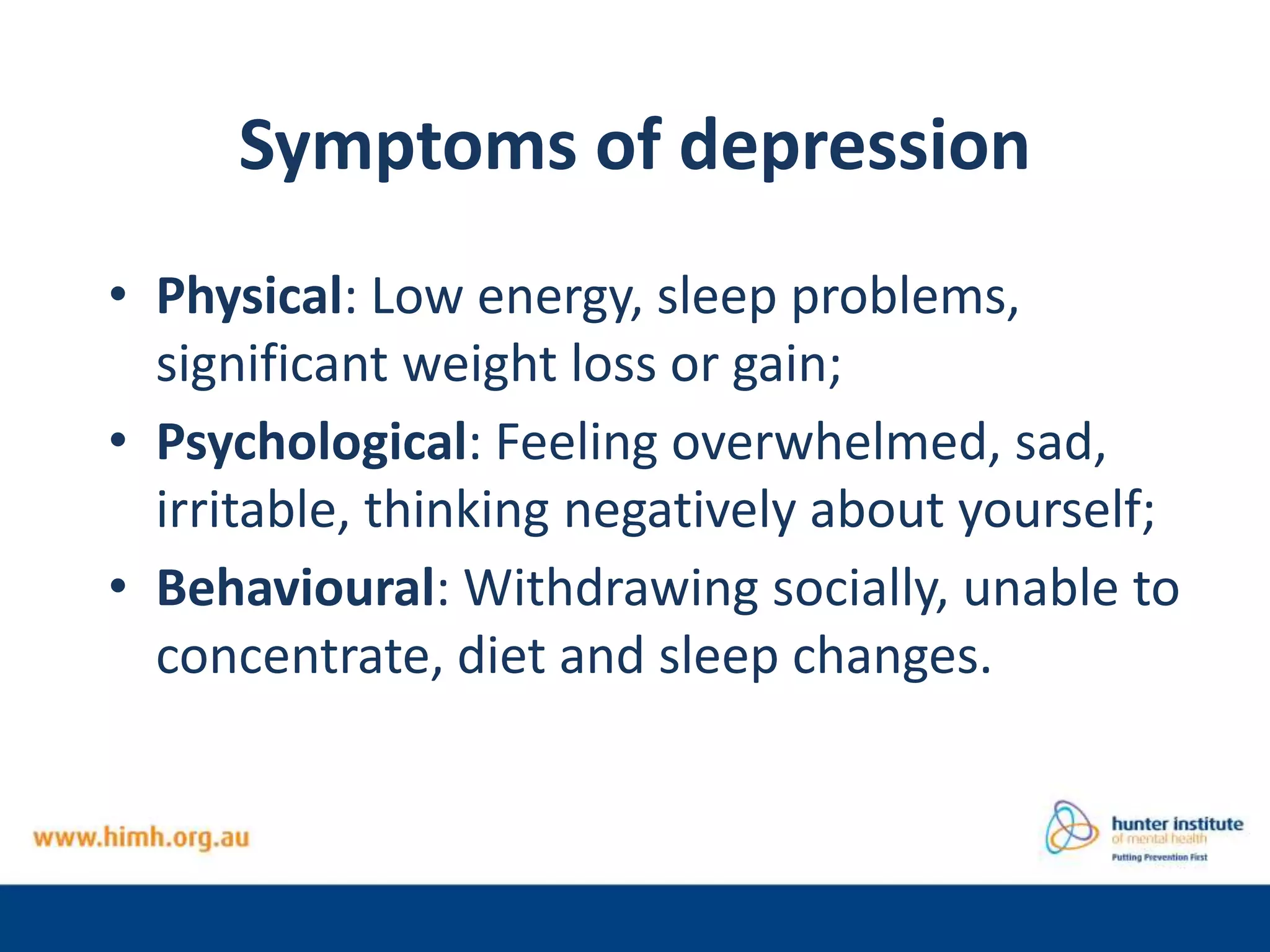
Symptoms of depression
• Physical: Low energy, sleep problems,
significant weight loss or gain;
• Psychological: Feeling overwhelmed, sad,
irritable, thinking negatively about yourself;
• Behavioural: Withdrawing socially, unable to
concentrate, diet and sleep changes.
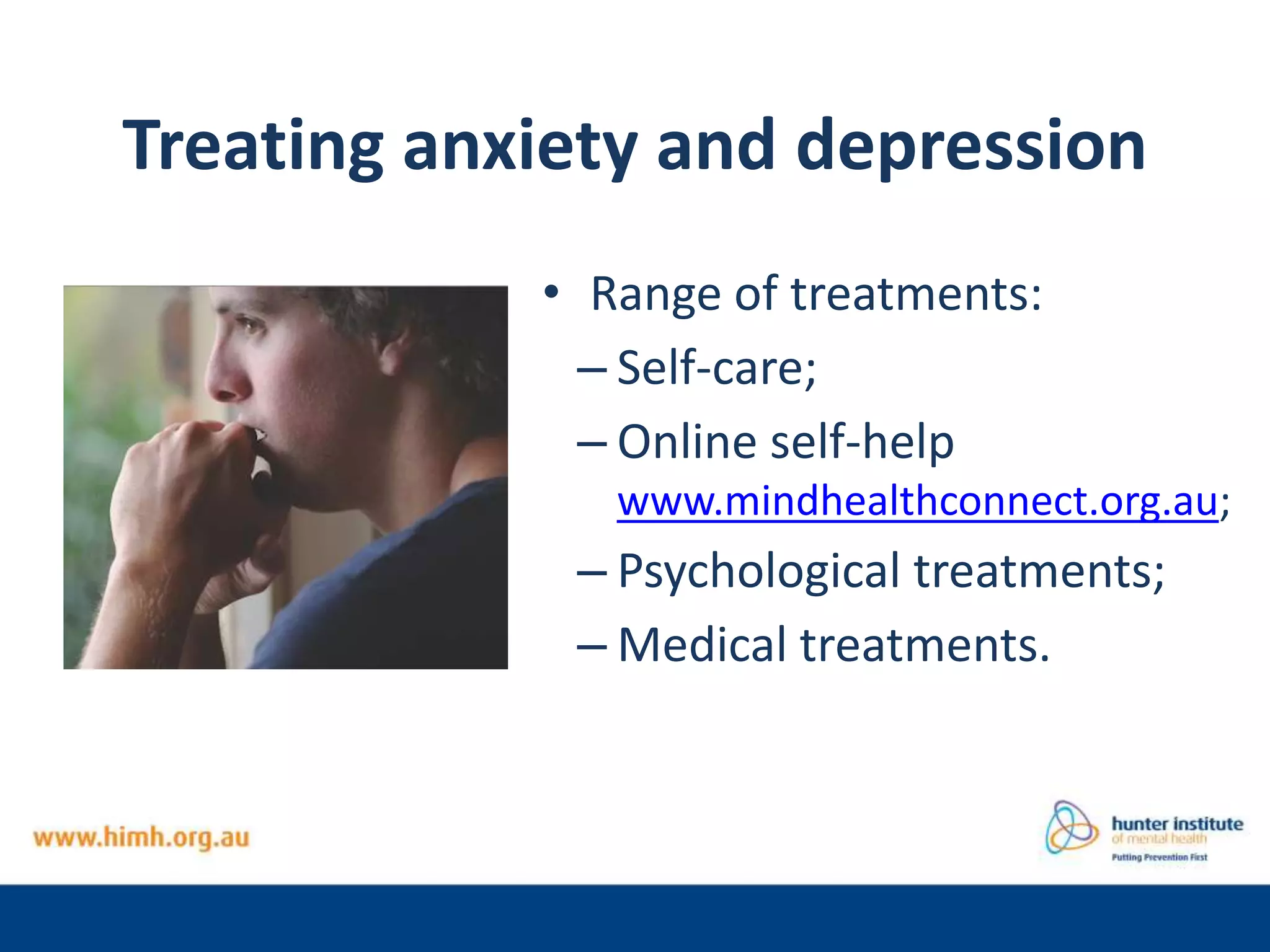
Treating anxiety and depression
• Range of treatments:
– Self-care;
– Online self-help
www.mindhealthconnect.org.au;
– Psychological treatments;
– Medical treatments.
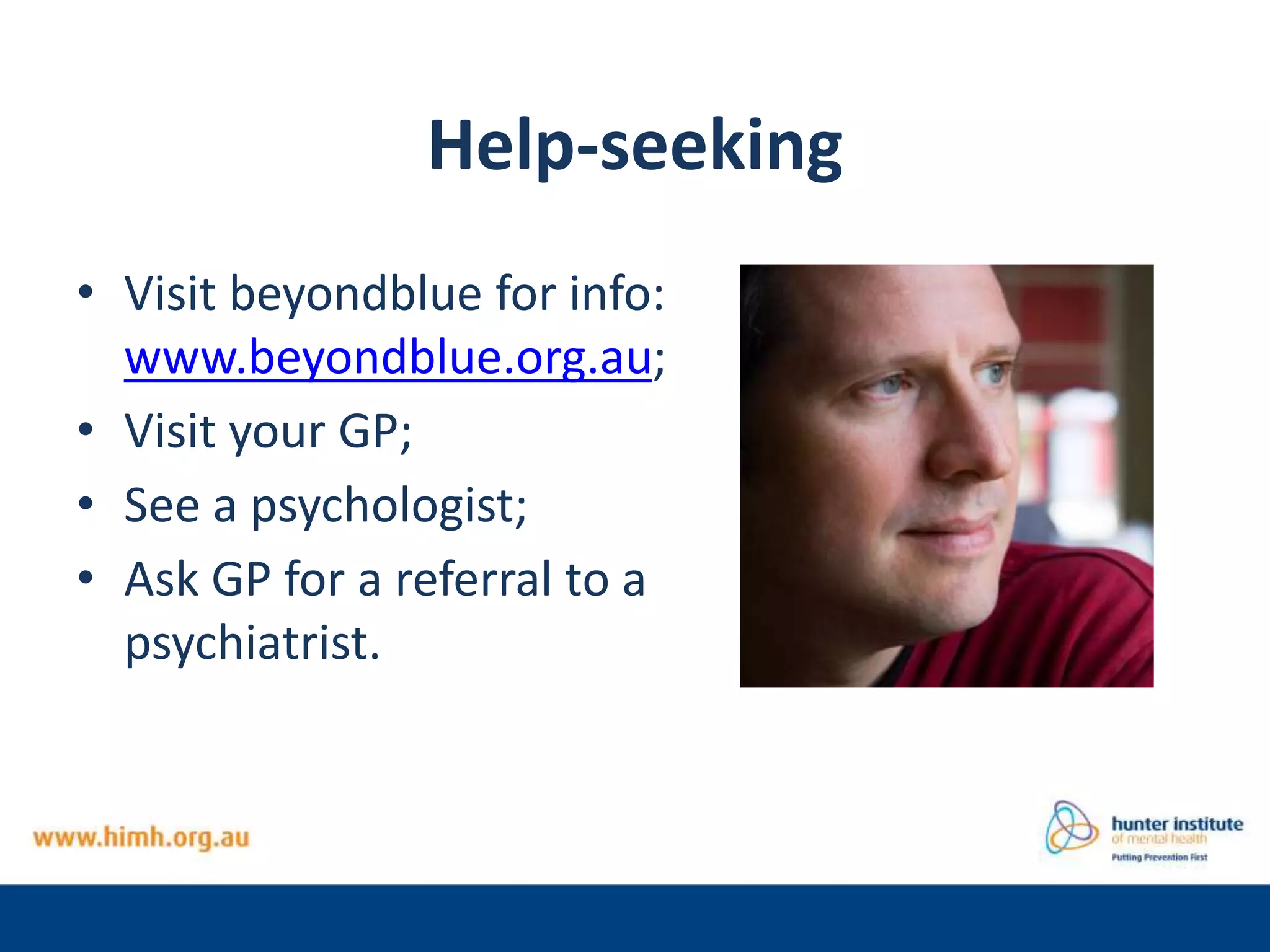
Help-seeking
• Visit beyondblue for info:
www.beyondblue.org.au;
• Visit your GP;
• See a psychologist;
• Ask GP for a referral to a
psychiatrist.
Crisis support
• Lifeline: 13 11 14 or www.lifeline.org.au
• Suicide Call Back Service: 1300 659 467 or
www.suicidecallbackservice.org.au
• SANE Australia: 1800 18 7263 or www.sane.org
• beyondblue: 1300 22 4636 or
www.beyondblue.org.au
• MensLine Australia: 1300 78 99 78 or
www.mensline.org.au
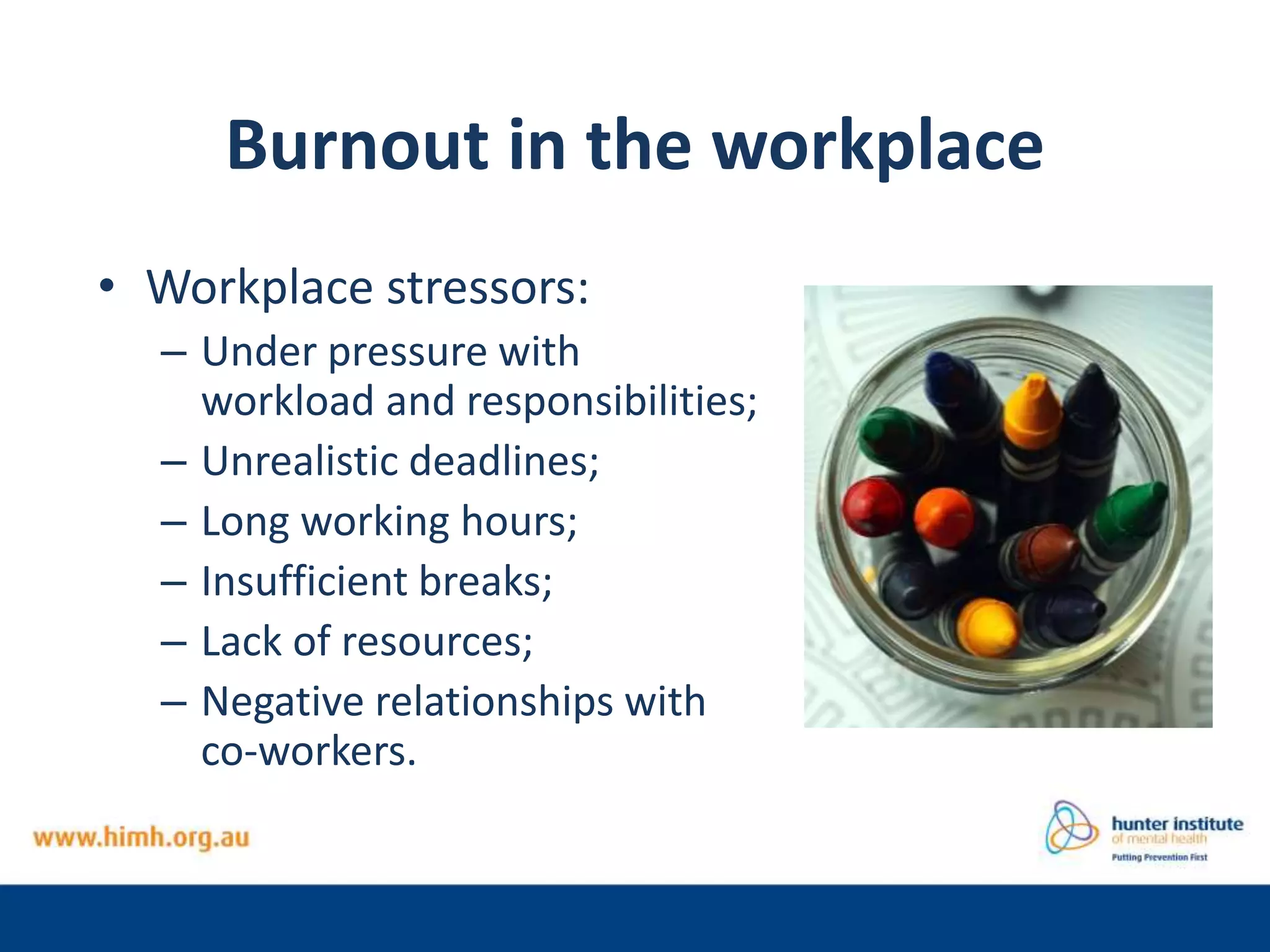
Burnout in the workplace
• Workplace stressors:
– Under pressure with
workload and responsibilities;
– Unrealistic deadlines;
– Long working hours;
– Insufficient breaks;
– Lack of resources;
– Negative relationships with
co-workers.
Warning signs
• Struggling at work;
• Letting work encroach
on personal life;
• Low morale;
• Feeling undervalued,
disconnected;
• Poor attendance;
• Poor performance;
• Avoiding
family/friends;
• Using alcohol/drugs
to cope.
Looking after yourself
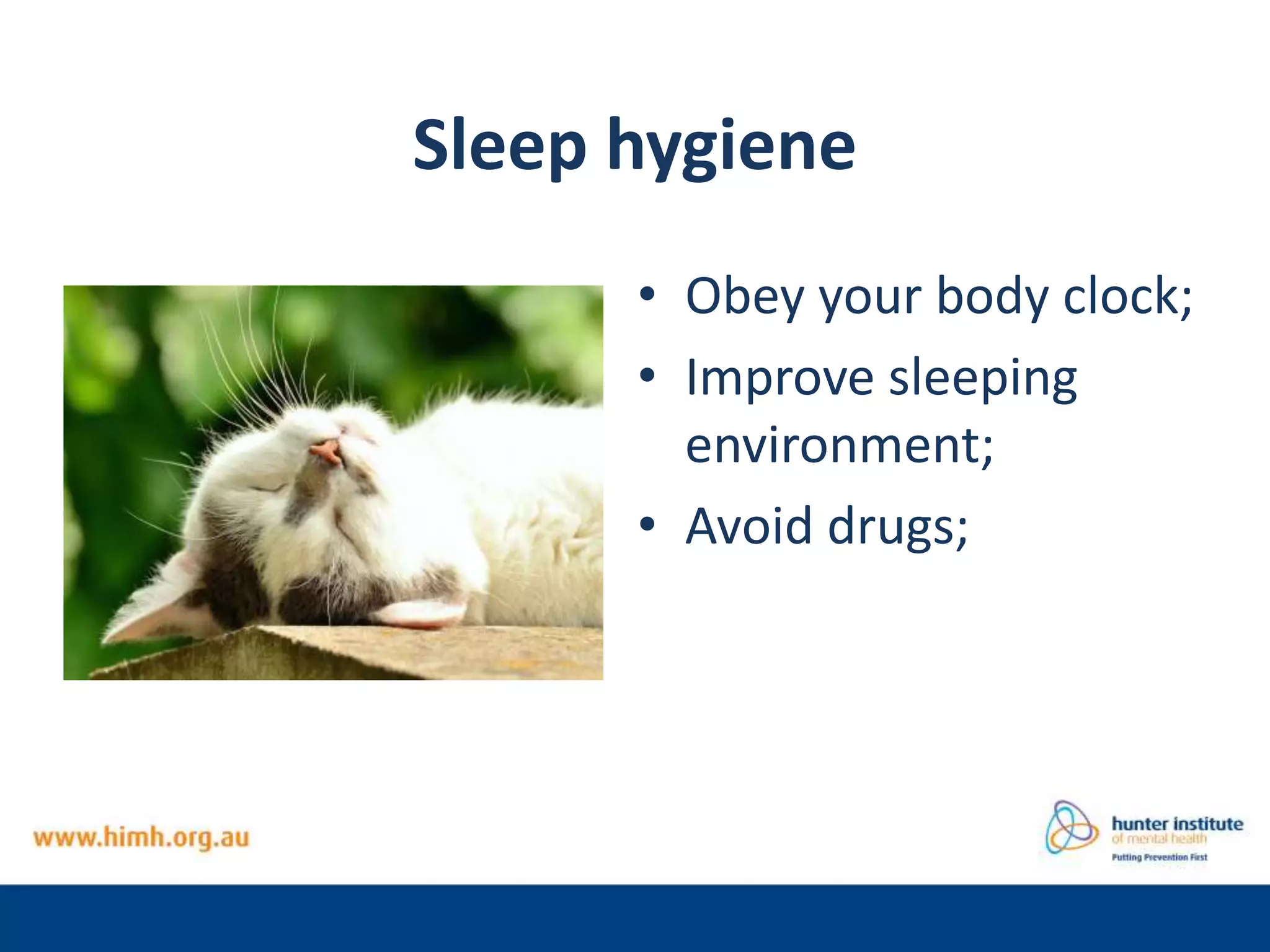
Sleep hygiene
• Obey your body clock;
Sleep hygiene
• Obey your body clock;
• Improve sleeping
environment;
Sleep hygiene
• Obey your body clock;
• Improve sleeping
environment;
• Avoid drugs;
Sleep hygiene
• Obey your body clock;
• Improve sleeping
environment;
• Avoid drugs;
• Relax your mind;
Sleep hygiene
• Obey your body clock;
• Improve sleeping
environment;
• Avoid drugs;
• Relax your mind;
• Lifestyle adjustments.
Exercise
• Fewer symptoms of depression and anxiety;
• 16 week exercise program = antidepressants;
• Release feel-good
chemicals;
• Reduce immune system
chemicals;
• Increase body temperature.
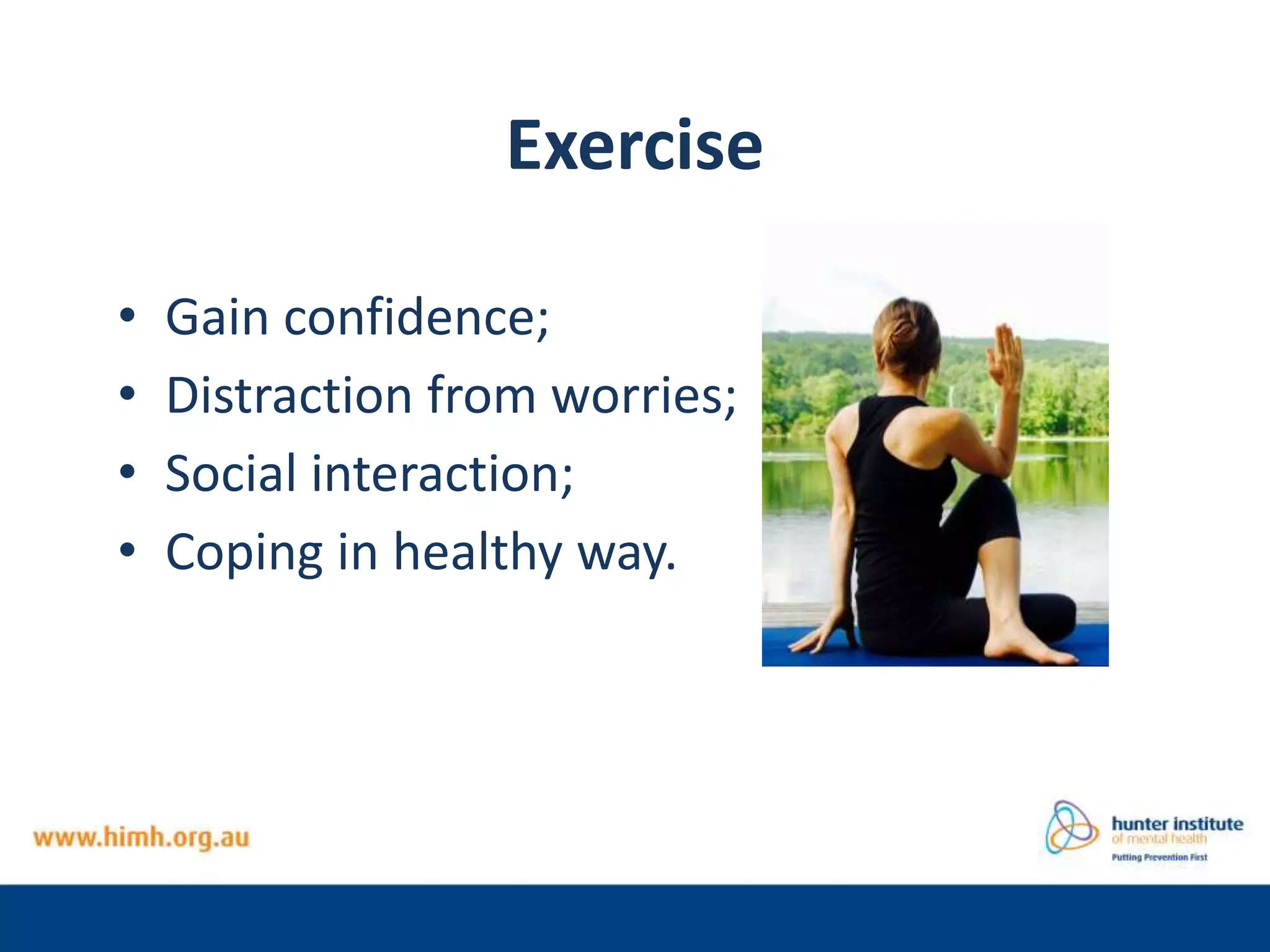
Exercise
• Gain confidence;
• Distraction from worries;
• Social interaction;
• Coping in healthy way.
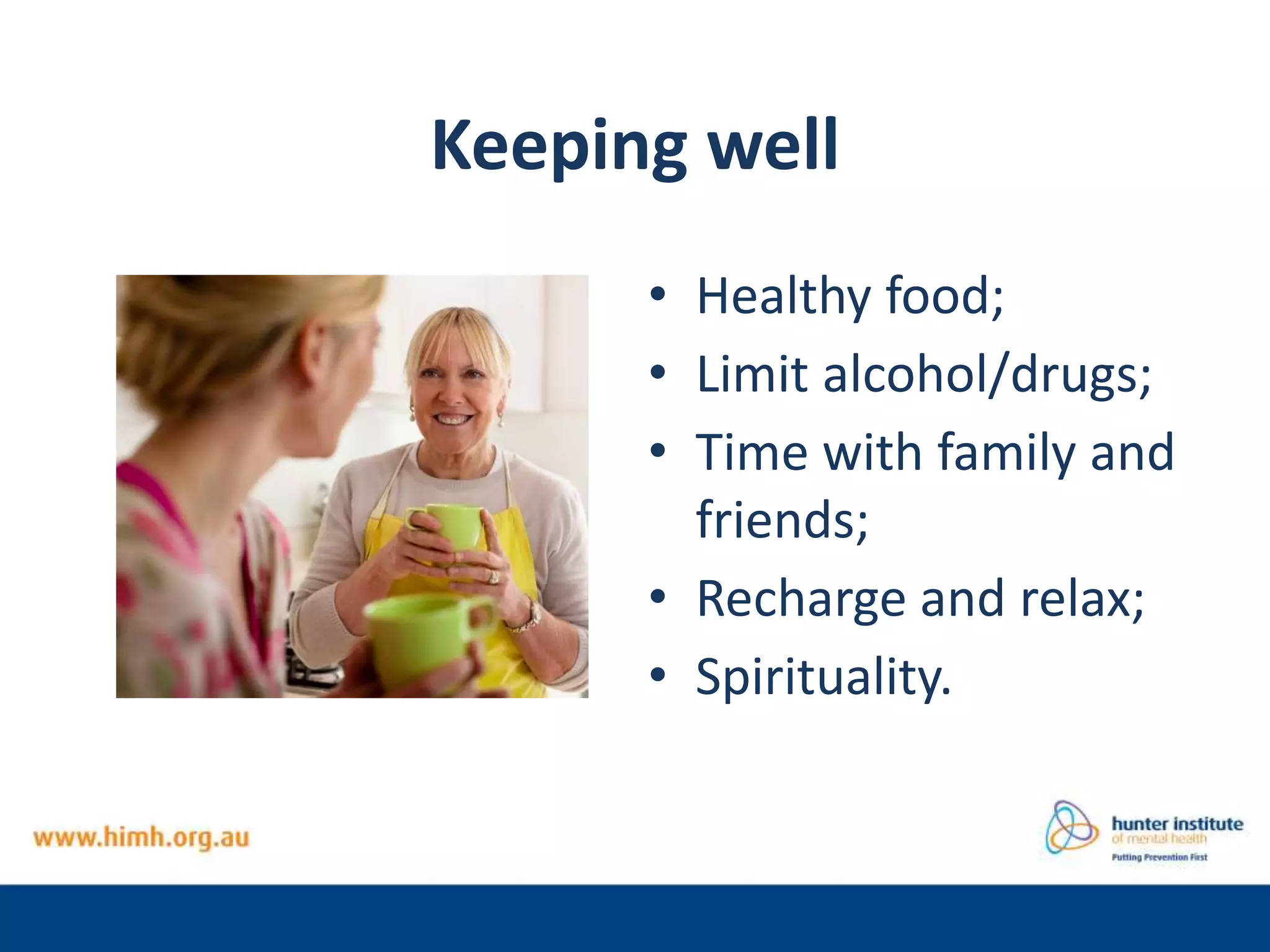
Keeping well
• Healthy food;
• Limit alcohol/drugs;
• Time with family and
friends;
• Recharge and relax;
• Spirituality.
In the workplace
• Work/life balance;
• Non-work friends;
• Mentoring;
• Supporting
colleagues;
• Inclusive of diversity;
• Reflective practice.
Monitoring wellbeing and
seeking help
• Warning signs;
• Avoiding unhealthy
coping strategies;
• Seeking help when
needed.
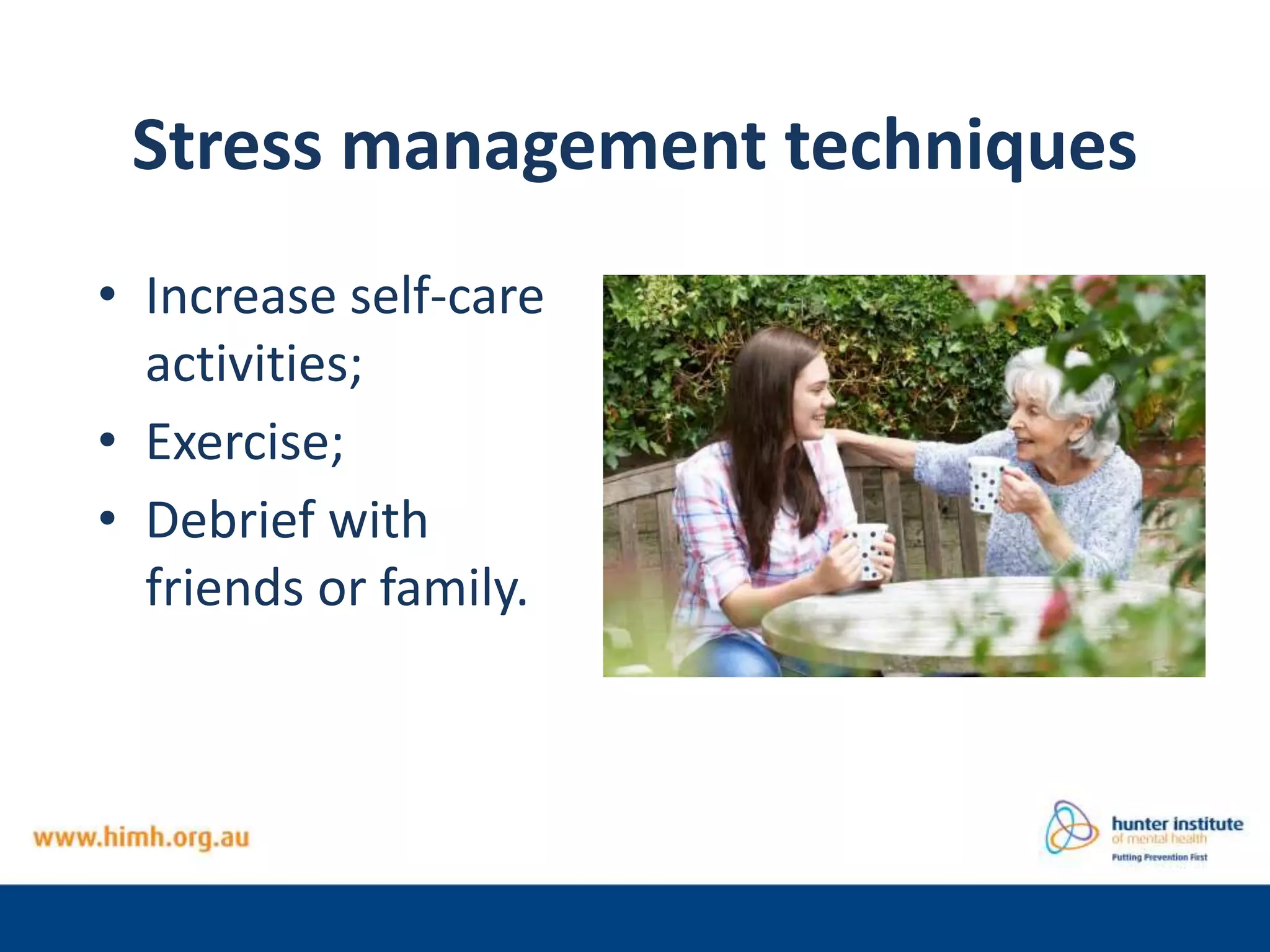
Stress management techniques
• Increase self-care
activities;
• Exercise;
• Debrief with
friends or family.
Avoid or alter the situation
• Avoid unnecessary
stress:
– Learn how to say “no”;
– Avoid people who
stress you out;
– Take control of your
environment.
Avoid or alter the situation
• Avoid unnecessary
stress:
– Learn how to say “no”;
– Avoid people who
stress you out;
– Take control of your
environment.
• Alter the situation:
– Express feelings instead
of bottling them up;
– Be willing to
compromise;
– Manage time better;
– Be more assertive.
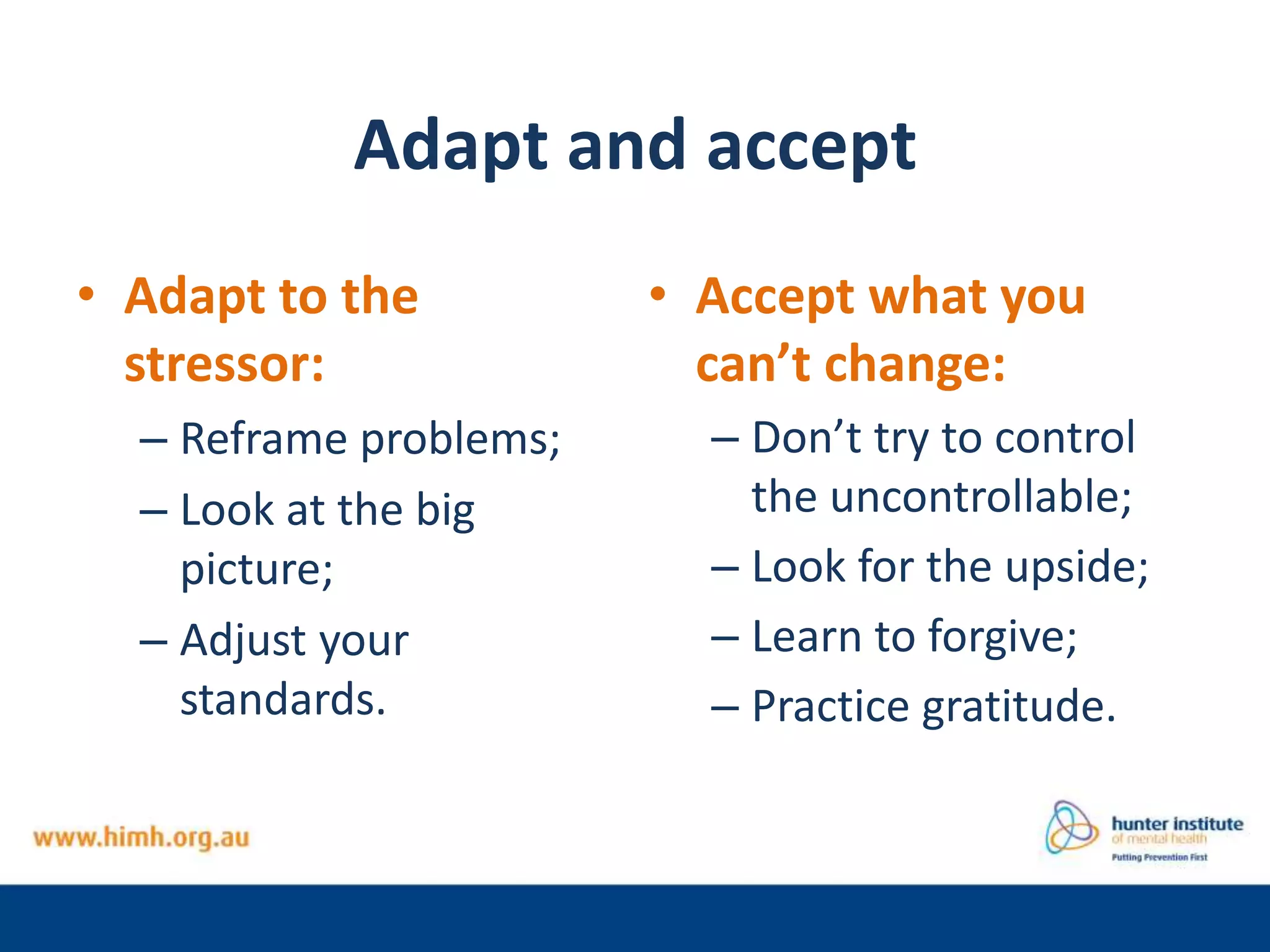
Adapt and accept
• Adapt to the
stressor:
– Reframe problems;
– Look at the big
picture;
– Adjust your
standards.
Adapt and accept
• Adapt to the
stressor:
– Reframe problems;
– Look at the big
picture;
– Adjust your
standards.
• Accept what you
can’t change:
– Don’t try to control
the uncontrollable;
– Look for the upside;
– Learn to forgive;
– Practice gratitude.
Mindfulness
• Focusing attention on present
moment;
• Roots in Buddhism;
• Improves wellbeing;
• Improve physical health;
• Treatment for mental illness;
• More mindfulness = more effect.
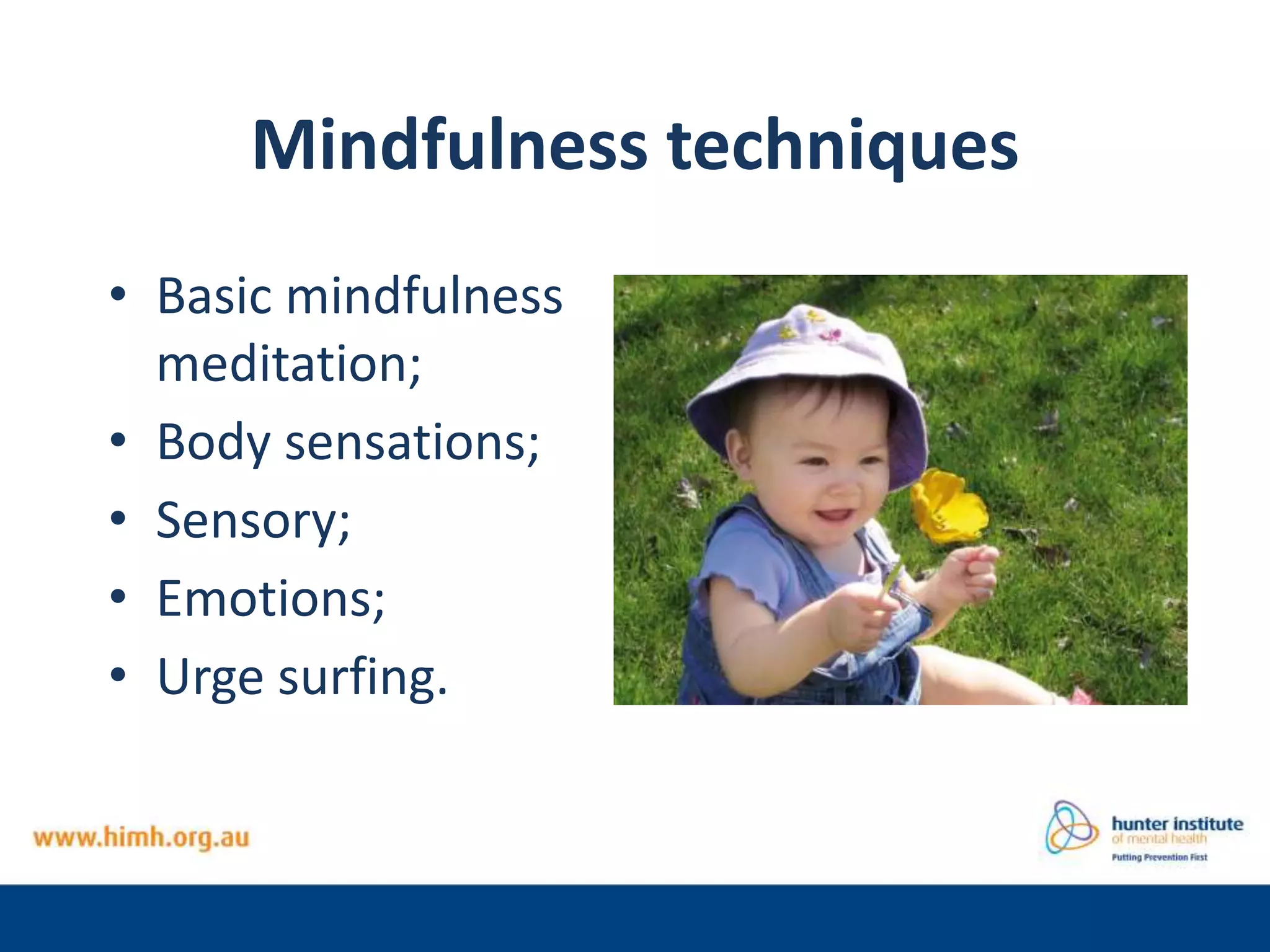
Mindfulness techniques
• Basic mindfulness
meditation;
• Body sensations;
• Sensory;
• Emotions;
• Urge surfing.
Guided visualisation
• Uses imagination to still mind;
• Relax and refuel;
• Achieve professional or
personal goals;
• Deeper awareness of self;
• Physical and mental health
benefits.
Mindfulness activity
Questions?
Celia Rae
Senior Project Officer
Hunter Institute of Mental Health
(02) 4924 6900
celia.rae@hnehealth.nsw.gov.au

Looking after yourself: Self-care in OOSH

  • 1.
    Looking after yourself:Self-care in OOSH Celia Rae, MPH, MHM, BA Senior Project Officer Hunter Institute of Mental Health
  • 2.
    Hunter Institute ofMental Health The Hunter Institute of Mental Health is a leading national organisation dedicated to reducing mental illness and suicide and improving wellbeing for all Australians. For more than 20 years we have been delivering successful, evidence-based mental health and suicide prevention programs from our base in Newcastle, NSW.
  • 3.
    Overview • Mental health; •Mental illness and accessing help; • Burnout; • Looking after your wellbeing; • Warning signs; • Stress management techniques; • Mindfulness; • Guided visualisation; • Questions.
  • 4.
  • 5.
    Mental health andwellbeing • Mental health is NOT mental illness; • Often terms used interchangeably; • We all have mental health; • Some us of experience mental illness.
  • 6.
    Our mental healthimpacts our… • Physical health;
  • 7.
    Physical health • Mentalillness = higher risk of chronic physical illness; = 3 x risk of stroke; = 1.5 x risk of heart disease or diabetes. • Chronic physical illness = higher risk of mental illness; = 2 x risk of depression and anxiety.
  • 8.
    Our mental healthimpacts our… • Physical health; • Quality of life;
  • 9.
    Our mental healthimpacts our… • Physical health; • Quality of life; • Relationships;
  • 10.
    Our mental healthimpacts our… • Physical health; • Quality of life; • Relationships; • Ability to cope with stress;
  • 11.
    Our mental healthimpacts our… • Physical health; • Quality of life; • Relationships; • Ability to cope with stress; • Reach goals and fulfil potential.
  • 12.
    How it affectschildren • Educator wellbeing influences student wellbeing; • Relationships are key for a child’s mental health; • Relationships can be difficult when experiencing poor mental health; • Mental illness does NOT mean unable to care for children.
  • 13.
    Mental illness • Conditionsthat impact upon a person’s thoughts, feelings and behaviour; • Diagnosed by health professional; • No single cause, combination of factors; • Can be a single episode or ongoing; • Common – 45% of the population will experience mental illness in their lifetime.
  • 14.
    Anxiety • 1 in4 people, 1 in 3 women, 1 in 5 men; • Disorder occurs when: –Anxiety is frequent or persistent; –Not always connected to obvious challenge; –Impacts on quality of life; –Impacts on day-to-day functioning.
  • 15.
    Symptoms of anxiety •Physical: Panic attacks, hot and cold flushes, racing heart, feeling tense; • Psychological: Excessive fear or worry, catastrophizing or obsessive thinking; • Behavioural: Avoiding situations that create anxiety, e.g. school or work.
  • 16.
    Depression • 1 in6 people, 1 in 5 women, 1 in 8 men; • Depression is characterised by: – Extreme sadness or low mood; – Lasting more than 2 weeks; – Loss of interest or pleasure in usual activities; – Impact on day-to-day functioning.
  • 17.
    Symptoms of depression •Physical: Low energy, sleep problems, significant weight loss or gain; • Psychological: Feeling overwhelmed, sad, irritable, thinking negatively about yourself; • Behavioural: Withdrawing socially, unable to concentrate, diet and sleep changes.
  • 18.
    Treating anxiety anddepression • Range of treatments: – Self-care; – Online self-help www.mindhealthconnect.org.au; – Psychological treatments; – Medical treatments.
  • 19.
    Help-seeking • Visit beyondbluefor info: www.beyondblue.org.au; • Visit your GP; • See a psychologist; • Ask GP for a referral to a psychiatrist.
  • 20.
    Crisis support • Lifeline:13 11 14 or www.lifeline.org.au • Suicide Call Back Service: 1300 659 467 or www.suicidecallbackservice.org.au • SANE Australia: 1800 18 7263 or www.sane.org • beyondblue: 1300 22 4636 or www.beyondblue.org.au • MensLine Australia: 1300 78 99 78 or www.mensline.org.au
  • 21.
    Burnout in theworkplace • Workplace stressors: – Under pressure with workload and responsibilities; – Unrealistic deadlines; – Long working hours; – Insufficient breaks; – Lack of resources; – Negative relationships with co-workers.
  • 22.
    Warning signs • Strugglingat work; • Letting work encroach on personal life; • Low morale; • Feeling undervalued, disconnected; • Poor attendance; • Poor performance; • Avoiding family/friends; • Using alcohol/drugs to cope.
  • 23.
  • 24.
    Sleep hygiene • Obeyyour body clock;
  • 25.
    Sleep hygiene • Obeyyour body clock; • Improve sleeping environment;
  • 26.
    Sleep hygiene • Obeyyour body clock; • Improve sleeping environment; • Avoid drugs;
  • 27.
    Sleep hygiene • Obeyyour body clock; • Improve sleeping environment; • Avoid drugs; • Relax your mind;
  • 28.
    Sleep hygiene • Obeyyour body clock; • Improve sleeping environment; • Avoid drugs; • Relax your mind; • Lifestyle adjustments.
  • 29.
    Exercise • Fewer symptomsof depression and anxiety; • 16 week exercise program = antidepressants; • Release feel-good chemicals; • Reduce immune system chemicals; • Increase body temperature.
  • 30.
    Exercise • Gain confidence; •Distraction from worries; • Social interaction; • Coping in healthy way.
  • 31.
    Keeping well • Healthyfood; • Limit alcohol/drugs; • Time with family and friends; • Recharge and relax; • Spirituality.
  • 32.
    In the workplace •Work/life balance; • Non-work friends; • Mentoring; • Supporting colleagues; • Inclusive of diversity; • Reflective practice.
  • 33.
    Monitoring wellbeing and seekinghelp • Warning signs; • Avoiding unhealthy coping strategies; • Seeking help when needed.
  • 34.
    Stress management techniques •Increase self-care activities; • Exercise; • Debrief with friends or family.
  • 35.
    Avoid or alterthe situation • Avoid unnecessary stress: – Learn how to say “no”; – Avoid people who stress you out; – Take control of your environment.
  • 36.
    Avoid or alterthe situation • Avoid unnecessary stress: – Learn how to say “no”; – Avoid people who stress you out; – Take control of your environment. • Alter the situation: – Express feelings instead of bottling them up; – Be willing to compromise; – Manage time better; – Be more assertive.
  • 37.
    Adapt and accept •Adapt to the stressor: – Reframe problems; – Look at the big picture; – Adjust your standards.
  • 38.
    Adapt and accept •Adapt to the stressor: – Reframe problems; – Look at the big picture; – Adjust your standards. • Accept what you can’t change: – Don’t try to control the uncontrollable; – Look for the upside; – Learn to forgive; – Practice gratitude.
  • 39.
    Mindfulness • Focusing attentionon present moment; • Roots in Buddhism; • Improves wellbeing; • Improve physical health; • Treatment for mental illness; • More mindfulness = more effect.
  • 40.
    Mindfulness techniques • Basicmindfulness meditation; • Body sensations; • Sensory; • Emotions; • Urge surfing.
  • 41.
    Guided visualisation • Usesimagination to still mind; • Relax and refuel; • Achieve professional or personal goals; • Deeper awareness of self; • Physical and mental health benefits.
  • 42.
  • 43.
    Questions? Celia Rae Senior ProjectOfficer Hunter Institute of Mental Health (02) 4924 6900 celia.rae@hnehealth.nsw.gov.au